Summary
- Google AI Overviews appear automatically at the top of search results for complex queries, synthesising answers from multiple sources and fundamentally changing how users interact with organic results.
- Click-through rates for informational pages may decline as users find answers without visiting a website, but pages cited inside an AI Overview can attract highly motivated, high-intent visitors.
- Google Search Console now includes an AI Overviews filter, giving marketers a direct way to measure how this feature is affecting impressions and clicks for their key pages.
- Adapting your SEO strategy means prioritising clear structure, topical authority, brand credibility, and content that goes deeper than what a short summary can provide.
Search has fundamentally changed over the past year as Google introduced a new experience that places an AI Overview at the top of many results pages. This major shift forces digital professionals to rethink how they approach organic traffic and overall online visibility. Every AI Overview pulls information from multiple sources to answer complex questions directly for the user, often before they ever reach a traditional link. Understanding the SEO impact of AI Overviews is now essential for maintaining your website traffic and long-term revenue goals. Let us examine exactly how AI Overviews affect your current methods and what you can do to adapt.
How AI Overviews Work

To fully understand this shift, we need to look at how generative AI actually constructs an AI Overview. When users search for specific topics, Google’s AI analyses large amounts of information across the web and uses advanced language models to synthesise a coherent, direct answer. The process is broadly similar to a technique called Retrieval-Augmented Generation — where the model retrieves relevant source material first, then uses it to generate a grounded response rather than relying purely on its training data.
Within the core of Google’s AI system, complex algorithms determine which sources are most trustworthy for a given topic. This search experience is designed to give users immediate value, answering their question in full without requiring them to visit multiple different websites. The result is a search results page where the summary often sits above everything else the user sees.
Google triggers an AI Overview primarily for complex questions that require synthesising multiple data points or perspectives. For simple navigational queries — like searching for a specific brand name or a website address — an AI Overview typically does not appear at all. It is also worth clarifying that AI Overviews appear automatically when triggered; they are a standard part of search results, not something a user opts into. Google’s separately branded “AI mode” is a distinct, experimental feature that provides a more fully conversational search interface.
As the technology matures, AI Overviews will continue to evolve in terms of the queries they respond to and how prominently they feature on the page. Staying informed about these changes is a practical necessity for anyone managing a website’s organic performance.
AI Overviews SEO Impact on Organic Traffic
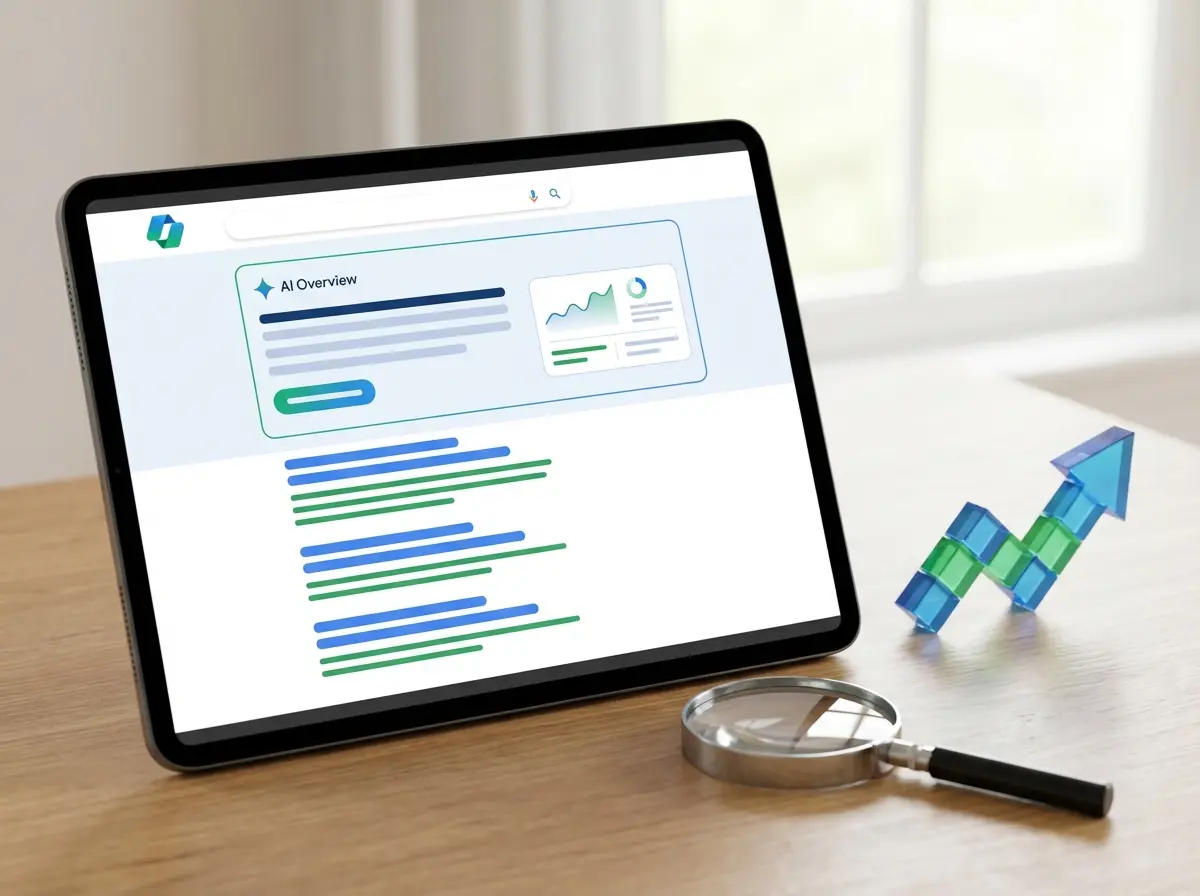
Many website owners are understandably concerned about how AI Overviews affect SEO and overall site performance. When an AI Overview answers a question completely, the user may not click any external links at all. This directly threatens the expected click-through rate for top-ranking pages that previously relied on informational queries for high traffic volume.
The introduction of these AI features has fundamentally altered the competitive landscape for informational keywords. These changes are pushing SEO workflows toward a greater focus on digital PR, brand authority, and commercial intent — areas where a short summary is unlikely to fully satisfy the user. Protecting your organic traffic increasingly means pivoting toward high-intent, long-tail queries that require more depth than an AI Overview can provide.
However, an AI Overview can also drive highly qualified traffic directly to your website. Google includes clickable citation links within every AI Overview it generates, and if your website provides strong source material, you can capture motivated visitors who want deeper insights beyond the summary. Research indicates that click-through rates from AI Overview citations tend to be lower in volume but higher in engagement than average organic traffic.
The impact varies considerably across industries. E-commerce sites may encounter AI Overviews appearing for product comparisons, while healthcare sites see them for symptom-related queries. Understanding how AI Overviews affect your specific niche is critical before drawing conclusions or making major strategic changes.
Key Takeaways
An AI Overview synthesises data from multiple sites to answer complex queries directly on the page.
Earning a citation within an AI Overview can drive highly qualified, high-intent visitors to your website.
Monitor your click-through rate alongside impressions in Google Search Console to understand the true impact on your pages.
Worried About AI Overviews Affecting Your Traffic?
Our SEO team can audit your most important pages and identify exactly where AI Overviews may be intercepting your organic clicks.
Analysing User Behaviour and Search Queries
Understanding how users behave in this new environment helps us adapt our content strategy effectively. People interact with an AI Overview differently than they interact with a standard list of search results. Rather than scanning multiple page titles and deciding which to click, users often read the generated summary first and only click through if it raises a question the summary does not answer.
This means that conversational, multi-part queries — the kind that previously sent users on a multi-page research journey — are increasingly resolved in a single search session. For content creators, this raises the bar: your page needs to offer something the summary cannot, whether that is interactive tools, original data, detailed step-by-step guidance, or personalised professional advice.
Most AI-generated summaries focus heavily on broad informational topics that have reasonably clear answers. If someone asks how to tie a specific knot, an AI Overview provides the steps immediately. For these types of queries, competing on volume alone is no longer a viable strategy — the optimisation approach must shift toward providing deeper, harder-to-replicate value.
The physical space an AI Overview occupies is also worth considering, particularly on mobile devices. A single AI Overview can fill the entire visible screen before the user scrolls at all, making it the most prominent feature of the page by a considerable margin. For businesses whose customers predominantly search on smartphones, this is a significant practical consideration when evaluating which keywords to target.
Strategies to Optimise for AI Overviews
You can take specific, deliberate actions to improve your chances of appearing as a cited source in AI Overviews. The system relies on clear, structured information from credible websites to build its summaries. Making your content easy for Google’s AI to parse is now as important as making it easy for human readers to follow.
How to Optimise for AI Overviews
Implement Schema Markup
Use structured data — a type of code added to your website — to clearly define the entities, topics, and content types on each page. This helps Google’s AI understand your content context more precisely and increases the likelihood of it being used as a reliable source.
Format for Readability and Direct Answers
Use descriptive headings, short paragraphs, and bullet lists to make text extraction simple. AI Overviews prefer content that answers specific questions directly and concisely, without unnecessary preamble. Place the core answer to your target question at the top of the page rather than building toward it gradually.
Build Brand Authority Across the Web
Increase your brand mentions across trusted industry websites, publications, and directories. Google’s AI favours highly authoritative sources when selecting citations, so earning coverage and links from respected external sites is one of the most reliable ways to strengthen your position as a credible reference.
Target High-Intent Queries That Summaries Cannot Fully Satisfy
Focus a portion of your content strategy on queries where the user clearly wants to take an action — getting a quote, booking a service, or comparing specific providers. These transactional and commercial-intent searches are far less likely to be fully resolved by a generated summary, meaning your traditional organic listing retains its value.
While traditional SEO remains important for technical site health, the content layer now requires a more authoritative and conversational approach. Modern search engines are moving beyond simple indexing toward a comprehensive understanding of context, intent, and credibility. Investing in content that genuinely goes deeper than competing pages is now the most durable long-term SEO strategy available.
Want Help Building Content That Gets Cited?
BizIQ’s SEO team helps local businesses create authoritative, well-structured content that earns visibility in AI Overviews and traditional search results alike.
Measuring AI Overviews SEO Success
Tracking your performance in the age of AI Overviews presents new challenges, but the tools available have improved significantly. Google Search Console now includes a dedicated AI Overviews filter in the Search results report, allowing you to isolate impressions and clicks that are directly associated with AI Overview appearances. This is the most direct way to measure whether your pages are being cited and how users are responding.
Beyond Search Console, tracking your overall brand share of voice — how often your brand appears in AI-generated summaries for your target keywords — is a growing priority for digital marketers. A number of third-party SEO tools are developing features to monitor AI Overview citations, and this capability is likely to become standard across the major platforms over the next year.
Pro Tip
In Google Search Console, navigate to Search results, apply the “Search type” filter, and look for the AI Overviews option to see which of your pages are appearing inside generated summaries. Compare this data against your overall click-through rate to identify where AI Overviews are helping or hurting.
Many AI Overviews now include interactive elements — follow-up question prompts, expandable sections, and carousel-style source panels — that provide additional signals about how users are engaging with the topic. Paying attention to which of your pages appear in these cited panels, and what surrounding content they appear alongside, gives you valuable context for refining your content strategy over time.
The Future of Search Engine Optimisation
The evolution of Google’s AI signals a clear direction: content quality, topical depth, and genuine authority will increasingly determine search visibility over keyword placement alone. Optimising for AI Overviews requires a deep understanding of semantic relationships — how topics, subtopics, and entities connect — rather than a checklist of keyword densities and meta tag formulas.
Entity-based content modelling is becoming a practical necessity rather than an advanced technique. This means creating content that thoroughly covers the people, places, products, and concepts relevant to your industry, and making the relationships between them explicit through clear writing and structured data. The more comprehensively your website covers a topic, the more likely the AI is to treat it as a trusted reference.
At the same time, the fundamentals of local and technical SEO retain their importance. A website that loads slowly, has inconsistent business information across directories, or lacks a secure connection will struggle to be treated as a credible source regardless of how well-written its content is. The businesses that will perform best in this new environment are those that combine strong technical foundations with genuinely authoritative, well-structured content — not those who treat it as an either/or choice.
Staying ahead of these trends is not about chasing every algorithm update. It is about building a digital presence that is genuinely trustworthy, well-organised, and more useful to your audience than anything a short summary can replace.
Let’s Build an SEO Strategy That Works Long-Term
BizIQ helps local businesses stay visible as search evolves — combining technical SEO, content authority, and local brand management into one cohesive strategy.
Frequently Asked Questions
How do I know if my site is appearing in an AI Overview?
The most reliable method is Google Search Console. Navigate to the Search results report, apply the AI Overviews filter under Search type, and you can see which of your pages are generating impressions and clicks from AI Overview appearances. You can also manually search your primary target keywords and check whether an AI Overview appears and whether your site is listed as a citation source. Several third-party SEO tools are also beginning to offer AI Overview tracking features as a supplement to Search Console data.
Will AI Overviews replace all organic search links?
No — AI Overviews are designed to complement the search experience, not replace the traditional results beneath them. They appear primarily for complex informational queries where synthesising multiple sources adds value. For local searches, navigational queries, transactional searches, and many commercial comparisons, traditional organic links remain the primary result. The most sensible strategy is not to view AI Overviews as a threat to eliminate, but as a feature to optimise for — appearing as a citation source gives your brand additional visibility at the top of the page.
Can I opt out of being included in an AI Overview?
Yes, technically. Adding a nosnippet meta tag to a page instructs Google not to extract or display text from that page in any summary format, which includes AI Overviews. The max-snippet tag gives you finer control by limiting how many characters Google can use. However, opting out is generally not advisable for most businesses, because being cited inside an AI Overview is a visibility opportunity. These tags will also prevent your content from appearing in traditional featured snippets. Unless you have a specific reason — such as protecting proprietary content — the better approach is to optimise for inclusion rather than block it.
Do AI Overviews hurt click-through rates?
For purely informational queries — where the user simply wants a quick answer — yes, AI Overviews can reduce click-through rates for the pages that previously ranked for those terms. The user gets their answer without needing to visit a website. However, the picture is more nuanced for high-intent queries. Users researching a significant purchase, looking for a local service provider, or trying to understand a complex topic tend to click through for more detail even after reading a summary. Monitoring your Search Console data by page and query type will give you a much clearer picture of where AI Overviews are helping or hurting your specific website.
What type of content is most likely to be cited in an AI Overview?
Google’s AI tends to favour content that is clearly structured, directly answers the question being asked, and comes from a source with demonstrated credibility in the relevant topic area. Pages that use proper heading hierarchies, contain concise and specific answers near the top, include Schema Markup, and are hosted on websites with strong E-E-A-T signals (Experience, Expertise, Authoritativeness, and Trustworthiness) are consistently better positioned for citation. Original research, detailed how-to guides, and content that addresses genuinely complex questions tend to perform particularly well compared to short, generic informational pages.
Is it worth still investing in SEO given AI Overviews?
Absolutely. The qualities that earn strong organic rankings — authoritative content, a well-structured website, accurate business information, and genuine topical expertise — are precisely the qualities that make a page a credible citation candidate for AI Overviews. The two goals are not in conflict; they are the same goal. What changes is the emphasis: generic, keyword-dense content has diminishing returns, while deep, credible, well-structured content becomes more valuable. Businesses that invest thoughtfully in SEO now are building exactly the kind of digital presence that both traditional rankings and AI-generated summaries reward.
Conclusion
Adapting to the new search landscape requires patience, a willingness to test new content approaches, and a clear-eyed view of where your current strategy is most vulnerable. AI Overviews are not a temporary experiment — they represent a fundamental shift in how Google delivers value to its users, and that shift will only deepen as the technology improves.
The businesses that will navigate this change most successfully are those that focus on what has always mattered most in SEO: being genuinely useful, clearly credible, and easy to understand. A well-structured page from a trustworthy source that directly answers what the user is asking will continue to earn visibility — whether that appears as a traditional ranked result or as a citation inside an AI-generated summary at the top of the page.
For local businesses in particular, the combination of strong on-page content, consistent business information across directories, and an active presence on review platforms provides a durable foundation that AI systems reward as much as traditional ranking algorithms do. The goal is not to game a specific feature — it is to build a digital presence so credible and well-organised that being cited is a natural outcome.
By focusing on authority, clear communication, and content that goes deeper than any short summary can replicate, you can turn the AI shift from an anxiety into a competitive advantage. The future of search is more contextual and more conversational than what came before — and businesses that embrace that direction will be better positioned for what comes next.