Written by the BizIQ Organic Search Team. We’re a small business too, with the same goals as you. We stand beside local service providers to help you navigate the complex world of digital marketing with honest, evidence-based strategies.
Electrician SEO: How to Rank Higher on Google and AI Search Engines
To rank an electrical business on the first page of Google and inside AI search engines, you must optimize for both local map algorithms and generative AI recommendation models. Here is exactly how to do it, step by step, to make your business the undisputed local authority. We know local SEO feels like a moving target, but we are here to break down what you actually need to know to win.
What we recommend starting with:
- Google Business Profile Optimization: Claiming and tuning your primary local asset to dominate the Local Pack.
- Structured Schema Markup: Providing search engines with machine-readable data to earn rich snippets and AI citations.
- High-Intent Content Strategy: Building dedicated service and location pages that convert local searchers into booked jobs.
- E-E-A-T & Trust Signals: Showcasing licenses, safety standards, and manufacturer certifications to satisfy both human readers and search algorithms.
The U.S. electrical contracting industry has grown to a massive $347.5 billion market in 2026, expanding at a 4.8% CAGR from 2021 through 2026 according to IBISWorld data. With over 261,958 electrician businesses operating nationwide, word-of-mouth referrals alone will not keep your trucks rolling at capacity. We believe sophisticated marketing belongs to you too, not just national enterprise brands. Homeowners and commercial property managers now default to search engines when they need a licensed professional, which makes a well-constructed digital presence your most durable asset. By implementing strategic SEO for electricians, you position your brand directly in front of high-intent searchers at the precise moment they are ready to hire.
Why Local SEO Is the Lifeblood of Your Electrical Business
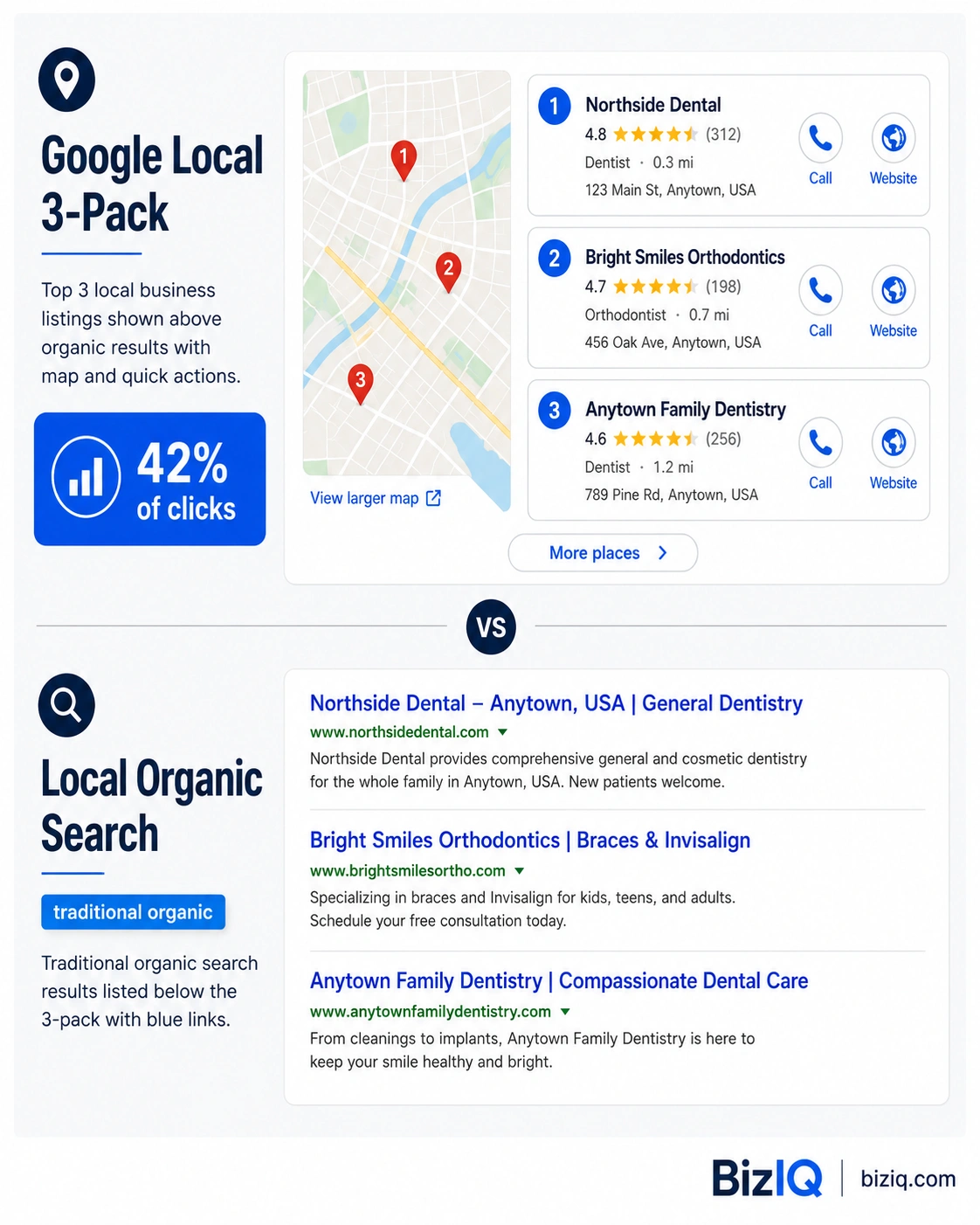
The Power of the Local 3-Pack
93% of Google searches with local intent surface a Local 3-Pack, making those three map listings the most contested real estate on the internet for service contractors. That concentration of attention translates directly to revenue: the Local 3-Pack captures 42% of all local search clicks according to BrightLocal research. Every click that lands on a competitor instead of you is a job that could have been yours.
Think of your Google Business Profile as your digital storefront sign. An unoptimized or unclaimed profile is the equivalent of a faded, half-lit sign on a busy street: customers will register it for a half-second and keep walking toward the competitor whose sign is bright, detailed, and clearly legible.
Traffic and Action Multipliers
Businesses holding the top three Local Pack positions experience a 126% increase in website traffic and a 93% increase in customer actions: calls, direction requests, and website clicks. This is based on data from Semrush and SOCi showing the massive value of the top spots compared to businesses ranked in positions four through ten. That gap is not marginal. It is the difference between a phone that rings consistently and one that sits quiet.
Connecting with local customers who are actively searching to hire: not passively browsing: is what separates local SEO from almost every other marketing channel. There is also a downstream opportunity most contractors overlook: integrating search visibility data with your service management software, such as ServiceTitan or Housecall Pro, to build a closed-loop revenue picture that traces every inbound lead from the original search query to the final invoice.
When local property owners face an electrical emergency, they do not scroll through pages of results. They click the first credible option they see, and they call immediately. This behavior makes the Local Pack the decisive battleground for electrical contractors. If your business is absent from those top three positions, you are effectively routing high-value jobs to competitors who have simply been more deliberate about managing their digital footprint.
Securing a position in that map section requires a systematic approach rather than a one-time setup. Google’s local algorithm weighs three core pillars: proximity, relevance, and prominence. Proximity is largely outside your control: it depends on where the searcher is standing. Relevance and prominence, however, are entirely engineered. Optimizing those two signals is where the real leverage lives, and it is where we lead with outcomes.
Step-by-Step: Optimizing Your Google Business Profile
Claiming and Verifying Your Profile
Start with the fundamentals. Your business name, address, and phone number (NAP) must be character-for-character identical across your GBP, your website, and every local citation where your business appears. A single inconsistency, like “St.” versus “Street” or a missing suite number, introduces ambiguity that erodes algorithmic trust.
GBP signals carry 32% of the total algorithmic weight for Local Pack rankings according to Whitespark’s Local Search Ranking Factors report. This makes it the single most influential lever in your local optimization toolkit. One common misstep worth flagging is setting your business hours to “Open 24 Hours” to capture late-night search volume. A BrightLocal study confirmed this tactic delivers no ranking benefit, and Google has grown increasingly aggressive about penalizing businesses that list hours inconsistent with their actual operations.
Selecting Categories and Predefined Services
Set your primary GBP category to “Electrician”: not a variation, not a parent category. Secondary categories should be used sparingly. Research shows that adding too many categories doesn’t improve rankings—precision outperforms padding here.
Adding predefined services is what we’ve seen work for businesses like yours to capture missed opportunities. Inputs like “panel upgrades,” “EV charger installation,” and “emergency electrical repairs” tell Google’s algorithm exactly which jobs you are equipped to handle, directly boosting your relevance score for those specific long-tail queries. These are not optional enhancements; they are direct signals to the ranking engine.
Your GBP optimization checklist:
- Claim and Verify: Confirm your NAP data is identical across your website, GBP, and all local citation directories.
- Select Primary Category: Set your primary category to “Electrician” to maximize relevance for core searches.
- Add Predefined Services: Input specific services like “panel upgrades” and “EV charger installation” to capture long-tail search volume.
- Upload Geo-Tagged Media: Add high-resolution photos of your branded trucks, licensed team members, and completed work to build immediate credibility.
- Publish Weekly Updates: Use the Google Updates feature to share seasonal safety tips, community involvement, and service promotions.
The E-E-A-T Framework: Building Trust with Google and AI Search Engines
Displaying Licensing and Credentials
Google and AI search engines prioritize websites that demonstrate high Experience, Expertise, Authoritativeness, and Trustworthiness (E-E-A-T). We know because we’ve been there, trying to prove credibility in a crowded space. For electrical contractors, this is not abstract: it is structural. State electrical license numbers, insurance documentation, and a verifiable physical address belong in your website footer on every page, not buried on a standalone “About” page that most visitors never reach.
Electrical contracting is a high-stakes service category. Google’s quality raters treat it as such, applying stricter scrutiny to sites in industries where poor advice or unqualified practitioners create genuine safety risk. Embedding your credentials into the site’s architecture: not just its content: signals to both human reviewers and automated crawlers that your business operates at a professional standard.
Highlighting Safety and Manufacturer Partnerships
Compliance with the National Electrical Code (NEC) and recognized safety training programs like OSHA 10/30 or NFPA 70E arc flash certification are not just operational requirements: they are ranking assets when surfaced correctly on your site. The same applies to manufacturer partnerships. Being a Tesla Certified Installer or a Generac Dealer carries weight that generic service descriptions cannot replicate.
AI search engines crawl these trust markers to verify your business’s legitimacy before surfacing you as a recommendation. A site that features verifiable credentials, third-party certifications, and documented safety standards gives these models the confirmation signals they need to confidently cite your business in a generated answer.
Trust signals to embed across your site:
- License Numbers: Display your state electrical license numbers in your website footer and on your contact page.
- Safety Standards: Reference compliance with the National Electrical Code (NEC) and list relevant safety certifications by name, referencing standards from the NECA and IEC.
- Manufacturer Badges: Feature partnership logos like Tesla Certified Installer or Generac Authorized Dealer to establish immediate technical authority.
- Real-World Case Studies: Publish detailed project summaries with before-and-after documentation of panel upgrades, commercial rewiring, or EV infrastructure installations.
Ready to Dominate Your Local Market?
Book a Free SEO Audit with our team today and discover exactly where your competitors are capturing your leads. Let’s build a steady stream of high-value jobs together.
How AI Search Engines Are Changing Electrician Marketing
The Shift to Conversational Search
Search behavior is undergoing a structural shift, not a gradual evolution. Homeowners increasingly bypass traditional search engines to ask diagnostic questions directly to AI platforms: and those platforms synthesize a single, direct answer rather than returning a list of links to evaluate. ChatGPT currently commands an 80.49% share of the AI search and chat layer according to data from Similarweb and Cloudflare, serving over 700 million weekly active users. This is not a niche audience.
AI Search Engines do not operate like traditional SERPs. They identify entities, verify relationships between those entities, and recommend specific local businesses based on the credibility and structure of the underlying data they can access. An electrician whose digital presence is a loosely organized collection of pages will not earn citations in this environment.
Optimizing for AI Overviews and Recommendations
Google’s AI Overviews appear in around 40% of local searches, but the distribution is uneven in ways that matter for contractors. For simple, high-intent transactional queries like “electrician near me,” AI Overviews trigger only about 15% of the time according to research from Search Engine Land: proximity and GBP signals still dominate those results. For complex, diagnostic queries like “how much does it cost to rewire a house” or “signs of outdated electrical panel,” AI Overviews appear far more frequently. Earning a citation within that generated answer puts your business in front of a searcher who is actively researching before they hire.
The search landscape is shifting rapidly, and electrical contractors who want to remain competitive in their area must adapt their content architecture accordingly. AI search engines do not reward keyword density: they reward structured, authoritative content that resolves a specific question with verifiable facts and clear entity relationships.
While competitors are still calibrating their traditional keyword strategies, contractors who build machine-readable, entity-rich content today will own the AI recommendation layer tomorrow. Providing clear, natural-language answers to complex diagnostic questions, such as panel sizing, load calculations, and permit requirements, earns authoritative citations within AI-generated answers and intercepts high-value leads before they ever reach a traditional SERP.
We see this work firsthand. For example, a competitive analysis of ServiceTitan and Four Arrows Marketing shows that contractors focusing on AI SEO for electricians and E-E-A-T signals capture a much larger share of conversational search traffic.
“AI search results are becoming a highly significant channel for local service acquisition. The contractors who build a clear, machine-readable digital footprint today will own the recommendations of tomorrow.”
— Andrew Adams, Integrated Marketing Director
Implementing Schema Markup for Machine Readability
The Role of Structured Data
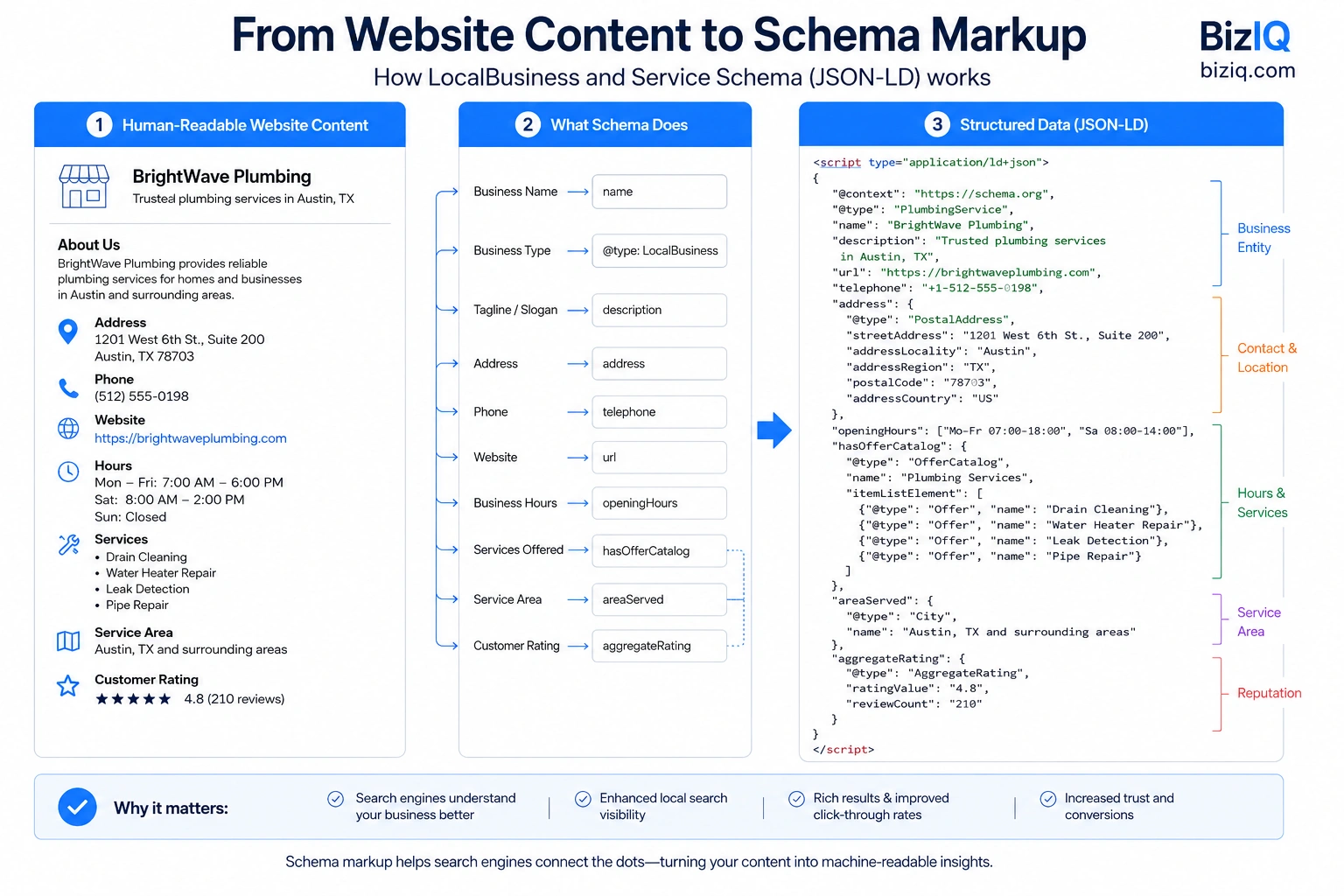
Schema markup functions as a translator between your website’s content and the machines that evaluate it. Without it, search bots and AI search engines like Google’s Gemini-powered search and Perplexity must infer your business details from unstructured text: a process that introduces ambiguity and reduces confidence in the data. With it, you hand them a precisely formatted data packet that removes all guesswork.
We recommend starting with the specific Electrician schema type on your homepage and Service schema on individual service pages. This taxonomy maps directly to how Google and AI models classify local businesses, and it aligns with the Google Local Business structured data guidelines. The implementation is a one-time technical investment with compounding returns as AI search surfaces grow.
JSON-LD Schema Implementation
Below is a compliant JSON-LD schema example for an electrical contractor. Drop this into the <head> of your homepage and modify the values to match your business:
<script type="application/ld+json">
{
  "@context": "https://schema.org",
  "@type": "Electrician",
  "name": "Apex Electrical Solutions",
  "url": "https://www.apexelectrical.com",
  "telephone": "+1-555-867-5309",
  "address": {
    "@type": "PostalAddress",
    "streetAddress": "456 Voltage Way",
    "addressLocality": "Austin",
    "addressRegion": "TX",
    "postalCode": "78701",
    "addressCountry": "US"
  },
  "openingHours": "Mo-Fr 08:00-17:00",
  "areaServed": "Austin, TX",
  "priceRange": "$$"
}
</script>
Implementing schema markup is one of the most effective SEO strategies available to local contractors. Think of it as a digital business card formatted specifically for search engine crawlers: instead of forcing Google or ChatGPT to reconstruct your business details from scattered page text, you are delivering the exact data they need in a clean, machine-native format. The contractors who implement this now will have a structural advantage over those who wait until AI search fully matures.
The Power of Review Substance Over Review Count
Algorithmic Weight of Reviews
Review signals account for 20% of the total algorithmic weight for Local Pack rankings according to Whitespark’s report: second only to GBP signals. Volume matters, but it is not the whole picture. Google’s algorithm parses review sentiment and scans for keyword mentions as active relevance and prominence signals. This means a review that says “fixed our panel upgrade in Phoenix same day” carries more algorithmic weight than a five-star review with no text.
Review velocity and platform diversity compound this effect. A steady cadence of new reviews across Google, Yelp, Angi, and the Better Business Bureau signals an active, trusted business to both the algorithm and to prospective customers evaluating their options.
Strategies for Getting High-Quality Reviews
Ask customers to mention the specific service and their city in their review. A prompt as simple as “If you have a moment, it would mean a lot if you could mention the service we completed and your neighborhood: it helps other homeowners in [city] find us” is enough to guide most satisfied customers toward a useful response.
Having keywords in the business name remains the #3 local pack ranking factor according to Whitespark, but manufacturing that through name manipulation carries real spam risk. Review substance is a far more durable and algorithmically safe path to building the same relevance signal: and it compounds over time rather than creating a liability.
Building a review strategy that works:
- Ask for Specificity: Guide customers to mention the service performed, such as “panel upgrade” or “generator installation,” and their city in their review text.
- Respond to Every Review: Write professional responses that naturally incorporate your service keywords and location: this is indexed content.
- Diversify Platforms: Collect reviews on Google, Yelp, Angi, and the Better Business Bureau to build cross-platform authority signals.
Technical SEO: Speed and Mobile Usability
Core Web Vitals and Page Speed
A slow website neutralizes every other optimization you have made. Google’s own data shows that 53% of mobile users abandon a site that takes longer than three seconds to load, and most local searches happen on mobile devices. Responsive design, compressed images, and fast hosting infrastructure are not optional refinements; they are table stakes for competitive local markets.
Core Web Vitals—specifically Largest Contentful Paint (LCP), Cumulative Layout Shift (CLS), and Interaction to Next Paint (INP)—are direct ranking inputs. A site that scores poorly on these metrics will underperform in both Local Pack and organic results regardless of how well-optimized its content is.
Site Architecture and Location Pages
Search Engine Land’s location page guidance is clear: create a dedicated page for every service you offer and every city you serve. This is not about padding your site with thin content: it is about giving search engines and AI crawlers discrete, focused landing pages that match specific search queries with high precision. A single “Services” page that lists everything you do in paragraph form is nearly invisible to algorithms that reward topical specificity. For example, a competitive analysis of Blue Corona demonstrates how a highly structured service page strategy captures localized commercial and residential queries that general pages miss.
The business case for this architecture is concrete. A structured local page build executed by Digital Funnel took one local electrician from zero organic traffic to over 100 inbound calls per month. Another case study from Elevation Marketing demonstrates similar lead growth for an electrical contractor. These outcomes are not exceptional: they are what happens when a site’s architecture aligns with how search engines actually index and rank local content.
Your website is the foundation of your entire digital marketing strategy. If it is slow, disorganized, or unnavigable on a phone, every other optimization effort you make will underperform. Think of technical SEO as the electrical panel of your website: if the panel is outdated and overloaded, none of the downstream systems will function at capacity.
Now that your technical foundation is secure, let’s address the most common questions electricians ask about search engine optimization.
Frequently Asked Questions About Electrician SEO
Below are direct answers to the most common questions about search engine optimization and AI search visibility for electrical contractors. We want to make sure you have the information you need to make confident decisions for your business.
How long does it take to see results from electrician SEO?
Technical fixes can produce measurable movement within weeks, but a complete SEO strategy typically requires 6 to 9 months to generate a consistent inbound lead flow, depending on the competitive density of your local market.
What is the difference between traditional SEO and AI SEO?
Traditional SEO targets rankings in search engine results pages (SERPs): the blue-link format most contractors are familiar with. AI SEO, sometimes called Generative Engine Optimization (GEO), focuses on earning citations and recommendations inside conversational AI tools like ChatGPT, Gemini, and Perplexity. Both matter. Neither replaces the other.
Do I need a separate website page for every service I offer?
Yes. Dedicated pages for services like EV charger installation or panel upgrades allow you to optimize for specific keyword clusters and give AI engines the discrete, classifiable data they need to accurately categorize your expertise. A single catch-all services page cannot do this work.
Does setting a service area in my Google Business Profile improve my rankings in those cities?
No. Whitespark’s testing confirms that adding service areas to your GBP has zero measurable impact on rankings in those locations. Proximity to the searcher and physical address signals remain the primary geographic ranking drivers. Displaying a verified physical address is a meaningful ranking advantage in competitive markets.
Can I do my own SEO, or should I hire an agency?
Basic local SEO: claiming and optimizing your Google Business Profile, building citation consistency, collecting reviews: is manageable in-house with the right guidance. Advanced technical SEO, schema implementation, and AI search optimization require a more specialized skill set, and the compounding value of getting those elements right early typically justifies the investment in a qualified agency.
Building Your Electrical Business Into the Local Authority
Dominating both Google and AI search engines requires a layered approach: GBP precision, structured schema data, E-E-A-T architecture, review substance, and a technically sound website working in concert rather than in isolation. None of these elements performs optimally without the others. The contractors who treat this as a system: not a checklist of one-time tasks: are the ones who build a durable pipeline of high-value inbound work.
We’re a small business too, with the same goals as you. We understand that every marketing dollar needs to earn its place. The strategies in this guide are the same ones we deploy for electrical contractors across the country. We believe sophisticated marketing belongs to you too, not just enterprise brands. Every local business is part of the small business driving America forward, and we are proud to stand beside you as you build the kind of digital presence that keeps your trucks moving.
Stop losing high-paying jobs to your competitors.
Schedule a 15-Minute Strategy Call with our trade marketing experts today to build your custom search plan and start growing your business.