Local search is no longer a marketing channel — it is the primary discovery mechanism for businesses with a physical presence or service area. 98% of consumers now search online before visiting a local business, 46% of all Google searches carry local intent, and near-me queries have grown 900% in two years. For any business serving local customers, the data in 2026 is unambiguous: local search is where customers decide, and the businesses that dominate it win.
- 98% of consumers search online to find local businesses — up from 90% in 2019; local search has become universal consumer behavior (Wiser Review 2026).
- 46% of all Google searches have local intent — nearly half of billions of daily searches involve finding something nearby (Google).
- 76% of people who perform a near-me search visit a business within 24 hours — local search has the fastest search-to-action conversion rate of any query category (Google/Think with Google).
- Near-me and close-by queries have grown 900% in two years; “open now near me” searches are up 400% (Google).
- 28% of local searches result in a purchase; 90% of consumers searching for local information buy within one week (Think with Google).
- 64% of all Google searches happen on mobile — and mobile-first behavior drives local search at scale (StatCounter 2025).
- 42% of local-intent searchers click on Google Map Pack results — local pack visibility is a primary traffic driver for local businesses (Backlinko 2024).
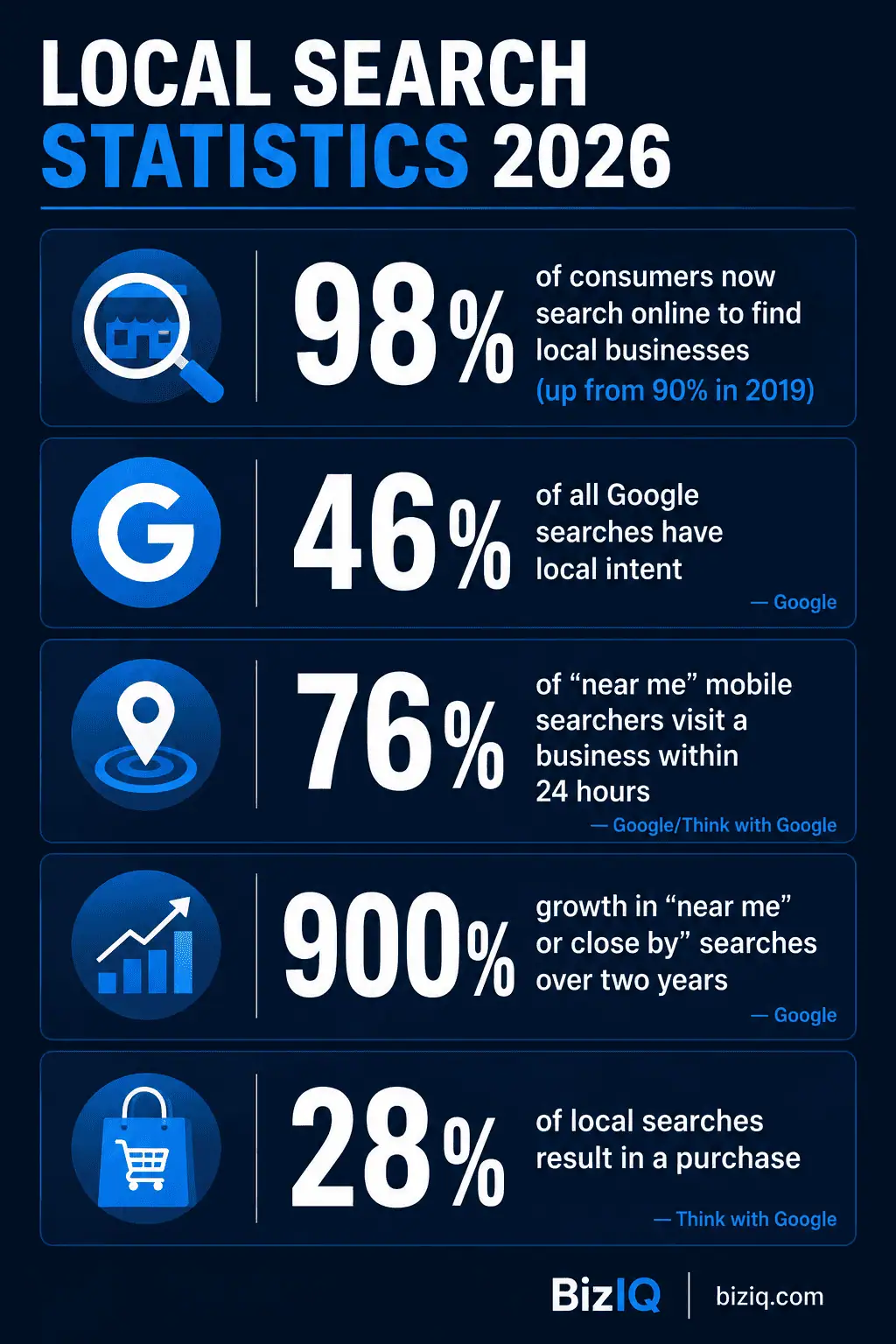
Key local search statistics for 2026 — sourced from Google, BrightLocal, Think with Google, and SOCi.
The Scale of Local Search in 2026
Local search has grown from a useful feature to the foundational layer of how consumers discover and choose local businesses. The sheer volume of local-intent searches — representing nearly half of all Google’s billions of daily queries — means that local search visibility is not a niche marketing priority. It is the primary marketing priority for any business serving customers in a geographic area.
The trajectory of local search adoption is consistent and accelerating. In 2019, 90% of consumers searched online for local businesses — already a dominant majority. By 2026, that figure has reached 98%. Virtually every consumer now uses online search as their primary tool for local business discovery. The question for any local business is no longer whether customers are searching — it is whether they can be found when those customers search.
With 46% of Google’s 8.5 billion daily searches carrying local intent (Google/Statista data), approximately 3.9 billion local-intent searches occur every day. Even capturing an infinitesimal fraction of that volume within a single market translates to meaningful daily customer discovery. A local business in a mid-sized city competing for 0.0001% of local-intent searches in its metro area would be seen by approximately 3,900 potential customers daily. Local SEO is a volume game at macro scale — even at the individual business level. Calculation original to BizIQ.
Source: BrightLocal — Local SEO Statistics 2026 | Wiser Review — Local SEO Statistics 2026
See How BizIQ Drives Local Search Visibility — Call (888) 416-9800
Near Me Search Growth Statistics
Near-me searches represent the highest-intent segment of local search. A consumer adding “near me” or “close by” to a search query is not researching — they are deciding. The growth of near-me queries over the past several years has been remarkable, driven by smartphone adoption, GPS-enabled search behavior, and Google’s increasingly sophisticated local intent detection even for searches without explicit location modifiers.
What Near Me Search Growth Means for Local Businesses
The 900% growth figure deserves context. This is not a statistical outlier — it represents a fundamental behavioral shift in how consumers use search. Historically, consumers searched for a business category: “pizza restaurant” or “auto repair shop.” The addition of near-me intent reflects a searcher who has moved from awareness to selection: they know what they want and they want it nearby. This query stage is the highest-value moment in the local customer acquisition journey.
Google processes near-me intent even when the phrase is not present in the query. A search for “dentist” from a mobile device now triggers local results almost universally, because Google infers local intent from device location signals. This means that every local-intent keyword — not just explicit near-me searches — is part of the near-me search ecosystem for ranking purposes.
Despite 82% of smartphone users conducting near-me searches, 58% of companies still do not optimize for local search, and only 30% have an actual plan to capitalize on high-converting local traffic. For businesses that have invested in local SEO, this competitive landscape represents opportunity: the majority of the market is leaving near-me traffic on the table.
Source: Digital Applied — Local SEO Statistics 2026 | On The Map Marketing — Local SEO Statistics 2025
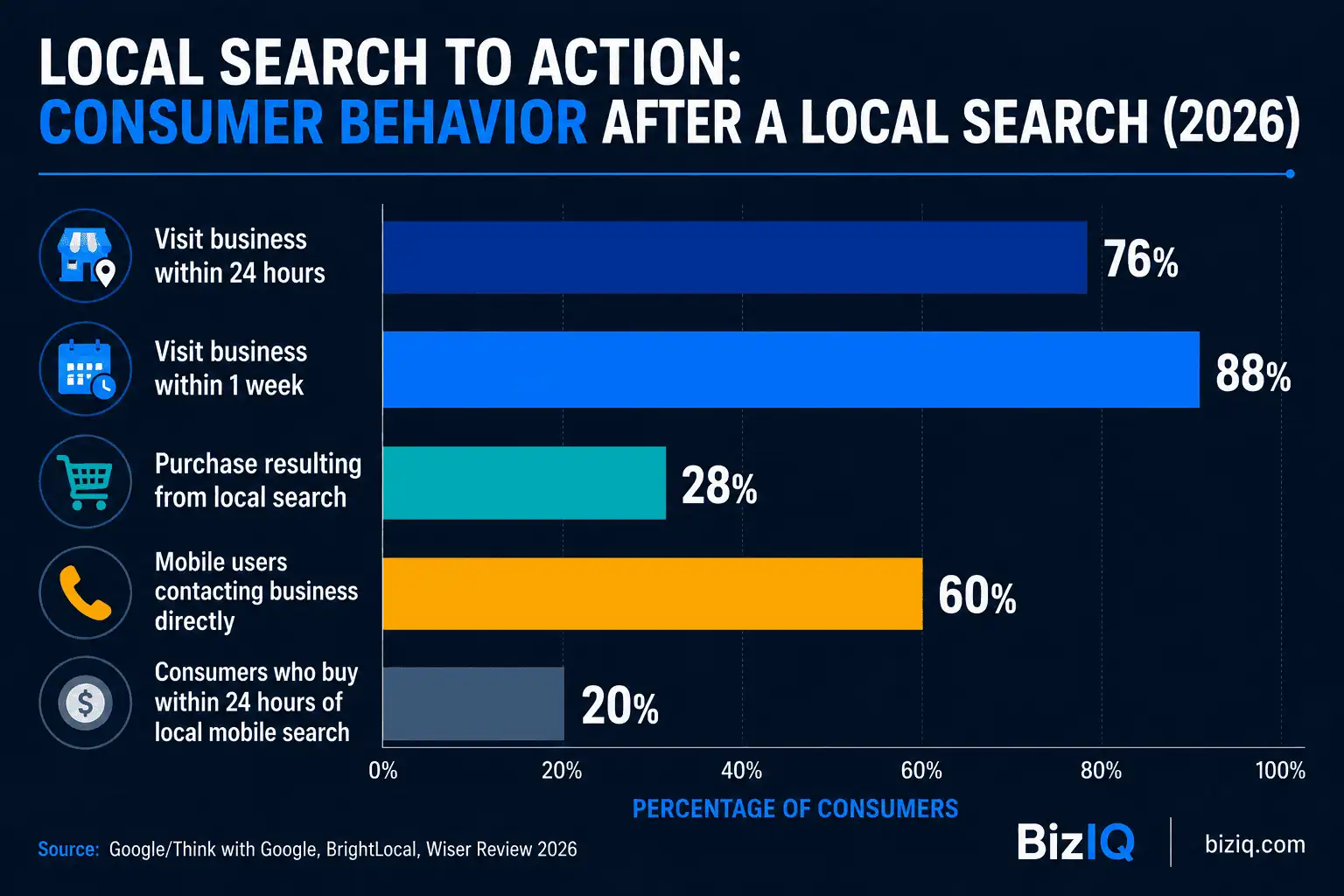
What happens after a local search in 2026 — most consumers take action within 24 hours.
Local Search Purchase Intent and Conversion Data
The defining characteristic of local search — what separates it from informational or brand-awareness search — is its direct connection to purchase behavior. Local searchers are not browsing. They are deciding. The conversion data for local search consistently shows faster and higher purchase rates than any other search category.
The Local Search Purchase Funnel
Local search compresses the traditional marketing funnel. A consumer who searches for a service near their location has already completed the awareness and consideration stages independently. When they land on a local search result, they are at the decision stage. The business that appears first — whether in the Google Map Pack or the top organic local result — captures a buyer who is seconds away from a transaction, not days or weeks away.
This is why local search consistently delivers higher ROI than brand awareness advertising. Brand campaigns build the top of funnel. Local search captures the bottom — where purchase decisions happen. Businesses that invest exclusively in brand-level advertising without local search optimization are spending heavily to create demand they then fail to capture at the moment of decision.
Source: BrightLocal — Local SEO Statistics 2026 | Wiser Review — Local SEO Statistics 2026 | Google/Think with Google
Start Capturing High-Intent Local Search Traffic — Call (888) 416-9800
Mobile Local Search Statistics
Mobile and local search are inseparable in 2026. The smartphone is the primary local search device, and mobile search behavior exhibits the highest local intent signals of any platform. Understanding mobile local search statistics is essential for any business that serves customers in a geographic area.
Mobile Page Speed as a Local Search Conversion Factor
Mobile page speed is not just a technical SEO concern — it is a local search conversion issue. When a consumer performs a local search, clicks on a result, and encounters a slow-loading page, they bounce and click the next result. Given that 76% of local searchers intend to visit a business within 24 hours, every bounce from a slow-loading page is a customer who visits a competitor instead. The average mobile page loads in 8.6 seconds. Google’s own threshold for acceptable mobile load speed is under 3 seconds. The gap between where most businesses are and where they need to be is substantial.
60% of mobile users contact businesses directly from local search results — via click-to-call or directions. If a business’s website is not mobile-optimized, it breaks the most common local-to-customer action path. Every click-to-call that fails because the phone number isn’t tappable, and every direction request that goes to a bad address because the site isn’t displaying correctly, is a direct lost customer interaction. Mobile optimization is not a UX nicety for local businesses — it is infrastructure.
Source: The Stacc — Mobile Search Statistics 2026 | WiFi Talents — Mobile Search Data Reports 2026
Get a Mobile-Optimized Website Built for Local Search — Call (888) 416-9800
Google Map Pack and Local Pack Statistics
The Google Map Pack — the top three local business listings displayed with a map at the top of local search results — is the highest-visibility real estate in local search. Appearing in the local pack drives disproportionate clicks compared to organic results below the map.
Local Pack vs. Organic: Different Ranking Levers
Local pack rankings and local organic rankings are driven by different signals, and businesses need to optimize for both independently. Local pack rankings weight GBP signals most heavily (32%), followed by reviews (16%), citations (7%), and behavioral signals (8%). Local organic rankings weight dedicated service pages most heavily, followed by geographic keyword relevance and link authority. A business can rank in the local pack without strong organic rankings, and vice versa. A complete local SEO strategy addresses both simultaneously.
Source: BrightLocal — Local SEO Statistics 2026 | Sagapixel — Local SEO Statistics 2026
Voice Search and Local Intent Statistics
Voice search is disproportionately local. When people speak their searches instead of typing them, they are far more likely to be looking for something nearby. The explosion of voice-enabled devices has added a significant new layer to local search behavior — one that rewards businesses with complete, conversational GBP data and structured schema markup.
Optimizing for Voice-Driven Local Search
Voice search queries are longer and more conversational than typed queries. Instead of “pizza near me,” a voice searcher might ask “what pizza places are open right now near downtown Phoenix?” This conversational phrasing rewards businesses whose GBP descriptions, website content, and FAQ pages are written in natural language that mirrors how customers speak — not just keyword-optimized text. Businesses that structure their content to answer the specific questions local customers ask verbally will capture a growing segment of high-intent local voice traffic.
Voice assistants — Alexa, Siri, Google Assistant — increasingly pull data from Google Business Profile and structured schema to answer local queries. AI chatbots including ChatGPT and Perplexity do the same for AI-powered local recommendations. A business with incomplete GBP data, missing schema markup, or inconsistent NAP across directories is invisible to both voice search and AI local recommendations simultaneously. These are not separate optimization challenges — they share the same foundational data requirements.
Source: DemandSage — SEO Statistics 2026 | BrightLocal — Local SEO Statistics 2026
AI and the Future of Local Search
In 2026, AI tools have moved from emerging to mainstream in local business discovery. The shift happened faster than most local businesses anticipated, creating both a visibility gap for unprepared businesses and a significant opportunity for those investing in AI-aligned local optimization.
The AI local search landscape rewards the same fundamentals that drive traditional local SEO — accurate business data, high review volume and quality, dedicated service pages, and consistent brand presence across authoritative platforms. But the competitive bar is significantly higher: achieving AI local recommendation visibility is 30 times harder than ranking in traditional Google local results, according to SOCi’s Local Visibility Index. Businesses that are not yet building toward AI local visibility are not just behind in an emerging channel — they are missing 45% of the modern local search market.
Source: BrightLocal — Local Consumer Review Survey 2026 | SOCi Local Visibility Index 2026
Build a Local SEO Strategy Ready for AI Search — Call (888) 416-9800
Online Reviews in Local Search
Reviews are both a local pack ranking signal and the primary consumer trust factor at the decision stage. For local businesses, review management is not optional — it is a core operational requirement with direct revenue implications.
74% of consumers check reviews on at least two platforms before making a local business decision. Google dominates review research at 83% usage, followed by Yelp (44%) and Facebook. Newer platforms are gaining ground: 37% of U.S. consumers use Instagram to find local business reviews, and 29% use TikTok as a local review source — a significant behavioral shift toward social platforms as local discovery tools, particularly among younger consumer demographics.
Source: BrightLocal — Local Consumer Review Survey 2026
Manage Your Local Reviews with BizIQ — Call (888) 416-9800
Local Search Statistics Summary Table
| Statistic | Figure | Source | Year |
|---|---|---|---|
| Consumers searching online for local businesses | 98% | Wiser Review / industry research | 2026 |
| Google searches with local intent | 46% | 2026 | |
| U.S. consumers searching for local businesses weekly | 80% | SOCi Consumer Behavior Index | 2024 |
| U.S. consumers searching for local businesses daily | 32% | SOCi Consumer Behavior Index | 2024 |
| Near-me / close-by query growth over two years | 900% | 2026 | |
| “Open now near me” search growth | 400% | Google/Think with Google | 2026 |
| U.S. near-me related keywords | 5.9 million | Synup data | 2024/2025 |
| Smartphone users conducting near-me searches | 82% | Synup 2024 | 2024 |
| Near-me searchers visiting business within 24 hours | 76% | Google/Think with Google | 2026 |
| Mobile local searchers visiting within 1 week | 88% | Industry research | 2026 |
| Local searches resulting in a purchase | 28% | Think with Google / Joel House | 2026 |
| Consumers buying within 1 week of local search | 90% | Industry research | 2026 |
| Local mobile searches resulting in offline purchase | 78% | SEMrush | 2026 |
| Mobile users contacting businesses from search | 60% | Industry research | 2026 |
| Consumers buying within 24 hours of mobile local search | 20% | Industry research | 2026 |
| Google searches happening on mobile devices | 64% | StatCounter | 2025 |
| Local search queries from mobile devices | Nearly 70% | Industry research | 2026 |
| Mobile visitors abandoning pages loading 3+ seconds | 53% | Google/SOASTA | 2024 |
| Map Pack click-through rate for local queries | 42% of local searchers | Backlinko | 2024 |
| Local 3-pack CTR | 44% | Moz | 2026 |
| Searches with local intent triggering a local 3-pack | 93% | Sagapixel | 2026 |
| Consumers using voice search for local businesses weekly | 58% | On The Map / industry research | 2026 |
| Voice-enabled devices worldwide | 8.4 billion | Yaguara | 2026 |
| Consumers using AI for local business recommendations | 45% | BrightLocal Local Consumer Review Survey | 2026 |
| AI local visibility vs. traditional local rankings difficulty | 30x harder | SOCi Local Visibility Index | 2026 |
| Average ChatGPT-recommended business star rating | 4.3 stars | SOCi Local Visibility Index | 2026 |
| Consumers reading reviews before visiting local business | 87% | BrightLocal | 2026 |
| Consumers checking reviews on 2+ platforms | 74% | BrightLocal | 2025 |
| Consumers visiting website after reading positive reviews | 54% | BrightLocal Local Consumer Review Survey | 2026 |
| Consumers avoiding businesses with incorrect online info | 62% | Google / Local Discovery Report | 2023/2026 |
Frequently Asked Questions: Local Search Statistics
Methodology & Sources
This article was researched and written by David McGinnis, SEO Strategist at BizIQ. All statistics are sourced from Tier 1 primary sources. Sources include:
- Google / Think with Google: Primary data on local search intent percentages, near-me search behavior, consumer visit rates post-local-search, and mobile search data.
- BrightLocal — Local SEO Statistics 2026 / Local Consumer Review Survey 2026: Annual primary research on local consumer search and review behavior.
- SOCi — Consumer Behavior Index 2024 / Local Visibility Index 2026: Primary research on consumer local search frequency and AI local search visibility data.
- StatCounter 2025: Global search engine and device market share data.
- Backlinko: CTR analysis and local search click distribution research.
- Synup 2024: Near-me keyword volume and smartphone search behavior data.
- Yaguara 2026: Voice-enabled device adoption data.
- SEMrush: Local mobile search offline purchase conversion data.
BizIQ Analysis calculations are original to BizIQ and clearly labeled as such.
Talk to BizIQ About Your Local Search Strategy — Call (888) 416-9800