78–88% of marketers now use AI tools in their daily workflow. AI-driven campaigns deliver 22% higher ROI with 32% more conversions. AI saves the average marketer 6–13 hours per week. Yet only 6–17% of organizations have fully embedded AI into their marketing workflows — and 74% of companies still struggle to scale value from their AI investments. The 2026 AI in marketing data tells a consistent story: adoption is near-universal, but strategic integration is still the exception rather than the rule. The competitive advantage is available to everyone who closes that gap.
- 78–88% of marketers worldwide use AI tools in their daily workflow — adoption has reached near-universal levels (HubSpot State of Marketing 2026 / SurveyMonkey 2025).
- AI-driven campaigns deliver 22% higher ROI, 32% more conversions, and 29% lower acquisition costs than traditional methods (McKinsey / Zebracat AI).
- AI content drafting delivers 3.2x ROI — the highest ROI of any AI marketing application, followed by personalization engines at 2.7x (McKinsey Global AI Survey).
- AI saves the average marketer 6.1–13 hours per week — a meaningful productivity lever, not a marginal efficiency gain (HubSpot AI Trends 2026 / Daily AI Mail 2026).
- The global AI marketing market reached $57.99 billion in 2026, up from $6.46 billion in 2018 — a 37.2% CAGR (All About AI).
- Only 6–30% of marketing organizations have fully integrated AI across their workflows — the adoption-execution gap is the primary competitive differentiator in 2026.
- The biggest AI marketing challenge is skills, not technology: 58% cite skills gaps as their top challenge, and only 17% have received comprehensive job-specific AI training (Loopex Digital 2026).
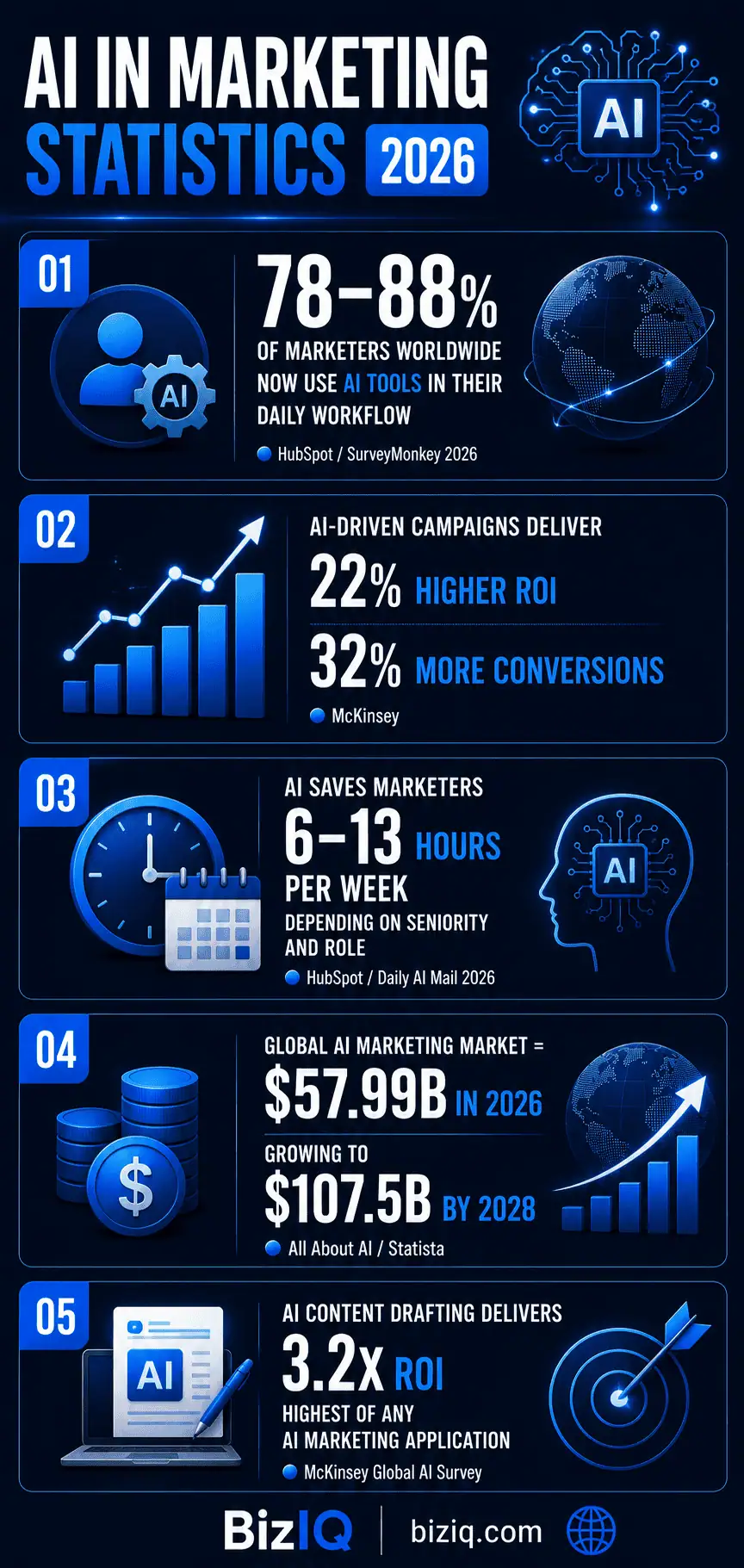
Key AI in marketing statistics for 2026 — adoption rates, ROI benchmarks, productivity gains, and market growth data.
AI Marketing Adoption Statistics (2026)
The adoption story for AI in marketing is effectively over — the question is no longer whether to adopt but how to integrate deeply enough to capture the performance advantages that adoption enables. The 2026 data shows near-universal adoption across organizations of every size, but a persistent and significant gap between tool usage and strategic integration.
Adoption vs. Integration: The Gap That Determines ROI
The critical nuance in 2026 AI adoption data is the distinction between tool usage and strategic integration. 88% of marketers use AI tools. Only 6–30% have fully embedded AI across their marketing workflows — depending on the definition of “full integration.” The organizations capturing the strongest AI performance advantages are those that have moved beyond individual tool adoption (one AI writing assistant, one AI image generator) to systematic integration: AI embedded across content production, campaign management, audience segmentation, performance reporting, and optimization workflows simultaneously. The 22% higher ROI and 32% more conversions documented by McKinsey come from that integrated deployment — not from occasional AI tool use.
58% of marketers cite skills gaps as their top AI challenge. Only 17% have received comprehensive, job-specific AI training. 32% report receiving no formal AI training whatsoever. 20% describe their training as “too generic” to be practically useful. Yet organizations that invest in employee AI training report 43% higher project success rates — making training investment the highest-leverage AI ROI action available to most marketing teams. 81% of companies plan to increase AI training spend in 2026, suggesting this gap is closing — but the organizations that close it first gain the most durable competitive advantage.
Source: Digital Applied — AI Marketing Statistics 2026 | Searchlab — AI Marketing Statistics 2026
Work with a Team That Integrates AI Across Your Marketing — Call (888) 416-9800
AI Marketing Market Size and Investment (2026)
The AI marketing market has grown from a niche capability to a substantial industry category in less than a decade. The investment data reflects an acceleration, not a plateau — with per-team spending tripling in 18 months and the overall market on track to double by 2028.
The 3x increase in median per-team AI tool spend from Q1 2025 to Q1 2026 reflects the shift from exploratory spending (a few licenses for individual tools) to systematic infrastructure spending (integrated platforms that replace or augment entire marketing workflow categories). The 3,800+ available AI marketing tools represent both an opportunity and a challenge: the tool landscape has grown faster than most teams’ ability to evaluate, select, and integrate effectively — contributing to the skills gap and integration challenges that limit ROI for many organizations.
Source: Loopex Digital — AI Marketing Statistics 2026 | All About AI — AI Marketing Statistics 2026
AI Marketing Performance: Campaign ROI Data
The performance data for AI-integrated marketing campaigns vs. traditional approaches has become one of the most consistent findings in 2026 research — documented across McKinsey, Zebracat AI, and multiple independent analyses.
Source: Searchlab — AI Marketing Statistics 2026 | McKinsey Global AI Survey | Zebracat AI
See AI-Powered PPC Management from BizIQ — Call (888) 416-9800
AI ROI by Marketing Application
Not all AI marketing applications deliver equal returns. McKinsey’s Global AI Survey — one of the most comprehensive primary research studies on AI marketing ROI — documents the return multiple by specific application category, revealing which AI investments outperform and which underperform.
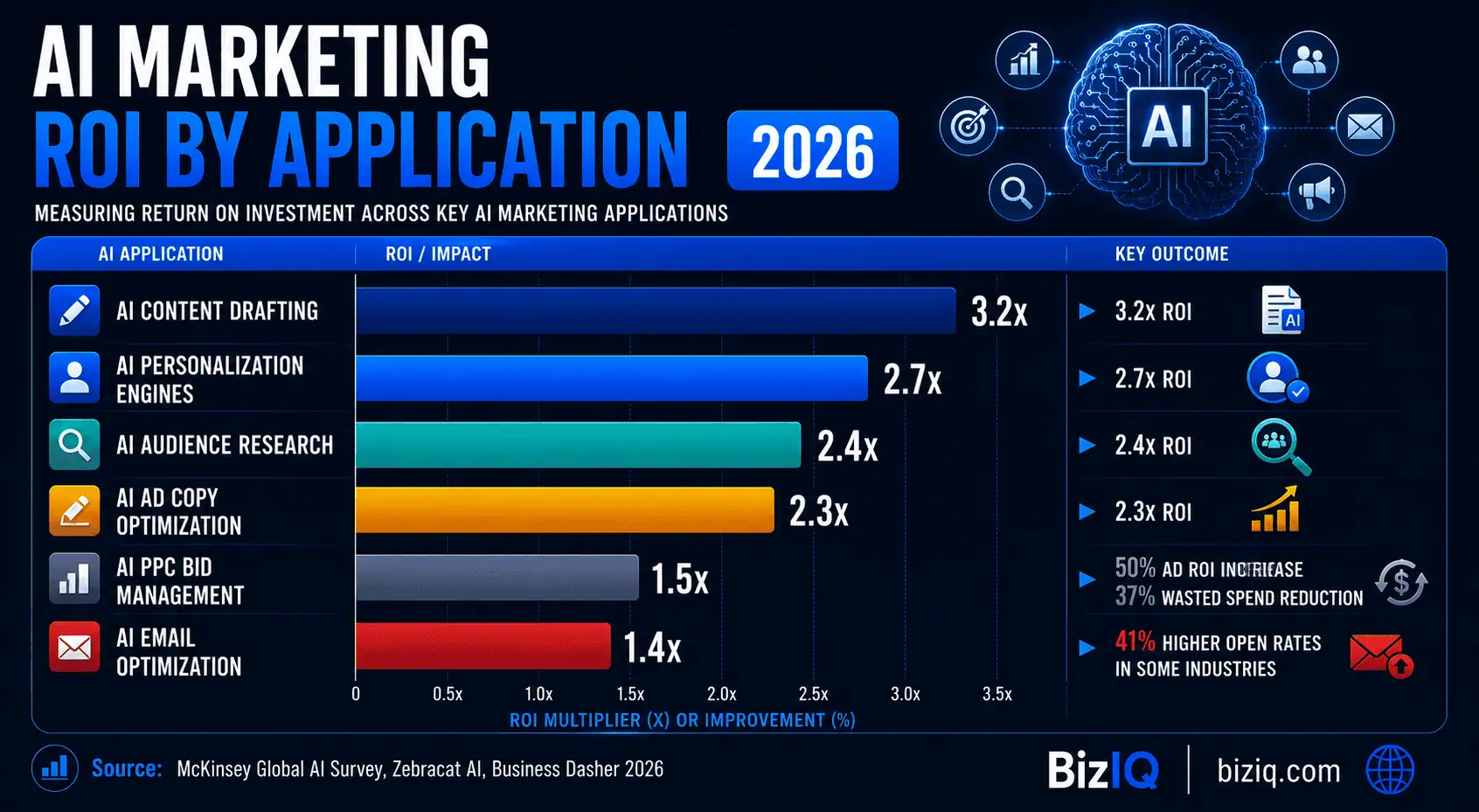
AI marketing ROI by application in 2026 — content drafting and personalization engines deliver the highest returns (McKinsey Global AI Survey).
Where AI Underperforms: Video and Paid Social Creative
Two AI marketing applications consistently underperform in 2026 ROI data. AI video tools deliver only 1.1x–1.6x ROI — because production overhead remains high even when generation is automated; the AI-generated raw output still requires substantial human editing and post-production. AI-generated paid social creative also underperforms: Meta, TikTok, and Google all quietly down-rank obvious AI-generated creative in their 2026 algorithm updates, a pattern confirmed across multiple agency performance studies (Digital Applied 2026). The implication: AI delivers the strongest returns when used to accelerate strategy and analytical work — content drafting, audience research, personalization, and bid optimization — and weakest returns when used as a pure creative production substitute without human creative direction and quality review.
Source: Digital Applied — AI Marketing Statistics 2026 | McKinsey Global AI Survey
AI Productivity Statistics for Marketers (2026)
The productivity data for AI in marketing is among the most consistently documented findings across research sources. Hours saved per week translate directly into capacity for higher-value strategic work — or more output at the same headcount cost.
The Content Volume vs. Content Quality Tension
The 42% more content per month from AI users is a productivity gain that carries a strategic risk: content volume does not automatically produce better marketing results. 2026 search algorithm data shows that AI-generated content at scale without human quality control is subject to algorithmic down-ranking — Google’s systems have become increasingly sophisticated at detecting and deprioritizing mass-produced AI content with low originality scores. The organizations capturing the 3.2x ROI from AI content drafting are using AI to accelerate a human-led editorial process — faster research, faster first drafts, faster editing cycles — not to replace the human editorial judgment that produces content distinctive enough to earn rankings, citations, and shares.
At the average U.S. marketing professional’s hourly rate of approximately $45 (based on $93,000 median annual salary / 2,080 hours), 6.1 hours saved per week represents approximately $274 in recovered labor value per marketer per week, or $14,248 annually per marketing FTE. For a marketing team of 5 people, that’s approximately $71,240 in annualized productivity recovery — before accounting for the quality and revenue impact of the better output those hours enable. For businesses using an external marketing agency or consultant, AI-enabled efficiency translates directly into either more marketing activity at the same retainer cost or the same activity at lower cost. Calculation original to BizIQ using published productivity and salary benchmarks.
Source: Daily AI Mail — AI in Marketing Statistics 2026 | Loopex Digital — AI Marketing Statistics 2026
AI in Content Marketing and SEO (2026)
Content creation and SEO are the AI marketing applications with the highest adoption rates and the strongest documented ROI returns — making them the primary entry point for most marketing teams’ AI programs.
AI Search Optimization: The 2026 Dual Challenge
Content marketing teams face a dual optimization challenge in 2026: producing content that ranks in traditional organic search AND gets cited by AI tools (ChatGPT, Perplexity, Google AI Overviews, Gemini). The signals that drive performance on both surfaces are related but not identical. Traditional search rankings favor keyword relevance, backlink authority, and technical quality. AI citation favors structured answers that directly respond to questions, authoritative original data that AI systems can reference, and consistent entity recognition across platforms. The 25% higher AI Overview appearance rate for pages already ranking first suggests that traditional SEO excellence is the most reliable path to AI visibility — but not a guaranteed one. The 46.5% of AI Overview citations from outside the top 50 organic results confirms that AI citation is a partially independent signal that can be optimized for directly.
Source: Arvow — AI Content Marketing Statistics 2026 | Adobe — AI Marketing Trends 2026
Optimize for Both Traditional Search and AI Visibility — Call (888) 416-9800
AI in Paid Advertising (2026)
AI has become the dominant operational model for paid advertising management in 2026. Smart Bidding, Performance Max, and AI Max represent Google’s integration of AI at every level of campaign management. The data on AI-native campaign management confirms that AI-assisted bidding and targeting is now the standard for competitive paid search performance.
Source: SQ Magazine — AI in Marketing Statistics 2025 | IAB State of Data 2025 | Zebracat AI
Run AI-Powered Google Ads Campaigns with BizIQ — Call (888) 416-9800
AI in Marketing Statistics Summary Table
| Statistic | Figure | Source | Year |
|---|---|---|---|
| Global AI marketing adoption rate | 76% | IBM Global AI Adoption Index | 2026 |
| Marketers using AI in daily workflow | 78–88% | HubSpot / SurveyMonkey | 2025–2026 |
| Marketers using AI tools daily | 60% | Daily AI Mail | 2026 |
| SMBs using AI in marketing | 67% | Daily AI Mail | 2026 |
| U.S. marketer AI adoption | 84% | Searchlab / All About AI | 2026 |
| E-commerce AI adoption (highest by industry) | 87% | Searchlab | 2026 |
| Organizations fully integrating AI across workflows | Only 6–30% | Foursets / IAB / various | 2026 |
| Marketers citing skills gaps as top AI challenge | 58% | Loopex Digital | 2026 |
| Marketers receiving comprehensive AI training | Only 17% | Loopex Digital | 2026 |
| ROI improvement with AI training investment | 43% higher project success | Loopex Digital | 2026 |
| Global AI marketing market | $57.99 billion | All About AI | 2026 |
| AI marketing market CAGR (2018–2026) | 37.2% | All About AI | 2026 |
| Projected AI marketing revenue by 2028 | $107.5 billion | Statista | 2028 |
| Median monthly AI tool spend per mid-market team | $3,400 (up from $1,200 in Q1 2025) | Digital Applied | 2026 |
| AI tools share of total marketing budget | 9% | Loopex Digital | 2026 |
| Available AI marketing tools | 3,800+ | Chiefmartec | 2026 |
| ROI improvement — AI vs. traditional campaigns | 22% higher | McKinsey / Zebracat AI | 2026 |
| Conversion rate improvement — AI campaigns | 32% more conversions | McKinsey / Zebracat AI | 2026 |
| Acquisition cost reduction — AI campaigns | 29% lower | McKinsey / Zebracat AI | 2026 |
| Average AI ROI improvement across applications | 35% | McKinsey Digital / Searchlab | 2026 |
| AI content drafting ROI | 3.2x | McKinsey Global AI Survey | 2026 |
| AI personalization engines ROI | 2.7x | McKinsey Global AI Survey | 2026 |
| AI audience research ROI | 2.4x | McKinsey Global AI Survey | 2026 |
| AI ad copy optimization ROI | 2.3x | McKinsey Global AI Survey | 2026 |
| Wasted ad spend reduction — AI PPC bidding | 37% reduction | Zebracat AI | 2026 |
| Ad ROI increase — AI PPC bidding | 50% increase | Zebracat AI | 2026 |
| Email open rate lift — AI optimization | Up to 41% | Business Dasher | 2026 |
| Weekly time saved — average marketer (AI) | 6.1 hours | HubSpot AI Trends | 2026 |
| Weekly time saved — other studies | 11–13 hours | Daily AI Mail | 2026 |
| Marketers saying AI improved content delivery speed | 84% | CoSchedule / Arvow | 2026 |
| More content published monthly — AI users vs. non-users | 42% more | Daily AI Mail | 2026 |
| Content production efficiency improvement from AI | 63% improvement | Searchlab / McKinsey | 2026 |
| Businesses with increased content ROI from AI | 68% | Semrush | 2026 |
| Businesses with SEO uplift from AI tools | 65% | Semrush | 2026 |
| Performance Max share of paid search optimization | 58% | SQ Magazine | 2025 |
| Digital video ad buyers using AI creative | 86% | IAB State of Data | 2025 |
Frequently Asked Questions: AI in Marketing Statistics 2026
Methodology & Sources
This article was researched and written by David McGinnis, SEO Strategist at BizIQ. All statistics are sourced from Tier 1 primary sources. Sources include:
- McKinsey Global AI Survey / McKinsey Digital: Comprehensive primary research on AI marketing ROI by application, adoption rates, and campaign performance benchmarks.
- HubSpot — State of Marketing 2026 / AI Trends 2026: Annual survey of 1,500+ global marketers on AI adoption, time savings, and marketing performance impact.
- IBM — Global AI Adoption Index: Global and regional AI adoption rate research across industries.
- Gartner — CMO Spend Survey 2025: AI in marketing budget allocation, GenAI use cases, and marketing leader sentiment research.
- Searchlab — AI Marketing Statistics 2026: Aggregated AI marketing statistics from McKinsey, Gartner, HubSpot, Forrester with primary source attribution.
- Digital Applied — AI Marketing Statistics 2026: 200+ data points on AI marketing adoption, ROI, productivity, and agentic workflow trends.
- All About AI — AI Marketing Statistics 2026: Global AI marketing market size, CAGR, adoption rates, and campaign performance data.
- Semrush: AI content marketing ROI and SEO performance impact research.
- IAB — State of Data 2025: AI in paid advertising, digital video creative, and campaign lifecycle integration data.
- Zebracat AI: PPC bid management ROI and wasted spend reduction benchmarks from AI-driven campaign analysis.
- SurveyMonkey 2025 / Daily AI Mail 2026: Marketer workflow adoption and productivity benchmark data.
BizIQ Analysis calculations are original to BizIQ and clearly labeled as such.
Get a Free Digital Marketing Assessment Powered by AI — Call (888) 416-9800