There are 33.2 million small businesses in the United States, representing 99.9% of all U.S. businesses. Yet 73% of SMB owners are not confident their marketing strategy is working, and 66.3% spend less than $1,000 on marketing per year. The gap between what the data shows drives small business growth and what most small businesses are actually investing tells the most important marketing story of 2026 — and it represents a massive opportunity for the SMBs willing to close it.
- 33.2 million small businesses operate in the U.S., contributing 43.5% of GDP and employing 61.7 million people (SBA 2026).
- 72% of overall SMB marketing budgets now go toward digital channels — the shift from traditional to digital is essentially complete (WordStream).
- Email marketing delivers $42 for every $1 spent — the highest ROI of any marketing channel (Litmus/Campaign Monitor).
- Local SEO delivers $13 return per $1 invested — and 49% of marketers rank organic search as the single best-ROI channel (HubSpot State of Marketing 2026).
- 61% of small businesses have not invested in SEO — the largest performance gap in SMB marketing (WordStream / CEO GPS 2026).
- 73% of SMBs globally are not confident their marketing strategy is working; budget constraints, lead generation, and ROI measurement are the top three pain points (Constant Contact 2024).
- Among SMBs that increased marketing spend in 2025, 88% saw stable or improved sales and revenue — investment in marketing works (Taradel 2025).
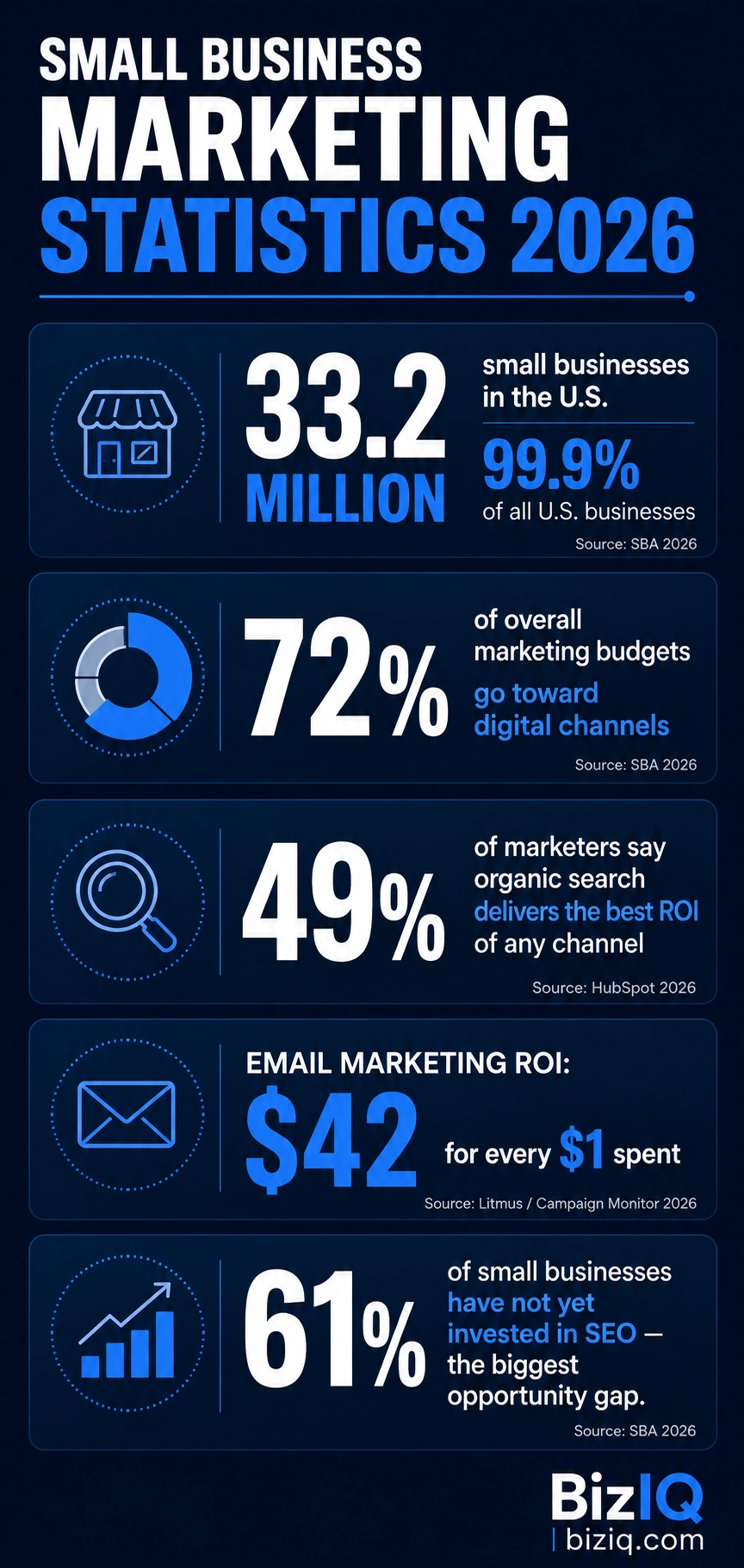
Key small business marketing statistics for 2026 — sourced from SBA, HubSpot, Litmus, and industry research.
The SMB Marketing Landscape in 2026
Small businesses represent the vast majority of American enterprise, yet they operate with fundamentally different marketing constraints than their larger counterparts. Understanding the current state of SMB marketing — where businesses are investing, where the gaps are, and what the data shows about what actually drives growth — is the starting point for building a strategy that competes effectively in 2026.
The confidence gap is one of the most striking findings in SMB marketing research: despite the clear ROI data for digital channels, nearly three-quarters of small business owners are unsure their marketing is working. This disconnect exists for several reasons: limited time (56% of SMBs have an hour or less per day for marketing), difficulty measuring ROI across channels, and budget constraints that force under-investment across the board rather than deep investment in proven channels.
The data is consistent and unambiguous: small businesses that invest in marketing grow faster. Among those that increased marketing spend in 2025, 88% saw measurable revenue improvements. The challenge for most SMBs is not that marketing doesn’t work — it’s that they haven’t invested enough, or in the right channels, to see the results that would validate continued investment.
Source: PPC Chief — Small Business Marketing Statistics 2026 | PostcardMania — SMB Marketing Statistics 2026
Explore BizIQ’s Affordable Local Marketing Packages — Call (888) 416-9800
Small Business Marketing Budget Statistics
How much should a small business invest in marketing? The data provides clear benchmarks — and reveals that most small businesses are significantly under-investing relative to what the research suggests is required for meaningful growth.
Budget Allocation: How SMBs Split Their Marketing Dollars
When small businesses do invest in marketing, digital channels capture the dominant share. Social media takes approximately 14.9% of the average SMB marketing budget. Email marketing receives 8%. Content and SEO investment varies widely, but businesses spending $2,500–$12,000 monthly on digital marketing represent the mid-market SMB range. The key finding across budget research is that channel concentration — investing deeply in two to three proven channels rather than spreading thin across six or more — is consistently associated with better marketing outcomes.
66.3% of small business owners spend less than $1,000 annually on marketing. For context: the U.S. Small Business Administration recommends 7-8% of revenue. A business generating $300,000 in annual revenue should be investing $21,000–$24,000 in marketing annually. At $1,000 per year, that business is investing approximately 95% less than the SBA baseline. The result is near-invisibility in competitive local markets — and a self-fulfilling cycle where lack of marketing investment leads to lack of growth, which is then cited as evidence that marketing doesn’t work.
Source: Revenue Memo — Small Business Marketing Budget Statistics 2026 | U.S. Small Business Administration
Digital Marketing ROI for Small Businesses
ROI data for digital marketing channels provides the clearest evidence for where SMBs should concentrate investment. The spread between best-performing and worst-performing channels is significant — and the highest-ROI channels are consistently the ones where small businesses are most under-invested.
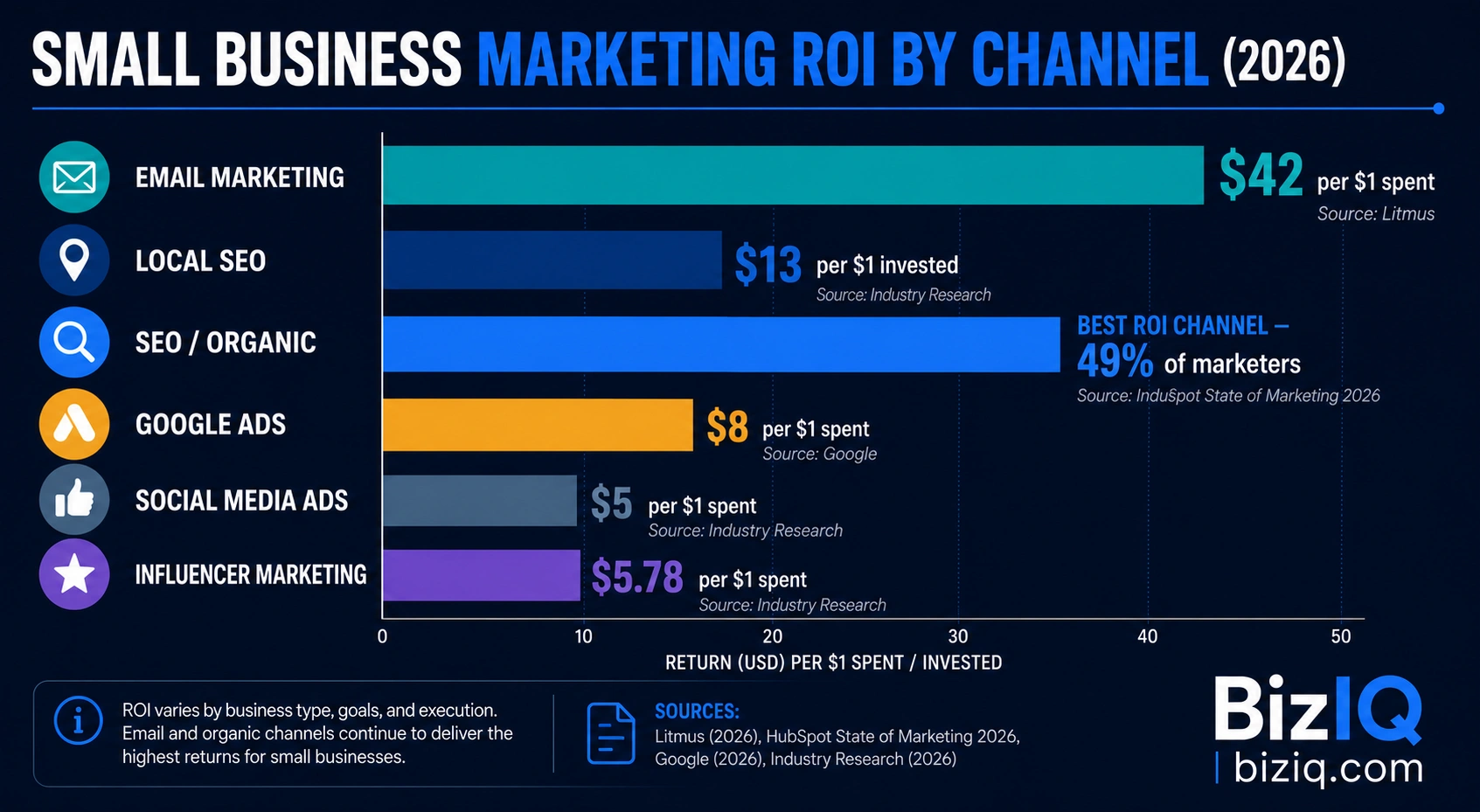
Small business marketing ROI by channel in 2026 — email and organic search consistently deliver the highest returns.
ROI Rankings: What the Data Shows
The consistent finding across ROI research is that content marketing and SEO deliver the highest long-term returns, with email marketing delivering the highest immediate returns. Paid channels like Google Ads offer faster but lower sustained ROI than organic. Social advertising sits in the middle — meaningful reach and discovery, but lower return-on-dollar than the organic channels.
For a small business allocating a limited marketing budget, the ROI data suggests a clear priority order: first, build the organic foundations (SEO, local SEO, GBP optimization) that generate compounding returns over time; second, invest in email marketing for customer retention and repeat business; third, layer in paid search for immediate lead generation in high-intent categories. Social media advertising serves best as a brand awareness and retargeting tool once the organic foundation is in place.
If local SEO delivers $13 per $1 invested and 61% of small businesses haven’t invested in it, the revenue opportunity gap is calculable. A business spending $500/month on local SEO ($6,000/year) should expect approximately $78,000 in attributable return annually at the $13:1 ratio. For a business generating $500,000/year in revenue, that represents a potential 15.6% revenue increase from a single channel — at an investment representing just 1.2% of revenue. The ROI case for local SEO is not marginal; it is one of the most favorable in the SMB marketing data landscape. Calculation and interpretation original to BizIQ.
Source: Revenue Memo — SMB Marketing Statistics 2026 | HubSpot — State of Marketing 2026
Get Started with Local SEO for Your Small Business — Call (888) 416-9800
SEO and Local Search for Small Businesses
The gap between the ROI potential of SEO and actual SMB investment in SEO is one of the largest mismatches in small business marketing. 61% of small businesses have not invested in SEO despite it consistently ranking as the highest-ROI marketing channel by practitioners.
Local SEO: The Small Business SEO Entry Point
For most small businesses serving a local market, local SEO — optimizing Google Business Profile, building local citations, generating reviews, and creating locally-relevant website content — delivers faster and more measurable results than broad organic SEO alone. Local search converts at dramatically higher rates than national organic search because local searchers have immediate purchase intent. 76% of people who search for a local business visit within 24 hours. 28% make a purchase as a direct result of that search.
For small businesses, local SEO is not just the best-ROI channel — it is the most accessible entry point into effective digital marketing. GBP optimization, citation management, and review generation are activities that produce measurable results without requiring large content production budgets, advanced technical expertise, or competitive domain authority against national players.
Source: AIOSEO — SEO Statistics 2026 | Revenue Memo — Small Business Marketing Statistics 2026
See BizIQ’s Local SEO Services for Small Businesses — Call (888) 416-9800
Social Media Marketing for Small Businesses
Social media is the most widely adopted marketing channel among small businesses. Its low barrier to entry, broad consumer reach, and versatility across awareness and conversion objectives make it the default starting point for SMB digital marketing. But adoption rates mask significant variation in effectiveness — most small businesses are on social media, but far fewer are using it in ways that generate measurable business outcomes.
Platform Performance for SMBs: Where to Focus
Facebook (83% SMB adoption) and Instagram (60%) remain the dominant platforms for small business social media marketing. LinkedIn (43%) leads for B2B-focused SMBs. TikTok is used by 34% of small businesses and represents the highest-growth opportunity — particularly for reaching Gen Z consumers, with 77% of Gen Z TikTok users using the platform for product discovery.
The social media data for small businesses shows a consistent pattern: businesses that invest in social media advertising (not just organic posting) see dramatically better results. Organic social media reach has declined steadily on most platforms as algorithms have prioritized paid content. Small businesses treating social media as a free marketing channel — posting without investing in targeted advertising — are getting declining returns from a channel that historically rewarded organic engagement.
The percentage of SMBs relying on a single marketing channel has declined from 24% in 2022 to 11% in 2025 — a significant positive shift. Multi-channel small businesses consistently outperform single-channel competitors: they are 53% more likely to see success in email, perform 43% better in paid social, and report 21% stronger search marketing results (Constant Contact 2025). The most effective SMB marketing strategy is not finding the one perfect channel — it is coordinating two to four channels that reinforce each other across the customer discovery and conversion journey.
Source: Revenue Memo — SMB Marketing Statistics 2026 | PostcardMania — SMB Marketing Statistics Definitive Guide 2026
Build Your Small Business Social Media Presence with BizIQ
Email Marketing for Small Businesses
Email marketing consistently delivers the highest measurable ROI of any marketing channel — $42 for every $1 spent per Litmus and Campaign Monitor research. For small businesses, email is both the best-performing customer retention channel and the most cost-effective tool for nurturing repeat business from existing customers.
Email marketing’s sustained performance is explained by one fundamental reality: an email subscriber has already opted in to hear from the business. Unlike social media followers who may never see organic posts, email subscribers represent a directly accessible, high-intent audience. For small businesses with limited marketing budgets, building and nurturing an email list is one of the highest-leverage long-term investments available — it compounds over time and is not subject to platform algorithm changes or rising paid media costs.
Source: HubSpot — State of Marketing 2026 | Revenue Memo — SMB Marketing Statistics 2026
Launch Email Marketing for Your Small Business — Call (888) 416-9800
AI Adoption in Small Business Marketing
AI marketing tools have shifted from enterprise-only to accessible for small businesses in 2026. The data shows that SMBs adopting AI marketing tools are gaining measurable competitive advantages — both in output volume and in campaign performance — over those that haven’t.
The distinction between “using AI” and “strategically adopting AI” matters. The 68% who see better ROI are not simply running content through AI tools — they are restructuring workflows to eliminate low-value tasks and reinvesting the time savings into high-impact activities that AI cannot replicate: strategic judgment, authentic brand voice, genuine customer relationship building. For small businesses that cannot afford large marketing teams, AI is the budget equalizer — but only when deployed strategically rather than reactively.
Source: Revenue Memo — Small Business Marketing Budget Statistics 2026
Small Business Marketing Challenges
Understanding the barriers to effective SMB marketing is as important as understanding the ROI opportunities. The most common challenges are consistent across research and define where small businesses most need strategic support.
Research consistently identifies three strategic errors that most limit small business marketing effectiveness: (1) Under-investing — allocating 1-2% of revenue to marketing rather than the SBA-recommended 7-8%, leaving the business essentially invisible in competitive markets; (2) Spreading too thin — dividing limited budgets across six or more channels instead of going deep on two or three proven high-ROI channels; (3) Measuring wrong — tracking vanity metrics like follower counts or impressions instead of lead generation, customer acquisition cost, and revenue attribution. Businesses that correct all three consistently report breakthrough in marketing confidence and measurable results.
Source: PostcardMania — 143 SMB Marketing Statistics Definitive Guide 2026 | PPC Chief — Small Business Marketing Statistics 2026
Get a Free Small Business Marketing Consultation — Call (888) 416-9800
Small Business Marketing Statistics Summary Table
| Statistic | Figure | Source | Year |
|---|---|---|---|
| U.S. small businesses (total) | 33.2 million | U.S. Small Business Administration | 2026 |
| Small business share of all U.S. businesses | 99.9% | U.S. Small Business Administration | 2026 |
| SMB contribution to U.S. GDP | 43.5% | U.S. Small Business Administration | 2026 |
| SMB employees across the U.S. | 61.7 million | U.S. Small Business Administration | 2026 |
| SMBs relying on digital marketing | 58% | DemandSage | 2026 |
| SMBs not confident in their marketing strategy | 73% | Constant Contact SMB Guide | 2024 |
| SMBs spending less than $1,000/year on marketing | 66.3% | Revenue Memo research | 2026 |
| SMB marketing budgets going to digital channels | 72% | WordStream | 2026 |
| SBA recommended marketing budget % | 7–8% of gross revenue | U.S. Small Business Administration | 2026 |
| SMBs that increased marketing spend and saw revenue improvement | 88% | Taradel | 2025 |
| Email marketing ROI | $42 per $1 spent | Litmus / Campaign Monitor | 2026 |
| Local SEO ROI | $13 per $1 invested | Industry research / Vice Arc Creative | 2025 |
| Google Ads ROI | $8 per $1 spent | Google economic impact research | 2026 |
| Social media advertising ROI for SMBs | ~$5 per $1 spent | Industry research | 2026 |
| Marketers ranking organic search as best ROI channel | 49% | HubSpot State of Marketing | 2026 |
| Small businesses that have not invested in SEO | 61% | WordStream / CEO GPS | 2026 |
| Small businesses investing in SEO | 74% | AIOSEO | 2026 |
| Average monthly SEO service cost for SMBs | $497 | AIOSEO | 2026 |
| SMBs using local search tactics (GBP, reviews) | 37% | Revenue Memo | 2026 |
| Website traffic from organic search | 53% | Industry research | 2026 |
| SMBs incorporating social media in marketing | 96% | Revenue Memo | 2026 |
| SMBs using Facebook regularly | 83% | Taradel | 2025 |
| SMBs using Instagram | 60% | Revenue Memo | 2026 |
| Consumers discovering businesses via social media | 58% | Revenue Memo | 2026 |
| SMBs incorporating AI into marketing | 59% | Revenue Memo | 2026 |
| SMBs using AI more likely to report marketing success | 5.7x more likely | Revenue Memo | 2026 |
| SMBs reporting better ROI from strategic AI adoption | 68% | SMB content marketing research | 2026 |
| SMBs citing budget as top marketing challenge | 23.3% | Industry survey / Taradel | 2025 |
| SMBs with one hour or less daily for marketing | 56% | Constant Contact | 2024 |
| Small businesses using 3–4 marketing channels in 2025 | Typical pattern | Taradel | 2025 |
| Single-channel SMBs (declined from 24% to 11%) | 11% | Revenue Memo | 2025 |
Frequently Asked Questions: Small Business Marketing Statistics
Methodology & Sources
This article was researched and written by David McGinnis, SEO Strategist at BizIQ. All statistics are sourced from Tier 1 primary sources. Sources include:
- U.S. Small Business Administration (SBA) 2026: Primary government data on U.S. small business count, GDP contribution, and employment. Official recommended marketing investment benchmarks.
- HubSpot — State of Marketing 2026: Annual survey of 1,500+ global marketers covering channel performance, ROI rankings, budget trends, and AI adoption in marketing.
- Litmus / Campaign Monitor: Annual email marketing benchmark research covering ROI, open rates, and industry performance data.
- Constant Contact — SMB Guide 2024: Primary research on small business marketing confidence, time allocation, and channel performance.
- Taradel 2025: Annual SMB advertising survey covering budget allocation, channel usage, and revenue impact of marketing investment.
- Gartner — CMO Spend Survey 2025: Annual C-suite marketing budget and strategy research.
- AIOSEO — SEO Statistics 2026: SEO adoption, pricing, and ROI benchmarks for small businesses.
- Google: Economic impact research on Google Ads ROI and local search performance data.
BizIQ Analysis calculations are original to BizIQ and clearly labeled as such.
Get a Free Small Business Digital Marketing Consultation — Call (888) 416-9800