Organic search accounts for 53% of all website traffic — and the #1 position on Google earns nearly 40% of all clicks for a query. Yet 96.55% of all published web pages receive zero organic traffic from Google, and 60% of searches now end without a click due to AI Overviews and featured snippets. The 2026 SEO landscape rewards businesses that understand these realities with precision: what drives rankings, where clicks actually go, and what the data shows about long-term SEO ROI.
- 53% of all website traffic comes from organic search — it is the dominant digital traffic channel across the web (SEO Inc. / industry research 2026).
- The #1 organic result earns 39.8% CTR; the #2 earns 18.7%; the #3 earns 10.2% — position one gets more clicks than positions 3–10 combined (SE Ranking 2025).
- SEO delivers 8x ROI — double the return of PPC — based on data from 119 companies (NP Digital / SeoProfy 2026).
- 92% of marketers plan to maintain or increase SEO investment in 2026 despite AI search disruption (HubSpot State of Marketing 2026).
- 96.55% of all web pages get zero organic traffic from Google — the visibility gap is enormous (Ahrefs, study of ~14 billion pages).
- AI Overviews now appear in 13.14% of Google queries, doubling since January 2025 — when present, CTR drops from 15% to 8% (Semrush 2025 / B2B SEO research).
- Google still sends 345x more traffic to websites than ChatGPT, Gemini, and Perplexity combined — organic search remains unchallenged as the primary traffic driver (Ahrefs 2025).
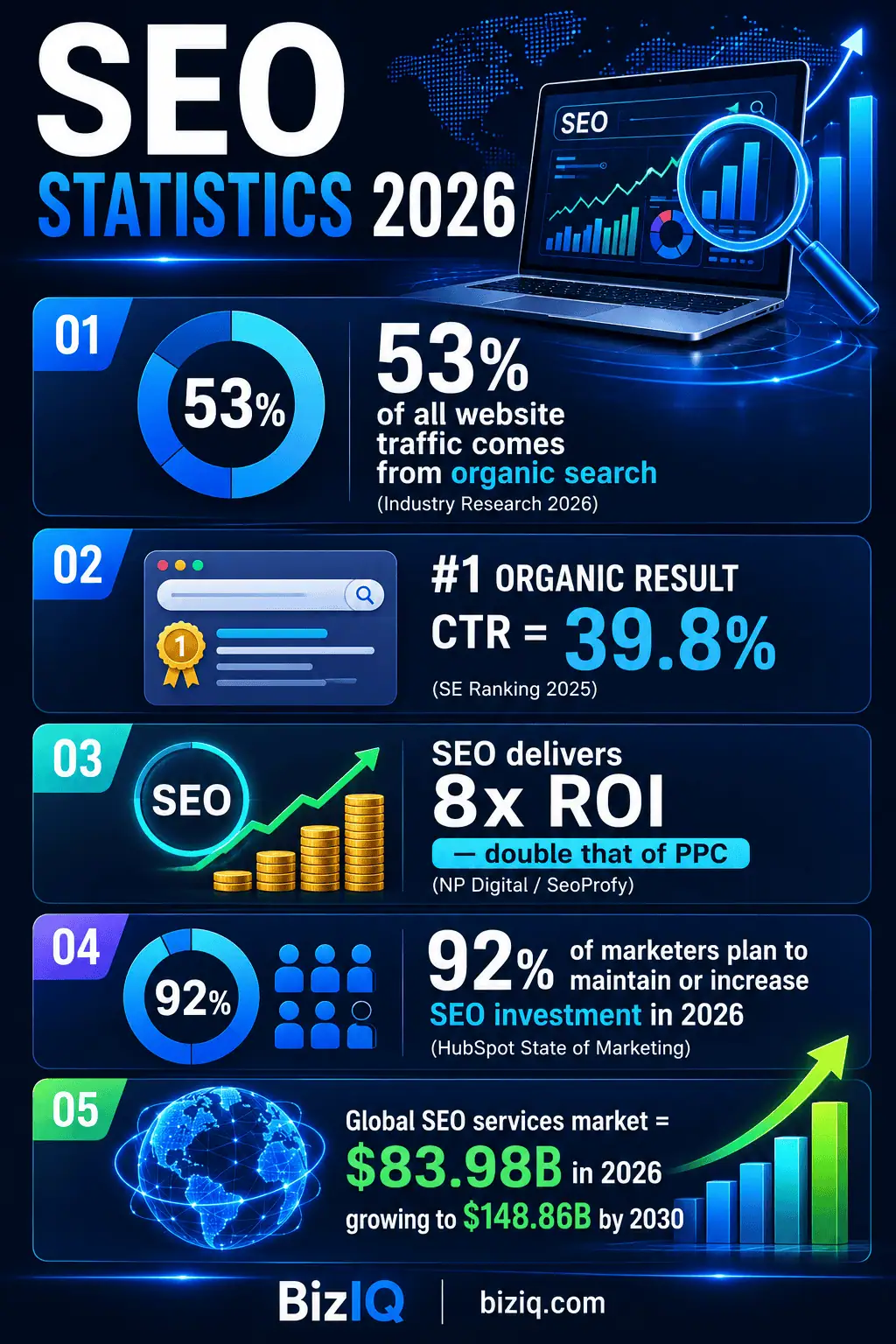
Key SEO statistics for 2026 — sourced from SE Ranking, HubSpot, BrightEdge, NP Digital, and Ahrefs.
Organic Search Market Size and Traffic Share
Organic search is the largest single traffic source on the internet — and its dominance has held consistent despite the rise of social media, AI tools, and paid advertising. Understanding the scale of organic search provides the essential context for any marketing investment decision.
The global SEO services market’s trajectory — from $83.98 billion in 2026 to a projected $148.86 billion by 2030 at 13.5% CAGR — reflects sustained institutional recognition that organic search investment produces durable, compounding returns. Despite significant disruption from AI search features, 92% of marketers plan to maintain or increase SEO spending in 2026. The behavioral data supports that decision: organic search drives more traffic, more revenue, and better ROI than any other digital marketing channel for the majority of business categories.
Source: AIOSEO — SEO Statistics 2026 | SeoProfy — SEO Statistics 2026
See BizIQ’s SEO Services and Organic Growth Solutions — Call (888) 416-9800
Google Search Behavior Statistics
How users actually behave on Google — what they click, how deep they scroll, and how many searches end without a website visit — shapes the strategic context for every SEO decision. The 2026 search behavior data reveals a more complex landscape than simple rankings suggest.
The Zero-Click Search Reality
The 60% zero-click rate requires important context. Not all zero-click searches represent lost opportunity for businesses. A user who searches a business by name and finds their phone number in the knowledge panel, calls directly, and never clicks to the website has still been captured as a customer — the interaction just doesn’t appear in website analytics as a session. The SEO implication: visibility and traffic are no longer equivalent metrics. Businesses need to measure not just organic sessions but also branded search volume growth, GBP calls and direction requests, and knowledge panel interaction — all of which carry commercial value that doesn’t appear in traditional traffic reports.
AI Overviews now appear on 13.14% of Google queries and reduce organic CTR when present — dropping average CTR from 15% to 8% for affected queries. However, two critical context points: (1) AI Overviews disproportionately appear on informational queries, not commercial or transactional ones; (2) 46.5% of pages cited in AI Overviews rank outside the top 50 organic results — meaning AI citation can deliver visibility to pages that wouldn’t otherwise drive meaningful traffic. For businesses, the response is to optimize for AI citation on informational content while protecting commercial query rankings.
Source: GoodFirms — AI SEO Statistics 2026 | Taylor Scher SEO — SEO ROI Statistics 2026
Organic CTR by Google Ranking Position
The value of a Google ranking is determined not just by whether a page ranks on page one, but by exactly where on that page it ranks. The CTR data by position reveals one of the most skewed distributions in all of digital marketing — the drop-off from position one to position three is enormous, and from page one to page two is virtually total.
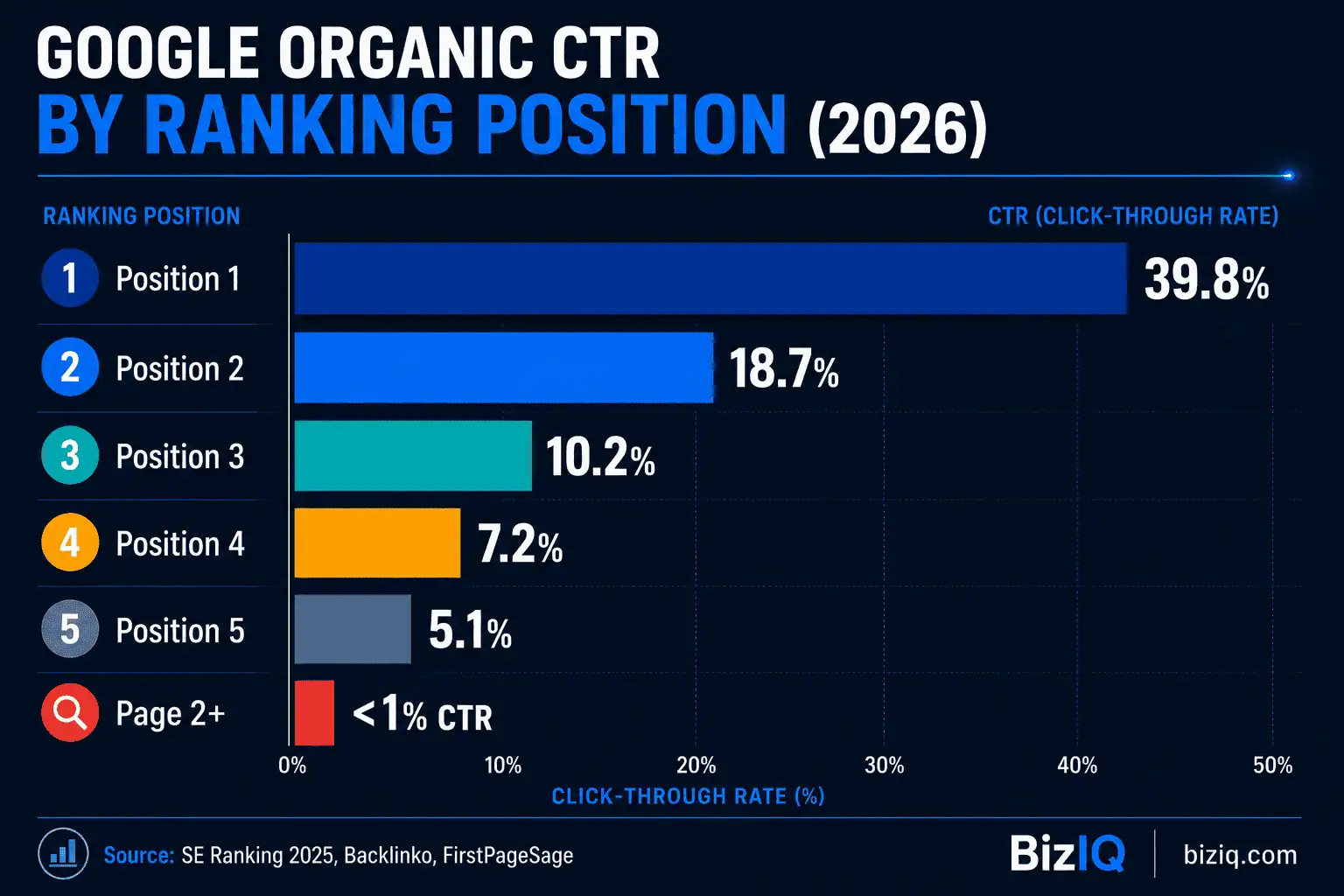
Organic CTR by Google ranking position in 2026 — position one captures nearly 40% of all clicks; page two captures virtually nothing.
For a keyword with 5,000 monthly searches, the difference between ranking #1 (39.8% CTR = 1,990 monthly visitors) and ranking #5 (5.1% CTR = 255 monthly visitors) is 1,735 visitors per month — at exactly zero additional advertising cost. At a 3% organic conversion rate and $200 average customer value, that ranking gap represents $10,410 in potential monthly revenue difference from a single keyword. Multiply across a portfolio of 20 target keywords and the revenue impact of ranking position becomes one of the largest financial levers in a business’s marketing stack. Calculation original to BizIQ.
Source: Taylor Scher SEO — SEO ROI Statistics 2026 | SE Ranking 2025 | Click Vision — SEO Statistics 2026
Improve Your Organic Rankings with BizIQ — Call (888) 416-9800
SEO ROI Statistics
The ROI case for SEO is one of the strongest in all of digital marketing — and it has become better documented as more businesses have tracked long-term organic performance data. The data across multiple industry studies consistently shows SEO delivering returns that dwarf paid alternatives over time.
SEO’s Compounding Advantage Over Paid Advertising
The most important financial distinction between SEO and paid advertising is the compounding vs. linear return structure. Paid advertising delivers traffic proportional to spend — stop spending, stop getting traffic. SEO builds cumulative authority: rankings achieved today continue delivering traffic months and years from the investment that earned them. Content published in 2024 is still generating organic traffic in 2026 without ongoing cost. This compounding dynamic explains why SEO ROI numbers are typically measured over 12–36 month windows and consistently outperform paid channels over those longer periods.
Source: SeoProfy — SEO Statistics 2026 | Taylor Scher SEO — SEO ROI Statistics | ClickRank — SEO Benchmarks 2026
Start Building Long-Term Organic ROI with BizIQ — Call (888) 416-9800
Technical SEO Benchmarks (2026)
Technical SEO — Core Web Vitals, mobile optimization, page speed, and site architecture — determines whether a website can compete for rankings regardless of content quality. In 2026, technical benchmarks are more stringent, and the majority of websites are still failing to meet them.
Core Web Vitals: The Technical Baseline
Google’s Core Web Vitals — Largest Contentful Paint (LCP), Interaction to Next Paint (INP, which replaced FID in March 2024), and Cumulative Layout Shift (CLS) — are official ranking signals. Nearly half of all competing websites fail at least one of these thresholds. LCP is the most commonly failed metric: 38.4% of U.S. websites fail LCP, primarily due to unoptimized hero images and slow server response times. INP failures are most common on JavaScript-heavy sites using frameworks like React and Angular, where front-end interactivity adds render-blocking delays. CLS failures are the most fixable: explicitly sizing images, ads, and embeds eliminates the majority of layout shift issues without architectural changes.
Source: ClickRank — SEO Benchmarks 2026 | Click Vision — SEO Statistics 2026
Backlink Statistics (2026)
Backlinks remain one of the most powerful organic ranking signals in 2026. The data on backlink distribution shows extreme concentration at the top — the pages ranking highest have dramatically more referring domains than those ranking lower, and the vast majority of published pages have no backlinks at all.
The backlink data explains the 96.55% zero-traffic statistic more precisely than any other ranking factor. Pages that get no organic traffic are, overwhelmingly, pages with no backlinks pointing to them. Without external authority signals, Google has no third-party validation of a page’s relevance or trustworthiness — and in a competitive search landscape, it will not rank content it cannot independently verify as valuable. Link-building is not an optional advanced tactic; it is the foundational authority signal that determines whether a page can compete at all.
Source: SeoProfy — SEO Statistics 2026 | AIOSEO — SEO Statistics 2026
Content Marketing and SEO Statistics
Content is the raw material of SEO — without content, there is nothing to rank. The data on content production and its relationship to organic traffic and lead generation provides some of the clearest benchmarks for content investment decisions.
The HubSpot State of Marketing 2026 data confirms that website, blog, and SEO is the #1 ROI-driving marketing channel for B2B brands, cited by 27% of B2B marketers. For content to earn rankings, it requires three concurrent qualities: topical relevance to the target query, sufficient backlink authority to compete at that keyword’s difficulty level, and technical accessibility for Google’s crawlers. Content that achieves all three consistently earns organic traffic that compounds over time — the foundation of durable organic growth.
Source: HubSpot — State of Marketing 2026 | DemandSage — SEO Statistics 2026
Explore BizIQ’s On-Site SEO Optimization Services — Call (888) 416-9800
SEO Statistics Summary Table
| Statistic | Figure | Source | Year |
|---|---|---|---|
| Organic search share of all website traffic | 53% | SEO Inc. / Embryo Agency | 2026 |
| Google’s global search engine market share | 89.85% | SeoProfy / StatCounter | 2026 |
| Global SEO services market value | $83.98 billion | AIOSEO | 2026 |
| Projected global SEO market by 2030 | $148.86 billion | AIOSEO | 2030 |
| Daily Google searches | 8.5 billion | Statista | 2026 |
| Revenue driven by organic traffic (multiple industries) | 40%+ | Reliqus / BrightEdge | 2026 |
| Users who never scroll past page 1 of Google | 75% | HubSpot | 2026 |
| Google users visiting page 2 of results | 0.44% | Click Vision | 2026 |
| Users clicking at least one organic result | 65% | Backlinko | 2026 |
| Google searches ending without a click (zero-click) | 60% | SparkToro / industry research | 2026 |
| Google traffic to websites vs. AI tools combined | 345x more | Ahrefs | 2025 |
| #1 organic result CTR | 39.8% | SE Ranking | 2025 |
| #2 organic result CTR | 18.7% | SE Ranking | 2025 |
| #3 organic result CTR | 10.2% | SE Ranking | 2025 |
| Clicks within top 10 organic results | 96.98% | Ahrefs | 2025 |
| AI Overviews appearance rate (% of queries) | 13.14% | Semrush | 2025 |
| CTR when AI Overview present vs. absent | 8% vs. 15% | B2B SEO research | 2026 |
| AI Overview pages from outside top 50 rankings | 46.5% | B2B SEO research | 2026 |
| SEO ROI vs. PPC | 8x (double PPC) | NP Digital / SeoProfy | 2026 |
| B2B SaaS SEO ROI (36 months) | 702% | FirstPageSage | 2025 |
| Marketers reporting positive SEO ROI | 91% | BrightEdge | 2026 |
| Marketers maintaining or increasing SEO investment | 92% | HubSpot State of Marketing | 2026 |
| Websites passing all Core Web Vitals | 54.6% | BrightEdge | 2025 |
| US websites failing LCP | 38.4% | Semrush | 2026 |
| Mobile visitors abandoning 3+ second load pages | 53% | Google/SOASTA | 2024 |
| Top-ranking websites that are mobile-optimized | 80% | Resourcera | 2026 |
| Referring domains advantage — position 1 vs. competitors | 3.8x more | Adilo study (16,008 data points) | 2026 |
| Web pages with zero backlinks | 96.55% | Ahrefs (~14B pages) | 2023 |
| Companies publishing 16+ posts/month — lead gen advantage | 4.5x more leads | B2B SEO research | 2026 |
| Higher CTR for URLs with target keywords | 45% higher | Backlinko / DemandSage | 2026 |
| AI citations pulled from first 30% of article body | 44.2% | DemandSage | 2026 |
Frequently Asked Questions: SEO Statistics 2026
Methodology & Sources
This article was researched and written by David McGinnis, SEO Strategist at BizIQ. All statistics are sourced from Tier 1 primary sources. Sources include:
- SE Ranking 2025: CTR analysis by organic ranking position across a broad keyword dataset. Organic traffic share data.
- Ahrefs 2025: Analysis of approximately 14 billion web pages for backlink and organic traffic distribution. Google vs. AI tool traffic comparison data.
- HubSpot — State of Marketing 2026: Survey of 1,500+ global marketers on channel ROI, SEO investment intent, and content marketing effectiveness.
- BrightEdge 2026: Enterprise SEO research on organic traffic share, revenue attribution, Core Web Vitals benchmarks, and SEO ROI reporting.
- Semrush 2025/2026: AI Overview appearance rate data, Core Web Vitals failure analysis, and organic performance benchmarks.
- NP Digital / SeoProfy: SEO ROI analysis based on data from 119 companies.
- FirstPageSage September 2025: B2B SaaS SEO ROI and break-even analysis from client campaign data.
- Backlinko / SparkToro: Click behavior analysis, zero-click search data, and CTR by position research.
- AIOSEO: Global SEO market size and projection data. Small business SEO adoption statistics.
BizIQ Analysis calculations are original to BizIQ and clearly labeled as such.
Get a Free SEO Audit for Your Website — Call (888) 416-9800