
- Why individual service pages outperform single-page lists in local search.
- The exact above-the-fold layout that converts 15% of visitors into phone calls.
- How to map keywords and structure internal links to pass page authority.
- Step-by-step content hierarchies for drain cleaning, sewer lines, and water heaters.
To rank at the top of Google, your plumbing website cannot depend on a single, generic services page. One page is not enough. Search engines rank individual pages that match specific search queries, meaning a homeowner looking for emergency drain cleaning needs to land on a page dedicated solely to that service.
Structuring your service pages correctly is the single most effective way to improve your local search visibility. By organizing your content logically, mapping your keywords strategically, and placing high-converting elements above the fold, you turn search engine crawlers into fans and website visitors into paying customers. The mechanics of how you build that structure, the siloed hub-and-spoke content hierarchy, the internal linking architecture, and the schema layer underneath it all: are what separate a plumbing business that generates consistent inbound calls from those that sit invisible on page four.
The anatomy of a high-converting plumbing service page
A high-ranking service page must balance search engine optimization with user experience, and those two goals pull in the same direction more often than people assume. Over half of your visitors will access your site via a mobile device. Industry data indicates that 53% of mobile users exit a website if it takes longer than three seconds to load. Your website is your 24/7 salesperson. When it is optimized, it works while you sleep. But if your contact information and value proposition are buried beneath a heavy hero image that takes four seconds to render, visitors will leave before they even see your phone number.
Every service page should open with a clear headline that confirms the user’s location and the specific service they need. This is followed by a short, 50 to 120-word introduction framing the problem, your solution, and a prominent call to action. That sequence is not arbitrary: it mirrors the mental state of someone who just searched “drain cleaning in Phoenix” at 9 PM with a backed-up kitchen sink. They are not browsing. They want confirmation that they found the right place, and they want a phone number.
The full content hierarchy that performs consistently across high-ranking plumbing service pages runs like this: Hero section with a geo-targeted H1, a direct-answer intro, a symptom-based H2 section, a service breakdown with method-specific H3s, a step-by-step process walkthrough, trust and authority signals, pricing context, a schema-ready FAQ block, and multiple CTAs placed above the fold, mid-page, and at the bottom. Think of it less like a webpage and more like a well-organized toolbox: every tool has its own dedicated slot, clearly labeled, immediately reachable. A cluttered drawer where drain cleaning, sewer repair, and water heater installation are all thrown together serves no one, least of all Google’s crawlers trying to determine the core topic of the page.
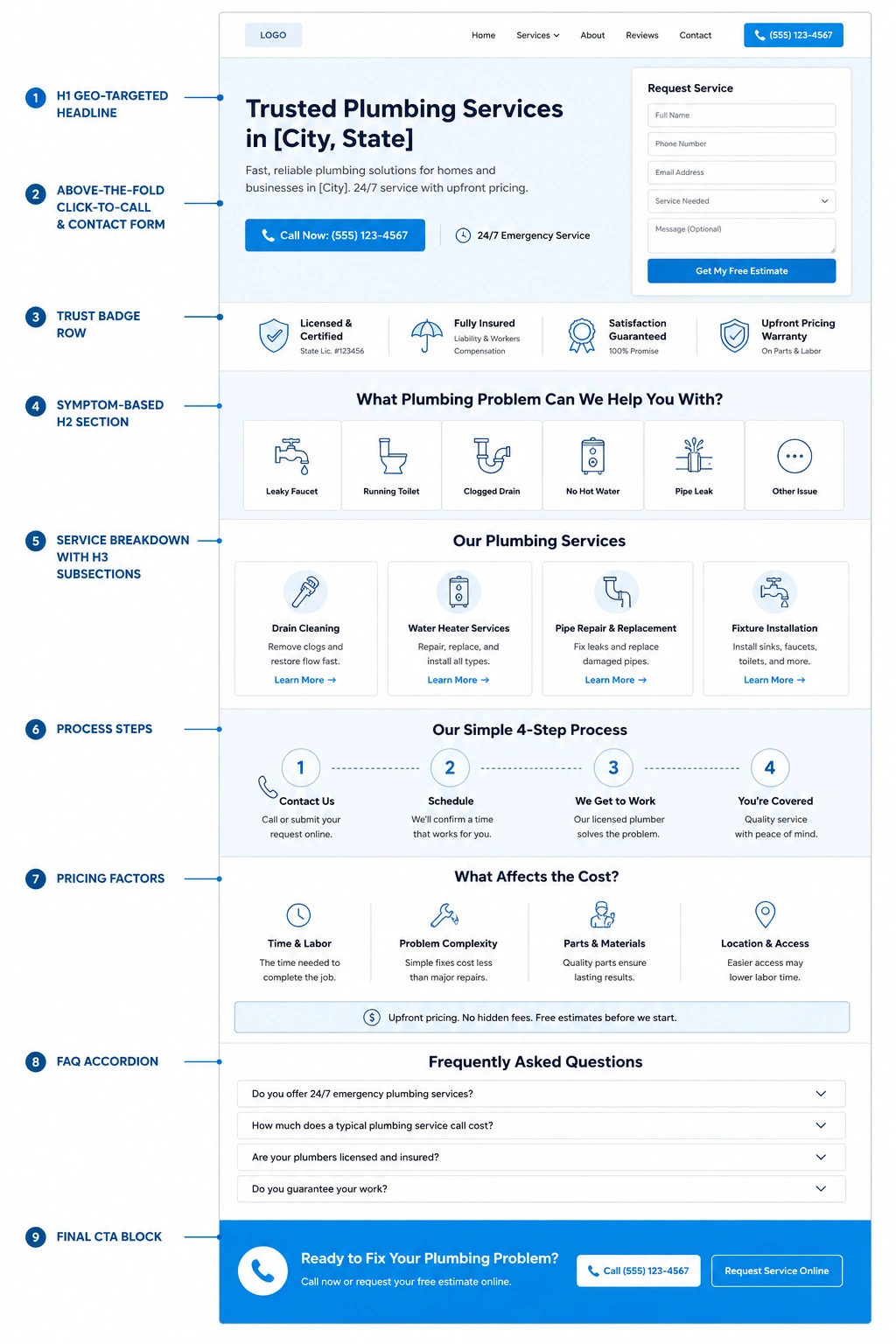
Wireframe illustrating an SEO-optimized plumbing service page layout with strategic content sections designed to improve conversions.
Keyword mapping and on-page optimization rules
Getting the on-page signals right is where most plumbing websites either build a lasting ranking foundation or quietly undermine themselves. There is an active debate in the SEO community about exact-match local keywords in headings versus natural language, and it is worth addressing directly rather than pretending there is one obvious answer. Practitioners who advocate for strict keyword placement argue that “Best Sewer Line Repair Dallas TX” in an H1 satisfies legacy algorithmic signals. Modern SEO strategists counter, with considerable evidence, that search engines now weight user engagement metrics heavily enough that a robotic heading increases bounce rates and ultimately costs you the ranking you were trying to earn.
The balanced approach, using the primary keyword naturally within a readable, user-first headline, holds up better across algorithm updates and converts at a higher rate. “Sewer Line Repair in Dallas” does the job without sounding like it was written by a keyword density calculator. Understanding local on-page SEO is about balancing these search signals with how real people read.
The on-page elements that matter most, and what to do with each:
- Title Tag: Format as
Service Keyword | City, State | Brand Nameto capture local intent. This structure keeps the highest-priority keyword at the front, where search engines weight it most heavily, while still surfacing your brand for users who scan the SERP before clicking. - H1 Headline: Use a single H1 that matches the primary search query in natural language (e.g., “Drain Cleaning in Chicago”). One H1 per page: not two, not zero.
- Subheadings (H2 & H3): Organize content using semantic variations that reflect how users describe their problems: “Signs You Need Sewer Line Repair,” “Our Water Heater Installation Process,” “How Hydro Jetting Works.” These subheadings pull in long-tail search traffic and improve topical depth simultaneously.
- Image Alt Text: Write descriptive alt text including the service and city name for every image. It is a minor signal individually, but across a site with 20 service pages, the cumulative effect on local relevance is measurable.
Selecting the right plumber SEO keywords for each page before you write a single word of body copy is the correct sequence. Keyword research informs structure; structure does not retroactively justify keyword choices. Keywords come first.
Optimal content hierarchies for core plumbing services
Not all service pages are built the same way, and they should not be. Each service has unique needs. The content priorities for a drain cleaning page differ meaningfully from those for a sewer line repair page or a water heater installation page, because the buyer’s mindset, urgency level, and decision-making process are different for each.
- Drain Cleaning Pages: Lead with immediate symptoms: clogged sinks, slow drains, gurgling toilets, sewage odors, because the user is almost always in an active problem state. Emergency availability and clear pricing factors belong above the fold. This is a high-frequency, moderate-ticket service where speed of response is the primary purchase driver.
- Sewer Line Pages: Emphasize advanced diagnostic tools like trenchless technology and camera inspections, because sewer line work is a high-anxiety, high-cost decision. Users researching sewer repair are doing more due diligence than someone with a clogged drain. Long-term warranties and before/after case examples carry significant conversion weight here.
- Water Heater Pages: Structure around comparisons: tankless versus traditional, energy efficiency ratings, installation timelines, and rebate eligibility. Critically, separate “Water Heater Repair” from “Water Heater Installation” into two distinct pages. “Water heater repair” and “water heater installation” represent distinct search intents, and a single page targeting both will rank weakly for each. According to plumbing SEO statistics, “drain cleaning” alone generates over 135,000 monthly searches in the U.S.: the volume is there, but only dedicated pages capture it.
The pricing transparency debate deserves a direct answer here. Some agencies argue that publishing price ranges on service pages scares off potential customers or limits the sales team’s ability to quote accurately. The counter-evidence is more persuasive: pages with clear pricing context, not exact quotes, but honest explanations of what drives cost (accessibility, severity, equipment required), convert up to 10% higher because today’s consumers actively avoid companies that obscure their rates. Pre-qualifying a lead before the phone rings saves everyone time.
Want to see how your current website stacks up? Get a detailed look at your site’s performance with our website SEO audit. Learn exactly where your service pages are losing rankings and how to fix them.
Internal linking strategies to distribute page authority
Your website’s architecture should mirror a structured cluster, with your homepage at the center. The homepage links directly to your top-tier services, while a central services hub links to every individual service page, ensuring search engines can crawl your entire site within three clicks. That three-click rule is not a superstition: it reflects how crawl budget works in practice, particularly for smaller plumbing websites that do not have the domain authority to waste on deeply buried pages that crawlers rarely reach.
Contextual internal linking is equally critical, and it is where most plumbing websites leave authority on the table. Within the body copy of your drain cleaning page, link naturally to related services like sewer line repair or hydro jetting. Keep links natural. This passes link equity laterally across your service cluster and guides users deeper into your site. This matters because according to home services marketing benchmarks, plumbing leads convert to booked customers at a rate of 12% to 16%, compared to the broader home services average of 7.8%. Getting users to a second or third page before they call meaningfully increases that conversion probability.
Localized service pages, such as “Drain Cleaning in Plano”, should link back to the main service page, “Drain Cleaning”, to reinforce both geographic and topical relevance. Blog posts answering common questions, like how to clear a clogged kitchen sink, should carry a contextual link pointing directly to the commercial drain cleaning service page. Understanding the mechanics of internal linking for SEO at this level of granularity is what separates a site that ranks from one that stagnates.
“A clean, crawlable site architecture with strategic internal linking ensures that search engines can easily discover and prioritize your highest-revenue service pages.”: SEO Strategy Team
Technical SEO foundations for service pages
Technical performance directly impacts your search rankings and user retention. Google prioritizes fast-loading, secure websites, meaning slow service pages will actively push potential customers to your competitors: not metaphorically, but literally, because a competitor’s faster page will outrank yours even with weaker content if the performance gap is large enough.
The benchmarks are clear. A 2026 marketing analysis of plumbing lead benchmarks found that websites loading in under two seconds experienced a 20% increase in form submissions compared to slower counterparts. Core Web Vitals: Largest Contentful Paint, Cumulative Layout Shift, and Interaction to Next Paint: are now confirmed ranking signals, which means a plumbing website with beautiful service page copy but uncompressed images and render-blocking JavaScript is fighting itself. Compress every image before upload, implement lazy loading, use a CDN for static assets, and audit your server response time. These are not advanced tactics; they are table stakes for any service page that expects to compete in a local market. The relationship between website structure and SEO runs deeper than most plumbing business owners realize. The technical architecture and the content strategy are not separate workstreams, they are the same workstream viewed from different angles.
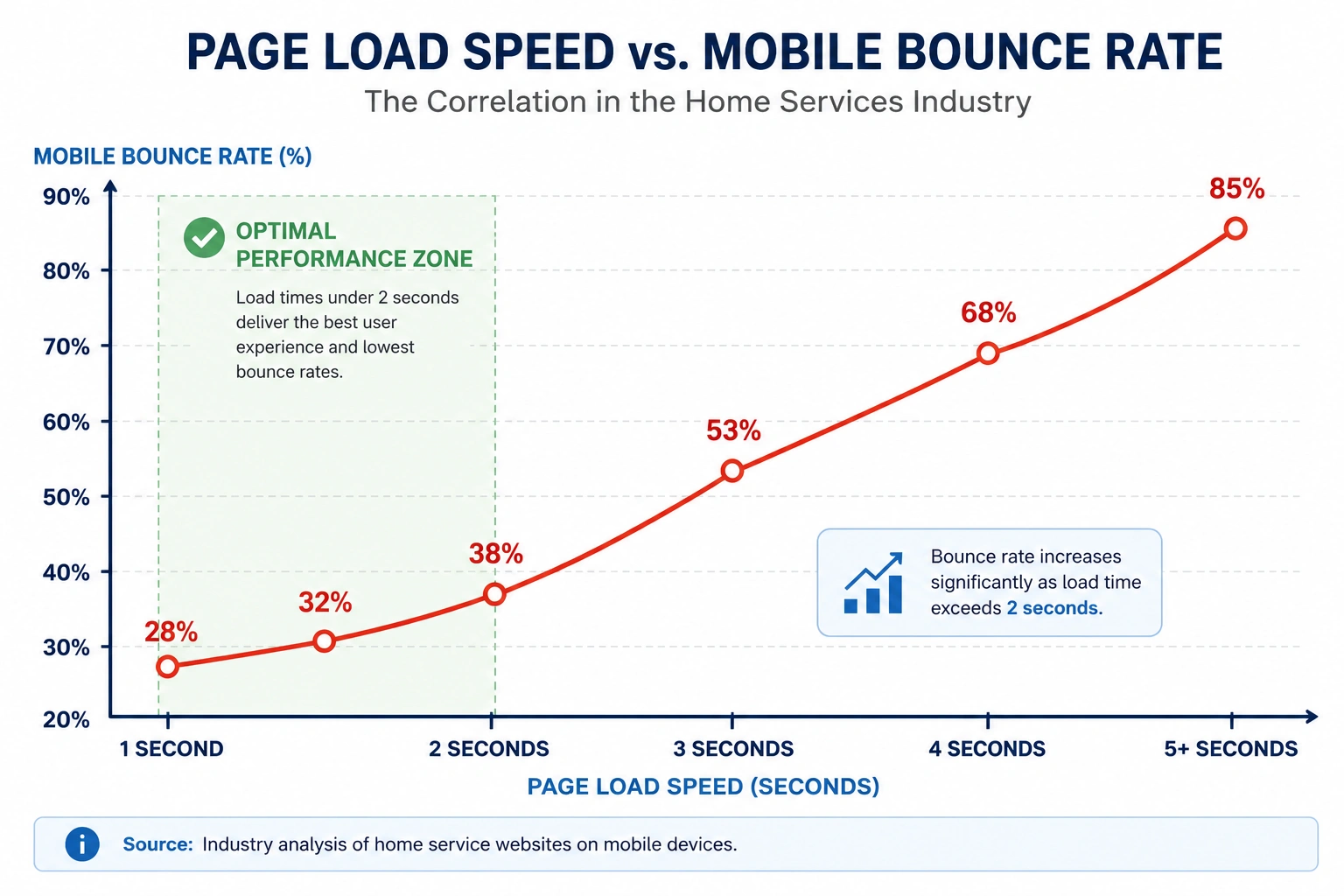
Data visualization illustrating how slower page load times correlate with higher mobile bounce rates in the home services industry.
HTTPS is non-negotiable. Beyond the ranking signal, an unsecured plumbing website with a “Not Secure” browser warning loses the trust of users who are about to hand over their phone number and home address. Mobile responsiveness follows the same logic: not just because of the mobile-first indexing reality, but because a homeowner searching from their phone at 7 AM with a burst pipe is not going to pinch-zoom their way through a desktop layout to find your phone number.
Ready to scale your local visibility? Explore our local SEO strategies to learn how we help local businesses dominate the map pack and organic search.
Local trust signals and schema markup integration
Schema markup is one of those areas where the gap between what most plumbing websites implement and what is technically possible is genuinely wide. Most sites have basic LocalBusiness schema, if that. They miss out. The ones pulling rich snippets, like star ratings, price ranges, and service details, in search results are running a more complete structured data stack.
- Local Business Schema: Implement structured data to help search engines parse your physical location, service areas, and operating hours accurately. Use the
Plumbersubtype underLocalBusinessfor maximum specificity: it exists for exactly this use case. - Service Schema: Add
Serviceschema markup to each individual service page to define the offering, its provider, and its area of availability. This is what enables rich snippet eligibility for star ratings and price range displays in SERPs, giving your listing a visual advantage over competitors running plain blue links. - Trust Badges: Display licensing credentials, insurance details, and industry association memberships prominently: above the fold where possible. A 2026 industry benchmark report noted that organic search conversion rates for highly optimized plumbing service pages can exceed 10%, compared to the 2% to 5% average for generic pages. A meaningful portion of that gap is attributable to visible trust signals that reduce the perceived risk of calling an unfamiliar contractor.
The FAQPage schema layer deserves separate attention. Every FAQ section on a service page should be marked up with FAQPage schema, which makes those Q&As eligible to appear as expandable results directly in the SERP. That kind of SERP real estate is disproportionately valuable for high-intent queries like “how much does sewer line repair cost”: the exact moment a homeowner is deciding whether to call you or a competitor.
Common structural mistakes that hurt plumbing rankings
Many plumbing websites fail to rank because of duplicate content and keyword stuffing: two problems that often appear together. The most common version of this: a website with 30 location pages where the only difference between “Plumber in Austin” and “Plumber in Round Rock” is the city name swapped into an otherwise identical template. Google’s quality systems are designed to detect exactly this pattern, and the result is either suppressed rankings or, in more aggressive cases, a manual penalty that requires significant remediation work to recover from.
Thin content is a related but distinct problem. A 300-word service page that lists your services, drops in a few keywords, and ends with a contact form is not competing with a 1,200-word page that walks through the diagnostic process, explains pricing factors, answers the five questions every homeowner asks before booking, and includes a video walkthrough of a recent job. The depth gap is too large. Organic search conversion rates for highly optimized plumbing service pages can exceed 10%, but that optimization requires substantive content, not keyword-dense filler.
Cannibalization is worth flagging too. If your site has both a “Water Heater Services” page and separate “Water Heater Repair” and “Water Heater Installation” pages, but the parent page is optimized for the same keywords as the children, those pages compete against each other in the index. The parent page should function as a hub: introducing the service category, linking to the child pages, and targeting broader navigational queries, while the child pages own the specific transactional keywords. Getting on-page SEO services right at the architectural level before publishing pages is considerably easier than untangling a cannibalization problem after the fact.
There is no clean, universal answer to how many service pages a plumbing website needs. A two-truck operation serving one city has different structural requirements than a regional plumbing company covering 15 service areas. What holds across both scenarios is the principle: one page, one primary intent, one keyword cluster. Build from that rule outward.
Frequently asked questions about plumbing SEO
Understanding the technical and structural details of local search can be challenging. We are here to help. The questions plumbing business owners ask most often about optimizing their service pages tend to cluster around the same core concerns: content length, page architecture, image optimization, and schema implementation.
Detailed answers on service page structure
How many words should a plumbing service page have?
High-ranking plumbing service pages typically require 800 to 1,500 words of original, localized content to establish topical authority and answer all user queries. That range is not arbitrary: it reflects the depth needed to cover symptoms, service methods, process steps, pricing context, trust signals, and FAQs without padding. Pages shorter than 800 words rarely have enough substance to outrank competitors in contested local markets. Pages pushing past 1,500 words without a clear structural reason tend to dilute topical focus and increase bounce rates among users who came for a quick answer.
Should I create separate pages for every service I offer?
Yes. Creating dedicated pages for individual services like drain cleaning, leak detection, and water heater repair allows you to target specific, high-intent keywords that a combined page cannot rank for simultaneously. A single “Plumbing Services” page attempting to rank for drain cleaning, sewer repair, water heater installation, and gas line work is asking Google to assign it four different primary topics, which it will not do. Each service page should also link back to a central services hub, reinforcing the topical cluster structure that distributes authority efficiently across the site.
What is the difference between a service page and a city page?
A service page explains a specific service you offer: the methods, the process, the pricing factors, the trust signals. A city page targets a specific geographic location you serve, and its differentiating content should include local reviews, neighborhood-specific project examples, and references to local landmarks or service area boundaries. The two page types serve different ranking purposes and should not be confused. A “Drain Cleaning in Dallas” page is a hybrid: it is a service page with geographic targeting baked into the H1 and title tag, not a city page in the traditional sense. True city pages are more appropriate for multi-location businesses that need to establish presence in markets where they have a physical address or significant service history.
How do I optimize images on my plumbing service pages?
Compress all images before upload: tools like Squoosh or ShortPixel can reduce file sizes by 60% to 80% without visible quality loss. Use modern formats like WebP where browser support allows. Write descriptive alt text that includes the service and location (e.g., “hydro jetting service in Phoenix AZ”) for every image on the page. File names matter too: “drain-cleaning-chicago.webp” signals relevance to crawlers in a way that “IMG_4872.jpg” does not. For plumbing service pages specifically, real job photos outperform stock imagery on both trust signals and engagement metrics. Users recognize stock photos immediately, and the implicit message is that you do not have actual work to show.
Do I need schema markup on my plumbing website?
Yes. Implementing LocalBusiness (specifically the Plumber subtype) and Service schema markup helps search engines understand your business details and can surface rich snippets in search results. Add FAQPage schema to every FAQ section on your service pages: this is one of the more accessible ways to earn expanded SERP real estate without building new backlinks. Review schema on pages that display customer testimonials can also contribute to star rating displays. The implementation is not technically complex, but it does require accurate, consistent data across all schema instances. Mismatched NAP (name, address, phone) data between your schema markup and your Google Business Profile is a common error that undermines the local relevance signals you are trying to build.
Optimizing your plumbing service pages is a continuous process of refining content, improving page speed, and building local authority, not a one-time project. The sites that keep top rankings are the ones that treat their service pages as living assets: updated when services change, expanded when new questions emerge in customer conversations, and audited regularly against competitors who are doing the same work.
By implementing this structured blueprint: dedicated pages per service, siloed hub-and-spoke architecture, contextual internal linking, schema markup, and above-the-fold conversion elements, you build a website that earns rankings through genuine relevance rather than gaming signals that erode with every algorithm update. The digital marketing for plumbers landscape rewards specificity, depth, and technical precision. Those are things you can build deliberately. If you are ready to see how your current site measures up, starting with a review of your page speeds and heading structures is the best next step.
Ready to dominate your local market?
Partner with a dedicated plumber seo agency to build a high-performing website that drives real business growth.