Local SEO ranking factors are well-documented in 2026, and the data tells a precise story: Google Business Profile signals control 32% of local pack ranking weight, review signals control 16%, and citation consistency controls 7%. Yet only 35% of SMBs have a Google Business Profile, 56% haven’t fully optimized the one they have, and 64% have NAP inconsistencies in at least one major directory. The local SEO opportunity gap is not a secret — it is a measurable competitive advantage for any business willing to close it.
- GBP signals account for 32% of local pack ranking weight — the single largest factor category (Whitespark/BrightLocal Local Search Ranking Factors 2025).
- Only 35% of SMBs have a Google Business Profile — leaving the majority of the local market undercompeting in the most important local ranking channel (SMB Marketing Report 2025).
- GBP actions increased 41% year-over-year — calls, direction requests, and website visits from GBP are growing rapidly (Google 2026).
- Local SEO delivers $13 per $1 invested — among the highest ROI of any marketing channel for local businesses (industry research 2025).
- GBPs with 50+ reviews win 4.4x more clicks than those with under 5 reviews; GBPs crossing 100 reviews saw 31% YoY lead volume growth (Visionary Marketing GBP Crawl 2026, n=180,000).
- NAP inconsistencies across 3+ citation sources exclude businesses from Google AI Mode local answers 74% of the time (Semrush 2026).
- 94% of high-performing brands have a dedicated local marketing strategy vs. 60% of average performers — strategy gap directly correlates with performance gap (BrightLocal Brand Beacon Report).
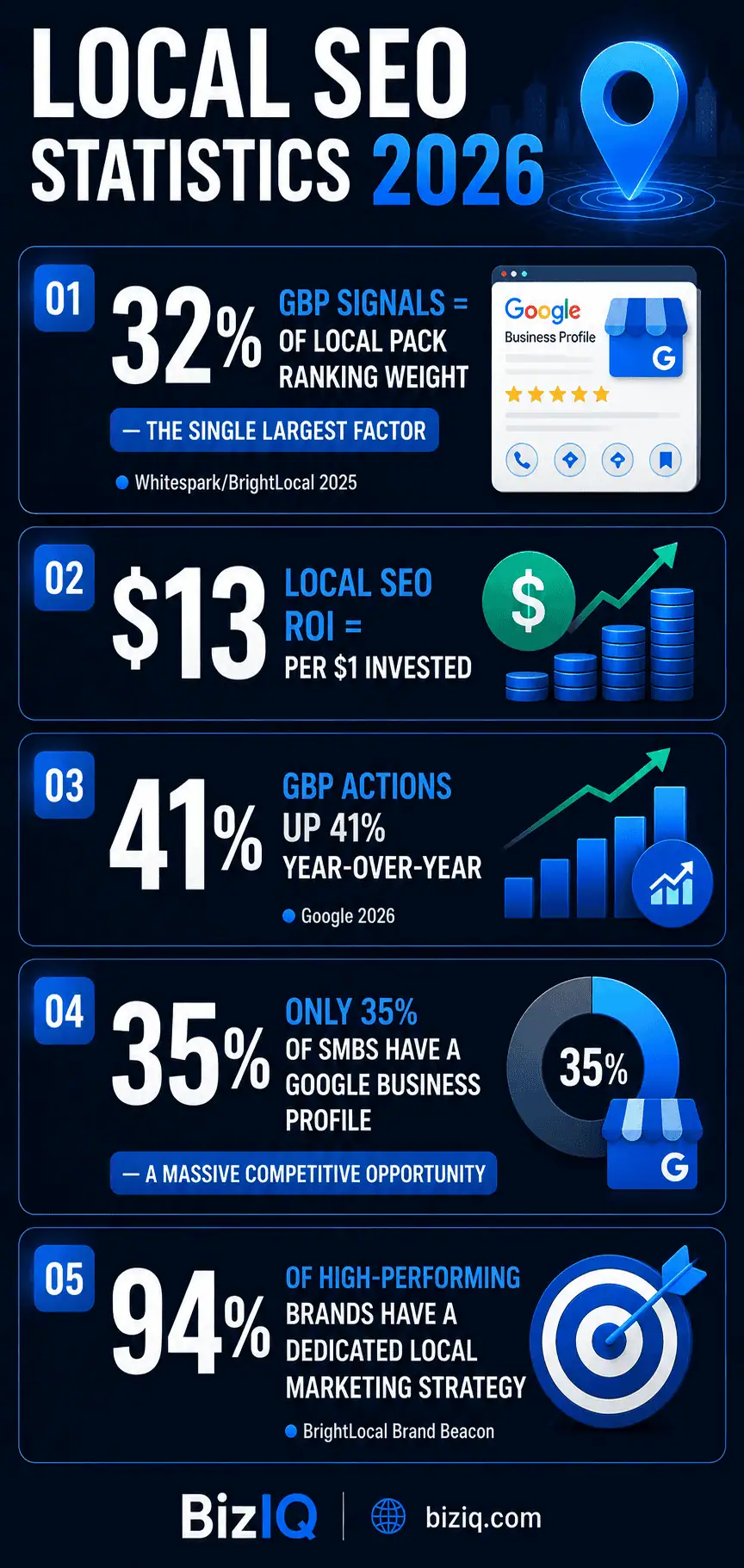
Key local SEO statistics for 2026 — ranking factor weights, GBP performance benchmarks, and competitive landscape data.
Local SEO Market Overview
Local SEO has become the primary marketing battleground for businesses serving a geographic area. The combination of near-universal consumer local search behavior, high purchase intent signals, and a competitive landscape where the majority of businesses remain under-optimized makes local SEO the most accessible high-ROI marketing investment available to local businesses in 2026.
The 34-percentage-point gap between high-performing and average-performing brands in local strategy adoption is perhaps the most operationally important finding in local SEO research. High performance in local search does not emerge from superior technology access, larger budgets, or industry advantages. It emerges from strategic intentionality: having a defined, documented local marketing strategy and executing it consistently across every location. For businesses without a formal local strategy, this is the single most impactful correction available.
Source: BrightLocal — Local SEO Statistics 2026 / Brand Beacon Report | Digital Applied — Local SEO Statistics 2026
Build a Local SEO Strategy That Drives Real Results — Call (888) 416-9800
Local Pack Ranking Factors (2026)
The Google Local Pack ranking algorithm weights specific signals in documented proportions. Understanding these weights is the foundation of effective local SEO investment — every dollar spent should be allocated in proportion to the ranking impact it produces.
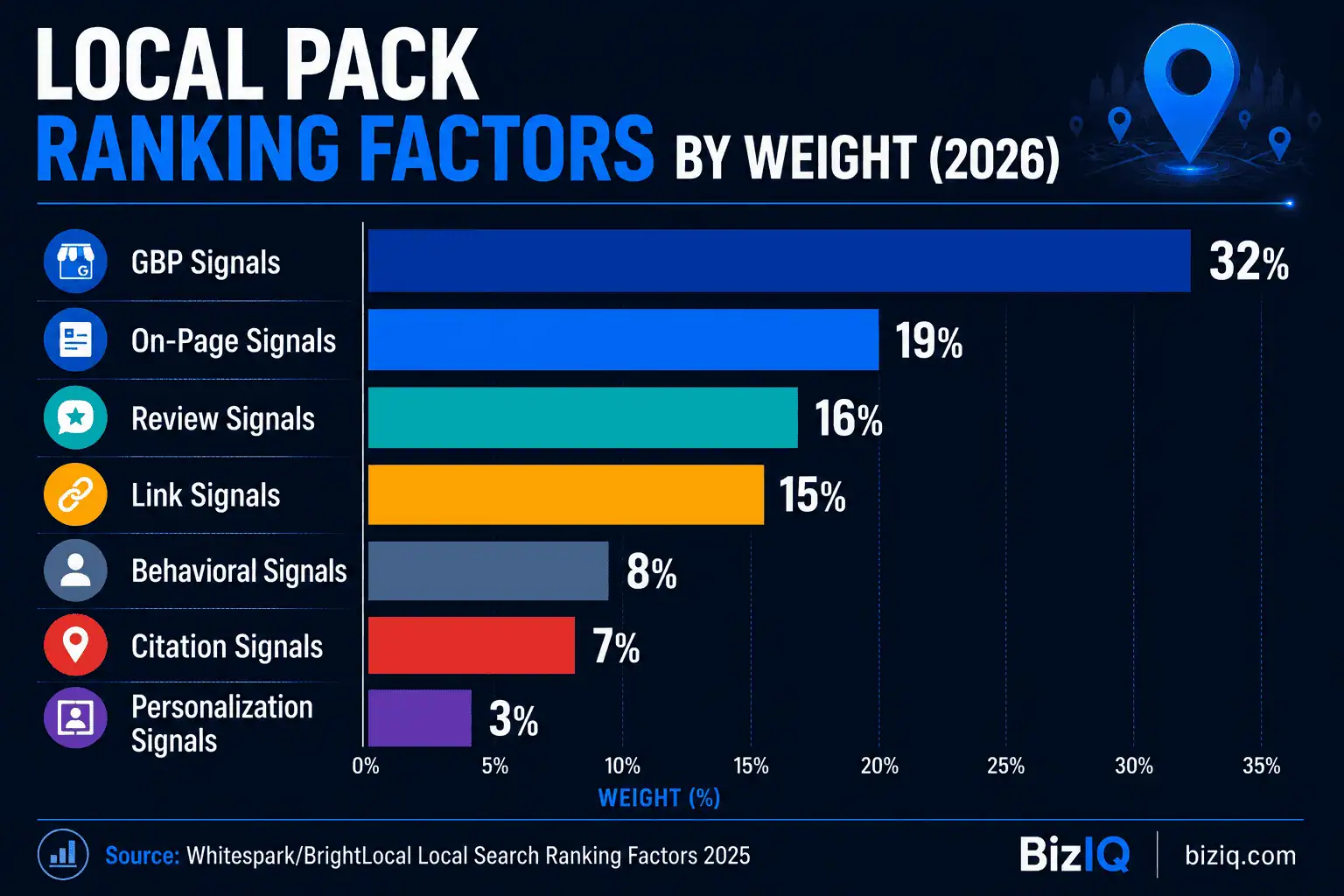
Local pack ranking factor weights in 2026 — GBP signals are the single largest factor at 32% (Whitespark/BrightLocal).
Top Individual Factors Within Each Category
Within the GBP signals category (32%), the three highest-weighted individual factors are: (1) primary GBP category selection, (2) proximity of the listed address to the searcher, and (3) keywords in the GBP business title. Within on-page signals (19%), the top factors are: (1) dedicated service pages for each service, (2) geographic keyword relevance of content, and (3) LocalBusiness schema markup. Within review signals (16%), the algorithm evaluates quantity, velocity (how often new reviews arrive), recency, diversity, and sentiment — not just the star rating average.
The ranking factors above govern the Google Local Pack (the map results). Local organic results — the standard blue links below the map — are governed by different signals. Local organic rankings weight on-page factors most heavily: dedicated service pages, geographic keyword content, and link authority. A business can rank in the local pack without ranking organically, and vice versa. An effective local SEO strategy optimizes for both — they share some signals (like NAP consistency and website quality) but require different primary optimization approaches.
Source: BrightLocal — Local Search Ranking Factors 2025 | ClickRank — Local SEO Ranking Factors 2026
Google Business Profile Performance Benchmarks
GBP is the highest-leverage single tool in local SEO. The performance data for well-optimized profiles — drawn from large-scale GBP crawl studies — shows dramatic differences between complete and incomplete profiles, and between profiles with active management vs. those left static after initial setup.
What Drives GBP Engagement Above Benchmark
The GBP crawl data from Visionary Marketing (180,000 profiles analyzed in March 2026) identifies consistent characteristics of high-engagement profiles: weekly GBP Posts covering service updates and promotions, minimum 10 photos with monthly additions of geo-tagged job site or location images, complete service listings with keyword-relevant descriptions, Q&A section populated with common customer questions and answers, and Google Posts that include a call to action. A tracked HVAC company that moved from position 6 to position 3 in 60 days did so by posting twice weekly and adding four new job-site photos per month — no other changes were made. GBP activity signals alone were the differentiating factor.
If a complete GBP produces 7x more clicks than an incomplete one, and the average optimized GBP receives 1,500 monthly views at a 4.2% action rate (63 actions/month), then an incomplete profile at the same view volume would produce approximately 9 actions per month. The difference: 54 additional customer interactions monthly — at zero additional advertising cost. For a service business converting 20% of GBP inquiries into customers at $250 average transaction value, that gap represents approximately $2,700 in monthly revenue opportunity — from profile completion alone. Calculation original to BizIQ.
Source: BrightLocal — Local SEO Statistics 2026 | Visionary Marketing — Local SEO Statistics 2026 (GBP Crawl, n=180,000)
Get Your GBP Fully Optimized by BizIQ — Call (888) 416-9800
Review Statistics for Local SEO
Reviews affect local SEO rankings through the review signals category (16% of local pack weight) and directly affect consumer conversion through trust and star rating thresholds. The review data in 2026 provides some of the most actionable local SEO benchmarks available — specific thresholds tied to measurable ranking and click outcomes.
Review Thresholds by Competitive Level
The review benchmark varies significantly by industry and market competitiveness. For most industries, 15–20 reviews is the minimum threshold to be considered credible in local pack results. For top-3 competitive pack placement, 50+ reviews with a 4.3+ average is the typical benchmark. In major metro areas or high-competition categories (legal, medical, restaurant), 100+ reviews is often required to hold a top-3 position. The AI recommendation threshold sits even higher: below 150 reviews, AI tools rarely name a specific business in local recommendations.
A competitor gaining 10 fresh reviews monthly will outrank a business sitting at 200 stale reviews from three years ago — if all other signals are equal. Google’s local algorithm weights review velocity (rate of new reviews arriving) alongside total count. A business with 60 reviews where the most recent arrived this week sends stronger freshness signals than one with 200 reviews where the last new review was 18 months ago. This means review generation is not a one-time campaign — it is an ongoing operational process.
Source: Visionary Marketing — Local SEO Statistics 2026 | ClickRank — Local SEO Ranking Factors 2026
Build Your Review Strategy with BizIQ’s Reputation Management
Citation Statistics for Local SEO
Citations — consistent NAP (Name, Address, Phone) references across directories — are the data infrastructure of local SEO. They confirm to Google that a business exists where it claims to exist, and that its contact information is reliable. Citation inconsistency is a silent ranking suppressor that affects more local businesses than any other technical issue.
How Data Aggregators Multiply Citation Errors
The most damaging citation inconsistencies are not manually created — they spread automatically through data aggregators. Foursquare, Data Axle, and Neustar Localeze feed NAP data to Google, Apple Maps, Yelp, and dozens of secondary directories simultaneously. A business that moved locations, changed its phone number, or underwent a rebrand without updating aggregator records continues pushing stale, incorrect data to new platforms months or years later. Correcting the source aggregator record is the most efficient fix — corrections flow downstream to directory listings automatically, rather than requiring manual updates at every individual platform.
Source: Visionary Marketing — Local SEO Statistics 2026 | ClickRank — Local SEO Ranking Factors 2026
Fix Your Citations with BizIQ’s Local Citation Management — Call (888) 416-9800
AI and Local SEO in 2026
AI search has introduced new local visibility requirements that operate alongside — and partially independently from — traditional Google local pack rankings. Businesses optimized for traditional local search are not automatically visible in AI local recommendations, and the data in 2026 shows the gap is significant.
What Drives AI Local Recommendation Visibility
The BrightLocal Local Search Ranking Factors 2025 identifies three primary factors for AI local visibility: (1) presence on expert-curated “Best Of” lists on authoritative domains, (2) dedicated pages for each individual service, and (3) prominence on key industry-relevant platforms. These factors diverge from traditional local pack optimization — a business can have a perfect GBP and still be invisible in AI recommendations if its website lacks dedicated service pages and its brand has no presence in industry authority publications.
ClickRank’s 2026 analysis identifies 150 reviews per location as the approximate threshold at which AI tools (ChatGPT, Perplexity, Gemini) begin consistently naming specific businesses in local recommendations. Below that threshold, AI systems tend to describe services generically without naming specific providers. For businesses with fewer than 150 reviews, the AI visibility gap is not just a missed opportunity — it means being invisible to 45% of local searchers using AI tools for discovery.
Source: BrightLocal — Local Consumer Review Survey 2026 / Local Search Ranking Factors 2025 | SOCi Local Visibility Index 2026
Local SEO Adoption and Competitive Benchmarks
Understanding where most local businesses actually stand in their local SEO investment helps identify both the competitive opportunity for well-optimized businesses and the improvement priorities for those starting from a weak position.
The local SEO adoption data consistently reinforces one conclusion: for any business willing to invest in local SEO systematically, the competitive landscape is favorable. The majority of local competitors have incomplete GBP profiles, inconsistent citations, thin review velocity, and no formal local strategy. Businesses that close these gaps — profile completion, citation consistency, review velocity, and regular GBP posting — gain competitive separation from the majority of the local market without competing on advertising budget.
Source: BrightLocal — Local Marketing Industry Survey 2024 | SMB Marketing Report 2025
Get Noticed in Local Search with BizIQ — Call (888) 416-9800
Local SEO Statistics Summary Table
| Statistic | Figure | Source | Year |
|---|---|---|---|
| Google searches with local intent | 46–51% | Google / Visionary Marketing | 2026 |
| Marketers saying local SEO is growing in importance | 82% | Aggregated survey data | 2026 |
| Local SEO ROI per $1 invested | $13 | Vice Arc Creative / industry research | 2025 |
| High-performing brands with dedicated local strategy | 94% | BrightLocal Brand Beacon Report | 2024 |
| Average-performing brands with local strategy | 60% | BrightLocal Brand Beacon Report | 2024 |
| GBP signals weight in local pack rankings | 32% | Whitespark/BrightLocal | 2025 |
| On-page signals weight | 19% | Whitespark/BrightLocal | 2025 |
| Review signals weight | 16% | Whitespark/BrightLocal | 2025 |
| Link signals weight | 15% | Whitespark/BrightLocal | 2025 |
| Behavioral signals weight | 8% | Whitespark/BrightLocal | 2025 |
| Citation signals weight | 7% | Whitespark/BrightLocal | 2025 |
| GBP actions YoY increase | 41% | 2025–2026 | |
| Click lift — complete vs. incomplete GBP profiles | 7x more clicks | Google Business Profile Insights | 2025 |
| Average GBP engagement rate | 4.2% | BrightLocal | 2026 |
| Top-performing GBP engagement rate | 6.5%+ | BrightLocal | 2026 |
| Monthly GBP views — active optimized profile | 1,000–2,500 | OwlClaw Benchmarks | 2026 |
| Schema lift — LocalBusiness schema on website | +14% GBP CTR | Visionary Marketing | 2026 |
| Click lift — 50+ reviews vs. under 5 reviews | 4.4x more clicks | Visionary Marketing (n=5,000) | 2026 |
| Lead volume growth — GBPs crossing 100 reviews | 31% YoY | Visionary Marketing GBP Crawl | 2026 |
| AI recommendation threshold — review count | 150+ reviews | ClickRank | 2026 |
| Minimum star rating for AI recommendation | 4.3 avg (ChatGPT), 4.1 (Perplexity) | SOCi Local Visibility Index | 2026 |
| Ranking advantage — consistent NAP across 50 directories | +2.4 positions | Visionary Marketing | 2026 |
| SMBs with NAP inconsistencies in at least one directory | 64% | Visionary Marketing | 2026 |
| AI Mode exclusion rate — 3+ NAP inconsistencies | 74% excluded | Semrush | 2026 |
| Consumers using AI for local business recommendations | 45% | BrightLocal Local Consumer Review Survey | 2026 |
| AI local visibility vs. traditional local search difficulty | 30x harder | SOCi Local Visibility Index | 2026 |
| SMBs with a Google Business Profile | Only 35% | SMB Marketing Report | 2025 |
| Local businesses without fully optimized GBP | 56% | Local marketing research | 2026 |
| Marketers rating GBP management as #1 local SEO service | 76% | Local Marketing Industry Survey | 2024 |
| Review velocity advantage — 1+ reviews/week vs. slower | +1.7 ranking positions | Visionary Marketing | 2026 |
Frequently Asked Questions: Local SEO Statistics 2026
Methodology & Sources
This article was researched and written by David McGinnis, SEO Strategist at BizIQ. All statistics are sourced from Tier 1 primary sources. Sources include:
- BrightLocal — Local SEO Statistics 2026 / Brand Beacon Report 2024 / Local Marketing Industry Survey 2024 / Local Consumer Review Survey 2026: Annual primary research across local marketing professionals and consumers.
- Whitespark — Local Search Ranking Factors 2025: Annual expert survey identifying weighted ranking factors for Google Local Pack and local organic results.
- Google / Google Business Profile Insights 2025: Primary performance data on GBP actions, complete profile impact, and consumer behavior.
- SOCi — Local Visibility Index 2026: Primary research on AI local search performance, GBP data accuracy in AI tools, and multi-location benchmarks.
- Visionary Marketing — GBP Crawl 2026 (n=180,000) / Consumer Panel 2026 (n=5,000): First-party GBP performance analysis and consumer panel research on local SEO benchmarks.
- Semrush 2026: Data on AI Mode local search inclusion requirements and NAP consistency impact.
- ClickRank — Local SEO Ranking Factors 2026: Analysis of local ranking signals, AI citation thresholds, and review velocity benchmarks.
- SMB Marketing Report 2025: GBP adoption rates among small businesses.
BizIQ Analysis calculations are original to BizIQ and clearly labeled as such.
Get a Free Local SEO Strategy Session — Call (888) 416-9800