Local SEO and PPC are the two most common digital marketing investments small businesses face — and the choice between them is one of the most consequential budget decisions a small business owner makes. This comparison covers every dimension that matters: cost, speed, long-term ROI, sustainability, and the specific scenarios where each channel is the right answer. No vague “it depends” — specific data, specific thresholds, specific recommendations.
| Factor | Local SEO | PPC (Google Ads) |
|---|---|---|
| Average cost-per-lead | $20–$40 | $55–$110 |
| Time to first lead | 3–6 months | 1–7 days |
| Long-term ROI trajectory | Compounds (improves over time) | Flat or increasing cost |
| What happens when you pause | Rankings maintained short-term | Traffic stops immediately |
| Consumer preference | 14x more likely to click organic vs. paid | Appears at top above organic |
| Targeting precision | Geographic and categorical | Keyword, demographic, behavioral |
| Best for | Long-term lead generation, lower CPL | Immediate results, new campaigns, gaps |
- Local SEO delivers leads at $20–$40 each — less than half the $55–$110 average cost-per-lead from local PPC.
- PPC generates leads within days — local SEO requires a 3–6 month ramp-up period before measurable results appear.
- Local SEO returns compound over time as rankings, reviews, and citations accumulate — PPC cost-per-lead stays flat or increases as competition rises.
- 14x more consumers click organic and Local Pack results than paid ads for local searches — consumer preference strongly favors non-paid results.
- When PPC stops, traffic stops immediately — local SEO rankings persist for months after investment pauses.
- The optimal strategy for most small businesses: local SEO as the primary long-term channel, PPC used selectively for immediate needs and competitive gaps.
Local SEO vs. PPC — a full comparison of cost-per-lead, time to results, and long-term ROI for small businesses in 2026.
Understanding Local SEO
Local SEO is the practice of optimizing your business’s online presence to appear in Google’s Local Pack — the map and three business listings that appear at the top of local intent search results. It is driven primarily by your Google Business Profile, customer reviews, citation consistency, and on-page website signals. Local SEO generates organic traffic — clicks that carry no per-click cost once rankings are achieved.
How it works: Google evaluates your GBP completeness, review signals, citation authority, and website local signals to determine which businesses appear in the Local 3-Pack for any given search. Building these signals takes time — 3–6 months for measurable improvements — but the resulting traffic has no incremental cost per click.
The compounding dynamic: Unlike PPC, local SEO investment accumulates. Reviews you acquired in month 3 are still working in month 18. Rankings earned in month 6 continue generating traffic without additional spend. Citation authority built in the first year compounds into stronger domain trust in year two. The cost-per-lead from local SEO actively decreases over time as these assets mature.
Understanding PPC (Pay-Per-Click Advertising)
PPC — most commonly Google Ads for small businesses — places your business at the top of search results for chosen keywords in exchange for a fee paid every time someone clicks your ad. The primary advantages are speed and control: ads can be live within hours, and budgets can be adjusted in real time based on performance.
How it works: You bid on keywords relevant to your business. When someone searches that keyword in your target location, your ad may appear above the organic results and Local Pack. You pay the bid amount each time someone clicks. Your total cost is clicks × cost-per-click. Your lead cost is total spend ÷ conversions.
The ceiling dynamic: Unlike local SEO, PPC does not compound. Your cost-per-click generally stays flat or increases as competitors also bid on the same keywords. Your volume is directly proportional to your budget — double the budget, roughly double the traffic. Stop paying, and all traffic stops immediately.
Head-to-Head: Local SEO vs. PPC on Every Dimension That Matters
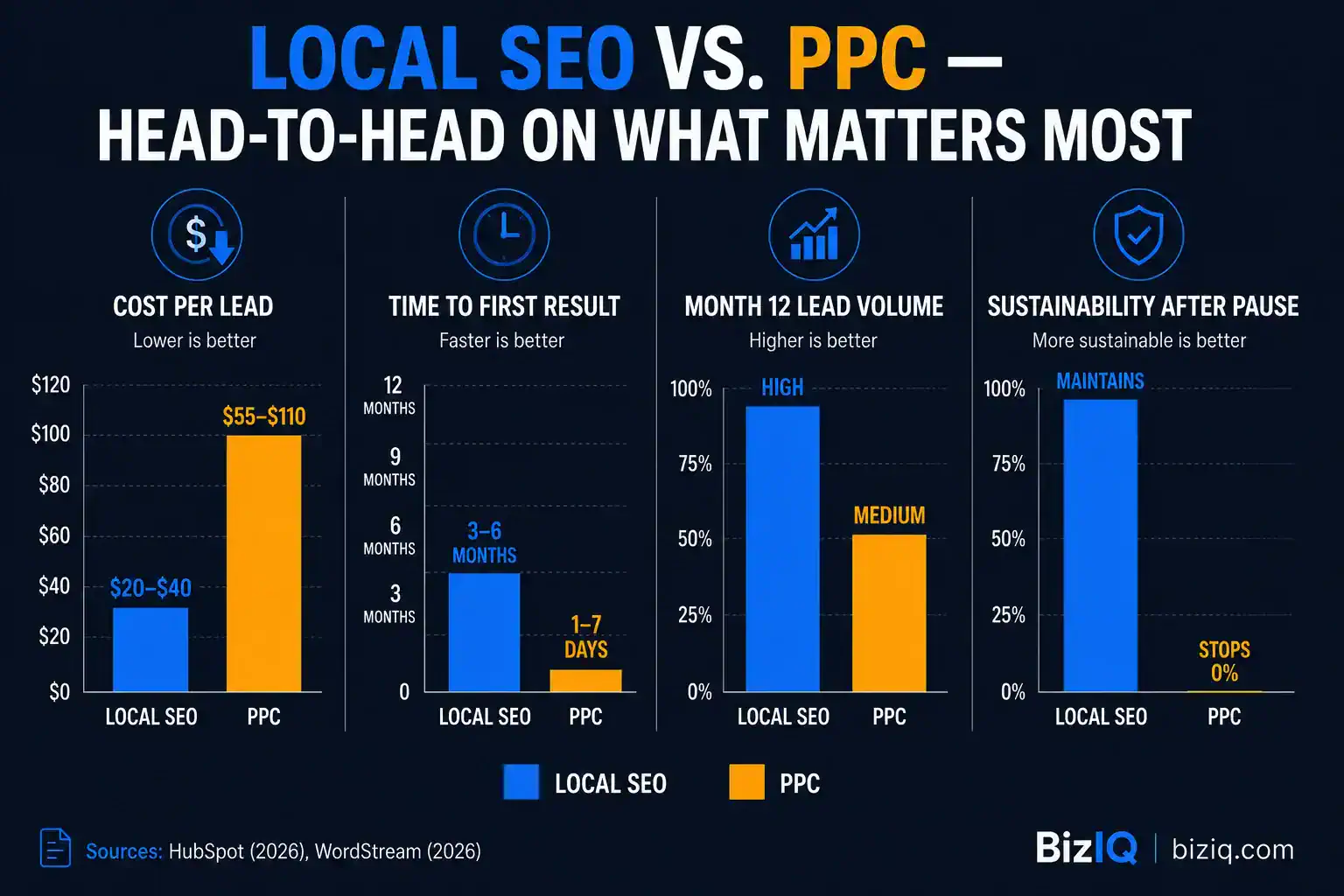
Local SEO wins on cost-per-lead and long-term sustainability. PPC wins on speed to first result. The data for small businesses in 2026.
Cost Per Lead
Winner: Local SEO. At roughly half the cost-per-lead of PPC, local SEO generates more leads per marketing dollar at campaign maturity. The gap widens over time as local SEO returns compound and PPC costs remain flat or rise.
Speed to First Lead
PPC generates leads within 1–7 days of campaign launch. Local SEO requires 3–6 months for measurable ranking improvements in most markets. This is the most significant practical advantage PPC holds over local SEO — for a business that needs leads immediately (new launch, slow season, sudden growth goal), PPC is the only digital channel that delivers at that speed.
Winner: PPC. Speed is PPC’s clearest structural advantage over local SEO. There is no way to accelerate local SEO to match PPC’s time-to-first-lead — the ranking signals take time to accumulate regardless of investment level.
Consumer Preference
Winner: Local SEO. The majority of local search clicks go to organic and Local Pack results — not to paid ads. This is not hypothetical; it is documented behavior. A business that ranks in the Local Pack captures more clicks than a competitor who appears only in paid results for the same query, even though the paid result appears above the Pack.
Long-Term ROI Trajectory
At month 6, local SEO and PPC may produce similar lead volumes for equivalent investment. By month 18, local SEO has compounded — more reviews, stronger citation authority, higher rankings, lower cost-per-lead. PPC at month 18 delivers the same CPL as month 1 — or higher if competitor bidding has increased. The long-term ROI trajectory favors local SEO for every business with a long-enough planning horizon.
Winner: Local SEO. The compounding return model makes local SEO the superior long-term investment for any business planning more than 12 months ahead.
Sustainability After Pausing Investment
Local SEO rankings persist for months after investment pauses — the authority and review signals accumulated over time don’t evaporate immediately. PPC traffic stops the moment ads are paused — not gradually, but completely and immediately.
Winner: Local SEO. The residual value of accumulated local SEO authority means a temporary budget pause does not eliminate all lead flow. For small businesses facing cash flow variability, this resilience is a meaningful practical advantage.
Control and Flexibility
PPC allows precise control: specific keywords, specific locations, specific hours, specific budgets. You can turn campaigns on and off, test messages in real time, and allocate spending by day of week, device type, and audience segment. Local SEO offers less granular control — you optimize toward rankings and let Google determine when and for whom your profile appears.
Winner: PPC. For businesses with specific targeting needs, time-sensitive promotions, or capacity-based lead volume requirements, PPC’s control capabilities are genuinely superior.
When Local SEO Is the Right Primary Investment
Local SEO is the right primary investment when: your planning horizon is 12+ months, your customer lifetime value is high enough to justify a 3–6 month ramp-up period, you serve a geographically defined local market, and you are competing against other local businesses rather than national chains with massive paid ad budgets.
This describes the majority of small businesses: plumbers, dentists, accountants, lawyers, restaurants, landscapers, HVAC companies, cleaning services, and hundreds of other local service categories.
When PPC Is the Right Primary Investment
PPC is the right primary investment when: you need leads immediately (new business launch, sudden revenue gap, time-sensitive seasonal opportunity), you are testing a new service or market before committing to long-term SEO, or you are in a market where the Local Pack is dominated by extremely well-established competitors and you need a bridge while building SEO authority.
The Optimal Strategy: Sequential Investment
Months 1–6: Invest in both. Use PPC to generate leads immediately while local SEO builds. Allocate 60% to PPC, 40% to local SEO during ramp-up.
Months 7–12: Shift allocation as local SEO rankings produce organic leads. 40% PPC, 60% local SEO. Begin reducing PPC on keywords where Local Pack position is achieved.
Month 13+: Local SEO as primary channel. PPC retained only for high-value keywords where paid placement supplements organic coverage or for seasonal campaigns. Budget shift: 20–30% PPC, 70–80% local SEO.
Result: immediate lead flow from PPC during ramp-up, compounding returns from local SEO at maturity, and a declining effective cost-per-lead over 12–24 months.
Strategy and interpretation original to BizIQ.
Who Should Choose Local SEO Only
Businesses with longer sales cycles where immediate lead volume is less critical. Businesses with tight budgets where concentrating investment in the higher-ROI channel at maturity makes more sense than splitting it. Businesses in lower-competition markets where Local Pack positions are achievable within 3–4 months rather than 6–12. Businesses with strong existing referral networks who need online presence to convert those referrals rather than generate new top-of-funnel traffic.
Who Should Choose PPC Only (For Now)
Newly launched businesses with no existing GBP, no reviews, and no citation history — for whom the SEO ramp-up period would produce no leads for 3–6 months during a critical revenue-building phase. Businesses with a specific short-term campaign need — a product launch, seasonal promotion, or limited-time offer — where the fast response time of PPC is the primary value.
Start with BizIQ’s Local SEO — Free Analysis Included
Frequently Asked Questions
Sources
- HubSpot Marketing Statistics
- WordStream Google Ads Benchmarks
- BrightLocal Local Search Research 2025
- Sistrix Organic CTR Data
- Moz Local Search Ranking Factors 2025
Last updated: May 2026.