Written by a Senior Local SEO Strategist specializing in high-urgency service-based business growth.
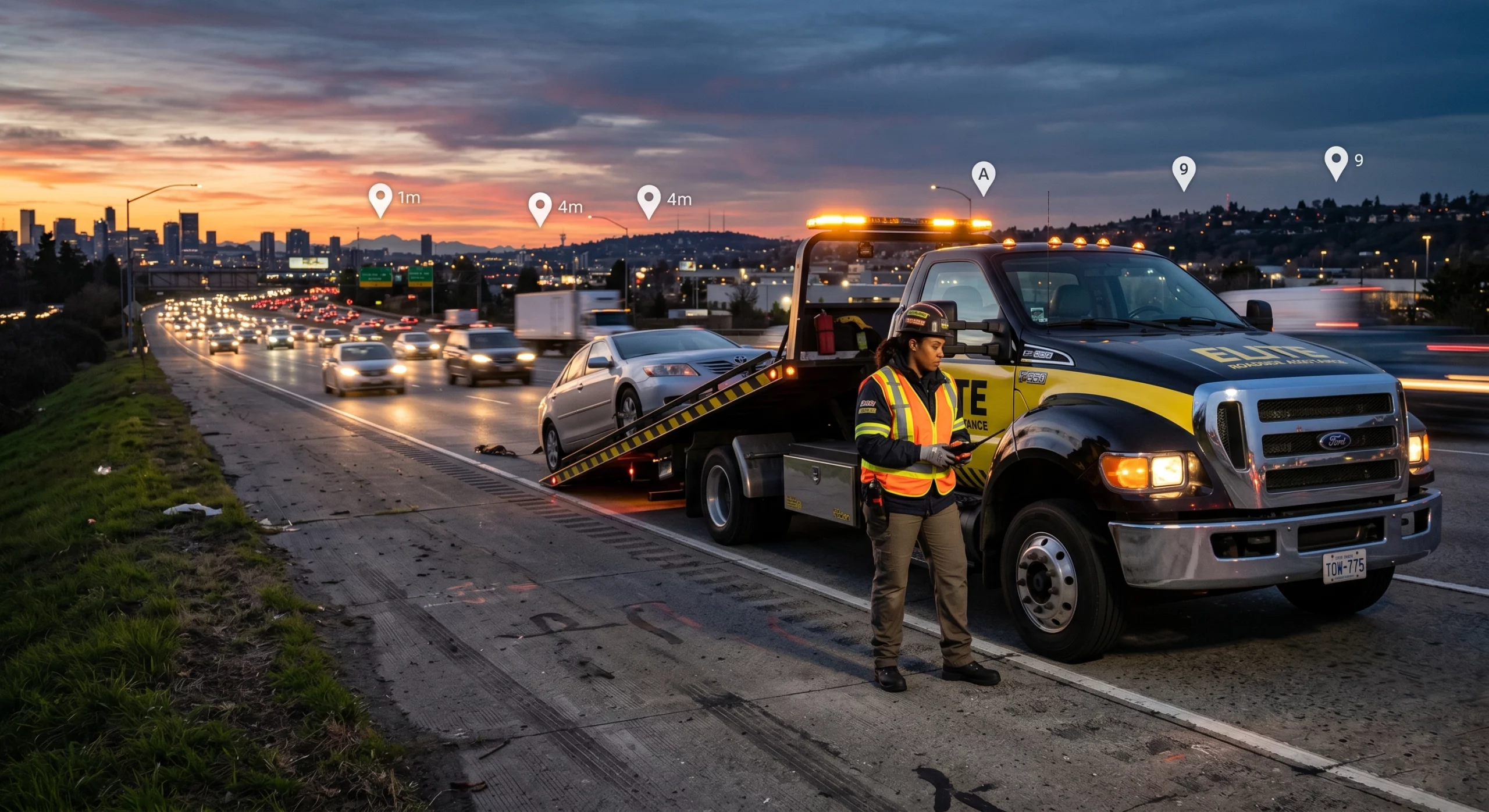
A professional roadside assistance operator manages a vehicle recovery on a busy highway shoulder during a colorful sunset.
- Google Business Profile Optimization: Capture your share of the 44% Map Pack click volume.
- High-Intent Keyword Targeting: Focus on emergency, location-based search terms.
- Mobile-First Technical SEO: Ensure your site loads in under 2 seconds for stranded drivers.
- AI Search Engine Optimization: Structure your content to rank in Google AI Overviews and ChatGPT.
How can Local Tow Operators Dominate Google Search and AI Overviews?
To rank your towing company high in Google and AI, you must claim your Google Business Profile (GBP), optimize for location-based keywords, build strong citation signals, dominate the Google Local 3-Pack, which captures 44% of all local clicks, and optimize your website’s semantic structure so AI search engines cite your business as the trusted local authority. An effective Local SEO blueprint also involves earning 5-Star reviews. Sophisticated marketing belongs to you too, and it starts with being visible where the decisions are made. Stranded drivers do not have the luxury of time; they click the first reputable option they see. Speed wins.
Towing is a unique, high-urgency industry where traditional long-funnel marketing does not apply. When a vehicle breaks down, the driver’s search intent is purely direct and immediate.
Why Local SEO Is the Lifeblood of Modern Towing Companies
The High-Urgency Nature of Towing Searches
No other service category shrinks the buyer journey quite like towing. A driver on the shoulder of I-95 with a blown tire is not comparing reviews across five providers: they are calling whoever appears first with a visible phone number and a credible rating. That reality shapes every SEO decision you make. Urgency dictates action.
According to industry data, 82% of “towing companies near me” searches on mobile devices display the Google Map Pack at the very top of the page, bypassing traditional organic listings entirely. That is not a trend worth monitoring; it is the terrain your business operates on. Data shows that organic local search leads have a 60% to 80% close rate with no marginal cost per call once you have earned those rankings.
Proximity matters, but it is not the whole story. Research shows that proximity accounts for 48% to 55% of local ranking variance, but review signals and keyword relevance dominate the top 10 positions. These are factors you can directly control and compound over time.
The Economic Landscape of Towing Marketing
The U.S. automobile towing market is valued at $11.8 billion in 2026, with 39,745 active businesses competing for dispatch volume. That density makes paid advertising an increasingly expensive endeavor, and it makes organic visibility an increasingly valuable one.
The debate between Google Local Services Ads (LSA) and organic SEO is worth addressing directly. LSA sits above the Map Pack and generates calls fast, typically at $20 to $50 per lead. That cost is manageable when trucks are idle. It becomes a structural problem when it compounds month over month with no equity to show for it. Organic SEO builds a durable asset; LSA rents attention.
We recommend starting with a hybrid model. LSA covers immediate cash flow while organic local SEO infrastructure builds out over a 3-to-6-month window. Neither strategy alone is sufficient at scale.
The competition for towing dispatches has never been more concentrated. Relying solely on pay-per-click or third-party motor club brokers compresses margins in ways that are difficult to recover from, particularly for owner-operators running two or three trucks.
Organic local search offers the highest return on investment available in this market. The top position in the Google Local Pack receives a 17.6% click-through rate, while the third position drops to 15.1%. That gap, between first and third, is the difference between a fleet running at capacity and trucks sitting in the yard.
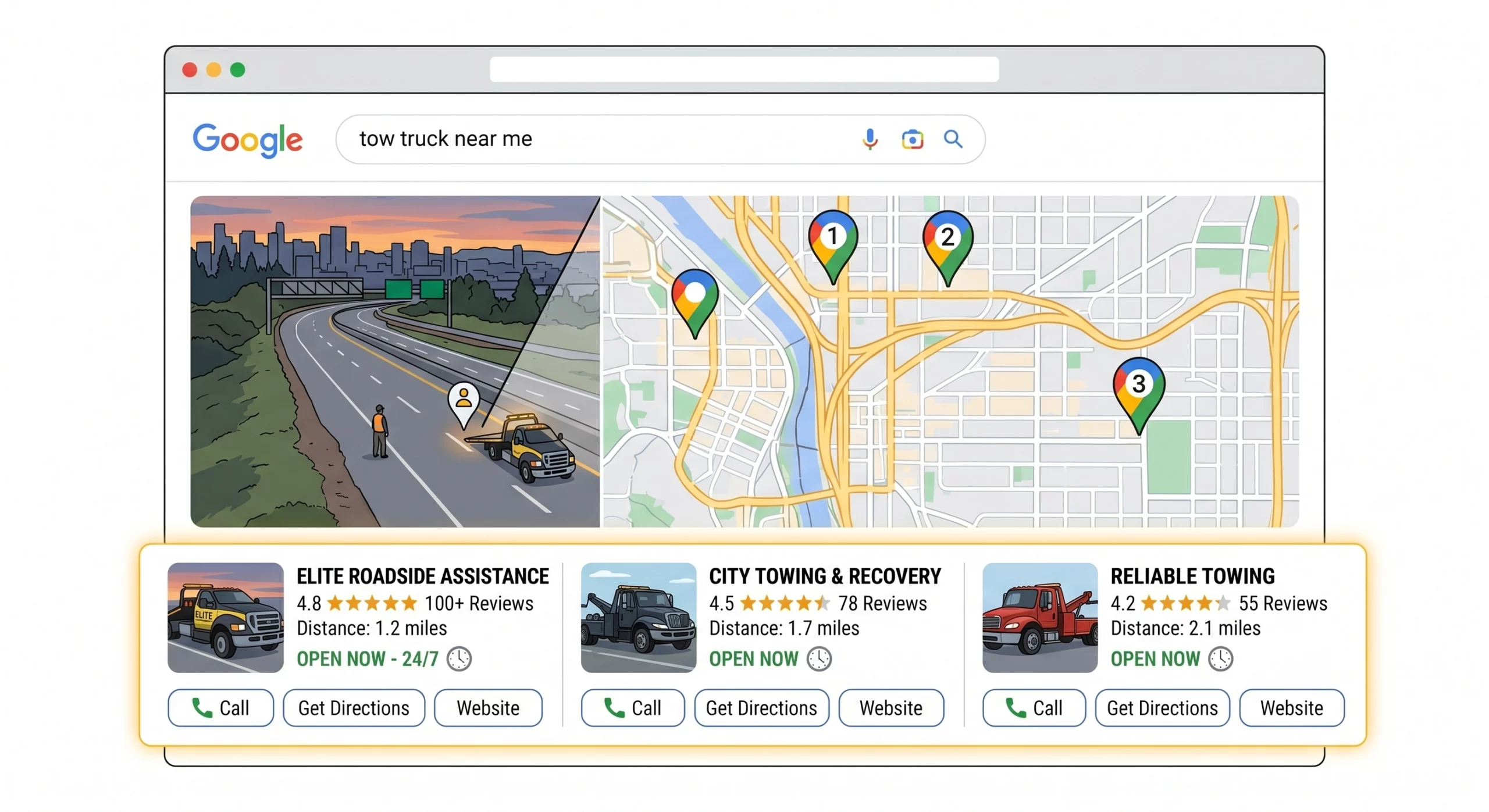
A web browser graphic showing a Google Maps local pack search result for local towing services, with Elite Roadside Assistance at the top.
Step 1: Claim and Optimize Your Google Business Profile (GBP)
Core Category and Service Selection
Your GBP primary category is not a formality. It dictates your reach. Set it to “Towing Service”, not “Roadside Assistance,” and not “Auto Repair Shop”, unless those services represent the majority of your revenue. Google uses the primary category to establish core relevance for high-volume queries like “tow truck near me,” and misalignment here costs you visibility before a single customer ever sees your profile.
Secondary categories extend your reach without weakening your core signal. Add “Roadside Assistance,” “Auto Wrecker,” and “Vehicle Recovery Service” to capture adjacent search intent. Within the GBP services dashboard, list every discrete offering: emergency towing, flatbed towing, heavy-duty towing, accident recovery, battery jump starts, and car lockout services. Each explicit service entry is a relevance signal that Google’s algorithm reads during query matching.
Profile Optimization and Review Velocity
NAP consistency (Name, Address, and Phone number) must be exact across every surface your business appears on. A single character difference between your GBP listing and your website footer creates a trust mismatch that suppresses rankings. Think of managing your directory citations like putting your shingle on every relevant street corner: if one sign has a typo, drivers get lost.
Review velocity is where most towing operators leave significant ranking potential untapped. Setting up an automated SMS review-generation system, like Podium or NiceJob, and texting a direct Google review link within one hour of completing a tow captures customers at their highest satisfaction point. A driver who just got rescued from a dark highway exit ramp is not going to remember to leave a review tomorrow. The request has to arrive while the relief is still fresh. Timing is everything.
Geotagged photos of your actual fleet, your yard, and your operators build trust with both Google and prospective customers in ways that stock imagery never will. Upload consistently, not in a single batch.
- Primary Category: Set your primary category to “Towing Service” to ensure Google associates your profile with high-intent emergency queries.
- NAP Consistency: Ensure your business Name, Address, and Phone number are identical across your website, GBP, and local directories.
- Geotagged Photos: Regularly upload high-resolution, real photos of your flatbeds, wreckers, and physical yard to build trust with both Google and customers.
- Review Acquisition: Actively request reviews from satisfied customers, as Google Business Profiles with high ratings and active responses dominate the Map Pack.
Step 2: Target High-Intent, Hyperlocal Keywords
Keyword Research and Intent Mapping
Emergency keywords carry the highest commercial intent in this vertical. “Tow truck near me,” “24-hour towing,” “emergency road service near me,” and “roadside assistance near me” are the terms that generate dispatch calls, not informational traffic. Your homepage and core service pages need to be built around these phrases, not around broad terms like “towing company.” Focus on intent.
Specialized service keywords open secondary revenue streams. Dedicated pages for “flatbed towing,” “motorcycle towing,” “heavy-duty recovery,” and “winch-out services” capture searches from drivers whose vehicle type or situation rules out a standard wheel-lift truck. These pages also build topical depth that strengthens your overall domain authority.
Geographic modifiers are where most towing sites underperform. Integrating specific neighborhood names, major highway intersections, and adjacent town names into your content signals geographic relevance to Google’s crawlers in ways that generic city-level targeting cannot replicate.
Building a Three-Tier Website Architecture
Google does not rank a single homepage across multiple cities. To capture search volume across your full service area, your site needs a structured hierarchy:
Tier 1 (Homepage): Primary city and core service: your foundational authority page. Tier 2 (Service Pages): Individual pages for /flatbed-towing, /roadside-assistance, /heavy-duty-towing: each targeting a distinct service and its associated keyword cluster. Tier 3 (Location Pages): Dedicated landing pages for adjacent cities (/locations/city-a, /locations/city-b) with unique, non-duplicated content that references local landmarks, specific highway corridors, and neighborhood names.
A location page for Scottsdale, Arizona that references Loop 101 and Old Town Scottsdale is categorically different from one that simply swaps a city name into a copied template. Google’s crawlers recognize the difference. So do the drivers reading it.
- Emergency Keywords: Optimize for terms like “tow truck near me,” “24-hour towing,” and “roadside assistance open now.”
- Specialized Service Keywords: Create dedicated pages for “flatbed towing,” “motorcycle towing,” “heavy-duty recovery,” and “winch-out services.”
- Geographic Modifiers: Integrate specific neighborhood names, major highway intersections, and adjacent town names into your content.
Is your towing website optimized for emergency calls?
As a small business ourselves, we know how critical every call is. Let’s make sure your site is built to convert.
Step 3: Optimize Your Website for Mobile-First and Speed
Mobile-First User Experience (UX)
The crisis-first UX model is not a design concept: it is an operational requirement. A driver on the shoulder of a busy highway, phone signal fluctuating, has one objective: reach a towing company in under three taps. Every design element that delays that action is a lost call. Friction kills conversions. Think of website optimization as turning more of the people who already find you on their phones into customers who directly call for a tow.
Deploy a non-scrolling, thumb-accessible “Call Now” button pinned to the footer regardless of content length. Cap all non-essential scripts. If your site takes longer than 1.5 seconds to load on a 3G throttle, you are losing conversions to competitors whose sites are leaner: not better-optimized in any sophisticated sense, just faster under low-signal conditions.
Core Web Vitals and Technical Health
Over 80% of emergency towing searches occur on mobile devices, often on the side of a busy highway. If your website takes longer than 3 seconds to load, a stalled driver will bounce back to the search results and call your competitor. That is not a hypothetical; it is a measurable conversion event. Seconds cost money.
Google uses mobile-first indexing, meaning it ranks your site based entirely on its mobile performance. Your mobile layout must feature a prominent, sticky “Call Now” button that allows users to initiate a call with a single tap. Compress images, leverage browser caching, and eliminate render-blocking resources before anything else. These are not advanced optimizations; they are the floor.
“In emergency towing, speed is your conversion rate. A mobile-optimized site with a prominent click-to-call button can increase mobile conversions by over 50%.”
BizIQ’s website design services for local businesses are built around this exact model: fast-loading, mobile-first architectures designed to convert high-urgency traffic, not just attract it.
Step 4: Implement LocalBusiness Schema Markup
Structured Data for Search Engines
Schema markup is where most towing sites leave a distinct competitive gap. While competitors focus on standard on-page SEO, few deploy granular LocalBusiness JSON-LD code that gives search engines programmatic confirmation of service area boundaries, operating hours, and accepted payment methods.
By embedding the LocalBusiness schema in your website’s header, you explicitly tell Google your exact service area, operating hours, and business coordinates. This is not redundant with your GBP; it reinforces it. It builds trust. AI models crawling your site for Overview citations use this structured data to verify your business as a legitimate local entity. Move beyond basic metadata: define your service radius, postal codes, and specific geographic coordinates.
Below is the exact JSON-LD schema template built for towing companies:
<script type="application/ld+json">
{
  "@context": "https://schema.org",
  "@type": "LocalBusiness",
  "@id": "https://www.yourtowingcompany.com/#business",
  "name": "Pro Towing & Recovery",
  "url": "https://www.yourtowingcompany.com/",
  "telephone": "+1-555-555-5555",
  "description": "24/7 emergency towing, flatbed towing, and roadside assistance.",
  "priceRange": "$$",
  "address": {
    "@type": "PostalAddress",
    "streetAddress": "123 Main St",
    "addressLocality": "Denver",
    "addressRegion": "CO",
    "postalCode": "80202",
    "addressCountry": "US"
  },
  "geo": {
    "@type": "GeoCoordinates",
    "latitude": 39.7392,
    "longitude": -104.9903
  },
  "openingHoursSpecification": [
    {
      "@type": "OpeningHoursSpecification",
      "dayOfWeek": [
        "Monday","Tuesday","Wednesday",
        "Thursday","Friday","Saturday","Sunday"
      ],
      "opens": "00:00",
      "closes": "23:59"
    }
  ]
}
</script>
Update the name, address, phone, and coordinates with your exact business details. Paste it into your site’s <head> section. This single implementation step is one of the highest-leverage technical actions available to a towing company with no existing schema.
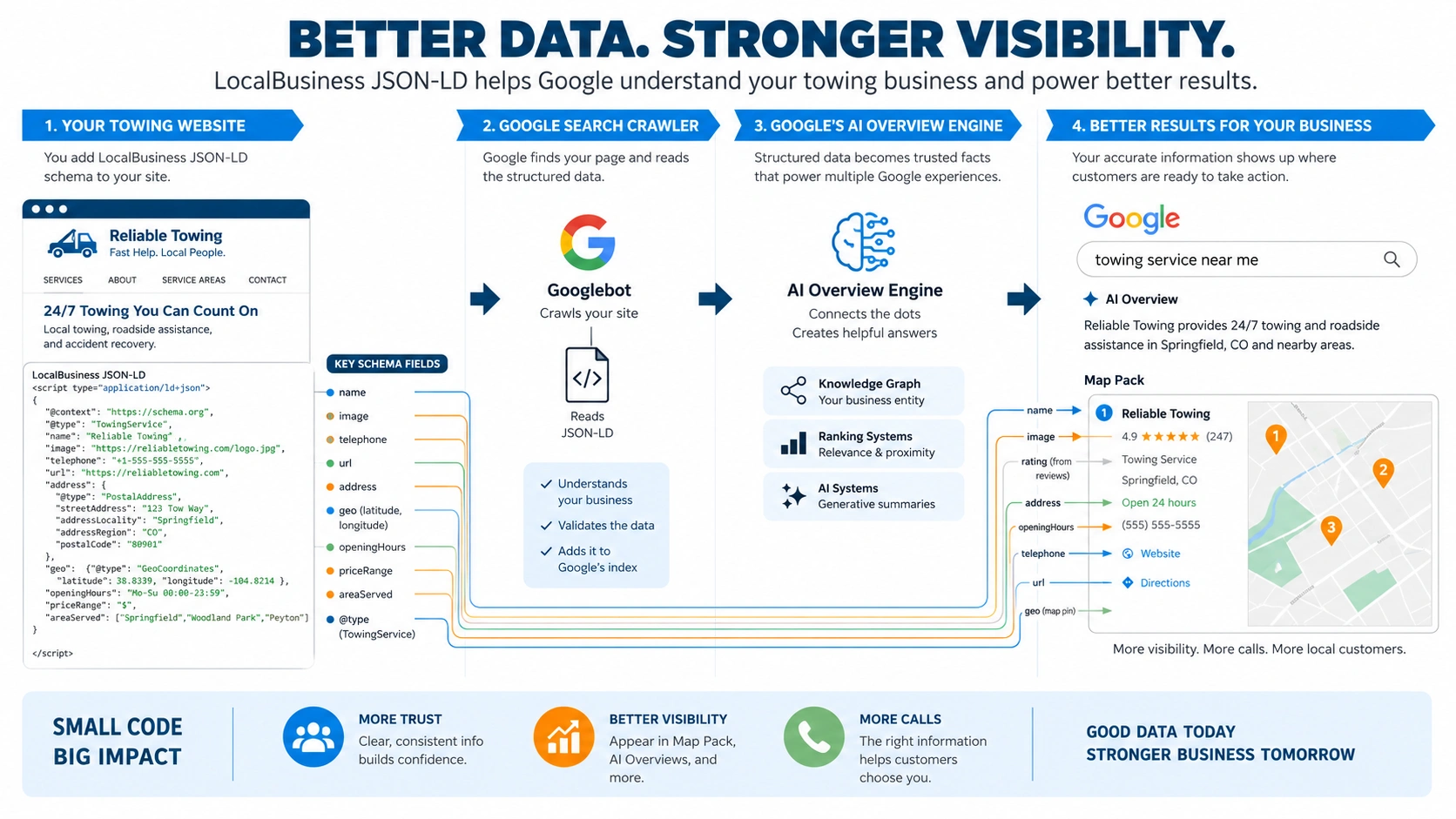
See how LocalBusiness JSON-LD helps Google understand a towing business and power Map Pack listings and AI Overviews.
Step 5: Optimize for AI Overviews and Conversational Search (GEO)
Generative Engine Optimization (GEO) Strategies
AI Overviews are not a future concept. They are here now. They are already reshaping how emergency service queries resolve, and towing companies that structure their content for conversational extraction are capturing citation placements that their competitors are not even aware they are missing.
Google’s AI Overviews prioritize pages that provide direct, conversational answers to complex queries. Your service pages need a concise 1-to-2 sentence summary at the very top, before any navigation or hero image, that answers the specific question a stranded driver or their family member might ask. Structure content to answer natural voice searches like “Siri, find a flatbed tow truck that can haul an AWD SUV” because that is precisely the query format AI models are now processing and resolving from structured page content.
Community platform presence matters more than most towing operators realize. Research shows that Google’s AI models frequently crawl for real-world recommendations on platforms like Reddit and YouTube. An active presence on these platforms, even a handful of genuine mentions in local community forums, contributes to the entity recognition that AI Overviews use to select citation sources.
Building Topical Authority
Publishing detailed guides on local accident recovery laws, roadside safety protocols, and vehicle troubleshooting builds the topical depth that AI models use to evaluate domain authority. Our goal is democratized expertise, giving local operators the same tools the national fleets use to build credibility. These are not blog posts for blog post’s sake; they are authority signals that reinforce your core service pages. They prove your expertise.
The presence of citations in trusted directories, such as Yelp, Towing.com, and Bing Places, serves a dual function. It builds traditional local SEO authority and gives AI models a verified data trail to confirm your business entity. Inconsistent or missing directory listings create confusion that AI systems resolve by citing a competitor instead.
- Conversational Queries: Structure your content to answer natural voice searches like, “Siri, find a flatbed tow truck that can haul an AWD SUV.”
- Topical Authority: Publish detailed guides on local accident recovery laws, roadside safety, and vehicle troubleshooting.
- Directory Citations: Ensure your business is listed on Yelp, Towing.com, and Bing Places, as AI models use these databases to verify local business entities.
Step 6: Build High-Quality Local Backlinks
Local Link Building Strategies
Backlinks from local auto repair shops, auto body centers, and car dealerships carry disproportionate weight for towing companies because they establish geographic co-citation. Google sees that businesses serving the same local authority market are vouching for you. This builds local trust. A link from a dealership’s “preferred towing partner” page is worth considerably more than a generic directory listing.
A backlink from your local Chamber of Commerce is one of the most efficient single link acquisitions available to a local business. It signals community legitimacy to Google’s algorithm in a way that is difficult to replicate through other means. Sponsoring local events or gaining coverage in local news publications adds geographic relevance that compounds over time.
Backlinks act as votes of confidence in Google’s algorithm. To build local authority, focus on acquiring links from local auto repair shops, auto body centers, local news publications, and your local Chamber of Commerce. Each link from a geographically relevant, topically adjacent source strengthens your position in the Map Pack for the service area that link represents.
Step 7: Track Your SEO Metrics and Dispatch Calls
Key Performance Indicators (KPIs)
Organic traffic volume tells you whether your content is being found. It does not tell you whether it is generating calls. Calls drive revenue. Track both, separately, and treat them as distinct signals: a site can accumulate organic sessions from informational content while the dispatch-generating pages stagnate.
Google Business Profile phone calls are the most direct revenue-linked metric available to a towing operator. Monitor them weekly, not monthly. Keyword rankings for terms like “towing companies near me” and “emergency road service near me” give you leading indicators before traffic and call volume shift. Use Google Search Console to identify which queries are generating impressions but not clicks: those are optimization opportunities with existing search demand.
Successful SEO requires continuous adjustment, not a one-time setup. Monitor your organic traffic, local keyword rankings, and most importantly, your phone calls to calculate your exact return on investment. We track these metrics because we care about the positive impacts we make on our small business partners. A 284% ROI within 90 days, which was the documented result from a structured GBP and location-page build-out for USA Towing, is achievable, but only if you are measuring the inputs and outputs with enough precision to know what is driving the results. Here’s what worked for a business like yours: tracking every dispatch back to the organic keyword that generated it.
BizIQ’s local SEO services include ongoing rank tracking, GBP performance monitoring, and monthly reporting built around the KPIs that directly connect to dispatch volume, not vanity metrics.
Frequently Asked Questions About Towing SEO
Q: How long does it take to rank a towing company on Google? A: Basic Google Business Profile optimizations can yield measurable results in 30 to 90 days. A complete SEO strategy, including location pages, schema, backlinks, and review velocity, typically takes 6 to 12 months to achieve leading organic rankings. The results vary depending on market competitiveness, but most businesses see meaningful movement within the first quarter.
Q: Do I need separate pages for every city I serve? A: Yes. Creating dedicated, localized landing pages for each major city, neighborhood, or county in your service area is essential for ranking on “towing in [City]” queries. A single homepage cannot carry geographic relevance across multiple markets. Each location page needs unique content, not a city-name swap on a copied template.
Q: How do I get my towing company into Google AI Overviews? A: Focus on semantic SEO. Answer specific questions directly on your service pages, implement the JSON-LD LocalBusiness schema, maintain active citations in trusted directories, and build community platform mentions. AI models select citation sources based on structured data clarity and entity verification, not just domain authority.
Q: Should I buy reviews to rank faster? A: No. Google’s detection systems for inauthentic reviews have become significantly more sophisticated, and the penalty for a confirmed violation is a permanent suspension of your Google Business Profile. The automated SMS review system described in this guide generates genuine reviews at scale without any of that risk.
Q: Is SEO better than Google Ads for towing? A: Google Ads, and Local Services Ads specifically, provide immediate lead flow at $30 to $100 or more per click in competitive markets. SEO takes longer but builds a compounding asset. The most defensible position is a hybrid model: LSA for immediate dispatch volume, organic SEO for long-term cost-per-lead reduction. Neither replaces the other at scale.
Dominating Google and AI search is the single most effective way to gain a steady stream of high-margin towing jobs without overpaying for ads. By combining a fully optimized Google Business Profile with a fast, mobile-friendly website and structured schema data, you position your towing company to capture drivers at their exact moment of need. Visibility drives calls. Towing companies are the backbone of innovation and the heartbeat of America’s roadways, and the operators who invest in earned authority through demonstrated results are the ones whose phones keep ringing when competitors are waiting for the next motor club dispatch.
We are a small business ourselves. We understand that every missed call is a real cost, and every optimization decision has to justify itself in dispatch volume. The strategies in this guide are the same ones we apply for our own partners: not theoretical frameworks, but field-tested approaches that educate with evidence and lead with outcomes.
Ready to Dominate Your Local Market?
Let our team of towing SEO experts build your custom dispatch-generating engine.