About the Author: This guide was written by a digital marketing specialist at BizIQ with deep hands-on experience helping local repair shops grow their car count and revenue. Having worked directly with 200+ small businesses, many of them in the automotive trades, the focus here is on what moves the needle, not what sounds good in a slide deck.
Key Takeaways:
- Optimize your Google Business Profile to get found in Google Maps and capture high-intent searchers before they call your competitor.
- The critical 60-review threshold: 60+ reviews convert searchers to direction requests at roughly twice the rate of shops with fewer than 25.
- Consistent NAP data is the digital equivalent of clear signage on every road leading to your shop.
- A day-by-day, 5-day local SEO checklist built for shop owners who have service bays to run and can’t afford to lose a week to a laptop.
How do Transmission Repair Shops Optimize for Local and AI Search?
Transmission shops get found online by optimizing their Google Business Profile (GBP) for keywords such as “transmission rebuild” or “fluid flush”, ranking well in Google Maps, the Local Pack, and AI Overviews. Publishing localized service pages detailing exact pricing structures, vehicle warranties, and diagnostic processes helps as well. When a driver types “transmission slipping when accelerating” into their phone at the side of the road, they choose the most trusted local specialist they find first. In this service category, “first” is almost always whoever owns those top three map positions. First wins.
Your Google Business Profile is your shop’s digital storefront on the busiest corner in town. If you’re tucked down a back alley with no signage and no street presence, it doesn’t matter how skilled your technicians are or how competitive your labor rate is. Nobody drives past a well-lit, clearly signed competitor to find you. SEO for transmission repair is the process of putting up those signs: everywhere, consistently, and in plain English.
Transmission repair is a high-ticket, anxiety-driven service. The average repair order (ARO) for a transmission rebuild or full replacement runs between $2,000 and $5,000+, which means a single new customer acquired through local search can represent a major revenue event. When a vehicle owner notices a shudder under acceleration or spots a puddle of red fluid under their car, they’re not browsing casually; they’re searching with urgency and a strong intent to act. That urgency is your opportunity, but only if your shop surfaces at the top of their results. For a deeper grounding in how local search works across all service categories, our local SEO guide is worth reading before you start making changes.
Google Maps & The Local Pack: Your Shop’s Digital Front Door
If your Google Maps listing is incomplete, outdated, or buried beneath two competitors, customers are driving right past you, digitally speaking. The Local Map Pack, the three-business map block that appears at the top of Google results for location-based queries, is the most contested piece of digital real estate in local search. For automotive repair, it’s where the bulk of clicks land. Industry data puts Local Pack click-through rates at 40% to 55% of all traffic for automotive repair queries, based on research from AuthoritySpecialist and their data on local SEO, as well as related car wash SEO statistics. This means more than half of the people searching for transmission repair in your city never scroll past those three listings. You need to be there.
Understanding the Mechanics of the Local Pack
Google’s local ranking algorithm weighs three factors: Proximity, Relevance, and Prominence. Proximity is fixed: Google knows where your shop is, and you can’t move it. But Relevance and Prominence are entirely within your control, and they’re where most shops leave ranking potential untouched. You can change that.
Relevance is how precisely your business profile matches what someone searched for. A profile that lists only “Auto Repair Shop” as its category and leaves the services section blank is algorithmically invisible for searches like “transmission flush near me” or “clutch repair [City]”. Prominence is the gathered weight of your online reputation: reviews, citations, backlinks, and the overall completeness of your digital footprint. Shops that treat their Google Business Profile as a one-time setup task rather than an ongoing asset consistently underperform on Prominence, regardless of how strong their actual service quality is. Understanding how these pillars fit into a broader growth plan is covered in depth in this local SEO strategy for small businesses, which explains how to build a steady stream of local leads without spending thousands on paid ads.
How Google’s AI Overviews Impact Transmission Searches
AI Overviews, Google’s evolution of search, now appear above the Local Map Pack for a growing share of queries, including many automotive service searches. They pull data directly from Google Business Profiles, customer review sentiment, and on-site service content to generate a conversational answer, often naming two or three specific local shops as recommended options.
This isn’t a threat to shops with optimized profiles. It’s a filtering mechanism that rewards them. AI models combine your business details, the language customers use in their reviews, and the specificity of your service descriptions to determine whether you’re worth citing. A profile that lists “transmission rebuild,” “transmission flush,” and “clutch repair” as distinct services, with reviews that mention those services by name, feeds the AI exactly the structured data it needs to surface your shop as a trusted answer. Incomplete profiles get filtered out. Complete ones get amplified.
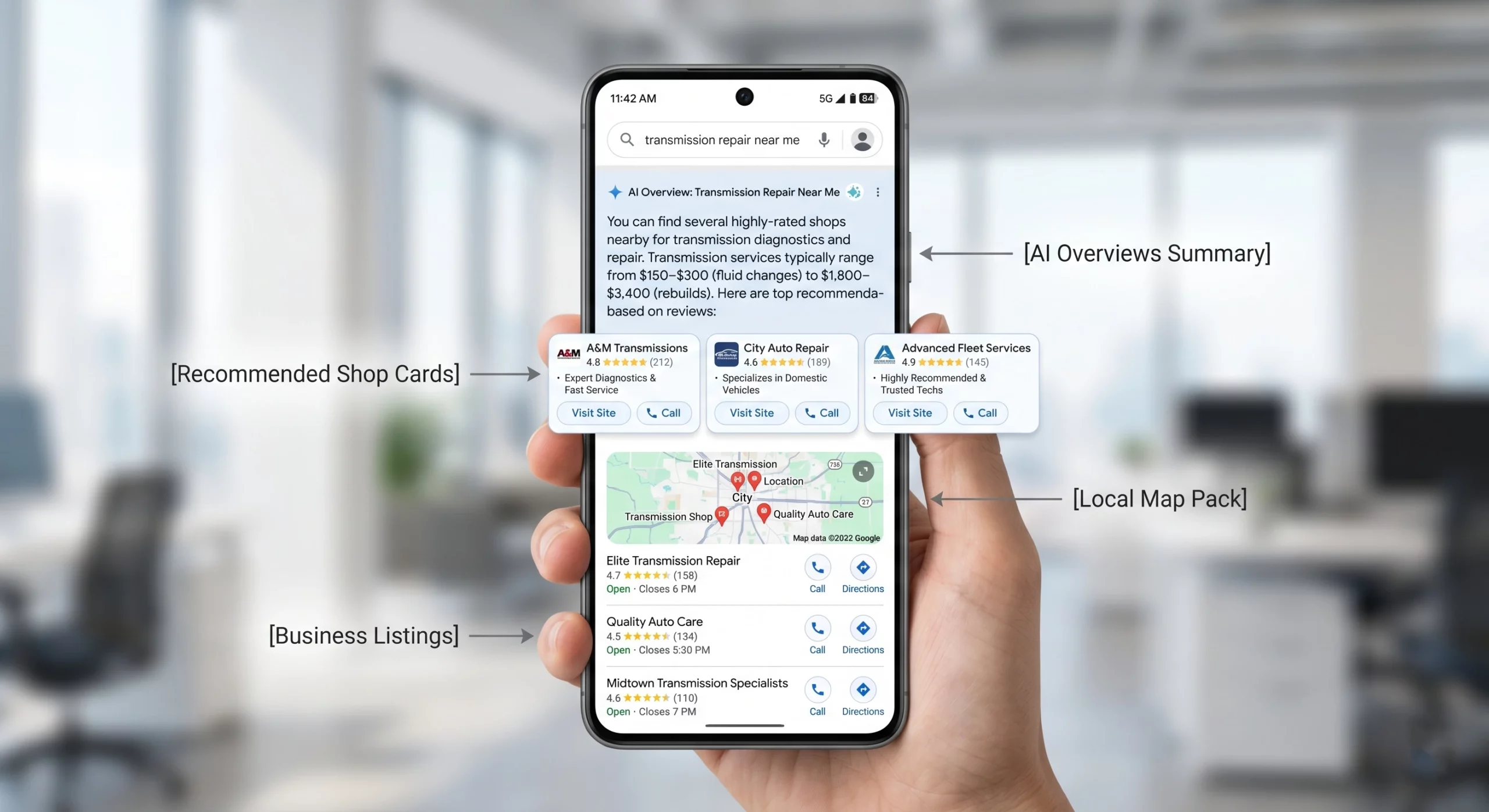
A professional mockup demonstrating the layout of Google AI Overviews and Local Map Pack listings on a mobile screen.
Google Business Profile Optimization: Fine-Tuning Your Profile
Think of your Google Business Profile as your shop’s primary diagnostic scanner. If it’s not calibrated correctly: wrong categories, missing services, no photos, stale information, you’re going to misread the data and miss the customers. GBP is the single most important ranking lever for local search visibility, and it’s also the one that most shop owners set up once and never revisit.
Your GBP is the primary source of truth for both Google’s map algorithm and AI Overviews. Every data point you enter (categories, services, hours, photos, description) either strengthens or weakens your relevance signal for every transmission-related search in your area. A thorough walkthrough of the technical setup is available in this guide to Google Business Profile optimization, but the core moves for a transmission shop are simple to execute:
Step-by-Step GBP Optimization for Transmission Shops:
- Primary Category Selection: Set your primary category to Auto Repair Shop to capture the broadest search volume, and add Transmission Shop as your secondary category. If your shop exclusively handles transmissions and drivetrain work, reverse that priority, but most shops serve a wider range of customers and benefit from the broader primary category.
- Complete Services Menu: Don’t let Google guess what you do. Manually add every service you offer: “transmission rebuild,” “transmission flush,” “clutch repair,” “differential service,” “transfer case repair.” Each entry is a relevance signal for a different search query. Leaving the services section blank is the equivalent of removing half your service menu from the front window.
- Visual Proof: Upload high-quality photos of your shop’s exterior, clean service bays, diagnostic equipment, and your team, and keep adding them on a regular schedule. Profiles with active photo updates receive 42% more direction requests than profiles without them, according to research on optimizing Google Business Profiles for auto repair. That gap compounds over time as competitors with static profiles fall further behind. Photos build trust.
Service Pages & Keyword Targeting: Capturing High-Intent Searches
Broad keywords like “mechanic near me” generate huge search volume, but they also attract huge competition and shoppers who haven’t yet decided what they need. Niche, localized keywords like “transmission rebuild [City]” and “transmission repair near me” represent a different kind of searcher entirely: someone who already knows what’s wrong and is actively selecting a shop.
The search volume data illustrates the opportunity. “Transmission repair” draws significant monthly searches based on industry insights. The variance in local search volume reflects how dramatically local population density affects search volume; a shop in a major metro competes for a far larger pool of searches than one in a smaller market. Either way, these are high-intent searches attached to high-ticket repair decisions.
Symptom-based keywords add another layer. Queries like “transmission slipping when accelerating” or “red fluid leaking under car” capture vehicle owners at the exact moment they’re experiencing a problem, before they’ve even identified a shop. A page that answers those questions clearly and positions your shop as the local expert converts that anxiety into a phone call. In fact, targeting symptom-based queries like “transmission slipping” or “red fluid leaking under car” is a proven way to capture early-stage searchers, as highlighted in auto repair keyword guides. For instance, “transmission fluid leak symptoms” alone generates approximately 4,100 monthly searches, and most transmission shops have no dedicated page targeting it.
Core Service Pages to Build:
- Transmission Repair & Rebuild Page: Your highest-ticket service deserves its own dedicated page. Target “transmission rebuild [City]” and “transmission repair [City]” with detailed content about your rebuild process, warranty terms, and what differentiates your shop’s approach. Generic descriptions don’t rank; specific ones do.
- Transmission Flush & Maintenance Page: Preventative maintenance searches like “transmission fluid change” and “transmission flush near me” attract a different customer, one who isn’t in crisis yet. Capturing them at this stage builds a long-term customer relationship, not just a one-time repair ticket.
- Symptom-Specific Pages: Dedicated pages for “transmission slipping,” “delayed engagement,” and “transmission fluid leak symptoms” intercept worried drivers mid-problem. These pages serve a dual purpose: they rank for informational queries and they position your shop as the knowledgeable local authority before the customer has even picked up the phone.
- Related Drivetrain Services: Separate pages for clutch repair, differential service, and transfer case repair build topical authority across the full drivetrain service category. Each page targets its own search cluster and signals to Google that your shop has genuine depth of expertise, not just a single-service focus.
Granular service mapping prevents algorithmic dilution. A single “Services” page that lists everything in bullet points ranks for nothing specifically. Individual pages with detailed, service-specific content rank for the exact queries your highest-value customers are typing.
If you’d rather spend your time under the hood than staring at a screen, BizIQ’s Google Business Profile setup service handles the technical configuration for you: categories, services, descriptions, photo uploads, and everything in between.
Reviews & Trust Signals: Word-of-Mouth on Steroids
Online reviews are word-of-mouth that lives forever online. When a driver is staring down a $3,500 transmission rebuild estimate, the first thing they do after getting off the phone with your service advisor is search your shop name and read what other customers said. Customer reviews and ratings directly influence 80% to 90% of consumer decisions when selecting a local repair shop, according to data on the influence of reviews on conversion. That’s not a soft influence; it’s the primary decision driver for most customers in this service category.
The psychology is simple. Transmission repair is a high-stakes financial commitment. Customers can’t evaluate your technicians’ skills directly, so they use reviews as a substitute for trust. A shop with 12 reviews and a 4.2-star average looks like a gamble. A shop with 74 reviews and a 4.6-star average looks like a proven operation. Same quality of work, completely different perception.
The Power of the 60-Review Threshold
There’s a measurable turning point in how reviews affect conversion behavior. 60+ reviews convert searchers to direction requests at roughly twice the rate of shops with fewer than 25. Specifically, auto repair shops with 60 or more Google reviews convert local search impressions into direction requests at roughly twice the rate of shops with fewer than 25 reviews (AuthoritySpecialist, 2026). That’s not a marginal improvement; it’s the difference between a profile that generates consistent inbound calls and one that gets views without action.
The reason the threshold matters is that volume signals sustained engagement. Volume builds trust. Twenty reviews could have been collected in the first three months of operation and never added to since. Sixty reviews, especially spread across a reasonable time span, suggest an active, ongoing business with a consistent track record of customer satisfaction. Every review you collect between now and that milestone moves the needle: a local business profile’s conversion rate improves by 2.8% for every 10 new reviews earned (Street Fight, 2022). That’s a compounding return on a zero-cost activity.
Managing Negative Reviews and Building Trust
We know: marketing agencies have overpromised and underdelivered for years. Here is what moves the needle for transmission shops, backed by what we’ve seen work. For example, a perfect five-star rating with 200 reviews raises eyebrows. Customers know that no shop gets every job right every time, and a profile without a single negative review reads as polished rather than authentic, both to human readers and search algorithms.
When a negative review does land, respond to it. Do not panic. Keep the tone calm, professional, and focused on resolution. Acknowledge the customer’s experience, offer to take the conversation offline, and avoid defensive language. A well-handled negative review often does more for your shop’s credibility than five more positive ones, because it demonstrates how your team behaves when something goes wrong. For a concrete example of how reputation management and local search visibility work together to drive measurable growth, our auto repair case study is worth reviewing.
“Auto repair shops with 60 or more Google reviews convert local search impressions into direction requests at roughly twice the rate of shops with fewer than 25 reviews.”
AuthoritySpecialist, 2026
NAP Consistency & Local Citations: Aligning Your Digital Signage
Imagine your shop has three different addresses listed across the internet: one with “Street” spelled out, one abbreviated as “St.”, and one with the wrong suite number left over from a location you moved out of two years ago. To a human, these are obviously the same business. To Google’s local algorithm, there are three conflicting data points about an entity it can’t fully verify. That confusion costs you rankings.
NAP consistency (making sure your name, address, and phone number are spelled the same everywhere, just like making sure your shop’s sign is readable from both directions on the street) is how search engines confirm that your business is real, stable, and located where you say it is. Your GBP, your website, Yelp, Apple Maps, Bing Places, Facebook: all of them need to show identical information, down to punctuation and abbreviation conventions. Details matter.
Why Inconsistent Contact Info Stalls Your Rankings
Inconsistent NAP data doesn’t just create minor friction; it actively dilutes your local authority by splitting your citation signals across multiple unverified business entities. Google’s algorithm grows less confident in your listing when details conflict, which translates directly into lower Local Pack positions.
Beyond the core directories, transmission shops have access to a set of niche, high-authority automotive citation platforms that most competitors ignore. Listings on RepairPal, the Carfax Service Shop Directory, and Mechanic Advisor function as industry-specific trust signals: they tell Google’s algorithm that your business is recognized and vetted within the automotive services ecosystem, not just listed in generic business directories. These platforms carry more topical weight than a listing on a generic local directory ever will. The same principle of building niche authority across related automotive verticals applies to other service categories, as explored in our resources on digital marketing for auto body shops.
A unified citation profile (consistent NAP across core directories plus targeted listings on automotive-specific platforms) acts as a compounding ranking signal. Each accurate listing reinforces the others, building a coherent picture of your business that Google can confidently surface in local results. This builds trust.
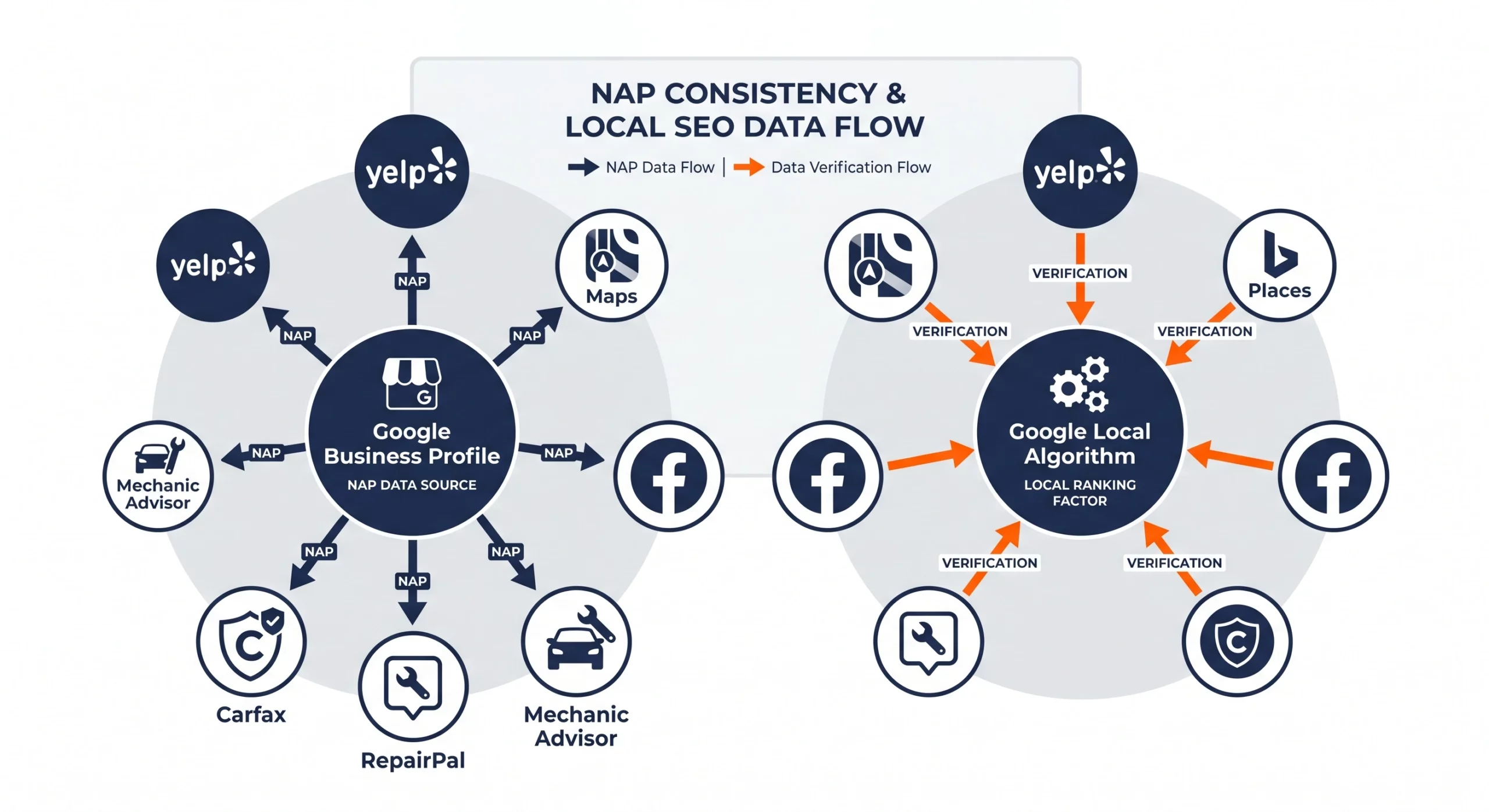
Diagram of a consistent NAP (Name, Address, Phone) data strategy.
Every dollar in your marketing budget should work hard. BizIQ’s affordable local SEO solutions are built specifically for small business owners who need measurable results without agency-scale overhead.
First-Week Actionable Checklist: Your Step-by-Step Plan
You run a shop; you don’t have time to become a marketing expert. That’s why we’re breaking this down into a first-week checklist you can finish in an afternoon. None of these tasks require technical expertise. All of them have a direct, measurable impact on your Local Pack visibility.
For a more detailed resource to return to after you’ve completed these foundational steps, our local SEO checklist covers the longer-term optimization work in detail.
5-Day Implementation Checklist:
- Day 1: Claim and Verify: Log into Google Business Profile Manager and confirm that your business name, address, and phone number match your physical signage and your state business registration exactly. If your profile is unclaimed, claim it now. Verification can take a few days, so starting here is critical.
- Day 2: Optimize Categories and Services: Set your primary category to Auto Repair Shop and your secondary to Transmission Shop. Then write a keyword-rich business description (up to 750 characters) that specifically mentions transmission rebuild, transmission flush, clutch repair, and any other drivetrain services you offer. Don’t write marketing copy; write a clear, specific description of what your shop does and who it serves.
- Day 3: Audit Your NAP: Search your business name on Google, Yelp, Facebook, and Yellow Pages. Document every variation you find (old phone numbers, misspelled street names, outdated suite numbers) and submit corrections through each platform’s business owner tools. This is labor-intensive. Do it anyway.
- Day 4: Upload Photos: Add at least 10 high-resolution photos to your GBP: exterior signage, clean service bays, diagnostic equipment, your team at work. If you have ASE certification plaques or specialty equipment visible in your shop, photograph those too. Visual specificity builds credibility.
- Day 5: Launch a Review Campaign: Pull your last 10 satisfied customers from your service management software and send each one a direct text or email with a link to your GBP review page. Keep the message short and genuine. This is the first push toward that 60-review threshold, and it costs nothing but five minutes of outreach.
Link Building & Local Authority: Building Digital Partnerships
Local link building isn’t about chasing domain authority scores on national websites. It’s about building a web of digital relationships within your actual service community, the same community where your customers live, work, and search for help.
Every local link pointing to your website is a vote of confidence from another organization Google already trusts. A link from your city’s Chamber of Commerce directory carries weight because that organization has established local authority. A link from a regional towing company that lists you as their preferred transmission specialist carries weight because it’s contextually relevant and geographically specific. These aren’t complicated link-building campaigns; they’re natural extensions of the business relationships you’re already maintaining offline.
Practical starting points: sponsor a local youth sports team and request a link from their website, join your local Chamber of Commerce (most provide a member directory listing with a backlink), and reach out to auto parts suppliers or towing operators you work with regularly. A simple “preferred partner” mention on their site, with a link to yours, costs nothing and builds genuine local authority. Links build authority.
Earning Industry-Specific and Local Backlinks
Niche-relevant links carry a different kind of weight than generic local ones. A mention from an automotive blog, a regional car club’s resources page, or a local automotive association directory tells Google’s algorithm that your shop is recognized within the industry vertical, not just within the geographic area.
Quality matters more than volume here. Relevance is key. A single link from a well-maintained regional automotive publication outperforms fifty links from low-quality generic directories. When seeking link opportunities, prioritize relevance and local specificity over sheer numbers. Reach out to local business partners directly (a towing company, an auto parts retailer, a used car dealership) and propose a mutual listing arrangement. These relationships often already exist; formalizing them with a backlink is a minor ask with a measurable SEO payoff.
Tracking Success & Analytics: Measuring Your Engine’s Output
Your GBP dashboard and Google Search Console are the indicators on your shop’s digital instrument cluster. They tell you exactly how much traffic your profile is generating, which queries are driving it, and where customers are dropping off before they call, request directions, or visit your physical shop. Ignoring these tools while optimizing your local presence is like running diagnostics without reading the codes.
Vanity metrics like impressions, keyword rankings, and social media reach are interesting but not actionable on their own. The numbers that matter for a transmission shop are direction requests, phone calls, and website visits generated directly from your GBP. These are the conversion actions that translate into cars on your lifts. Track what matters.
Key Metrics to Monitor
The baseline benchmark for a Google Business Profile is a 4.2% conversion rate from impressions to direct actions (phone calls, website clicks, or direction requests), as reported by Street Fight. That’s the average. Highly optimized profiles (those with 50+ reviews and a consistent cadence of photo updates) generate approximately three times more direction requests than unoptimized ones. The gap between a neglected profile and an actively managed one isn’t marginal; it’s the difference between a slow week and a full service schedule.
Within GBP Insights, track “Direction Requests” and “Phone Calls” as your primary conversion indicators. Watch for week-over-week trends rather than single-day spikes, and link changes with specific optimization actions: a new batch of photos, a cluster of new reviews, an updated service description. Google Search Console fills in the organic side of the picture: which keywords are driving clicks to your service pages, which pages are gaining impressions without converting, and where technical issues might be suppressing your rankings. Together, these two tools give you a complete read on your local search performance without requiring a third-party analytics platform. Data guides decisions.
Frequently Asked Questions
What is the 80/20 rule for SEO?
The 80/20 rule (Pareto Principle) in SEO means that 20% of your efforts, specifically, optimizing your Google Business Profile and building a consistent base of high-quality local reviews, drive roughly 80% of your local search visibility and inbound customer calls. Prioritize those two levers before anything else.
What are the 4 types of SEO?
The four core types are on-page SEO (optimizing website content and structure), off-page SEO (building backlinks and external authority), technical SEO (site speed, crawlability, and schema markup), and local SEO (optimizing for Google Maps and location-based search results). For transmission shops, local SEO delivers the most direct return on effort.
Is it worth paying someone to do SEO?
For most shop owners, yes, with one condition: the partner needs to understand local search specifically, not just general digital marketing. Hiring an experienced local SEO specialist speeds up your path to the 60-review threshold, correct citation coverage, and Local Pack visibility, particularly in competitive markets where doing it yourself over 12 months costs more in lost revenue than the service fee.
How long does it take to see results from local SEO?
GBP optimizations (category updates, service additions, photo uploads) can produce measurable changes in direction requests within a few weeks. Broader Local Pack ranking improvements, particularly in competitive markets, typically take three to six months of consistent effort. The shops that see the fastest results are the ones that execute the foundational steps in the first week and maintain them consistently afterward.
Do I need separate pages for different transmission services?
Yes. A “transmission flush” page and a “transmission rebuild” page serve completely different search intents and target different keyword clusters. Combining them on a single general services page dilutes your relevance signal for both queries. Separate pages with detailed, service-specific content are how you rank for the specific, high-intent searches that drive your highest-ticket repair jobs.
Getting Found Is a Long Game: With Short-Term Wins
Local SEO for transmission repair isn’t a one-time project. It’s an ongoing process of building trust, both with Google’s algorithm and with the vehicle owners in your service area who are making expensive, stressful decisions under time pressure. The shops that consistently rank well in their Local Map Pack didn’t get there by accident; they got there by treating their digital presence with the same discipline they apply to their service bays.
The good news is that most of your local competitors haven’t done the foundational work. Incomplete GBP profiles, inconsistent NAP data, and review counts stuck in the single digits are the norm, not the exception. That gap is your opportunity, and the first-week checklist above is how you start closing it. Start today.
There’s no clean endpoint to this process, and that’s worth acknowledging. Google updates its local algorithm, AI Overviews expand into new query types, and competitor shops eventually catch up. But the shops that build a strong foundation early and maintain it consistently hold a compounding advantage that becomes harder to overtake over time.
Request Your Free Local Visibility Review
Not sure where your shop stands right now? We’ll review your Google Business Profile, check your NAP consistency across the web, and build a custom plan showing exactly what it would take to outrank your local competitors and get more direction requests.
No obligation. No sales pitch. We’re a small business too, and we know what it costs to lose a high-ticket repair job to a competitor who simply showed up higher in the results.