Key Takeaways
- Immediate Cash Flow: Google Local Services Ads deliver phone calls within days of going live, with a national average cost per lead of $36.23 and conversion rates between 31% and 40%: making them the fastest path to filling your schedule.
- Compounding Equity: A mature organic auto glass SEO strategy drives a 19.9x long-term ROI and cuts your customer acquisition cost from roughly $553 (paid ads) down to approximately $126 over 24 months.
- The Hybrid Blueprint: Running both channels concurrently generates 42% more total leads and achieves a 40% lower cost per acquisition compared to either channel operating in isolation.
A driver catches a rock chip on the highway at 7 AM. By the time they pull into a parking lot, they have already opened Google on their phone and typed “mobile windshield replacement near me.” That search takes less than four seconds. Whether your business appears in that moment, and whether it appears at the top or buried below three competitors, is exclusively a function of which marketing channels you have invested in and when.
For mobile auto glass technicians, the answer is not LSAs or SEO. LSAs win for speed. Organic SEO wins for long-term profitability. The more useful question is understanding exactly why each channel operates the way it does, what the real numbers look like, and how to sequence them without burning cash on the wrong one at the wrong time.
The mobile technician’s reality
Operating as a service-area business without a physical storefront changes the entire digital marketing equation. You do not get walk-in traffic. You do not benefit from a high-visibility commercial address. Every job you book traces back to a digital touchpoint: a Google search, a Maps listing, or a phone call from an ad. That makes your online presence the functional equivalent of your front door. This is a pervasive challenge for those running a mobile auto glass repair business.
Auto glass searches are almost entirely high-intent and emergency-driven. Over 90% of windshield repair searches happen on mobile devices, often from the side of the road or a parking lot, which means the customer is not browsing: they are committing. That search intent compresses the sales cycle dramatically. A well-placed listing converts faster in this vertical than in almost any other home service category. For a mobile auto glass operation, being visible in these exact moments is what actually works for small shops.
Comparing paid ads to renting and SEO to owning helps clarify the long-term financial differences. LSAs put you at the top of the page immediately, but that position exists only as long as your budget does. Organic SEO: your Google Business Profile, your local landing pages, your citation footprint: is infrastructure you build and own. One channel funds your week. The other funds your next five years.
Understanding Google Local Services Ads (LSAs) for auto glass
Google Local Services Ads sit above traditional Google Ads and above the Map Pack on both mobile and desktop SERPs. They dominate the screen. For a mobile technician, that placement is significant: it is the first thing a customer with a cracked windshield sees before they have even scrolled, capturing their attention before they can consider any organic competitors.
How LSAs work for mobile technicians
The pay-per-lead model is straightforward. You set a weekly budget, define your service area by zip code or city, and Google charges you only when a customer calls or sends a message directly through the ad. No click-throughs to your website, no wasted impressions: you pay for contact, not curiosity. It keeps costs predictable. Because Google LSAs fully support Service Area Businesses (SABs), you do not need a physical commercial address to get started.
The Google Guaranteed badge is what distinguishes LSAs from standard PPC. It signals to the customer that Google has verified your business, which carries real weight when someone is deciding who to trust with their vehicle. Earning that badge requires completing background checks and licensing requirements through Evident, Google’s third-party verification partner, submitting proof of state-level licensing, and providing documentation of general liability insurance. For newer operations, that verification process can take up to two weeks: worth keeping in mind before you plan a launch date.
The pros and cons of LSAs
The primary advantage is unmistakable: immediate top-of-SERP visibility with no SEO runway required. A technician who clears verification on a Monday can be receiving calls by Wednesday.
The cost picture is more nuanced. What the data shows is that the average LSA CPL ($15 to $25) is a useful baseline, but the actual cost per lead can oscillate. The national average cost per lead for auto glass sits at $36.23 as of early 2026, according to google-local-service-ad-statistics, though that number climbs toward $50 to $60 in dense metro markets where multiple verified technicians are competing with bigger shops for the same searches. That is still a workable unit cost when you are booking $300 to $600 windshield replacements, but it is not the lower floor you will see cited in older automotive search advertising benchmarks. Budget accordingly.
Lead quality is the other variable worth watching. LSAs generate a volume of spam calls, wrong-number contacts, and out-of-service-area requests. Google does allow you to dispute these and reclaim credit, but the process is manual and requires active monitoring inside the dashboard. Technicians who set LSAs and walk away will find their effective cost per lead drifting higher than the platform’s reported average.
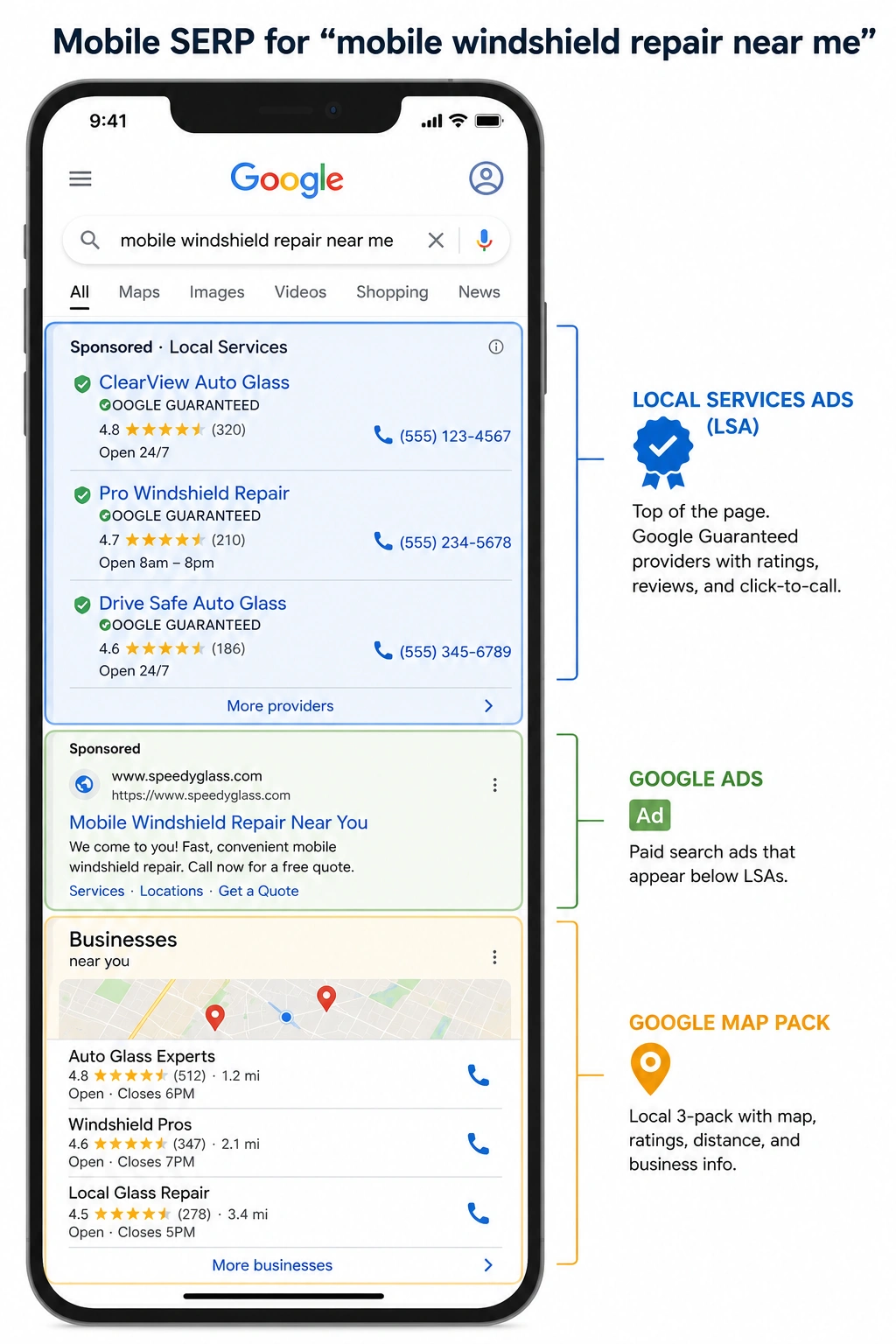
Where LSAs sit on the mobile SERP compared to Google Ads, the Map Pack, and organic search results.
The power of organic auto glass SEO
Organic auto glass SEO for a local mobile business is not a single tactic: it is a stack of compounding signals that includes your Google Business Profile, localized service pages, and consistent citation building across the web. Your Google Business Profile, your service-area landing pages, your local citations, your review velocity, and your on-site technical foundation all play a function. When executing SEO for auto glass repair, each layer reinforces the others. It builds authority. The cumulative effect is a digital presence that generates organic leads without a per-contact cost.
Key benefits of organic SEO
- Compounding ROI: Once organic rankings stabilize, the cost per lead approaches zero on a marginal basis. The investment is in the monthly retainer that builds and maintains the asset, not in paying Google for each phone call. Over a 24-month horizon, that structure produces a long-term ROI of 19.9x: a figure that reflects the gap between a $1,500 monthly SEO investment and the density of free, high-intent traffic it eventually drives.
- Local Pack Visibility: What the data shows is that 86% of “near me” searches trigger the Google Map Pack, capturing 40% to 60% of all local clicks. That three-pack is the primary battleground for local auto glass density, especially for mobile services.
- Higher Conversion Trust: Studies show a 14% organic close rate vs. 7% paid search close rate. Customers who find you through an organic listing have often already done some degree of vetting: they have read reviews, scanned your service pages, and made a decision before they call. That pre-qualification shows up directly in your close rate.
- Long-Term Asset Equity: Investing in auto glass SEO means building a durable digital asset. It is yours forever. A case study on auto-glazing marketing illustrates what sustained organic investment looks like at scale: 84% share of voice in their target market and a 1.84 average Google Maps ranking for primary high-intent keywords. That kind of market presence does not happen through ad spend. You must earn it. It is built through consistent optimization over time, and once established, it is genuinely difficult for competitors to displace quickly.
Cost-per-lead comparison: LSAs vs. SEO
The unit economics of these two channels look very different depending on your time horizon, and conflating short-term and long-term costs is where most technicians make poor allocation decisions that drain their marketing budgets prematurely. Timing is everything.
Direct cost metrics comparison
- Immediate Ad Spend (LSAs): LSAs require an uninterrupted budget. The moment you pause your campaign, whether by choice, budget constraint, or a billing issue, lead flow drops to zero. There is no residual value. You are paying for access to the platform, not building anything that persists after you stop.
- Long-Term SEO Investment: A local SEO retainer in the $1,500 to $3,000 per month range sounds prohibitive against a $36 LSA lead, but the math changes substantially over 24 months. While paid ads require ongoing spend that never decreases, investing in organic auto glass SEO drives a 19.9x long-term ROI by building a permanent digital asset that continues to attract customers without additional cost. Paid advertising produces a customer acquisition cost of approximately $553 over that period; mature organic SEO brings that figure down to roughly $126. The crossover point typically arrives somewhere in months 9 to 12, after which organic traffic is generating leads at a fraction of what LSAs cost.
- Lead-to-Booking Ratios: LSAs convert at 31% to 40% from initial contact to booked job: that is a strong number, driven largely by the trust signal of the Google Guaranteed badge. Organic leads convert at a lower initial rate but arrive with higher intent and close at a higher rate once you are in the conversation. Neither metric tells the full story in isolation: what matters is your blended cost per booked job across both channels.
Auto Glass SEO Services
Speed vs. sustainability: When to use which
Choosing between paid ads and organic search depends entirely on your business maturity and cash flow timing, as newer shops need immediate leads while established ones can afford to invest in long-term equity. When evaluating SEO vs. PPC, the tradeoff is often between immediate survival and long-term equity. Cash flow dictates your choice.
Immediate lead generation with LSAs
LSAs make the most sense at three specific moments: when you are inaugurating a new operation and have zero organic presence, when you are expanding into a new service area where you have not yet built local authority, and when you have immediate schedule gaps that need filling to cover operating overhead: fuel, equipment leases, and insurance. A mobile van sitting idle is a fixed cost with no revenue offset. Idle vans lose money. LSAs are the fastest mechanism to change that equation. They fill schedules fast.
New technicians often underestimate how quickly LSAs can generate volume once verification clears. The Google Guaranteed badge does real work in a trust-sensitive category like auto glass, where customers are handing over their vehicle or inviting a technician to their home or workplace.
Long-term compounding traffic with SEO
Organic SEO becomes the primary investment once you have a functioning operation with enough cash flow to sustain a 3-to-6-month runway before rankings crystallize. Established shops that have already proven their service model benefit most from SEO because they can afford to wait for the compounding effect to kick in: and because they have the review history and operational track record that Google’s algorithm rewards.
There is also a business valuation argument worth making. Think about the future. A shop with dominant organic rankings in its market is worth more to a buyer than one that relies entirely on paid lead generation, because the organic asset transfers with the business. Paid ad accounts do not carry the same equity. Build real business value.
“LSAs are like renting a billboard: you pay every month, and the minute you stop, the leads stop coming. SEO is like planting an orchard. It takes time to grow, but once the trees crystallize, you get fruit every year without planting new ones.”
BizIQ Local Marketing Strategist:
Targeting high-value services: Calibration and windshield replacement
Not all auto glass jobs are created equal. Some are far more profitable. A standard chip repair might run $75 to $150. A full windshield replacement with ADAS camera recalibration can reach $800 to $1,200 or more, depending on the vehicle. The marketing strategy for those two jobs should look completely different, as low-ticket repairs require high-volume local visibility while high-ticket calibrations need precise, intent-driven keyword targeting.
Capturing high-ticket ADAS and replacement jobs
ADAS calibration is still a relatively underserved keyword category in most local markets. Queries like “ADAS calibration near me” or “windshield replacement with camera calibration” carry high commercial intent and face less direct competition than generic “windshield repair” terms. Targeting these high-ticket services, such as commercial fleet windshield replacement, yields higher profit margins. This boosts your bottom line. Building dedicated local SEO landing pages around these services, explaining how to handle auto glass local markets dynamics, does two things simultaneously: it educates the customer enough to justify the higher price point, and it signals topical authority to Google’s algorithm.
On the LSA side, the platform allows you to filter which service categories trigger your ads. Technicians running tight margins on chip repairs can configure their LSA campaigns to prioritize full replacement and calibration jobs, effectively using the pay-per-lead model to cherry-pick higher-margin work. Using Google Ads for auto glass repair alongside LSAs is an astute way to control your lead mix. Control your incoming jobs. When you plan your auto glass windshield marketing, balancing these high-value categories is what actually works for small shops trying to maximize their average ticket size.
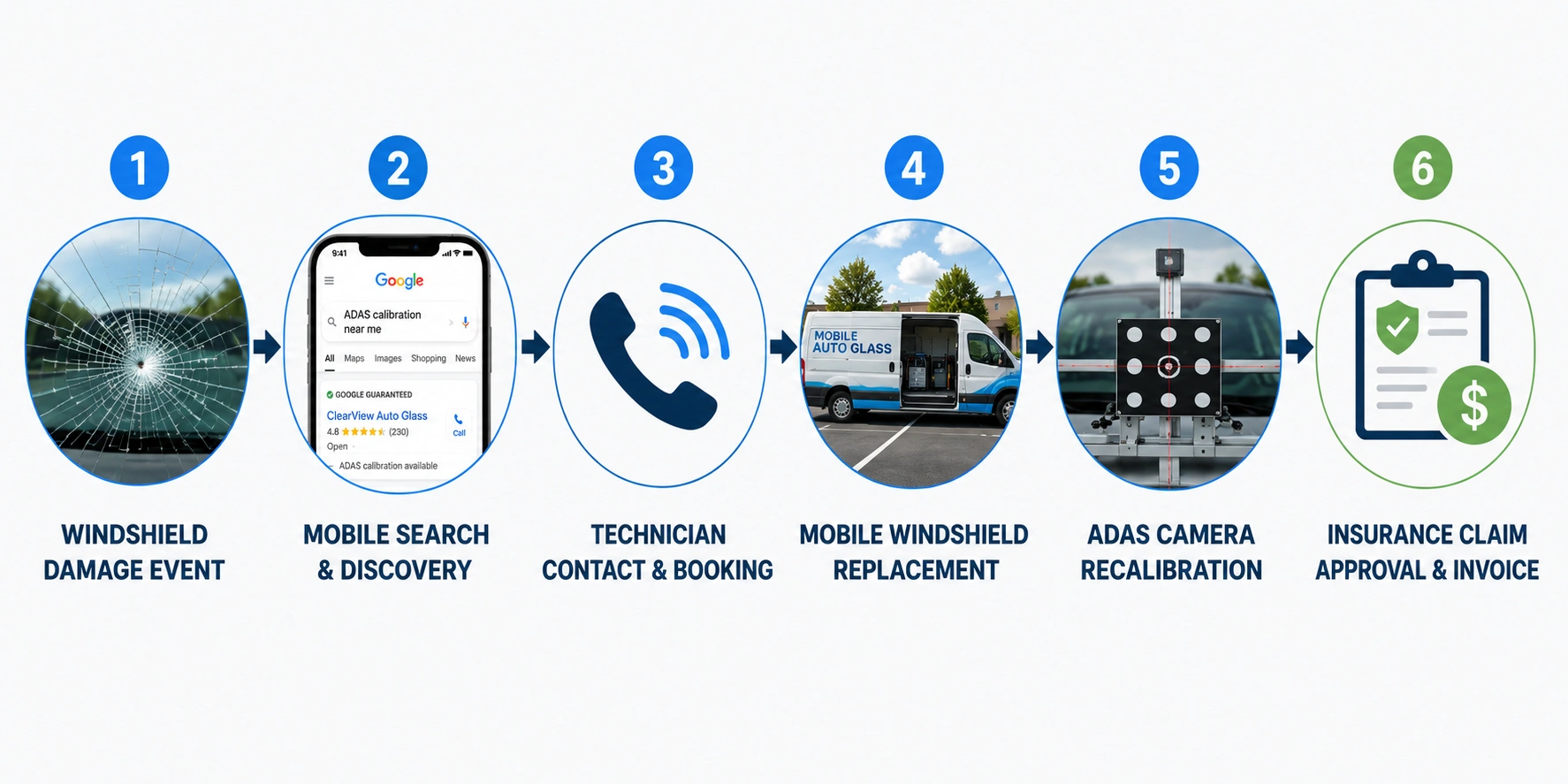
The ADAS calibration customer journey, from windshield damage and mobile search to replacement, recalibration, and claim approval.
Ready to rank for high-ticket ADAS and replacement keywords?
Understand the full strategic picture before you allocate your budget.
How mobile technicians can balance both strategies
The 42% lead volume increase and 40% CPA reduction that comes from running LSAs and SEO concurrently is not accidental, as combining immediate paid leads with long-term organic visibility captures customers at every stage of their search. It is the result of each channel compensating for the other’s weaknesses during specific phases of business growth. The sequencing matters as much as the investment itself. Timing determines your success.
The step-by-step hybrid approach
- Phase 1 (Months 1 to 3): Launch LSAs immediately. Complete the Evident background check, submit your licensing and insurance documentation, and get your Google Business Profile live as a service-area business with your zip codes defined. The goal in this phase is cash flow: enough booked jobs to cover operating overhead and fund the next phase. Do not optimize for margin yet: optimize for volume and review generation.
- Phase 2 (Months 4 to 6): Reallocate a portion of LSA revenue into building your organic foundation. Build for the long term. This means optimizing your Google Business Profile with service-specific photos, posts, and Q&A responses; building consistent NAP citations across local directories; and creating localized landing pages for your primary service areas. Every five-star review you collect in Phase 1 becomes a ranking signal in Phase 2.
- Phase 3 (Month 6+): As organic rankings mature and Map Pack placement stabilizes, begin scaling back LSA spend on lower-margin, high-competition keywords. Redirect that budget toward ADAS calibration and fleet account acquisition: either through targeted LSA categories or through content that attracts commercial clients searching for recurring service contracts. The organic engine is now handling your baseline lead volume; paid spend becomes a precision instrument rather than a survival mechanism.
Tracking ROI and conversion metrics
Key metrics to track
Cost Per Lead and Customer Acquisition Cost are the two numbers that matter most for channel-level decisions, but they are only useful if your attribution is clean. Most mobile technicians underestimate how much lead source obscurity costs them: they know they got a call, but they do not know whether it came from their LSA, their Maps listing, or their website’s organic traffic.
Call tracking numbers solve this directly. They remove the guesswork. Assign a unique tracking number to your LSA campaign and a separate one to your website’s organic contact points. This gives you a clean split between paid and organic call volume, which is the foundation for calculating an accurate CPL and CAC for each channel. Without that separation, you are making budget decisions based on blended averages that obscure which channel is performing in practice.
The metric that most technicians overlook entirely is lifetime value, specifically for commercial fleet accounts. A single fleet manager at a logistics company or delivery service can represent 15 to 40 windshield replacements per year at full replacement pricing. The lifetime value of that account dwarfs any individual consumer job, which means the customer acquisition cost you are willing to accept for a fleet lead should be substantially higher than what you would pay for a one-time consumer call. Build that distinction into your tracking from the start, because it changes how aggressively you should pursue commercial-focused keywords in both your LSA categories and your organic content strategy.
Actionable next steps for mobile auto glass shops
Your local search audit checklist
Most of the foundational work costs nothing except time, and it directly improves performance in both channels simultaneously.
Start with claiming and fully optimizing your Google Business Profile as a service-area business. This is your digital storefront. Hide your residential address, define your service zip codes precisely, and populate every available field: services, business description, hours, and photos of your van and completed jobs. An incomplete profile is one of the most common reasons mobile technicians underperform in the Map Pack despite having strong reviews.
Gather your licensing documentation, business registration, and general liability insurance certificates now, before you need them. The LSA verification process through Evident moves at Google’s pace, not yours, and having your documents ready eliminates the most common delay in getting campaigns live.
Implement an automated SMS review request within one hour of completing each job. Review velocity is one of the strongest ranking signals for both LSA prominence and organic Map Pack placement, and the window for capturing a review is fleeting. A customer who is satisfied at the moment you finish the job becomes progressively less likely to leave a review as the day goes on. Automate the ask, and make it a standard part of your post-job workflow so that you consistently build the review volume needed to outrank your local competitors in both paid and organic search results.
Frequently asked questions
Is local SEO better than Google Ads for auto glass?
It depends on your timeline. Google Ads and LSAs deliver immediate phone calls but require ongoing ad spend with no residual value when you stop. Local SEO takes 3 to 6 months to mature but builds a permanent digital asset with higher long-term ROI. For most mobile technicians, the answer is not one or the other: the tradeoff is sequencing them correctly based on where you are in your business lifecycle.
How much do Google Local Services Ads cost for auto glass?
The verified national benchmark sits at $36.23 per lead as of early 2026, though that figure climbs toward $50 to $60 in competitive metro markets. You pay only when a customer calls or messages you directly through the ad. Your actual effective cost per lead will depend on how actively you dispute invalid leads: spam calls, wrong numbers, and out-of-area contacts that slip through Google’s filters.
How long does it take for auto glass SEO to show results?
A well-executed campaign typically takes 3 to 6 months to generate consistent organic traffic and inbound calls. The first 90 days are largely infrastructure work: technical site optimization, citation building, and Google Business Profile refinement. The compounding effect becomes visible in months 4 through 6, and by month 12, a mature organic presence is driving leads at a fraction of what paid channels cost on a per-acquisition basis.
Can mobile technicians use LSAs without a physical storefront?
Yes. Google LSAs fully support Service Area Businesses (SABs). You can hide your home address and define your coverage area by zip codes or cities after passing verification. The requirement is not a physical location: it is passing Google’s background check and verification process through Evident, which covers the business entity, the owner, and any employees who interact with customers.
What is the average ROI for auto glass digital marketing?
Paid channels, including LSAs and standard PPC, deliver an average 4.4x ROI, which is respectable for immediate lead generation. Mature local SEO campaigns, by contrast, can reach a 19.9x ROI over 12 to 24 months as organic rankings stabilize and the cost per lead approaches zero on a marginal basis. The gap between those two figures is the financial case for treating organic SEO as a long-term capital investment rather than a monthly expense.
Mobile technicians do not have to choose between filling next week’s schedule and building a business that generates leads without paying Google every month. These are not competing strategies: they are sequential phases of the same growth engine. The technicians who understand that distinction are the ones who stop being price-takers in their local market and start owning it.
LSAs get you in the game immediately. Organic SEO makes the game progressively easier to win over time. Running them together, with clear tracking and deliberate phase transitions, is how you compress the timeline from a new operation to a dominant local brand without overextending your budget in either direction.
An audit is the right starting point. Know your current digital footprint, know your local competition, and build the strategy from actual data rather than assumptions about what your market looks like.
Build your hybrid LSA and local SEO roadmap with BizIQ.
Schedule a strategy session and get a clear, market-specific plan for scaling your mobile auto glass operation, without guessing which channel deserves your next dollar.