
Most remodeling contractors who reach out to us have already been burned once. They hired someone who promised page-one rankings, paid for six months of reports they couldn’t interpret, and ended up with a website that ranked for their own business name and nothing else. The first question they ask isn’t “What do you offer?”: it’s “Am I going to get ripped off again?”
That skepticism is earned. The SEO industry has a persistent problem with vague deliverables and opaque reporting, and contractors are a particularly easy target because the work happens online, far from the job site where you can see exactly what’s been done. If you’ve ever thought “I just want leads I can trust” or “I need someone who gets what I do,” the questions below address the specifics that most agency pitch decks skip over entirely, including pricing models, link-building methods, contract terms, and how to tell whether any of it is producing real business.
Remodeling businesses have more marketing options than ever, and that proliferation creates its own problem. Pay-per-click campaigns, lead aggregators, social media management, and email newsletters: each vendor promises the highest ROI, and most of them are selling a version of the same generic package they sell to every local service business. A plumber and a custom kitchen designer have almost nothing in common from a marketing standpoint, yet plenty of agencies treat them identically. That approach fails. Investing in construction company SEO built around how remodeling customers search, and how long their decision-making process takes, is a fundamentally different approach than buying clicks or renting leads from a platform that sells the same inquiry to four of your competitors.
The contractors who struggle most with digital marketing tend to share a few common frustrations:
- Paying for lead-generation platforms that deliver low-quality inquiries, often shared with multiple competitors bidding on the same job.
- Attracting small repair requests rather than the high-value kitchen, bath, or whole-home projects that move the needle on revenue.
- Having no dependable way to tell whether marketing spend is producing booked jobs or just website traffic that goes nowhere.
Why a Specialized Home Remodeling Digital Marketing Strategy is Necessary
A homeowner planning a full kitchen renovation isn’t searching the same way someone does when a pipe bursts at midnight. The remodeling decision cycle runs weeks or months, requiring research, comparison, and trust-building before a single phone call gets made. Trust takes time. That means the content, keywords, and local authority signals that drive remodeling leads look very different from what works for emergency trades. A home remodeling SEO blueprint accounts for that extended consideration window, targeting searches that reflect early-stage research (“kitchen remodel ideas [city]”) as well as high-intent queries (“licensed kitchen remodeler near me”) rather than treating all local searches as equivalent. Impactful local SEO for home remodelers must map directly to this deliberate buyer journey.
Generic agencies rarely understand this nuance. They apply the same keyword targeting and content templates they use for HVAC companies or locksmith services, without accounting for the fact that a remodeling project is a five-figure or six-figure investment for the homeowner. The sales cycle, the trust signals, and the review volume needed to convert: all of it operates differently. Seasonal crew capacity matters too: a contractor who can only take on three or four major projects per quarter needs a different lead volume than a quick-service trade that handles dozens of jobs per week. An agency that doesn’t understand your business model can technically “improve your rankings” while generating leads that are completely wrong for your capacity.
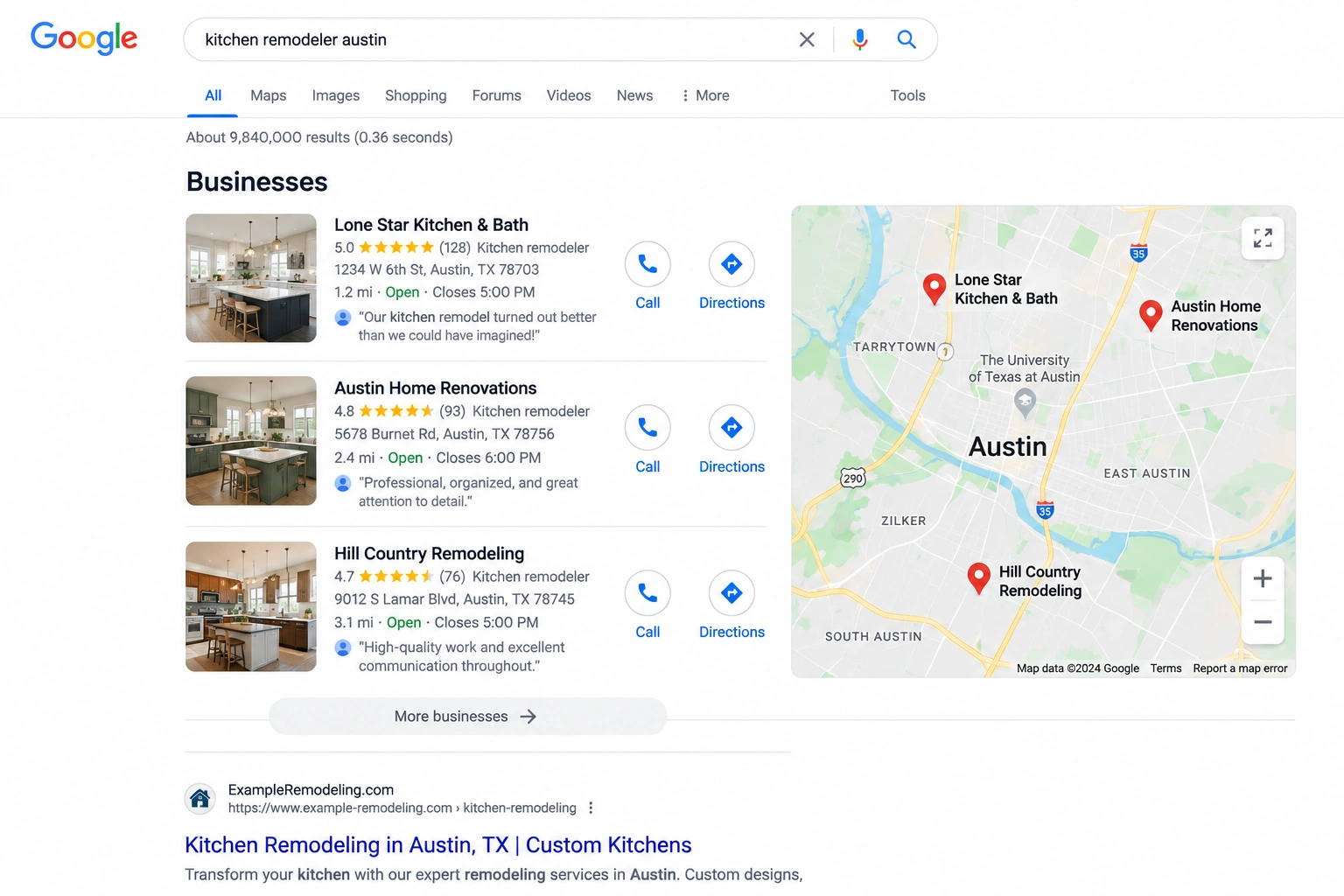
A local search for kitchen remodeling displays three prominent Map Pack listings with ratings, reviews, locations, and direct contact options.
Evaluating Agency Claims: How to Choose a Remodeling SEO Company
When contractors start researching SEO for remodelers, the first challenge is figuring out which agencies understand the trade and which ones are applying a recycled template. The difference usually shows up in how an agency answers direct questions, not in the case studies they send over. Look for proof. A few markers worth watching for:
- Red flag: Guarantees of specific ranking positions (e.g., “#1 on Google”) without any contractual accountability tied to actual business outcomes rather than vanity metrics.
- Green flag: Clear-cut reporting that connects keyword movement to phone calls, form submissions, and lead quality, rather than just traffic volume.
- Red flag: A solo freelancer or a junior-heavy team with no senior oversight, which creates a single point of failure if that person leaves or gets overwhelmed with other clients.
- Green flag: A team-based structure with dedicated account management, where multiple specialists handle technical SEO, content, and local authority building separately, which is a substantial operational difference rather than just a selling point.
Demystifying Link-Building for Renovation Businesses
Link-building is one of the most misunderstood parts of SEO, and also one of the most frequently abused. Think of it the way you’d think about word-of-mouth referrals in your trade network: a recommendation from a respected local supplier, a regional home builders’ association, or a well-read home improvement publication carries legitimate weight. A mention from a random directory site that lists thousands of unrelated businesses carries almost none. Those links fail. Working with a reputable SEO link building agency means building the kind of digital reputation that mirrors how trust works in your industry:
- Earning citations from local business directories, chamber of commerce listings, and regional publications that your target customers read.
- Getting mentioned in digital PR placements: local news coverage, industry roundups, or contractor spotlights: that signal genuine community presence to search engines.
- Securing links from trade associations and supplier networks relevant to your specialty, whether that’s kitchen and bath, whole-home renovation, or historic restoration.
- Avoiding bulk link schemes or low-quality directory spam, which can suppress local visibility rather than improve it.
If you’re evaluating agencies and want a concrete benchmark for accountability, the BizIQ local marketing guarantee is worth understanding before you sign anything. BizIQ guarantees that your business will appear on the first page of Google’s local maps results or organic search results within 60 days for at least two keyword phrases, or your next month’s marketing fee is waived. That’s a performance commitment tied to a real business outcome, not a promise about a metric you can’t take to the bank.
Understanding the Cost: What Does Good SEO Cost?
When contractors ask us how much SEO costs, they are usually trying to figure out if they are getting ripped off. The candid answer is that SEO pricing varies significantly based on your local market’s competitiveness, the current state of your website, and the scope of work required to close the gap between where you rank now and where your best customers are searching. There’s no one-size-fits-all rate card, and any agency that quotes you a flat monthly fee before auditing your site and your market is pricing by formula rather than by your actual situation. For a detailed breakdown of what goes into contractor SEO engagements and what drives cost differences, the SEO pricing for contractors resource covers the major variables. BizIQ’s specific pricing starts at $399/mo: exact figures are discussed during a free custom consultation based on your market and goals.
The more useful frame for evaluating cost isn’t “is this expensive?”: it’s “what am I building?” Paid advertising produces leads while you’re paying for it and stops the moment you pause the campaign. That is renting leads. Organic SEO builds equity in a digital asset you own: a website that ranks, a Google Business Profile with authority, and a content library that answers the questions your best customers are asking before they ever call. The cost per lead from paid channels tends to rise over time as competition increases; organic visibility, once established, doesn’t reset to zero when the invoice goes unpaid.
“I’ve been working with BizIQ for over 7 years and my experience has been exceptional… I’ve worked with several other SEO compaines and never have I had the sustained results that I’ve gotten with BiZIQ.” – Michael Park, Dreamworks Kitchen & Bath
Contracts and Commitments: What to Look for in an Agreement
A sensible SEO contract looks a lot like a renovation timeline: you’re committing to a phased process, not a single event. Month one is typically an audit and technical cleanup, which involves fixing crawl errors, optimizing site structure, and establishing baseline tracking. Month two moves into on-page optimization and local profile setup. This builds momentum. Month three and beyond is where content development and authority building compound over time. Expecting measurable organic growth before that foundation is in place is like expecting a finished kitchen before the rough-in work is done. What you should push back on is any agreement that locks you into a multi-year term without defined performance milestones, or that doesn’t specify what “results” means in contractual language. Ambiguous deliverables in a contract are a problem regardless of how confident the sales pitch sounds.
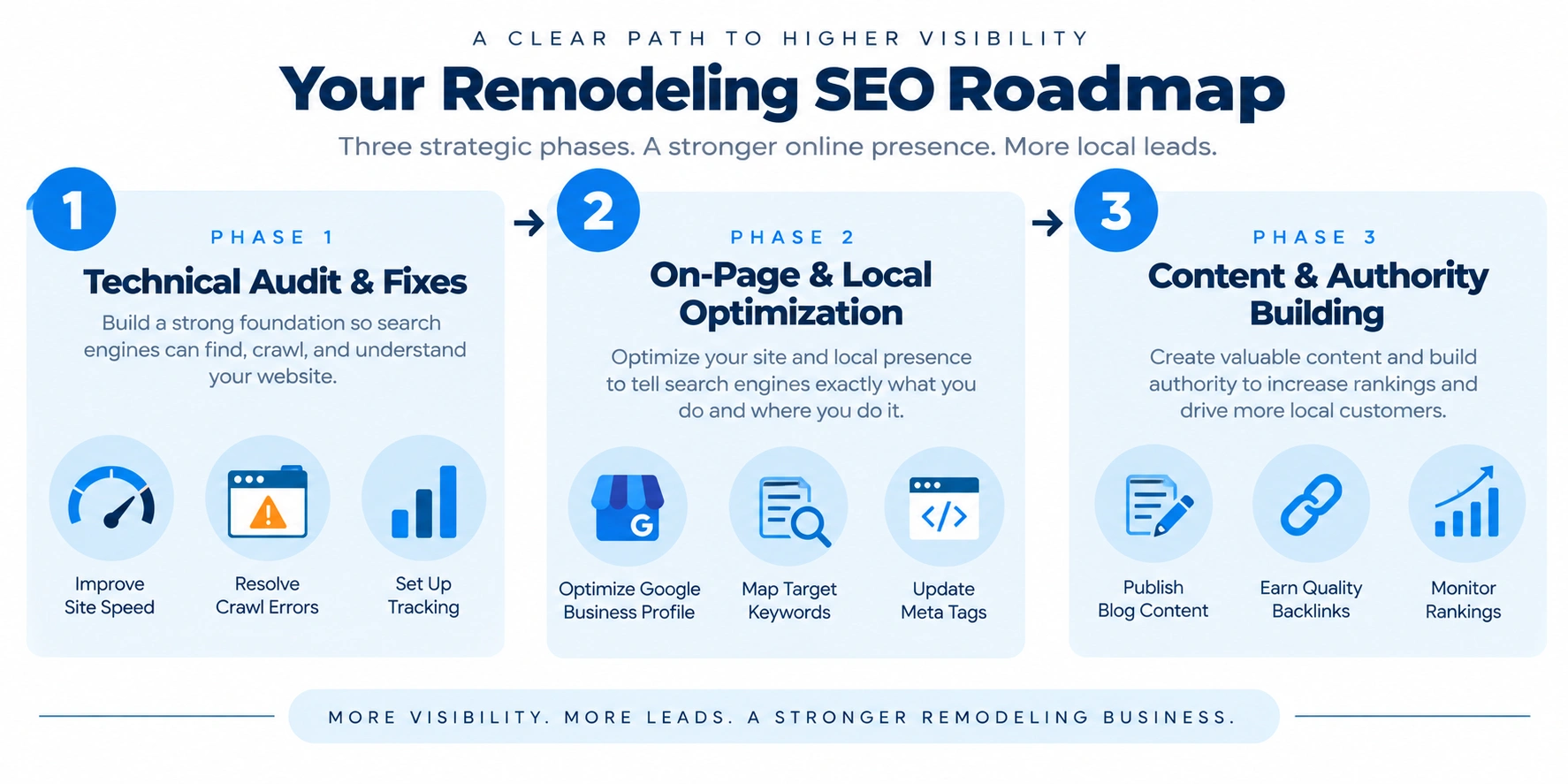
A three-phase SEO roadmap moves from technical improvements to local optimization and ongoing content and authority building for remodeling businesses.
Every remodeling business operates in a different competitive environment: a contractor in a mid-size metro faces different ranking challenges than one in a major urban market. If you want to understand what a realistic local SEO strategy looks like for your specific niche and geography, the remodeling business SEO page is a useful starting point, and a custom consultation will give you a clearer picture of what is involved for your market.
Key Questions to Ask SEO Agencies for Remodelers
Before signing anything, run through these questions on your next agency call. Ask them directly. The quality of the answers will tell you more than any slick case study they send over:
- “How do you handle tracking local keyword rankings, specifically at the city level or the neighborhood level?” A city-wide average can hide the fact that you’re invisible in the zip codes where your best projects come from.
- “Who works on my account day to day, and how often will we communicate?” You want a named account manager and a transparent communication cadence, not a rotating support queue where you have to explain your business to a different person every time you call.
- “Can you show me examples of local links you’ve built for clients in the home improvement space, and explain specifically how you acquired them?”
- “What does your contract say about performance milestones, and what happens if those milestones aren’t met on schedule?”
Tracking What Matters: Local Keyword Rankings and Real Leads
Ranking reports that show your position for a broad city-level keyword are a starting point, not an all-encompassing picture. They hide the truth. When contractors ask us how do I know if it’s working, we look at visibility at the zip-code and neighborhood level using local map grid tools. This involves a grid of geographic points across your service area, each showing where your Google Business Profile ranks from that specific location. A contractor might rank in the top three results near their office address and fall off the map entirely three miles away where a cluster of high-income homeowners is persistently searching. Beyond rankings, the metrics that matter are tracked phone calls, form submissions attributed to organic search, and the quality of those inquiries, not raw traffic volume. Vanity metrics are easy to report; lead quality takes more work to measure and is the only number that connects to revenue.
Frequently Asked Questions About Remodeler SEO
Contractors researching SEO partners tend to ask the same fundamental questions, and they deserve straightforward answers rather than sales-filtered responses. Here are those answers. The questions below cover the specifics that don’t always make it into agency pitch decks, including timelines, trade-offs, tracking methods, contract terms, and what to do when something doesn’t add up. A kitchen remodeler in a competitive metro market and a whole-home renovation contractor in a smaller city will face different challenges, but these questions apply across the board.
Clear Answers for Skeptical Contractors
How long until I see results from SEO for home remodelers?
When wondering how long until I see results, the candid timeline for organic SEO is three to six months before meaningful ranking movement, and six to twelve months before you can draw reliable conclusions about lead volume. That range reflects the actual sequence of work involved, not a hedge. The first month or two is foundation: technical fixes, local profile optimization, and keyword mapping. Rankings don’t move much during this phase because you’re building the infrastructure that makes movement possible. Be patient. Months three through five are when content and authority signals start compounding, and you’ll typically see your Google Business Profile gaining local visibility before your organic website rankings shift significantly. Expecting results in week four is the equivalent of asking a contractor to show you a finished bathroom before the tile has been grouted. Any agency that promises faster results without explaining the specific mechanism behind them is worth questioning.
Is SEO worth it for home remodelers compared to paid ads?
When deciding is SEO worth it for contractors compared to paid ads, the better question is which approach fits your current situation. Paid ads produce leads faster, sometimes within days of launching a campaign, but the cost per inquiry tends to be high, and the leads skew toward price-shoppers filling out forms on multiple sites simultaneously. These leads cost more. Organic search attracts people who are further along in their research, have already formed some intent, and are more likely to be evaluating a shortlist of contractors rather than casting a wide net. The durability difference matters too: paid campaigns stop producing the moment you stop funding them, while organic rankings built over time continue generating inquiries even during slow months. For a contractor who wants to reduce dependence on lead aggregators and build something more stable, SEO for home remodelers is typically the longer-term play, though it requires patience that paid ads don’t demand.
How do we track local SEO for remodeling contractors?
Tracking local SEO effectively requires more than a monthly ranking report. To answer the question, what exactly do I get for my money, look for a tracking setup that includes your Google Business Profile’s performance data (search impressions, direction requests, and phone call clicks), local map grid rankings across your service area rather than a single city-wide position, call tracking numbers that attribute inbound calls to organic search specifically, and form submission data filtered by traffic source in your analytics platform. The combination of these data points tells you whether your visibility is improving in the neighborhoods where your target customers live, and whether that visibility is converting into actual inquiries. Reporting that only shows keyword positions without connecting them to lead activity is incomplete: it tells you how the game is going, but not whether you’re winning.
What is the difference between a generalist agency and a specialist remodeling SEO company?
A generalist agency can execute the technical fundamentals of SEO adeptly, such as site speed, crawl health, and basic on-page optimization. Where they typically fall short is in the content and keyword strategy layer, which requires understanding how remodeling customers search and what they need to see before they trust a contractor enough to call. Sometimes contractors ask, can I do some of this myself? While you can certainly handle basic local listing updates, a specialist understands that “kitchen remodel cost” and “kitchen remodel contractor near me” represent completely different stages of the buyer journey and require different content responses. They know that project photography, licensing information, and detailed service-area pages carry specific weight for remodeling searches. The gap between generalist and specialist shows up most clearly in the quality of content strategy and the relevance of the links they build, not in the technical audit, which most competent agencies handle similarly.
What should I do if an agency guarantees #1 rankings on Google?
Treat it as a signal to ask harder questions. Google explicitly states that no one can guarantee specific ranking positions because the algorithm is dynamic and influenced by factors outside any agency’s control. An agency making this promise without qualification is either overstating their capabilities or planning to use tactics that produce short-term ranking gains at the cost of long-term penalties. The distinction worth understanding is between a ranking guarantee, meaning a specific position for a specific keyword, which is unverifiable and often gamed, and a performance guarantee tied to a real business outcome. BizIQ’s Local Marketing Guarantee commits to first-page visibility in Google’s local maps or organic results within 60 days for at least two keyword phrases, with a financial consequence (a waived monthly fee) if that benchmark isn’t met. That’s a contractually accountable commitment to a measurable outcome, not a promise about a number that can be manipulated.
Choosing an SEO partner for your remodeling business comes down to a few things that have nothing to do with the pitch deck: whether they can explain what they’re doing and why, whether their reporting connects to leads rather than just rankings, and whether the contract holds them accountable to outcomes rather than activity. The contractors who get the most from SEO partnerships are the ones who ask uncomfortable questions early, specifically about timelines, link-building methods, and who will be working on their account day to day. An agency that answers those questions directly, without deflecting into jargon or vague promises, is worth a longer conversation. One that doesn’t is telling you something important before you’ve signed anything.
If you’re ready to have that conversation, BizIQ works specifically with contractors and local service businesses on evidence-based SEO strategies backed by a real performance guarantee. Reach us at (888) 416-9800, or visit us at 3627 E Indian School Rd Suite 103. Our team is available Monday through Friday, 7 AM to 4 PM. If you want to see what a realistic local SEO strategy looks like for your remodeling business before committing to anything, that’s exactly what the first conversation is for.