
Most home remodelers we work with tell us they know they should be showing up in local search. They just do not know where to start, or why the effort matters until they see what happens when it works. If you have spent money on shared lead platforms only to watch the same job go to three other contractors, or if your phone stays quiet despite years of quality work, you already know this frustration. The problem is rarely the craftsmanship. It is that the homeowners who need your services cannot find you, or when they do find you, what they see does not give them enough confidence to pick up the phone.
We have worked standing beside regional home builders and remodelers through exactly this situation. What we have learned is that the path to getting more estimates booked is not a mystery. It is a set of deliberate, interconnected decisions about how your business shows up when someone searches online. This piece walks through what actually works for businesses like ours, grounded in verified industry research and the practical experience of helping remodeling businesses increase local visibility, gain reviews from happy customers, and generate more phone calls from people who actually need us.
A regional home builder and remodeler who starts with a localized search strategy is essentially doing the same thing they do on a job site: translating real-world skill into something a client can see, evaluate, and trust. The digital version of that translation involves your Google Business Profile, your website’s service pages, your review history, and the content you publish. According to NARI’s research on digital presence for remodelers, homeowners planning major renovations actively research online, comparing project photos, reading reviews, and evaluating a contractor’s digital footprint before making contact. That means the decision to call you, or not, often happens before you ever speak to a prospect. Our Beginner’s SEO Guide covers the full technical architecture behind this, but the strategic foundation starts here.
The challenges we see most consistently among remodelers trying to get found online fall into a recognizable pattern:
- Inconsistent phone calls and estimates despite high-quality real-world craftsmanship, because the digital presence does not reflect the work being done on the ground.
- Wasted marketing spend on generic directories that sell the same lead to multiple competitors simultaneously, producing price-race conversations instead of qualified estimates.
- Confusion over what actually works to rank in local search results, compounded by vendors who make vague promises without showing their methodology.
The Digital Front Door: Optimizing Your Google Business Profile
A remodeling company’s Google Business Profile is its digital front door: the first point of engagement for homeowners before they ever visit the main website. Think of it the way you would think of a physical showroom. A showroom that is dusty, unlit, and missing half its displays does not inspire confidence, regardless of the quality of the work displayed in the back. An inactive or incomplete Google Business Profile operates the same way. It signals to both the algorithm and the homeowner that this business may not be actively serving clients.
The profile needs to function as a living asset, not a static directory listing. Consistency is key. For remodelers, this means that digital marketing for contractors involves treating the Google Business Profile as a weekly responsibility, posting project updates, uploading fresh photos from completed jobs, and responding to questions that homeowners leave in the Q&A section. Each of these actions sends engagement signals that reinforce local search visibility. NARI’s industry guidance is consistent on this point: an active profile builds the kind of digital trust that converts a curious homeowner into a scheduled estimate.
Category selection is one of the most overlooked levers in Google Business Profile optimization. Choosing “General Contractor” as a primary category when your core business is kitchen and bath remodeling is the equivalent of a specialty restaurant listing itself as “food service.” The specificity matters because Google uses primary category as a primary ranking signal for high-intent searches, meaning your choice directly dictates which local leads see your business first. A homeowner searching for “kitchen remodeler near me” is far more likely to find a profile categorized as “Kitchen Remodeler” than one categorized broadly. The same logic applies to secondary categories; adding “Bathroom Remodeler,” “Home Addition Contractor,” or “Custom Home Builder” as additional categories expands the range of searches where your profile becomes eligible to appear.
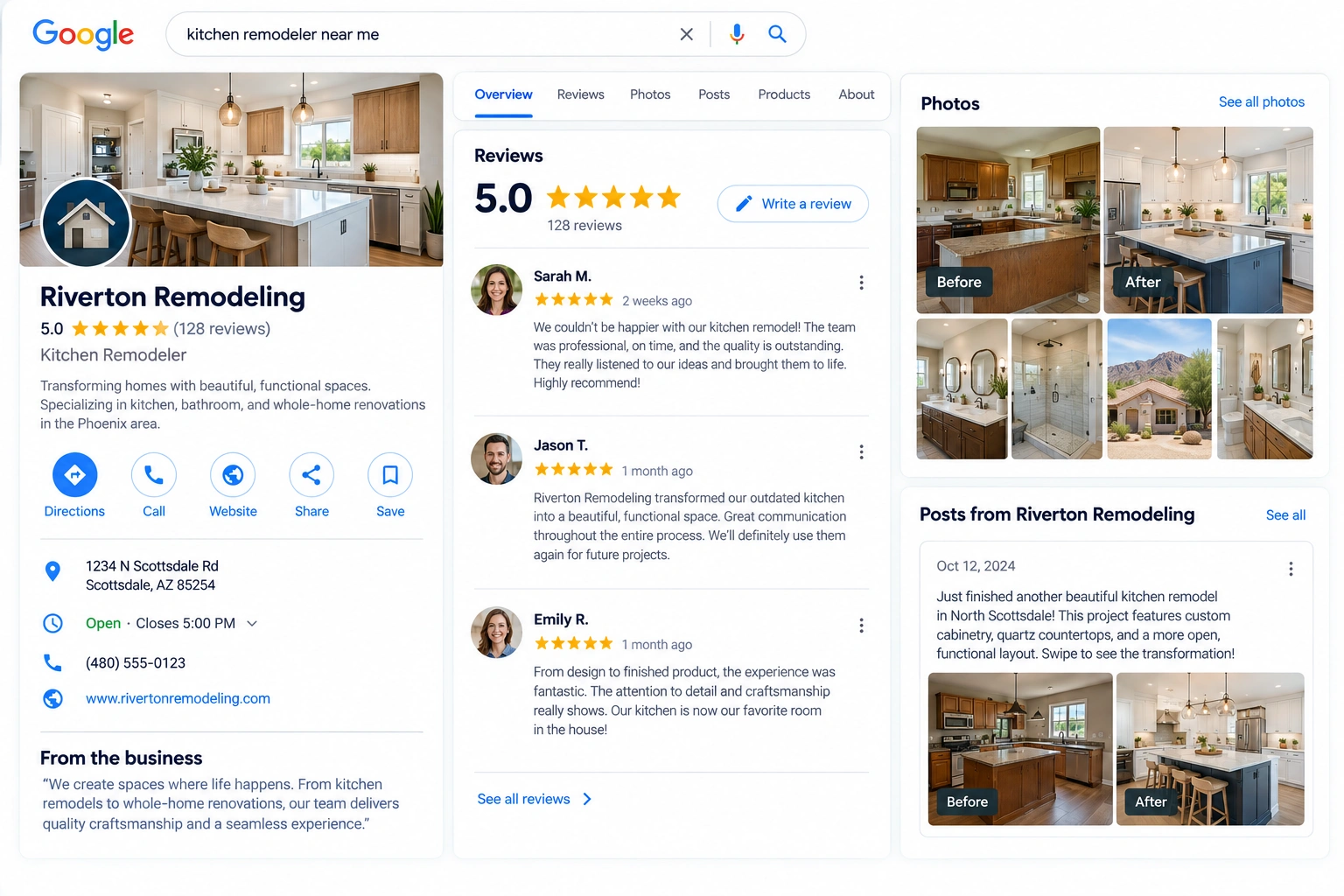
A complete remodeling contractor profile combines accurate business information, strong reviews, project photography, and timely business updates.
Hyperlocal Relevance vs. National Competitors
One of the more lasting advantages a regional home builder and remodeler holds over a national franchise or aggregator platform is geographic specificity, which allows you to speak directly to the unique architectural styles and local building codes of your community. Large national competitors can outspend you on paid advertising, but they cannot manufacture authentic local roots. Local trust cannot be bought. Google’s local search algorithm rewards signals of genuine community presence, and those signals are available to every contractor willing to build them deliberately.
The practical ways mid-sized remodelers can use local relevance to outrank national corporations at the neighborhood level include:
- Localized project pages targeting specific neighborhoods and cities, such as “Kitchen Remodel in [Your Town],” which signal to search engines that your company has direct, verifiable experience in that geography.
- Local backlinks and community sponsorships from chamber memberships, local trade associations like NARI, neighborhood business directories, and community event sponsorships, each of which functions as a third-party endorsement of your local presence.
- Real project photography from specific local subdivisions and neighborhoods, which builds both search relevance and the kind of visual credibility that makes a homeowner feel they are hiring someone who understands their area’s architectural character and building environment.
The combination of these signals, which include localized content, community backlinks, and neighborhood-specific photography, creates a local authority footprint that national competitors structurally cannot duplicate at the neighborhood level. This is where SEO for home remodelers diverges most sharply from generic digital marketing: the specificity of place is the asset.
Expanding Your Geographic Footprint with Service Area Pages
A single location page covering your city is a starting point, not a ceiling. Remodelers who want to capture phone calls and estimates from surrounding suburbs need dedicated service area pages that are genuinely distinct from one another, not templated copies with the city name swapped out. Search engines have grown sophisticated enough to recognize thin, duplicated content, and homeowners can tell the difference between a page written for their community and one that was generated in bulk.
Building geo-expansion pages that truly rank and convert requires a more considered approach, which our local SEO for builders resource covers in depth. The foundational steps are:
- Identify high-value target suburbs within your service area by cross-referencing where your past projects have been located, where permit activity is high, and where homeowner demographics align with your project types.
- Write unique, detailed content for each page that addresses local context, including relevant building codes, common architectural styles in that suburb, HOA considerations, or the types of renovations that are most common in that area’s housing stock.
- Include neighborhood-specific project references and local client testimonials on each page, which at the same time builds search relevance and provides the social proof that converts a visitor into a caller.
The goal is for each page to read as if it was written by someone who has really worked in that community, because ideally, it was. Generic service area pages add little value. Pages that reference the specific character of a neighborhood and the real projects completed there function as both a ranking asset and a trust signal.
Ready to See Where You Stand in Local Search?
Our BizIQ local SEO services are built specifically for businesses that need to rank where their customers are searching. We back our work with a Local Ranking Guarantee: your business will appear on the first page of Google’s local maps results or organic search results within 60 days of beginning our services for at least two keyword phrases, or you do not pay your next month’s marketing fee. We work for free until we get you ranked.
View our BizIQ Local SEO Pricing or call us directly at (888) 416-9800 to discuss your market.
Turning Search Traffic into Booked Jobs through Reputation Management
Online reviews occupy a different position in the remodeling industry than they do in most other service categories. For a homeowner committing to a high-ticket kitchen renovation or a full master bath remodel, the review record is not a secondary consideration: it is often the deciding factor. NARI’s industry research is direct on this point: reviews function as a primary visibility and ranking tool, not simply a reputation bonus. Google’s local search algorithm weighs review recency, volume, and specificity when determining which businesses to surface in competitive local searches.
The practical implication for how you manage online reviews is that review acquisition needs to be a consistent habit, not something that happens when a client volunteers feedback. A consistent process for requesting reviews at project completion, whether through a text, an email, or a direct ask during the final walkthrough, produces the steady collection of recent reviews that both the algorithm and prospective clients are looking for.
Two to three new reviews per month is the threshold NARI research identifies as critical to converting warm leads. The reasoning is worth sitting with: even referred clients, people who received your name from a neighbor or a friend, perform an online search to verify your legitimacy before calling. A profile with a handful of reviews from two years ago does not reassure that homeowner the way a profile with recent, detailed reviews does. The content of those reviews matters as much as the volume. Details build trust. A review that describes specific project details, such as the tile pattern chosen, how the crew managed daily cleanup, and how the project manager communicated during a scheduling delay, carries far more conversion weight than a generic five-star rating with no text. When you ask for reviews, here is what we recommend: encourage clients to describe one or two specific things that stood out about the experience.
“I’ve been working with BizIQ for over 7 years and my experience has been exceptional… I’ve worked with several other SEO companies and never have I had the sustained results that I’ve gotten with BiZIQ.” – Michael Park, Dreamworks Kitchen & Bath
Bridging the Gap Between Online Marketing and Real-World Customer Service
There is a tension that comes with running an effective localized search strategy, and it is worth naming directly. When your phone starts ringing more consistently, and your estimate calendar fills up, the day-to-day pressure on your business increases. Marketing that works creates demand, and demand that outpaces your capacity to deliver creates client service problems that no amount of good SEO can fix. Growth requires balance.
Digital marketing strategist Meredith Oliver, speaking through the NAHB Shop Talk series, makes the case that strategic website design, SEO, and content marketing must work in tandem to convert online shoppers into active buyers, but that conversion only holds if the real-world experience matches the online promise. A remodeling company that markets itself on responsiveness, clean job sites, and clear communication needs to really deliver those things. The online reputation that drives phone calls and estimates is built one project at a time, and it can be damaged the same way. The companies we see maintain their growth are the ones that treat their marketing strategy and their day-to-day capacity as connected systems, scaling one alongside the other rather than treating them as separate departments.
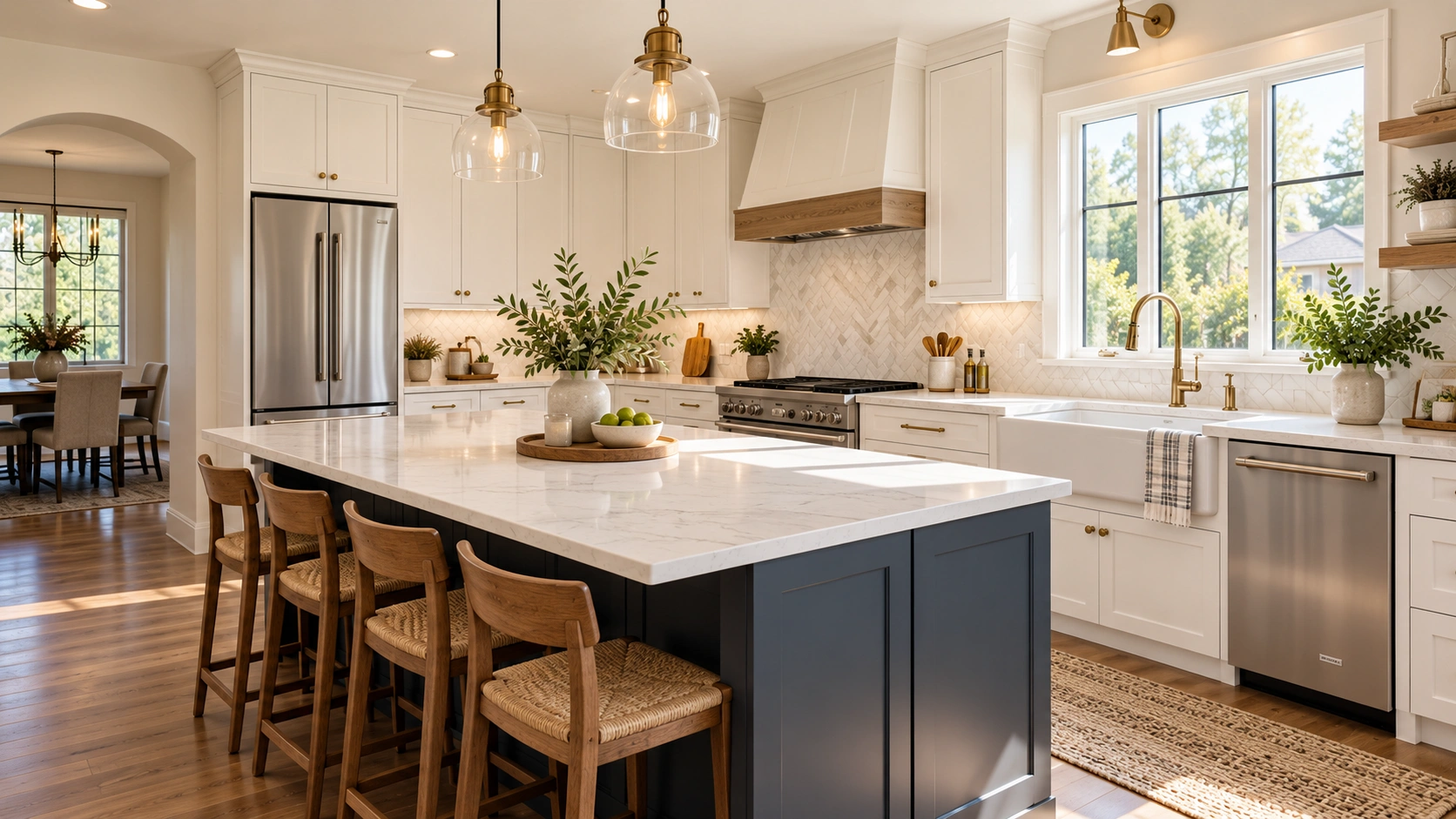
A finished kitchen remodel combines custom cabinetry, a spacious quartz island, warm brass details, and natural light for an inviting result.
Get a Customized Local SEO Audit: No Cost, No Obligation
We will analyze your current Google Business Profile setup, citation consistency across directories, and local keyword rankings against your top local competitors. Get a free SEO audit to see exactly where your localized search strategy stands and where the clearest opportunities for growth are.
Optimizing Your Remodeling Website for Maximum Lead Generation
Your Google Business Profile and service area pages drive traffic. Your website is where that traffic either converts into a phone call or disappears. First impressions matter. The two systems need to work together, and a website that is difficult to navigate, slow to load, or unclear about service areas and project types will bleed the leads that your localized search strategy generates.
The NAHB’s website best practices framework for maximum lead generation identifies several consistent principles for remodeling and home building companies:
- Immediate accessibility of service areas, project portfolios, and contact information; a homeowner who cannot find your phone number or service area within the first few seconds of visiting your site will leave before they call.
- Strategic calls to action placed at natural decision points throughout the site, including after project gallery sections, at the bottom of service pages, and within blog content that addresses homeowner questions.
- Aligned traffic drivers including SEO for remodeling companies, paid search, and social media, used in a way so that each channel reinforces the others rather than operating in silos.
The website also needs to reflect the quality of the work. A portfolio section with low-resolution photos or projects that are not categorized by type and location makes it harder for a homeowner to find the specific evidence they are looking for. High-resolution before-and-after galleries, organized by project type and tagged to specific neighborhoods or cities, serve double duty: they build search relevance, and they give the homeowner the visual confidence to make contact.
Addressing Homeowner Anxiety with Helpful Content
Homeowners researching major renovations are not just looking for a contractor; they are managing anxiety. Costs are uncertain, timelines feel uncertain, and the internet is full of contractor horror stories. Trust is hard-won. NARI’s research on homeowner behavior is clear that this anxiety shapes how people search and what content earns their trust before a sales conversation begins.
A remodeling company that publishes genuinely helpful content: realistic project timelines, guides for evaluating contractor bids, explanations of what the permitting process involves in your area, or walkthroughs of what to expect during a kitchen demo; positions itself as a credible partner rather than just another vendor. This content does not need to be honest and specific. We are not recommending inventing national average cost figures that may not apply to your market; instead, here is what we recommend: publish your own local cost ranges based on the projects you truly complete, with honest context about what drives costs up or down. That kind of transparency builds more trust than a generic price estimate copied from a national source, and it attracts the homeowners who are already mentally prepared to invest in quality work.
The content strategy and the localized search strategy reinforce each other. Pages that answer real homeowner questions earn organic search traffic from people who are actively researching, which means they arrive at your site already engaged, already thinking about their project, and already partway through the decision process.
Frequently Asked Questions About SEO for Remodeling Companies
The questions below come up consistently among remodelers who are working through their localized search strategy for the first time or reassessing an approach that has not produced results. We have answered them with the same directness we use with clients: no hedging, no vague recommendations, and no promises we cannot back up.
Common Queries on Local Search and Reputation Management
How do we choose the right primary category for our Google Business Profile?
The primary category is one of the most important settings in your Google Business Profile, and it is also one of the most commonly misconfigured. Choosing a broad category like “General Contractor” when your core business is kitchen and bath remodeling means you are competing for visibility in a much wider pool while simultaneously being less relevant for the high-intent searches that truly produce estimates. Specificity wins here. “Kitchen Remodeler,” “Bathroom Remodeler,” or “Home Addition Contractor” as a primary category tells Google’s algorithm exactly what type of work you do, which makes your profile eligible to appear when homeowners search for that specific service in your area. Our [MISSING: downloadable asset] covers the full category selection process, including how to layer secondary categories to expand your visibility across related search terms without diluting your primary relevance signal.
How many reviews do we need to secure each month to see a difference?
According to NARI’s research on contractor digital presence, securing two to three new reviews per month is the threshold that keeps your profile competitive for converting warm leads. The reason this number matters is not algorithmic alone; it is behavioral. Even a referred client, someone who already heard your name from a trusted source, will search for you online before calling. A profile with stale reviews or a thin review history creates doubt at exactly the moment when that homeowner is deciding whether to reach out. The content of the reviews matters as much as the cadence. Reviews that describe specific project details, like the type of tile installed, how the crew communicated during a delay, or what the finished space looks like, are significantly more convincing than generic five-star ratings. When you ask clients for reviews, encourage them to describe one or two specifics. That guidance alone tends to produce more useful reviews without requiring additional effort from the client.
Can a local remodeling company outrank large national competitors?
Yes, and the mechanism is worth understanding clearly. Google’s local search algorithm prioritizes signals of genuine local relevance: project references from specific neighborhoods, community involvement, backlinks from local organizations, and review content that names specific locations and project types. National competitors and aggregator platforms can outspend a regional home builder and remodeler on paid advertising, but they cannot manufacture the neighborhood-level specificity that Google rewards in organic and map-pack results. NARI’s research on local digital presence confirms that mid-sized remodelers who build this kind of hyperlocal footprint, through localized project pages, community backlinks, and geo-tagged photography, consistently outperform larger national brands at the neighborhood level. The investment is in specificity and consistency, not in budget.
How does real project photography impact our local search rankings?
Project photography operates on two levels simultaneously. At the search level, photos uploaded to your Google Business Profile and website contribute to engagement signals, such as how long visitors spend on your profile, whether they click through to your website, and whether they interact with your content. At the conversion level, before-and-after galleries organized by project type and location give homeowners the visual evidence they need to feel confident about reaching out. NARI’s industry research identifies real project photography, particularly before-and-after galleries from specific neighborhoods or cities, as a powerful conversion asset and local search signal. A photo tagged to a specific subdivision or city reinforces the geographic relevance of your profile in a way that stock photography or generic images cannot. The practical recommendation is straightforward: photograph every completed project, organize the images by type and location, and upload them consistently to both your website and your Google Business Profile.
What is the Harold Hammerman “Spirit of Education” Award?
It is a national recognition presented by NARI to individuals who have made significant contributions to educating remodeling professionals. In 2025, the award was presented to Bob Vance, owner of Home Remodelers SEO, for his work training remodeling professionals in digital marketing, website optimization, and customer engagement. The recognition is notable because it signals how central digital literacy has become to professional development within the remodeling industry; this is no longer a peripheral skill set but a core competency that NARI is formally acknowledging through its NARI Achievement Awards program.
A localized search strategy is not a campaign you run once and walk away from. It is a system that compounds over time, with each new review, each updated project photo, and each geo-targeted service page adding to a digital footprint that becomes progressively harder for competitors to displace. The remodelers we work with who see the most consistent growth are the ones who treat their online presence with the same discipline they bring to a job site: showing up regularly, doing the work carefully, and letting the quality of the output speak for itself.
We are standing beside regional home builders and remodelers through every stage of that process, from the initial audit of what is working and what is not, through the technical buildout of service pages and profile optimization, to the ongoing management of reviews and content that keeps the pipeline full. As Garrett Cisek, Co-Founder of BizIQ, puts it: “Because we started as a small business, we understand the hurdles that many small business owners have to face when they begin to market their brand and services online.” That perspective shapes how we approach SEO for remodeling companies: not as a vendor selling a product, but as a partner who has worked through the same challenges.
Schedule a Consultation and See Our 60-Day Local Ranking Guarantee in Action
If your phone calls and estimates are not where they need to be, the next step is a direct conversation about your market, your current visibility, and what a realistic growth path looks like. We back every engagement with our Local Ranking Guarantee: first-page placement in Google’s local maps or organic results within 60 days for at least two keyword phrases, or your next month’s marketing fee is waived.
View BizIQ Local SEO Pricing to see plan options, or call us at (888) 416-9800 to speak with someone directly.