
Your remodeling business builds exceptional, high-quality spaces, but if your home renovation website isn’t showing up in search results, local homeowners can’t hire you. We put together this detailed SEO for home remodelers checklist to give you a clear, practical path to optimizing your website, earning trust with search engines, and converting online searches into high-ticket remodeling projects. No jargon, no filler: just the specific steps that move the needle for home renovation businesses like yours.
On-page SEO is the structural framing of your digital presence. It supports everything else. Just as a custom home with out-of-square framing will fight you at every finish stage, a website with weak on-page foundations will underperform regardless of how much you spend on ads or social media. The good news is that executing targeted on-page fixes can improve your local visibility and conversion rates faster than most remodelers expect. Search engines need clear, consistent signals to understand what services you offer and where you build, and every item on this checklist is designed to send exactly those signals.
- Keyword Targeting and Page Structure: Aligning your content with how homeowners typically search for remodeling services.
- Local Trust Signals: Making it simple for both Google and local homeowners to verify your physical location and contact details.
- Visual Portfolio Optimization: Ensuring your high-resolution project galleries load quickly and communicate relevance to search engines.
Mapping Your Services to Local Search Intent
- Effective keyword research for home renovation websites starts with understanding how homeowners describe their problems, not how remodelers describe their services. Homeowners rarely search for broad construction terms; they search for specific solutions like “master bathroom remodelers near me” or “modern kitchen design-build remodeler.” That distinction matters enormously when you’re deciding which phrases to target on each page. Specificity drives conversions. Understanding local search intent means recognizing that a homeowner typing “historic home renovations” is much closer to signing a contract than one typing “home improvement ideas.”
- Deliberate keyword mapping ensures every service page on your website targets a distinct cluster of keywords. When multiple pages compete for the same terms, search engines struggle to determine which page deserves to rank, a problem called keyword cannibalization that quietly drains your organic visibility. Mapping your terms to individual remodeling service pages prevents this and creates a clean architecture that search engines can crawl efficiently. For a deeper look at how to align search terms with buyer intent across a construction business, our guide on commercial construction keywords walks through the mapping process in detail.
- Targeting high-intent phrases narrows the competitive field dramatically. A remodeler in a mid-sized market who only targets “home remodeling” is competing against every remodeler, franchise, and home improvement retailer in the country. Optimizing individual pages for phrases like “luxury kitchen remodeling in [City]” or “historic home restoration remodeler” attracts visitors who are already committed to hiring someone. Organic search traffic built this way compounds over time, unlike paid ads, which stop generating leads the moment you stop paying. The investment in getting your pages right today continues paying dividends for years.
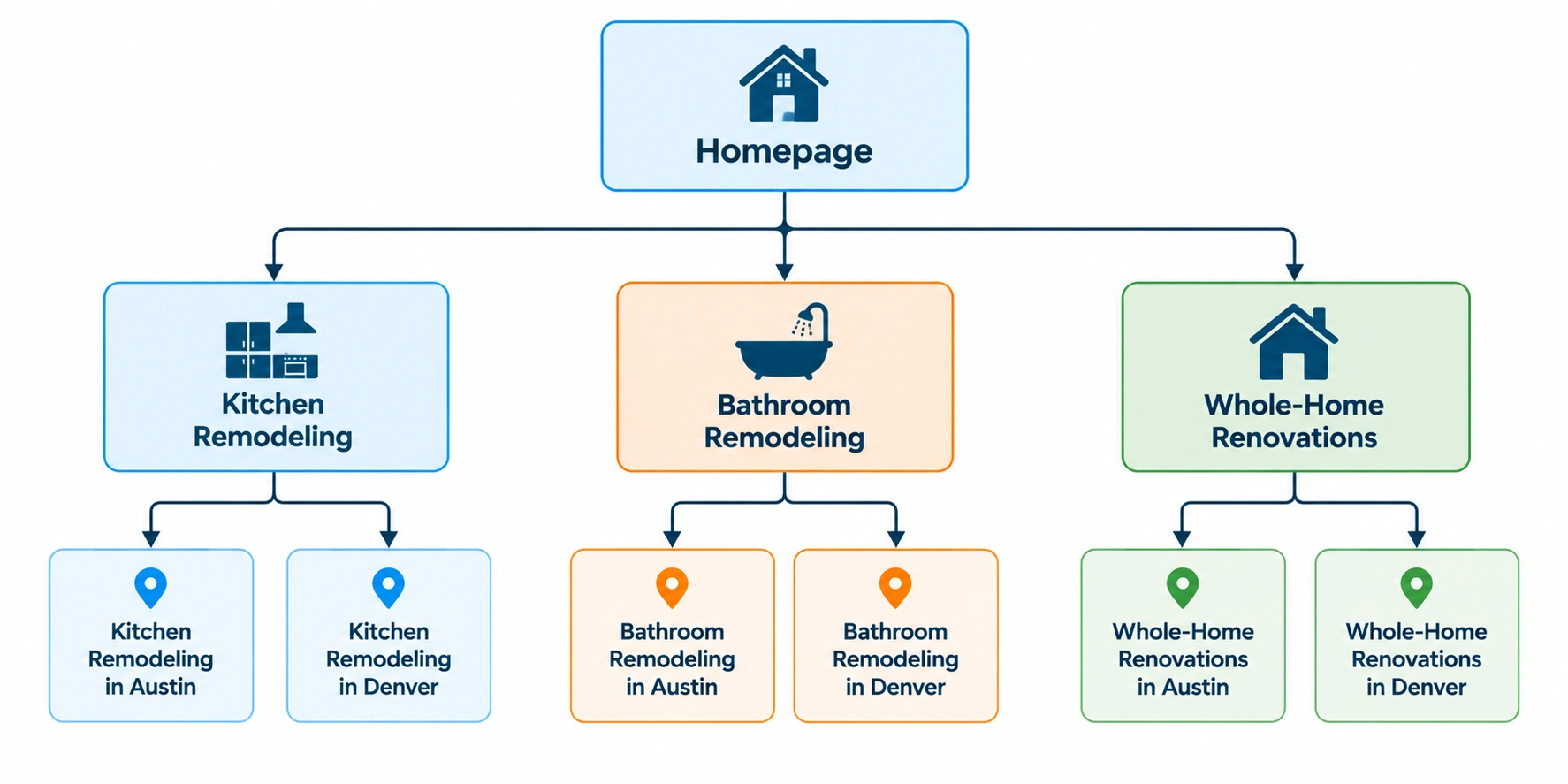
A structured home remodeling website connects core service pages with location-specific pages for kitchen, bathroom, and whole-home renovations.
Optimizing Page Titles and Header Tags for Maximum Visibility
The HTML elements that frame each page, title tags, H1s, and subheadings, are among the highest-leverage on-page signals you control. Getting these right across every service page is essential to SEO for remodelers. Do not skip them.
- Title Tags (50-60 characters): Place your primary service and city first: for example, “Kitchen Remodeling in [City] | [Brand Name].” This format surfaces your page when local homeowners search for immediate help, and it keeps the most relevant information visible in the search result snippet before it gets truncated.
- H1 Headings: Each page gets exactly one H1, and it must directly match what the user searched for. “Premier Home Renovation and Remodeling Services in [City]” works; a vague tagline does not.
- H2 and H3 Subheadings: Use H2s to organize major content sections, like “Our Remodeling Process” and “Materials We Use,” and H3s for the granular steps within them, like “Initial Design Consultation” or “Construction & Finish Work.” This hierarchy helps search engines parse your page’s structure and helps homeowners skim to the information they need.
Implementing local SEO for small businesses effectively requires weaving geographic modifiers into these HTML tags at every level, not just the title tag, to capture the full range of local search volume your market offers.
Crafting High-Converting Remodeling Service Pages
A service page that ranks but doesn’t convert is a missed opportunity. Traffic alone is useless. Each page needs to do two jobs concurrently: satisfy the search engine’s relevance criteria and persuade a homeowner to pick up the phone.
- Clear Value Proposition: State immediately what distinguishes your craftsmanship and which service areas you cover. Homeowners evaluating multiple remodelers make fast judgments: give them a reason to stay on your page within the first two sentences.
- Service-Specific Content: Write at least 500 words of unique, substantive content for each service page. Thin content or copy-pasted text across pages signals low quality to search engines and erodes the trust homeowners need before committing to a five-figure project.
- Strategic Internal Linking: Connect your service pages to your portfolio galleries and contact page to guide visitors naturally through their research. A homeowner reading about your bathroom remodeling process should be one click away from seeing your finished work.
Professional on-page optimization ensures your meta tags, image alt texts, and header structure work in concert to send coherent relevance signals to search engine crawlers, rather than having each element operate in isolation.
Is your website failing to bring in the high-ticket remodeling leads you need to grow?
You don’t have to navigate technical SEO on your own. At BizIQ, we specialize in helping local remodelers build a powerful, compounding online presence that keeps their phones ringing. Let our team handle your digital marketing so you can focus on building beautiful spaces. Explore our detailed home remodeling marketing solutions today to request your custom website evaluation.
Maximizing Local Trust with NAP Uniformity and Phone Placement
Here are the key local trust factors to focus on:
- Absolute NAP Uniformity: Local search engines prioritize businesses they can verify as legitimate, physical operations. The most critical signal you can provide is absolute uniformity in your Name, Address, and Phone number, known as NAP uniformity, across every page of your website and every directory listing on the web. A single discrepancy between your website footer and your Google Business Profile can dilute the local authority you’ve worked to build. When we audit a remodeling company’s local footprint, we use their official contact details as the benchmark for every listing and page. For example, a properly formatted address entry looks like this: 3627 E Indian School Rd Suite 103, Phone: (888) 416-9800. Even minor formatting variations, such as “Suite #103” on one page versus “Ste 103” on another, can confuse search engine crawlers and fragment your local authority across multiple unverified entries. Uniformity at this level of granularity is what separates remodelers who stand out in their local map pack from those who barely appear in it.
- Strategic Phone Number Placement: Equally important is having a prominent phone number on every page of your website, ideally in the top-right corner of the header and repeated in the footer. Homeowners who are ready to call for an estimate should never have to hunt for your number. Make it obvious. Our on-site optimization packages include a full audit of your website’s contact information to ensure search engines can verify your physical location without ambiguity.
“Because we started as a small business, we understand the hurdles that many small business owners have to face when they begin to market their brand and services online”, Garrett Cisek, Co-Founder of BizIQ
Optimizing Project Galleries and Portfolio Images
Remodeling is a visual sale. Homeowners want to see your finished work before they invite you into their homes, which makes your portfolio gallery one of the most persuasive pages on your site, and also one of the most technically vulnerable. Large, unoptimized portfolio images are the leading cause of slow website loading speeds, and slow pages lose rankings and visitors simultaneously. Speed matters.
The fix is systematic:
- Compress every image file before uploading.
- Convert to modern formats like WebP.
- Write descriptive, keyword-rich image alt text for each photo.
An alt text entry like “modern kitchen remodel with quartz countertops in [City]” does two things: it tells search engines what the image depicts and reinforces the geographic and service relevance of the page. Implementing affordable local SEO strategies means treating your visual assets with the same optimization discipline as your written content, because slow loading speeds on mobile devices will cost you prospective clients before they ever read a single word.
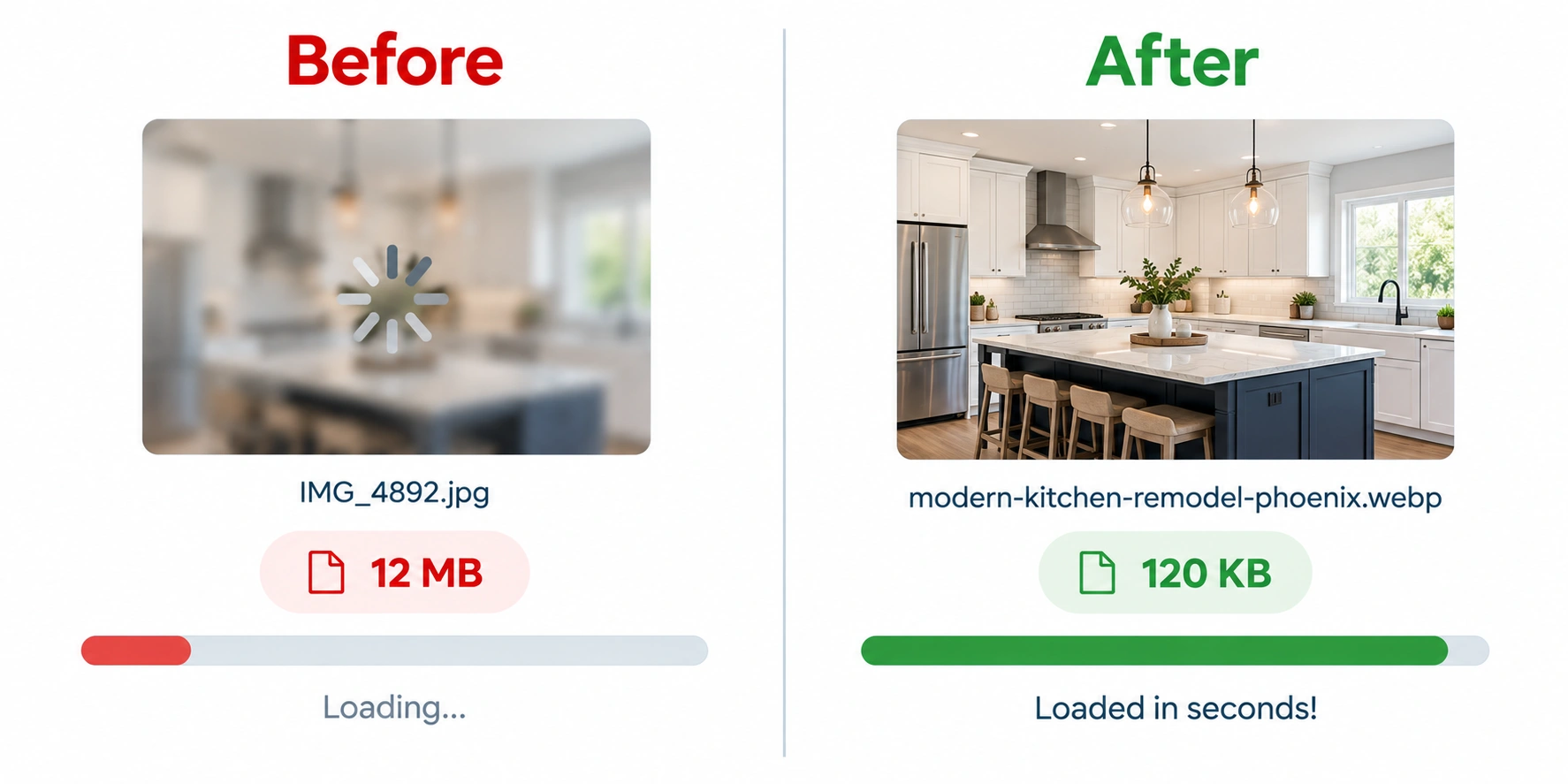
Image optimization reduces a large 12 MB file to a lightweight 120 KB WebP while preserving a crisp, professional kitchen remodel photo.
Don’t let slow-loading images or hidden technical errors drive potential clients to your competitors.
A fast, optimized website is your most productive sales asset, working around the clock to capture high-value renovation leads. Contact BizIQ today at (888) 416-9800 to speak with our team and find out how we can help your business appear where local homeowners are actively searching.
Implementing Local Schema Markup for Remodeling Companies
Schema markup is structured data you add to your website’s code to give search engines an unambiguous, machine-readable description of your business. Think of it as giving search engines a cheat sheet about your business: you’re handing them the answers so they can recommend you to the right customers. For SEO for remodelers, three schema types are non-negotiable: They clarify your data.
- HomeAndConstructionBusiness Schema: Communicates your specific business category, operating hours (Monday through Friday, 7 AM – 4 PM), and physical address directly to search engines, removing any ambiguity about what you do and when you’re available.
- LocalBusiness Schema: Surfaces your local phone number and defines your geographic service area, reinforcing the proximity signals that determine whether you appear in map pack results.
- Project Schema: Associates specific completed projects with geographic locations, giving search engines concrete evidence of your local activity rather than just your stated service area.
Best Practices for Contractor Website Content
Search engines reward content that demonstrates authentic, first-hand expertise, and homeowners do too. Google’s quality guidelines place significant weight on real-world experience as a trust signal, which means a page written by someone who has personally managed a historic renovation project will consistently outperform a page assembled from generic industry descriptions.
Remodeling companies who write detailed project narratives, explaining why they chose a specific tile substrate for a steam shower, or how they navigated a load-bearing wall removal during a kitchen expansion, produce original content that no competitor can replicate. That specificity builds local authority because it signals to both search engines and prospective clients that your expertise is authentic and geographically grounded. Real experience wins. For a detailed framework covering content creation, citation building, and long-term ranking strategy, our SEO guide covers the full scope of what it takes to build visibility in your local market.
Ensuring Mobile-Friendliness and Technical Site Health
- Responsive design: Your site needs a layout that adapts cleanly to any screen size, especially since most homeowners research remodeling ideas on their smartphones, often while sitting in the exact room they want to renovate.
- Fast page loading speeds: If pages take several seconds to load, visitors leave before they ever engage with your content or your credentials. That activity sends negative signals to search engines, compounding the problem over time.
- Tap-friendly buttons and easy navigation: If your website is difficult to navigate on a small screen, or if buttons are too small to tap accurately, it fails the user. Your site needs call-to-action buttons large enough to tap confidently on a phone.
- Readable text: Text must read clearly without zooming so that homeowners standing in their outdated kitchens can find the information they need immediately.
- Search engine compliance: Mobile-friendliness is a direct ranking factor, not an optional enhancement. It is essential. A site that fails local mobile searches hands the lead to whoever ranks below you, missing out on searches that frequently translate into direct phone calls and project inquiries.
Frequently Asked Questions About Remodeling SEO
How long does it take for a remodeling website to rank on Google?
SEO is a compounding, long-term investment. While minor technical fixes and on-page adjustments can yield improvements in conversion rates within a few weeks, it generally takes 3 to 6 months of consistent optimization to see significant ranking improvements for competitive local keywords.
Should I create separate pages for every city I serve?
Yes. If your physical office is in one city but you serve multiple surrounding areas, creating dedicated, high-quality service-area pages is highly recommended. Each page should feature unique content, local project details, and testimonials from homeowners in that specific city to avoid search engine penalties for duplicate content.
Do I need a blog for my home renovation website?
While not strictly mandatory, a blog is an exceptionally powerful tool to build topical authority. Writing about local building permits, remodeling cost guides, or design trends allows you to capture homeowners early in their research phase, long before they are ready to hire a remodeler.
What is the difference between organic SEO and Local SEO?
Organic SEO focuses on improving your website’s visibility in standard search results for informational queries. Local SEO specifically targets local search intent, optimizing your website and Google Business Profile to appear in the local Map Pack and map searches for geographic-specific queries.
How do I track the success of my on-page SEO efforts?
Monitor key performance indicators using free tools like Google Search Console and Google Analytics. Track organic search impressions, keyword rankings for your service pages, and, most importantly, direct conversions such as contact form submissions and phone calls.
Optimizing your home renovation website doesn’t have to be an overwhelming undertaking. By starting with the foundational steps in this checklist: mapping your keywords to individual service pages, placing your phone number prominently on every page, and compressing your project photos before upload, you build a digital presence that generates leads consistently rather than sporadically. Each item you complete compounds on the ones before it, and the gap between a well-optimized remodeler site and a neglected one widens every month. If you’re ready to move beyond DIY adjustments toward a professional, compounding local search strategy, partnering with a team that understands both the technical and local dimensions of remodeler SEO ensures every detail is executed correctly.
Ready to get found by homeowners and fill your schedule with high-value remodeling projects? At BizIQ, we have spent years helping small businesses and remodelers build sustainable, high-performing online presences that deliver measurable results. Let us turn your website into your most profitable asset. Contact us today to learn more about our specialized remodeling company SEO services and request your professional site evaluation.