Written by Chris Osburn, BizIQ SEO Team. We help independent local businesses outsmart corporate giants through honest, high-impact digital marketing strategies.
Key Takeaways
- The Steering Problem: Insurers deploy rehearsed, fear-based scripts and Direct Repair Programs (DRPs) to divert your customers to preferred shops, often before you ever get a second call.
- The SEO Solution: Intercepting drivers online before they reach their claims adjuster is the most effective counter-offensive available to an independent shop today.
- The Revenue Payoff: Building an insurance education hub on your website protects your profit margins, neutralizes the insurer’s pitch, and secures your independence from referral networks you don’t control.
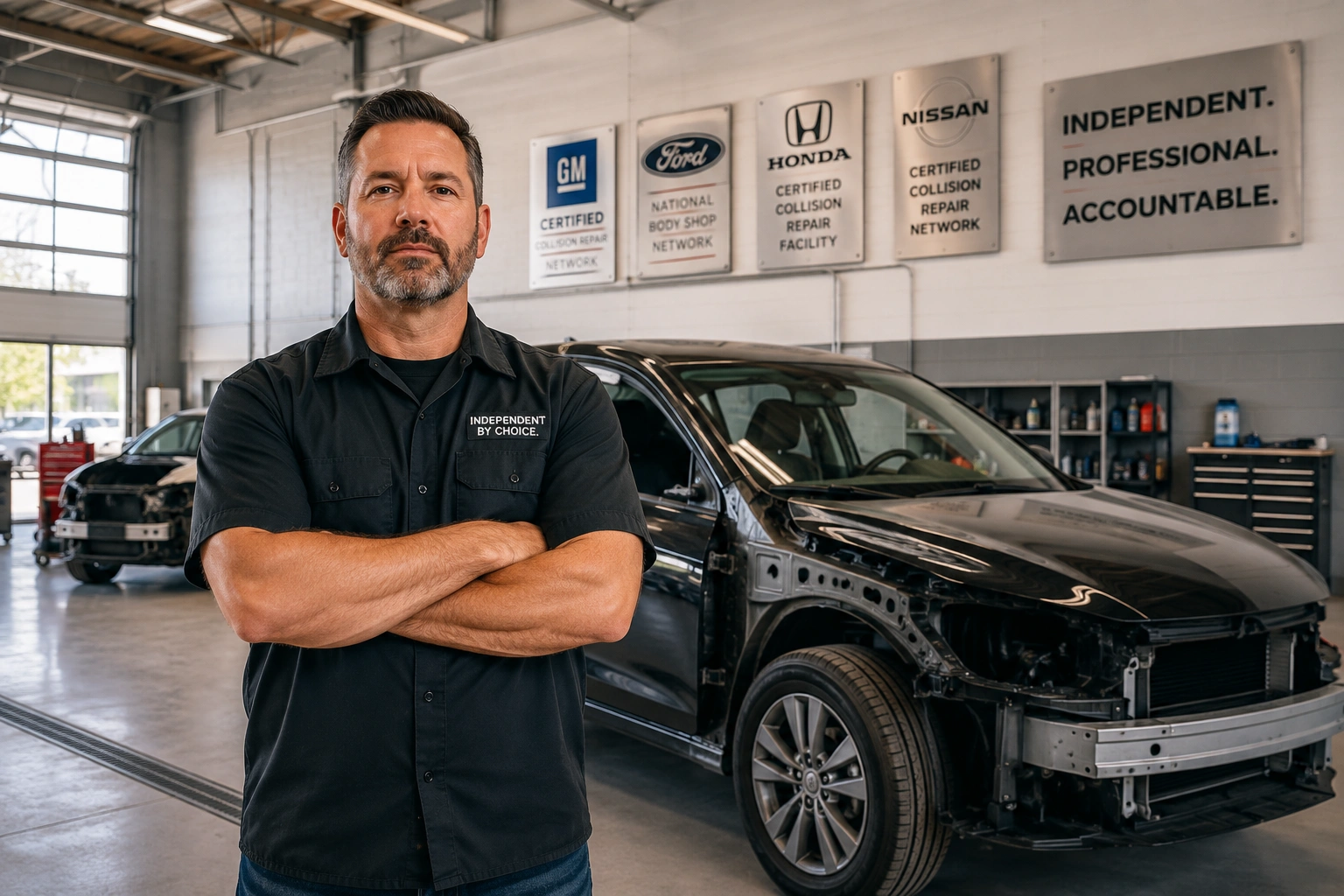
An independent collision repair shop owner stands in a professional facility showcasing OEM certifications and quality workmanship.
How Can SEO Help Insurance Repair Shops Recover Leads Lost to Insurance steering?
Auto Body Shop SEO helps insurance repair shops recover leads by making their business visible when customers search independently for trusted repair providers. While insurance steering can influence a customer’s initial decision, a strong SEO strategy increases your visibility in Google and AI-powered search, builds trust through authoritative content and reviews, and helps drivers find and choose your shop based on reputation, expertise, and convenience rather than insurer recommendations alone.
Every independent auto body shop owner knows the sinking feeling of a stolen customer. A driver calls you from the scene of an accident, shaken but relieved to hear your voice. They want you to fix their car. But it doesn’t last. Two hours later, they call back to cancel. Their insurance adjuster told them that if they use your shop, the repairs won’t be guaranteed, the claim will be delayed, and they might be stuck with the bill. This isn’t a misunderstanding or a clumsy adjuster having a bad day. It is insurance steering, a calculated and scripted practice, and it is actively draining your shop’s revenue.
The frustrating part isn’t just losing the job; it is watching a customer’s hard-earned trust get systematically dismantled in minutes by an adjuster’s rehearsed script. It’s knowing the driver trusted you first, and that trust was systematically dismantled by someone with a phone script and a financial incentive to send that car somewhere else.
Setting the Stage: The DRP Squeeze
Insurance steering is a deep-seated challenge that forces independent shops into a brutal binary: join a Direct Repair Program and slash your labor rates, or stay independent and watch your local market share erode. According to data from the National Association of Insurance Commissioners (NAIC), between 44% and 50% of auto body shops participate in DRPs, and those participating shops rely on insurers for 57% of their total sales. That level of reliance hands the insurer enormous leverage over pricing, parts selection, cycle times, and ultimately, over your shop’s survival.
Think of it like someone else getting to decide which restaurant your regular customers visit, even though you are the one who earned their loyalty and built the reputation. The insurer didn’t do the work. They just control the referral faucet.
For the independent shop, competing against that referral engine feels like bringing a clipboard to a gunfight. But there is a genuine vulnerability in the insurer’s playbook: drivers search the internet before they call their insurance company. That window, brief, high-anxiety, and full of unanswered questions, is where you win or lose the customer relationship.
The Silent Customer Thief: How Insurance Steering Stifles Independent Shops
The Insurer’s Coercive Scripting
Defining insurance steering clearly matters here because the practice is deliberately designed to look like helpful customer service. In insurance terms, steering refers to the act of directing or pressuring a policyholder toward a specific vendor, which in this case means a DRP-affiliated collision center, through pressure, misinformation, or manufactured urgency.
The scripts adjusters use are polished. They don’t say “you must use our shop.” They say things like: “We can’t guarantee the work if you go somewhere out of network,” or “It could take weeks longer to process your claim at an independent facility.” Both statements are misleading. The warranty on collision repairs comes from the auto body shop, not the insurance company. When an insurer claims they “can’t guarantee” your work, they are hiding the fact that they never guaranteed any shop’s work in the first place.
The driver on the other end of that call is not in a rational decision-making state. They’ve just been in an accident. They’re stressed, possibly injured, and looking for someone to tell them what to do. The adjuster sounds authoritative. The script is designed to exploit that psychological vulnerability, not inform it.
The Impact on Repair Quality and Safety
This is where the stakes move beyond revenue. DRP agreements frequently mandate the use of non-OEM or salvage parts to minimize claim payouts, a compromise that directly compromises structural integrity and occupant safety. Modern vehicles are not forgiving of approximation. The average Total Cost of Repair (TCOR) reached $4,730 in 2024, driven in large part by the spread of Advanced Driver Assistance Systems (ADAS), which now appear on over 31% of all repair estimates. These systems require precise calibration to function correctly post-collision. Evidence shows that 50% of consumers who had their vehicles repaired returned due to ADAS-related calibration failures, a direct consequence of DRP shops cutting corners to satisfy insurer budget targets.
The landmark litigation Indiana Autobody v. State Farm put hard numbers on what active steering does to non-DRP shops. When carriers implemented aggressive steering protocols, independent shops saw immediate, measurable collapses in repair volume: work from American Family insureds dropped by 60%, Farmers (Zurich) by 50%, Shelter Insurance by 40%, and Liberty Mutual by 25%. These aren’t gradual market shifts. They’re the documented result of a coordinated referral cutoff.
The Friction of DRP Agreements
The mechanics of DRP participation deserve a clear-eyed look, because the insurer’s pitch to shops, including steady volume, administrative simplicity, and a reliable referral stream, hides what the agreement really costs. Insurers cap labor rates far below prevailing market averages. They impose strict administrative oversight, including cycle time metrics that pressure shops to prioritize throughput over thoroughness. And they retain the right to audit, renegotiate, or terminate the relationship at will.
This puts DRP shops in a genuine conflict of interest. They must choose. Please the insurer to maintain referral volume, or follow OEM repair guidelines and risk ejection from the network. For shops that have built their entire business model around DRP referrals, which, given that 57% figure, is a meaningful portion of the industry, that’s not a theoretical tension. It’s a daily operational reality.
The Financial Reality of Steering
The revenue gap between DRP-participating and independent shops is stark enough to warrant direct attention. DRP-participating shops generate an average of $867,800 in gross annual sales compared to just $326,800 for non-DRP independent shops, a massive gap that highlights the financial pressure independent shops face daily. That gap isn’t purely a function of quality or reputation. A significant portion of it reflects the insurer’s referral machinery working exactly as designed.
For the independent shop, this gap clarifies the strategic necessity: building an alternative local customer acquisition channel isn’t optional. It’s existential. To genuinely combat insurance company steering tactics, you need to reach the driver before the adjuster does. The most reliable way to do that, at scale, is through search. SEO makes it possible.
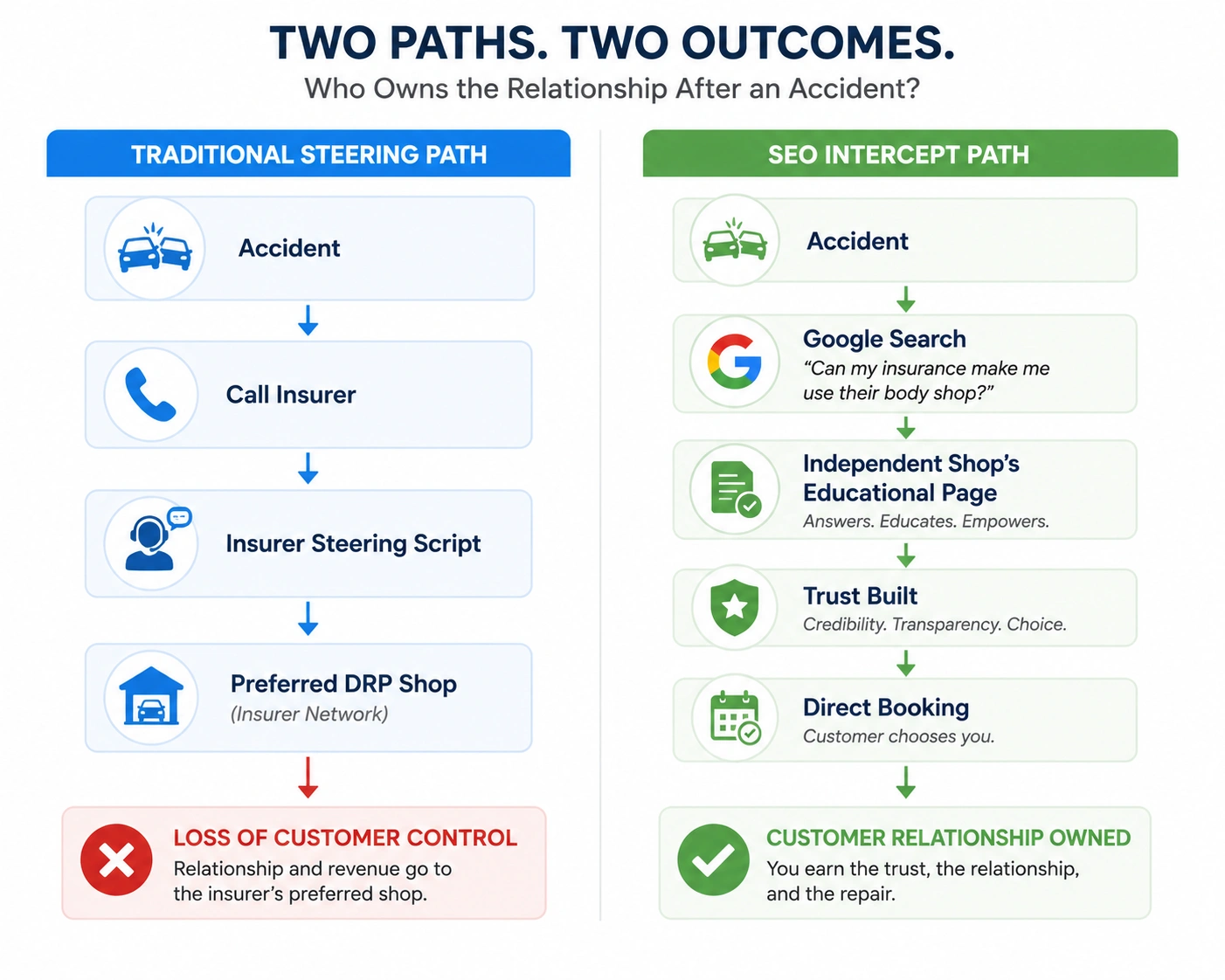
Flowchart comparing the traditional insurer steering process with an SEO strategy that helps independent body shops earn direct bookings.
The Legal Landscape: Anti-Steering Laws and Consumer Rights
Federal Antitrust Precedents
The legal architecture protecting independent shops from insurer coercion is older and more durable than most shop owners realize. The 1963 Federal Consent Decree (United States v. Association of Casualty and Surety Companies, et al.) permanently prohibited major insurance trade associations and their member carriers from steering automotive repair work, fixing labor rates, or controlling independent damage appraisers. This wasn’t a regulatory guideline. It was a federal antitrust ruling with permanent injunctive force.
The decree faced its most serious modern threat during the 2019- 2020 Department of Justice review of legacy antitrust decrees. The DOJ proposed terminating it, characterizing it as outdated. Intense industry pushback, led by the Society of Collision Repair Specialists (SCRS), state trade associations, and U.S. Senator Richard Blumenthal, successfully preserved it. The fact that insurers lobbied for its termination tells you everything you need to know about how much it still constrains them.
Understanding whether insurance steering is illegal requires this distinction: the practice is prohibited under federal antitrust law and state consumer protection statutes, yet insurers routinely bypass the spirit of both through verbal scripts and administrative friction that stop just short of explicit coercion. The decree is a shield. But it only works if drivers know it exists. That’s where your content comes in.
State-Level Statutes
Consumer protection in collision repair is primarily enforced at the state level, and the statutes are often more specific and more direct than the federal framework. Insurers are legally prohibited from forcing consumers to use specific repair shops in all 50 states. Publishing these statutes on your website, with precise legal citations and clear explanations of driver rights, transforms your shop from a simple service provider into a trusted local consumer advocate that drivers can rely on. That shift in positioning is not cosmetic. It builds a category of trust that no DRP shop can copy.
Anti-steering insurance laws vary in their specificity, but the core protection is consistent: the vehicle owner chooses the repair facility. The insurer is legally obligated to pay for the repair at your chosen shop.
State-by-State Consumer Rights
- California: California Insurance Code § 758.5 clearly states that no insurer shall require an automobile to be repaired at a specific automotive repair dealer.
- New York: New York Insurance Law Section 2610 bans insurers from even recommending or suggesting a specific shop unless the policyholder clearly requests a recommendation, which is one of the strictest anti-steering rules in the country.
- Michigan: MCL 500.2110b(1) prohibits insurers from unreasonably restricting an insured’s choice of repair facility. Michigan protects drivers.
- Texas & Louisiana: State statutes protect the driver’s absolute right to choose their repair shop, making any coercive scripting by adjusters a direct violation of state insurance codes. Insurance steering laws in Texas and Louisiana are enforceable through state Departments of Insurance, giving consumers a clear complaint pathway when adjusters cross the line.
Intercepting the Driver: The SEO Strategy to Win Back Customers
Capturing the “Panic Search”
Immediately after an accident, drivers don’t sit quietly and wait for their adjuster to call. They search. They type questions like “Do I have to use the body shop my insurance recommends?” into their phones while still in the parking lot. That single query generates between 3,300 and 4,500 monthly US searches. “Can my insurance make me use their body shop?” pulls another 1,200 to 1,800 monthly searches. The broader keyword cluster surrounding consumer repair rights commands over 55,000 monthly searches in the United States.
These aren’t passive browsers. These are drivers in the middle of a high-stress decision, actively looking for permission to choose you. An independent auto body shop SEO strategy built around these high-intent queries puts your shop’s helpful answer in front of that driver before the adjuster’s steering script ever reaches them on their phone.
The window is narrow. Once the adjuster gets on the phone and the steering script begins, the psychological foundation has already been laid. Ranking for these queries means you are in the conversation first, and first impressions in a crisis carry massive weight.
Establishing Trust Through Transparency
When a driver is feeling pressured by their insurer, the shop that acts as an honest consumer advocate wins their business. Not the shop with the flashiest website or the lowest advertised deductible. The one that gave them clear answers when they were confused and scared. Trust is everything.
Providing that clarity is not just a content strategy. It is a positioning decision. You are declaring that your shop’s obligation is to the vehicle owner, not to the carrier’s cost-containment targets. Partnering with a local SEO consultant ensures that this educational content surfaces at the top of local search results, because the best consumer advocacy content in the world doesn’t help if it is buried on page four.
Consumer rights insurance steering policies are what set you apart. Most DRP shops can’t touch this topic without violating their own contractual obligations to the carrier.
Practical SEO Steps
- Build an Insurance Education Hub: Create dedicated pages that answer specific questions about claims, billing, and repair rights, targeting the exact queries drivers type during a panic search, helping build trust before they ever talk to an adjuster.
- Optimize for Local Search: Ensure your Google Business Profile is fully built out to capture high-intent “near me” traffic from drivers in your service area.
- Publish Practical Resources: Provide downloadable tools, phone scripts, and state-specific rights checklists that help drivers push back against adjusters and stay committed to your shop.
Stop letting insurers control your lead flow. Take control. If you want to protect your shop’s independence and keep your bays full of high-margin work, you need to own the online conversation. Discover how specialized digital marketing for auto body shops can help you reach local drivers first.
Building the Insurance Education Hub: Topics That Intercept Searchers
Core Pillar Content
The foundation of your content strategy should be a central resource page, something like “Your Rights After an Accident: The Truth About Collision Repair Choice.” This page targets insurance steering auto body shop and insurance steering vs consumer choice auto repair directly, and it should be built to answer the question a stressed driver is asking: Can my insurance company force me to use their shop?
The answer is no. And your page should say so in the first sentence, not the fifth paragraph.
From there, the page earns its authority by citing the 1963 Federal Consent Decree and your state’s specific anti-steering statutes. This isn’t superficial legal language. It is E-E-A-T signaling: demonstrating to both readers and search algorithms that your shop understands the regulatory landscape at a level that generic marketing copy never reaches. Critically, the page must address the claim that using an independent shop will invalidate the driver’s insurance claim or vehicle warranty. It won’t. That needs to be stated plainly, with the legal basis attached.
Debunking the Direct Billing Myth
One of the insurer’s most effective steering pitches is the billing threat: “If you go to a non-preferred shop, we can’t do direct billing, and you’ll have to pay upfront.” Drivers hear this and assume it’s true because it sounds formal and authoritative. It isn’t.
Independent shops handle direct billing, submit digital estimates directly to the carrier, and manage supplemental claims from intake to close. The driver pays their deductible. That’s it. Building a dedicated page targeting the exact phrase what is direct billing in auto insurance and related queries, a cluster commanding over 9,400 monthly searches, completely debunks this myth before the adjuster can ever deploy it. The insurance steering claims process explained angle gives you a natural framework: walk the driver through exactly what happens, step by step, when they choose your shop. Demystify the process, and the insurer’s administrative friction argument collapses.
High-Intent Content Hub Structure
Generic blog content won’t move the needle here. You need a strategy. “How to wash your car in winter” is not competing for the driver who just rear-ended someone on the freeway. The content structure that works is built around informational clusters tied directly to the questions drivers ask during a panic search: repair rights, billing mechanics, parts quality, adjuster scripts, and state-specific legal protections.
Each cluster page shows search engines that your site carries genuine authority on collision repair rights, not just collision repair. That distinction matters for ranking. It also matters for the driver reading your content, who needs to feel that the shop they are considering fully understands the system they are navigating.
Comparing DRP vs. Certified Independent Shops
The comparison deserves to be made transparently, without evasion. DRP shops are contractually bound to prioritize the insurer’s bottom line. That means aftermarket or salvage parts when the OEM alternative costs more, rushed cycle times to meet arbitrary throughput metrics, and repair decisions filtered through the carrier’s cost-containment framework rather than the manufacturer’s repair procedures.
Your independent, OEM-certified shop operates under a different obligation entirely. You answer to them. Your only contractual commitment is to the vehicle owner: restore the car to its pre-accident condition in accordance with manufacturer safety standards. No parts substitution mandates. No cycle time pressure from a carrier representative. No conflict of interest between doing the job right and keeping your referral volume up.
When a driver understands this distinction, not as marketing language but as a factual description of how each model works, the choice becomes considerably less unclear.
“The warranty on collision repairs comes from the auto body shop, not the insurance company. When an insurer claims they ‘can’t guarantee’ our work, they are hiding the fact that they never guaranteed any shop’s work in the first place.” , Industry Advocate
Answering the Questions Insurers Hope Drivers Don’t Ask
The “Decline the DRP” Phone Script
A downloadable, print-friendly PDF script is one of the most effective content assets an independent shop can publish. It turns a passive reader, someone who found your page while searching ‘how to fight insurance steering,’ into a customer who feels in control and stays committed to your shop through the entire claims process.
The script needs to address the specific pitches adjusters use, with exact word-tracks:
- Insurer: “We can’t guarantee the work if you go to an independent shop.” Driver: “My chosen shop provides a lifetime warranty on all repairs. Since your company is paying for the repair, you are legally required to cover the cost of restoring my vehicle to pre-accident condition at my shop of choice.”
- Insurer: “It will take weeks longer to get an adjuster out to an independent shop.” Driver: “State law requires you to inspect the vehicle within a reasonable timeframe. I’ve already authorized my shop to write the estimate and submit photos to speed up your process.”
This resource keeps users on your page longer, which improves engagement signals that search algorithms factor into rankings. It builds trust. A driver who has practiced these responses is far less vulnerable to the adjuster’s script.
The “Zero Out-of-Pocket” Myth
No legitimate shop can waive a deductible. Doing so is insurance fraud, and any shop offering to “eat your deductible” is either misrepresenting what they are doing or actively committing it. Publishing a clear, honest breakdown of how the financial flow works, where the driver pays the deductible to the shop, the shop bills the carrier directly for the remainder, and there are no surprise charges at pickup, builds a category of trust that the insurer’s preferred network cannot match.
This transparency is also a direct answer to the insurer’s pitch. It stops doubts. When the adjuster implies that choosing an independent shop creates financial uncertainty, your content has already prevented that fear with a factual, step-by-step explanation. For shops focused on how to get more auto body shop leads without insurance referrals, this kind of complete honesty is the real engine, not a tagline.
Demystifying the Steering Claims Process
The final obstacle keeping drivers from choosing your shop is usually administrative anxiety: they don’t know what happens after they tell the adjuster they’ve chosen an independent facility. They worry about claims stalling, extra paperwork, or ending up in a billing dispute.
Answering these questions directly, with a clear, step-by-step explanation of what your shop does on the driver’s behalf, removes that obstacle entirely. When drivers realize that your shop submits digital estimates, manages supplemental claims, and communicates directly with the carrier throughout the repair process, the insurer’s “hassle-free DRP experience” pitch loses its primary selling point.
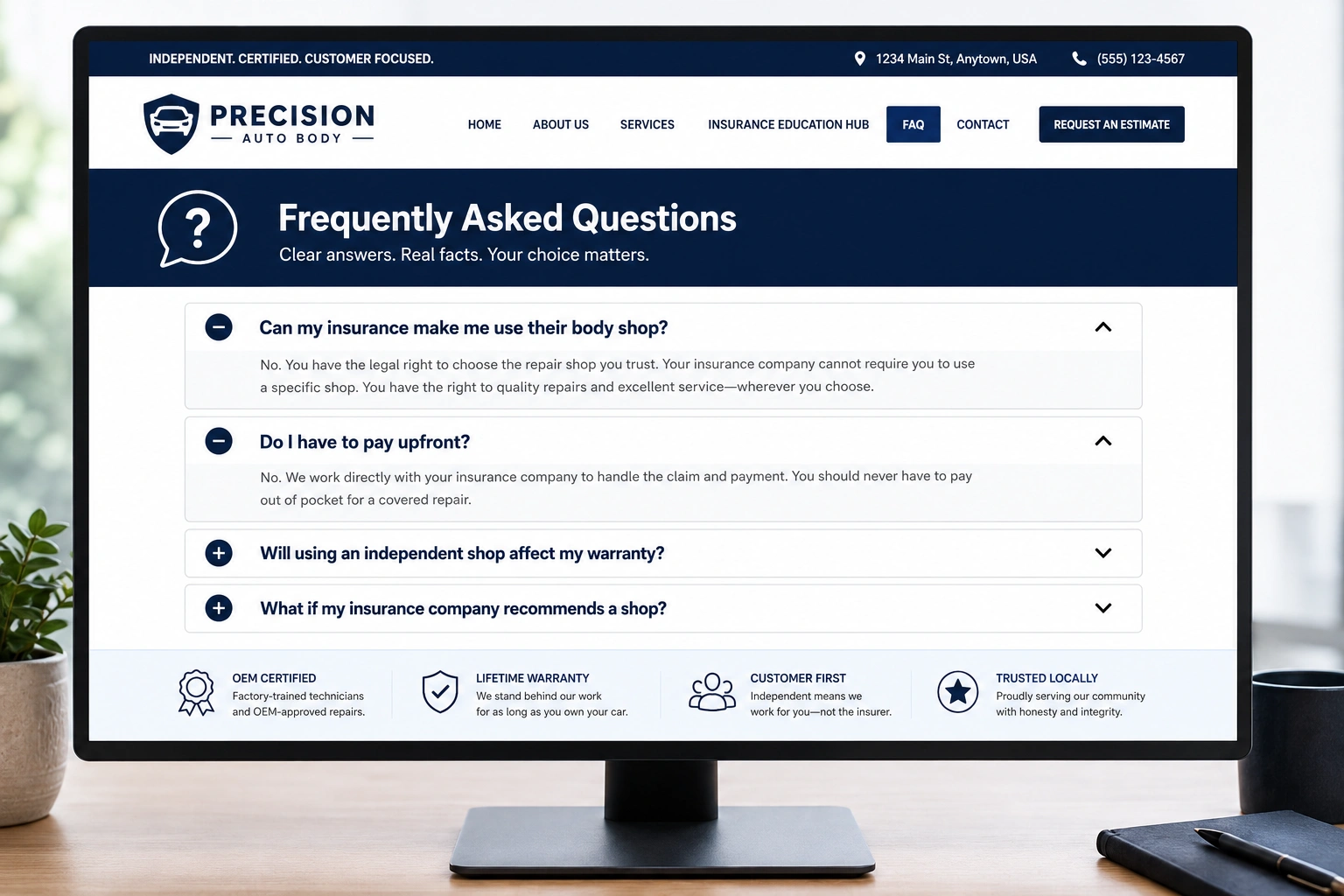
Modern auto body shop website highlighting an Insurance Education Hub and FAQ content that builds trust and answers common claims questions.
Want to see how your shop’s website stacks up against the competition?
You don’t have to navigate the complex world of search engines alone. Discover how SEO marketing companies transform your online presence and help you win back the local leads that insurers are actively stealing.
Local SEO Tactics for Independent Collision Centers
Google Business Profile Optimization
Your Google Business Profile is the most immediate piece of local search real estate you control. For a driver searching “auto body shop near me” from the scene of an accident, the map pack result is often the first thing they see, landing right before any organic listing or paid ad. Getting that placement requires a fully built-out GBP with the correct primary category (“Auto Body Shop” or “Collision Repair Center”), accurate NAP data, high-quality photos of your facility and completed repairs, and your OEM certifications clearly displayed.
The messaging feature deserves particular attention. A driver who finds your profile at 7 PM after an accident isn’t going to call. They’ll message. Having that channel active and monitored, and knowing how to capture leads with your Google Business Profile through regular posts and Q&A responses, turns that late-night inquiry into a morning appointment. Local SEO for independent repair shops starts here, not with a blog post.
Reviews and Local Citations
Five-star reviews do more than signal quality. They directly counter the insurer’s implicit claim that independent shops are unreliable or unaccountable. A shop with 200 verified Google reviews and a 4.8-star average is not a shop a driver worries about. The adjuster’s script loses traction against that kind of social proof.
Building a systematic review collection process, specifically automated follow-up texts or emails sent immediately after vehicle pickup, is one of the highest-ROI operational changes an independent shop can make. It’s not complicated. It just requires consistency.
Local citations matter for a different reason. NAP consistency (Name, Address, Phone number) across Yelp, YellowPages, and local business directories signals to search algorithms that your business is legitimate and geographically anchored. Inconsistencies, such as a suite number listed in one directory but not another, or a phone number that changed two years ago still appearing on an old listing, erode that signal quietly and persistently. Auto body shop digital marketing that ignores citation accuracy is building on a cracked foundation.
Local SEO Implementation Steps
- Optimize Your GBP: Add high-quality photos of your facility, OEM certifications, and completed repairs. Fill out every available field, including service descriptions and business hours.
- Build Local Citations: Ensure your shop’s NAP is consistent across Yelp, YellowPages, and local business directories. Audit existing listings for outdated information. Keep it clean.
- Request Reviews: Send automated follow-up texts or emails to customers immediately after vehicle pickup, asking for a Google review, which helps build a steady stream of positive feedback that search engines love. Timing matters: request while the experience is fresh.
The Long-Term ROI of Independent Lead Generation
Owning vs. Renting Your Customers
Relying on DRP referrals is structurally similar to renting your customer base from the insurance company. The insurer controls the volume, the pricing terms, and the exit clause. They can renegotiate your labor rates downward, tighten parts mandates, or simply redirect volume to a competing shop, and there is nothing in a standard DRP agreement that prevents any of it.
Investing in search engine optimization reverses that dynamic. When your shop ranks for the queries drivers type during a panic search, the customer relationship begins with you, not with the carrier’s claims department. You own the first impression. You control the narrative. And because that ranking is built on content authority rather than a contractual arrangement, no insurance carrier can end it.
Growing your auto business without insurance steering dependency requires building an asset the insurer can’t touch. Organic search authority is that asset.
The Compounding Value of SEO
Paid advertising delivers leads while the budget runs. The moment you stop paying, the traffic stops. SEO works differently: content that ranks today continues driving organic traffic for months or years, compounding in authority as it gathers backlinks, engagement signals, and topical depth. For a budget-conscious independent shop, that compounding return is precisely why SEO is a smart investment rather than an optional marketing expense.
Ranking for high-intent queries, such as ‘can my insurance force me to use their body shop,’ ‘what is direct billing in auto insurance,’ or ‘independent collision repair near me,’ builds local authority that makes your shop the default choice in your community. Not the insurer’s default. Yours. Auto body shop lead generation marketing built on organic search doesn’t just fill bays; it builds a brand that operates independently of the carrier’s referral machinery.
The Financial Impact of Search Authority
The long-term financial case for independent lead generation is clear. It makes sense. Non-DRP shops that control their own lead flow don’t negotiate their labor rates from a position of dependency. They don’t absorb parts-margin concessions to maintain referral volume. They don’t operate under the threat of a carrier renegotiating their agreement mid-year. The $541,000 annual revenue gap between DRP and non-DRP shops is real, but it is not permanent: it reflects the insurer’s referral advantage, not an inherent quality or capability difference.
By building search authority, you protect your business from the whims of insurance adjusters. Your bays stay full because drivers in your market trust your shop, found you when they needed you most, and chose you before anyone else got to them.
Frequently Asked Questions About Insurance Steering & Auto Repair
Why FAQ Schema Matters
Implementing FAQ schema on your website allows you to win rich snippets in search results, those expanded answer blocks that take up significantly more SERP real estate than a standard blue link. For queries like ‘is insurance steering illegal’ or ‘what are anti-steering laws,’ a rich snippet positions your shop as the authoritative answer before the driver even clicks through.
There’s also a broader intent-capture opportunity worth noting. Intent matters. Some drivers searching for terms like steering wheel lock insurance or does a steering wheel lock reduce insurance are looking for physical vehicle security devices, not collision repair rights. However, a well-structured FAQ page that addresses adjacent queries can redirect these users toward your core services by explaining that while physical security measures have their place, the most important protection for their vehicle post-accident is choosing a repair facility that follows OEM procedures rather than insurer cost-containment mandates.
Common Questions About Insurance Steering and Auto Repair
These are the exact questions insurance adjusters hope drivers don’t ask. By providing clear, legally grounded answers, you arm your local community with the knowledge they need to protect their investment and their safety.
Do I have to use the body shop my insurance recommends?
No. The choice of repair facility belongs entirely to the vehicle owner in all 50 states. Your insurer is required to pay for your vehicle’s repair at a facility you select, provided the shop performs the work at a reasonable cost. Politely but firmly inform your adjuster that you have chosen your repair shop of choice, and ask them to proceed with the claim accordingly.
Can my insurance make me use their body shop?
Absolutely not. You have the absolute right to choose your own repair shop. Under state laws, an insurance company cannot force you to use their preferred facility. They may try to steer you, but understanding your legal rights is your shield before the insurer locks them in to a network that prioritizes their bottom line over your safety.
What is insurance steering and is it illegal?
Insurance steering is an anti-competitive practice where carriers coerce or pressure policyholders to use DRP-affiliated shops through fear-based scripts, implied delays, or misleading warranty claims. It is prohibited under the 1963 Federal Consent Decree and reinforced by state-level anti-steering laws across the country. In practice, insurers bypass the explicit prohibition by using verbal scripts that stop just short of a direct mandate, which is why consumer education is the most effective solution.
How do anti-steering laws protect consumers?
These laws protect your right to have your vehicle repaired correctly, not just cheaply. They prevent insurers from forcing the use of aftermarket or salvage parts that compromise structural integrity, and they prohibit carriers from capping labor rates in ways that prevent shops from following OEM repair procedures. If you are OEM-certified, these laws give your customers the legal standing to insist on your facility and your repair standards.
How can an independent auto body shop get leads without DRPs?
Building a search-optimized online presence that targets high-intent queries is the most scalable alternative to DRP referrals. When your shop ranks for the questions drivers ask immediately after an accident, you intercept them before the insurer’s script reaches them. A fully optimized Google Business Profile, a structured insurance education hub, and consistent review generation work together to turn Google searches into new customers without any dependency on carrier referral networks.
What is direct billing?
Direct billing is when the repair shop invoices the insurance carrier directly for the cost of repairs, rather than requiring the vehicle owner to pay upfront and seek reimbursement. Reputable independent shops handle direct billing with all major carriers, submitting digital estimates, managing supplemental claims, and communicating with the adjuster throughout the repair process. The driver pays their deductible directly to the shop. That’s the full extent of their financial exposure.
The battle for the customer relationship doesn’t start in your front office. It starts on the search engine results page, in the thirty seconds after an accident when a driver types a question into their phone and waits to see who answers. By building a thorough, legally grounded content strategy that addresses drivers’ fears at their moment of greatest need, you bypass the insurer’s steering tactics entirely. You don’t have to slash your rates or compromise your repair standards to keep your bays full. Invest in your search authority, educate your market, and take back the leads that are rightfully yours.
Ready to reclaim your market share and stop losing leads to insurance steering?
Partner with BizIQ to build an SEO strategy that bypasses the insurer’s gatekeeping and drives high-value, independent leads straight to your shop. Explore our specialized automotive industry digital marketing services and schedule your strategy session today.