Written by Ryan Russell
Ryan and his team specialize in helping independent self-storage operators deploy advanced local SEO strategies to compete with national brands and maximize facility occupancy.
- Capture Your Share: How to claim your portion of the projected $47.3 billion self-storage market in 2026.
- Dominate the Map Pack: Step-by-step Google Business Profile (GBP) optimization to outrank corporate chains.
- AI-Ready Optimization: Advanced schema and content structures to win recommendations in Google’s AI Overviews.
- Bridge the Occupancy Gap: Proven local search tactics to move your facility from the 82% independent average toward 93% REIT occupancy.
How do Independent Self-Storage Operators Outrank Major REITs using SEO in 2026?
Independent self-storage operators can beat REITs by dominating hyper-local search and AI engines. To do this, the key is to optimize your Google Business Profile (GBP) for exact neighborhood proximity, secure hyper-local backlinks, and publish direct answers to local storage questions, allowing your more adaptable facility to capture the high-intent traffic that rigid corporate giants miss.
You have probably heard that local SEO is “paramount” for self-storage, but what does that really mean when you are competing with a billion-dollar REIT down the street? It means that when someone within three miles of your facility searches for a place to store their life, you either show up on their phone or you do not exist.
To win the self-storage battle, you must dominate local mobile search within a tight 3-to-5-mile radius of your physical facility. Implementing targeted SEO for self-storage ensures your digital presence is no longer just a virtual brochure: it is your actual front gate. With 60% to 70% of all storage searches happening on mobile devices, that digital gateway is where your occupancy is won or lost. Mobile search dominates.
The self-storage industry is undergoing a massive digital shift. Industry data on what self-storage operators are prioritizing in 2026 shows that digital visibility is the main driver of occupancy. To adjust, operators are learning what to do differently in 2026 to handle heightened competition. Google’s AI Overviews now appear in 30% of local and informational searches, which means traditional keyword stuffing has lost its influence entirely. To capture high-intent renters who are ready to lease today, independent operators must optimize for local intent, mobile speed, and semantic search. At BizIQ, we believe sophisticated marketing belongs to you, too: not just the enterprise brands with endless budgets. Here is exactly how to do it, step by step.
Dominate the Google Maps “3-Pack” via Google Business Profile (GBP)
Your Google Business Profile is the single most vital digital asset for driving immediate rentals. Standard local SEO for self-storage strategies focus heavily on map visibility, and for good reason. Industry data shows that 45% to 60% of all inbound calls to storage facilities originate directly from GBP listings. That means if your profile is incomplete or unoptimized, you are handing high-value leads directly to the REIT down the street.
Think of your GBP as the digital storefront of your physical facility. First impressions matter. Just as you would not leave your facility’s physical gate broken or your office sign dark, you cannot afford to leave your digital listing unmanaged. Securing top rankings requires treating GBP optimization as a continuous, daily operational task rather than a one-time setup: a core focus of any competitive self-storage SEO strategy. This is something BizIQ’s Google Business Profile management services are built to handle at scale across multi-location portfolios.
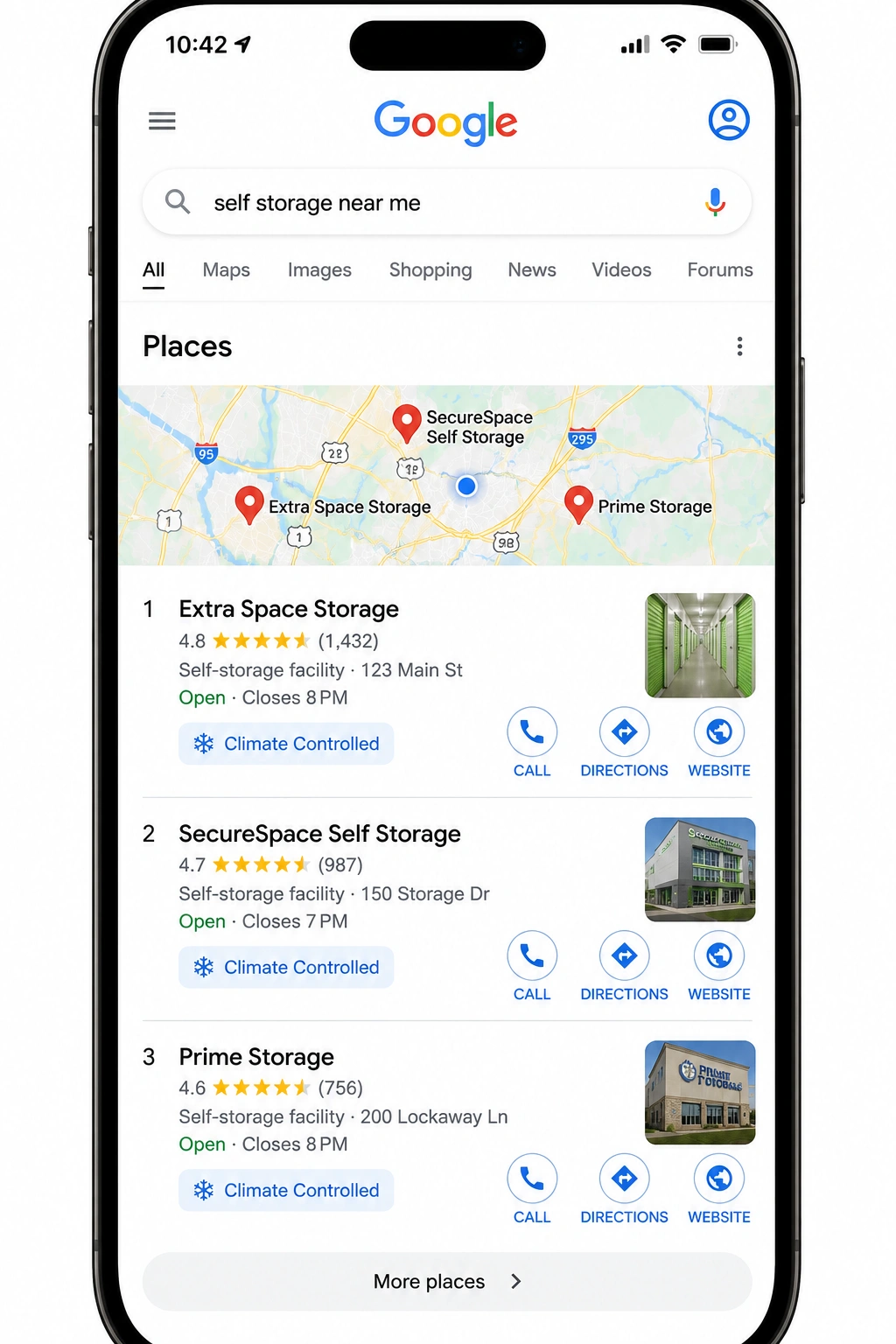
Optimized Google Business Profiles help self-storage facilities stand out in local search results and drive more customer actions.
Claiming and Verifying Every Facility Location
Google currently supports several verification pathways for physical business locations, and the right method depends on your facility’s age and data footprint. Video verification has become the prevalent pathway for new physical sites. It requires you to record your facility’s exterior signage, interior access points, and operational equipment in a single continuous walkthrough. Postcard verification remains available as a fallback, though turnaround times can stretch two weeks or longer.
Multi-location operators face a compounding risk: duplicate listings. They dilute your authority. Grounding your facility in foundational self-storage SEO principles means keeping your digital listings clean and consolidated. Managing every location under a single, clean Google Business Profile dashboard prevents the fragmentation that occurs when individual facility managers create their own profiles independently. Consolidated ownership also protects against unauthorized edits. This is a real threat when competitor-adjacent listings get hijacked or when former employees retain manager-level access.
Selecting Categories and Attributes for Maximum Visibility
“Self-Storage Facility” is the non-negotiable primary category. No substitution. Secondary categories, such as “Automobile Storage,” “Moving and Storage Service,” and “Boat Storage,” extend your facility’s eligibility surface for adjacent searches without weakening the primary signal, allowing you to capture niche renters who need specialized vehicle or commercial storage solutions.
Attribute selection is where most operators leave money on the table. Specific attributes like Climate Controlled, 24-Hour Access, Drive-Up Access, and Security Cameras feed directly into Google’s filtering layer. A renter who searches “climate-controlled storage near me” and then filters by amenity will only see facilities that have explicitly declared those attributes. If yours is not declared, it does not appear, regardless of proximity. Here is what I recommend: log in to your profile today and check every single amenity box that applies to your site.
Maintaining NAP Consistency Across the Web
Name, Address, and Phone number consistency is the connective tissue of local search authority. Search engines build trust in a business by cross-referencing its NAP data across dozens of directories, aggregators, and mapping platforms. Inconsistencies: even minor formatting differences like “Suite 100” versus “#100” or “Street” versus “St.”: register as conflicting signals and erode that trust incrementally.
Think of NAP consistency like making sure your business name, address, and phone number look exactly the same everywhere online: Google notices when they do not match.
Tracking phone numbers introduce an added tension here. Do not lose track. Call-tracking numbers are genuinely useful for measuring inbound lead volume, but placing a tracking number as your primary GBP phone number creates a NAP mismatch with every other directory that lists your real local number. The practical resolution: keep your permanent local number as the primary GBP listing and add the tracking number in the “additional phone” field. You preserve consistency without sacrificing attribution data.
Build Hyper-Local On-Page Authority
- Dedicated Location Pages: Create unique, highly optimized landing pages for every physical facility. Never duplicate content across locations. Speed is paramount.
- Local Landmarks & Neighborhoods: Mention nearby schools, major highways, and landmarks (e.g., “Located 3 miles from Fort Bliss”) to indicate geographic relevance to search crawlers, which helps Google understand the exact neighborhood boundaries your facility serves.
- Frictionless Mobile UX: Ensure your page loads in under 3 seconds; 53% of mobile users abandon sites that load slower.
Dedicated Location Pages vs. Single Homepage Models
Consolidating multiple facilities onto a single homepage is one of the most common and detrimental structural mistakes in multi-location storage SEO. When a single page tries to serve geographic intent for three, five, or twelve different cities simultaneously, search engines cannot assign strong local relevance to any of them. This is a problem sometimes called crawl dilution, though it is more precisely a relevance fragmentation issue.
A clean, hierarchical URL structure resolves this. The format domain.com/locations/city-state isolates local authority to each individual page while keeping the entire portfolio under one authoritative root domain. That matters because every backlink your brand earns (from local press, moving company partnerships, and chamber of commerce directories) compounds its value across all location pages rather than being split across separate domains.
Unique content for each location page is not optional. Templates fail. Unit sizes, security features, gate access hours, and local management staff vary by facility. Writing copy that reflects those specifics, rather than swapping out a city name in a templated paragraph, is what separates a page that ranks from one that merely exists.
Integrating Local Landmarks and Neighborhoods
Search engines interpret geographic proximity through the contextual signals embedded in your page copy, not just your address field. Referencing local landmarks, universities, major intersections, and named neighborhoods gives crawlers a richer spatial picture of where your facility truly serves.
The practical application is uncomplicated: weave geographic modifiers into your headers and body copy naturally. Context is key. “Serving students at State University and residents in the Northside neighborhood” accomplishes two things simultaneously: it satisfies the proximity signal search engines need, and it speaks directly to the renters most likely to convert at that location. Long-tail keyword combinations like “Downtown Springfield climate-controlled storage” or “storage near I-35 and Oak Street” capture high-intent searches that national REIT pages, optimized for broad city-level terms, rarely compete effectively. Here is what I recommend: walk your facility’s neighborhood and note the five most prominent landmarks, then write them naturally into your location page copy.
Frictionless Mobile UX and Page Speed
Google’s mobile-first indexing means the mobile version of your site is the version that gets ranked. Mobile is the priority. A desktop experience that loads in 1.8 seconds but delivers a 4.2-second mobile experience is, from Google’s perspective, a 4.2-second experience.
Interaction to Next Paint (INP) replaced First Input Delay as a Core Web Vital in 2024 and remains the benchmark for page responsiveness in 2026. INP measures how quickly your page responds to every user interaction (taps, swipes, form inputs) throughout the entire session, not just the first one. For self-storage sites, where the rental flow requires multiple form interactions, a delayed INP score directly translates to abandoned applications and lost leases. BizIQ’s website design and management services are built around these performance benchmarks, ensuring that the rental flow from landing page to signed agreement is as frictionless as possible on any device.
Utilize Advanced Local Business Schema Markup
- Structured Data Implementation: Embed the highly specific SelfStorage schema markup nested under the broader LocalBusiness classification on Schema.org.
- Direct Search Engine Communication: Use JSON-LD code to directly communicate facility attributes like GPS coordinates, office hours, and real-time unit availability.
- Validation Protocols: Test and validate your structured data using Google’s Rich Results Test to ensure zero errors. Validation is essential.
Implementing the SelfStorage JSON-LD Schema
Schema markup functions as a direct translation layer between your website and search engine crawlers. Without it, a crawler reads your page the way a person reads a document in a foreign language: the words are visible, but the meaning is uncertain. With it, every critical attribute of your facility is declared explicitly and unequivocally.
The Schema.org/SelfStorage type is nested under the LocalBusiness classification and supports properties that are specifically relevant to storage operations, helping search engines categorize your business with high precision. The essential fields to populate include postalCode, geo (latitude and longitude coordinates), openingHours, and amenityFeature. The latter allows you to declare specific amenities like climate control, 24-hour access, and on-site security as structured data points rather than plain text. Below is a clean, customizable JSON-LD template to deploy on each location page:
Schema Example for Location Pages
<script type="application/ld+json">


{

  "@context": "https://schema.org",

  "@type": "SelfStorage",

  "name": "Your Facility Name",

  "url": "https://www.yourdomain.com/locations/city-state",

  "telephone": "+1-555-000-0000",

  "address": {

    "@type": "PostalAddress",

    "streetAddress": "123 Main Street",

    "addressLocality": "City",

    "addressRegion": "ST",

    "postalCode": "00000",

    "addressCountry": "US"

  },

  "geo": {

    "@type": "GeoCoordinates",

    "latitude": 00.000000,

    "longitude": -00.000000

  },

  "openingHoursSpecification": [

    {

      "@type": "OpeningHoursSpecification",

      "dayOfWeek": ["Monday","Tuesday","Wednesday","Thursday","Friday"],

      "opens": "09:00",

      "closes": "18:00"

    }

  ],

  "amenityFeature": [

    { "@type": "LocationFeatureSpecification", "name": "Climate Controlled", "value": true },

    { "@type": "LocationFeatureSpecification", "name": "24-Hour Access", "value": true },

    { "@type": "LocationFeatureSpecification", "name": "Security Cameras", "value": true },

    { "@type": "LocationFeatureSpecification", "name": "Drive-Up Access", "value": true }

  ]

}

</script>
Deploy this block in the <head> of each location page, not sitewide. Each page should carry schema that reflects only that facility’s specific attributes. Precision drives visibility.
Validating Your Structured Data Code
Deploying schema without validating it is roughly analogous to wiring your gate system and never testing whether the keypad really works. Google’s Rich Results Test accepts a URL or raw code and returns a clear pass/fail result alongside any warnings or critical errors.
The distinction between errors and warnings matters. Errors prevent your structured data from generating rich snippets in search results. They need to be resolved immediately. Warnings flag optional but recommended properties; addressing them improves your schema’s completeness score, which correlates with stronger AI Overview eligibility. After deployment and validation, Google Search Console’s “Enhancements” report provides ongoing monitoring of your schema’s indexing status and surfaces any new errors introduced by site updates, ensuring your technical foundation remains solid over time.
Drive Review Velocity and Keyword-Rich Responses
Proximity and trust are Google’s primary local ranking factors. Consistently acquiring high-quality reviews from actual tenants creates a powerful feedback loop: it signals to search engines that your facility is active and trusted, while simultaneously convincing undecided prospects to choose you over a competitor. What we have seen work for businesses like yours is a systematic approach to review acquisition that integrates smoothly into daily operations: not a one-time push that fades after the first month.
Getting the review is only half the equation. Responses matter too. How you respond to those reviews represents an opportunity to improve self-storage lead conversions and drive organic traffic. In fact, case studies on local SEO content services show that active local engagement leads to massive traffic increases. Specific, keyword-rich responses reinforce your local authority and demonstrate exceptional customer service to both search engines and prospective renters reading your profile before they call.
“More than 1.5 million self-storage units nationwide are rented to military personnel. In communities adjacent to domestic US military bases, military occupancy can range from 20% to 95%, making targeted local reputation management and community-specific keywords critical for facility survival.”
–Self Storage Association
Establishing a Post-Move-In Review Acquisition System
Timing is the variable most operators underestimate. Asking for a review within 24 to 48 hours of move-in, when the experience is fresh, and the tenant’s relief at having secured a unit is still palpable, yields significantly higher response rates than requests sent weeks later. The emotional window is narrow: use it.
SMS automation outperforms email for this specific ask. A direct text with a one-tap link to your Google review page removes every friction point between the tenant’s intention and the completed review. Critically, incentivizing customers to leave reviews violates Google’s terms of service and risks profile suspension. This is a consequence far more damaging than a slow review count. Instead, reward facility managers internally for hitting review milestones. That keeps the incentive structure clean and the reviews authentic.
Optimizing Review Responses for Local Keywords
Every response you write is indexable content. A response that reads “Thanks for the kind words!” contributes nothing to your local search footprint. A response that reads “Thank you for choosing our climate-controlled storage units in downtown Springfield; we’re glad the drive-up access made your move easier!” reinforces three distinct local and feature-based signals in a single sentence.
The conversion data behind this practice is substantial: every 0.1-star improvement in your average Google rating increases your website conversion rate by 4.4%, and responding to 100% of reviews boosts conversions by 16.4% compared to ignoring them. Negative reviews require a different approach. Acknowledge the specific issue without becoming defensive, offer a direct resolution path, and keep the response brief. Prospective renters reading a negative review are not judging the complaint: they are judging how your team handles it.
Optimize for 2026 AI Search & Semantic Intent
Google’s search experience has fundamentally shifted with the integration of AI Overviews at the top of local search results. These generative summaries pull information directly from highly authoritative, structured local pages to recommend specific facilities. This means a facility with flawless schema, strong reputation signals, and well-structured content can appear in an AI recommendation even when it does not hold the top organic position, bypassing traditional ranking hierarchies completely. To remain visible, operators must transition from basic keyword targeting to Generative Engine Optimization (GEO). Understanding LLM SEO for self-storage is now a requirement to stay competitive. AI changes search rules.
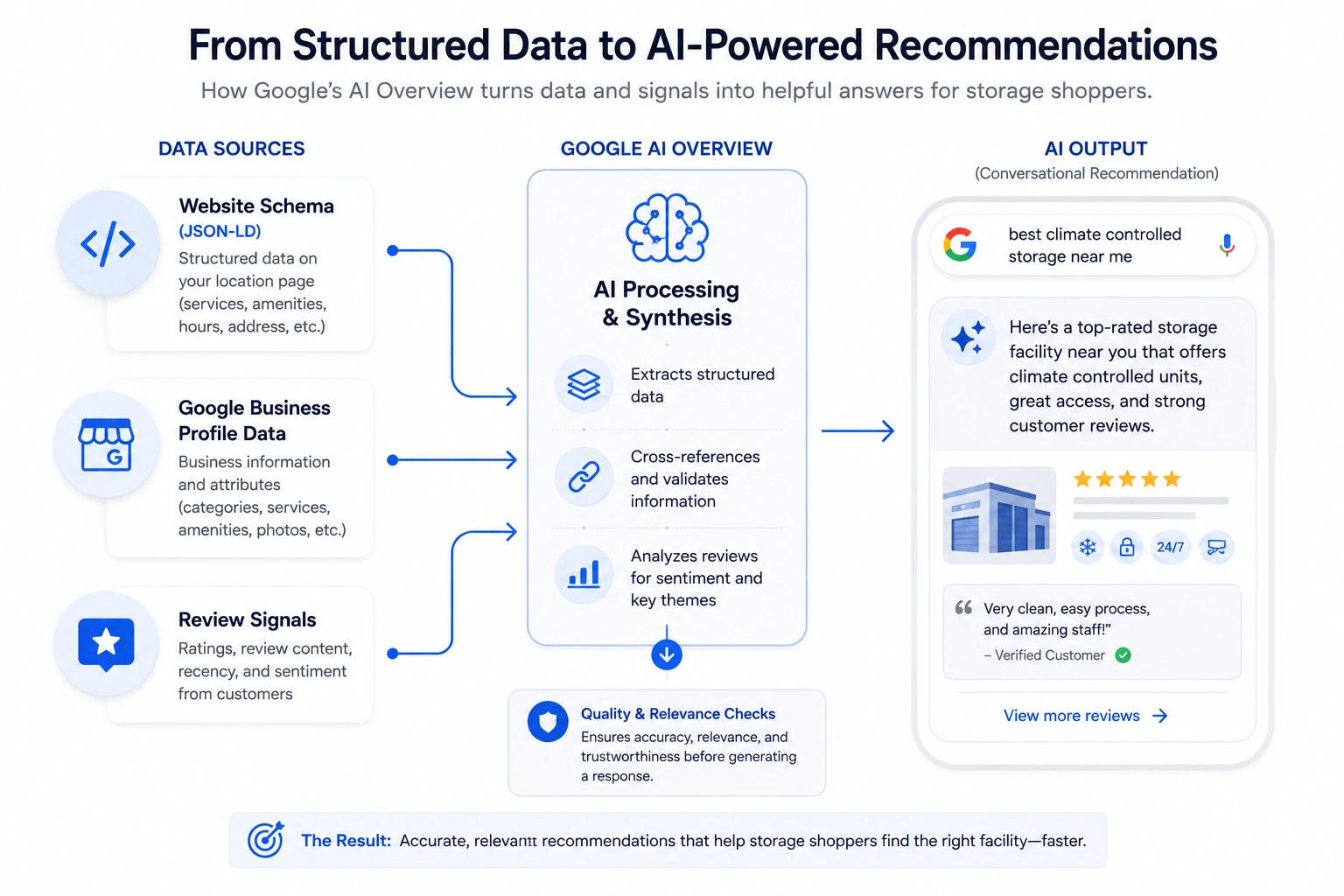
AI Overviews combine website schema, business profile data, and customer reviews to generate local storage facility recommendations.
Want to Beat the REITs?
Let our team of self-storage SEO specialists handle your local optimization, GBP management, and schema deployment. We are a small business ourselves, and we know how to make your marketing dollar stretch further.
Understanding Generative Engine Optimization (GEO)
AI models (Gemini, ChatGPT, Claude) do not crawl the web in real time for every query. They rely on database records. They amalgamate content from sources they have already indexed and weighted by authority. That weighting process still relies heavily on the same trust signals that power traditional organic rankings: strong backlink profiles, consistent NAP data, high review volume, and structured content that answers specific questions without ambiguity.
To position your facility as a citable source in AI-generated recommendations, your location pages need to function as authoritative reference documents, not just conversion pages. That means declaring your amenities explicitly, answering common renter questions within the page body, and maintaining the kind of consistent digital footprint (across your GBP, citations, and website) that signals to AI systems that your data is reliable. BizIQ’s local brand management services address exactly this: citation consistency, reputation signals, and the structured content architecture that AI engines favor.
Structuring Content for Answer Engine Optimization (AEO)
Voice search queries and conversational AI prompts follow natural language patterns that differ considerably from typed keyword strings. “Where is the closest secure storage unit with 24-hour access?” is a fundamentally different query structure than “24-hour storage Springfield IL,” and your content needs to satisfy both simultaneously to capture users at different stages of the search journey.
FAQ sections structured with direct, concise answers are the most reliable mechanism for capturing both People Also Ask (PAA) placements and AI Overview citations. The format is not complicated: a clear question followed by a 2-to-4-sentence answer that uses natural language and includes the relevant location and feature terms. What makes the difference is specificity: generic answers about “what is self-storage” will not win PAA panels. Specificity wins. Granular answers to questions like “Does your Springfield facility offer drive-up access for large vehicles?” will. Identify those questions by reviewing your GBP Q&A section, your inbound call logs, and the PAA panels that already appear for your target keywords.
Local Citation Building & Data Aggregators
- Data Aggregator Submission: Submit your verified NAP data to major aggregators (Foursquare, Neustar Localeze) to disseminate your information across the web, establishing a solid foundation of trust with search engine crawlers that evaluate your business’s legitimacy.
- Tier 1 Directory Optimization: Build and maintain consistent citations on high-authority platforms like Yelp, Yellow Pages, Apple Maps, and Bing Places.
- Duplicate Listing Clean-Up: Use local SEO tools to identify and suppress duplicate listings that dilute your search authority. Clean data ranks.
Submitting to Major Data Aggregators
Data aggregators like Foursquare and Neustar Localeze function as the wholesale distributors of local business information. When your NAP data is accurate at the aggregator level, it disperses outward to hundreds of smaller directories, mapping applications, and GPS navigation systems. Many of which you would never manually audit. One accurate submission at the source is worth dozens of individual directory corrections downstream.
Accuracy at this layer is non-negotiable. A single transposed digit in your phone number or an outdated suite number in your address will replicate across the entire distribution network, and correcting it requires either re-submitting at the aggregator level or manually suppressing errors across individual platforms. Neither is fast. Getting it right the first time is the only efficient path.
Cleaning Up Duplicate Listings and Inconsistencies
Duplicate listings split your local ranking power. When two or three GBP entries exist for the same physical facility (a common occurrence after ownership changes, address updates, or unsanctioned profile creation by staff), search engines cannot determine which listing to surface, and the result is that neither ranks as strongly as a single, consolidated profile would.
Auditing your citation landscape manually is viable for a single-location operator but becomes impractical at scale. Automation saves time. Platforms like Moz Local and BrightLocal automate the discovery and suppression workflow, flagging duplicates across hundreds of directories and providing a structured remediation queue. BizIQ’s citation management services integrate this process into ongoing local brand management, so duplicate proliferation gets caught and corrected before it compounds into a measurable ranking drag.
The Financial Impact: Bridging the Occupancy Gap
The financial divergence between independent self-storage operators and national REITs is directly tied to digital visibility. Industry benchmarks for storage facilities highlight this performance gap. According to the Matrix Monthly self-storage report, independent operators often hover between 82% and 85% occupancy. Succeeding means surviving the squeeze by adjusting your marketing to handle heightened corporate competition.
Closing that 9% to 11% vacancy gap is not an abstract marketing goal. It is pure profit. On a 100-unit facility with an average monthly rent of $150 per unit, moving from 82% to 93% occupancy generates an additional $1,650 in monthly revenue and roughly $19,800 annually. Multiply that across a multi-facility portfolio, and the compounding effect on Net Operating Income and asset valuation becomes the most compelling argument for investing in local search dominance that exists. These are the real, positive impacts we make when we help local businesses claim their space online.
Quantifying the Independent vs. REIT Occupancy Gap
National chains capture the “first-contact bias” at a structural level. More than 50% of renters lease from the first facility they contact, and 25% contact only two facilities before making a decision. This means the facility that appears first in the local map pack wins the majority of available demand before any competitor gets a call. REITs use automated, scalable SEO frameworks to hold those top positions consistently across hundreds of markets simultaneously.
Independent operators cannot match that budget. They can, however, move faster. A regional portfolio manager can update GBP attributes, respond to reviews, and publish hyper-local content in the time it takes a national chain’s marketing department to route a change request through three approval layers. That nimbleness is a genuine competitive asset, and it is most effective when channeled into the hyper-local signals: neighborhood references, landmark proximity, community-specific keywords, that national templates are structurally incapable of replicating at the local level.
Calculating the ROI of Local Search Dominance
The lifetime value of a self-storage tenant is consistently underestimated. Average length of stay exceeds 12 months for most facility types, and ancillary revenue from boxes, locks, and tenant insurance adds meaningful margin on top of base rent. When you factor those numbers into a cost-per-acquisition comparison, organic local SEO, which carries a high upfront investment but near-zero marginal cost per additional lead, outperforms pay-per-click advertising resolutely over any period longer than six months.
PPC delivers immediate visibility, and there are scenarios where it makes sense as a short-term occupancy lever. But every click costs money regardless of whether it converts, and the moment you stop spending, the traffic stops. Paid ads are temporary. Organic search authority compounds. A location page that ranks well in month six continues to generate leads in month eighteen without additional spend. That compounding dynamic is what makes local SEO the highest-ROI channel for facilities focused on long-term economic occupancy, and what makes it the most direct lever for increasing asset valuation ahead of a refinancing event or sale.
Strategic Action Plan for Self-Storage Operators
Taking action on SEO can feel overwhelming when you are simultaneously managing physical operations, gate systems, and customer service. You do not need to implement everything overnight. Take it step-by-step. A prioritized, phased approach lets you build local search presence systematically and start seeing measurable improvements in website traffic and online rentals within 3 to 6 months without impeding the day-to-day operations that keep your facility running.
Prioritizing High-Impact SEO Tasks
Phase 1 (Weeks 1 to 2): Focus entirely on claiming, verifying, and fully optimizing your Google Business Profile. Select the correct primary and secondary categories, populate every attribute relevant to your facility, upload high-quality interior and exterior photos, and confirm that your NAP data matches your website exactly to eliminate any conflicting signals that could confuse Google’s algorithms.
Phase 2 (Weeks 3 to 4): Audit and optimize your location pages for mobile speed, local landmark references, and clear calls-to-action. Run each page through Google’s PageSpeed Insights and address the highest-impact performance issues first. Image compression and render-blocking scripts typically deliver the fastest gains. Speed wins renters.
Phase 3 (Month 2): Implement SelfStorage JSON-LD schema markup on each location page and launch a methodical review acquisition campaign using SMS automation. Validate every schema deployment through Google’s Rich Results Test before considering it complete.
Phase 4 (Month 3+): Build local backlinks through partnerships with regional moving companies, real estate agencies, and neighborhood chambers of commerce. Begin monitoring your positions in both traditional organic search and AI Overviews via Google Search Console’s Performance and Enhancements reports.
Tracking Success with the Right Benchmarks
Organic traffic and impressions from Google Search Console give you the clearest signal of whether your content and schema work is gaining traction. Watch for impression growth first: rankings and clicks follow once Google’s crawlers have processed and indexed your optimized pages.
GBP Insights metrics (phone calls, website clicks, and driving direction requests generated directly from your listing) are the most direct measure of local map pack performance. A well-optimized profile should show consistent month-over-month growth in all three categories within 60 to 90 days of a full optimization pass.
Conversion rate benchmarks give you a ceiling to work toward: the industry average sits at 2.45% overall, with mobile converting at 1.90% and desktop at 3.80%, highlighting the critical importance of optimizing for both device types. If your mobile conversion rate is significantly below 1.90%, the problem is almost certainly in your rental flow UX rather than your search visibility. Fixing it will deliver faster occupancy gains than any additional keyword optimization. UX drives conversions.
Frequently Asked Questions (FAQs)
Q: How long does it take to see results from self-storage SEO?
A: Google Business Profile optimizations can show local map improvements in a matter of weeks, but a multi-layered local SEO strategy typically takes 3 to 6 months to drive significant, stable organic ranking and occupancy increases. Results vary, but consistent effort always yields measurable progress.
Q: Do I need a separate website for each storage facility location?
A: No. A single, authoritative domain with highly optimized, unique location pages for each facility is the industry best practice. This structure lets you pool your backlink authority and brand power into one domain, making it considerably easier to rank each individual location page than if you managed multiple separate websites competing against each other.
Q: What is the average online conversion rate for self-storage websites?
A: The industry average website conversion rate is 2.45%, which breaks down to 1.90% on mobile and 3.80% on desktop. The benchmark for converting an inbound online lead to a signed lease is 25%, compared to 57% for telephone inquiries and 70% for walk-ins. Streamlining your digital rental flow is the most direct lever for closing that gap.
Q: How does climate control affect local search volume?
A: “Climate-controlled storage near me” is one of the highest-volume, highest-intent keyword phrases in the industry, particularly in regions with extreme seasonal temperatures. Declaring this attribute explicitly on your GBP and creating dedicated content around it on your location pages is critical for capturing premium renters who are specifically seeking this feature. These renters typically pay higher monthly rates for it.
Q: Can I manage self-storage SEO myself, or should I hire an agency?
A: Basic tasks (updating GBP hours, responding to reviews, writing local blog posts) are manageable in-house. Scaling technical optimizations like multi-location schema markup, Core Web Vitals rectification, and local link-building campaigns is where a specialized self-storage digital marketing agency earns its fee. The complexity compounds quickly across multiple locations, and the cost of errors (duplicate listings, schema conflicts, crawl dilution) can set back months of progress in a short period.
Dominating your local market in 2026 requires moving past basic keyword targeting and committing to a multi-layered local search strategy that works at the technical, content, and reputation levels simultaneously. By claiming your Google Business Profile, deploying advanced schema markup, and optimizing for mobile responsiveness and AI search, you can bypass national REITs and secure your facility’s long-term economic occupancy. Small businesses are the backbone of innovation and the heartbeat of America. We stand with you. With the right strategy, your local facility can win the search battle and keep driving America forward.
Ready to scale your occupancy?
Partner with BizIQ to deploy a high-performance local SEO strategy tailored for your facility. Contact our self-storage marketing experts today for a free, no-obligation local SEO audit.