What this framework delivers:
- Immediate visibility in the Google Local Pack, placing your business in front of high-intent searchers at the exact moment they need pest control services
- Multiplied organic phone calls and service bookings driven by compounding search authority rather than continuous ad spend
- Sustainable, long-term customer acquisition built on a structured local SEO foundation that grows in value over time; not a campaign that stops the moment the budget runs dry
- A repeatable, battle-tested execution blueprint drawn from real-world industry performance data and the strategic pillars that move pest control businesses from invisible to dominant in local search
Pest control operators spend real money on marketing that produces inconsistent results. Seasonal PPC campaigns spike the phone for a few weeks, then go quiet. Shared lead platforms deliver the same prospect to four competitors simultaneously. Social media generates engagement but rarely a booked job. The frustration is understandable, and it stems from a structural problem: most marketing channels are transactional. They require continuous investment to maintain output, and the moment you pause, the leads stop.
Local search is different. A well-executed local SEO strategy functions as a compounding digital asset, one that accumulates authority, relevance, and trust over time, and continues generating organic phone calls long after the initial optimization work is complete.
When a homeowner discovers a rodent problem at 9 PM on a Tuesday, they are not browsing social media or waiting for a retargeted ad to appear. They open Google and search for an exterminator near them. That search intent is immediate, high-urgency, and ready to convert. For pest control businesses, capturing that moment, appearing in the top three results on the search engine results page, is the single most direct path to consistent organic bookings.
Paid advertising can occupy that space, but at a cost that compounds with competition. Every new pest control operator entering your market drives up your cost-per-click. Organic search engine optimization works differently: the authority you build through structured local campaigns, content, and reputation signals does not reset when a competitor increases their ad budget. That asymmetry is what makes a properly executed local SEO strategy the most defensible customer acquisition channel available to local service providers.
Establishing a serious digital footprint for a pest control company starts with understanding what “local visibility” truly requires at the technical level. Specialized pest control SEO services address the full stack: website architecture, on-page optimization, local citation consistency, Google Business Profile management, and content strategy, all calibrated to the specific search behaviors of homeowners and property managers in your service area.
The transition from low visibility to top-three local rankings is rarely the result of a single change. It is the cumulative effect of dozens of coordinated optimizations that collectively shift how Google evaluates your business relative to competitors. Businesses that attempt to execute this piecemeal, fixing the GBP one month, adding a few pages the next, and collecting reviews sporadically, tend to plateau early. The businesses that break through are the ones running structured local campaigns where every element reinforces the others.
Google’s local algorithm does not reward effort. It rewards relevance signals, authority signals, and behavioral signals, and it evaluates all three simultaneously. Proximity is largely fixed by your physical location, but relevance and prominence are entirely within your control. Relevance is built through precise category selection, keyword-aligned content, and service-specific landing pages that match the exact language searchers use. Prominence is built through review volume and recency, citation consistency across directories, and the overall strength of your web presence.
The businesses that dominate local map pack results in competitive pest control markets have typically addressed all three pillars in a coordinated way. There is no shortcut that substitutes for this; or more precisely, there are shortcuts that produce temporary gains, but they do not hold under sustained competitive pressure. A structured approach to local search visibility is what separates businesses that consistently generate organic leads from those that fluctuate with ad spend.
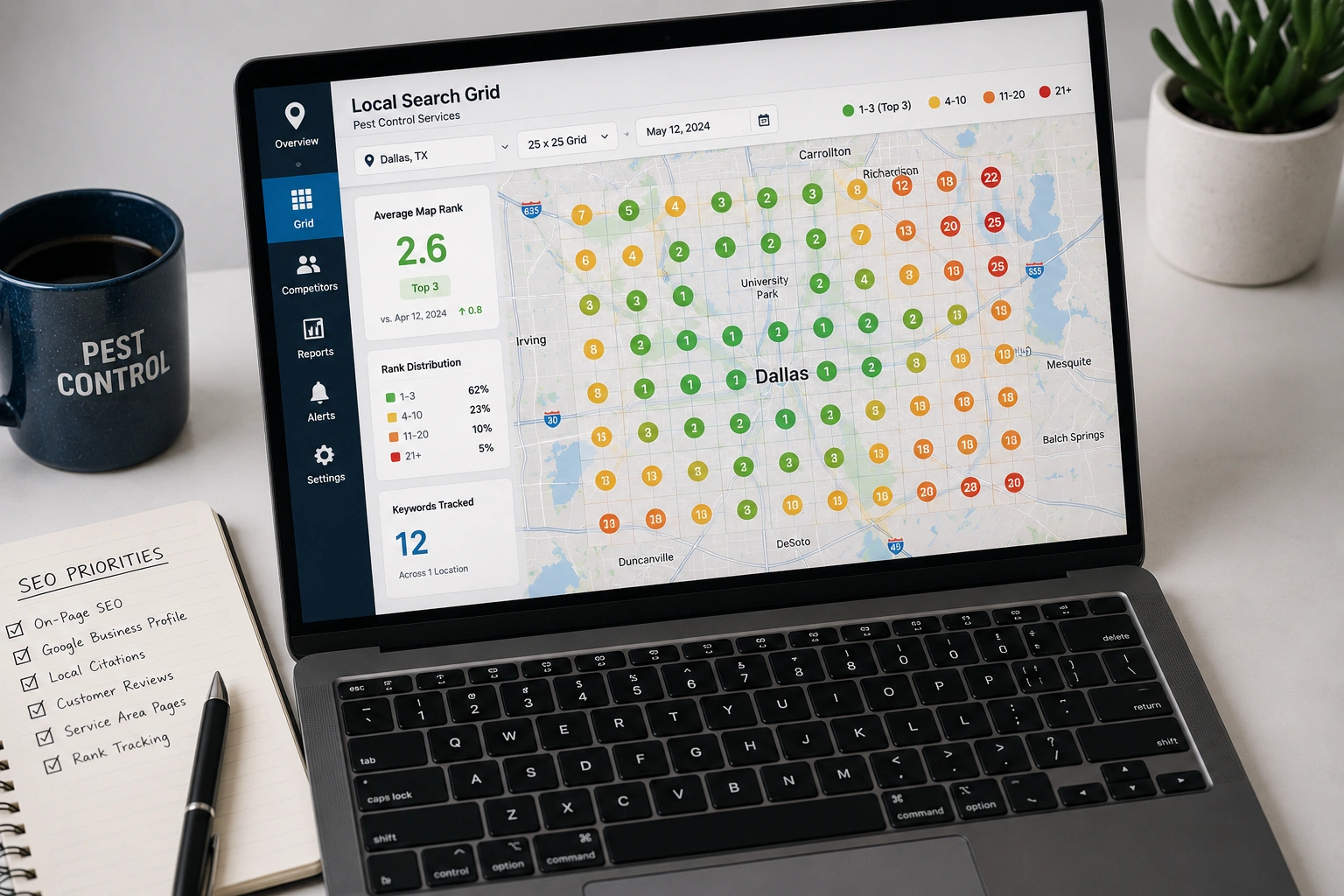
A local search geogrid reveals where a pest control business ranks in the Google Map Pack across its target service area.
Local SEO Strategy for Pest Control Companies
Building a Compounding Digital Asset
Local SEO is not a one-time fix. It is a continuous investment in digital infrastructure that, when built correctly, lowers your cost-per-acquisition over time while paid channels trend in the opposite direction. A pest control business that ranks organically in the top three local results for its primary service areas is not dependent on any single platform’s pricing decisions or algorithm changes in the paid advertising ecosystem.
The compounding nature of organic search comes from how authority accumulates. Each optimized landing page, each consistent citation, each five-star review, and each piece of relevant content adds a signal layer that reinforces your relevance and prominence in Google’s local algorithm. Paid ads provide immediate visibility, but they build nothing permanent. Organic SEO builds equity: a digital asset that belongs to the business and appreciates with consistent attention.
Aligning with Local Search Algorithms
Google’s local search algorithm evaluates three primary factors: proximity (how close the business is to the searcher), relevance (how well the business profile and website match the search query), and prominence (how well-known and trusted the business appears based on reviews, citations, and backlinks). A generic marketing approach addresses none of these methodically.
Capturing high-intent local traffic requires a structured campaign that speaks directly to each of these signals. That means optimizing your Google Business Profile with precise categories, building service-specific and geography-specific landing pages, and implementing a consistent review generation process. These are not independent tactics; they function as an integrated system, and the gap between a business that executes all three and one that executes none is typically the gap between page one and page three.
The first two pillars work in tandem to establish local relevance. Neither operates effectively in isolation:
- Pillar 1: Complete Google Business Profile optimization: Ensure complete NAP consistency across all platforms, select precise primary and secondary business categories, maintain an active posting cadence, and build out the full services section to match the treatment types your business offers. An optimized GBP is the foundation that makes everything else visible.
- Pillar 2: Geographic and service-specific keyword targeting: As detailed in our local service business SEO guide, each service area and treatment type requires its own dedicated landing page built around the localized search queries your customers typically use. A termite control page targeting Phoenix searchers and a rodent exclusion page targeting Scottsdale searchers are not redundant; they are distinct ranking assets.
- Combined effect: When your GBP categories align with your landing page content and your citation data is consistent across directories, Google receives a coherent, reinforcing signal about what your business does and where it operates. That coherence is what pushes businesses into the top three local results.
Three Pillars of Local Search Visibility
Google Business Profile Optimization
The Google Business Profile is the most valuable single asset in local search. It is what populates the map pack, drives direct call clicks, and surfaces your business in “near me” searches, all without the user ever visiting your website. An incomplete or misconfigured GBP is one of the most common reasons pest control businesses fail to appear in the local pack despite having a functional website.
Complete optimization means more than filling in the basic fields. It requires selecting the correct primary category (“Pest Control Service” rather than a generic “Home Services” label), adding relevant secondary categories, maintaining strict NAP (Name, Address, Phone) consistency across every directory and citation source, uploading regular photos and service updates, and ensuring the service list reflects every treatment type you offer. Each of these elements contributes to Google’s relevance assessment. Details matter here.
Geographic and Service-Specific Keyword Targeting
Local search intent is fundamentally geographic. A homeowner in Phoenix searching for termite control is not looking for a national brand’s homepage; they want a local provider who serves their specific area. Websites that fail to create dedicated landing pages for each service and each geographic market they serve are leaving significant search visibility on the table.
Keyword targeting for pest control requires mapping the full range of service-specific and location-specific queries your prospective customers use. “Bed bug treatment in [City],” “rodent exclusion near [Neighborhood],” “commercial exterminator [Metro Area]”: each of these deserves its own optimized page, not a single generic services page that tries to rank for everything and ranks for nothing.
Reputation Management and Review Generation
Using Customer Reviews for Search Prominence
Reviews are not just a trust signal for prospective customers; they are a direct input into Google’s local ranking algorithm. The volume of reviews your business has gathered, the recency of those reviews, and the overall sentiment all factor into how Google assesses your prominence relative to competitors. A business with 12 reviews and a 4.2-star average is not competing on equal footing with a business that has 340 reviews and a 4.8-star average, regardless of how well-optimized the rest of the profile is.
Keyword-rich reviews carry additional weight. When customers mention specific services, like “termite inspection,” “bed bug treatment,” or “rodent removal,” in their reviews, those terms reinforce your relevance for those exact search queries. This is not something you can manufacture, but you can encourage it by asking customers to describe the specific service they received when leaving feedback.
Implementing Automated Feedback Loops
Waiting for satisfied customers to leave reviews voluntarily produces a trickle, not a stream. The businesses that build dominant review profiles do so through systematic, automated outreach: text or email follow-ups sent within hours of a completed service, with a direct link to the review platform. The timing matters: a customer who just had a successful treatment resolved is at peak satisfaction and most likely to respond. Speed is everything here.
Automated review generation systems remove the inconsistency from this process. Rather than relying on individual technicians to remember to ask, the system triggers automatically based on job completion status. Consistent positive user signals, including volume, recency, and sentiment, directly improve organic search engine rankings and build the kind of social proof that converts a first-time searcher into a booked appointment.
The third pillar closes the loop between search visibility and customer trust:
- Pillar 3: Actively manage online reviews to signal trust to both Google’s algorithm and prospective customers who are evaluating multiple providers simultaneously. Review management is not passive monitoring; it is a structured acquisition process.
- Industry benchmark: Rentokil delivered a 200% year-over-year increase in five-star reviews in North America, securing over 55,000 reviews. That scale of review accumulation does not happen by accident; it is the result of systematic, automated feedback collection deployed across every service interaction.
- Ranking impact: Review volume and recency are among the most directly controllable prominence signals in Google’s local algorithm. A sustained review generation program compounds over time, making it progressively harder for competitors to displace your position in the local map pack.
Ready to see how your pest control business stacks up against local competitors?
Contact BizIQ at (888) 416-9800 to get a free SEO audit and speak with a local marketing expert today.
Scaling Local Pack Rankings and Organic Call Volume
Establishing Local Points of Presence
Physical presence matters in local search. Google’s proximity factor means that a business with a verified address in a target service area will consistently outperform a business trying to rank in that area from a distant location, all other signals being equal. For multi-location pest control operators, this creates a strategic necessity: establishing verified local points of presence in high-value markets is not just an operational decision; it is a search visibility decision.
The mechanics of this are simple. A verified business address in a target metro, combined with an optimized GBP for that location, creates a local anchor that Google can confidently surface for proximity-based searches. The challenge for growing operators is doing this at scale without the overhead of full branch infrastructure. It requires smart planning.
Capturing the Google Local Map Pack
The Local Pack, the three map-based results that appear at the top of local searches, captures up to 44% of all clicks on a search results page. That concentration of click share makes Local Pack placement the primary driver of organic phone calls and service bookings for pest control businesses. Appearing in position four is not a consolation prize; it is a fundamentally different traffic outcome.
Achieving and holding a Local Pack position requires the combined force of all three pillars: a fully optimized GBP, a website with relevant service and location pages, and a strong review profile. Businesses that focus on one or two of these elements and neglect the third tend to hover just outside the pack rather than inside it. The compounding effect of all three working together is what creates durable, defensible map pack rankings.
Rentokil’s 2024 strategic review in North America provides a useful real-world illustration of how physical presence and digital optimization intersect. Facing weakened digital lead flow, they launched a pilot program of “satellite branches” in Dallas, Chicago, Miami, and Nashville, fully branded, low-overhead operational hubs designed specifically to establish local points of presence in high-density markets. These locations were not full-scale branch offices. They were lean, strategically positioned hubs staffed with sales and customer support teams, with the explicit objective of increasing the company’s digital footprint and driving organic search leads in populous catchment areas. The pilot reflects a sophisticated understanding of how Google’s proximity signal works in practice: a verified local address, combined with optimized digital assets, creates a search visibility advantage that a distant location simply cannot replicate through content alone.
Many pest control businesses arrive at a local SEO engagement carrying the weight of a prior marketing provider’s decisions: inconsistent citations, a GBP with the wrong primary category, a website with no service-specific landing pages, and a review profile that has gone dormant. These are not disastrous problems, but they are compounding ones. Each month without structured optimization is a month a competitor with a better-managed digital presence is widening the gap.
The shift from short-term paid campaigns to a structured local SEO strategy is a shift in how you think about marketing spend. Paid campaigns are an operating expense; they produce output while the budget is active and nothing when it is not. A properly built local SEO foundation is a capital investment that appreciates. The organic leads it generates in month eighteen cost a fraction of what they cost in month three, because the infrastructure supporting them has been built and does not need to be rebuilt. That trajectory is what makes local search engine optimization the most strategically sound long-term investment available to a growing pest control business.
“Our visibility online has increased drastically since we started with BizIQ. Great group to work with. Monica is on the ball and makes sure we are taking advantage of all our resources.” Jacob Clonts, Heritage Homes & Fireplaces
Conversion Rate Optimization for Pest Control Bookings
Designing for Immediate Action
Ranking in the top three local results delivers traffic. What happens to that traffic depends entirely on what the visitor encounters when they land on your website or GBP listing. A pest control customer searching at 10 PM with an active infestation problem is not in a patient, research-oriented mindset; they want to confirm you serve their area, verify you are credible, and contact you immediately. Every second of resistance between landing and contacting is a conversion lost.
Prominent, sticky click-to-call buttons on mobile devices are not optional for a pest control website; they are the primary conversion mechanism. Over 70% of local mobile searches result in a phone call, and a button that disappears when the user scrolls past the header is a button that does not get tapped. Trust signals, including real review counts, industry certifications, and satisfaction guarantees, need to appear above the fold, not buried in a footer.
Reducing Friction with Online Booking
A meaningful segment of high-intent visitors prefer not to call. They want to schedule an inspection on their own terms, at whatever hour they are making the decision. Integrating real-time booking software directly onto the website captures this segment rather than losing them to a competitor who offers self-service scheduling.
The booking flow itself matters as much as its existence. A multi-step form that asks for excessive information before confirming availability creates drop-off. A streamlined flow, including service type, location, preferred time, and contact details, keeps the user moving toward confirmation. Every additional field is a decision point where a frustrated or impatient customer can exit.
Ranking is only the entry point. The conversion architecture of your website determines whether that organic traffic becomes revenue. Dedicated page layouts, similar in principle to the approach detailed in our guide on cleaning service landing pages, can be adapted directly for pest control websites to reduce friction and guide visitors toward immediate action. The structural logic is the same: service-specific pages with clear calls to action, trust signals positioned prominently, and mobile-first design that prioritizes the click-to-call interaction.
The trust signal component deserves particular attention. Rentokil’s UK pest business maintains a “world-class” Trustpilot rating, with 90% five-star reviews from more than 9,500 customers. That level of social proof, displayed prominently on a landing page, transforms a doubtful visitor into a confident caller. For smaller local operators, even a well-displayed collection of 80 to 100 genuine Google reviews achieves a meaningful version of the same effect.
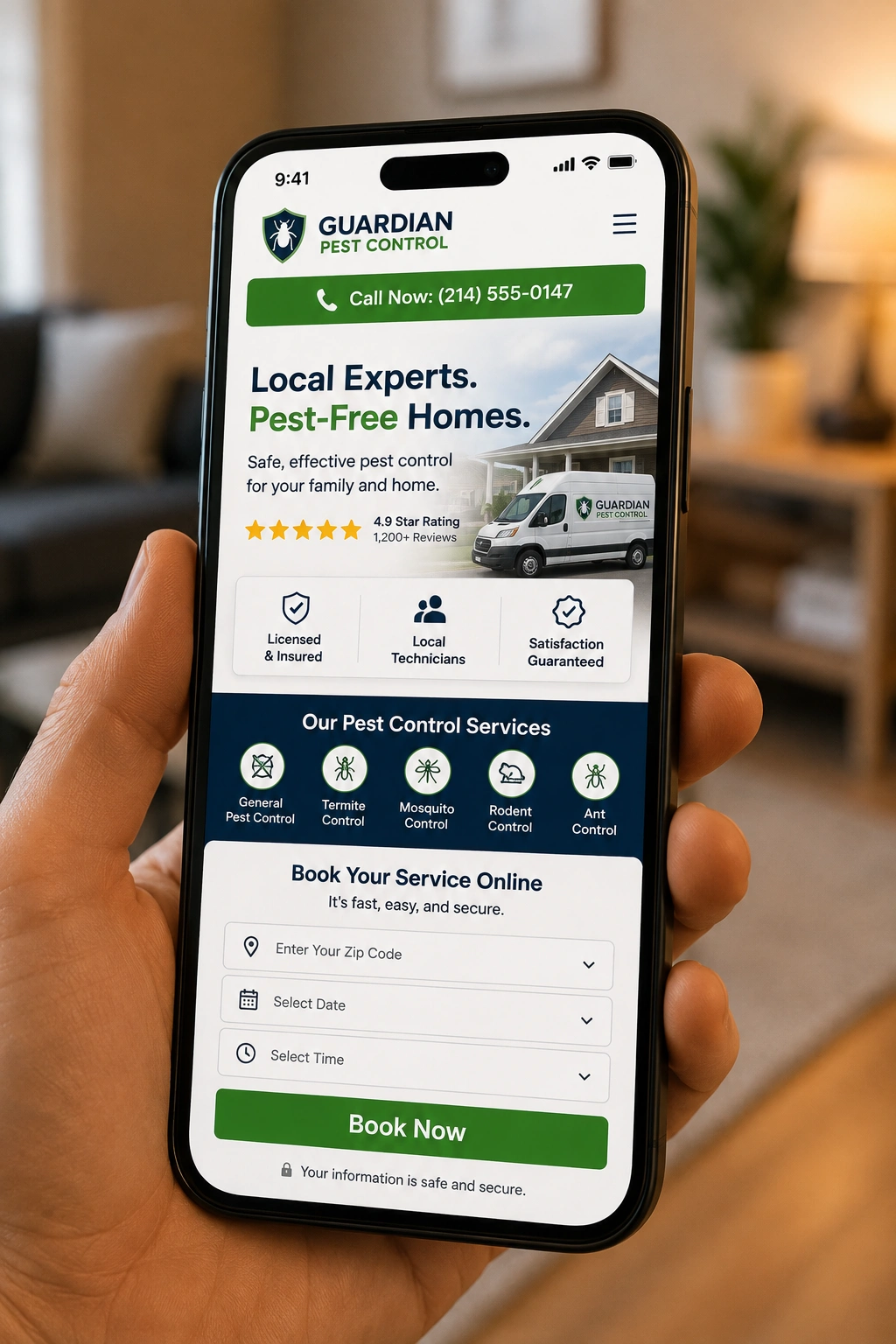
A mobile-friendly pest control website makes it easy for local customers to call, explore services, build trust, and book online.
Want to implement these conversion-focused strategies on your own website?
Contact BizIQ’s local marketing experts at (888) 416-9800 during 7am–4pm to schedule your free consultation.
Operational Efficiency and Closing the Booking
Speed from Lead to Proposal
Generating an organic lead is not the finish line. It is only the start. A high-intent caller who reaches voicemail at 2 PM on a Tuesday will call the next business in the local pack within minutes. The operational response to organic leads is as strategically important as the SEO work that generated them, and it is an area where many growing pest control businesses underinvest.
Speed from first contact to inspection and proposal is the variable that determines whether an organic lead converts into a paying account or a missed opportunity. Training customer-facing staff to prioritize inbound organic calls, using performance dashboards to track response times, and establishing clear escalation protocols for after-hours inquiries are not secondary concerns; they are the operational layer that determines the actual yield of your SEO investment.
Equipping Technicians with Mobile Workflow Tools
The scheduling, inspection, and proposal process is where operational friction most commonly kills conversions. A technician who cannot access job details on a mobile device, generate a proposal in the field, or update job status in real time creates delays that erode customer confidence. Mobile workflow tools eliminate these gaps by connecting the field operation to the office system in real time.
Rentokil’s “RIGHT WAY 2” growth plan in North America addressed this directly, using tools like PestPac and the ServiceTrak app to streamline the entire workflow from lead to completed job. The result was a consistent work order completion rate of approximately 97% in 2024. That benchmark reflects what operational rigor looks like at scale, and the underlying principles apply equally to a ten-truck regional operator.
The operational layer that converts organic leads into active accounts requires attention at every step:
- Response speed is non-negotiable. High-intent local leads have a short window before they contact a competitor. Inbound calls from organic search should be treated as the highest-priority contact type, with response time targets measured in minutes, not hours.
- Performance dashboards give owners and managers real-time visibility into lead response rates, conversion ratios, and technician scheduling efficiency, the data layer that makes continuous improvement possible rather than anecdotal.
- Mobile workflow tools like PestPac and ServiceTrak (as deployed in Rentokil’s “RIGHT WAY 2” plan) allow technicians to manage scheduling, conduct inspections, and generate proposals in the field without returning to the office, compressing the time from first contact to signed agreement.
- ~97% work order completion rate achieved by Rentokil North America in 2024 establishes a concrete operational benchmark. For a local operator, closing the gap between current completion rates and that standard is a direct revenue lever.
Local Service Ads vs Organic SEO for Pest Control
The Cost of Continuous Ad Spend
Google Local Services Ads and PPC campaigns deliver something genuinely valuable: immediate visibility at the top of search results, available from day one. For a new pest control business or one entering a new market, that immediacy has real strategic value. The problem is structural: paid visibility is entirely dependent on continuous budget allocation. The moment spend stops, visibility stops.
In competitive pest control markets, cost-per-click for high-intent keywords can be substantial, and it trends upward as more operators enter the paid auction. Rising ad costs compress margins, particularly for smaller operators competing against regional chains with larger marketing budgets. A business that builds its entire lead flow on paid channels is constantly exposed to that cost pressure, with no equity accumulating from the investment.
Long-Term ROI of Organic Search Visibility
Organic SEO builds differently. The authority accumulated through optimized content, citation consistency, and review volume does not depreciate when you pause a campaign; it persists and continues generating leads. Over a 12-to-24-month horizon, the cost-per-acquisition from organic search typically falls significantly below what paid channels can achieve, because the infrastructure cost is largely fixed while the lead volume grows.
There is a case to be made for running both channels simultaneously, particularly in the early stages of an SEO campaign when organic rankings are still building. PPC provides immediate volume while organic authority develops; once organic rankings stabilize in the top three, the paid budget can be reduced or redirected toward expansion markets. That sequencing, paid for immediacy and organic for sustainability, is the most capital-efficient approach available to a growing pest control operator.
Google Local Services Ads and PPC occupy a legitimate role in a pest control marketing strategy, particularly for businesses that need immediate lead volume while their organic presence develops. The strategic error is treating paid channels as a permanent substitute for organic search rather than a complement to it. Paid campaigns are an operating expense with a fixed return ceiling; organic SEO is a capital investment with a compounding return trajectory. A business that runs both intelligently, using paid ads to fill the pipeline while organic authority builds, will consistently outperform one that relies exclusively on either channel. The long-term cost-per-acquisition advantage of organic search is not marginal; it is the difference between a marketing budget that scales with growth and one that grows faster than revenue.
Implementing a Repeatable Pest Control SEO Strategy
Step-by-Step Execution Blueprint
The execution sequence matters as much as the tactics themselves. Starting with content before fixing technical foundations produces diminishing returns. Starting with reviews before the GBP is properly configured means those reviews are supporting a profile that Google cannot fully trust. The order of operations is:
First, audit. Then build. Then amplify.
Partnering with a Specialized Local SEO Agency
Running a pest control business is operationally demanding. Managing a complex local SEO campaign at the same time, tracking keyword rankings, monitoring citation consistency, producing service-specific content, and analyzing GBP performance data, requires time and technical expertise that most operators do not have available in-house. Attempting to do it partially is often worse than not doing it at all, because inconsistent optimization produces inconsistent signals that can suppress rather than improve rankings.
Partnering with a specialized agency that understands local home services shortens the timeline from invisible to visible. The difference between a generalist agency and one with specific experience as a pest control seo agency is the difference between a campaign that takes 18 months to show meaningful results and one that begins moving rankings within the first 90 days.
The execution blueprint for a pest control business entering or restructuring its local SEO strategy follows a clear sequence. Step one: conduct a thorough audit of your Google Business Profile and website structure: verify NAP consistency across all directory listings, confirm your primary and secondary GBP categories are accurate, and identify any service areas or treatment types that lack dedicated landing pages. Step two: build those missing pages, each one targeting a specific service and geographic market with content that matches the exact search language your customers use. Step three: implement an automated review generation system that triggers follow-up requests within hours of each completed job, building review volume and recency consistently rather than sporadically. These three steps do not require a large budget to initiate; they require disciplined execution and a clear understanding of how each element contributes to the overall local search signal.
Frequently Asked Questions About Pest Control SEO
How long does it take to see results from pest control SEO?
SEO is a long-term strategy, and anyone who tells you otherwise is selling something. Technical optimizations and Google Business Profile updates can produce minor ranking improvements within 30 to 90 days, particularly if there are obvious gaps like an unclaimed GBP or missing service categories. Significant organic lead growth and stable top-three local pack rankings typically require 6 to 12 months of consistent, structured optimization. The timeline varies based on market competitiveness and the starting condition of your digital presence, but the 6-to-12-month window is a reliable planning benchmark.
Why is my pest control business not showing up in the Google Map Pack?
The most common culprits are: no verified physical address in the target search area (proximity is a hard algorithmic factor), inconsistent NAP data across directories that creates conflicting signals about your business identity, a low volume of recent customer reviews relative to competitors in the pack, or an incorrect primary business category on your GBP. In many cases, it is a combination of two or three of these issues rather than a single cause. A structured local SEO audit will identify which signals are suppressing your visibility and prioritize the fixes by impact.
Should I hire a pest control seo company or run PPC?
Both, sequenced intelligently. PPC and Local Services Ads provide immediate visibility and are particularly valuable for new businesses or during peak infestation seasons when you need volume quickly. SEO builds a compounding asset that lowers your cost-per-acquisition over time and generates leads that do not stop when the budget does. The most effective pest control marketing strategies use paid channels to maintain lead flow while organic authority develops, then gradually shift the balance toward organic as rankings stabilize. Treating them as mutually exclusive is a false choice.
How do customer reviews impact local search rankings?
Reviews function as a direct prominence signal in Google’s local algorithm. Volume, recency, and sentiment all factor into how Google evaluates your business relative to competitors. A business accumulating new reviews consistently, even at a modest rate, signals to Google that it is active and trusted. Keyword-rich reviews that mention specific services (“termite inspection,” “rodent exclusion”) also reinforce your relevance for those search queries. The practical implication: review generation is not a marketing nicety, it is a core SEO activity that belongs in your standard operating procedures.
Is it worth paying for SEO services?
For most pest control operators, yes, with a qualification. The value of professional SEO services is highest when you lack either the time or the technical expertise to execute a structured campaign consistently. Inconsistent SEO produces inconsistent results; a professional team that understands local home services SEO will execute the full stack, including technical optimization, content, citations, GBP management, and review strategy, in a coordinated way that a business owner managing it between service calls simply cannot replicate. The return on investment from a well-executed local SEO campaign, measured over 12 to 24 months, consistently outperforms the equivalent spend on paid advertising for established local operators.
Scaling a pest control business through organic search is not a matter of finding a single tactic that works; it is a matter of building and maintaining a complete local search infrastructure. The businesses that dominate their local markets have optimized Google Business Profiles, service-specific landing pages for every treatment type and geography they serve, consistent citation data, and a systematic review generation process running in the background of every completed job. None of these elements is technically complex in isolation. The challenge is executing all of them simultaneously, consistently, and with enough strategic coherence that the signals they send to Google reinforce rather than contradict each other. Explore BizIQ local SEO packages to see how a structured, professionally managed local SEO campaign can accelerate this process for your pest control business, or call (888) 416-9800 to speak directly with a local marketing specialist about where your current digital presence stands and what it would take to move it.
Ready to scale your organic bookings?
Contact BizIQ today at (888) 416-9800 or visit our website to request your free local marketing audit.