
Written by the BizIQ Editorial Team. We are local marketing specialists dedicated to helping small and medium-sized home service businesses grow their online presence and secure consistent, high-value jobs.
- Google Map Pack Domination: How to optimize for the 32% Google Business Profile ranking factor and manage the critical “Business Open at Time of Search” signal that most contractors overlook entirely.
- Service Page Architecture: Why bundling your services onto a single page actively suppresses your rankings, and the exact sitemap structure to capture leads in your area searching for windows and doors.
- The Cost Calculator Strategy: How to build an interactive middle-of-funnel lead magnet that converts research-stage homeowners before they ever call a competitor.
- AI Search Optimization (AEO): How to get your business recommended by next-generation search engines like ChatGPT, Gemini, and Claude, without abandoning the traditional SEO that still drives 97.5% of your leads.
How Can SEO Help Window and Door Companies Generate More Jobs?
SEO helps window and door companies improve their visibility when homeowners search for window replacement, door installation, and repair services. By optimizing website content, local search profiles, service pages, and customer reviews, businesses can attract qualified prospects, increase estimate requests, generate more leads, and get more jobs.
If you are running a window and door business right now, we know the economics of paid lead generation are bruising. Google Ads clicks for competitive terms like “window replacement near me” predictably exceed $50 per click in mid-sized markets. Meanwhile, shared lead platforms like Angi and HomeAdvisor sell the same prospect to three or four contractors simultaneously, compressing your margins before you even load the truck. That model works until it doesn’t; for most contractors, the tipping point arrives quicker than expected.
Here’s what truly matters for local SEO in 2026 and the exact steps to start ranking in your service area. We want to show you what truly works based on evidence, without the marketing hype. The financial stakes make this worth solving properly. The math is simple. According to Angi’s 2025/2026 data, the average window replacement project is valued at $7,355, with full-home replacements frequently clearing $15,000. Missing a single page-one organic ranking in your primary service city is not a minor visibility gap: it is a recurring, compounding revenue leak that grows every month you remain invisible to homeowners who are actively planning projects.
Local SEO for window and door businesses is what truly works to get your business found when local homeowners search for window and door installation. When a homeowner types “window installer near me” or “sliding patio door replacement [city]” into Google, the businesses that appear in the Google Local Pack, the map-based block showing the top three local results, capture between 65% and 80% of all clicks for that query, according to BrightLocal’s 2025 research. Organic rankings below the map pack capture most of what remains. Paid ads, by contrast, receive a shrinking share of clicks as homeowners grow increasingly adept at scrolling past them. Aligning your website and Google Business Profile with Google’s ranking signals means we intercept leads in your area searching for windows and doors before they ever register a competitor’s name.
The economics of window and door SEO: Why organic beats paid ads
Pay-per-click advertising for window and door companies is capital-intensive in a way that compounds quietly. Keywords like “window replacement near me” and “door installation contractor” regularly exceed $50 per click in competitive markets. Apply a standard 10% website conversion rate to that traffic, and you are spending $500 to generate a single inbound lead. Factor in a 25% sales close rate, and your customer acquisition cost (CAC) climbs to $2,000 per job, on a project where your margin is already under pressure from material costs and labor. That arithmetic is difficult to sustain at scale, which is why so many contractors who rely exclusively on paid search find themselves running fast just to stay in place. The broader challenge of SEO for Home Service Companies is precisely this: paid channels create activity, but organic visibility builds an asset.
Contrast that with a well-executed local SEO campaign. The difference is stark. With the average window replacement project valued at $7,355, generating five additional organic leads per month translates to roughly $36,775 in potential project revenue, with zero per-click cost attached to any of it. The more important distinction is structural: paid ads stop producing the moment your budget runs out, whereas organic search rankings crystallize authority over time, progressively lowering your long-term cost per lead. A contractor who invests consistently in SEO for 12 months does not just rank better; they build a compounding asset that competitors cannot simply outspend overnight.
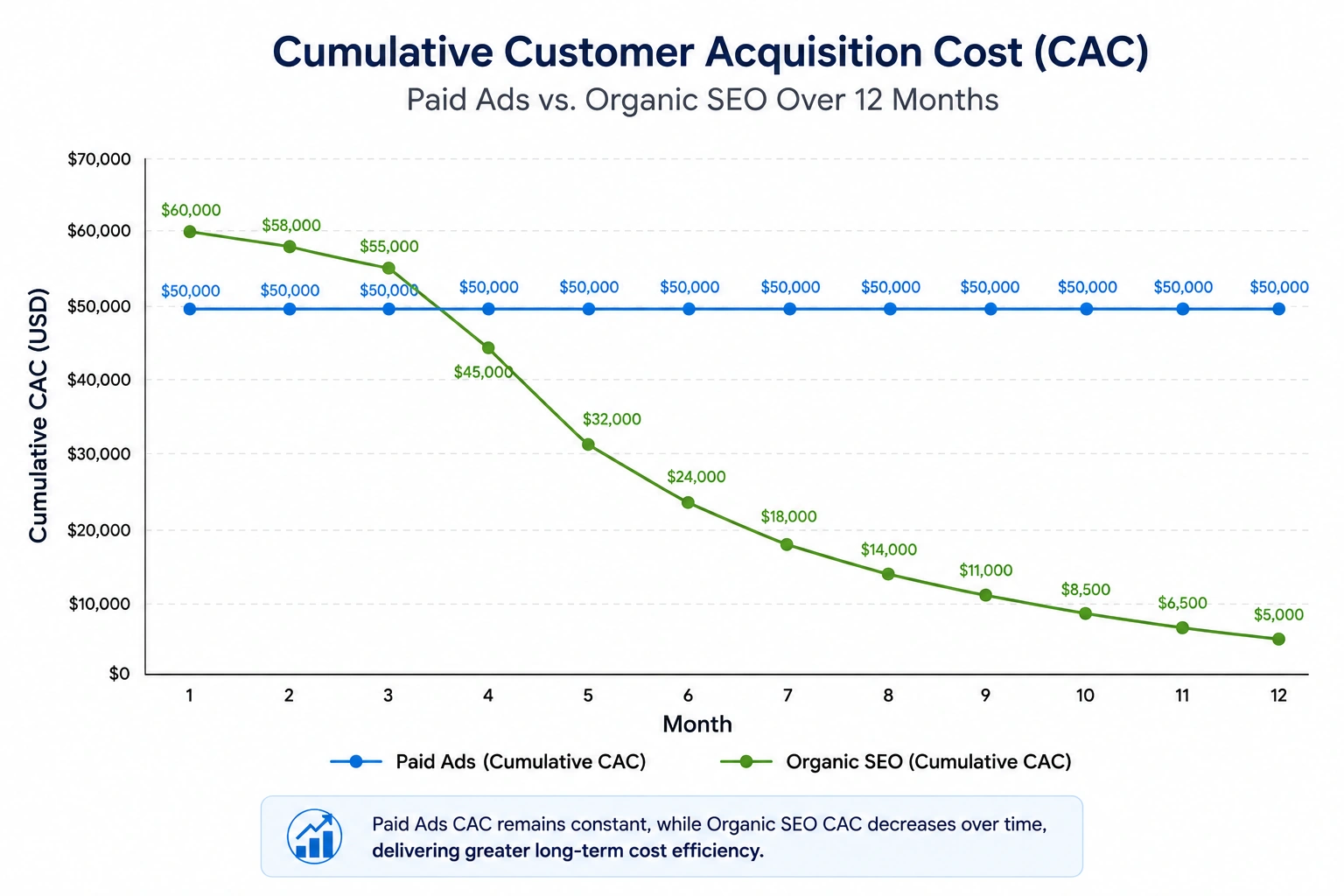
Organic SEO becomes more cost-effective than paid advertising over time, lowering customer acquisition costs after month four.
The 2026 local pack blueprint: Dominating the 32% Google Business Profile ranking factor
According to the Whitespark 2025/2026 Local Search Ranking Factors report, Google Business Profile signals comprise 32% of the total ranking weight in the Local Pack, making your Google Business Profile the single highest-impact optimization target available to a window and door contractor. Optimizing your Google Business Profile is like claiming your business’s digital storefront. Most businesses claim their profile and stop there. That is a mistake. The contractors who consistently occupy the top three map positions treat their profile as an active, managed channel, not a static directory listing.
Four mechanics determine whether your profile ranks or stagnates:
- Select the Correct Primary Category: This remains the most consequential single on-profile signal. Your primary category must be set to exactly “Window installation service” or “Window supplier”, not a generic “Contractor” or “Home improvement” label, to align with the specific user intent Google is trying to satisfy. Mismatched categories dilute your relevance signal even when every other profile element is optimized.
- Manage Dynamic Operating Hours: In 2026, Business Open at Time of Search has risen to the #5 ranking factor in the Local Pack. When a homeowner searches for a window installer at 7:00 PM and your profile reads “Closed,” Google actively deprioritizes your listing in favor of competitors whose profiles indicate availability. Accurate, extended hours, or a clearly defined “By Appointment” status, directly affect how often your profile surfaces during evening research sessions, which is when a significant portion of homeowner searches occur.
- Build a Systematic Review Engine: Review signals account for 20% of local pack visibility, according to BrightLocal’s local algorithm research. Building a systematic review engine is about building a digital reputation that works for you while you sleep, securing reviews from happy customers. An automated text or email request sent 1 to 3 days after every completed installation is the most reliable mechanism for generating a consistent review cadence. SOCi’s research indicates that every 10 new reviews earned improves local conversions by 2.8%, a compounding return that accelerates as your review count grows relative to competitors.
- Address the Proximity Constraint Strategically: Physical distance from the searcher accounts for 48% of predictive power in general local search results, per a Search Atlas local algorithm study from August 2025. That figure is not a ceiling: it is a baseline. Within the top 10 results, proximity’s influence drops to 36%, while review count and keyword relevance rise to represent 26% and 22% of ranking weight, respectively. A contractor with a strong review profile and well-optimized service pages can extend their effective ranking radius into adjacent towns, capturing jobs that a closer but under-optimized competitor will never see.
Service page architecture: Stop bundling your revenue drivers
A single “Services” page that lists vinyl windows, casement windows, entry doors, patio doors, and egress installations in one block is not a content strategy; it is a keyword dilution problem. Google cannot assign strong topical relevance to a page that attempts to rank for eight distinct search intents simultaneously. It confuses the algorithm. Top-performing window and door sites allocate 25 to 40 dedicated pages to capture specific, local queries. The gap in organic traffic between that approach and the single-page model is not marginal: it is the difference between page one and page three.
The Digital Marketing for Window & Door Service Businesses framework that consistently produces results uses this page architecture:
- Vinyl Window Replacement: A dedicated page targeting homeowners evaluating cost-effective, low-maintenance upgrades. This is typically the highest-volume service keyword in the category and warrants its own URL, title tag, and localized content.
- Double-Hung & Casement Windows: Style-specific pages that capture long-tail, specific queries from buyers who already know what they want. These searchers are further along in the decision cycle and convert at higher rates than generic window replacement traffic.
- Sliding Patio Doors & Entry Doors: Door installation services need to be separated entirely from window services. Combining them on a single page prevents either service from building distinct topical authority in Google’s index.
- Egress Window Installation: This high-ticket, specialized service frequently carries significant local search volume with comparatively low competitor optimization. A dedicated egress page often ranks faster than any other service page because so few contractors have built one.
- Service-Area Pages: We recommend building dedicated service-area pages for neighboring municipalities to capture organic traffic outside your immediate service radius. We recommend that these pages feature unique local project photos, real reviews from customers in that specific area, and regionally relevant details: climate considerations, local permit requirements, and neighborhood-specific installation challenges, to prevent triggering Google’s duplicate content filters. Template-swapped city pages with only the location name changed do not rank: they get filtered.
Get My Free SEO & Competitor Snapshot →
We will score your website against your top local competitor and show you exactly where you are losing jobs.
The middle-of-funnel strategy: Building an AI-powered window cost calculator
Homeowners do not decide to replace their windows on a Tuesday and call a contractor by Wednesday. The research phase typically stretches several weeks, during which they are comparing material types, reading cost guides, watching installation videos, and building a mental shortlist of contractors they might trust. Modernizer’s 2025/2026 data puts the national average window replacement cost at $1,047 per window, including materials and labor. That number is the anchor point for nearly every homeowner’s early-stage research, and it is the search query that drives enormous volumes of research-stage traffic to whoever answers it most usefully.
A dynamic calculator on your website captures that traffic at the exact moment homeowners are forming their project budget. The build is simpler than most contractors assume. No coding is required. A prompt to ChatGPT or Claude: “Build a clean HTML/JavaScript window cost calculator using these price tiers: $750 for budget vinyl, $1,200 for mid-grade double-pane, $2,000 for premium wood or fiberglass. Include fields for the number of windows, window type, and installation complexity. Output a total estimate range.” : will generate functional code in minutes, without a developer. The lead generation mechanism sits at the end of that calculator: require users to enter their email address to receive a detailed PDF breakdown of their estimate. Passive research traffic becomes a named, qualified lead with a documented project scope.
“A window cost calculator is the ultimate middle-of-funnel lead magnet. Homeowners do not search for window costs unless they are actively planning a project. Capture them during the research phase, earn their trust with transparency, and you will be the first contractor they call for an in-home estimate.”
Optimizing for AI search: Gemini, Claude, and ChatGPT visibility
AI search engines do not yet threaten local contractor leads. According to a Leadhub industry report from 2026, AI Overviews appear in only 2.5% of window and door search queries, compared to over 15% penetration in other industries. Traditional organic and local SEO remain the dominant lead sources for this category by a wide margin. Contractors who have reorganized their entire strategy around AI displacement have, in most cases, abandoned the channels that were genuinely producing jobs.
That said, a meaningful and growing segment of homeowners is using AI assistants: ChatGPT, Gemini, and Claude, to shortcut the research process. Queries like “Who is the best window contractor in Denver?” or “Find me a door installer near [neighborhood]” are increasingly common. The recommendations these models surface are not random. They rely on data. Large language models extract their local business recommendations from trusted directories, review platforms, and community discussions: Yelp, the Better Business Bureau, Google Business Profile data, local chamber directories, and Nextdoor threads.
Generative Engine Optimization for a window and door contractor is not a separate discipline; it is the downstream effect of maintaining active, highly-rated profiles across the platforms that LLMs treat as authoritative sources. This means consistency across directories, which is like making sure your business name, address, and phone number look exactly the same everywhere, like introducing yourself with the same name at every networking event. Contractors who have already built a strong local directory presence and review volume are, by extension, already genuinely optimizing for AI-assisted search. The ones who are not are invisible on both channels simultaneously.
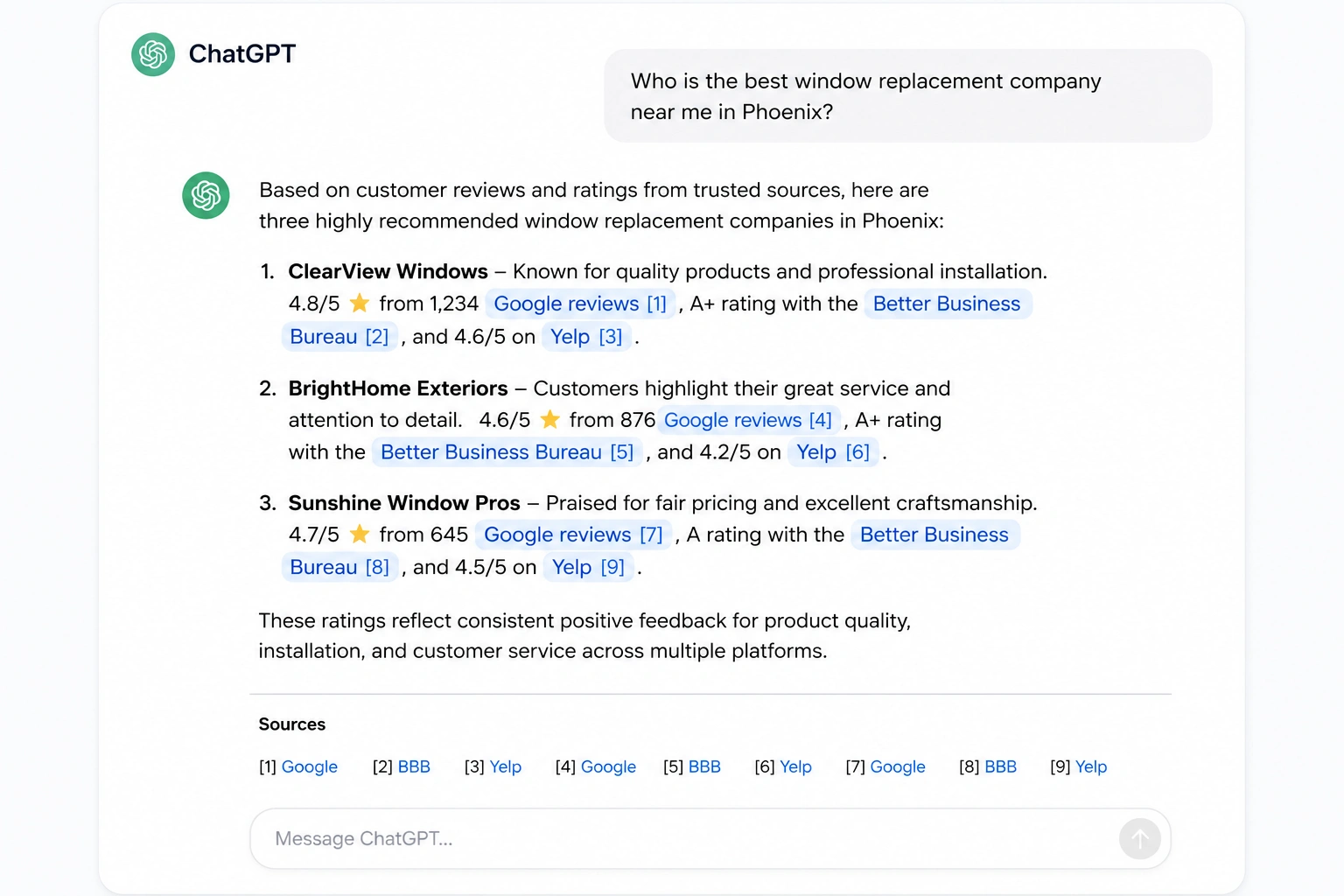
A ChatGPT response demonstrates how AI recommendations reference trusted sources like Google Reviews, BBB, and Yelp.
Book a Free 15-Minute Strategy Call → Let’s map out a custom 2026 SEO playbook for your service area.
The 5-step link-building strategy for contractors
Domain authority is not built through any single tactic; it compounds through a deliberate pattern of earning relevant, trusted links from sources Google already respects. For window and door contractors, the most productive link-building channels are closer to home than most agencies suggest, and they require less content production than the generic “write guest posts” advice implies.
- Manufacturer Partner Links: Every major brand you install, such as Simonton, Pella, Milgard, or Andersen, maintains a dealer locator on their website. Request to be listed. These are high-authority, topically precise backlinks from domains that Google already treats as industry references. A single manufacturer listing often carries more ranking weight than a dozen generic directory submissions.
- Local Chamber & Business Directories: A verified listing in your local Chamber of Commerce directory, the BBB, and regional business associations strengthens your geographic relevance signals. These links are not glamorous, but they are bedrock, and they are the citations that AI search engines cross-reference when building local business recommendations. This relies heavily on consistency across directories.
- Complementary Contractor Partnerships: Local roofing, siding, and HVAC contractors serve the same homeowners you do, at different points in the renovation cycle. A reciprocal guest post arrangement or a shared project feature, “We replaced the windows while [Roofing Partner] handled the exterior,” generates complementary contractor partnerships that distribute link equity within a tightly relevant niche. These links carry strong topical signals because the referring domain’s content is genuinely adjacent to yours.
- Community Sponsorships: Sponsoring a local youth sports team, a charity home renovation event, or a regional home show almost always produces a backlink from the organization’s website. These links are geographically precise, editorially placed, and frequently hosted on .org domains, a combination that Google’s local algorithm responds to consistently.
- Local Press & PR: A story about a charity window installation for a family in need, a business milestone, or a notable commercial project is genuinely newsworthy to local outlets. Editorial links from regional newspapers and local news websites carry significant authority and are nearly impossible for competitors to replicate on demand.
For a broader framework on building this kind of link profile without an enterprise budget, the affordable SEO strategies for small businesses guide covers the prioritization logic in detail.
Managing expectations: The realistic SEO timeline
SEO is a compounding asset, not a switch. It takes time. That distinction matters because contractors who treat it like a paid campaign, expecting immediate lead flow from day one, tend to abandon the strategy at the exact moment it is beginning to work. A professional local SEO campaign in a competitive market typically requires 3 to 6 months to produce quantifiable ranking improvements. Suburban markets with moderate competition often yield first organic leads within 90 days of launching properly structured service-area pages. Dense urban markets, such as Chicago, Phoenix, or Atlanta, may require 6 to 12 months of uninterrupted link building and review generation before a contractor breaks into the top three Map Pack positions.
What makes the timeline worth accepting is what happens on the other side of it. Consistent, high-volume organic lead flow typically establishes itself between months 6 and 12. Unlike paid advertising, it does not reset when your budget runs out. A contractor who builds strong organic rankings in their primary and secondary service cities owns a lead generation channel that competitors cannot simply outbid. The investment front-loads the cost; the returns extend indefinitely.
FAQ: SEO for window and door companies
How do window and door contractors get leads through SEO?
Contractors capture SEO leads by ranking in Google for searches homeowners make when planning installation projects. This includes optimizing service pages for keywords like “window replacement near me,” building a strong Google Business Profile, creating location-specific content, and publishing research-stage articles that capture homeowners earlier in the buying journey.
Is SEO worth it for window and door companies?
Yes. With average project values exceeding $7,000, even a modest increase in organic leads produces significant revenue. A window and door contractor who captures five additional organic leads per month and closes 25% of them adds roughly $9,200 per month in revenue, with no per-click cost. Over time, SEO becomes the lowest cost-per-lead channel available, and the only one that compounds rather than resets.
How much does SEO cost for a window contractor?
A professional local SEO campaign run by a specialized home services agency typically costs between $800 and $1,500 per month, depending on market size and the depth of local competition. That range covers ongoing Google Business Profile management, content production, directory consistency, and link acquisition, the full stack of activities required to move and hold rankings in a competitive local market. It is an investment.
What keywords should window and door companies target?
Your strategy should address three distinct keyword categories: service keywords (vinyl window replacement, entry door installation), location keywords (window contractor Johnson City, door installer Tri-Cities), and research keywords (cost of window replacement, vinyl vs. fiberglass windows). Targeting all three captures homeowners at every stage of the buying process, from early cost research through to ready-to-book intent.
How long does it take to see results from local SEO?
Most window and door companies see measurable ranking improvements within 3 to 6 months, with consistent lead flow established by months 6 to 12. Paid advertising can supplement lead generation during the SEO build period, providing near-term leads while the organic foundation matures.
Your next step to get started: Taking control of your local market
The homeowner buying journey has changed in ways that make passive marketing, such as referrals, yard signs, and the occasional Angi lead, an unreliable foundation for a growing window and door business. Homeowners are researching costs, comparing contractors, and reading reviews weeks before they pick up the phone. The contractors who show up consistently during that research phase, in the Map Pack, and in organic results, are the ones who get the call. The ones who do not are funding their competitors’ growth. Do not let them.
Local SEO is not a marketing expense in the traditional sense. It is the infrastructure that makes every other channel more effective: your ads convert better when homeowners have already seen your reviews, your referrals close faster when your website reinforces the recommendation, and your brand accumulates authority that no competitor can purchase overnight. A well-executed local SEO strategy for a window and door company is the single most resilient lead generation system available, and it is one that you own entirely.
Your market is being won right now. We are here to help you make sure it is being won by you. Your next step to get started is to evaluate where your business stands today compared to those taking your local leads.
Get Your Free Competitor SEO Snapshot Now → No commitment. No sales pressure. Just a clear, data-driven look at where your business stands on Google and how to win your market.