Written by the BizIQ Local SEO Specialist Team. We help local home service businesses show up when nearby customers search, turning local search engine optimization into a predictable lead-generation engine.
What this guide covers:
- Why local search engine optimization is the most profitable marketing channel for carpet cleaners in 2026.
- The step-by-step blueprint to optimize your Google Business Profile and claim the top spot in the Local Map Pack.
- How to build an automated “fresh review” engine to satisfy Google’s strict recency algorithms.
- The exact architecture for hyper-local service area pages that convert casual searchers into scheduled bookings.
- How to future-proof your business against AI-driven search changes and Google AI Overviews.
How Can SEO Help a Carpet Cleaning Company Grow its Business?
SEO helps carpet cleaning companies increase their visibility when customers search for carpet cleaning, stain removal, upholstery cleaning, and related services. By optimizing website content, local search listings, service pages, and customer reviews for both search engines and AI search, businesses can attract more qualified leads, increase bookings, and generate consistent long-term growth.
If you are running a carpet cleaning business, you have likely wondered why your competitors show up at the top of Google while your business is buried on page three. Relying on expensive lead-generation platforms that sell the same lead to five other cleaners is exhausting, and traditional coupon mailers do not bring in the high-margin commercial or residential jobs you want. This guide delivers a plain-language, evidence-based blueprint to help your business show up when nearby customers search, allowing you to take control of your lead flow without the guesswork.
The local search landscape for home services has shifted dramatically. The rules have changed. In 2026, Google’s search algorithm has moved beyond simple keyword matching to prioritize real-time user signals, mobile performance, and hyper-local relevance. To compete with bigger companies, you do not need an enterprise marketing budget; you simply need to understand what moves the needle for local search engine optimization.
Why Local SEO Is the Ultimate Lead Source for Carpet Cleaners
The 43% Conversion Power of Local Search
Local search traffic converts at a 43% conversion rate for home services, including carpet cleaning, making it the highest-converting marketing channel in the industry by a significant margin. That number deserves a moment of attention, because it is not just high; it is structurally different from every other channel. The person searching “carpet cleaning near me” at 9 a.m. on a Tuesday is not browsing. They need help now. They have a problem, they want it solved today, and they are ready to book.
The “near me” purchase loop reinforces this: 28% of local “near me” searches result in a booked service or purchase within 24 hours. Compare that to a Facebook ad impression or a cold email sequence, where the user has no active intent and no immediate urgency. Social media can build brand awareness, but it cannot replicate the buying momentum of someone who just discovered a wine stain on their living room carpet before a dinner party.
Organic Lead Dominance Over Paid Ads
65% of all home service leads originate from organic search and local SEO, a figure that dwarfs paid advertising channels. The distinction matters because paid ads and organic search are not equivalent investments; they behave completely differently over time.
Paid ads produce leads while the budget runs. The moment you pause a campaign, the phone stops ringing. The flow stops. Local SEO, by contrast, builds compounding digital equity. Every optimized page, every fresh review, and every consistent citation compounds on the last. Think of it like keeping your service van running. Skip the maintenance long enough, and you eventually break down and stop getting calls. Invest consistently in the health of your business’s online presence, and it becomes a self-sustaining engine. Our breakdown of local SEO strategies goes deeper on how that compounding effect works across different channels.
When homeowners experience a pet emergency, a major wine spill, or simply want to refresh their living space before the holidays, they do not browse social media for recommendations. Instead, they turn to Google and search for immediate solutions, which is why capturing this high-intent traffic is critical for your business’s survival.
With the U.S. carpet cleaning market valued at $6.9 billion in 2026 and over 41,611 active businesses competing for market share, standing out online is no longer optional. Investing in local search engine optimization ensures that when a customer in your neighborhood needs a deep steam clean, your business is the first one they see.
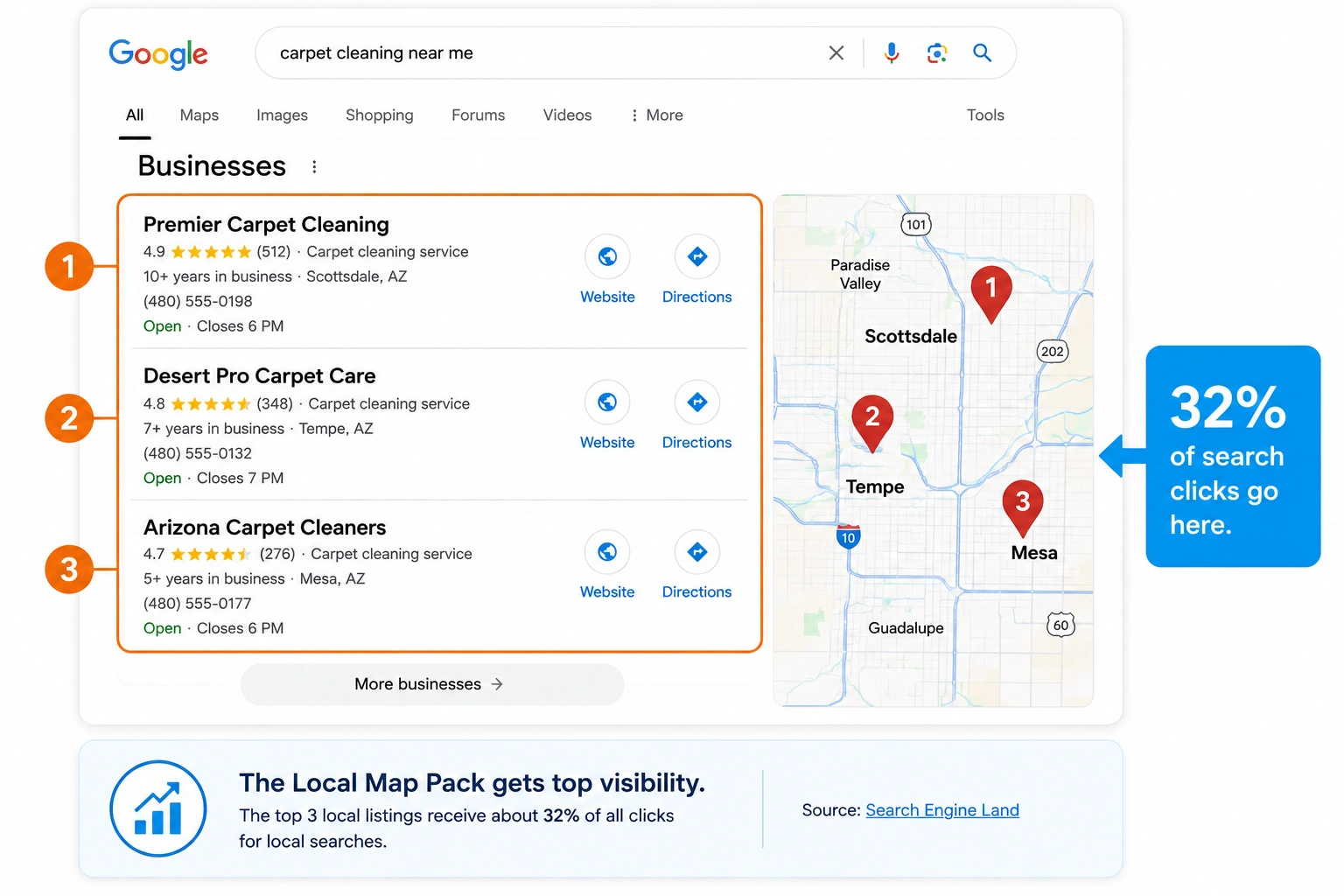
The Google Local Map Pack highlights the top three carpet cleaning businesses, where approximately 32% of local search clicks occur.
Step 1: Claim and Optimize Your Google Business Profile
Selecting the Primary Category Correctly
Your primary category is not a minor administrative detail. It is your foundation. According to the Whitespark 2026 Local Search Ranking Factors Report, selecting “Carpet Cleaning Service” as your primary category carries a 32% algorithmic weighting, which is the single most influential individual ranking factor in the entire Local Pack. Misclassifying your business under a generic label like “Cleaning Service” or “Home Services” quietly bleeds ranking power without any obvious warning sign.
Beyond the primary category, add secondary categories that reflect your full service range: “Upholstery Cleaning Service,” “Tile Cleaning Service,” and “Water Damage Restoration Service.” Each captures adjacent, high-intent queries from customers who need exactly those services but may not know to search for your business by name. For a step-by-step setup and verification process, our Google Business Profile setup resource covers every field in detail.
Service Area Business (SAB) Address Visibility Guidelines
Service Area Businesses, meaning carpet cleaners who travel to clients and operate from a home office rather than a commercial storefront, face a genuine tension here. Displaying a physical address ranks as the 7th most influential individual factor in the Whitespark report, so there is a real ranking argument for showing one. The compliance argument, though, is harder to dismiss: Google’s guidelines explicitly require businesses without a physical storefront to hide their address and designate service areas instead. Showing a residential address as if it were a commercial location risks immediate profile suspension, which can devastate lead flow overnight. Do not risk it.
The practical consensus for 2026 is plain. Use a verified home address during the setup process, then toggle the address to “hidden” and define your service areas precisely. You can compensate for the ranking differential through hyper-local on-page content and schema markup, as both of these are within your control and carry no compliance risk.
Photo Upload Cadence and Visual Signals
Google rewards active profiles. Uploading at least five new, real, high-resolution photos every week signals to the algorithm that your business is operating and engaged, rather than dormant. Stock photos undermine this entirely; they do not show your actual work, they do not build consumer trust, and Google’s image recognition is increasingly capable of identifying them. Avoid them completely.
What to upload instead: before-and-after shots of heavily stained carpets restored to clean, your wrapped service van parked in a recognizable neighborhood, and your technicians in uniform arriving at a job. These images satisfy Google’s activity signals, answer the unspoken question every prospective customer has (“Are these people professional?”), and differentiate your profile from competitors who are still using generic imagery.
Google Business Profile Optimization Checklist:
- Set your primary category to “Carpet Cleaning Service” and add secondary categories for upholstery and tile.
- Fill out the services tab completely with detailed, benefit-driven descriptions for services like “Pet Stain and Odor Removal.”
- Toggle your physical address to “hidden” if you operate as a Service Area Business from a home office.
- Upload at least 5 new, real photos weekly to signal to Google that your business is active.
- Keep your Name, Address, and Phone Number (NAP) perfectly consistent with the information on your website.
Step 2: Build High-Intent Service and Location Pages
Structuring Dedicated Service Pages
Trying to rank a single homepage for every service you offer is a structural problem, not a content problem. It does not work. Google needs a dedicated page to understand that your business is the most relevant answer to a specific query. A homepage optimized for “carpet cleaning” cannot simultaneously rank for “pet stain removal,” “upholstery cleaning,” and “commercial carpet cleaning”; each of those queries carries distinct intent, and each deserves its own page built around that intent.
The architecture is consistent across service pages: target the specific service term in the H1, URL slug, and opening paragraph. Include clear call-to-action buttons above the fold, pricing transparency where possible, and local trust markers, including real reviews, certifications, and photos from actual jobs. These elements do not just help rankings; they convert the traffic you earn. Our work with SEO for carpet cleaning businesses follows this exact page structure, and the pattern holds across every home service vertical we work in.
Creating Hyper-Local Neighborhood Landing Pages
Neighborhood landing pages are where most carpet cleaners leave significant ranking opportunities on the table. A single city-wide page for “carpet cleaning in Austin” competes with every other cleaner in a major metro. A dedicated page for “carpet cleaning in Westlake Hills” competes with far fewer businesses and speaks directly to residents of that specific area.
The distinction between a useful neighborhood page and a thin duplicate is specificity. Details matter. Mention local landmarks, reference common housing styles in that area, and embed a Google Map centered on that neighborhood. A page that reads like it was written for Westlake Hills specifically, rather than copy-pasted from a Phoenix template, is your digital storefront for that suburb. It tells residents you are active in their immediate area, and it tells Google you have genuine geographic relevance there. For a broader look at how this approach applies across cleaning verticals, our resources on digital marketing for cleaning services cover the same principles.
The exact pages your website needs:
- Primary Service Pages: Steam Carpet Cleaning, Low-Moisture Cleaning, Commercial Carpet Cleaning.
- Specialty Service Pages: Pet Stain and Odor Removal, Upholstery Cleaning, Tile and Grout Cleaning.
- Hyper-Local Location Pages: Dedicated pages for your top 3 to 5 target suburbs or neighborhoods (e.g.,
yourwebsite.com/services/carpet-cleaning/westlake).
Let us do the heavy lifting. Get a free, personalized local SEO audit from our team to see exactly what is holding you back from dominating your local market. Book Your Free Local SEO Audit
Step 3: Master the Review Loop to Build Prominence
The Algorithmic Impact of Review Recency and Velocity
Review signals account for 20% of total ranking influence in Google Maps, second only to Google Business Profile signals themselves. Volume matters, but recency matters more. The “18-Day Rule” captures the practical implication: if your profile goes longer than 18 days without receiving a new review, Map Pack visibility begins to decline. Google’s algorithm decays the weight of older reviews aggressively; reviews aged 180 days or more lose up to 90% of their ranking influence.
According to industry surveys, 74% of consumers only trust reviews written within the last three months. A competitor with 30 fresh reviews from the past month will outperform your business in both rankings and consumer trust if your last review is from eight months ago, regardless of how many total reviews you have accumulated. This is not a theoretical concern; it is a measurable, observable pattern in local search results across every home service market. It is a reality.
Setting Up an Automated Review Request System
The timing of the review request is everything. Do not wait. Send a text link immediately upon job completion, rather than the next day or in a weekly batch. The customer’s satisfaction is highest in the moment they see clean carpets. That window closes fast.
Train technicians to make the ask in person: “I’m sending a link to your phone right now. If you’re happy with our work, leaving a quick review helps our local business immensely.” That combination of a verbal ask and an immediate text link consistently outperforms any other review acquisition method.
Responding to every review within 48 hours is equally non-negotiable, and copy-paste response templates are a liability, not a shortcut. When a customer mentions a specific service or neighborhood in their review, mirror that language in your response. This action feeds Google’s local relevance signals and demonstrates to prospective customers that a real person read what they wrote. The marketing strategies for carpet cleaners we recommend all treat the review loop as a core operational system, not an afterthought.
Reviews from happy customers do more than just build trust; they feed Google’s algorithm with rich, localized keywords. When a customer writes, “They did an amazing job with pet stain removal on our living room rug in Westlake,” they are providing Google with verified, geographic proof of your service quality.
Although 49% of consumers trust online reviews as much as personal recommendations from friends and family, growing skepticism around fake reviews means authenticity is key. Responding to reviews individually and showcasing real customer experiences is the fastest way to build credibility in a crowded local market.
“In 2026, raw review volume is a vanity metric. Google’s algorithm rapidly decays the weight of older reviews, meaning those older than 180 days lose up to 90% of their ranking influence. To stay visible in the Map Pack, you must maintain a steady, active velocity of fresh reviews.”
–BizIQ Local Search Strategist
Step 4: Optimize for Google AI Overviews and LLMs in 2026
How AI Search Extracts Answers from Structured Local Content
AI Overviews are no longer an emerging feature; they are increasingly the first thing a user sees when searching for local home services. Google’s AI synthesizes answers from structured data and highly relevant local content, which means businesses that have not structured their websites for machine readability are effectively invisible to this layer of search.
The technical requirement is JSON-LD schema markup using the specific CleaningService subtype. This schema tells search crawlers exactly what your business does, where it operates, and what specific services it offers. It removes the guesswork. Nesting individual service offers, such as “Pet Stain Removal,” “Steam Carpet Cleaning,” or “Upholstery Cleaning,” directly within the hasOfferCatalog property gives AI search engines the granular, machine-readable data they need to cite your business as the relevant answer to a specific query.
A simplified example of how that schema looks in practice:
{
  "@context": "https://schema.org",
  "@type": "CleaningService",
  "name": "Spotless Carpet Cleaners",
  "areaServed": [{"@type": "City", "name": "Austin"}],
  "hasOfferCatalog": {
    "@type": "OfferCatalog",
    "name": "Carpet Cleaning Services",
    "itemListElement": [
      {"@type": "Service", "name": "Pet Stain Removal"}
    ]
  }
}
Optimizing for Conversational and Voice Search Queries
Voice search devices, including Apple Siri, Amazon Alexa, and Google Assistant, process queries differently than typed searches. A user typing might enter “carpet cleaner Westlake.” The same user speaking asks, “Who is the best carpet cleaner near me?” Your content needs to answer both. Structuring FAQ sections on your service pages to directly address question-based queries (“How long does carpet cleaning take?” / “Do you clean pet stains?”) naturally captures this conversational traffic.
Voice search attribution remains genuinely difficult to measure. There is no reliable software that tracks how many bookings originate directly from a voice assistant. That limitation is real. What is clear is that optimizing for conversational queries improves overall organic visibility, which is measurable and valuable regardless of the attribution gap.
AI search engines do not guess; they look for structured, machine-readable data to verify that your business is the most relevant answer to a user’s query. By combining structured schema markup with natural, conversational content, you position your carpet cleaning business to be cited as the primary recommendation in Google’s AI-generated summaries.
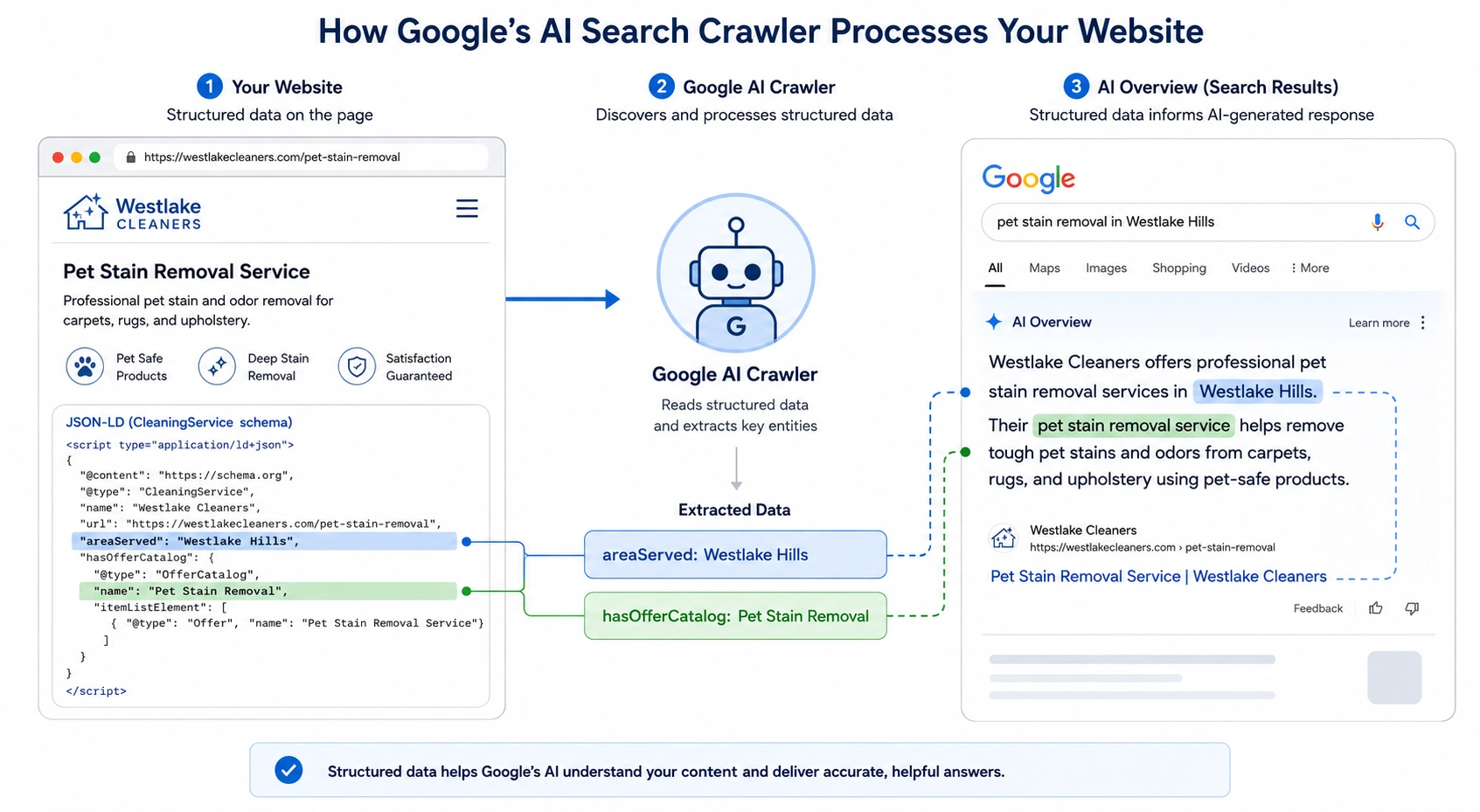
Structured data helps Google’s AI crawler extract key business information for accurate AI Overview search results.
Our team specializes in building modern, schema-optimized websites that rank in both traditional search and AI-driven overviews. Let us help you get found.
Step 5: Build Local Citations and Authoritative Backlinks
Directory Submissions and NAP Consistency
Citation signals account for 6% of local ranking weight, which is a smaller slice than profile or review signals, but one that is entirely within your control and surprisingly easy to get wrong. A citation is any mention of your business name, address, and phone number on an external platform: Yelp, YellowPages, Angi, HomeAdvisor, and dozens of industry-specific directories.
Think of your business listings like a business card. Keep them clean. If the phone number on your website says one thing, your Yelp listing says another, and your Angi profile has an old address, Google cannot determine which version is authoritative, resolving that uncertainty by lowering your rankings. NAP consistency across every platform is not glamorous work, but inconsistency is a quiet ranking penalty that compounds over time. Managing that consistency at scale is where local citations become a strategic asset rather than a maintenance task, and our citation management services handle the audit and correction process systematically.
Building Locally Relevant Inbound Links
Link signals carry 8% of local ranking weight and are harder to acquire than citations, which makes them more valuable when you do earn them. The most accessible local link opportunities for carpet cleaners are relationship-based: real estate agents, property managers, and home builders who maintain resource pages for their clients. A link from a local property management company’s “Preferred Vendors” page is worth considerably more than a link from a generic directory. These links build trust.
Industry credentials also carry weight. A link from the Institute of Inspection, Cleaning and Restoration Certification (IICRC) signals professional expertise to both search engines and prospective customers. Sponsoring a local youth sports team or community event can earn civic links from organizations with genuine local authority, which are the kind of links that are difficult to manufacture and therefore trusted.
Citation and Link Building Action Steps:
- Audit your existing business listings to ensure your NAP data is 100% consistent across the web.
- Submit your business to major local directories and industry-specific platforms.
- Reach out to local real estate and property management companies to offer partner discounts in exchange for a link on their website.
- Sponsor local community events, youth sports teams, or charity drives to earn high-authority local civic links.
Tracking Your Local SEO Success Metrics
Monitoring Google Search Console and GA4 Organic Traffic
Google Search Console shows you exactly which carpet cleaning queries are generating impressions and clicks to your website, providing actual data from Google’s own index rather than estimated traffic. Filter by query to identify which service and location pages are gaining traction, and watch for queries where you earn impressions but low clicks, which typically signals a title tag or meta description that needs refinement.
GA4 layers behavioral data on top of that: which location pages hold attention, which ones see users leave immediately, and where in the booking funnel visitors drop off. Time on page is a useful proxy for content relevance. Watch it closely. If users spend 12 seconds on your Westlake Hills neighborhood page before leaving, the content is not answering what they came to find.
Tracking Call Volume and Conversion Sources
Behavioral signals, such as mobile click-to-call, direction requests, and website clicks from your Google Business Profile, account for 9% of local ranking weight. These are not just metrics; they are ranking inputs. They drive rankings. A profile that generates consistent call and direction activity signals to Google that it is a relevant, trusted result, which reinforces its Map Pack position.
Call tracking software attributes phone calls directly to their source, whether that is your Google Business Profile, an organic landing page, or a paid ad, which eliminates the guesswork about where your leads originate. Keyword rankings are a leading indicator; booked jobs are the only true measure of whether your local SEO investment is working.
Tracking your local SEO metrics allows you to stop guessing and focus strictly on the high-impact ranking levers that drive actual revenue. By monitoring how many phone calls and booking requests originate from your organic search presence, you can clearly measure the return on your marketing investment.
Your 2026 Carpet Cleaning SEO Checklist
Weekly and Monthly Local SEO Action Items
Consistency is the variable most carpet cleaners underestimate. It is the key. The businesses that dominate local search in their markets are rarely doing anything exotic; instead, they are executing a short list of high-impact tasks on a reliable schedule.
Weekly:
- Upload 5 new real photos to your Google Business Profile.
- Respond to all new reviews with personalized, non-templated replies.
- Send review request texts to every completed job immediately upon service.
Monthly:
- Audit your local citations for NAP consistency across all major directories.
- Publish one new hyper-local neighborhood landing page targeting a priority suburb.
- Review Google Search Console performance to identify which pages are gaining or losing impressions.
Local search engine optimization is not a one-time setup; it is an ongoing process of building digital authority. By committing just an hour a week to these high-impact tasks, you can steadily climb the local rankings and build a self-sustaining lead pipeline that keeps your vans booked solid year-round. Most businesses see meaningful Map Pack movement within a 3-6 month window of consistent execution. This timing is not because the algorithm is slow, but because trust takes time to accumulate.
Frequently Asked Questions (FAQs)
Addressing Common Carpet Cleaning SEO Queries
How long does it take for carpet cleaning SEO to start generating phone calls?
For a brand-new website and Google Business Profile, it typically takes 3 to 6 months of consistent optimization, review acquisition, and local content publishing to rank in the Map Pack and generate steady inbound calls. However, if you already have an established profile and focus heavily on securing 3 to 5 fresh reviews per week, you can see a noticeable lift in Map Pack visibility within 30 to 45 days.
Should I put keywords in my Google Business Profile name?
Including keywords like “Carpet Cleaning” in your business name is highly influential for rankings, but you must proceed with caution. Google’s terms of service strictly prohibit adding unnecessary keywords to your business name unless they are part of your legally registered business name (DBA). Adding keywords to a business legally named “John’s Services” can result in an immediate profile suspension. If you want to use keywords in your name, legally register a DBA that includes your primary service.
Do I need a physical storefront to rank in the Google Map Pack?
No, you do not need a commercial storefront. Many of the highest-ranking carpet cleaning companies operate as Service Area Businesses from home offices. While displaying a physical address provides a slight ranking advantage, you can easily outrank storefront competitors by maintaining an active profile, securing a steady stream of recent reviews, and building hyper-local neighborhood landing pages on your website.
How do I handle SEO if I serve multiple cities or a large metropolitan area?
Do not try to rank your homepage for every city. It is a mistake. Instead, keep your homepage focused on your primary location and build dedicated, hyper-local location pages for each surrounding city or major suburb you serve. Ensure each page features unique content, local landmarks, and embedded maps to signal geographic relevance to Google.
Is paid advertising better than local SEO for carpet cleaners?
Paid ads are useful for generating immediate leads, but they stop producing the moment you turn off your budget. Local SEO is a long-term investment that builds a self-sustaining organic lead pipeline. Because organic search traffic converts at 43% for home services, combining short-term paid ads with a long-term local SEO strategy yields the best overall ROI.
To dominate your local carpet cleaning market in 2026, stop guessing and focus strictly on the high-impact ranking levers proven by data. Your immediate next step is to audit your Google Business Profile primary category to ensure it is set to “Carpet Cleaning Service.” Do this first. Once verified, implement an automated text-message system to request a Google review from every single customer immediately upon job completion. By securing just 3 to 5 fresh reviews every month and building out dedicated landing pages for your top three target neighborhoods, you will build an unstoppable local search presence that keeps your business growing.
At BizIQ, we have helped thousands of small businesses show up when nearby customers search. Let our team of experts manage your Google Business Profile, build your local citations, and optimize your website so you can focus on what you do best: running your business. Book Your Free Strategy Consultation Today