Written by a BizIQ Local SEO Strategist. Our Local SEO Strategist has spent over a decade helping local home service contractors and flooring installers dominate their local markets and generate exclusive organic leads.
What You Will Learn:
- How to claim your free business listing on Google and optimize it in 15 minutes.
- The Subfloor of SEO: Why maintaining the same information everywhere your business appears prevents Google from hiding your site.
- Dedicated Sample Boards: Why creating dedicated pages for each material you install is non-negotiable.
- The 2-Hour Weekly Plan: A simple maintenance checklist to keep the leads rolling in.
How Does SEO Help Flooring Service Companies Get More Customers?
SEO helps flooring service companies appear higher in search results and in AI when homeowners and businesses need flooring installation, replacement, refinishing, or repair services. By optimizing your Google Business Profile (GBP), website content, local listings, service pages, and customer reviews, flooring companies can attract qualified leads, increase estimate requests, and get more customers.
Many flooring owners wonder what SEO really means for their business and where they should start. If you want to get more high-paying flooring jobs in your local area, you do not need to pay lead generation sites for shared, low-quality leads, nor do you need to write a massive check to a marketing agency. You simply need to make your business visible where 89% of homeowners look when they are ready to renovate: Google Search and Google Maps. This guide strips away the confusing tech jargon and gives you the exact, step-by-step blueprint to rank higher, earn trust, and turn local searches into exclusive phone calls.
Most flooring contractors believe that Search Engine Optimization (SEO) is a complicated coding mystery. It is not. Local SEO is digital subfloor preparation: if you lay a flat, clean foundation, your rankings will sit perfectly. When a homeowner in your city types “hardwood floor refinishing near me” into their phone, Google’s job is to show them the most reliable, relevant local installer. By taking control of a few simple settings on your website and business profiles, you make it incredibly easy for Google to choose you over your competitors.
The digital showroom: Why your Google Business Profile is your most valuable asset
Claiming and verifying your digital storefront
Your Google Business Profile is like your storefront’s sign on the busiest street in town: except millions of people walk by it every day. It is the map listing that appears at the absolute top of local search results when someone looks for flooring services. It is completely free and visible to every homeowner within your service radius around the clock. Claiming it takes about 15 minutes. Ignoring it costs you jobs every single week.
The verification process is simple: Google will ask you to confirm ownership via a postcard mailed to your business address, a short video walkthrough of your location, or a phone call. Once verified, your profile becomes eligible to appear in the Local Pack: the map and three business listings that sit above every organic search result. That positioning matters significantly. Between 50% and 70% of all local clicks go directly to those top three map results, which means the Local Pack is generating more phone calls for flooring companies than their actual websites in most markets.
Your profile is not one tactic among many, and our local SEO strategy for small businesses shows how it anchors your entire digital presence. The short version: your profile accounts for 32% of the total ranking weight in Google’s local algorithm, making it the single most valuable asset a local installer can control.
Choosing the right primary category
Category selection is where most flooring contractors quietly lose ground to competitors. Selecting “Contractor” as your primary category, rather than “Flooring Contractor” or “Wood Flooring Installer,” is the equivalent of labeling your showroom “Building Stuff” instead of “Hardwood Specialists.” Google uses your primary category as the single highest-weighted relevance signal when deciding which businesses to show for a given search.
Once your primary category is locked in, layer secondary categories to capture adjacent searches without weakening the primary signal. A flooring company that installs hardwood, carpet, and tile should carry “Carpet Installer” and “Tile Contractor” as secondary categories. This structure lets you appear for a wider range of searches while keeping your core relevance signal clean. In competitive markets, a simple category correction has moved businesses from page two of the Local Pack to the top three within weeks: not because anything else changed, but because Google finally understood what the business actually does.
Using post-2026 core update features
The March 2026 Core Update introduced real consequences for incomplete profiles. Businesses with missing business hours, vague service descriptions, or no predefined services listed saw measurable ranking drops. This is not a penalty in the traditional sense; it is Google deprioritizing profiles it cannot confidently recommend to searchers.
The Services menu inside your Google Business Profile is where you list specific materials: hardwood, laminate flooring, luxury vinyl plank, tile, and carpet. Each entry is a relevance signal. A profile that lists “Laminate Flooring Installation” as a service will outrank an identical competitor whose profile just says “Flooring”: because Google can match the former to specific search queries with far greater confidence. Filling out these fields also satisfies the user experience checks built into the algorithm; a homeowner who clicks your profile and immediately sees the exact material they need is far less likely to bounce back to the search results.
Optimizing your profile is the fastest way to capture these high-intent searchers.
Despite this massive opportunity, there is a glaring gap in the market: only 18% of flooring contractors have a fully optimized Google Business Profile. This means that by spending just 30 minutes filling out your profile completely, choosing “Flooring Contractor” as your primary category, and listing your secondary services, you instantly leap ahead of 82% of your local competitors. This single asset is responsible for 40% to 60% of all local lead volume for successful installers.
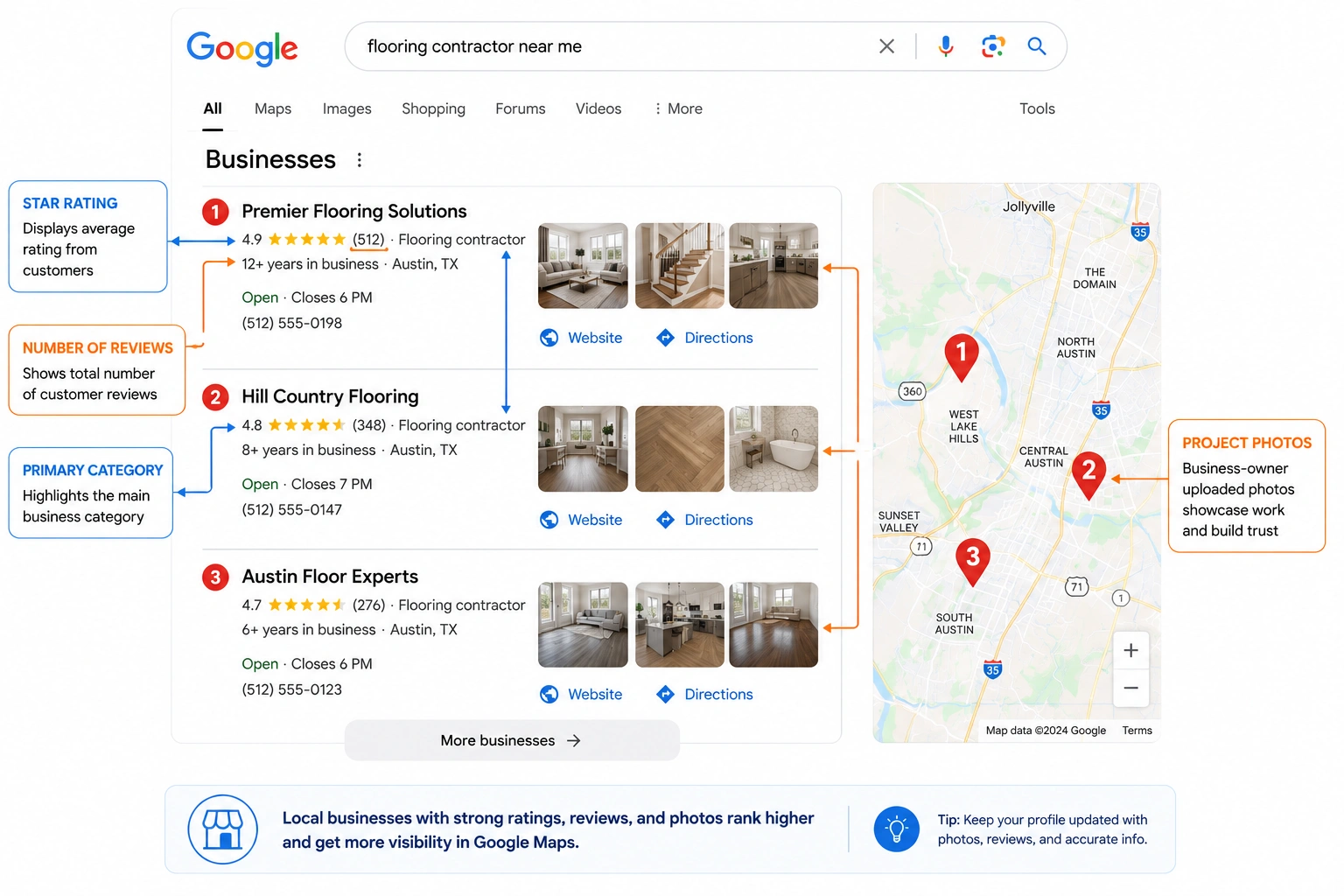
An optimized Google Local Map Pack highlighting the ranking signals that help flooring contractors attract more local customers.
Laying the subfloor: The critical role of NAP consistency
What NAP consistency really means
NAP stands for Name, Address, and Phone Number. It is the most unglamorous topic in local SEO, and also one of the most consequential. Think of it as subfloor preparation: if the subfloor is uneven, it does not matter how beautiful the hardwood is on top: the whole installation will fail over time. Google’s crawler continuously cross-references your business details across the web to verify that you are a legitimate, physically present business. When it finds conflicting information: “Elite Flooring” on one platform and “Elite Flooring LLC” on another, or a disconnected phone number still listed on a directory from three years ago, it loses confidence in your listing and suppresses your visibility.
The rule is simple: decide on one exact format for your business name, address, and phone number, and replicate it identically everywhere. Not approximately. Identically. “100 Main Street” and “100 Main St.” are different strings to a crawler, and that difference can quietly erode your rankings over months without any obvious cause.
The high-authority directory ecosystem
For home service trades, the directories that carry meaningful ranking weight are a short list: Angi, HomeAdvisor, Houzz, Thumbtack, Yelp for Business, and the Better Business Bureau. Claiming the free versions of these platforms is entirely sufficient: there is no need to pay for premium memberships or featured placements to establish the foundational trust Google requires. These listings function as high-authority backlinks, each one telling Google that a credible third-party platform has independently confirmed your business’s existence and location.
This is where local citations and link building intersect in a practical way. You are not just filling out profiles; you are building a corroborating network of references that makes your Google Business Profile’s claims verifiable. Directory management is a core component of our digital marketing for home service companies framework.
Cleaning up citation errors
Duplicate listings are a specific problem worth addressing directly. If your business has moved, changed its phone number, or rebranded at any point, there is a reasonable chance that old information is still indexed somewhere. A simple diagnostic: search your old phone number on Google and see what surfaces. Search your old business name in quotes. Any listing that appears with outdated details needs to be claimed and corrected, or flagged for removal.
Leaving these errors in place does two things: it confuses Google’s verification process, and it sends real customers to a dead phone line or the wrong address. The latter is an online reputation management problem as much as an SEO problem: a homeowner who cannot reach you because of a bad listing will not try a second time.
NAP Consistency Checklist:
- Name: Use your exact, legal business name across every single website (e.g., do not write “Elite Flooring” on Yelp and “Elite Flooring LLC” on Google).
- Address: Ensure your physical address is formatted identically everywhere (e.g., decide whether you will write “100 Main Street” or “100 Main St.” and stick to it).
- Phone Number: Use a consistent local phone number across all directories so Google can easily verify your physical location.
- Key Directories to Claim: Claim your free profiles on Google, Yelp, Houzz, Angi, and the Better Business Bureau (BBB) to build a solid foundation of trust.
Dedicated sample boards: Why you need individual pages for every material
Preventing keyword cannibalization
Imagine throwing all your flooring samples: hardwood, laminate, LVP, tile, carpet: into a single unlabeled bin and asking a customer to find what they need. That is exactly what happens when you list every service on your homepage without dedicated pages. Google faces the same confusion: when multiple queries could plausibly match a single page, the algorithm cannot determine which page is the strongest answer for any one of them. The result is that all of them rank poorly. This is keyword cannibalization, and it is one of the most common structural mistakes in flooring websites.
The fix is not complicated, but it does require discipline. Every material you install deserves its own page: not a section on a page, not a tab in a dropdown, but a standalone URL with its own optimized header, body copy, and meta description.
Structuring your material-specific pages
The URL structure for these pages should follow a consistent pattern: yourwebsite.com/material-city. In practice, that means pages like /hardwood-installation-denver or /lvp-installation-aurora. Each page’s H1 should match the primary search query you are targeting (e.g., “Hardwood Flooring Installation in Denver”), and the body copy should address the specific concerns a homeowner searching that term would have.
Meta tags matter here too: not as a magic ranking lever, but as a relevance confirmation. A page whose title tag, H1, and first paragraph all reference the same material and city sends a coherent signal. A page that mentions hardwood in the title but discusses all flooring types in the body sends noise. This service-specific architecture is highly effective, as shown in our guide on SEO for plumbers.
Localizing your content for high-intent searches
Localization goes beyond dropping a city name into a template. It means writing content that reflects genuine geographic context: humidity levels that affect hardwood expansion in your region, local building codes that govern subfloor requirements, or the specific neighborhoods where you have completed projects. These details signal topical and geographic authority to search engines in a way that generic content cannot replicate.
A page about hardwood installation in a humid coastal market should read differently from one targeting a dry inland climate. That specificity is not just good SEO: it is the kind of content marketing for flooring companies that genuinely builds trust with homeowners before they ever pick up the phone.
Core Material Pages to Build First:
- Hardwood Flooring Installation: Target local homeowners looking for high-end, classic wood installations and refinishing.
- Luxury Vinyl Plank (LVP) Installer: Capture the massive search volume for durable, water-resistant flooring options.
- Tile & Stone Installation: Focus on high-margin kitchen and bathroom remodel searches in your specific zip codes.
- Carpet & Laminate Fitting: Target budget-conscious homeowners and commercial property managers looking for fast turnarounds.
Hyperlocal keywords: Why 3 leads beat 5,000 clicks
The math behind hyperlocal intent keywords
Many marketing agencies will try to sell you on “traffic” by targeting broad keywords like “how to install vinyl plank flooring.” But unless you are selling flooring materials nationwide online, broad traffic is completely useless to your business. A homeowner in another state reading your DIY blog post will never hire you to install their floors.
The math is worth sitting with. A broad search term might pull 5,000 monthly clicks and generate zero local leads, because the people searching it are scattered across the country and primarily looking for information, not a contractor.
Hyperlocal keywords are like asking for directions from someone who really knows the neighborhood, not a tourist. Generic SEO is shouting into a crowd; hyperlocal SEO is having a conversation in a small room where everyone needs what you offer.
A hyperlocal search like “vinyl plank installation [your city]” might see only 50 monthly searches. But because those searchers are local homeowners actively looking to hire, those 50 searches can convert at 6% to 10%, producing three to five qualified leads per month. Targeting specific neighborhoods or surrounding suburbs pushes that conversion rate higher still: 8% to 15% is achievable when the search intent is tightly matched to the page content.
Three leads from 50 searches: that is not a consolation prize, that is a functioning lead generation system.
Mapping search intent to the flooring funnel
Homeowners move through a predictable research arc. Early in the process, they are comparing materials: “hardwood vs LVP,” “best flooring for pets,” “how long does laminate last.” These searches have high volume and low purchase intent. Later, the query shifts: “hardwood floor installation near me,” “LVP installer [city],” “flooring contractor [neighborhood].” That second category is where your pages need to live. Understanding this progression is key, and our guide on SEO local search strategies offers a deeper look at how local rankings respond to each stage.
Targeting the research-phase queries is not worthless: it builds brand familiarity: but it should never come at the expense of the high-intent local pages that really generate calls.
Real-world case studies of hyperlocal success
The financial impact of getting this right is not theoretical. A case study from Lakeside Floor Coverings showed a 105% increase in organic new users year-over-year, with localized blog content alone driving a 229% YoY increase in organic new users and a 121% increase in organic leads: all through optimized, geographically specific content rather than broad traffic plays.
Another case study by Fannit documented a comparable result for a regional flooring brand: expanding the SEO footprint from two target cities to six generated $4.3 million in revenue growth using hyper-local page architecture.
And for a New York flooring retailer tracked by Local SEO Bot, achieving top-three Google Maps visibility translated to a 131% increase in website clicks and a 58% increase in direct phone calls: the kind of numbers that make the case for local SEO more clearly than any abstract argument.
Instead, you must focus on searches like ‘vinyl plank installation [city]’. While a broad search might get 5,000 clicks a month, it will generate zero local leads. Conversely, a hyperlocal search might only get 50 searches a month, but because those searchers are local homeowners actively looking to hire an installer, those 50 searches can easily turn into 3 highly qualified leads: a 10% conversion rate compared to the standard 2.35% e-commerce average.
“In local flooring SEO, relevance is your currency. It is infinitely better to be found by 10 people who are holding a credit card in your neighborhood than by 10,000 people who are looking for DIY tips across the country.”
The review engine: How to turn happy customers into 24/7 salespeople
The shift to review velocity over historical volume
In the flooring industry, trust is everything. Homeowners are letting you into their homes to tear up their living spaces, and they want to know you will do the job right. This is why online reviews are a direct ranking factor for local search: and why the way Google weighs them has shifted.
Total review count used to be the primary signal. A business with 200 reviews outranked one with 50, almost by default. That calculus has changed. Review velocity: the rate at which a business receives new reviews: now carries more weight than historical volume. A profile that earned 200 reviews over five years and has received nothing in the past six months looks stagnant to Google’s algorithm. A profile with 40 reviews that adds three or four per month looks active, engaged, and trustworthy. The practical implication: asking for reviews needs to be a standing process, not a one-time campaign.
The address visibility debate for service area businesses
There is a genuine tension here for home-based installers. Historically, many independent contractors hid their physical addresses on their Google Business Profile to protect their privacy: a reasonable choice when your business address is your home. The tradeoff now is measurable: profiles with a visible physical address rank significantly higher (it sits at number seven among all weighted local ranking factors) than those configured as service-area only.
There is no universally clean answer to this. Installers who operate out of a commercial space: even a small warehouse or storage unit: should absolutely display that address. For those working from home, the decision involves weighing privacy concerns against a real ranking disadvantage. One middle-ground approach: use a registered business address through a local mailbox service or coworking space. It is not a workaround; it is a legitimate business address that satisfies Google’s requirements without exposing a residential location.
Optimizing reviews for the AI search layer (GEO)
AI search engines: Google AI Overviews, Perplexity, ChatGPT: are increasingly fielding queries like “Who is the best installer for pet-friendly laminate flooring in [City]?” These systems synthesize customer reviews to construct their recommendations. A review that says “Great job!” gives an AI engine nothing to work with. A review that says “They installed vinyl plank throughout our basement in Denver and it looks incredible: highly recommend for anyone with pets” gives the engine material, city, and use case in a single sentence.
Coaching customers to include the specific material and city in their review is not manipulative; it is helping them write a more useful review. The phrasing is simple: “If you have a moment, it would really help us if you could mention the type of flooring we installed and your neighborhood: it helps other homeowners find us.” Most satisfied customers are happy to oblige.
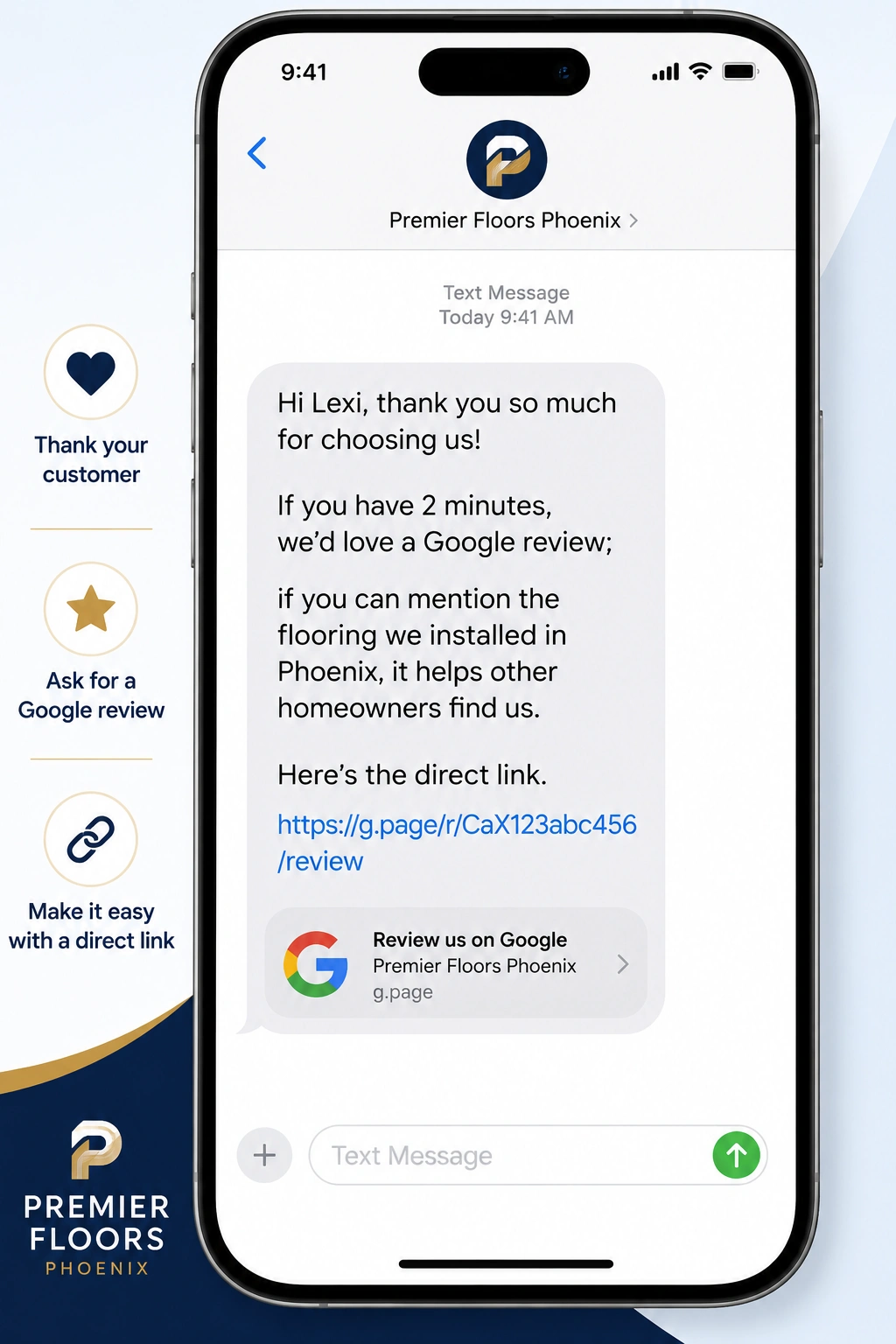
A professional SMS template encourages satisfied flooring customers to leave a Google review using a direct review link.
Schedule a free 15-minute strategy call with our team today and let us show you how affordable local SEO solutions can grow your business.
Your 2-hour weekly SEO maintenance plan
Setting up a repeatable routine
Local SEO is not a project with a finish line. It is a maintenance rhythm: closer to keeping your tools calibrated than to a one-time installation. The good news is that the weekly workload is genuinely manageable for a solo operator or small crew. Two hours per week, broken into four tasks, is enough to maintain and build on the foundation you have established.
The compounding effect is the real argument here. An organic ranking that takes 90 days to build will continue driving free, high-intent clicks for years without an ongoing ad budget. Google Ads stop the moment you stop paying. A well-maintained local SEO presence does not.
Managing photos and real-time engagement
Uploading real, unedited before-and-after project photos to your Google Business Profile is one of the highest-return activities in your weekly routine. Not stock images. Not renders. Actual photos from jobs you completed this week, showing the transformation from subfloor to finished surface. Google’s algorithm treats fresh photo uploads as a signal of an active, operating business, and homeowners browsing your profile respond to authentic work documentation far more than polished marketing imagery.
Geo-tagged photos carry an additional benefit: they signal your active service areas to Google’s local algorithm. Most modern smartphones embed GPS coordinates in photo metadata automatically. When you upload those images directly from your phone to your Google Business Profile, that location data travels with them. A quick, keyword-rich caption does the rest: “Completed a beautiful hardwood floor installation in [City] today: love how this one turned out.”
Streamlining review generation
The review request process should be standardized, not improvised. A simple text message sent within 24 hours of project completion: while the experience is fresh: converts at a dramatically higher rate than a follow-up email sent a week later. Keep the message short, include the direct link to your Google review page, and mention the specific material and city as discussed in the previous section.
Responding to every review you receive is equally important, and it takes less time than most contractors expect. A 30-second response that naturally mentions the service and location (“Thanks for the kind words, Sarah: we loved installing your new hardwood floors in [City].”) reinforces your local relevance signals and demonstrates to prospective customers that you are attentive. These review generation principles apply across all home service trades, as discussed in our guide on 6 ways to market your carpet cleaning business.
Your 2-Hour Weekly SEO Checklist:
- Upload 5 Project Photos (30 Mins): Take clear before-and-after photos of your latest installations and upload them directly to your Google Business Profile.
- Request 3 Reviews (30 Mins): Send a personalized text message with your direct review link to every customer within 24 hours of completing their project.
- Respond to Reviews (15 Mins): Write a quick, polite response to every review you receive, naturally mentioning the service and city (e.g., “Thanks for the review, John. We loved installing your new hardwood floors in [City].”).
- Publish a Weekly Update (45 Mins): Share a quick post on your Google Business Profile showcasing a completed project or offering a seasonal maintenance tip.
Common SEO pitfalls that cost flooring contractors thousands
Treating your website like a static brochure
The biggest mistake flooring contractors make is treating their website like a static brochure. If your site takes more than three seconds to load, or if it is not fully responsive on mobile devices, Google will actively penalize your rankings. Because 78% of mobile local searches for flooring contractors lead to a purchase or booking within 24 hours, a slow, hard-to-navigate mobile site is directly handing jobs to your competitors.
A website that has not been updated in two years sends a signal to Google that the business may no longer be active: or at minimum, that it is not engaged enough to merit a prominent recommendation. Adding new project case studies, updating your material offerings seasonally, and publishing even occasional location-specific content keeps the site alive in Google’s estimation. Active, content-driven websites consistently outperform static ones in local search rankings, a pattern we also see in our SEO for carpet cleaning businesses campaigns.
Ignoring mobile user experience and speed
Mobile performance is not a secondary concern. It is the primary one. The majority of “flooring contractor near me” searches happen on a phone, often while a homeowner is standing in the room they want renovated. A site that loads slowly, requires pinching to read, or buries the phone number under three menu layers loses that customer in under ten seconds.
Compressing large project photos before uploading them is the single fastest fix for most flooring websites. High-resolution images are the most common cause of slow load times, and the visual quality difference between a 4MB JPEG and a properly compressed 400KB WebP is imperceptible to a homeowner on a phone screen. Converting your image library to WebP format and running your site through Google’s PageSpeed Insights takes an afternoon and can produce meaningful ranking improvements within weeks.
Wasting time on low-quality legacy directories
Not all citations are equal, and the gap between Tier 1 and Tier 3 directories has widened considerably. Many legacy local directories: the ones that proliferated in the mid-2010s and promised “get listed in 500 directories overnight”: have lost their search authority entirely. Submitting to them today provides no ranking benefit and can occasionally introduce NAP inconsistencies that actively hurt your visibility.
Focus strictly on the platforms that carry genuine authority: Google, Yelp for Business, Angi, Houzz, and the BBB. Quality over quantity is not a platitude here; it is the operationally correct approach. Five clean, fully optimized Tier 1 listings will outperform 200 low-authority citations every time.
Demystifying the AI search layer and generative engine optimization
How Google AI overviews and Perplexity recommend flooring pros
The search landscape is shifting rapidly with the introduction of the AI search layer. Today, homeowners aren’t just looking at standard search results: they are asking AI engines for direct recommendations. To ensure your flooring business is the one recommended by these systems, you must maintain precise primary categories, list predefined services, and secure keyword-rich customer reviews that AI models can easily synthesize and trust.
Google AI Overviews, ChatGPT, and Perplexity all crawl the web to construct their recommendations, but they prioritize sources that are structured for machine readability. A business with a complete Google Business Profile, consistent citations, and reviews that contain specific material and location references is far more likely to surface in an AI-generated recommendation than one with a vague profile and generic reviews. Hiding product specifications behind JavaScript visualizers: a common pattern in flooring websites: is particularly damaging here, because AI crawlers cannot execute JavaScript the way a browser can.
Structuring content for LLM crawlers
Clear Q&A formatting is the most practical adaptation for AI search readiness. Using H2 and H3 headers followed by direct, concise answers makes your content easily parseable by large language models. An “Executive Summary” or “Direct Answer” block at the top of each service page: 50 to 70 words that answer the user’s primary question immediately: improves both AI crawlability and Google’s Featured Snippet eligibility simultaneously.
Creating a text-heavy, crawlable directory of your available materials is the other high-value move. Competitors who hide their inventory behind dynamic visualizers are leaving a significant indexing gap. A simple, well-structured materials page that lists product names, specifications, and installation details in plain HTML gives AI engines something concrete to work with: and gives you a ranking advantage that most local flooring sites are not yet exploiting.
Frequently asked questions about flooring SEO
How much does local SEO cost for a flooring company?
If you handle it yourself, local SEO costs nothing but your time. Claiming your Google Business Profile, keeping your business listings consistent, and asking for reviews are completely free. If you choose to hire a professional agency to build dedicated service pages and manage your campaigns, monthly retainers typically range from $1,500 to $4,000 depending on your market’s competitiveness.
How long does it take to see results from flooring SEO?
Most local flooring companies see early wins in Google Maps visibility within 30 to 45 days of optimizing their Google Business Profile. For organic website rankings on competitive terms like “hardwood flooring installation [city],” expect a timeline of 90 to 120 days of consistent effort to see steady, high-quality lead flow.
Can I do my own SEO, or do I need to hire an agency?
You can absolutely handle the vast majority of local SEO yourself. Claiming your Google Business Profile, uploading real project photos, and texting your clients for reviews require no coding knowledge. Hiring an agency becomes worthwhile when you want to scale rapidly, build out dozens of city-specific landing pages, or simply cannot carve out the weekly maintenance time.
What is the most important first step for a flooring company starting SEO?
Claim and verify your Google Business Profile. The local map pack appears above all organic search results, so an optimized profile is the fastest, most effective way to start showing up in “near me” searches and generating phone calls, often within the first month.
Why can’t I just rely on Google Ads instead of SEO?
Google Ads generate leads immediately, but they are expensive, often costing $15 to $40 per click in the flooring niche. When you stop paying, your leads stop. Organic SEO builds a digital asset that drives free, high-intent clicks to your business 24/7 without an ongoing ad budget.
Laying the groundwork for local search visibility requires attention to detail, a clean foundation, and the right tools. Claiming your Google Business Profile, ensuring consistent business information across directories, and creating dedicated pages for core materials build a lead-generation engine that keeps your crews busy year-round. Most of your competitors are not doing this well, or at all.
Click here to book a free 15-minute Local SEO Strategy Session with our team. We will analyze your local market, audit your competitors, and give you a customized blueprint to rank #1 in your city.