In this guide, you will learn:
- How to optimize your Google Business Profile to survive the 2026 suspension wave and protect your most essential digital asset.
- The mechanics behind ranking in the Local Pack (Map Pack) and what separates the top three listings from everyone else.
- How to prepare your website for AI search engines through Generative Engine Optimization, and why waiting is a competitive disadvantage.
- Mobile-first conversion strategies designed to turn high-urgency clicks into emergency phone calls before a competitor does.
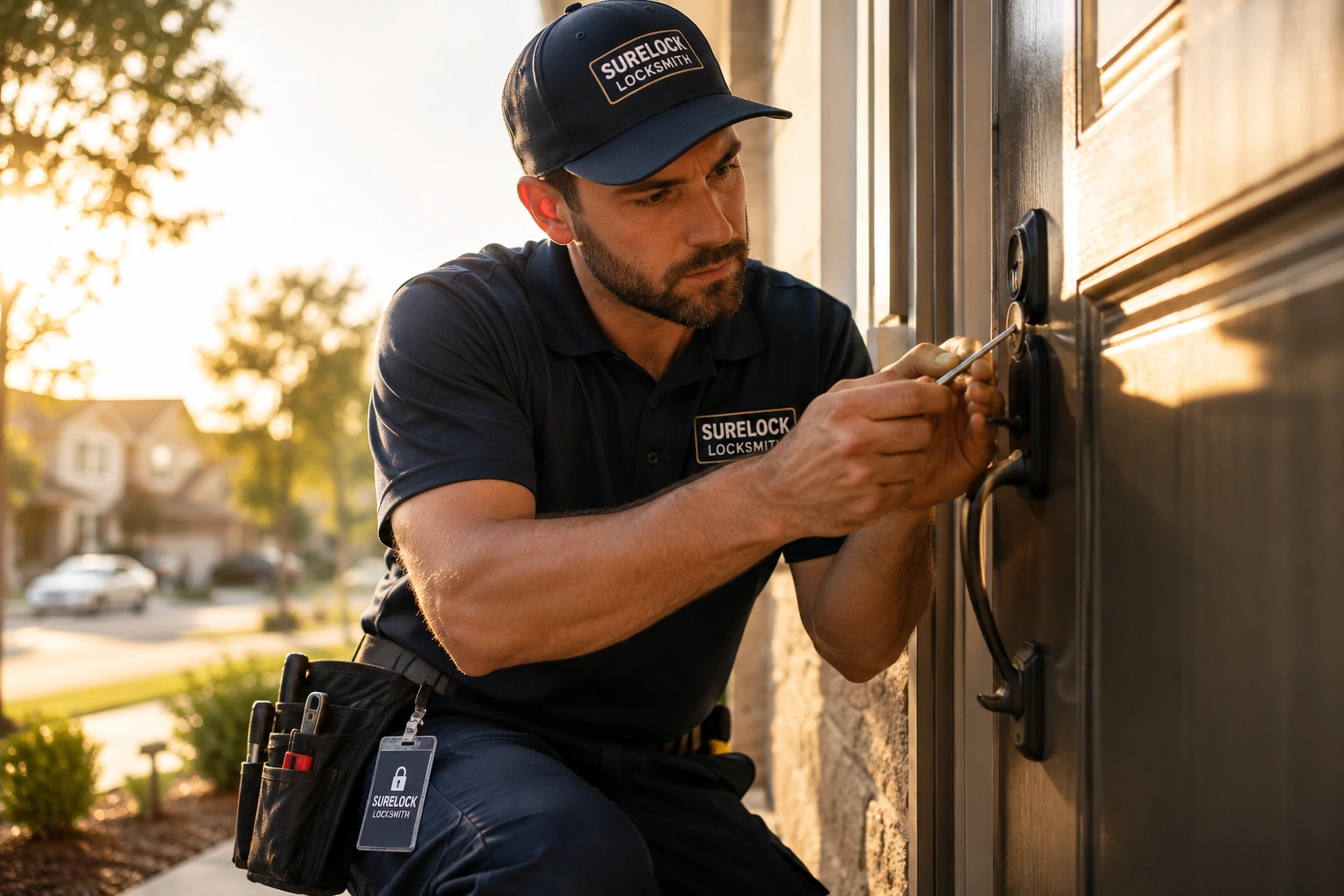
A professional locksmith assists a homeowner at a residential front door, showcasing trusted local service and expertise.
Why is SEO Important for Locksmith Businesses?
SEO for locksmiths helps locksmith businesses appear in search results when customers need lockout assistance, key replacement, lock repair, or security services. By optimizing local listings, website content, service pages, and customer reviews, locksmiths can increase visibility, generate more phone calls, attract qualified leads, and grow their business more consistently.
Locksmith marketing sits at an uncomfortable intersection: one of the highest-intent local search categories in existence, and one of the most aggressively policed by Google’s spam filters. You are competing against well-funded national directories, franchise operations with dedicated SEO teams, and a wave of fraudulent listings that have made Google treat every locksmith profile with institutional suspicion. Getting visible in that environment is not a matter of publishing a few blog posts and hoping for the best.
Sophisticated marketing belongs to you. Not to the enterprise with a six-figure agency retainer. Not to the directory that aggregates your leads and resells them. The tools, the strategies, and the data that drive real local search dominance are accessible to independent locksmiths who are willing to implement them correctly, and that is precisely what this guide covers.
This guide provides a detailed, practitioner-level breakdown of how to win in local search as a locksmith in 2026 and beyond.
We are a small business ourselves, and we understand what it means to compete for every job against operators who may have more resources but not necessarily more expertise. When someone is locked out of their home at 11 PM, they are not browsing page three of Google: they are calling the first trusted professional they see. The question is whether that professional is you. Local search dominance is not a luxury for locksmiths. It is the system by which your phone rings.
Understanding the Three Pillars of Local SEO for Locksmiths
Google’s local search algorithm is not a black box. It follows clear rules. It operates on three weighted signals that determine which businesses appear in the Local Pack and in what order. Understanding these signals at a functional level, not just conceptually, is what separates locksmiths who rank consistently in the top three positions from those who fluctuate wildly or disappear from search results entirely when Google updates its core algorithms. These local SEO ranking factors are the bedrock everything else builds on.
Relevance: Aligning Content with High-Intent Queries
Relevance is how accurately your digital presence reflects what a searcher is looking for. Google’s algorithm cross-references the language on your website, the categories on your GBP, and the keywords embedded in your reviews against the user’s query. If someone searches “emergency locksmith downtown Phoenix,” Google is looking for a business whose content specifically addresses emergency locksmith services in that geographic zone: not a generic homepage that mentions “locksmith services” once in the footer.
This is why a single-page website, or a homepage that lumps residential, commercial, automotive, and emergency services into one undifferentiated block of text, consistently underperforms. Specificity wins. Dedicated service pages, each built around a specific, high-intent query, give Google the precise relevance signals it needs to match your business to the right searches. Emergency locksmith marketing, for instance, requires its own page structure: a fast-loading, mobile-optimized page with a clear call to action, not a subsection buried under a “Services” dropdown. The same logic applies to locksmith SEO services pages targeting commercial clients; they need their own dedicated real estate on your site.
Distance: Managing Proximity and Service Areas
Distance is the most unstable of the three pillars. Google’s proximity algorithm weighs the physical distance between the searcher’s real-time GPS coordinates and your registered business location or defined service area. On mobile, this calculation happens in milliseconds and updates dynamically as the user moves. Seconds matter. A locksmith whose GBP lists a commercial address in the city center will consistently outrank a competitor with a hidden residential address in the suburbs, even if the suburban operator is technically closer to the searcher.
Service area boundaries require deliberate configuration. Defining too large a radius signals to Google that you are attempting to game the algorithm, and the automated filters respond accordingly. Defining too narrow a radius means you are invisible to searchers in adjacent neighborhoods who would otherwise call you.
Prominence: Building Trust and Authority
Prominence is the most multidimensional of the three pillars, and it is where most locksmiths leave ranking potential on the table. According to data on local SEO ranking factors, on-page optimization accounts for 24% of local ranking factors, with Google Business Profile signals contributing another 17%. Those two levers alone represent more than 40% of what determines your Local Pack position.
Review recency carries heavy weight within the prominence calculation. Freshness matters. A profile with thirty recent, service-specific reviews signals active business operations to Google’s algorithm. A profile with one hundred reviews, the most recent of which is fourteen months old, signals inactivity, and Google interprets inactivity as reduced relevance. Local citations (consistent directory listings across Yelp, Angi, BBB, and industry-specific directories) and high-quality local backlinks from neighborhood associations, business chambers, or local news outlets compound the prominence signal over time.
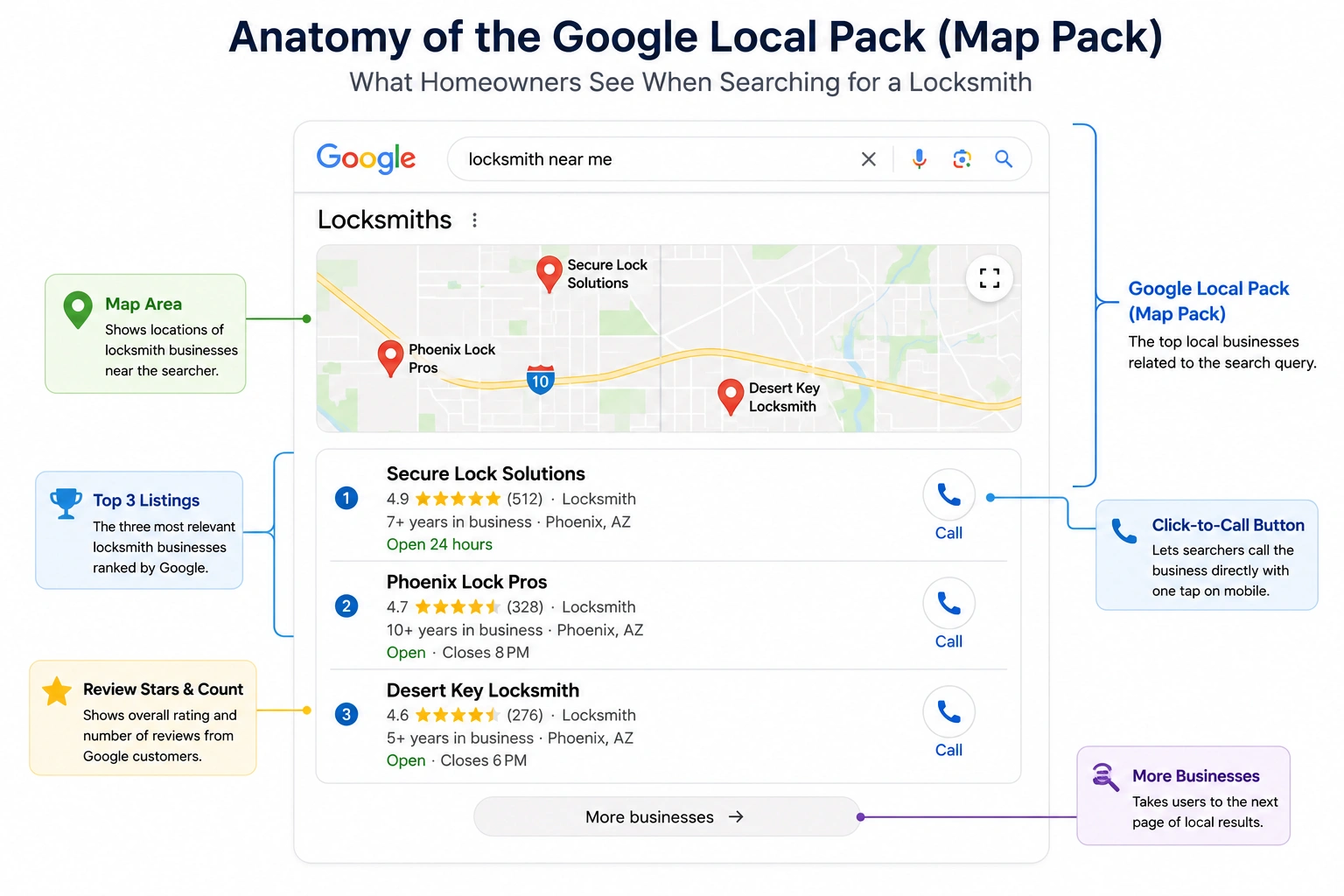
An annotated Google Local Map Pack showing the key elements that help locksmith businesses attract local search traffic.
Relevance and distance work together in ways that are not always intuitive. A locksmith with a perfectly optimized website but a poorly configured service area can be outranked by a competitor with a weaker site simply because Google’s proximity signal favors the competitor’s registered location. Think of it this way: Google wants to show searchers the closest viable options, so where you appear online matters as much as what you say. Google’s local algorithm is highly sensitive to the searcher’s physical location. If a user searches for a locksmith from a specific neighborhood, Google will prioritize businesses closest to them, making localized landing pages critical.
This emphasis on prominence is backed by data. The numbers do not lie. BrightLocal data shows that on-page optimization represents approximately 24% of local SEO ranking factors, followed closely by Google Business Profile signals at 17%. This means that while having a complete and accurate profile is vital, the content on your website and your off-site reputation are equally, if not more, important for ranking well.
Mastering Google Business Profile & Navigating the 2026 Suspension Wave
No single asset in your local SEO stack is more significant, or more fragile, than your Google Business Profile. For locksmiths specifically, managing it correctly is not optional. It is vital. It is the difference between appearing in local search and being invisible to the 78% of customers who never scroll past the Map Pack, meaning a single suspension can instantly halt your incoming leads.
The High-Risk Classification
The locksmith industry is classified by Google as a high-fraud category. This means automated systems are particularly watchful, leading to a surge in suspensions. The margin for error is zero. In fact, Google Business Profile suspensions for locksmiths surged by an alarming 300% in Q1 2026 alone. These automated filters can trigger suspensions for even minor inconsistencies in your business information, making strict compliance essential.
Google’s own guide to handling Google Business Profile suspensions outlines the appeals process, but reinstatement is neither fast nor guaranteed, often leaving businesses without phone calls for weeks on end. Prevention is the only reliable strategy.
Compliance Checklist to Avoid Suspensions
To navigate this high-risk environment, adherence to Google’s guidelines is essential. The necessity of matching your Google Business Profile name exactly to your legal business registration cannot be overstated. Avoid the temptation of keyword stuffing in your business name, as this is a direct violation that can lead to suspension. Play by the rules. Equally important is maintaining absolute NAP (Name, Address, Phone) consistency across all online directories, social media profiles, local citations, and your website to prevent automated systems from flagging your account.
Navigating Google Business Profile Video Verification
Video verification is increasingly becoming a standard requirement for locksmiths. Do not skip it. The step-by-step process involves recording a video that showcases your business’s authenticity. Key elements to include are physical tools of your trade, branded vehicles with permanent decals, your official business registration documents, and real-time evidence of active work being performed by your technicians. Google reviewers typically approve these videos within five to seven business days, ensuring your profile can be verified and remain active.
5-Point Compliance Checklist for Google Business Profile:
- Match your business name exactly to your legal business registration documents.
- Use a local phone number that matches the number on your website and other directories.
- Avoid using P.O. Boxes, UPS Stores, or shared co-working spaces as physical addresses.
- Keep your business categories accurate (primary category: “Locksmith”).
- Ensure your website footer contains the exact same Name, Address, and Phone (NAP) details.
Service Area Businesses (SAB) vs. Physical Storefronts: The Big Address Debate
The address question is one of the most practically critical decisions a mobile locksmith makes when setting up or auditing their GBP, as Google’s algorithms treat physical storefronts and service areas with entirely different sets of rules. Get it wrong, and you are either invisible in the Local Pack or suspended before you can generate a single lead. The stakes are high.
The Address Dilemma for Mobile Locksmiths
A significant debate within the locksmith industry focuses on whether to display a physical address. For mobile locksmiths operating directly from home, the decision to hide a residential address while still complying with Google’s strict guidelines can be challenging, especially when competitors use fake commercial addresses to gain an unfair advantage. Displaying a physical commercial address, particularly one with permanent signage, significantly reduces the risk of suspension. However, for home-based businesses, specific strategies are needed to maintain compliance. Safety and visibility must be balanced.
Defining a Practical Service Radius
Mobile locksmiths must define a practical service radius. To avoid triggering spam filters, it is recommended to keep your service radius under twenty miles. Trying to cover too large an area can lead to your listing being flagged. Keep it tight. If you serve multiple distinct areas, the key is to showcase this strategically on your website through dedicated landing pages rather than creating duplicate Google Business Profile listings, which can trigger immediate and permanent suspensions.
Generating Hyper-Local Signals
To truly stand out, move beyond simply mentioning city names on your website. Include real-time neighborhood photos and references to local landmarks. Show, don’t just tell. Discussing local security trends specific to certain areas builds hyper-local relevance that generic competitors cannot match, proving to both Google and potential clients that you are deeply embedded in the community. This approach to local SEO strategies helps you connect with customers on a deeper, more immediate level.
Actionable Rules for Mobile Locksmiths Operating as Service Area Businesses:
- Clear your physical address from the Google Business Profile if you operate out of a home.
- Set your service area by specific zip codes or cities, not a massive, unrealistic radius.
- Do not create multiple listings for the same business unless you have physical, staffed offices in those locations.
- Ensure your service area matches the actual coverage area stated on your website.
Let’s find out what works for your specific service area.
Request a free, no-obligation local SEO audit from our team, and we’ll show you exactly where your profile stands.
Request Your Free Local SEO Audit
Mobile-First Optimization: Capturing High-Urgency Emergency Leads
Emergency locksmithing is one of the few service categories where the customer’s stressed mental state at the moment of search directly determines what your website needs to do, as they require immediate reassurance and clear action paths. Understanding that state is not a soft marketing consideration: it is a technical requirement. Speed is everything.
Mobile Search Dominance in Emergency Locksmithing
The reliance on mobile devices for emergency services is clear. Mobile devices drive between 60% to 64% of all emergency locksmith searches, and this number climbs above 80% for critical “locked out” situations. When someone is locked out, they are experiencing anxiety and need immediate help. They want fast solutions. This stressful psychological state demands a mobile-first approach to your website; it is no longer an option, but the baseline for survival in a market where competitors are only a single tap away.
The 3-Second Rule and Core Web Vitals
Website load times are critical, especially on mobile. A mere one-second delay in mobile load time can reduce conversions by 7%. Slow sites lose money. Furthermore, statistics show that 53% of mobile users abandon websites that take longer than 3 seconds to load. Optimizing your Core Web Vitals through technical techniques like image compression, browser caching, and code minification is crucial for delivering a fast, effective user experience that keeps anxious searchers on your page.
Mobile-Centric Conversion Loops
Your website must be designed for instant action. Make calling effortless. Clear “tap-to-call” buttons are non-negotiable, and transparent pricing should be visible above the fold. Treat trust signals, such as licensing and certifications, as primary SEO and conversion levers. Excellent home service SEO starts with a mobile experience that is built for speed and instant engagement.
When someone is stranded outside their car at midnight, they are not researching lock brands. They need instant help. Your mobile site must load instantly and make it incredibly easy to call you with a single tap.
Google uses mobile-first indexing, meaning it ranks your site based on how well it performs on a mobile device. If your site is slow, you lose both search rankings and the anxious customer who won’t wait 5 seconds for your page to load.
A landmark case study of Paragon Security in New York demonstrated that a combined search strategy achieved a sub-$25 cost per lead while securing the #1 organic and Map Pack rankings.
Generative Engine Optimization (GEO): Preparing for AI Search Engines
The local search landscape is undergoing a fundamental shift that most independent locksmiths have not yet accounted for in their marketing strategy, leaving them vulnerable to competitors who adopt new technologies early. Understanding it now is a meaningful competitive advantage. Adapt or get left behind.
The Shift to AI-Driven Search
AI search engines, including Google’s Search Generative Experience, Gemini, ChatGPT with web browsing, and Perplexity, are fundamentally changing how users find local businesses by delivering direct answers instead of a list of blue links. These platforms are moving beyond simple keyword matching to combine information and provide direct answers, often citing specific local businesses. Generative Engine Optimization (GEO) is the forward-looking strategy that ensures your business is visible and cited within these new AI search paradigms.
The way AI is transforming SEO is not theoretical: it is already affecting which businesses get recommended and which get ignored. AI search is here.
Implementing Structured Data (JSON-LD Schema)
Structured data, particularly JSON-LD schema, is vital for helping search engines accurately index your business details. Key components for locksmiths include your name, address, geographic coordinates, and the areas you serve. This is search engine food. Embedding this schema on your homepage provides AI and traditional search engines with a clear, organized understanding of your business.
The concept of Generative Engine Optimization (GEO) is central to future-proofing your locksmith business online. By implementing the Schema.org Locksmith schema template, you are giving AI search engines a clear, structured map of your business, making it highly likely they will cite you as the recommended local expert.
{
  "@context": "https://schema.org",
  "@type": "Locksmith",
  "name": "Your Business Name",
  "address": {
    "@type": "PostalAddress",
    "streetAddress": "Your Street Address",
    "addressLocality": "Your City",
    "addressRegion": "Your State",
    "postalCode": "Your Zip Code"
  },
  "geo": {
    "@type": "GeoCoordinates",
    "latitude": "Your Latitude",
    "longitude": "Your Longitude"
  },
  "areaServed": [
    {
      "@type": "City",
      "name": "Your Service City 1"
    },
    {
      "@type": "City",
      "name": "Your Service City 2"
    }
  ],
  "telephone": "Your Phone Number",
  "url": "Your Website URL",
  "openingHoursSpecification": [
    {
      "@type": "OpeningHoursSpecification",
      "dayOfWeek": [
        "Monday",
        "Tuesday",
        "Wednesday",
        "Thursday",
        "Friday"
      ],
      "opens": "09:00",
      "closes": "17:00"
    },
    {
      "@type": "OpeningHoursSpecification",
      "dayOfWeek": "Saturday",
      "opens": "09:00",
      "closes": "12:00"
    }
  ],
  "hasCredential": [
    {
      "@type": "VerifiableCredential",
      "name": "License",
      "credentialCategory": "Business License"
    },
    {
      "@type": "VerifiableCredential",
      "name": "Certification",
      "credentialCategory": "Locksmith Certification"
    }
  ]
}
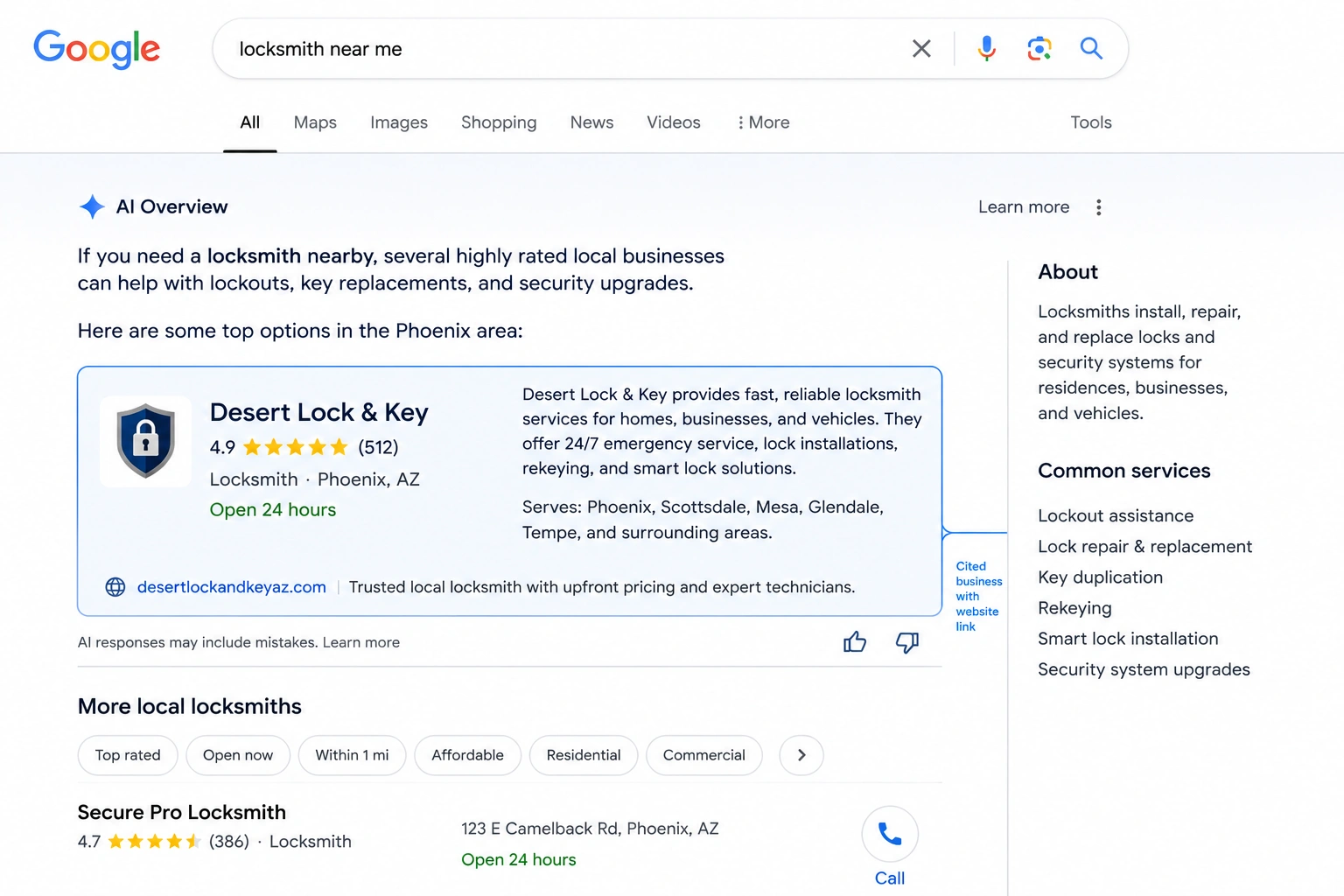
A Google AI Overview recommends a local locksmith while citing the business website, service area, and customer ratings.
Implementing structured data can feel like learning a foreign language, but here is exactly how to do it without the headache. Let our team handle the technical heavy lifting so you can focus on running your business. Contact BizIQ for Technical SEO Assistance
On-Page SEO & Vertical Hub Architecture for Locksmith Websites
Website structure is an underrated ranking factor. Most locksmith websites are built flat, meaning they rely on a single homepage, a generic services page, a contact page, and perhaps a blog, which fails to provide search engines with clear topical authority. That architecture is a structural disadvantage.
Transitioning to a Vertical Hub Architecture
Locksmith websites often suffer from a flat, unorganized structure. Moving to a vertical hub architecture involves creating distinct sections for different service categories. Silos create clarity. This strategy separates high-intent emergency traffic from research-based residential or commercial services, improving user experience while making it significantly easier for search engine crawlers to index your pages and assign topical authority.
Brand Entity Association
Targeting specific hardware brands, such as Schlage, Medeco, or Kwikset, as primary keywords can be incredibly effective. This approach captures users who are at the consideration stage of the funnel, actively researching specific products. These are high-value leads. Positioning yourself as an authorized dealer or certified installer for these premium brands builds significant trust with both potential customers and search engine algorithms that look for real-world business entities.
Hyper-Local Landing Page Personalization
The power of hyper-local SEO cannot be overstated for locksmiths. Create unique landing pages for specific neighborhoods within your service area. Target one area at a time. Populate these pages with localized content, integrating local landmarks and discussing neighborhood-specific security trends. This creates a strong local signal that clearly distinguishes you from generic competitors who offer a one-size-fits-all approach, showing Google that you have actual physical relevance in each specific suburb.
The Winnipeg Locksmith Shops case study is a prime example of this effectiveness. By focusing on local pack optimization and geo-targeted service pages, they experienced a 43% increase in organic traffic within months.
Key Pages Every Locksmith Website Must Have:
- Emergency Lockout Services (optimized for mobile speed and tap-to-call)
- Residential Locksmith Services (including smart lock installation and rekeying)
- Commercial Locksmith Services (including master key systems and access control)
- Automotive Locksmith Services (including car key replacement and ignition repair)
- Hyper-local Neighborhood Landing Pages (targeting specific local search zones)
Review Generation and Local Citations: Building Prominence
Prominence is not passive. It does not accumulate on its own simply because you do good work, meaning you must actively solicit feedback and build local citations to signal your ongoing relevance to search engine algorithms. It requires an intentional, systematic approach.
Active Review Automation
Shift your review collection strategy from passive to active. Ask every single customer. Implement systems that prompt customers for reviews immediately after a service is completed. Encourage them to mention specific services, such as “rekeying service” or “emergency car lockout,” to naturally feed your keyword profile and help Google associate your business with those high-intent search queries. Automating these requests ensures a consistent stream of fresh, relevant feedback.
NAP Consistency Across Directories
Think of directory citation consistency like spelling your name correctly on every single form you fill out. Conflicting business details across various online directories trigger distrust signals for search engines. Inconsistencies hurt rankings. Regularly auditing and cleaning up inconsistent citations across platforms like Yelp, YellowPages, and local business directories is a critical step in building your online prominence and establishing search engine trust.
Trust-Forward UX Elements
Displaying trust signals clearly above the fold is powerful. This includes licensing badges, Better Business Bureau (BBB) accreditation, and ALOA (Associated Locksmiths of America) certifications. By treating compliance as an SEO lever, you bypass the industry’s often “spammy” reputation and build credibility. Visual proof of work, such as technician photos or videos, can also significantly drive conversions. Real photos build trust.
A profile with thirty recent, active reviews will consistently outrank a competitor with one hundred older, stale reviews, because search algorithms heavily weigh the freshness of user feedback to determine active business status. Search engines want to know that your business is active and reliable today, not just three years ago.
Locksmith PPC vs. SEO: A Balanced Search Strategy
The choice between paid and organic search is not one-sided. They work together. The locksmiths who generate the most leads at the lowest cost are almost always running both, using paid ads for immediate emergency calls while building organic authority for long-term, zero-cost traffic.
Local Services Ads (LSAs) and Advanced Verification
Local Services Ads (LSAs) offer a highly predictable pay-per-lead model, removing the financial uncertainty of traditional pay-per-click advertising, where you pay for clicks that might never convert into actual jobs. However, they require passing Google’s strict Advanced Verification process to earn the coveted Google Verified badge. This process is rigorous. While LSAs can be effective for emergency locksmiths, understanding their pros and cons is crucial for integration into a balanced strategy. Referencing Google’s official documentation on Google Local Services Ads is recommended for detailed information.
Organic SEO and Map Pack Visibility
The long-term, compounding value of organic search and Map Pack visibility is clear. Organic rankings provide high-intent leads without a direct cost per click, building a sustainable flow of customers that continues to support your business even when you pause your paid advertising campaigns. Furthermore, a strong organic presence builds long-term brand equity and trust, which paid ads alone cannot achieve. Organic search is an asset. Focusing on affordable local SEO ensures consistent lead generation.
Maximizing SERP Real Estate with a Combined Strategy
Combining PPC, particularly LSAs, with organic SEO drives down the overall cost per lead and maximizes your visibility. Dominating both the paid and organic sections of the search engine results page (SERP) builds maximum trust and ensures you capture customers at every stage of their decision-making process, whether they need an emergency lockout service right now or are researching security upgrades for next month. The Paragon Security case study, which achieved a sub-$25 cost per lead, demonstrates how these strategies work together.
Relying solely on paid ads is a risky strategy. Diversification is key. When you combine paid search with a solid organic SEO foundation, you capture users at every stage of the funnel while driving down your average cost per lead.
Frequently Asked Questions About Locksmith SEO
- How long does Google Business Profile video verification take?
Google reviewers usually review and approve verification videos within five to seven business days. If the video fails to meet the strict location, existence, or authorization criteria, Google will prompt you to re-record the video. Ensure you show physical tools, branded vehicles, and your business registration during the recording to guarantee approval on the first attempt. - Why does Google suspend legitimate locksmith listings? Google classifies locksmiths as a high-fraud category and applies automated filters to detect spam. The most common trigger is mismatching your Google Business Profile name with your legal business registration or adding promotional keywords to your profile name. To prevent suspensions, ensure your NAP details are 100% consistent across the web.
- What is the difference between Local Services Ads and organic SEO?
Local Services Ads (LSAs) operate on a pay-per-lead model and require passing Google’s Advanced Verification to display the Google Verified badge at the very top of search results. Organic SEO focuses on ranking your website and Google Business Profile in the free Local Pack and standard search results through content, links, and technical optimization. - Can a locksmith rank in the Local Pack without a physical storefront? Yes, mobile locksmiths can operate as Service Area Businesses (SABs). You must hide your residential address from the public map and define a realistic service radius, usually under twenty miles, to avoid triggering automated spam suspensions.
- What are the best SEO practices for locksmith companies to improve review recency? Implement an active review automation system that sends a text or email request to customers immediately after a service is completed. Prompt your technicians to ask for reviews in person, and encourage customers to mention the specific service they received (e.g., “rekeying” or “emergency lockout”) to naturally boost your keyword profile.
Securing your local search presence is about more than just rankings: it is about securing the future of your business. Do not leave it to chance. Our passion comes from the positive impacts we make on our small business partners, helping them build lasting lead flows through an evidence-based approach that delivers real, measurable growth over time. Small business is the backbone of innovation and the heartbeat of driving America forward.
Ready to take the logical next step toward dominating your local market?
Schedule a strategy session with our local SEO experts today. We can help you build a reliable local search presence that keeps your technicians busy and your phones ringing.
Schedule Your Strategy Session with BizIQ