

Digital search analytics and manufacturing operations converge to illustrate the growing role of SEO in industrial marketing.
We have seen a focused search strategy deliver three specific results for businesses like yours:
- Capture High-Intent Traffic: Position your brand directly in front of engineers and procurement managers who are actively searching for your specific capabilities, not generic industry terms, but the exact tolerances, certifications, and materials they need.
- Lower Customer Acquisition Costs: Organic search delivers leads at an average of $415 CPL, a 40% reduction compared to paid channels averaging $691. That gap compounds over time as your content continues ranking without incremental spend.
- Build Long-Term Authority: Unlike a trade show booth that disappears Sunday afternoon, a properly optimized digital presence generates RFQs at 2 a.m. on a Tuesday, 24 hours a day, without a sales rep on the clock.
Why is Keyword Intent Different for Manufacturing SEO?
Manufacturing buyers use highly specific search terms like part numbers, specifications, and processes; not generic phrases. Targeting these low-volume, high-intent keywords captures motivated B2B buyers mid-funnel. This specific traffic builds trust, filters out irrelevant consumers, and directly drives high-quality B2B lead generation.
B2B buyers no longer wait for sales pitches. They self-educate online long before contacting a vendor. We are a small business too, and we know how frustrating it is to watch leads dry up while competitors land the big contracts. If your manufacturing website does not appear on the first page of search results, you are actively handing high-value RFQs to your competitors. This is not a slow-moving trend; it is the current state of industrial procurement.
Research from Thomasnet confirms that 70% of the industrial buying process occurs online before a buyer ever contacts a sales representative. Gartner frames this as a nonlinear looping journey, where buyers continuously cycle back through problem identification and solution exploration rather than moving cleanly from awareness to decision. That looping behavior means a single touchpoint rarely closes anything; your digital footprint needs to intercept buyers at multiple stages, across multiple query types, and across both traditional search engines and AI-driven discovery tools like Perplexity and ChatGPT. A static brochure website built in 2017 is not equipped to do that work. It cannot compete.
Why Organic Search Dominates Industrial Lead Generation
Organic search accounts for 69% of all manufacturing leads, making it the single most productive inbound channel in industrial B2B marketing: ahead of paid media, trade directories, and outbound sales combined. That focus matters because it tells you where procurement teams spend their research time. They are not waiting for your cold email. They want answers now. They are typing queries into Google at 11 p.m. while building a vendor shortlist.
The close rate gap is where the financial argument sharpens. Organic search leads close at 14.6%, compared to 1.7% for outbound methods like cold calling. That is not a marginal improvement: it is a structural one. Buyers who find you through organic search have already self-qualified; they arrived because your capabilities matched their query, not because a rep interrupted their day.
Conversion Rate and the Rent-vs-Own Problem
Implementing a strategic manufacturing program yields a 3.0% average conversion rate, three times higher than the 1.0% rate delivered by pay-per-click advertising. That trend holds true when looking at landing page conversion rates by industry. The data is clear. PPC has its place in a full-funnel strategy, but relying on it as a primary channel is structurally costly: the moment the budget pauses, the traffic evaporates. Organic optimization builds a lasting digital asset, one that continues attracting qualified buyers without ongoing ad spend, functioning more like owning the building than renting a floor in it.
The Three-Year ROI Case
B2B manufacturers report average SEO returns of 748% to 813% over a three-year period. These numbers are real. The compounding mechanism is simple: high-quality technical content and a sound site architecture continue to rank and generate leads long after the initial optimization work is complete. For mid-sized manufacturers still allocating most of their marketing budget to outbound outreach and trade shows, this shift toward inbound attraction is not a tactical adjustment: it is a structural change in how pipeline gets built.
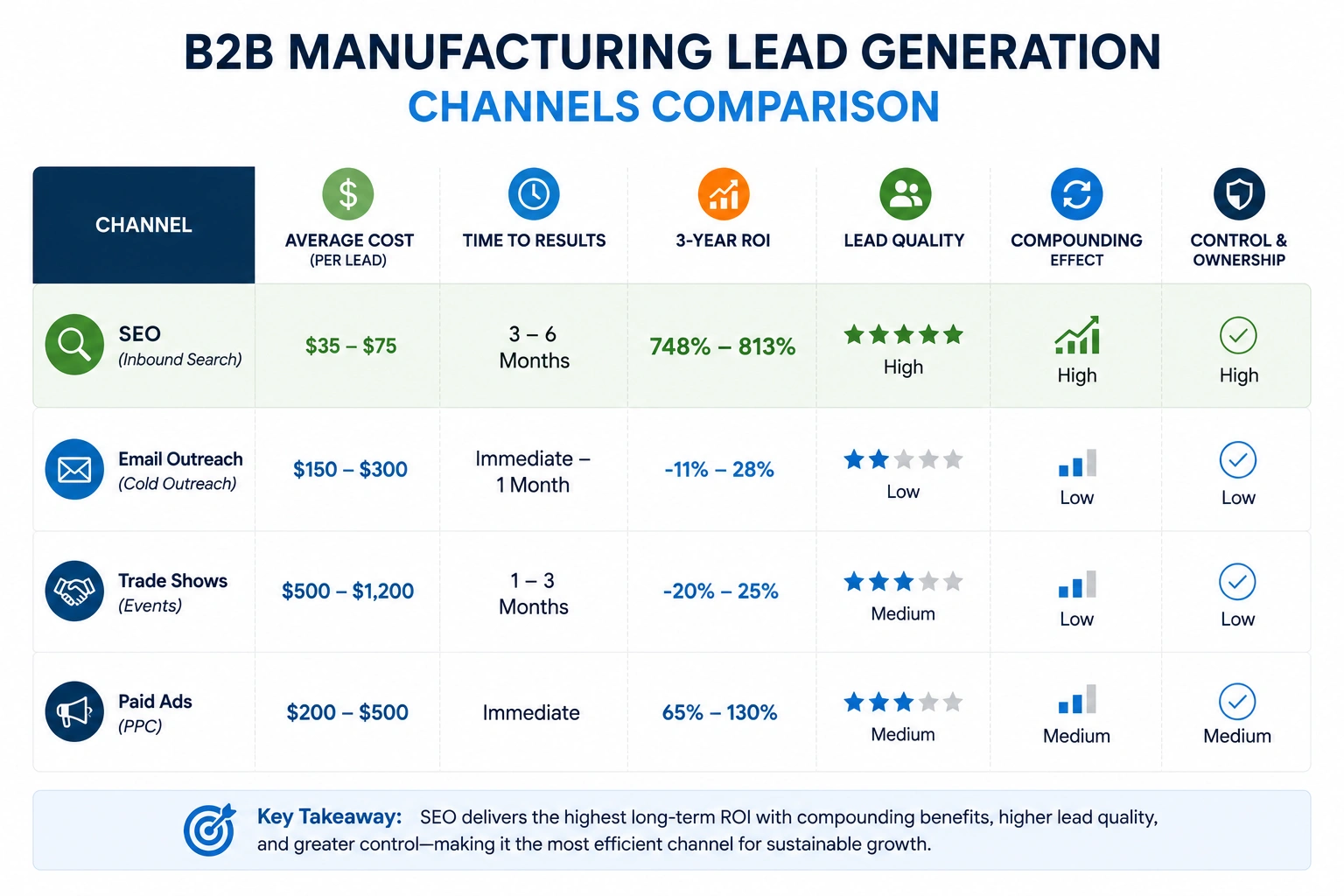
A comparison of B2B manufacturing lead generation channels showing SEO’s long-term ROI and compounding business value.
Aligning Your Website with the Industrial Buyer Journey
The nonlinear buying journey Gartner describes is not an abstraction; it has direct effects on how you structure and prioritize content. It is a reality. Buyers at different stages are typing fundamentally different queries, and a site that only optimizes for bottom-funnel transactional terms will miss the majority of the research activity happening upstream.
Here is what works and why: we need to map our content to how real people buy. Three distinct phases require distinct content strategies:
- Problem Identification Phase: Buyers at this stage are researching broad operational challenges, not yet vendor-shopping. Queries like “how to prevent corrosion in marine environments” or “causes of fatigue failure in aluminum extrusions” signal a buyer who is defining the problem. Content that answers these questions authoritatively positions your brand as a technical resource before the vendor conversation begins.
- Solution Exploration Phase: Here, buyers are evaluating material options, process capabilities, and technical specifications. They are searching for things like “tensile strength of 6061 aluminum” or “difference between investment casting and die casting.” These queries are mid-funnel and highly indexable; they are also where most manufacturers have the largest content gaps.
- Supplier Selection Phase: This is where transactional intent crystallizes. Queries like “custom stainless steel casting services Ohio” or “AS9100 certified 5-axis CNC machining aerospace” indicate a buyer building a shortlist. Dedicated capability pages optimized for these terms are the direct mechanism for capturing RFQs.
Search Intent Categories That Drive Industrial Conversions
Understanding which query type a page is targeting is essential work, not an afterthought. Do not skip this. Three categories rule most industrial search behavior:
- Technical Product Searches: Engineers hunting for specific tolerances, material grades, or part numbers. These searches are often low-volume and extraordinarily high-intent.
- Industry Application Queries: Operations managers seeking solutions to specific process challenges: contamination, throughput constraints, material fatigue. The buyer is not yet thinking about vendors.
- Problem-Solution Research: Procurement teams in the early stages of defining a challenge. Content that meets them here builds brand familiarity that pays dividends when they reach the supplier selection phase weeks or months later.
Core Pillars of a Successful Manufacturing SEO Strategy
Three basic pillars determine whether a manufacturing program generates compounding returns or stalls after the first few months.
Technical SEO ensures that search engine crawlers can easily navigate, index, and understand your website’s structure. This is the non-negotiable baseline. Search engines require a clear, hierarchical URL structure that mirrors the site’s navigational logic, something like example.com/products/linear-guideways rather than a flat, parameter-heavy URL schema. For manufacturers with extensive product catalogs, server-side rendering for technical specification tables is critical; client-side JavaScript rendering means crawlers may never index the most commercially valuable data on the page. Fast load times and Core Web Vitals compliance are not optional enhancements: they are ranking factors.
Keyword Relevancy Over Volume is the strategic principle that separates manufacturers who generate RFQs from those who generate traffic. A term like “machining” may carry substantial monthly search volume, but the commercial signal is weak. Focus instead on low-volume, high-intent keywords that align with your specific capabilities and target personas. A procurement officer at the other end of a long-tail search is ready to talk business. They want to buy.
Local SEO and Directory Presence is frequently underinvested by manufacturers who think of themselves as national or global players. Contract manufacturers and machine shops, in particular, win a significant share of their business from regional buyers. Optimizing a Google Business Profile with accurate categories, “Machine Shop,” “Manufacturer,” “Metal Fabricator,” and maintaining consistent NAP data across directories directly affects local pack visibility. Learn more about how to capture leads with Google Business Profile. Authoritative platforms like Thomasnet, MFG.com, and IndustryNet function as barnacle SEO platforms: their domain authority is high enough that a well-maintained listing can rank for competitive terms your own site cannot yet touch.
Pillar Implementation Steps
- Audit Technical Foundation: Confirm that all technical specification tables are server-side rendered and fully crawlable. Run a Core Web Vitals assessment and prioritize Largest Contentful Paint and Cumulative Layout Shift fixes before layering on content work.
- Map Keywords to Intent: Every page on the site should be assigned a specific, high-intent query aligned to a defined buyer persona and funnel stage. Pages without a clear keyword assignment are competing against themselves or ranking for nothing.
- Optimize Local Profiles: Audit NAP consistency across every directory listing, claim and fully populate your Google Business Profile, and identify three to five industrial directories where a verified listing will generate both referral traffic and a high-authority backlink.
Ready to see how your website stacks up against the competition? Find out now. Explore our affordable SEO strategies today and discover the exact obstacles holding back your organic lead generation.
The Power of Dedicated Capability Pages
Many manufacturers make the mistake of listing all their services on a single, generic page. This hurts visibility. When CNC machining, sheet metal fabrication, and injection molding share one URL, search engines fail to assign clear topical relevance to any of them: and the page ends up ranking for nothing specific. Each core capability needs its own dedicated page, built around the exact technical vocabulary your buyers are using.
The Atomization Protocol in Practice
The execution is orderly. Take a broad service category like “laser cutting” and fracture it into capability-specific silos: Titanium Laser Cutting, Steel Laser Cutting, Aluminum Laser Cutting. Each page gets its own URL, its own equipment table, its own tolerance specifications, and its own material compatibility list. It is highly specific. This is not content duplication: it is the structural distinction that allows each page to rank for the hyper-specific query it was built to answer. Manufacturers who have executed this protocol systematically have reported double-digit increases in qualified inbound leads within six to nine months, precisely because they stopped forcing procurement officers to infer capabilities from a generic services list.
What the Analytical Buyer Truly Needs
Engineers and procurement managers are not looking for marketing language. They want facts. They are building a technical case internally, often proving vendor selection to a committee, and they need hard data to do it. By detailing your exact equipment specs, maximum tolerances, and material capabilities on dedicated pages, you answer their questions before they even ask, and eliminates the friction that causes buyers to move on to the next result. Technical specificity is not a nice-to-have; it is the tool that converts a page visit into an RFQ submission.
“In the industrial sector, search volume is often low, but the deal value is exceptionally high. Ranking #1 for a term searched only 50 times a month can generate millions in revenue if those searchers are procurement officers.”
Using Technical SEO and Schema Markup
Technical SEO ensures that search engine crawlers can navigate, index, and correctly interpret your site’s structure. For manufacturers with extensive product catalogs, this is where significant ranking power lives, and where most competitors are still leaving ground uncovered.
Implementing structured data, specifically Product, Organization, and HowTo schema, enables search engines to surface rich snippets directly in results pages: product availability, dimensional specifications, certifications, and review data visible before a buyer even clicks. Winning “Position 0” featured snippets for technical queries like “what is the tensile strength of 6061 aluminum” requires structuring content to deliver a direct, concise answer immediately after the H2 or H3 that poses the question. AI-driven search tools like Perplexity and ChatGPT pull from the same well, clean, structured, authoritative content is what gets cited.
Server-side rendering for specification tables deserves particular emphasis. Do not ignore this. If your product pages rely on JavaScript to load technical data, there is a meaningful chance that Googlebot is indexing a blank table. That is not a hypothetical risk; it is a documented crawl behavior that silently suppresses rankings for the most commercially valuable pages on the site.
Core Web Vitals compliance, particularly Largest Contentful Paint under 2.5 seconds and minimal Cumulative Layout Shift, directly affects both ranking and the experience of the analytical buyer who will not wait three seconds for a spec sheet to render.
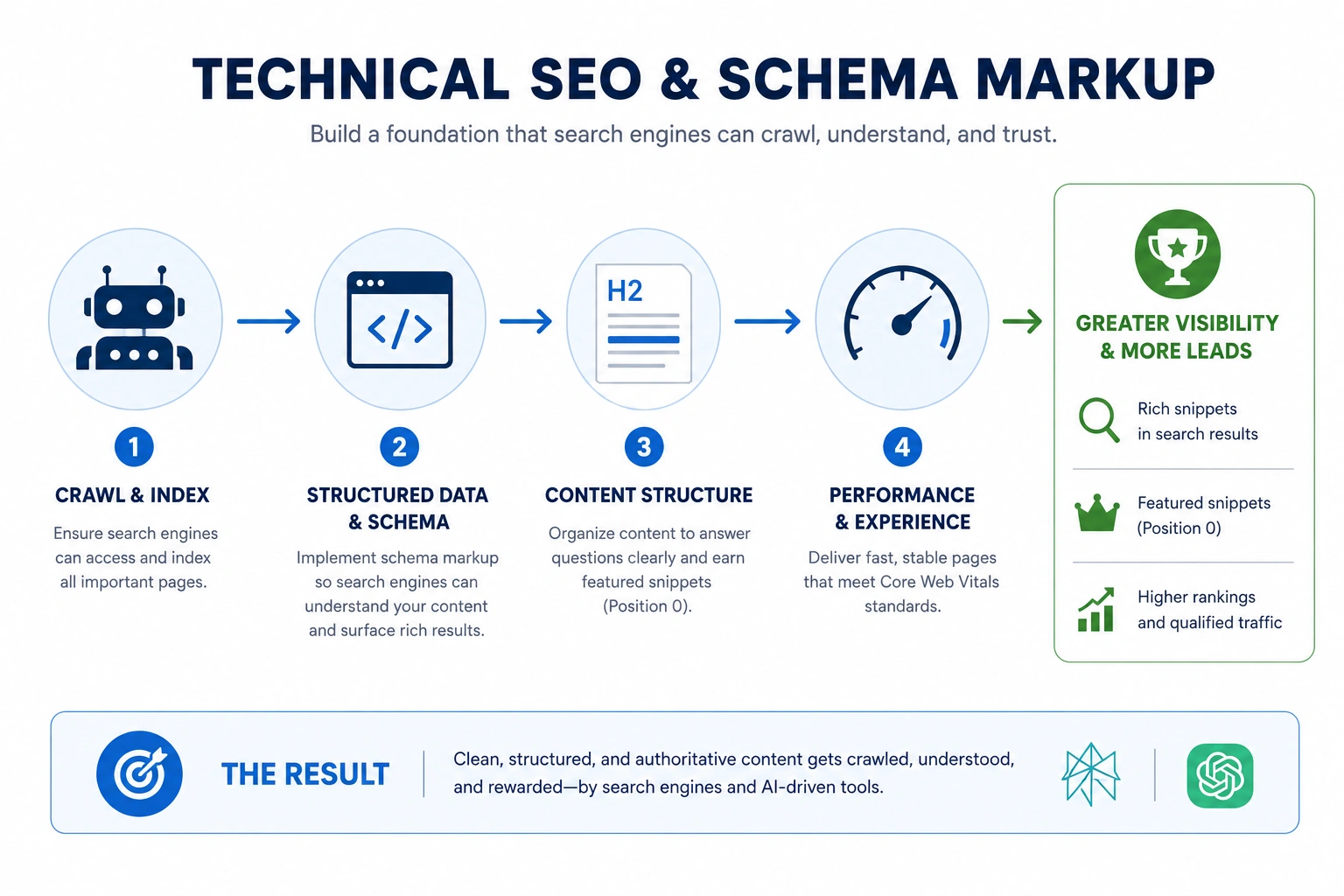
A simplified overview of how technical SEO and schema markup help search engines understand and rank website content.
Discover our digital marketing for manufacturing companies and let us build a predictable, compounding inbound lead engine for your business.
Building Authority Through Industry Backlinks
Domain authority in the industrial space grows through a different mechanism than in consumer markets. It requires focus. Trade publication coverage, supplier network citations, and industrial directory listings carry far more weight with both search algorithms and procurement teams than generic guest posts on marketing blogs.
Three link-building paths consistently produce results for manufacturers:
- Industrial Directories: Thomasnet, MFG.com, and IndustryNet are not just referral sources: they are high-authority domains whose backlinks carry genuine ranking weight. A verified, fully populated listing on Thomasnet functions as both a lead channel and a link asset.
- Supplier Partnerships: Material suppliers and component distributors have a direct commercial interest in your success and are natural co-marketing partners. Collaborative technical content, a joint guide on material selection for aerospace applications, for example, creates a backlink opportunity that is editorially earned rather than transactionally acquired.
- Technical Thought Leadership: Whitepapers, failure analysis case studies, and process engineering guides are the content formats that trade publications actually want to reference. A well-researched whitepaper on fatigue failure modes in welded aluminum structures will attract inbound links from engineering forums, university departments, and industry associations, the kinds of citations that meaningfully move domain authority.
Link Building Methods That Compound Over Time
- Barnacle SEO: Anchor your brand to the domain authority of major industrial directories. For local and regional manufacturers, a Thomasnet listing optimized with accurate categories and capability descriptions can rank for competitive terms within weeks.
- Co-Marketing Campaigns: Identify two or three strategic supplier partners and propose co-branded technical content. The backlink is a byproduct of a genuinely useful collaboration, which makes it more durable and more likely to attract secondary citations.
- Digital PR: Pitch technical commentary and data-driven insights to editors at publications like Manufacturing Engineering, Fabricating & Metalworking, and Design News. Editorial links from trade publications are among the highest-authority backlinks available in the industrial space.
Measuring the Metrics That Matter for ROI
Traffic volume is a vanity metric for manufacturers. A site drawing 50,000 monthly visitors from students researching term papers is generating noise, not a pipeline. The metrics that matter are the ones that connect organic search activity to commercial outcomes.
Tracking the wrong metrics creates a strategic disconnect that compounds over time. Marketing Qualified Leads (MQLs) and Sales Qualified Leads (SQLs) are the primary business-level outcomes to track, but industrial sales cycles often span six to eighteen months and involve multiple stakeholders, which means first-touch or last-touch attribution models will systematically undervalue early-stage informational content. A procurement officer who read your whitepaper on corrosion resistance in marine environments eight months ago and submitted an RFQ today will not show up as an organic search conversion in a last-touch model.
Micro-conversions fill that attribution gap. CAD file downloads, spec sheet views, capability page scroll depth, and RFQ form initiations (not just completions) are behavioral signals that indicate commercial intent before a lead formally enters the pipeline. Configuring these events in Google Analytics 4 and cross-referencing them with Google Search Console query data gives you a materially more accurate picture of which content is generating qualified engagement versus which pages are simply gathering impressions.
Once you establish a solid tracking system, you can transition from basic traffic monitoring to true revenue attribution. This shows the positive impacts we make on our small business partners.
Multi-touch attribution models: linear, time-decay, or data-driven, are more appropriate for long industrial sales cycles than single-touch models, even if they require more configuration work upfront. The investment is justified: without it, you are making budget allocation decisions based on an incomplete and often misleading dataset.
Common Pitfalls to Avoid in Industrial SEO
The most common mistakes in manufacturing programs are not technical failures: they are strategic ones rooted in applying consumer SEO logic to an industrial context. Avoid these errors.
The High-Volume Keyword Trap
Chasing broad, high-volume terms is the most common waste of resources in the manufacturing sector. Ranking for “manufacturing” or “metal fabrication” might generate thousands of monthly impressions, but the commercial signal in those queries is so diffuse that the resulting traffic rarely converts. The visitors are students, researchers, job seekers, and competitors, not procurement officers with an active RFQ. Low-volume, high-specificity terms like “precision investment casting for medical implants” or “NADCAP-certified electroless nickel plating” attract fewer visitors and generate substantially more qualified pipeline. The deal value per visitor is orders of magnitude higher. Focus on intent.
Two additional pitfalls deserve direct attention. The PDF-first trap, where manufacturers house their most technically valuable content in un-crawlable PDFs rather than indexable HTML pages, silently hurts rankings for the exact queries that would generate the highest-value leads. Migrating technical documentation from PDF to structured web pages is one of the most effective content moves available to most manufacturers. And neglecting local optimization remains surprisingly common among manufacturers who consider themselves national players; regional procurement teams consistently search with geographic modifiers, and a competitor with a well-optimized Google Business Profile and consistent directory presence will capture that traffic by default.
Frequently Asked Questions About Manufacturing SEO
Does SEO truly work for highly specialized or niche manufacturers?
Yes, and niche manufacturers often see the quickest results precisely because competitive crowdedness is lower. Targeting hyper-specific long-tail keywords aligned to your exact capabilities means you are competing against a smaller field for queries with high commercial intent. A manufacturer of custom PTFE-lined pipe fittings for chemical processing applications is not competing with every industrial supplier on the internet; they are competing with a handful of specialists, and a focused program can establish dominance in that niche within six to nine months.
How long does it take to see measurable leads from a manufacturing SEO campaign?
Most manufacturers begin seeing measurable improvements in search visibility within three to six months of launching a dedicated program. Consistent lead generation and compounding organic traffic typically appear between months six and twelve. Highly competitive technical categories, aerospace components, medical device manufacturing, and semiconductor fabrication may require nine to twelve months to achieve stable page-one rankings for primary terms.
Should we prioritize writing blog posts or optimizing our service pages first? Optimize your core service and capability pages first, without exception. These pages target buyers who are closest to submitting an RFQ, and they are the pages that directly generate revenue. Blog content captures top-of-funnel research queries and builds topical authority, but it does not substitute for a capability page that answers a procurement officer’s specific technical question. Get the foundation right before building the content architecture on top of it.
What role do certifications like ISO or AS9100 play in SEO? Certifications function as both trust signals and ranking assets. Including ISO 9001, AS9100, ITAR, or NADCAP certifications on your capability pages allows you to rank for searches that explicitly include certification terms: queries that are almost exclusively generated by procurement professionals with active sourcing requirements. Beyond rankings, certifications displayed prominently on capability pages reduce the friction that causes qualified buyers to leave before submitting an inquiry.
How does SEO help manufacturers who sell exclusively through distributor networks? End buyers still research the original manufacturer online to verify quality, capabilities, and brand credibility, even when the actual transaction flows through a distributor. A strong organic presence ensures that when a design engineer searches for your product category, they find your brand first, building the preference that drives demand downstream through your distribution channel. Manufacturers who neglect their own site presence effectively cede brand authority to their distributors, which weakens their negotiating position and reduces their visibility in the specification process.
Implementing a strategic SEO framework is no longer an optional investment for manufacturers who want to remain competitive in a market where procurement decisions begin on a search results page. We’re a small business too, and we know this can feel overwhelming. We are here. But sophisticated marketing belongs to you, and we’ve seen this work for businesses like yours.
The work is sequential: audit your technical foundation first, identify the exact queries your target buyers are using at each stage of their research journey, build dedicated capability pages that answer those queries with genuine technical depth, and establish the backlink authority that signals credibility to both search algorithms and the procurement teams evaluating your brand. The manufacturers who are capturing the RFQs your sales team is not seeing have not discovered a secret: they have simply built a digital presence that meets buyers where the buying process truly starts.
Ready to transform your website into a 24/7 lead generation machine? Learn how to capture leads with Google Business Profile or contact our team today to build a customized organic growth plan for your manufacturing business.