
Key Takeaways
- How to map high-intent keywords to your service pages so Google stops guessing what you do
- Step-by-step Google Business Profile optimization to dominate the Map Pack
- Technical SEO tactics to ensure search engines index your project galleries
- Real-world case studies showing how remodelers achieved a 30x ROI
How can a Home Remodeling Business use SEO to Book More High-Ticket Clients?
Home remodeling businesses can utilize SEO to target hyper-local, high-intent keywords like “kitchen remodeling contractor [City]” and showcase transformation stories. Optimizing your Google Business Profile (GBP) with location-specific project pages, before-and-after-image alt-text, and glowing client reviews ensures local homeowners find and trust your business when planning major renovations.
Ranking a home remodeling business on the first page of Google requires two things working in coordination: a website architecture that mirrors the way local homeowners search, and a geographic authority signal strong enough to convince Google you’re the most credible contractor in the area. Many remodelers assume sophisticated marketing belongs to enterprise brands with six-figure ad budgets. That assumption is costing them contracts. At BizIQ, we believe sophisticated marketing belongs to you, too. Consistency and local relevance outperform raw spend in local search: every time.
Optimizing your site captures high-value local search traffic and generates consistent, high-margin remodeling leads without feeding expensive third-party lead networks.
Homeowners are already searching for you. 89% of them turn to Google to find and vet local remodeling contractors before picking up the phone (according to remodeling SEO statistics). That search behavior creates a clear opportunity, but only for contractors whose websites are structured to intercept it. Outbound methods like print advertising close at roughly 1.7%. Organic SEO leads close at an average 14.6% (according to remodeling conversion data), a gap that compounds dramatically when you’re selling $40,000 kitchen renovations. At BizIQ, we believe small businesses are the backbone of innovation and the heartbeat of America. We’re a small business ourselves, which is exactly why we’re sharing the full playbook, not a teaser.
Mapping Keywords to High-Value Remodeling Services
Grouping every service you offer onto a single homepage is one of the most persistent and damaging structural mistakes in contractor SEO. It’s not a minor inefficiency; it actively prevents Google from understanding what you specialize in and which pages deserve to rank for which queries.
Keyword mapping is the methodology of assigning specific, high-intent search terms to the individual pages best positioned to satisfy them. A homeowner searching “Denver kitchen renovation” has a fundamentally different intent than one searching “historic home restoration Denver.” They’re at different stages of decision-making, envisioning different scopes of work, and comparing different contractor profiles. A single catch-all page cannot serve both searches with the precision Google’s algorithm rewards.
The structural solution is a siloed site architecture: dedicated, content-rich pages for each core service. That means separate URLs for /kitchen-remodeling/, /bathroom-remodeling/, /basement-finishing/, and any other high-revenue service line you operate. Each page functions as a standalone authority document for its specific topic, and each one targets a distinct keyword cluster. “Denver kitchen renovation” maps to the kitchen page. “Bathroom remodelers in Denver” maps to the bathroom page. The homepage targets your brand name and broad local contractor terms: nothing else. Silos build local relevance.
For this architecture to work, each service page needs substance. Thin pages with 200 words and three stock photos don’t satisfy semantic search requirements. Each page should carry at least 500 to 800 words of original content, real project portfolios from your own work, and localized FAQs that address the specific concerns homeowners in your market raise. That combination of depth, authenticity, and geographic specificity is what signals topical authority to Google’s crawlers.
The payoff is measurable. Case studies from contractors who implemented this siloed structure documented a 746% increase in non-branded organic traffic within 16 months (as reported in remodeling search studies). That’s not a ranking improvement in isolation; it’s a compounding lead pipeline built on search queries that were previously going to competitors. Here’s what worked for a business like yours: we recommend starting with a clean site structure.
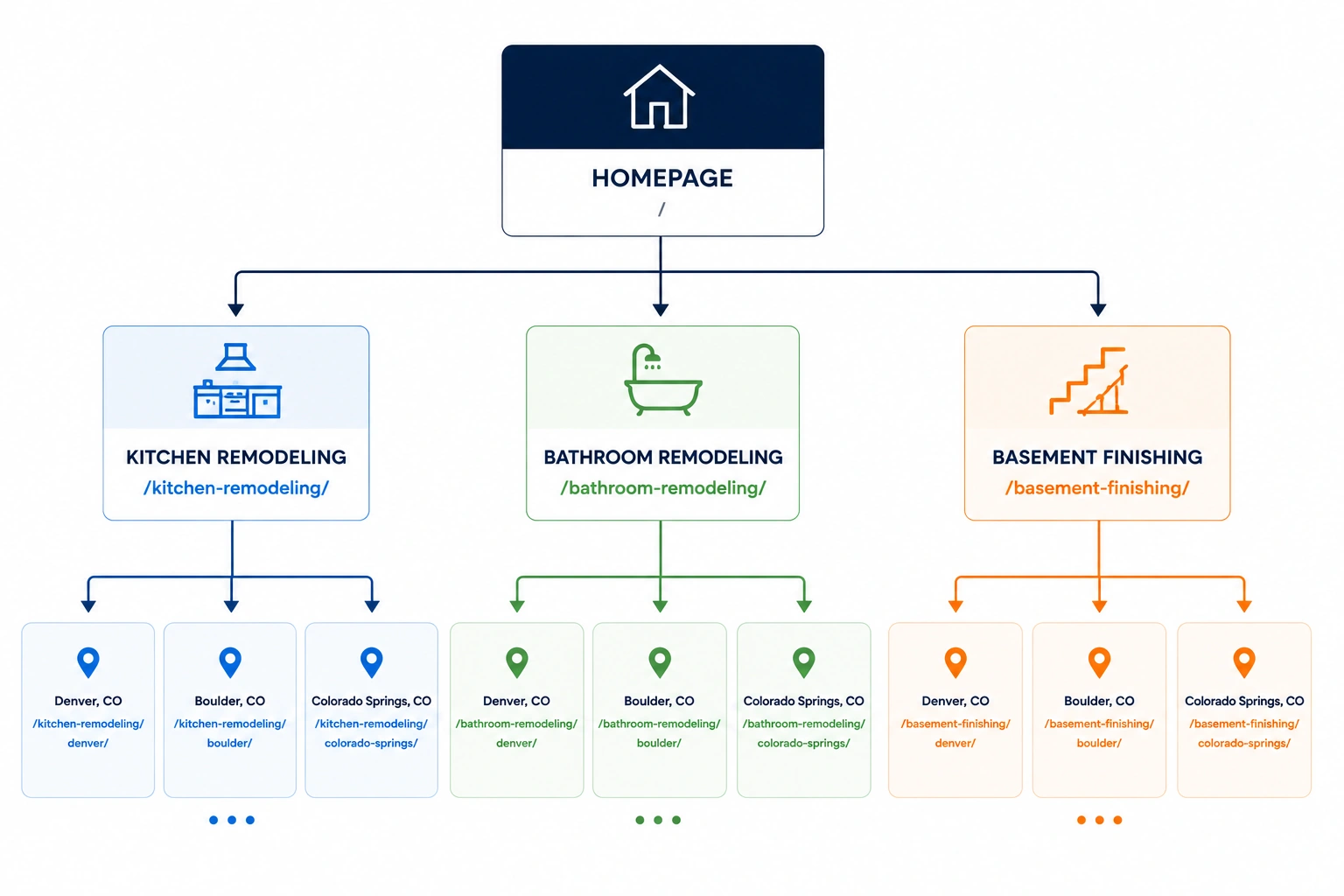
A simplified site architecture showing how service pages connect to location-specific pages for stronger SEO organization.
Dominating the Local Map Pack and Google Business Profile
Your Google Business Profile is not a supplementary listing. It’s the primary conduit through which Google decides whether your business appears in the Map Pack: those three prominent results that sit above organic listings for nearly every local service query. According to industry research, GBP signals account for approximately 32% of local pack ranking factors, making it the single highest-leverage asset in your local SEO stack.
Claiming and verifying the profile is table stakes. Optimization drives local visibility. What separates contractors who dominate the Map Pack from those who don’t is the consistency and quality of what happens after verification. Google Business Profile optimization is an ongoing operational discipline, not a one-time setup task.
Category selection matters more than most contractors realize. Setting “General Contractor” or “Kitchen Remodeler” as your primary category tells Google exactly what business type you are, and that classification directly influences which search queries trigger your listing. Secondary categories like “Bathroom Remodeler” or “Interior Designer” extend your reach without diluting the primary signal.
Review velocity, the rate at which fresh reviews accumulate, influences local rankings more than total historical count. A contractor with 10 new reviews per month will consistently outrank a competitor sitting on 200 stale reviews. Building an automated review acquisition system, even something as simple as a post-project text sequence, creates the kind of sustained momentum that compounds over time.
Here’s exactly how to do it, step by step:
- Claim and verify your Google Business Profile with your exact legal business name, physical address, and local phone number to ensure 100% NAP consistency. This means making sure your business shows up the same way across Google, Yelp, and Facebook: like using the same name on your business card and your shop sign.
- Select precise categories, setting “General Contractor” or “Kitchen Remodeler” as your primary category, and adding secondary categories like “Bathroom Remodeler” or “Interior Designer.”
- Upload high-resolution photos of completed projects weekly, geotagging them to your primary service areas to reinforce local relevance signals.
- Implement a review generation system to consistently collect feedback, targeting a floor of at least 30 Google reviews with a 4.5+ rating to outpace local competitors (according to local search competitiveness studies). To remain competitive in tougher markets, aim for 15 to 25 high-quality reviews with an average rating of 4.5 or higher (detailed in remodeling SEO reviews data).
Technical SEO and Crawlability for Contractor Websites
A well-mapped keyword strategy and an optimized GBP won’t generate rankings if Google’s crawlers can’t efficiently access and index your site. Technical SEO is the foundation layer. For remodeling contractors, it’s where a lot of organic potential quietly bleeds out.
Mobile responsiveness is mandatory. Over 60% of local searches originate from mobile devices, and Google’s mobile-first indexing means your desktop experience is largely irrelevant to how your pages are ranked. If your project gallery renders poorly on a phone screen, you’re losing both rankings and conversions simultaneously. Think of conversion rate optimization as turning more of the people who walk through your door into paying customers; if your site is broken on mobile, you’re locking the door on them.
Page speed is the other pressure point. Large, uncompressed project photos, the kind that showcase the craftsmanship homeowners are paying to see, are the most common culprit behind slow load times. Pages that take longer than 3 seconds to load see dramatically higher bounce rates (as noted in remodeling site performance data), and that behavioral signal feeds back into your rankings. Compress images before upload. It’s a five-minute fix with measurable consequences.
Submitting an XML sitemap to Google Search Console gives crawlers a direct map to every page on your site, including new service pages and project galleries you add over time. Local Business Schema markup layers on top of that by giving Google structured, machine-readable data about your business (defined at Schema.org LocalBusiness): your address, phone number, service area, and operating hours. Together, these two implementations reduce the interpretive work Google has to do, and that efficiency tends to accelerate indexing. For a full breakdown of the technical requirements specific to contractors, our team covers the implementation details in our construction company SEO resource.
- Submit an XML sitemap directly to Google Search Console to ensure crawlers can find and index every page on your site.
- Optimize site speed by compressing large project images so pages load in under 3 seconds and prevent high bounce rates.
- Implement Local Business Schema markup to provide search engines with structured data about your address, phone number, and service area.
- Ensure mobile responsiveness so that local mobile searches result in a smooth user experience across all devices.
Optimizing Before and After Project Galleries for Search Engines
Project galleries are where remodeling websites win or lose conversions. A homeowner deciding between three contractors will spend more time on the one whose gallery shows work that looks like what they want done in their own home. That’s the conversion argument, and it’s well understood. The SEO argument is less intuitive. That gap is where most remodeling sites leave significant organic traffic uncaptured.
Search engines cannot see images. They read the signals surrounding them: file names, alt text, captions, and the copy that appears on the same page. A photo named IMG_4829.jpg communicates nothing. Google has no mechanism to connect that file to a search query like “modern kitchen remodel Denver,” even if the image itself is a stunning transformation of a Denver kitchen. That’s a wasted ranking opportunity on every single photo in your gallery.
Renaming image files is a low-effort, high-return fix. Before uploading any project photo, rename it to a descriptive, keyword-rich string that reflects the actual content: modern-kitchen-remodel-denver.jpg, master-bathroom-renovation-scottsdale.jpg, open-concept-basement-finishing-chicago.jpg. Follow that with alt text written for both accessibility and search intent. Something like “Quartz countertops and custom white shaker cabinets installed in a Denver kitchen remodel” gives Google the context it needs to surface that image for relevant local queries.
The traffic impact of this practice is not theoretical. Properly optimized project galleries rank in Google Images, which functions as a separate discovery channel for homeowners in the early research phase of a renovation project. Someone browsing kitchen ideas on Google Images who clicks through to your gallery is already pre-qualified. They’ve seen your work before they’ve read a single word about your business. Case studies show that optimizing project galleries can lead to a 124% increase in organic traffic (documented in remodeling gallery optimization metrics).
One more point worth making: stock photos compromise the entire value proposition of a project gallery. Homeowners can identify stock imagery immediately, and it erodes the trust that authentic craftsmanship photography builds. Use real photos from real jobs. For more tactical guidance on building a locally dominant content presence, we recommend starting with our detailed local SEO guide which covers content optimization in depth.
“Optimizing our project gallery images with local alt text and descriptive file names was the turning point. It helped us rank for highly specific neighborhood search terms and drove a 124% increase in organic traffic.”
–Steven Fielding, Builder Funnel
Building Authority with Local Backlinks and Citations
Off-page SEO is the part of local search that most contractors either ignore entirely or approach with a spray-and-pray mentality. Neither works. What does work is a deliberate, geography-anchored strategy for earning external signals that tell Google your business is a legitimate, trusted authority in a specific market.
Local citations, your business name, address, and phone number listed consistently across directories like Houzz, Yelp, and Angi, form the baseline. NAP consistency across these platforms isn’t glamorous work, but inconsistencies between listings create conflicting signals that suppress local rankings. A phone number that differs between your Houzz profile and your Google Business Profile is the kind of friction that quietly costs you Map Pack positions. Our local SEO services include citation auditing as a foundational step for exactly this reason.
Backlinks from locally relevant sources carry more weight for geo-targeted SEO than generic directory submissions. A feature in a local home design publication, a link from a neighborhood association you’ve partnered with, a mention in a local business journal after completing a notable renovation: these are the external signals that build genuine geographic authority. Google interprets each one as a vote of confidence from a source that knows your market.
The acquisition process takes time and relationship-building. There’s no shortcut that scales cleanly. But the compounding effect of a strong local backlink profile is one of the most durable competitive advantages in local search; it’s significantly harder for a competitor to replicate than a technical fix.
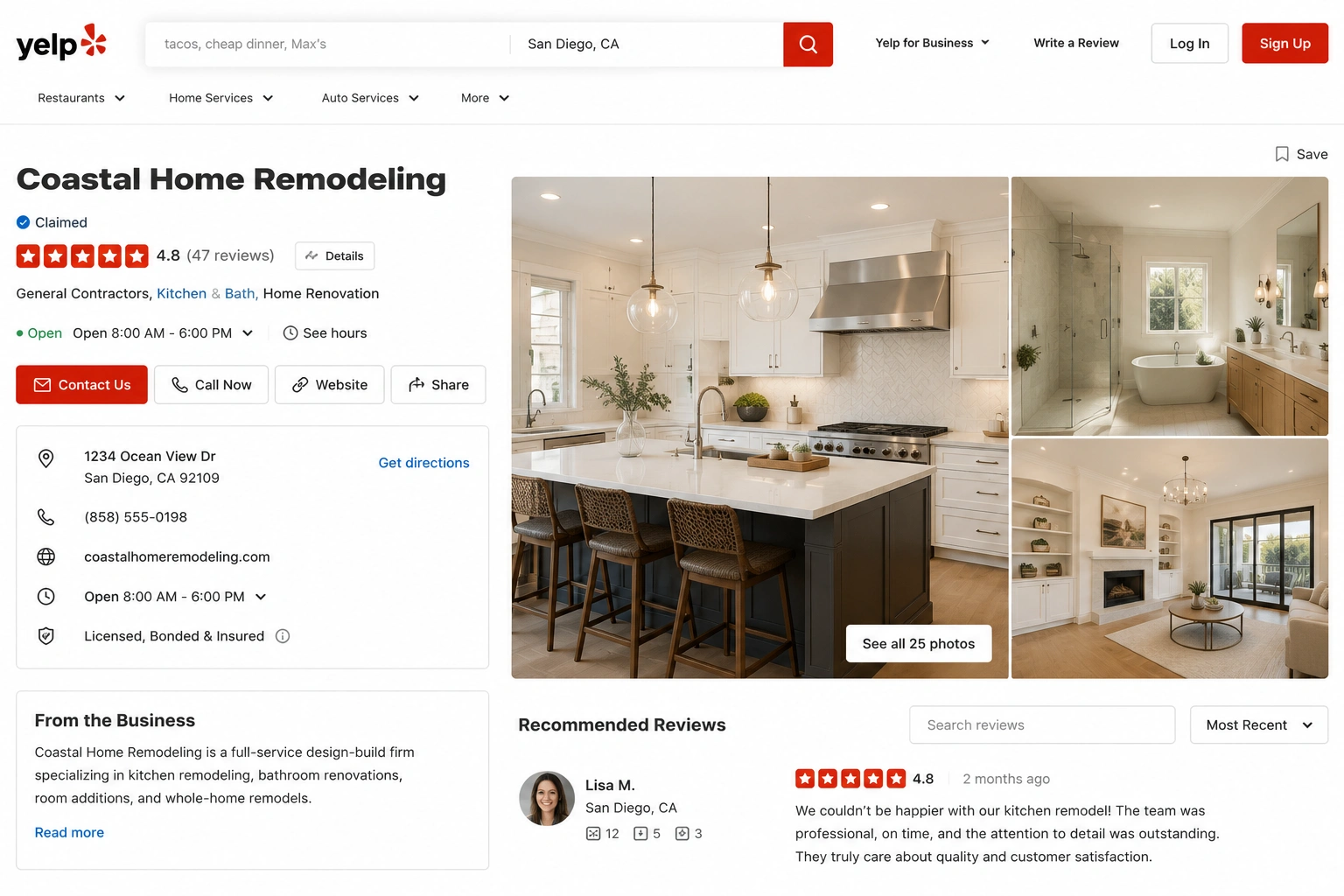
A complete local business profile featuring consistent contact information, strong customer reviews, and quality project photos.
Schedule a Free 30-Minute SEO Strategy Session with our team to map out a custom backlink and citation-building plan for your business.
Schedule Your Strategy Session
Measuring SEO Success with Google Analytics and Search Console
Organic SEO is a long-cycle investment, which means the metrics you track need to reflect progress across months, not days. The contractors who abandon their SEO programs prematurely almost always do so because they were watching the wrong numbers, or not watching any numbers at all.
Google Search Console is the most direct window into how your site performs in search. It shows keyword impressions, click-through rates, and average position for every query your pages appear for. That data tells you which service pages are gaining momentum, which keywords are generating impressions but not clicks (a signal to revisit your title tags and meta descriptions), and where technical crawl issues are suppressing visibility.
Google Analytics layers on top of that by connecting search traffic to on-site behavior. Organic traffic volume tells you whether your audience is growing. Growth indicates search relevance. Conversion rate of organic visitors tells you whether that audience is the right one. Average time on page tells you whether your project galleries and service content are holding attention or losing it. Cost-per-lead from organic, tracked over time, is the metric that makes the ROI case to any skeptic, including yourself. If you’re managing this process independently, our guide to DIY SEO on a budget walks through the setup without assuming you have a dedicated analytics team.
Here is what you need to know to track performance:
- Organic traffic volume to monitor overall growth of visitors finding your site through non-paid search results.
- Keyword impressions and clicks in Google Search Console to identify which queries are driving visibility and which need title tag refinement.
- Conversion rate of organic leads to verify that incoming traffic is translating into actual quote requests and consultations.
- Average time on page to confirm visitors are engaging with your content and project galleries rather than exiting immediately.
Real-World Proof: How Remodelers Win with Organic Search
Abstract arguments for SEO are easy to make. The financial evidence is more persuasive.
A kitchen and bath remodeler in Central Pennsylvania made the decision to exit expensive third-party lead networks and redirect that budget into a structured local SEO program. Within the campaign period, they achieved a 30x ROI and were generating $180,000 per quarter in revenue attributable directly to organic search (as shown in this remodeling SEO case study). The metric that tells the real story is cost per lead: it dropped from $1,200 on third-party networks to $340 via local SEO (detailed in remodeling cost per lead data), a reduction that compounded with every month the organic rankings held. For contractors evaluating whether to pursue affordable local SEO strategies, that CPL pathway is the benchmark worth studying.
This case demonstrates a fundamental structural shift in lead generation. Third-party lead networks rent you access to homeowners. Organic search builds an asset you own: one that appreciates in value as your domain authority grows and your content library deepens. The contractor who builds that asset over 12 months is operating from a fundamentally different competitive position than the one still paying $1,200 per lead two years later.
Organic rankings aren’t guaranteed, and Google’s algorithm updates can shift positions without warning. But the directional evidence across dozens of contractor case studies points consistently toward the same conclusion: structured, geography-anchored SEO produces the lowest long-term cost per acquisition of any digital channel available to a remodeling business. We see these positive impacts we make on our small business partners every day, proving that sustainable growth is within reach.
Frequently Asked Questions About Remodeling SEO
Answering these core questions helps protect your marketing investment and sets realistic expectations for organic growth.
Understanding these principles also prevents the most common failure mode in contractor SEO: expecting paid-ad timelines from an organic strategy, or vice versa. The two channels operate on different clocks and serve different functions in a growth stack.
How long does it take to see results from home remodeling SEO?
New or under-optimized websites typically begin showing ranking movement for lower-competition terms within 3 to 5 months (according to remodeling SEO timeline metrics). Stable, first-page positions for competitive city-level keywords like “kitchen remodeling [city]” generally take 6 to 12 months to establish (as outlined in remodeling keyword positioning research). That timeline frustrates contractors accustomed to the instantaneity of paid ads, but the distinction matters. Once organic rankings are established, they generate a consistent stream of high-quality leads without a recurring cost-per-click. The compounding nature of that return is what makes the initial patience worthwhile. SEO requires patience.
Should I invest in Google Ads or organic SEO for my remodeling business?
Both serve a function, and the honest answer is that they work better together than either does alone. Balance both channels. Google Ads convert at an average of 4.2% with a cost-per-lead around $140 (detailed in home remodeling ad benchmarks), making them effective for immediate lead generation while your organic program builds momentum. Organic search, once established, drives 55% to 70% of inbound lead volume for mature remodeling firms (according to home services lead conversion standards) at a fraction of the long-term cost. The practical approach: run ads to maintain lead flow in months one through six, then gradually reduce paid spend as organic rankings stabilize and take over the volume.
How many Google reviews do I need to rank in the local Map Pack?
There’s no fixed benchmark, but local search data consistently shows that remodelers with more than 30 Google reviews receive significantly more inquiries than those below that number. Reviews build trust. In most mid-to-large markets, a floor of 15 to 25 high-quality reviews with an average rating of 4.5 or higher is the minimum competitive baseline. More important than the total count is velocity: a business accumulating fresh reviews monthly signals active, ongoing customer satisfaction, which Google’s local algorithm weights heavily.
What are the best keywords for a home remodeling company to target?
Target a stratified mix of service-specific and location-based terms. Target user intent. High-intent phrases like “kitchen remodeling [city]” and “bathroom renovation contractor near me” capture homeowners who are actively ready to hire. Long-tail queries like “historic home restoration specialists [city]” or “open-concept kitchen remodel cost [city]” attract a narrower but highly qualified audience: people who know exactly what they want and are comparing specific contractors. Mapping these terms to dedicated service pages, rather than trying to rank a single page for all of them, is what converts keyword research into actual rankings.
Do before-and-after photos help my website’s SEO?
Yes, but only when they’re properly prepared before upload. Images require optimization. Compressing image files to keep page load times under 3 seconds prevents the speed penalties that suppress rankings. Renaming files from generic codes to descriptive strings like bathroom-renovation-phoenix.jpg and writing localized alt text gives Google the semantic signals it needs to surface your images in Google Images search results. That secondary traffic channel drives additional high-intent visitors who are already visually engaged with the type of work you do before they ever reach your service pages.
Building a dominant search presence for a home remodeling business isn’t a single project with a completion date. It’s an accumulating set of structural decisions: keyword architecture, GBP management, technical maintenance, gallery optimization, and citation consistency, each of which compounds the others over time. The contractors who treat it as an ongoing operational discipline, rather than a one-time website launch, are the ones generating $180,000 quarters from organic search while their competitors are still paying $1,200 per lead.
Start with an audit of your current keyword mapping. If your homepage is trying to rank for kitchen remodeling, bathroom renovation, basement finishing, and general contracting simultaneously, that’s the first thing to fix. Build the siloed architecture. Optimize the GBP. These systematic improvements build long-term authority and a sustainable pipeline of high-value leads.
Book a Free 30-Minute SEO Strategy Session with our team today, and let’s build your custom organic growth plan.
Get a Free SEO Audit
Written by an SEO strategist with over a decade of experience helping residential contractors and home service businesses build organic search authority.