Written by the BizIQ Editorial Team: digital marketing specialists with deep roots in the residential construction vertical, helping homebuilders across the country build organic search visibility that converts.
In this guide, you’ll learn:
- How to structure your website to rank floor plans and quick move-in homes
- What works to eliminate multi-market duplicate content issues
- Practical local SEO tactics to dominate Google Maps in your service areas
- Key metrics to measure the true ROI of your organic search campaigns
How can Homebuilders Optimize Their Website to Rank Higher and Capture Organic Buyer Leads?
Homebuilders should concentrate on SEO that targets high-intent keywords like “new homes in [City]” and create location-specific community pages. Boosting visibility requires maintaining an optimized Google Business Profile (GBP), showcasing high-quality imagery with descriptive alt text, and offering downloadable floor plans to convert traffic into qualified leads.
Earning the trust of modern homebuyers starts long before they step into a model home: it begins the moment they type their first query into Google. According to real estate and construction search benchmarks compiled by Semrush, 97% of all homebuyers begin their search online, with 70% completing the bulk of their research before they ever contact a builder directly. That window, between first search and first conversation, is where your organic presence either earns or forfeits the relationship.
If your website doesn’t surface when buyers search for new construction in your market, you are virtually hidden from your most motivated prospects. Visibility is credibility. The builders capturing those leads aren’t necessarily the best in the market; they are the ones whose websites are structured to help buyers find exactly what they need. We’re a small business too, with the same goals as you. We know that small businesses are the backbone of innovation and the heartbeat of America, which means every dollar you spend must deliver real results. That is why a data-backed approach to search ranking is not optional for homebuilders who want to grow.
The three pillars of homebuilder search engine optimization
Organic search drives between 38% and 54% of qualified project inquiries for established contractors, a figure that dwarfs most paid channels at equivalent spend levels. That traffic doesn’t arrive by accident. It flows to builders whose websites satisfy three linked factors: technical performance, on-page content relevance, and off-page authority.
A fast site with thin content won’t rank. A content-rich site with crawl errors won’t either. Think of your website’s technical foundation like the concrete slab of a custom home: if the slab is compromised, it doesn’t matter how refined the kitchen finishes are. Slabs support the structure. All three pillars must carry weight simultaneously, and search engines evaluate them in concert when determining where your pages land on the results page.
Search engine optimization, when approached as a long-term business investment rather than a one-time project, compounds over time in ways that paid advertising simply cannot. Each optimized page, each earned link, and each resolved technical issue accumulates into a lasting asset that continues generating qualified traffic months and years after the initial work is done.
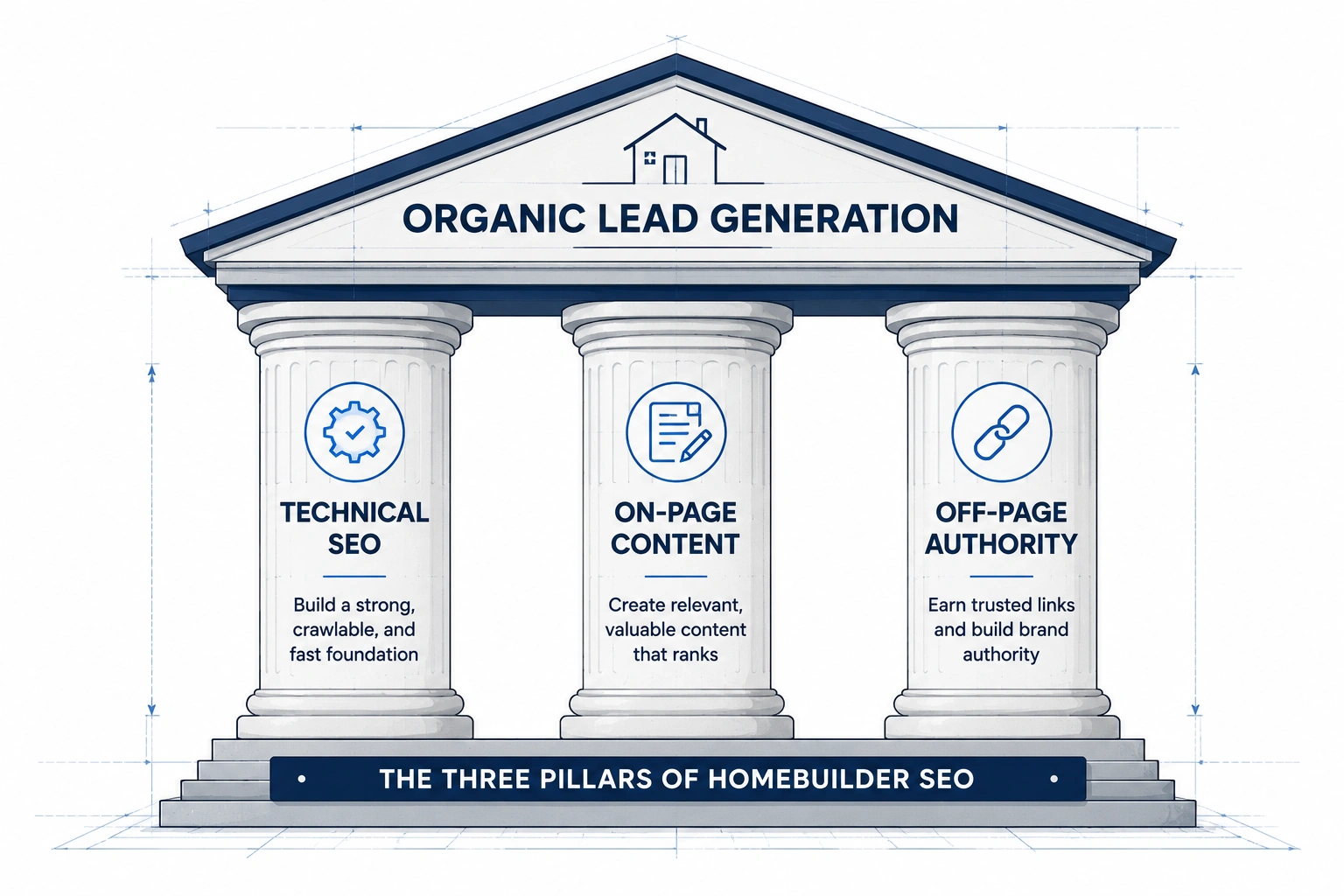
Technical SEO, on-page content, and off-page authority work together to support long-term organic lead generation.
Structuring your website for maximum search visibility
Site architecture is where most homebuilder websites lose the most ground. Structure dictates performance. The instinct is to organize pages around internal business logic, such as divisions, product lines, or sales teams, rather than around the specific queries buyers type. Reorganizing around search intent changes the path of organic performance faster than almost any other single intervention.
A shallow, intent-mapped structure ensures search engines can crawl your highest-value assets within three clicks of the homepage, while improving the user experience for buyers comparing options across communities:
- Homepage: Optimized for broad terms like custom home builder [city] to establish your primary brand signal and capture early-funnel awareness.
- Community Pages: Dedicated landing pages for each neighborhood, incorporating local school district data, nearby amenities, commute distances, and driving directions. These are signals that both buyers and search engines weigh heavily.
- Floor Plan Pages: Individual pages for each model, like The Breckenridge, built to capture long-tail comparison searches from buyers evaluating layouts side by side.
- Quick Move-In Listings: Frequently refreshed pages targeting high-urgency buyers who have already decided to purchase and are searching for homes available now.
Each layer of this structure serves a distinct segment of the buyer journey. Intent drives action. A buyer searching for 3-bedroom new construction homes in Scottsdale and a buyer searching quick move-in homes near me are not at the same stage of their journey, and your site architecture must reflect that distinction.
Solving the multi-market duplicate content challenge
Builders operating across multiple cities face a structural search problem that compounds quietly until it becomes a serious liability. Reusing the same community description templates across different location pages, swapping only the city name, signals to search engines that your pages are identical. This causes search engines to filter out the duplicates rather than rank them. Duplicates dilute authority.
The fix isn’t cosmetic. It requires genuine localization at the content level, and here’s what works:
- Localize the Narrative: Rewrite community descriptions to incorporate specific local landmarks, regional climate considerations, and applicable building codes. A Phoenix community page should address foundation engineering for expansive desert soils; an Atlanta page should lead with school district rankings and regional architectural character.
- Implement Self-Referencing Canonicals: Technical canonical tags tell search engines that each location page is an independent, primary source of value, not a variant of a template.
- Incorporate Unique Local Proof: Feature testimonials, project case studies, and high-resolution photography from actual builds completed in that specific market. Generic stock imagery and borrowed reviews do not satisfy Google’s standards for high-ticket industries.
The basic principle is simple: every location page must earn its own right to rank by delivering information a buyer in that specific market cannot find on any of your other pages.
Is your website structured to capture organic homebuyer leads? Get a thorough, manual SEO audit of your site’s hierarchy, page speed, and local visibility. Request Your Free SEO Audit — construction-specific SEO solutions
Optimizing high-value assets for long-tail search
Most homebuilder websites treat floor plans and quick move-in listings as dynamic database records: elements that get populated from a CMS and displayed without any search consideration. That is a significant missed opportunity, because these pages represent some of the highest-intent real estate on your entire domain. Intent matters.
Long-tail searches like 3-bedroom floor plan Austin or new homes in Tampa under $600k come from buyers who have already done the broad research and are now in active comparison mode. Optimized landing pages in this category can achieve conversion rates up to 10.6%, compared to just 1.1% for standard pages. The gap between those two numbers is not a rounding error: it is the difference between a website that generates appointments and one that generates pageviews.
Each floor plan page should contain a minimum of 400 words of original content alongside the standard spec sheet. Describe the lifestyle the layout enables: how the open-concept great room functions for a family with young children, how the primary suite placement creates separation from secondary bedrooms, and what the outdoor living configuration looks like in the local climate. Include your builder’s license number and any relevant certifications. Details build trust. These are direct signals that build buyer confidence and satisfy Google’s quality criteria for high-ticket buying pages, aligning with Google’s E-E-A-T guidelines.
“In many cases, long-tail keywords for homebuilders reflect stronger buyer intent because they include specifics like location, price, floor plan features, or move-in timing. Searches like new homes in Tampa under $600k are often more valuable than broad terms like new homes.”
Dominating local search with Google Business Profile
Home buying is a deeply local decision, and Google’s Map Pack reflects that. Local search is vital. Think of local SEO as making sure your business shows up when neighbors search for what you offer. The Local Pack captures an estimated 40% to 50% of all clicks for local homebuilder searches, which means a builder who doesn’t appear there is giving up roughly half of all available local traffic before a single organic result is even considered.
Local search leads convert at an 80% rate, a figure that reflects the specificity of intent behind queries like custom home builder near me or new construction homes [city]. The buyers conducting those searches know what they want and where they want it; our job is to be the most credible answer when they ask. Understanding which signals Google prioritizes for local rankings is essential: our breakdown of local SEO ranking factors outlines exactly what moves the needle in the Map Pack. Your Google Business Profile needs complete category selection, consistent NAP data across every directory, a steady cadence of genuine reviews, and geo-tagged project photos that reinforce your service area coverage. Consistency is key.
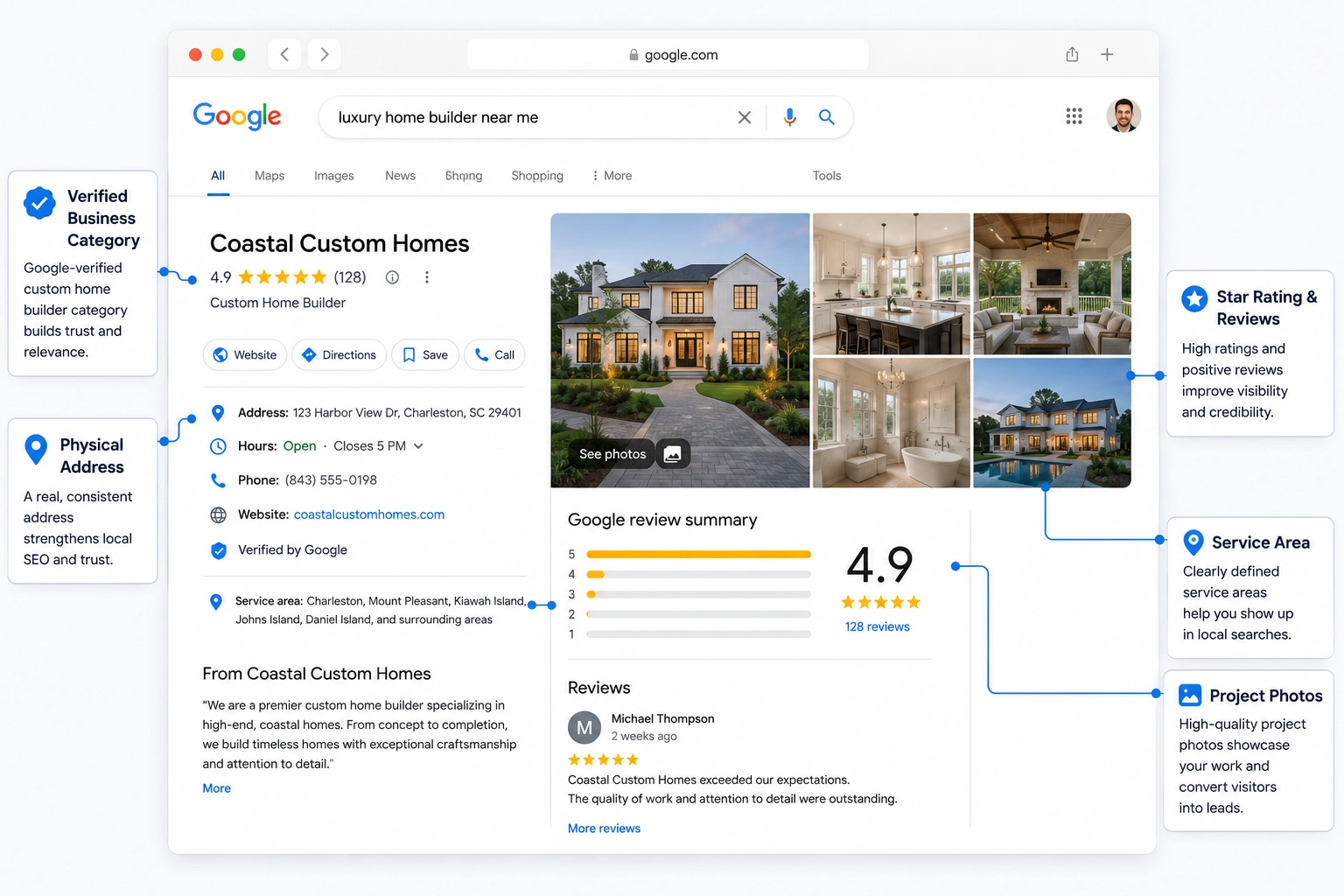
A fully optimized Google Business Profile showcasing the local ranking signals that help custom home builders attract more leads.
Building authority through local backlinks and citations
Off-page authority is the dimension of search optimization that builders often overlook, often because it feels less controllable than on-page work. Search engines treat local citations and high-quality links as third-party endorsements: signals that your business is legitimate, established, and trusted within its geographic market. Links build trust.
Three categories of off-page activity consistently move the needle for homebuilders:
- Local Citations: Submit your business to trusted local and industry-specific directories, including Houzz, the NAHB member directory, and local Chamber of Commerce listings, and verify that your NAP data is character-for-character identical across every platform. Inconsistencies erode the trust signal.
- Industry Partnerships: Earn contextually relevant links by co-authoring content with local real estate agencies, mortgage lenders, and regional building material suppliers. A link from a well-regarded local real estate brokerage carries far more weight than a generic directory submission.
- Community Involvement: Sponsor local events, youth athletics programs, or neighborhood improvement initiatives to secure trusted mentions from local news outlets and community organizations. These links are difficult to manufacture and genuinely difficult for competitors to replicate.
Community involvement, in particular, functions as both a brand-building and an SEO activity simultaneously, which is why it fits naturally into a broader set of construction marketing ideas that extend well beyond search. Sponsorships pay off.
Technical SEO essentials for homebuilder websites
Search engines will not rank a website that delivers a poor user experience, regardless of how strong the content is. Speed is paramount. 76% of homebuyers begin their search on a mobile device, which means mobile rendering, tap target sizing, and load speed on cellular connections are not secondary concerns.
High-resolution photography is essential for homebuilders, but uncompressed images are among the most common causes of slow page speed in this vertical. Every hero image, community gallery, and floor plan rendering needs to be compressed and served in a next-generation format like WebP without sacrificing visual quality. Beyond images, implementing ConstructionBusiness schema markup on your homepage and community pages tells Google precisely what services you offer, what geographic areas you serve, and how to surface your reviews and pricing ranges in rich result formats. Builders who skip schema markup are leaving organized exposure on the table that their competitors are actively claiming. Schema matters.
Measuring the business impact and ROI of SEO
The cost-per-lead comparison alone makes a clear case. Industry data compiled by First Page Sage shows that SEO-driven leads cost between $15 and $50 per qualified inquiry, while traditional channels like print, radio, and billboards run between $100 and $400 for equivalent lead quality. That gap compounds significantly when you factor in lead-to-contract conversion rates, where organic search leads, because they arrive with established intent and prior research, consistently outperform interruption-based advertising leads. Organic leads convert.
Homebuilders who commit to a sustained search program typically see a 3x to 5x return on their investment within the first 12 months, scaling toward 10x over a 24-month horizon as domain authority accumulates and content assets mature. A single closed home sale at median new construction pricing is often enough to cover an entire year of search optimization costs, which reframes the investment math entirely. One sale covers it.
Frequently asked questions about homebuilder SEO
How long does it take to see results from homebuilder SEO?
Results vary based on your situation, but most clients see improvements in five months, often breaking even on their investment in that timeframe. Establishing a consistent, predictable flow of high-intent leads typically requires a six-to-nine-month window of continuous optimization: not because the work is slow, but because search authority accumulates incrementally and compounds over time.
Why do homebuilders struggle with local SEO in multiple markets?
Builders operating across multiple cities often create overlapping geographic signals, making it difficult for search engines to determine which page should rank for a given location query. Creating distinct location pages with unique local signals, including specific landmarks, localized testimonials, and market-specific photography, resolves the confusion and gives each page a defensible reason to rank independently.
What are the most common technical SEO issues on homebuilder websites?
Slow page speed from uncompressed high-resolution images tops the list. Speed matters most. Close behind it: duplicate location content, weak internal linking between community and floor plan pages, and site structures that bury high-value assets too deep for search engine crawlers to reach efficiently.
Are long-tail keywords better than broad keywords for homebuilders?
It’s not always clear-cut, but long-tail keywords like quick move-in homes in Austin under $500k tend to deliver higher-quality leads because they reflect specific buyer criteria and strong purchase intent. Broad terms build awareness and brand visibility; long-tail terms bring buyers who are much closer to signing a contract. A mature search strategy needs both, but early-stage campaigns often see faster returns by prioritizing long-tail terms where competition is lower and intent is sharper.
How does video content impact homebuilder SEO?
Meaningfully. Listings with video tours and community walkthroughs receive 403% more inquiries and generate 157% more organic search traffic than comparable listings without video. Beyond the traffic lift, video increases time-on-page, which is a user signal that reinforces content quality to search engines and keeps buyers engaged long enough to take the next step.
Building a dominant organic presence takes commitment and a clear system
Organic search visibility for homebuilders isn’t a campaign you run once and revisit annually. SEO is a system. It is a compounding system: structured site architecture that captures intent at every stage of the buyer journey, floor plan and community pages that function as genuine search assets rather than database outputs, local signals that establish credibility in every market you serve, and technical infrastructure that ensures search engines can find and evaluate all of it.
Treating your quick move-in listings, floor plans, and community pages as high-value indexable assets, rather than internal navigation tools, is the single most overlooked opportunity available to most homebuilders today. The buyers you want are already searching. You can do this: here’s how to make sure they find you. What you need to know is that a well-executed search program builds a steady, growing stream of those buyers arriving at your website with intent already established, before a single sales conversation has taken place. We’re in this together, and we have the demonstrated results to help you build a presence that lasts.
Contact BizIQ today to speak with an SEO specialist and discover how we can help you optimize your website, rank your floor plans, and dominate your local market.
Schedule Your Strategy Call: We’ll help you attract quality leads