Written by an experienced Ecommerce SEO Strategist at BizIQ, specializing in technical site performance, search everywhere optimization, and helping small businesses grow.
- Accelerating site speed to secure a 3x conversion rate multiplier
- Flattening site architecture to increase crawl frequency by 5.7x
- Optimizing product catalogs for AI-assisted search and answer engines
Why is Internal Linking Crucial for Ecommerce SEO?
Internal links establish site architecture, pass page authority to product pages, and help search engines crawl your site efficiently. Therefore, they are crucial to ecommerce SEO. Internal linking boosts organic visibility, keeps users browsing longer, and directly supports driving organic sales without added ad spend.
Running an online store is one of the most rewarding ways to build a business, but it comes with a unique set of hurdles. Many store owners we talk to feel like they are on a constant treadmill of rising ad costs, watching their margins get squeezed by pay-per-click platforms. We believe small businesses are the backbone of innovation, and you shouldn’t have to rely solely on expensive ads to find your next customer. That is why we focus on what delivers results: building a sustainable organic search strategy. Organic traffic lasts. When SEO and ecommerce work together, your store builds local visibility in your community and establishes a highly visible, trusted digital storefront that welcomes active buyers day and night.
Organic search remains the single most decisive acquisition channel for online retailers, driving between 43% and 53% of all ecommerce traffic globally. Unlike social media or display ads, which often catch people when they are browsing mindlessly, search engines connect you with people who have high-intent commercial or transactional queries. According to recent industry benchmarks, organic search traffic converts at an average rate of 2.1% to 2.95%, consistently outperforming paid social channels, which hover around 0.9%. By focusing on proven ecommerce SEO strategies, you can capture high-value traffic without the ongoing costs of paid advertising, building a foundation that supports your business and helps drive America forward long after your ad campaigns are paused.
Connecting Site Speed Directly to Organic Revenue
Core Web Vitals and Largest Contentful Paint (LCP)
Largest Contentful Paint measures how long it takes for the primary visible content of a page, such as a hero image, a product photo, or a headline block, to fully render in the browser. Google’s threshold is 2.5 seconds or less for a “good” score. Seconds cost sales. Miss that mark and you are already paying a penalty, both in rankings and in the quiet attrition of shoppers who leave before your page finishes loading.
The technical bottlenecks on ecommerce product pages are foreseeable: uncompressed hero images served at full resolution, render-blocking JavaScript that fires before the page content does, and hosting infrastructure that is not geographically close to your customers. These are not exotic problems. They are the default state of most stores that were built quickly and never audited. Compressing product images into modern WebP format, deploying a global Content Delivery Network to serve assets from edge nodes near your visitors, and deferring non-essential JavaScript until after the main content renders are the three interventions that move the needle fastest on LCP scores.
Speed optimization does not exist in isolation from your keyword strategy, either. There is little value in a blazing-fast page that targets the wrong query. Pairing your performance work with disciplined keyword research ensures that the pages you are accelerating are the ones that capture genuine purchase intent.
The Direct Correlation Between Load Times and Conversion Rates
The numbers from the landmark Portent Site Speed Study are striking enough to warrant repeating in any serious discussion of ecommerce revenue. A site loading in 1 second achieves an average conversion rate of 3.05%. At 5 seconds, that rate collapses to 0.67%: a 78% drop in purchasing probability caused entirely by load time. Every 100-millisecond delay in LCP reduces conversion rates by approximately 3.5%, which means the degradation is not a cliff edge you fall off at some threshold; it is a continuous, compounding bleed.
Mobile performance compounds this further. Improving mobile page load times by just 0.1 seconds yields an 8.4% increase in conversion rates and a 9.2% increase in average order value. That is not a rounding error; it is a meaningful revenue shift achievable through image optimization and CDN configuration alone.
Many brands treat page speed as a minor technical checklist item rather than a core revenue driver. Think of your page load speed like the front door of a physical shop. Friction kills sales. If the door is heavy, jammed, and takes ten seconds to open, most shoppers will simply walk away and visit the store next door. In the digital world, this friction is measured through Core Web Vitals, and search engines like Google use these metrics to determine how user-friendly your site is. When you optimize your site’s speed, you are not just checking a box for search engine crawlers; you are creating a smooth, friction-free shopping experience that respects your customers’ time.
To capture this speed-driven revenue multiplier, we recommend starting with a thorough website audit for SEO to identify what is slowing down your pages. Often, the culprits are oversized product images that have not been compressed or third-party tracking scripts that load before the page content does. Here is exactly how to do it, step by step, based on what is possible based on evidence and what truly matters for businesses like yours. By compressing your images into modern formats like WebP and using a global CDN to serve your site from servers closer to your visitors, you can significantly reduce your LCP. Keeping your mobile load times under 2 seconds is one of the most effective ways to reduce cart abandonment and increase your average order value.
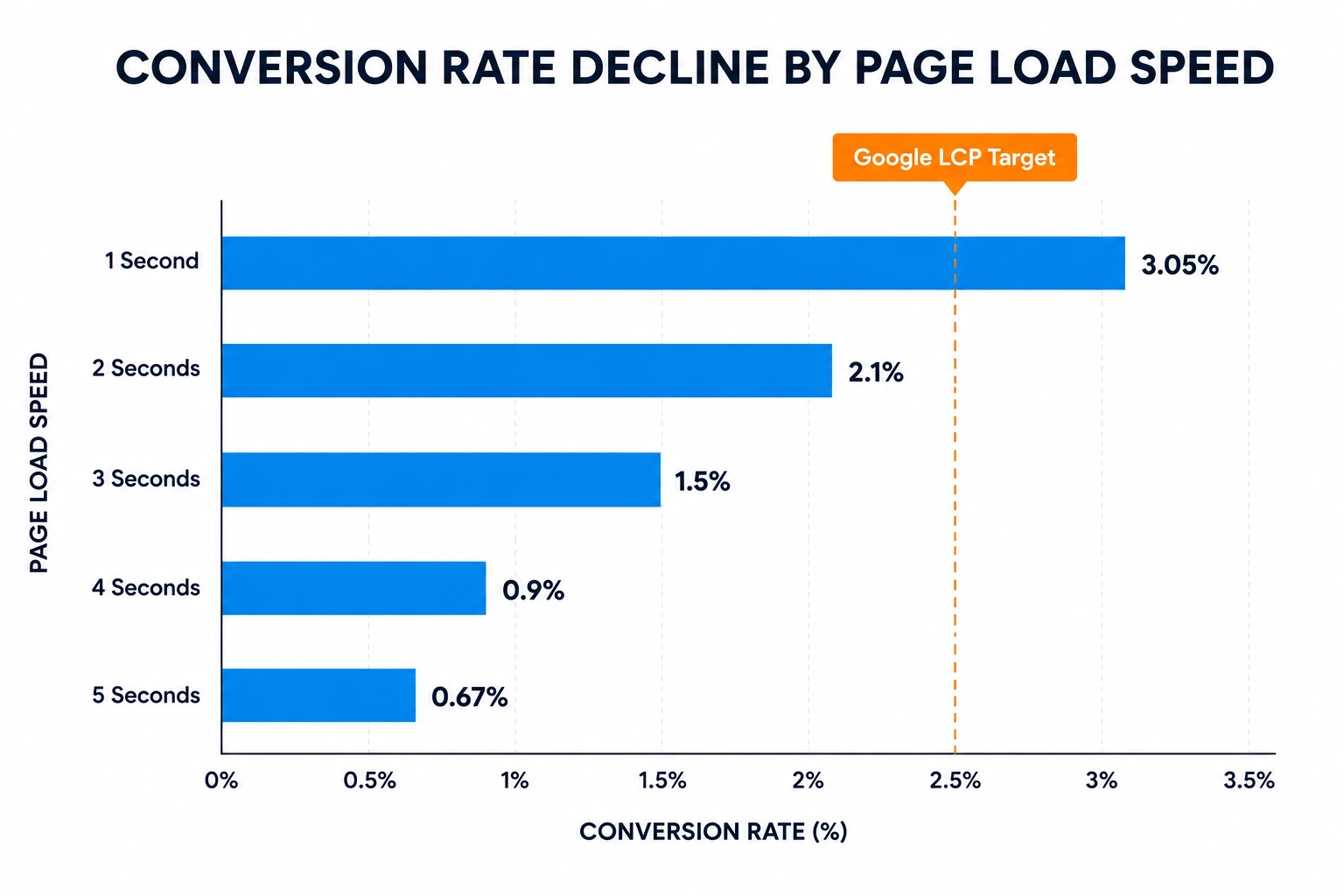
Faster page load speeds lead to higher conversion rates, with Google’s 2.5-second LCP target marking a key performance benchmark.
Optimizing Site Architecture for Crawl Budget and Indexation
Designing a Flat and Logical Site Hierarchy
Crawl budget is finite. Search engine bots allocate a limited number of requests per crawl cycle to any given domain, and the deeper your product pages are buried in your site hierarchy, the less frequently those bots will reach them. Product pages reachable within three clicks of the homepage are indexed 2.4x faster and receive 2.7x more organic traffic than pages buried at greater depth. According to Screaming Frog’s crawl depth analysis, pages at Depth 1 average 2.3 crawls per day compared to just 0.4 crawls per day at Depth 5. This represents a 5.7x difference in crawl frequency that translates directly into indexation speed and ranking velocity.
The three-click rule is a useful guideline, but the underlying principle matters more than the number: every page that generates revenue should sit as close to the homepage as your category structure allows. Flattening your architecture also concentrates link equity. When your homepage links to category pages, and category pages link directly to products, the authority signal flows cleanly through the hierarchy rather than dissipating across five or six intermediate levels. A flat, logical structure is one of the most reliable ways to boost ecommerce traffic and sales without creating new content or building a single external link.
Implementing Structured Breadcrumb Navigation
Breadcrumbs serve two distinct functions, and both matter. They guide users. For users, they provide an immediate orientation signal: a shopper browsing a product page knows exactly where they are in the catalog and can navigate back to a parent category without hitting the browser’s back button. That reduction in friction keeps users engaged and reduces pogo-sticking, which is a behavioral signal search engines observe.
For search bots, structured breadcrumbs communicate the hierarchical relationships between pages in a format that is clear-cut. Implementing BreadcrumbList schema via JSON-LD takes this a step further: it surfaces clean, navigable breadcrumb trails directly in the search results page, giving your listings a visual structure that competitors without schema implementation simply do not have. The implementation is direct, but it needs to be consistent across every product and category page to deliver its full benefit.
- Keep click depth shallow: Structure your categories so that every product page is accessible in three clicks or less from the homepage.
- Use breadcrumb navigation: Implement structured breadcrumbs on every product and category page to provide clear pathways for users and search bots.
- Streamline internal linking: Use high-authority category pages to link directly to your best-selling or high-margin products, bypassing deep default paths.
Mastering Faceted Navigation and Pagination
Resolving Faceted Search Duplicate Content Issues
Faceted navigation is where ecommerce SEO gets complicated. Filters create duplicate pages. Product filters: color, size, price range, and material are essential for user experience, but each filter combination generates a unique URL. A catalog with 500 products and a dozen filter attributes can produce tens of thousands of parameterized URLs, most of which contain near-identical content. Search engines see this as index bloat; your crawl budget gets consumed by thin, duplicate pages instead of your actual product and category content.
The rel="canonical" tag is the standard first response, pointing filtered URLs back to the clean parent category page to consolidate link equity. Its limitation is real, though: search engines still crawl those filtered pages to read the canonical tag, so the crawl budget problem is not fully solved. The noindex, follow meta tag is a more aggressive option; it prevents indexation while still allowing bots to follow internal links on those pages. For truly low-value combinations, including multi-select filters and price sorting parameters, robots.txt disallow directives are the most efficient tool because they prevent crawling entirely.
The emerging consensus is a hybrid model: keep high-value, single-attribute filter pages indexable when they have verified search volume (a page for “black leather boots” is worth indexing; a page for “black leather boots, size 9, under $150, sorted by newest” is not), apply noindex to low-value multi-select combinations, and use robots.txt to block infinite crawl traps like price-sorting parameters.
Managing Pagination and Avoiding Infinite Scroll Traps
Numbered pagination links are crawlable. Infinite scroll, by default, is not. When a search bot reaches the bottom of a category page and there is no <a href> link to page 2, it stops, and every product that would have appeared on subsequent pages becomes invisible to the index. Infinite scroll is a user experience preference, not an SEO constraint, and the two do not have to conflict. The practical solution is to implement infinite scroll for the visual browsing experience while maintaining crawlable, numbered HTML pagination links in the page source as a fallback for bots.
Robots.txt disallow directives should block pagination parameters that generate near-infinite crawl paths; ?sort=price_asc&page=47 is not a page that needs to be in Google’s index, and allowing bots to follow those chains wastes the crawl budget that should be going to your actual product pages.
- Canonicalize parameterized URLs: Point duplicate filter combinations back to the clean, master category page to prevent index bloat.
- Index high-demand facets: Allow search engines to index specific filter pages that have verified search volume, such as “red leather wallets.”
- Avoid infinite scroll traps: Use crawlable, numbered pagination links to ensure search bots can discover deep catalog items.
Writing High-Converting Product and Category Descriptions
Creating Unique Copy to Avoid Duplicate Content
Manufacturer-supplied product descriptions are a trap. They are convenient, they are accurate, and they are used by every other retailer selling the same product. When fifty online stores publish identical copy, Google has no meaningful signal to distinguish between them; and the result is that none of those pages rank particularly well. Writing unique, compelling SEO product descriptions for every indexable page in your store is one of the highest-leverage on-page investments you can make, precisely because most of your competitors will not bother.
The goal is not to rewrite the manufacturer’s spec sheet in different words. Write for humans. It is to answer the questions a real buyer has at the moment they are considering a purchase: What problem does this solve? What makes this version better than the alternatives? What do I need to know before I commit? That framing: benefit-first, specificity-driven, written in the brand’s actual voice: is what separates product copy that converts from copy that merely describes.
Optimizing Category Pages for Commercial Intent
Category pages are often neglected. They are seen as navigation infrastructure rather than ranking assets, which is a missed opportunity. A well-optimized category page targets the broader, high-volume commercial investigation keywords that sit above individual product queries in the purchase funnel: terms like “men’s waterproof hiking boots” rather than a specific model name. That is a different audience at a different stage of intent, and it deserves copy written specifically for them.
The structural challenge is keeping introductory category copy useful without pushing the product grid too far down the page. Keep it brief. A concise, informative paragraph above the grid: one that addresses what the category contains, what differentiates the products, and what a buyer should consider: serves both the user and the search engine without burying the merchandise. Contextual internal links within that copy, pointing toward priority products or subcategories, pass authority downward through the hierarchy in a way that feels natural rather than mechanical.
Copying manufacturer-supplied descriptions is one of the fastest ways to trigger duplicate content issues and lose search visibility. If fifty different online stores use the exact same description provided by the manufacturer, Google has no reason to rank your page over any of the others. To stand out in competitive search results, you must write unique, compelling copy for every indexable page in your store: this is your opportunity to speak directly to your customer, answering their questions and addressing their pain points in your brand’s unique voice.
When writing these descriptions, focus on incorporating long-tail keywords and semantic variations naturally. Instead of repeating your primary keyword over and over, which looks unnatural and can hurt your rankings. Integrate terms that relate to the product’s use cases, durability, and specific features. If you are selling leather boots, you might include terms like “weatherproof construction,” “all-day comfort,” and “sizing guide.” This approach not only helps you rank for a wider variety of search terms but also provides the detailed information that helps shoppers make a confident purchase decision.
“SEO helps online stores get found by the right customers at the right time. Unlike ads, which stop when you stop paying, strong SEO keeps bringing in shoppers over time.” , Carolyn Shelby, Principal SEO
Earning Authority Through Product-Led Content and Digital PR
Creating Linkable Assets with Product-Led Content
Transactional pages, product detail pages, and category grids rarely attract organic backlinks. Other websites do not link to a product listing the way they would link to a resource that taught them something or solved a problem. That is the fundamental challenge of ecommerce link building, and it does not have a shortcut. The workaround is creating content that earns links on its own merits: highly detailed buying guides, detailed product comparisons, troubleshooting articles, or definitive “what to look for” resources that a blogger or journalist would genuinely reference.
The hub-and-spoke model makes this commercially feasible. An informational blog post, for example, “The Complete Guide to Choosing Hiking Boots,” attracts external backlinks from outdoor publications, gear review sites, and travel blogs. Those links build domain authority. Internal links from that post to specific product pages and category pages transfer a portion of that earned authority directly to your transactional content. The informational content does the link-earning; the internal links do the distribution.
Using Digital PR and Merchant Relationships
Digital PR is the intentional pursuit of editorial coverage from authoritative publications: not paid placements, but earned mentions that come with a followed backlink. A well-executed data study, a genuinely newsworthy product launch, or a contrarian industry perspective can generate coverage from outlets whose domain authority would take years to replicate through any other method.
Supplier and partner relationships are an underused source of links that many ecommerce operators overlook entirely. Ask your suppliers. Manufacturers often maintain “where to buy” or store locator pages; getting your store listed there earns a contextually relevant link from a domain with established authority in your product category. These are not glamorous links, but they are real, they are relevant, and they are often available simply by asking. Taken together, these strategies drive organic traffic to your entire catalog by raising the authority floor of your entire domain, not just individual pages.
Earning high-quality backlinks is one of the most challenging aspects of ecommerce SEO because other websites are naturally hesitant to link directly to commercial product pages. To overcome this hurdle, creating “linkable assets”: high-value, informational content that solves problems for your target audience, is the most durable approach. A highly detailed buying guide, a detailed comparison between popular products, or a step-by-step troubleshooting article naturally attracts links from bloggers, journalists, and industry resources over time.
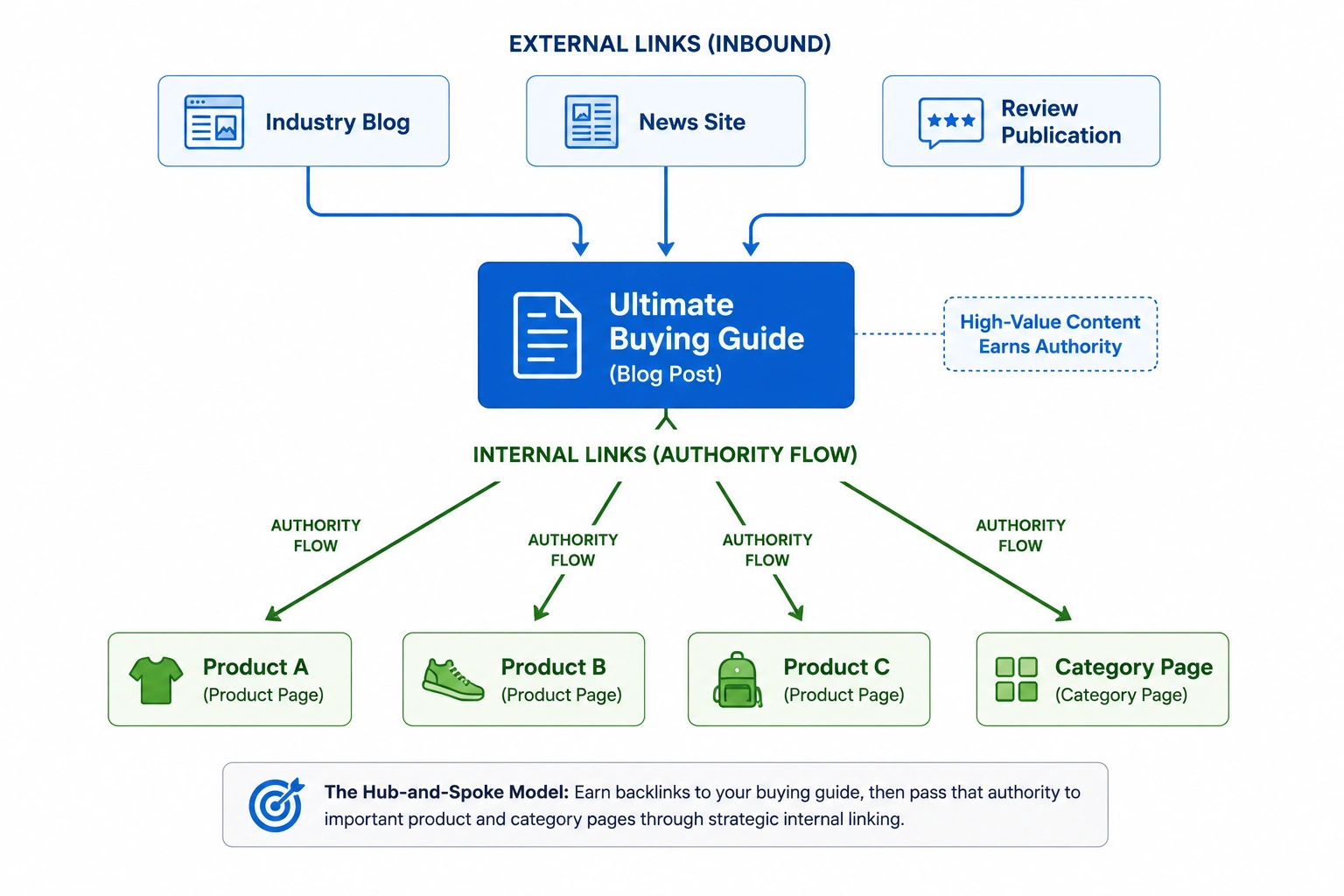
A hub-and-spoke internal linking strategy distributes authority from a buying guide to key product and category pages.
Get a Free Growth Consultation
Managing Out-of-Stock Products and Seasonal Campaigns
Handling Temporarily and Permanently Out-of-Stock Items
A product page that has gathered backlinks, ranking history, and organic traffic is an asset. Letting it become a 404 error because the item sold out destroys that asset immediately and permanently. Do not delete pages. For temporarily out-of-stock products, the right approach is to keep the page live, maintain the URL, disable the Add to Cart button, and add an email notification signup so interested buyers can be alerted when inventory returns. The page continues to rank, continues to gather authority, and continues to capture demand: it just converts differently until the product is available again.
Permanently discontinued products require a different decision. A 301 permanent redirect to the most relevant active product or parent category preserves the gathered link equity and sends users somewhere useful rather than to a dead end. The redirect target matters: pointing a discontinued product to a category page that contains similar items is far more useful than pointing it to the homepage, both for users and for the authority transfer.
Optimizing Seasonal Campaigns for Year-Round Value
Seasonal campaign pages are frequently rebuilt from scratch each year, which means they start every cycle with zero accumulated authority. The fix is simple but unexpected: use evergreen, year-round URLs: /black-friday, not /black-friday-2025: and keep those pages live between events. During the off-season, the page can display teaser content, an email signup for early access, or a “last year’s deals” archive. Plan for the long term. The URL continues to accumulate backlinks and crawl history year-round, so when the event approaches and you refresh the content and product grid, the page is already positioned to rank rather than starting from zero.
- Keep temporary out-of-stock pages active: Maintain the URL, display clear restock timelines, and use Schema markup to show the item is temporarily unavailable.
- Redirect discontinued products: Implement a 301 permanent redirect to the most relevant active product or parent category to preserve accumulated link equity.
- Recycle seasonal campaign URLs: Use evergreen, year-round URLs and update the content annually to preserve search rankings.
Optimizing for Search Everywhere and AI Overviews
Preparing Your Catalog for Generative AI Engines
Google’s AI Overviews, ChatGPT’s shopping integrations, and Perplexity’s product recommendations are no longer experimental features: they are active discovery surfaces that capture queries before users ever reach a traditional search results page. The implications for ecommerce are significant. AI Overviews have reduced organic click-through rates by 61% for informational queries that trigger an AI summary, according to Seer Interactive’s 2025 analysis. For commercial queries, the impact is less severe but accelerating, which means the window to establish your store as a trusted AI citation source is narrowing.
What makes a product catalog eligible for AI-driven recommendations? Accuracy, structure, and verifiability. AI engines pull from sources they can parse with confidence: stores whose product data is complete, current, and consistently formatted across every touchpoint. Thin descriptions, mismatched pricing between your website and your merchant feed, and missing availability signals all reduce the probability that an AI engine will surface your products when a user asks for a recommendation.
The Role of Structured Data in AI Discovery
Structured data is the bridge between your product catalog and the machine-readable layer that AI scrapers and search bots consume. Data must be clean. Detailed schema markup: covering product name, description, price, availability, review data, and brand; this gives AI engines the standardized inputs they need to include your products in generated recommendations without ambiguity.
Maintaining perfect consistency between your on-page schema, your Google Merchant Center feed, and your actual inventory is more operationally demanding than most stores realize. A product showing “in stock” in your schema while your feed reflects “out of stock” creates a trust signal conflict that AI systems resolve by deprioritizing your data. Automated, database-synced schema generation, rather than manually maintained markup, is the only practical approach at catalog scale. Integrating verifiable expert review metadata and merchant transparency signals, including return policy, seller rating, and shipping speed, strengthens the domain trust signals that secure placements in AI-generated product recommendations.
The search landscape is changing rapidly, and traditional search engine results pages are evolving into answer engines. Generative AI features, such as Google’s AI Overviews, are now answering user queries directly on the search page, often pulling information from multiple sources to recommend specific products. To ensure your products are eligible for these AI-driven placements, you must focus on structured data and semantic clarity: making sure your product catalog is easily readable not just by human shoppers, but by AI scrapers and search bots that are looking for the most accurate, up-to-date information.
Implementing Schema Markup for Rich Snippets
Utilizing Product and Offer Schema
Product schema provides search engines with the basic identifiers for a product detail page: name, description, image URL, brand, and SKU. It is the baseline. Offer schema is where the commercially relevant data lives: real-time price, currency, availability status (InStock, OutOfStock, PreOrder), and seller information. Together, these two schema types enable rich snippets: the search result enhancements that display star ratings, pricing, and stock status directly beneath your link in the SERP.
The CTR impact of rich snippets is well-documented. Rich snippets drive clicks. Implementing detailed product and offer schema increases click-through rates by up to 30% compared to standard text listings, because a result showing “★★★★☆ 4.2 | $89.99 | In Stock” answers the buyer’s first three questions before they have even clicked. That pre-qualification also improves conversion quality: users who click on a rich snippet already know the price and availability, which reduces the friction between the search result and the purchase decision.
Implementing Collection and ItemList Schema
Category pages require a different schema approach. CollectionPage schema signals to search engines that a page contains a curated set of related products, establishing the hierarchical relationship between the category and its individual items. ItemList schema provides a structured index of those products: essentially a machine-readable table of contents for your product grid: that search bots can parse without needing to render the full page.
JSON-LD is the implementation format Google recommends for all structured data, and for good reason: it lives in the <head> of your document, separate from the HTML markup, which means it does not interfere with your page’s visual structure and is easier to maintain and validate. Google’s Rich Results Test is the authoritative tool for confirming that your schema implementation is syntactically correct and eligible for rich result display. Run it on every new product template before deployment, not as an afterthought after pages are already indexed. Test before launching.
Adding thorough JSON-LD product schema markup is like giving search engines a detailed, standardized map of your product pages. Instead of forcing Google’s bots to guess your product’s price, availability, or review rating by scanning your page’s text, schema markup delivers this data in a structured format that search engines can read instantly. This structured data is what enables rich snippets: those eye-catching search results that display star ratings, prices, and stock status directly under your link. Implementing this markup is one of the most effective ways to stand out on the search results page and increase your click-through rates.
Frequently Asked Questions About Ecommerce SEO
Common Queries Regarding Search Optimization for Online Stores
How long does it take to see results from ecommerce SEO?
Most online stores see measurable improvements in keyword rankings and organic traffic within 12 to 16 weeks of implementing technical and on-page optimizations. However, highly competitive transactional keywords may require six months or more of consistent authority building. The results vary based on your industry, but most clients see improvements within 3 to 6 months.
Should I index my product filter and facet pages?
Index only those facet pages that have verified search volume: for example, “red leather wallets” or “waterproof hiking boots.” For low-value or infinite filter combinations like price sorting or multi-select filters, use canonical tags pointing back to the main category page to protect your crawl budget and prevent duplicate content issues.
How do I handle discontinued products without losing SEO authority?
If a product is permanently discontinued, implement a 301 permanent redirect to the most relevant active product or parent category to preserve the gathered link equity. Letting these pages turn into 404 errors destroys your search authority and creates a frustrating experience for users who click on your links from external sources.
Is Shopify or WooCommerce better for ecommerce SEO?
Both platforms are highly capable of ranking well. Shopify offers excellent out-of-the-box technical performance, fast loading speeds, and built-in CDN integration, making it a strong default for most merchants. WooCommerce provides deeper control over custom code, database optimization, and hosting configuration, which is the better fit for stores with complex, custom-built requirements. The platform matters less than how well it is configured.
How does site speed affect my organic rankings and sales?
Site speed is a direct ranking factor via Core Web Vitals and a significant conversion driver. Improving your mobile page load times by just 0.1 seconds can yield an 8.4% increase in conversion rates. An ecommerce site loading in 1 second achieves an average conversion rate of 3.05%, whereas a site loading in 5 seconds drops to just 0.67%. For deeper guidance on platform-specific and ongoing SEO strategy, explore our eCommerce SEO resources.
To kickstart your organic sales growth, start by auditing your site’s click depth using a crawler like Screaming Frog. Identify every product page buried deeper than three clicks and restructure your internal links to bring them closer to the homepage. Keep your structure flat. This single architectural adjustment can increase your crawl frequency by up to 5.7x, accelerate indexation, and ensure your highest-margin products are visible to active buyers. We are a small business too, with the same goals and aspirations as the clients we serve, and we are here to stand beside you as you scale your store’s organic revenue.
Start your free trial of our performance monitoring tool to track and optimize your store’s Core Web Vitals in real time, or contact our team to take an empowering next step toward building a high-converting ecommerce SEO strategy.