Written by a BizIQ digital marketing strategist specializing in compliance-safe organic growth and advanced search engine optimization tips for Registered Investment Advisors (RIAs) and wealth managers.
- The top organic position on Google earns a 39.8% clickthrough rate, compared to just 2.1% for the top paid ad on the same page.
- AI Overviews now appear in 25.79% of financial queries, which means question-based content structure is no longer optional; it’s the entry fee.
- Under the SEC Marketing Rule, every optimized page, landing page, and blog post your firm publishes is legally classified as an advertisement, meaning that compliance and organic search strategy are now part of the exact same conversation.
How can Financial Advisors Rank Higher in both Traditional SEO and AI Search Engines?
Financial advisors can rank higher in search and AI by optimizing for Answer Engine Optimization (AEO), which requires publishing concise, direct answers to specific client questions, using structured data, and maintaining a highly accurate digital footprint across professional directories.
Prospective clients are no longer just browsing Google. They are asking ChatGPT and Perplexity to find and vet their next financial advisor. The search landscape has changed. We know how much pressure you’re under to keep the pipeline full while keeping compliance officers happy. At BizIQ, we believe sophisticated marketing belongs to you, too. You don’t need an enterprise-sized budget to compete; you just need to know what we’ve seen work for businesses like yours.
As search behavior shifts, traditional search engine optimization (SEO) is evolving into Answer Engine Optimization (AEO) and Generative Engine Optimization (GEO). For financial advisors, this means your online presence must meet both Google’s traditional ranking algorithms and the large language models (LLMs) that power modern AI search. To stay competitive, firms must understand how AI’s impact on SEO changes how high-net-worth prospects discover financial advice online.
The New Paradigm of Search and AI for Advisors
Understanding the Shift to AI Search Engines
Traditional search engines rank individual web pages. AI search tools do something different: they synthesize a single answer from dozens of sources and present it without requiring the user to click anywhere. That distinction matters more than most advisors realize, because nearly 65% of Google searches now end without a click. The answer lands directly in the interface.
What prevents this from being ruinous for organic visibility is where AI engines source their answers: high-ranking, authoritative websites. The pipeline runs directly through traditional SEO. A firm that earns strong organic rankings is simultaneously building the raw material that AI models pull from when generating responses. These two disciplines are not competing priorities; they are sequential ones.
Approximately 25% of high-income prospects now use AI tools to research and evaluate financial advisors before making contact. Google’s Gemini-powered AI Overviews and Microsoft Copilot are synthesizing answers from structured, credentialed sources, and firms that have not built that foundation are invisible to that segment of the market. Generative engine optimization services exist precisely to close that gap, but they cannot substitute for the technical and content infrastructure that traditional SEO builds first. Advisors who want to capture this traffic need to focus on zero-click search optimization to ensure their brand stays visible even when users never reach their website.
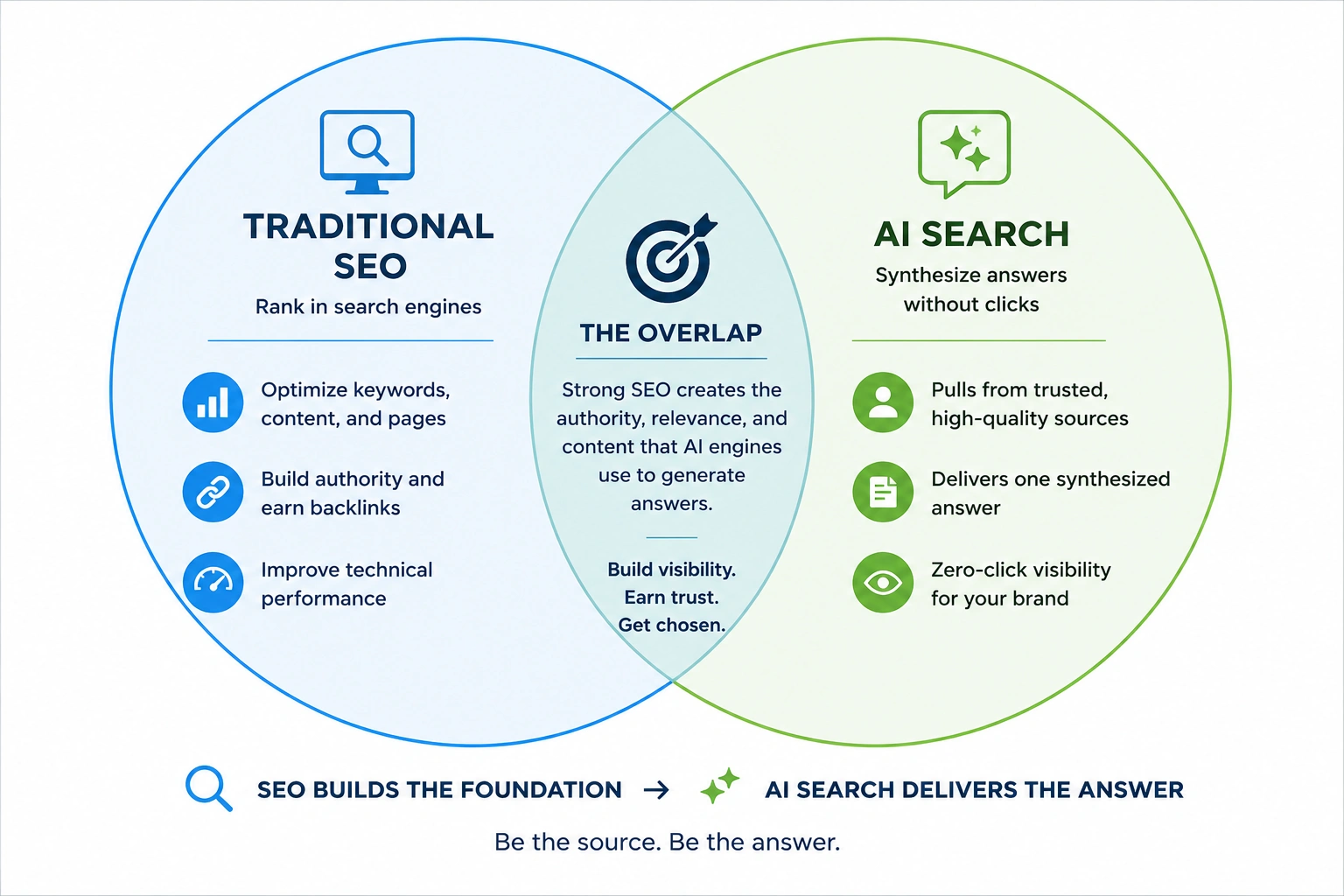
Traditional SEO and AI search work together, helping financial advisors build authority and earn visibility in AI-generated answers.
Building Topical Authority with the Pillar-Cluster Model
The Architecture of a Topic Cluster
Google’s search quality evaluator guidelines place financial planning squarely inside the “Your Money or Your Life” (YMYL) category. That classification triggers a stricter evaluation of Experience, Expertise, Authoritativeness, and Trustworthiness, known as the E-E-A-T framework, and it means that publishing isolated blog posts on loosely related topics does not gather authority the way it once did. Creating high-quality, user-focused content is essential to align with Google’s Helpful Content Guidelines and build trust with both algorithms and human prospects.
The pillar-cluster model is how that depth gets communicated to search algorithms. A pillar page covers a broad topic in a detailed, high-level format: think a 3,000-word guide on Roth conversion strategy. Cluster articles then drill into the specific sub-questions that topic generates: Roth conversions and Medicare premium thresholds, Roth conversions for clients in their peak earning years, or the five-year rule and its exceptions. Each cluster article links back to the pillar, and the pillar links out to each cluster. That web of internal linking signals to both search engines and AI models that your firm has genuine, organized expertise, not just a collection of loosely related posts.
The organic search results data reinforce why this matters. The data is clear. A top-ranking position earns a 39.8% clickthrough rate versus 2.1% for the top paid ad. Topical authority is what earns those positions in YMYL categories, where Google is explicitly skeptical of thin or unverified content. A guide on E-E-A-T for financial services SEO shows that proving your credentials is the only way to protect your search visibility.
- Pillar Page: Create a detailed, high-level guide (e.g., “Roth Conversion Strategy”) that covers a core topic broadly.
- Cluster Articles: Write 6 to 10 shorter, highly focused posts (e.g., “Roth Conversions and Medicare Premiums”) that answer specific questions.
- Internal Linking: Link every cluster article back to the pillar page to signal deep, structured expertise to search engines and AI models.
Optimizing Content for AI Search Engines
The “Answer-First” Formatting Style
AI models do not read content the way a human does. They parse structure, extract the most direct answer to a query, and cite the source. That process rewards a specific formatting discipline: place a concise, 40-to-60-word direct answer immediately below each H2 or H3 question, before expanding with deeper context. When the answer is front-loaded, AI Overviews can extract and cite it cleanly. Brands cited inside AI Overviews earn 35% more organic clicks, which is a meaningful lift at a time when zero-click behavior is shrinking traditional traffic.
E-E-A-T signals are the other half of this equation. Trust is paramount. Linking individual advisors to their CFP® or CFA credentials, their FINRA BrokerCheck profiles, and their SEC registration records makes expertise machine-readable. Deploying Person schema markup formalizes those connections in a way that AI engines can parse without ambiguity, using Google’s Structured Data Documentation as your technical blueprint. This matters more than most firms appreciate: AI-sourced traffic converts at rates 25 times higher than standard organic search traffic, which makes the investment in structured credentialing far more consequential than it appears on the surface.
- Question-Based Headings: Use natural, conversational phrasing in your H2s and H3s that matches how users prompt AI tools.
- Direct Answers: Provide a clear, concise answer at the very top of each section before expanding with deeper context.
- Explicit Authorship: Link every piece of content to a verified author profile with clear credentials to satisfy Google’s strict E-E-A-T guidelines.
Navigating SEC Compliance and the Marketing Rule
The Regulatory Definition of Digital Content
For Registered Investment Advisors, SEO is not a standalone marketing function: it is a regulatory compliance activity that happens to generate leads. Under the SEC Marketing Rule, every public URL, blog post, and landing page is legally classified as an advertisement. Content must be free of misleading statements and archived for regulatory review. That is not a technicality; it is an examination priority. The rules are strict.
The compliance stakes are particularly high around testimonials and third-party ratings. If your firm features Google Reviews or client quotes to support local SEO, the same page must carry clear disclosures: whether the reviewer is a current client, whether they received compensation, and whether their experience is representative. A December 2025 SEC Risk Alert identified alternative trade-name microsites and unverified testimonials as top examination priorities for 2026. Firms that have built their local SEO strategy on non-compliant review practices are carrying regulatory exposure they may not have fully priced in.
There is also the question of content substantiation. FINRA Rule 2210 prohibits misleading or exaggerated statements, which means the widely circulated claim that organic search leads convert at 14.6%, a figure with no traceable primary source, is precisely the kind of unverified statistic that creates liability. Realistic organic conversion benchmarks for financial advisor websites sit between 1% and 3%. Building a strategy around accurate numbers produces better decisions and a cleaner compliance posture.
“Advisors must be able to substantiate any material statements of fact on their website and keep archived copies of all digital content.”
—SEC Marketing Rule Guidance.
The CReD Framework for Multi-Platform Visibility
The Components of the CReD™ Framework
Your website is one node in a larger information ecosystem. AI engines train on public data from across the web, including LinkedIn articles, Medium posts, professional directories, and industry forums. A firm that publishes exclusively on its own domain is limiting its surface area for AI citation. This is a mistake. The CReD™ framework (Create, Reformat, Distribute) addresses this directly.
The process starts with creating high-quality, compliance-reviewed content that establishes genuine authority. That content then gets reformatted into multiple formats: social posts, slide decks, newsletter segments, and short-form video scripts. Each format reaches a different audience and indexes on a different platform. Distribution across high-authority channels, such as LinkedIn, Medium, and trusted financial directories, multiplies the number of places where AI models can encounter and cite your expertise.
The financial case for this kind of sustained, multi-platform investment is not theoretical. One firm documented a $300,000 SEO investment over 5.5 years that generated $2.8 million in annual recurring revenue, representing a 9,000% marketing ROI and proving that organic growth scales exponentially over time. That figure comes from a compounding content strategy, not a single campaign. The CReD™ framework is the operational structure that makes compounding possible.
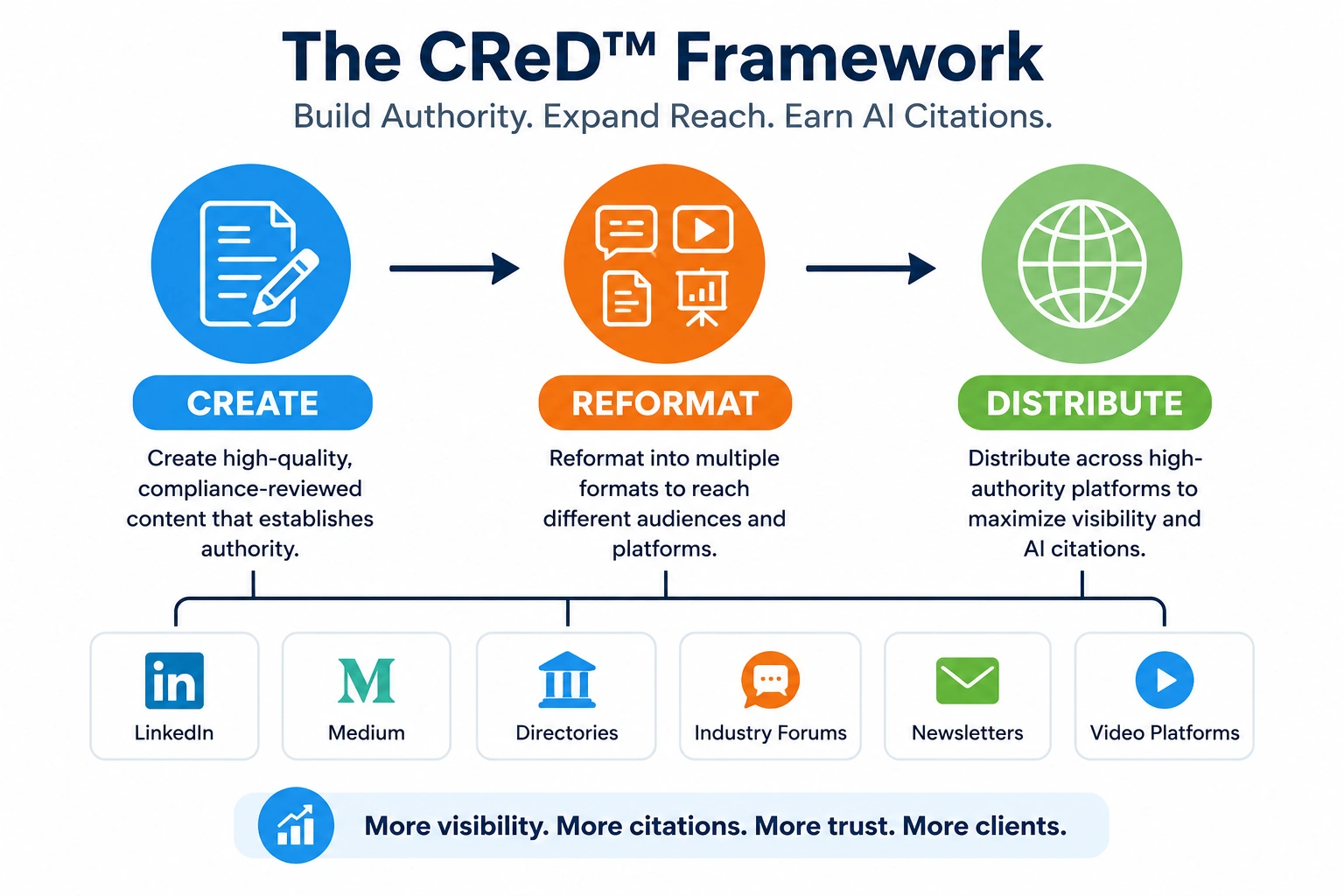
The CReD™ Framework shows how creating, repurposing, and distributing content expands visibility across search and AI platforms.
Partner with the Experts:
Ready to scale your firm’s organic presence safely? Schedule a complimentary SEO and AI-visibility audit with our advisory marketing team to identify your firm’s growth opportunities.
Local SEO and the Power of Google Business Profile
Optimizing Your Google Business Profile (GBP)
For independent RIAs, making sure your business shows up when neighbors search for you is the highest-converting organic channel available. Local “near me” queries convert at a 65% higher rate than generic informational searches, and the gap is widening as AI search tools increasingly surface local results for service-based queries. The Google Business Profile (GBP) is the primary lever for capturing that traffic.
NAP consistency is the baseline. Name, address, and phone number must be identical across every digital directory where your firm appears: Google, Yelp, financial advisor directories, and state regulatory listings. Inconsistencies create conflicting signals that suppress local rankings. This hurts visibility. Beyond NAP, deploying Schema.org Financial Service Documentation to implement FinancialService and LocalBusiness schema markup makes your firm’s physical address, regulatory registrations, and service area machine-readable for local search algorithms. This is not optional infrastructure for firms competing in dense metro markets; it is the difference between appearing in the local map pack and being absent from it entirely.
Reviews are the third variable, and they carry compliance weight. Collecting client testimonials for local SEO purposes is allowed under the SEC Marketing Rule, but only with the required disclosures in place on the same page. Cherry-picking reviews by displaying only five-star feedback while suppressing negative experiences is explicitly prohibited. The compliance and the SEO strategy point in the same direction: balanced, disclosed, authentic reviews build both rankings and regulatory defensibility.
- Complete Your Profile: Ensure your business name, address, and phone number (NAP) are identical across all online directories.
- Collect Compliant Reviews: Gather client testimonials in strict accordance with SEC disclosure rules to boost your local map pack ranking.
- Geographic Relevance: Use location-specific language (e.g., “serving clients in the Denver metro area”) to capture high-intent “near me” searches.
Shifting from Keywords to User Intent
The Evolution of Search Queries
Keyword density is a legacy metric. AI models evaluate semantic meaning and topical depth: they are assessing whether a piece of content genuinely addresses the question a user is asking, not whether a particular phrase appears seven times on the page. Writing “financial advisor in Chicago” repeatedly does not signal relevance; it signals that the content was written for an algorithm that no longer exists in that form.
The practical shift is toward intent-focused content that addresses the specific financial pain points of a defined audience. A solo advisor serving tech employees in Seattle writes differently than a wealth management firm serving retirees in Scottsdale, and that specificity is exactly what both Google and AI engines reward. Nearly 65% of Google searches result in no click because the answer is delivered directly on the search results page, which means the traffic that does arrive at your site is already pre-qualified. Chasing broad search volume produces impressions; targeting high-intent, localized queries produces consultations.
There is a case to be made that the niche specialization debate, broad authority versus hyper-targeted content, has already been settled by AI search behavior. Generative models favor highly specific, experience-backed answers over generic financial overviews. Specificity wins. An article on “tax-efficient RSU strategies for California tech employees” will be cited in AI responses far more reliably than a generic guide to “how to invest your money.”
Measuring Success in the AI Search Era
Tracking AI Search Visibility
Traditional metrics are separating. Impressions no longer predict clicks the way they once did, because AI Overviews intercept a growing share of informational queries before users ever reach organic results. Firms that measure success exclusively through Google Search Console impression data are working with an incomplete picture.
A more accurate measurement approach involves building a list of 20 to 25 prompts related to your niche and location, the kinds of questions your target clients would type into ChatGPT or Perplexity, and running them quarterly to track whether your firm appears in the cited sources. That manual audit is imperfect, but it captures visibility that standard analytics tools currently miss.
Closed-loop attribution, or figuring out which of your efforts truly brings customers, is the other gap most firms have not closed. The goal is tracking a prospect along the path from someone browsing to someone walking through your door, using CRM integration to connect digital touchpoints with actual revenue outcomes. We’ve seen this work directly. For example, CCM Wealth Management implemented a localized content strategy and grew monthly organic sessions from 230 to 976 over three years, generating 35 inbound leads in a single year, converting 12 into active clients, and adding $18 million in new AUM at an average of $1.5 million per client.
Those results are not anomalies, but they are also not automatic. They reflect a deliberate, sustained investment in the infrastructure that search engines and AI models reward: structured content, verified credentials, compliant reviews, and consistent distribution across authoritative platforms.
Frequently Asked Questions
Structuring FAQ Content for Featured Snippets
Deploying FAQPage schema markup structures your questions and answers in a format that AI Overviews and Google’s featured snippets can directly extract and surface. The questions below are formatted to address the highest-intent queries financial advisors encounter when researching their digital marketing strategy.
How does AI search affect traditional SEO for financial advisors? AI search builds on traditional SEO. AI engines pull data from top-ranking organic sites, meaning a strong traditional SEO foundation is required to be visible in AI summaries. Firms that rank well organically are the same firms getting cited in ChatGPT and Perplexity responses.
What is the SEC Marketing Rule’s impact on blog posts? Under Rule 206(4)-1, blog posts are considered advertisements. They must not contain misleading statements, must include clear disclosures for any testimonials, and must be archived for compliance review. Every public-facing URL your firm publishes falls under this classification.
What is the pillar-cluster model? It is a content organization strategy where a detailed page is supported by multiple cluster articles covering specific subtopics, all linked together to demonstrate topical authority to search engines and AI models.
How can an advisor show up in ChatGPT or Perplexity? By publishing clear, question-based content, establishing strong E-E-A-T signals through verified author bios and schema markup, and distributing content across high-authority platforms like LinkedIn, Medium, and trusted financial directories.
Does AI search mean advisors will get fewer website visits? Informational queries may generate fewer clicks due to zero-click behavior, but the traffic that does arrive is highly qualified. AI-sourced visitors convert at rates significantly higher than standard organic traffic, making the overall lead quality stronger even when raw volume is lower.
Adapting your digital presence for both Google and AI search is not about publishing more content: it is about providing clearer, more authoritative signals at every layer of your site’s architecture. Structuring expertise into topic clusters, formatting content so AI engines can extract and cite it, maintaining strict compliance with the SEC Marketing Rule, and distributing your authority across multiple platforms: these are not separate initiatives. They are the same initiative, executed at different levels of the stack. Consistency is key. Start by auditing your top three service pages today to confirm they directly answer the questions your prospective clients are already asking.
Small businesses are the backbone of innovation, and we believe sophisticated marketing belongs to you, too. We’re in this together, driving America forward one firm at a time.
Take the Next Step:
Ready to dominate search and AI? Contact us today to build a compliance-safe organic growth strategy for your advisory firm.