Three things determine whether a hungry diner walks through your door tonight or your competitor’s: whether you appear in the Google Local 3-Pack (which captures up to 44% of all local search clicks), whether an AI assistant surfaces your name when someone asks for a dinner recommendation, and whether your digital presence is persuasive enough to convert that discovery into a reservation. Lose any one of those three, and you are invisible at the exact moment intent is highest.
What makes this particularly critical is that 79% of restaurant searches are non-branded. Diners are not typing your name into Google; they are searching “best sushi downtown” or “gluten-free pasta near me” and choosing from whatever surfaces first. That behavioral pattern means your ranking position is not a vanity metric: it is a direct proxy for foot traffic and revenue. Restaurants that treat local SEO as a background task rather than a core operational discipline are, in effect, ceding those non-branded queries to whoever bothered to optimize.
How Do AI Search Assistants Choose Which Local Restaurants to Recommend, and How Can My Venue Get Featured?
The local search ecosystem has also grown considerably more complex. Google’s algorithm now weighs relevance, distance, and prominence simultaneously, while generative AI engines like ChatGPT, Gemini, and Perplexity synthesize recommendations from structured data sources your website may not even be feeding them. Aligning your digital footprint with all of these systems, not just Google Maps, is what separates restaurants that stay perpetually booked from those that depend entirely on third-party delivery apps, eating 15% to 30% of every order. Stop losing 30% of your revenue to those intermediaries by building a local search presence that drives direct bookings instead.
At BizIQ, we are a small business too. We know that small businesses are the backbone of innovation and the heartbeat of America. We believe sophisticated marketing belongs to you, which is why we focus strictly on what actually works. This guide covers every lever worth pulling: Google Business Profile architecture, schema markup, AI-readability via llms.txt, reputation velocity, location page structure, and hyper-local content. Each section is built around what actually moves rankings, not what sounds strategically impressive.
Transforming Your Google Business Profile into a High-Converting Storefront
Your Google Business Profile acts as your restaurant’s main digital storefront, often getting seven times more views than your website. Google’s local algorithm relies heavily on how complete, accurate, and active your profile is to determine Local 3-Pack rankings. Claiming and verifying your profile is just the beginning; the real advantage comes from the detailed configuration that most businesses overlook.
Choosing the right primary category is more important for ranking than most businesses know. Whitespark’s 2026 Local Search Ranking Factors Survey points to it as the most critical signal for the local pack. A pizza restaurant that chooses the general “Restaurant” category instead of “Pizza Restaurant” is reducing its visibility for specific, high-intent searches. This is an easy-to-fix, self-inflicted problem.
Beyond the category, current local search favors detailed attribute completeness: the specific operational tags that match everyday and voice search terms. Attributes like “heated patio,” “EV charging,” or “sensory-friendly dining” aren’t just decorative; they help your profile appear in the long-tail queries that drive significant traffic. A study by Malou showed that restaurant groups actively optimizing their GBP and local presence saw an average organic traffic increase of 74% within three months of consistent effort. That number is significant because it shows what happens when businesses treat their profile as a dynamic asset, not a one-off setup.
Google Business Profile Optimization Checklist
- Select the Most Specific Primary Category: “Pizza Restaurant,” “Sushi Restaurant,” or “Vegan Restaurant” will always outperform the catch-all “Restaurant” for cuisine-specific queries. This is the most impactful single change most operators can make.
- Complete Every Attribute: Operational tags like “outdoor seating,” “wheelchair accessible,” and “good for kids” directly feed conversational search intents and voice assistant recommendations. Leave them blank and you forfeit those queries entirely.
- Keep Photos Current: Profiles with regular, high-quality food photography updates receive 35% more clicks to their websites. Upload fresh imagery weekly, not quarterly.
- Maintain Accurate Hours: Update holiday and seasonal hours immediately. Google’s algorithm penalizes profiles with inaccurate hours during active search windows, and a single mismatch can suppress your ranking at peak dining times.
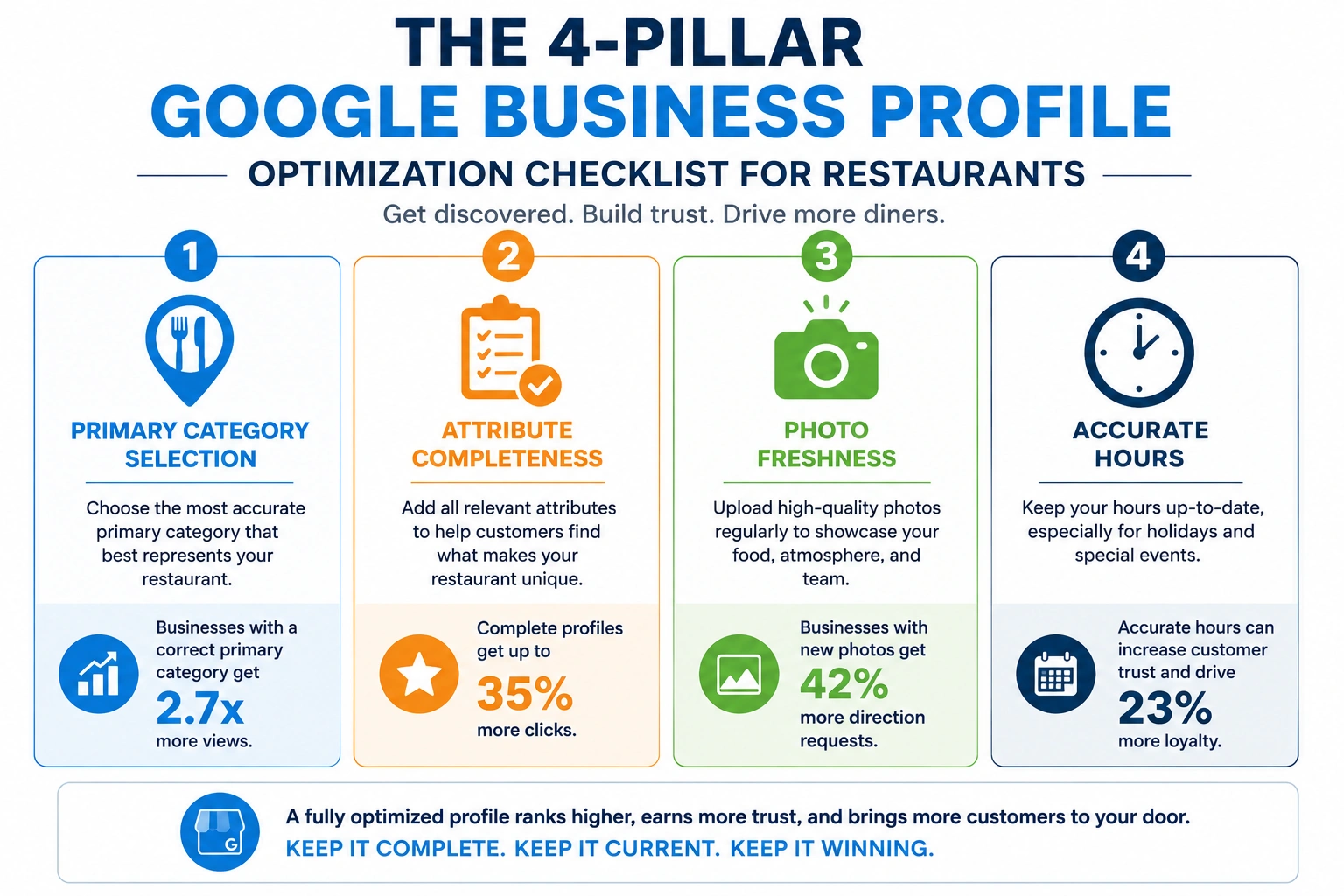
The four key elements of an optimized Google Business Profile help restaurants improve local visibility and attract more diners.
Eliminating the PDF Menu for Better Search Engine Legibility
PDF menus are one of the most persistent and quietly damaging technical mistakes in restaurant SEO. Three specific problems compound each other:
- Search crawlers and AI models cannot extract text from flat PDF files, meaning your signature dishes, the very items people search for, go completely unindexed.
- A degraded mobile experience forces users to pinch and zoom on a document format designed for print, driving up bounce rates at the exact moment a diner’s intent is highest.
- The absence of schema integration locks you out of rich snippets. PDF menus cannot carry structured data, so Google has no mechanism to display your dishes and prices directly in search results.
Converting your menu to live HTML and nesting it within proper Restaurant and MenuItem schema is not a design project; it is a technical SEO priority. Every dish name, description, and price point becomes a crawlable, indexable keyword signal the moment it lives in HTML. For a restaurant with a 40-item menu, that conversion creates dozens of new semantic entry points for dish-specific queries that a PDF was silently blocking. Structured data acts as a translation layer, converting your restaurant’s information into a format that search engines and AI can understand. Three schema types offer the most significant impact on ranking and visibility:
- Restaurant Schema: This schema type embeds your business’s name, address, phone number, cuisine type, and price range in a machine-readable format. This verifies your business entity for both Google and AI crawlers.
- Menu Schema: By marking up individual dishes, their descriptions, and prices, you enable Google to display this information directly in search results for specific dish queries. For example, a search for “gluten-free truffle pasta near me” could lead directly to your offering.
- Aggregate Rating Schema: This schema type displays your star ratings and review counts within organic search listings, establishing immediate credibility before a potential diner even visits your website.
Google explicitly recommends JSON-LD as the implementation format. It integrates smoothly into your site’s <head> section without altering your visual design. If your development team hasn’t reviewed your schema in the last six months, it’s possible that errors are present, silently hindering your eligibility for rich snippets.
Future-Proofing Your Brand for AI Search with LLM Optimization
Generative AI engines do not crawl the web the way Googlebot does. ChatGPT, Gemini, Perplexity, and Apple Intelligence synthesize recommendations from structured, clean, machine-digestible sources. If your website buries its most important information inside heavy design scripts, JavaScript-rendered content, or flat PDF files, these models will route around you entirely. They will recommend your competitor instead, not because that competitor has better food, but because their data was easier to parse.
The practical response to this is Generative Engine Optimization (GEO), and one of its most useful implementations is an llms.txt file placed in your website’s root directory. This Markdown-formatted file acts as a structured briefing document for AI crawlers: it summarizes your menu, location, hours, cuisine type, and unique selling points in a format that large language models can ingest in seconds. Think of it as a robots.txt file, but written for AI rather than traditional search spiders, a deliberate signal that says “here is exactly what you need to know about us.”
The urgency here is not hypothetical. Recent data shows that 40.16% of local queries now trigger Google’s AI Overviews, meaning a significant share of the searches that should be sending diners to your door are now being answered by a generative summary rather than a traditional results page. If your restaurant is not represented in that summary, you are absent from nearly half of local discovery moments.
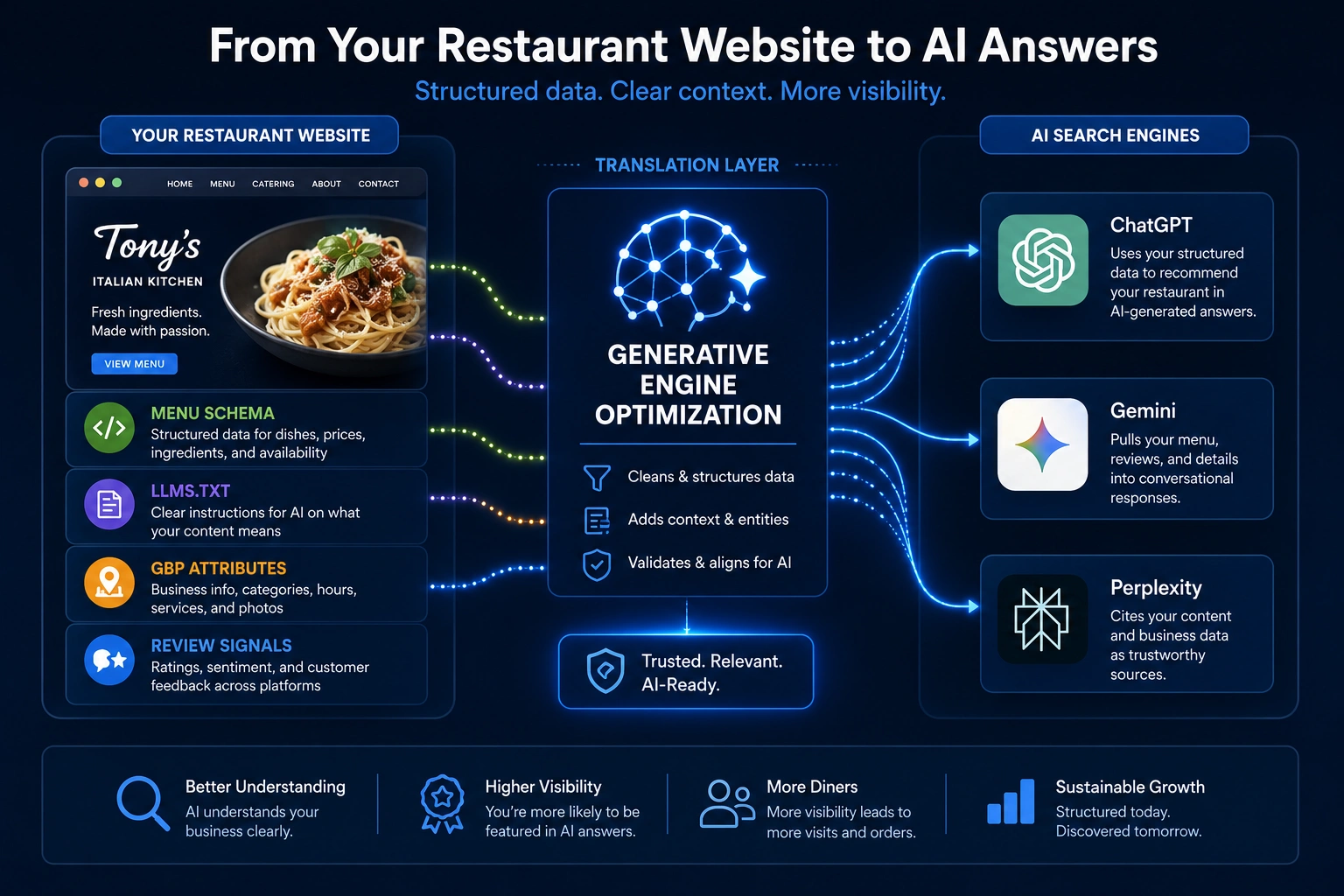
Generative Engine Optimization transforms structured website data into AI-ready content for modern search platforms.
Implementing llms.txt does not require a developer sprint. A well-structured Markdown file covering your restaurant name, locations, cuisine, hours, top dishes, price range, and reservation link takes less than an afternoon to produce. The compounding benefit is that it also improves how traditional crawlers interpret your site architecture, making it a dual-purpose technical asset. Partner with BizIQ to implement a custom restaurant digital marketing services system built specifically for high-competition restaurant markets, one that integrates GEO, schema, and GBP optimization into a single coherent strategy. Online reviews are no longer just marketing material; they’re a technical input for search engine ranking. Google’s local algorithm uses review velocity, recency, and keyword density in customer feedback to determine your restaurant’s relevance and prominence. A review like “the gluten-free truffle pasta was incredible and the service was fast” offers more SEO value for specific dish and attribute searches than numerous generic five-star ratings that lack useful detail.
The connection to revenue is clear and established. Harvard Business School research indicates that a one-star increase in a restaurant’s average rating can lead to a 5% to 9% increase in revenue. Restaurants with ratings of 4.4 stars or higher achieve weekly sales approximately 90% greater than those of competitors at a 3-star rating. This difference isn’t solely due to food quality; it reflects the cumulative impact of increased visibility, trust, and click-through rates. Don’t let competitors who actively manage their feedback capture more customers.
Reviews are a key local ranking factor, influencing about 20% of the Local Pack’s weight, according to BrightLocal data.
Core Pillars of a High-Velocity Reputation Strategy
- Review Velocity: Aim for at least two new reviews weekly. This signals to Google that your business is actively serving customers, which helps maintain stability in the local pack. Stagnant review profiles fall behind competitors who consistently gather fresh feedback.
- Keyword Richness: Encourage guests to mention specific dishes, dietary needs, and ambiance details in their reviews. This builds relevance for the long-tail, food-specific queries that attract high-intent customers.
- Rapid Response Times: Respond to all reviews, positive and negative, within 48 hours. This boosts user engagement and shows active management, both of which influence Google’s prominence scoring.
- Multi-Platform Presence: Distribute reviews across Google, Yelp, and TripAdvisor. This ensures your restaurant feeds multiple AI engines and directory aggregators at once, rather than concentrating reputation equity in one place.
Businesses like yours have benefited from this approach. Understanding the benefits of local reviews for small business SEO explains how sentiment analysis, response rates, and platform diversity lead to measurable ranking improvements.
Creating Dedicated Location Pages for Multi-Unit Restaurant Groups
Multi-location operators who bury their branches inside a single dropdown menu are leaving a substantial amount of local search equity on the table. Each physical location needs its own dedicated, search-optimized landing page, a localized hub that allows Google to associate that specific address with the geographic queries being searched in that neighborhood.
A common mistake is content duplication: copying the same descriptive text across every location page and swapping only the address. Google’s duplicate content filters recognize this pattern quickly, and the result is that none of the pages rank with full authority. The fix requires genuine localization: unique neighborhood descriptions, references to nearby landmarks, parking-specific instructions, and location-specific team photography. These are not cosmetic differences; they are the signals that tell Google each page is a distinct, authoritative document about a distinct place.
Embedding a verified Google Map directly on each location page sends strong proximity signals to Google’s ranking algorithm. Integrating how to optimize google maps for business success into this page architecture, including verified map embeds, localized schema markup with coordinates, and location-specific operating hours, creates a reinforcing loop where your GBP, your website, and Google’s mapping data all point to the same verified entity. That consistency is what proximity-based ranking rewards.
Each location page should also carry its own localized schema markup with the specific address, phone number, and hours for that branch. NAP consistency across your website, GBP, and third-party directories is not a minor housekeeping task. Discrepancies between these sources create entity confusion for both Google and AI engines, which can suppress rankings across all your locations simultaneously.
Using Hyper-Local Content to Establish Neighborhood Authority
National chains have scale. What independent operators and regional groups have is specificity: a genuine, credible connection to a particular neighborhood that a corporate brand cannot authentically replicate. Google’s algorithm recognizes this distinction, and hyper-local content is the mechanism for making it legible to search engines.
Generic culinary blog posts do not build neighborhood authority. Writing about “the five best pasta techniques” positions you as a food publisher, not a local institution. What actually moves the needle is content that ties your restaurant to the physical community around it: a guide to the best Saturday morning activities within walking distance of your location, a post about your partnership with the farmers market two blocks away, or coverage of the neighborhood event you sponsored last quarter. Each of these creates topical associations between your domain and the geographic entities Google uses to evaluate local relevance.
This content strategy also generates a secondary benefit that is easy to overlook: local backlinks. When you write about a nearby business, event, or organization, there is a natural reciprocal linking opportunity that builds your domain’s local authority in a way that generic content never will. Over time, this network of neighborhood-specific content and inbound links compounds into a competitive moat that is genuinely difficult for a chain with templated content to replicate.
Frequently Asked Questions about Restaurant Local SEO
How long does it take to see results from local restaurant SEO?
Most restaurants begin seeing measurable improvements in Map Pack visibility, website traffic, and customer actions within three to six months of consistent optimization. That timeline is not fixed: it compresses in less competitive markets and stretches in dense urban environments where every operator is actively working their GBP. The variables that matter most are the current state of your profile, how aggressively you are acquiring reviews, and whether your on-site technical foundation (schema, NAP consistency, mobile speed) is clean. Operators who address all three simultaneously tend to see movement faster than those who optimize in isolation.
Do PDF menus really hurt my restaurant’s search engine rankings?
Yes, and the damage is more specific than most operators realize. Search engine crawlers and AI models cannot reliably extract text from PDF files, which means every dish name, ingredient, and dietary tag locked inside that document is invisible to search engines. Switching to a live HTML menu, structured with MenuItem schema, transforms each dish into an indexable keyword signal. For a restaurant with a 60-item menu, that conversion can create dozens of new organic entry points overnight.
What is an llms.txt file, and does my restaurant need one?
An llms.txt file is a Markdown-formatted text document placed in your website’s root directory. It summarizes your menu, hours, location, cuisine type, and key differentiators in a clean, easily digestible format that AI engines can parse without fighting through JavaScript-heavy page rendering. Whether every restaurant needs one today is debatable, as the technology is still maturing. However, early adopters may gain a discoverability advantage in AI-driven local search before the practice becomes standard, much like early GBP optimizers dominated the Map Pack before competitors caught on.
How do online reviews impact my local map rankings?
Reviews are one of the most critical local ranking factors, accounting for approximately 20% of the Local Pack’s weight. Google evaluates total review count, average star rating, response velocity, and the specific keywords embedded in customer feedback. That last factor is the one most operators underestimate: the semantic content of your reviews directly influences which dish-specific and attribute-specific queries your restaurant surfaces for. A profile with 200 reviews that all say “great place” is less algorithmically useful than one with 80 reviews that mention specific dishes, dietary accommodations, and neighborhood context.
Should I create separate pages for each of my restaurant’s locations?
Every location in a multi-unit group needs its own dedicated page with a unique URL, localized schema markup, specific operating hours, and an embedded Google Map. Consolidating multiple locations onto a single page, or worse, a single dropdown, prevents Google from associating each address with the hyper-local queries being searched in that specific neighborhood. The investment in building and maintaining individual location pages pays compounding dividends as each page accumulates its own local authority over time.
Dominating the local map pack, organic search results, and generative AI engines is not a campaign; it is an operational discipline that compounds over months and years. The restaurants that consistently appear at the top of local search are not there by accident; they have claimed and actively maintained their Google Business Profile, replaced static PDF menus with crawlable HTML and schema, built a structured reputation acquisition system, and begun feeding AI engines the clean, structured data those models need to recommend them confidently.
We’re a small business too. We know that small business is the backbone of innovation and the heartbeat of America. Sophisticated marketing belongs to you, not just the giant national chains. Here is your next step: we recommend exploring our guide on how to improve your local SEO right now to find a prioritized set of impactful actions you can implement this week, not next quarter.