- Win the Local Map Pack by optimizing your Google Business Profile and building local citation consistency.
- Earn AI Search Citations in ChatGPT, Perplexity, and Google AI Overviews using Generative Engine Optimization (GEO).
- Maximize Client Conversions with structured schema markup and answer-first content architecture.
How Does the Rise of AI Search Engines Impact Local SEO for Law Firms, and How Do We Adapt?
The landscape of legal search is undergoing its most significant upheaval in a generation, forcing law firms to adapt or risk becoming digitally invisible. To secure a steady stream of high-value cases, modern law firms must master a dual-track strategy: dominating traditional local search results while optimizing for generative AI engines. We’re a small business ourselves, and we know that sophisticated marketing belongs to you, not just massive national firms with endless budgets. After all, small businesses are the backbone of innovation and the heartbeat of America, and boutique law firms are no exception. Here is what works to keep your firm ahead of the curve.
According to recent search data in the Digital Authority 2026 Annual Research Report, 78% of legal search queries now trigger a Google AI Overview, representing the highest AI penetration rate of any industry. At the same time, the same Digital Authority report highlights that 58% of prospective clients use “near me” qualifiers when searching for legal representation. This means your firm’s longevity depends on being both locally discoverable and AI-recommended. Visibility is no longer guaranteed. We take an evidence-based approach to help you navigate these shifts, standing beside you, not above or behind, as you grow your practice. We educate with evidence and lead with outcomes, helping you build authority without the typical agency hype.
The Convergence of Local Search and Generative AI
Understanding Generative Engine Optimization (GEO)
Generative Engine Optimization is the practice of structuring your website’s content and authority signals so that large language models, the engines powering ChatGPT, Perplexity, and Google AI Mode, cite your firm when compiling answers to legal queries. It is distinct from traditional SEO in one critical way: you are no longer competing for a ranked link position. You are competing to be woven into the answer itself.
The “ten blue links” model rewarded keyword density, backlink volume, and page authority scores. GEO rewards something harder to fabricate: demonstrable expertise, structured data, and content that an AI can extract and quote with confidence. These are not mutually exclusive disciplines; adapting SEO strategies for AI search requires building on the traditional foundation while adding an entirely new layer of optimization on top of it. Traditional tactics are evolving. They are not dying.
The urgency here is real. SEMrush data confirms that 78% of legal search queries trigger a Google AI Overview, a penetration rate that outpaces every other professional services vertical. For a personal injury firm or a family law practice, that statistic translates directly to a shrinking window of organic visibility for firms that have not yet adapted.
How AI Search Engines Synthesize Legal Recommendations
When a prospective client types “estate planning attorney in Denver” into Google AI Mode or asks ChatGPT the same question, the AI does not conjecture. It crawls and synthesizes data from Google Business Profiles, legal directories, structured website content, and authoritative third-party sources before presenting a curated shortlist. The firms that appear in that shortlist are not necessarily the largest or the oldest. They are the most legible to the machine.
As discussed in JD Supra’s analysis of AI search summaries, these models synthesize complex legal topics directly for the user. Understanding precisely how AI selects local businesses for search results is foundational to this strategy. AI engines weight consistency: consistent NAP data, consistent practice area signals, consistent authorship, because inconsistency reads as unreliability. A firm with a polished website but disjointed directory listings will consistently lose ground to a smaller competitor whose digital footprint is tightly structured and machine-readable.
The zero-click dimension compounds this pressure. Digital Applied’s 2026 search study found that 69% of all Google searches end without a click to an external website. The shift is clear: as highlighted by Attorney at Law Magazine’s look at AI Overviews, AI engines are answering your clients’ questions, and the only question left is whether they are citing your firm. When an AI Overview satisfies the query at the top of the page, users have no reason to scroll further. Firms that earn a citation inside that summary capture attention; firms that do not are functionally absent from the interaction. Our digital marketing for legal businesses practice is built around closing exactly that gap.
The Role of E-E-A-T in YMYL Legal Content
Google classifies legal content under the “Your Money or Your Life” (YMYL) designation, meaning it applies its most stringent quality standards to any page that could materially affect a reader’s financial, legal, or physical wellbeing. Under the E-E-A-T framework: Experience, Expertise, Authoritativeness, and Trustworthiness: legal pages face a higher evidentiary burden than virtually any other content category.
Google’s December 2025 Core Update made this concrete: as detailed in TSEG’s analysis of Google’s December 2025 Core Update, 67% of YMYL content that lacked verified attorney authorship and demonstrable real-world case experience was penalized in rankings. Generic, AI-generated legal overviews without a named, credentialed author and specific case context were the primary victims. Trust is paramount. The practical implication is that every substantive page on your site should carry a verified attorney byline, reference real case types your firm has handled, and avoid the kind of hedged, non-committal language that signals to Google’s quality evaluators that no actual practitioner was involved in its creation.
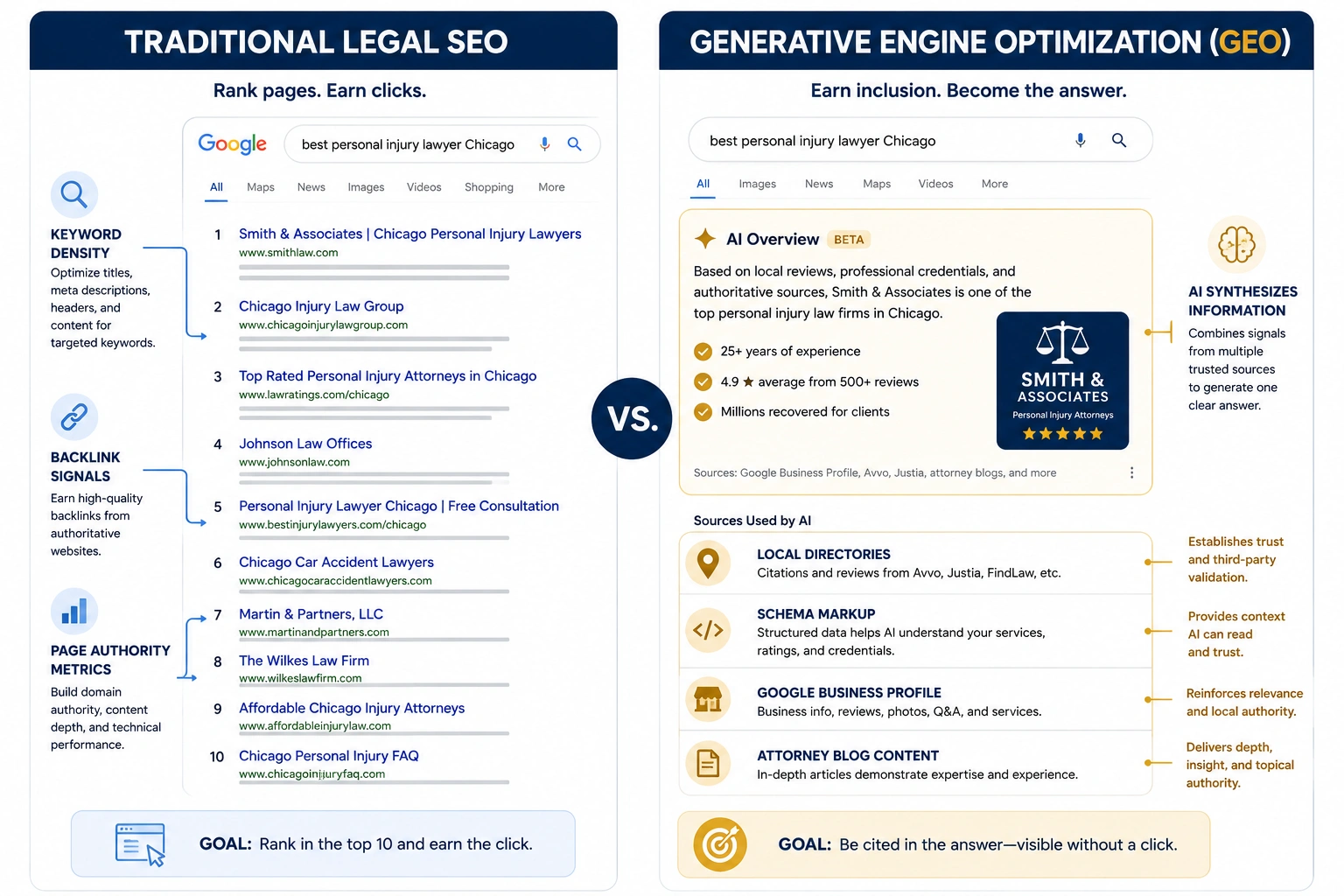
This infographic compares traditional SEO rankings with AI-generated search results and the sources that power generative search.
Optimizing Your Google Business Profile for Local Dominance
Maximizing Google Business Profile (GBP) Ranking Weights
Your Google Business Profile is not a dormant listing. It is an active asset. It is an active ranking instrument, and the data bears this out: Whitespark’s 2026 Local Search Ranking Factors report attributes 32% of local pack ranking weight directly to GBP optimization. Within that category, primary category selection carries more individual influence than any other single action you can take.
Selecting “Personal Injury Attorney” rather than the broader “Law Firm” as your primary category tells Google’s local algorithm, and by extension, the AI systems that draw from it: exactly what type of legal need you serve. Secondary categories allow you to layer in adjacent practice areas without diluting the primary signal. Firms that treat category selection as a one-time setup task and never revisit it are leaving a disproportionate share of local ranking potential on the table. Pairing precise category selection with a fully completed profile: verified photos, updated service descriptions, accurate hours, and active Q&A responses: magnifies the effect. Our SEO local search strategies guide covers the full GBP optimization sequence in detail.
The Power of Local Citation Consistency
Citation consistency is tedious work, but its impact on local rankings is measurable and direct. Details matter. Think of your business listings like addresses: if someone gives the wrong street name everywhere, customers get lost, and search engines lose trust. A firm with its suite number listed as “Ste. 400” on its website, “Suite 400” on Yelp, and “#400” on Avvo has technically the same address in three different formats, but aggregators and AI engines read these as potential discrepancies.
The audit process starts with the four major data aggregators: Neustar Localeze, Data Axle, Foursquare, and Yext, because errors at the aggregator level disseminate outward to hundreds of downstream directories. Correcting the source eliminates the need to chase individual listings manually. After the aggregators are clean, the priority shifts to legal-specific directories: Avvo, Martindale-Hubbell, Justia, and FindLaw. These carry both citation authority and the kind of third-party validation that AI models weight heavily when assembling recommendations.
Review Acquisition and Velocity Strategies
Client reviews contribute 20% of the local ranking weight in Whitespark’s model, with Google’s algorithm factoring in volume, recency, and the sentiment expressed in review text, including whether practice-area keywords appear naturally in the review body. A steady cadence of new reviews outperforms a burst of reviews followed by months of silence, because velocity signals ongoing client activity.
The ethical boundaries here are non-negotiable. ABA Model Rule 7.1 prohibits false or misleading communications, which extends to counterfeit or incentivized reviews. The FTC estimates that 15% to 20% of online reviews online are fake, and bar disciplinary bodies are increasingly treating review manipulation as a professional conduct issue, not merely a professional conduct transgression. The practical process we recommend is simple: at case resolution, send a personalized, one-sentence email or text thanking the client and including a direct link to your Google review profile. No incentive. No script. Just a clear path for a satisfied client to share their experience. Firms that build this into their intake-to-close workflow consistently outperform those that treat reviews as an afterthought.
- Select precise primary and secondary categories that accurately reflect your practice areas, such as “Personal Injury Attorney” or “Family Law Attorney.” According to Whitespark’s 2026 Local Search Ranking Factors report, primary category selection stands as the single most influential ranking factor, contributing to the 32% of local pack ranking weight attributed to GBP optimization.
- Maintain absolute NAP consistency across your website, local directories, and state bar profiles. Discrepancies in your name, address, or phone number confuse search engines and lower your local search rankings.
- Implement a systematic review generation process to consistently acquire high-quality client feedback. Client reviews contribute 20% of the local ranking weight, and Google prioritizes review volume, velocity, and positive sentiment.
Structuring Content for Generative Engine Retrieval
Implementing Answer-First Content Architecture
LLMs extract content by scanning for the most direct, self-contained response to a query. A practice area page that opens with three paragraphs of firm history before addressing what the firm does for clients is, from the AI’s perspective, a page that buries its value. Answer-first architecture inverts that structure: the first 50 to 170 words of every essential section should deliver a direct, complete answer to the question that section addresses, before layering in supporting analysis, case context, or procedural detail.
This is not about writing for machines at the expense of human readers. Humans prefer clarity too. A prospective client who lands on your car accident practice area page at 11pm, shaken and looking for clarity, benefits from the same directness that an LLM requires. The architecture serves both audiences concurrently. For the technical implementation of this approach across your site, our guide on AI search engine optimization provides the specific structural steps.
Localizing Legal Context and Jurisdictional Signals
AI search engines are not just synthesizing general legal information: they are attempting to serve geographically and jurisdictionally relevant answers. Location is everything. A page about “wrongful termination claims” that does not specify whether it addresses California’s FEHA protections or Texas at-will employment doctrine is less useful to the AI, and therefore less likely to be cited, than a page that makes the jurisdictional context unambiguous.
Every practice area page should carry a clear jurisdiction note, not buried in a footer disclaimer, but stated plainly in the opening section: “This page addresses [practice area] law as it applies in [State], under [relevant statute or regulatory framework].” This single addition profoundly improves the page’s relevance signal for state-specific queries, which represent the overwhelming majority of high-intent legal searches. Building a complete AI search strategy for a law firm means treating jurisdictional clarity as a ranking variable, not just a compliance obligation.
Formatting for Machine Readability
GPTBot, Google-Extended, and ClaudeBot all parse structured content more reliably than dense, unbroken prose. Bulleted lists, comparison tables, and a clear H2/H3 heading hierarchy give AI crawlers discrete, extractable units of information. A page with a single wall of text forces the model to make interpretive judgments about where one idea ends and another begins; a page with clear structural scaffolding removes that ambiguity entirely.
One caveat worth stating plainly: Google’s December 2025 Core Update penalized mass-produced AI content at scale, particularly in YMYL categories. The formatting improvements described here are about making genuine, attorney-reviewed content more comprehensible, not about generating volume through automation. Firms that used AI to flood their sites with generic practice area pages without human editorial oversight saw significant ranking losses. Quality and structure work together; neither substitutes for the other. Both are required.
- Adopt an answer-first architecture by leading every practice area page with a direct, 1–2 sentence answer to a common legal question (within the first 50 to 170 words) before providing deeper analysis. This makes your content highly extractable for AI search engine optimization.
- Incorporate clear jurisdiction notes on every page, as AI search engines prioritize localized legal context and state-specific regulations to avoid serving irrelevant legal advice.
- Use bulleted lists and clear headings to make your content easily readable for AI crawlers like GPTBot and Google-Extended, ensuring your site is primed for a complete AI search strategy.
Streamline Your Legal Marketing Today
Ready to turn search visibility into signed cases? We can help. At BizIQ, we specialize in helping local law firms dominate their markets with customized local SEO and cutting-edge GEO strategies. We’re here to stand beside you as a true partner, delivering transparent, evidence-based marketing that fits your budget.
Get Your Free Law Firm SEO Audit
The Financial Impact of Local and Organic Search
Comparing SEO and PPC ROI in the Legal Sector
Legal PPC is among the most expensive paid advertising environments in digital marketing. Keywords like “car accident lawyer” and “medical malpractice attorney” consistently command $50 to $200 per click in competitive markets, and those costs have climbed steadily as more firms enter the auction. The compounding problem is structural: the moment you stop funding the campaign, the traffic stops. There is no residual asset.
Organic SEO operates on a different economic logic. Industry benchmarks from First Page Sage’s 2025 report reveal that law firms achieve an average 526% ROI over three years from organic search investment, a figure that reflects both the sustained traffic value and the compounding authority that builds over time. The firms that committed to organic SEO three years ago are now reaping that investment; the firms that relied exclusively on PPC are still paying for every click. Our 7 essential SEO tips for law firms outlines where to concentrate that organic investment for maximum return.
It’s not always clean-cut: organic SEO requires patience and consistent execution, and a well-managed PPC campaign can fill pipeline gaps during the early months of an SEO build. The case for organic is not that PPC is worthless; it is that PPC alone is financially unsustainable at the keyword prices the legal sector now commands. Our approach does not hype, fear-monger, or oversell: we look at what works for your budget.
High-Intent Conversions from Local Mobile Searches
Local mobile search captures a specific, high-urgency segment of prospective clients: people who have just been in an accident, received a legal notice, or reached a decision point that requires immediate counsel. Data from the Digital Authority 2026 Annual Research Report indicates that 78% of local mobile searches for legal services result in a contact or conversion within 24 hours, a conversion velocity that no other digital channel approaches.
The Local 3-Pack receives 44% of all clicks for legal queries according to First Page Sage’s 2025 report, which means the three firms displayed in that map pack are collectively capturing nearly half of all available search traffic for those terms. Ranking fourth in organic results, while valuable, does not duplicate that prominence. You must be in the top three. The map pack is not just a visibility channel; it is the primary intake mechanism for urgent, high-intent legal needs.
“Our organic search presence has completely transformed our intake pipeline. By focusing on local map pack optimization and structured legal content, we went from chasing leads to having qualified clients contact us daily.”
—James Tawney, Managing Partner
Technical SEO Foundations for AI Crawlers
Auditing Robots.txt and AI Crawler Access
Your robots.txt file is a directive document, and many law firm websites were configured years ago without any consideration for AI crawlers. GPTBot, ClaudeBot, and Google-Extended are relatively new user agents, and a blanket Disallow: / or an overly broad crawl restriction can unintentionally block these agents from accessing your most valuable educational content: the exact content that earns AI citations.
The audit process is simple. Pull your current robots.txt file (accessible at yourdomain.com/robots.txt) and check whether GPTBot, ClaudeBot, and Google-Extended appear with explicit Allow directives for your blog and resources directories. If they are absent from the file entirely, most crawlers will default to full access, but explicit permissions are more reliable. The configuration below represents the structure we recommend for legal sites:
User-agent: GPTBot
Allow: /blog/
Allow: /resources/
Disallow: /wp-admin/

User-agent: Google-Extended
Allow: /blog/
Allow: /resources/
Disallow: /wp-admin/

User-agent: ClaudeBot
Allow: /blog/
Allow: /resources/
Disallow: /wp-admin/
Explicit permissions ensure your most authoritative content remains accessible to the agents that determine your AI citation eligibility.
For larger legal sites with hundreds of practice area pages and blog posts, crawl budget becomes a secondary concern. Consolidating thin or duplicate content, implementing canonical tags correctly, and ensuring your XML sitemap accurately reflects your current content inventory all contribute to more efficient crawl allocation. AI crawlers, like traditional Googlebot, prioritize sites that are structurally unified. Structure is key.
Site Speed and Core Web Vitals
Page speed is not a tangential technical concern for legal sites; it is a direct ranking variable with documented consequences. Analysis from the Digital Authority 2026 Annual Research Report found that sites with a Largest Contentful Paint (LCP) exceeding 3 seconds suffered 23% greater traffic losses than faster-loading competitors in the same update cycle. For a firm investing in content and local optimization, a slow site is a leak in the funnel. Speed matters.
The most impactful improvements are typically image compression (converting to WebP format and implementing lazy loading), eliminating render-blocking JavaScript that delays the initial page paint, and leveraging browser caching for static assets. For WordPress-based legal sites, a well-configured caching plugin combined with a content delivery network (CDN) can reduce LCP from the 4–5 second range to under 2.5 seconds without a full site rebuild. These are not glamorous adjustments, but the traffic data consistently validates them.
Master Your Law Firm’s Growth
Don’t let technical SEO oversights or outdated crawl directives keep your firm in the dark. We can help. Let’s work together to audit your technical setup, optimize your site speed, and ensure AI engines can easily find and recommend you.
Explore Our Legal Marketing Services
Implementing Schema Markup for Machine Readability
Deploying LegalService and Attorney Schema
JSON-LD schema markup functions as a direct translation layer between your website and the systems that index it. It removes guesswork. Rather than requiring a search engine or AI model to deduce what your firm does, who your attorneys are, and where you practice, schema markup states these facts explicitly in a structured format that machines parse without ambiguity.
The LegalService schema type should be implemented on your homepage, with the Attorney schema applied to individual attorney profile pages. Together, these two schema types define your firm’s qualifications, practice areas, geographic jurisdiction, and contact information in a format that both Google’s local algorithm and AI citation engines can read directly. Your technical team should implement the following JSON-LD structure on the law firm’s homepage:
{
  "@context": "https://schema.org",
  "@type": "LegalService",
  "name": "Example Law Firm",
  "image": "https://example.com/logo.png",
  "@id": "https://example.com/#legalservice",
  "url": "https://example.com",
  "telephone": "+1-555-555-5555",
  "address": {
    "@type": "PostalAddress",
    "streetAddress": "123 Main Street, Suite 100",
    "addressLocality": "Phoenix",
    "addressRegion": "AZ",
    "postalCode": "85001",
    "addressCountry": "US"
  },
  "geo": {
    "@type": "GeoCoordinates",
    "latitude": 33.448376,
    "longitude": -112.074036
  },
  "openingHoursSpecification": {
    "@type": "OpeningHoursSpecification",
    "dayOfWeek": [
      "Monday",
      "Tuesday",
      "Wednesday",
      "Thursday",
      "Friday"
    ],
    "opens": "09:00",
    "closes": "17:00"
  },
  "sameAs": [
    "https://www.facebook.com/examplelaw",
    "https://www.linkedin.com/company/examplelaw"
  ]
}
The sameAs property deserves particular attention. Populating it with your verified social profiles and directory listings creates an explicit entity graph that connects your website to your broader digital footprint, a signal that AI models use to confirm your firm’s identity across multiple sources.
FAQ and LocalBusiness Schema Integration
FAQPage schema transforms your practice area Q&A sections into directly extractable content blocks for Google AI Overviews and other LLM summaries. This increases visibility. When a prospective client asks Google AI Mode “what is the statute of limitations for a personal injury claim in Arizona,” a page with properly implemented FAQ schema that answers that question is far more likely to be cited than a page that contains the same information in unformatted prose.
LocalBusiness schema on your contact page serves a different but equally important function: it verifies your physical office location and phone number for local map algorithms. This schema type, combined with your GBP data and consistent NAP across directories, creates a corroborated confirmation of your firm’s physical presence that directly supports local pack eligibility. For firms with multiple office locations, each location should have its own LocalBusiness schema instance with location-specific address and phone data.
- Deploy LegalService and Attorney schema on your homepage and team pages using JSON-LD to explicitly define your lawyers’ credentials, practice areas, and jurisdictions.
- Embed FAQ schema on practice area pages to make your question-and-answer blocks directly extractable for Google AI Overviews and other LLM summaries.
- Utilize LocalBusiness schema on your contact pages to verify your physical office locations and phone numbers for local map algorithms, helping you get law firms into Google Local Pack.
Building Authority Through Trusted Legal Directories
The Role of Third-Party Validation in AI Search
AI models do not take your word for it. They require proof. When an LLM assembles a recommendation for a legal query, it cross-references your firm’s website claims against third-party sources: directories, bar association listings, review platforms, and news mentions, to determine whether your stated credentials and practice areas are verified externally. A firm with a polished website but sparse directory presence looks, to the model, like an unverified claim.
The major legal directories: Avvo, Martindale-Hubbell, Justia, FindLaw, and Super Lawyers, carry substantial authority in this validation process because AI training data includes these platforms at scale. A complete, accurate, and actively maintained profile on each of these platforms does more than generate referral traffic; it contributes to the entity recognition that determines whether your firm appears in AI-synthesized recommendations at all. This is why master law firm marketing strategies always include a systematic directory and local citation campaign as a foundational layer, not an optional add-on.
Beyond the major platforms, state bar directories carry a specific type of authority that generalist directories cannot replicate. An AI model tasked with recommending a licensed attorney in a specific jurisdiction will weight a verified state bar listing as a high-confidence credentialing signal. Ensuring your state bar profile is complete, accurate, and links back to your website closes a trust loop that purely commercial directories cannot.
Measuring and Monitoring Your AI Search Visibility
Tracking Share of Voice in Conversational Search
Traditional analytics dashboards, including Google Search Console, GA4, and rank trackers, were not built to measure AI citation frequency. Google’s AI Overview citation algorithms remain highly volatile and effectively black-boxed, with no standardized public metric available to quantify exact citation rates across the legal sector. This is a genuine gap in the current measurement landscape, and any vendor claiming to offer precise, real-time AI citation tracking should be evaluated carefully. Do not buy the hype. We have earned authority through demonstrated results, and we believe in being entirely honest about what can and cannot be tracked.
What firms can do, and should be doing on a weekly basis, is manual prompt testing. Open ChatGPT, Perplexity, and Google AI Mode and run the queries your prospective clients are most likely to use: “best [practice area] attorney in [city],” “[practice area] lawyer near [neighborhood],” “how do I find a [practice area] attorney in [state].” Document which firms appear in the synthesized answers, how they are described, and what sources the AI cites. This manual audit, done consistently, reveals patterns that no automated tool currently captures.
Competitor analysis through this lens is equally instructive. When a competing firm appears in AI recommendations and yours does not, the gap is rarely mysterious: they have more structured content, stronger directory presence, more consistent NAP data, or more recently updated practice area pages with clear jurisdictional signals. Reverse-engineering their content architecture, not copying it, but understanding the structural choices they made, gives you a clear plan for closing the visibility gap. Adapting your legal marketing SEO services approach based on real-world AI behavior, rather than theoretical best practices alone, is what separates firms that grow their AI share of voice from those that languish.
Frequently Asked Questions About Legal SEO and AI
How does Generative Engine Optimization (GEO) differ from traditional SEO?
Traditional SEO focuses on ranking your website’s links on search engine results pages, while GEO focuses on structuring your content and building trust signals so that AI engines cite and recommend your firm in synthesized answers.
Why is my law firm not showing up in ChatGPT or Google AI Overviews?
Your firm may be invisible to AI if your robots.txt file blocks AI crawlers, if your website lacks structured schema markup, or if your content lacks the clear, answer-first formatting that LLMs require to extract information.
Do client reviews impact my local map pack rankings?
Yes, client reviews are a critical ranking factor. The quantity, rating, and velocity of your reviews directly influence your position in the Google Local 3-Pack, and keywords within reviews can trigger your profile for specific searches.
Can I rank in the Google Map Pack for a city where I do not have a physical office?
No, ranking in the Google Map Pack requires a verifiable, physical office address in that specific city. However, you can use localized organic SEO strategies and city-specific landing pages to rank in traditional search results for those areas.
How often should I update my law firm’s website content?
You should review and update your top practice area pages at least once a quarter to ensure all legal references, statistics, and local regulations are accurate, as AI engines prioritize content freshness and accuracy.
The future of legal marketing belongs to firms that can successfully traverse the intersection of local search dominance and AI-driven discovery. Preparation is key. By optimizing your Google Business Profile, implementing structured schema markup, and formatting your content for generative retrieval, you ensure your firm remains the top recommendation wherever prospective clients search. We are a small business ourselves, and we are committed to the positive impacts we make on our partners by helping you traverse this changing landscape.
Take the Practical Next Step for Your Firm
Don’t let changing search algorithms leave your firm behind. Let’s begin. Partner with BizIQ to implement a meticulous, future-proof search strategy that drives real results. Let’s work together to make your firm the clear choice in your local market.