- Claim Your Map Pack Space: Secure your spot in the Google Map Pack where over 30% of local searches convert directly into phone calls.
- Optimize for AI Discovery: Format your digital presence so AI search engines like ChatGPT and Google AI Overviews recommend your business.
- Build High-Value Citations: Keep your business information consistent across the web to build search engine trust.
- Deploy Local Landing Pages: Create unique city pages that rank outside your immediate physical office location.
How is Traditional Search and AI Different When Customers Search for Local Service Businesses, and How Can I Ensure My Business is Chosen?
Traditional search shows a map and a list of links, but AI assistants like ChatGPT and Google AI Overviews act as smart matchmakers. When a customer asks AI, “Find an emergency plumber near me who works on tankless water heaters and has great weekend reviews,” the AI agent scans the web to instantly verify your skills, hours, and reputation. To rank your local consumer service business on search and AI fast, you must align your Google Business Profile, optimize your website structure, and build consistent web-wide citations. Securing your spot in the Google Map Pack and earning direct recommendations from AI search engines like ChatGPT and Google AI Overviews requires a coordinated digital strategy. We get it because we’ve lived it: as a small business ourselves, we know that sophisticated marketing belongs to you too, and we are here to show you exactly how to do it, step by step.
Winning local search visibility is no longer about chasing vanity keywords or publishing low-value blog posts every week. It requires a coordinated strategy that aligns your Google Business Profile, your website structure, and your web-wide citations to build undeniable authority. Because search engines and AI models prioritize consistency, any mixed signals on your pages or directory listings will quietly push your business out of the recommendation loop. Consistency builds trust.
The shift from blue links to direct AI recommendations
The traditional customer journey of scrolling through ten blue links is rapidly shrinking into a single conversational step. According to recent industry data, more than 35% of consumers have used an AI tool to find a local business, and 61% of Gen Z users prefer asking AI assistants over traditional search engines. However, the competition to be featured in these AI-generated summaries is highly competitive; the SOCi Local Visibility Index reveals that only 1.2% of local business locations are ever recommended by AI search results.
AI engines like ChatGPT, Claude, and Google AI Overviews do not invent recommendations out of thin air. They need proof. They synthesize data from established platforms, directories, and customer reviews to evaluate which businesses are the safest to recommend. For instance, ChatGPT pulls up to 70% of its local results directly from Foursquare’s city guides, while Google’s AI Overviews heavily favor Google Business Profile data, which saw a 6,700% spike in citations within Google’s AI search results following recent algorithm updates.
If your business is not actively optimized across these primary data sources, you remain completely invisible to high-intent buyers. This is why establishing entity reinforcement across multiple platforms is the single most important factor for AI search visibility. To understand how this fits into the broader landscape, explore our guide on AI search engine optimization to see how search behavior is shifting.
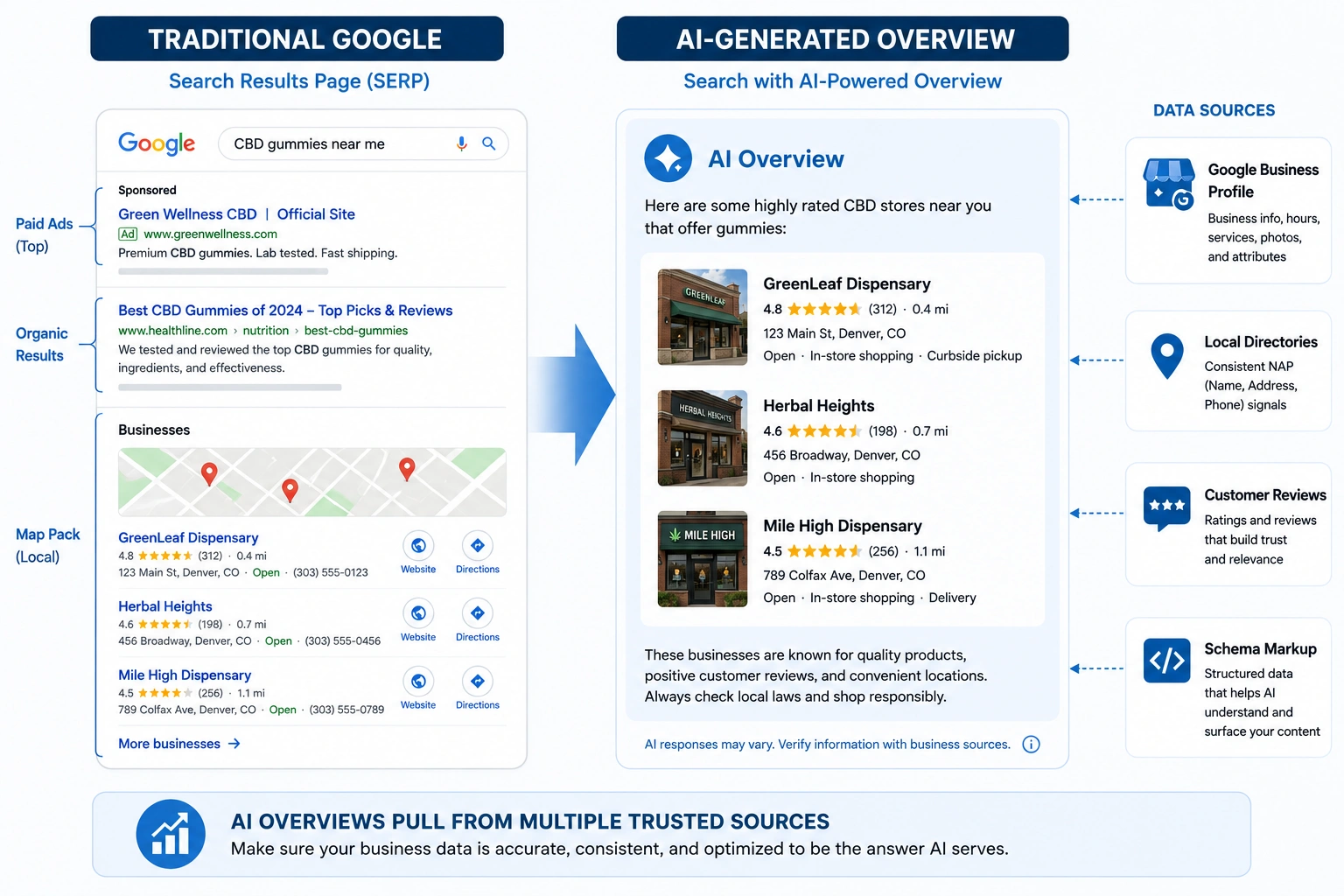
See how AI Overviews combine data from Google Business Profiles, reviews, local directories, and schema markup to answer searches.
Optimizing the Google Business Profile for maximum Map Pack weight
- Select the Correct Primary Category: Google Business Profile signals carry 32% of the total Map Pack ranking weight (BrightLocal, 2025), making category selection your primary gatekeeper. Ensure you select the most precise primary category, such as “Plumber” or “HVAC Contractor,” to align with Google’s relevance algorithm. For a step-by-step setup, see our guide on how to build a Google Business Profile.
- Drive Consistent Review Velocity: Feed the review signals that account for 20% of Google’s local ranking algorithm by requesting reviews immediately after job completion. Make the process effortless by texting a direct review link right after finishing a service call. Speed matters.
- Maximize User Engagement: Upload high-quality, non-stock jobsite photos (at least 20 to build immediate trust) and encourage direction requests. These behavioral signals represent 9% of ranking weight and prove to Google that your business is active in the real world.
- Keep Your Operating Hours Accurate: “Business is open” has recently risen to become a top-five ranking factor for real-time local searches. Update your hours during holidays and seasonal shifts to avoid missing out on peak emergency service calls.
Building a high-performance website as Google’s lie detector
- Optimize Your Mobile Page Speed: Ensure your site loads in under two seconds, preventing the high bounce rates that signal poor user experience to Google. Over 53% of mobile users will abandon a website that takes longer than three seconds to load, which directly suppresses your visibility. This is a core element of digital marketing for local consumer services.
- Create Dedicated Service Pages: Create dedicated service pages for every service you offer instead of grouping them onto a single page, allowing search engines to match your content to specific search queries. This gives search engines clean, clear relevance indicators for each specific query.
- Build Unique Location Pages: Build unique city landing pages for every city in your service area to rank outside your immediate physical location. Avoid boilerplate duplicate content; instead, feature local reviews, photos of local jobs, and mentions of local landmarks. Uniqueness wins.
- Implement LocalBusiness Schema Markup: Use Schema.org LocalBusiness JSON-LD markup to provide search engines with structured, easily extractable data about your address, phone number, and services. This LocalBusiness schema markup feeds AI Overviews and voice search results directly.
Don’t let your competitors capture the high-intent leads searching for your services right now.
Partner with BizIQ to build a high-performance website, optimize your local signals, and secure your place at the top of search and AI.
Explore Our Local SEO Marketing Services
Implementing the hub-and-spoke site farming model
To dominate AI search and traditional search simultaneously, advanced local marketers deploy a strategy known as site farming. This hub-and-spoke model uses your primary website as the central hub, connected directly to your Google Business Profile. You then build separate, highly focused spoke websites on independent domains that target your highest-margin services in specific neighborhoods or adjacent cities.
These spoke sites do not compete with your main website; instead, they use directional linking to point back to your hub, reinforcing your brand’s authority. AI models crawl these independent domains and recognize the consistent business name, address, and phone number (NAP) across all of them. This entity reinforcement builds high trust in the AI’s database, making your business far more likely to be recommended. It builds trust.
In fact, establishing active profiles and spoke sites across multiple platforms yields a 3x higher AI citation probability than relying on a single website alone. To stay ahead of these shifts, read our insights on adapting to AI search changes. This approach ensures your business remains the dominant answer as search engines evolve.
“Entity reinforcement is the new backlink. AI search engines do not just count links; they look for consistent, web-wide confirmation that your business is a legitimate, active authority in your local market.”
Using reviews as behavioral proof and AI trust signals
Customer reviews are no longer just testimonials for your website; they are essential inputs that feed search algorithms and AI recommendation engines. When a customer leaves a detailed review mentioning a specific service and location, such as emergency AC repair in Phoenix, they are providing Google and AI models with direct, keyword-rich proof of your relevance. Improving your average rating by just a fraction, such as moving from 3.5 to 3.7 stars, can increase your conversion rates by nearly 120%.
These review signals represent 20% of the local Map Pack ranking weight, making them the fastest-growing ranking factor (BrightLocal, 2025). Steady, fresh reviews that mention your specific services and locations provide search engines with real-time proof of your business’s relevance and activity. The businesses that treat review collection as a systematic post-job process see their visibility compound over time. Reviews drive growth.
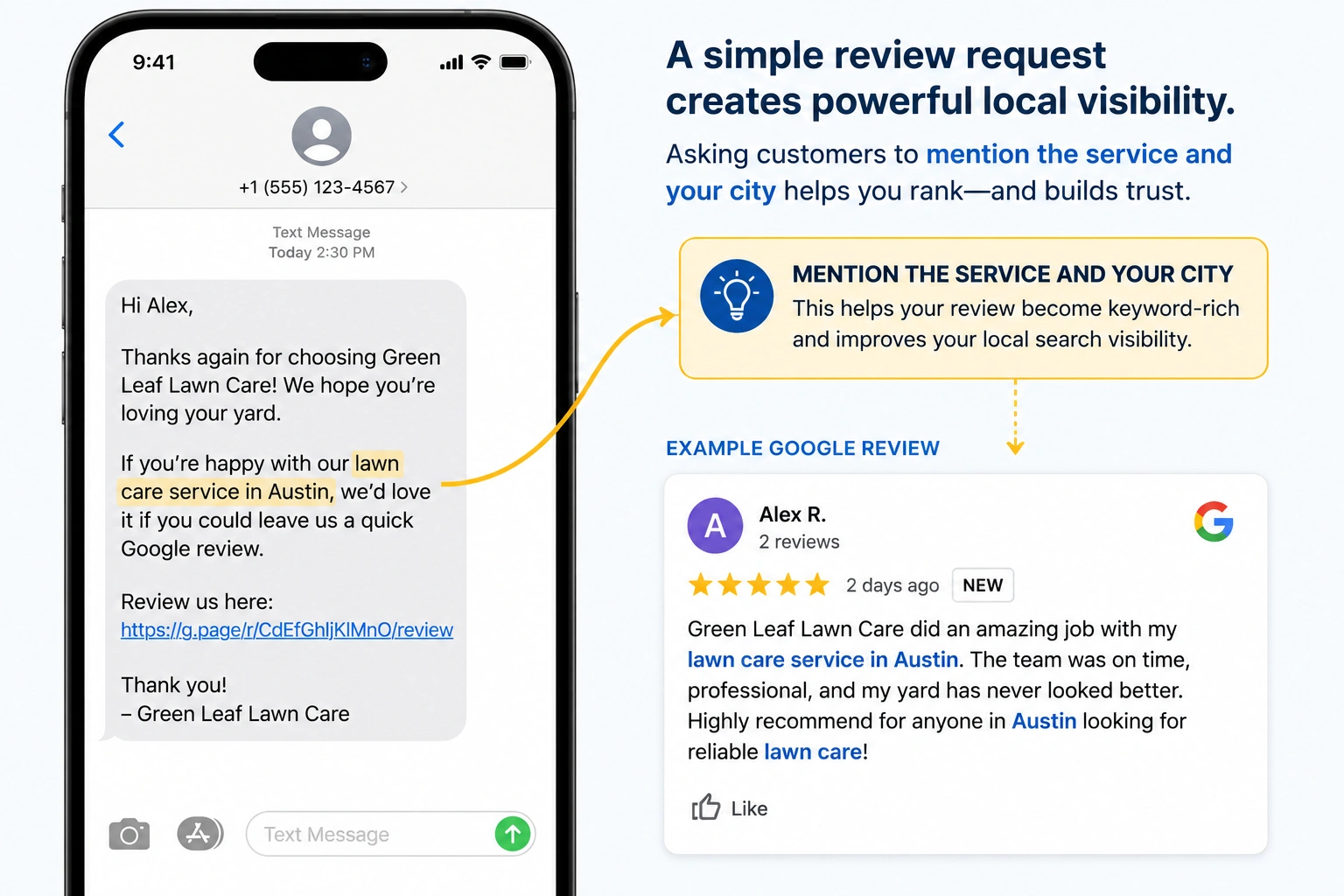
A simple SMS review request encourages customers to leave keyword-rich Google reviews that strengthen local SEO.
Stop chasing customers for reviews manually.
Use automated tools to request feedback immediately after invoicing, boosting your review velocity and feeding critical trust signals to Google and AI search engines.
Structuring content for Answer Engine Optimization
- Use an Answer-First Format: Place direct, clear answers to common customer questions at the very top of your pages to capture featured snippets and AI summaries. This answer-first format ensures search engines find your answers immediately instead of crawling through paragraphs of text.
- Incorporate Natural Language Questions: Use conversational, natural language questions as H2 or H3 headings to match the exact phrases users speak into voice assistants. For example, structuring a heading as “How much does a furnace tune-up cost in Denver?” targets high-intent local queries perfectly.
- Include Localized Pricing Guides: Provide transparent, localized pricing ranges and service expectations to capture high-intent buyers who are ready to make a decision. Transparent pricing builds immediate trust and keeps users on your page longer. Trust is everything.
- Avoid Duplicate Content Templates: Ensure every location page features unique content, local landmarks, and specific neighborhood challenges to avoid search engine filters. Utilizing generic, copy-paste duplicate content templates will directly hinder your rankings across adjacent service areas.
Avoiding the common pitfalls that stall local SEO momentum
The biggest mistake local service businesses make is treating SEO as a short-term campaign rather than long-term infrastructure. Because local search authority compounds over time, switching agencies or resetting your strategy every few months severely disrupts your momentum. Patience pays off. Industry data from First Page Sage (2026) shows that local SEO campaigns deliver a 700% average ROI for service-based businesses within 6 to 12 months.
Those who commit to a consistent, long-term plan face very little competition at the top, as 88% of local businesses have no active strategy to appear in AI search results. To understand what to prioritize, review the local SEO ranking factors that drive long-term success. Consistent execution is the absolute key to building a barrier that competitors cannot easily cross, which requires implementing proven local SEO strategies for service-based businesses.
Answers to common local SEO and AI search questions
Understanding how search engines and AI models evaluate your business is the first step toward building a dominant online presence. Clear data wins. Evaluating your digital performance helps identify gaps in your local visibility.
Frequently asked questions
What is the difference between traditional local SEO and Answer Engine Optimization (AEO)? Traditional local SEO focuses on ranking your website in Google’s organic search results and the Map Pack using backlinks, keywords, and technical optimization. Answer Engine Optimization (AEO) focuses on structuring your content and reinforcing your business entity across the web so that AI models like ChatGPT, Claude, and Google AI Overviews confidently recommend your business in direct, conversational answers. This represents a shift from optimizing for search engines to optimizing for direct recommendation engines.
How long does it take to see real results from a local SEO campaign? Local SEO is a cumulative approach that operates on momentum rather than instant results. During months one to three, you will typically see technical cleanup and stabilized Map Pack positions. Between months four and twelve, your authority compounds, making your rankings highly durable and difficult for competitors to displace.
Why is my business not showing up in Google AI Overviews or ChatGPT recommendations? If AI engines are ignoring your business, it is usually due to a lack of entity reinforcement or inconsistent business data. If your name, address, or phone number varies across directories, AI models cannot verify your business with confidence. Additionally, having no active profiles on major review platforms reduces your AI citation probability by 3x.
Does website loading speed affect my local search rankings? Yes, website speed is a critical ranking and conversion factor. Over 53% of mobile users will abandon a website that takes longer than three seconds to load, and a mere one-second delay can reduce your overall conversions by 20%. Google tracks these user bounces as negative behavioral signals, which will quickly drag down your Map Pack and organic rankings.
How do customer reviews influence my visibility in the Google Map Pack? Reviews are both trust signals and ranking signals, accounting for roughly 20% of the Map Pack ranking weight. Google and AI models analyze review recency, volume, and sentiment, as well as specific keywords within the reviews. Steady, fresh reviews that mention your specific services and locations provide search engines with real-time proof of your business’s relevance and activity.
Building a dominant local search presence is not about finding a temporary loophole or tricking the algorithm. It is about creating a clean, high-performance digital foundation that makes it incredibly easy for both Google and AI search engines to verify your business as the premier authority in your market, and then maintaining that foundation consistently enough that your authority compounds while your competitors’ stagnates. By aligning your Google Business Profile, optimizing your website speed, and deploying a consistent review strategy, you turn search visibility into a predictable, cumulative source of high-value phone calls and booked jobs.
Small business is the backbone of innovation and the heartbeat of America; we are proud to stand beside you to make sophisticated marketing belong to you too, and we are here to help you claim it. As a small business ourselves, we share the same goals and aspirations as the clients we serve. We win together. Our passion, drive, and satisfaction come from positive impacts we make on our partners.
Ready to take your local visibility to the next level?
Don’t let your competitors capture the high-intent leads searching for your services right now. Partner with BizIQ to build a high-performance website, optimize your local signals, and secure your place at the top of search and AI.
Written by the BizIQ Editorial Team. As a small business ourselves, we share the same goals and aspirations as the clients we serve. We specialize in helping home and consumer service businesses build cumulative local search visibility and drive high-intent phone calls.