Written by the BizIQ Franchise SEO Expert Team. We share your challenges because we’re a small business too, and we understand the unique hurdle of scaling local search visibility. We help multi-location brands build authority, drive foot traffic, and turn searchers into loyal customers.
- Centralized Brand Authority: Learn how to use your main domain’s strength without sacrificing individual local relevance.
- The Sibling Suppression Crisis: Understand why Google often indexes only one location and suppresses the rest, and how to fix it.
- The 16% Review Factor: Discover why local reviews are your most powerful ranking signal after Google Business Profile optimization.
- AI Search Readiness: Prepare your franchise for Generative Engine Optimization (GEO) as AI Overviews reshape local discovery.
What is the Most Critical Technical Step for a Franchise to Rank All of its Individual Branches in Local Search?
The most critical step is to create distinct Google Business Profiles (GBPs) and unique landing pages for every single location to avoid duplicate content penalties. Franchise SEO works when each location earns its own local relevance signals while sharing one strong brand foundation. If you manage a multi-location brand, you have likely felt the deep frustration of watching local customers find your competitor instead of your nearby branch, especially when you know your business is right there, ready to serve them. It is incredibly common for a franchise system with ten, fifty, or hundreds of units to find that only one or two locations surface in local search results, while the rest remain virtually invisible to searchers in their respective markets.
This visibility gap is not a failure of your local managers; it is a structural search engine optimization challenge. It is a structural issue. Google’s algorithms are designed to prevent SERP clutter, which means they often struggle to tell apart multiple branches of the same brand operating in adjacent territories. Winning in local search requires treating SEO not as a series of isolated campaigns, but as a scalable digital infrastructure: something you architect once and extend deliberately. By understanding the key SEO benefits for franchises, you can build a system that supports individual franchisees while maintaining strict corporate brand consistency. We see this connection clearly because small businesses drive the larger narrative of our economy: they are the backbone of innovation and the heartbeat of America.
Why franchise sites struggle with the sibling suppression crisis
The root of most franchise SEO problems is how search engines process near-identical content spread across multiple pages. When dozens of locations share templated service descriptions, Google treats your franchise as a single entity: it selects one location to surface and demotes the rest, essentially picking a single representative for the whole family. This is sibling cannibalization. Because domain authority is centralized, the algorithm concludes that returning multiple pages from the same brand for a single local query would hurt the user experience. The result: your corporate headquarters or oldest location ranks, and newer branches go dark. Local customers miss out.
Each location must carve out its own distinct digital footprint to escape this trap. That means abandoning generic, copy-paste page templates in favor of hyper-local landing pages built around unique, location-specific content: local staff photos, community-specific testimonials, and neighborhood service area descriptions that a visitor from that zip code would recognize. Local SERPs are increasingly rewarding hyper-local relevance over raw domain authority; a page that mentions the Riverside District by name will outperform one that says “serving the greater metro area.” If your franchise location pages are carbon copies of each other, search engines will filter them, and Google often indexes one location and suppresses the rest. Applying what works for franchise SEO at the page level: unique geographic signals, locally sourced copy, and location-specific schema, forces Google to treat each branch as a distinct, rankable entity.
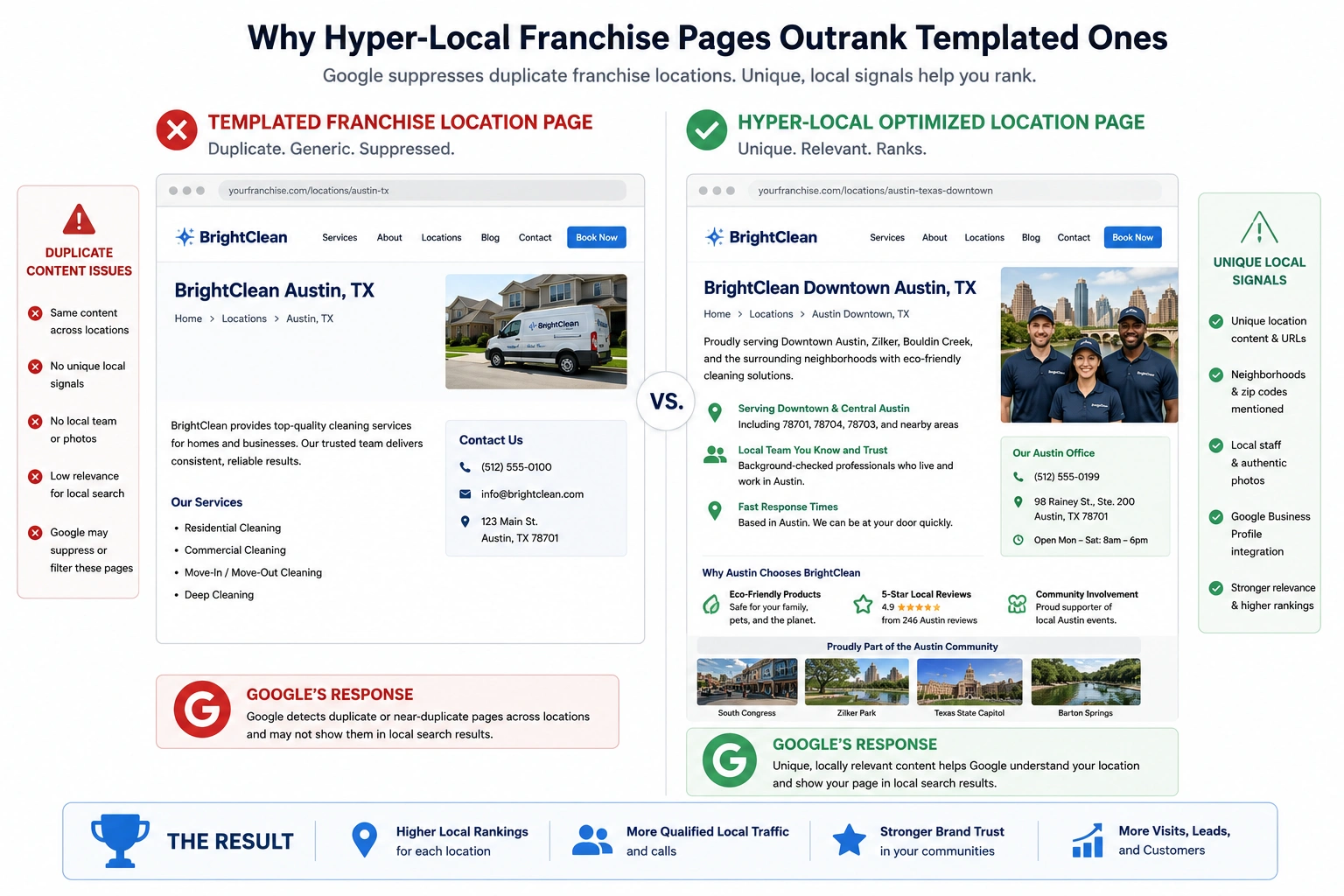
See how hyper-local franchise location pages outperform duplicate templates by providing unique local SEO signals.
The core building blocks every location needs to be visible
- Unique Location Landing Pages: Every branch must have its own dedicated URL (e.g.,
domain.com/locations/city-name) containing unique, location-specific content, local staff bios, and neighborhood-specific service descriptions to prevent sibling cannibalization. - Google Business Profile for every location: Each location must claim, verify, and actively manage its own profile, ensuring that categories, attributes, and business descriptions are tailored to that specific market, not copied from the corporate template.
- NAP consistency across directories: Your business Name, Address, and Phone number must appear identically everywhere online. Think of it as your business’s fingerprint: even a minor variation in street abbreviation is read by crawlers as a different entity entirely.
- Hyper-Local Citations and Local Links: Build local authority by earning mentions and backlinks from neighborhood chambers of commerce, regional blogs, and local directories, not just national aggregators like Yelp or Apple Maps, which every competitor already has.
Mastering the Google Maps three-pack with the power of reviews
Reviews from local customers account for roughly 16% of local pack ranking signals: second only to Google Business Profile optimization itself. That number is easy to underestimate until you watch a competitor with a thinned service offering outrank you purely on review volume and recency. The mechanics matter as much as the volume. Reviews drive visibility.
- Automate the Review Invitation Process: Integrate review requests directly into your POS or CRM systems so the ask goes out immediately after a transaction, when the experience is freshest and the customer is most likely to respond.
- Train Staff to Request Keyword-Rich Feedback: Prompt customers to reference specific services in their reviews (e.g., “best AC repair in Phoenix”) rather than generic praise. Those contextual keywords feed search engines the signals they’re actively parsing.
- Respond to Every Review Promptly: Write unique, meaningful responses to both positive and negative reviews. Boilerplate responses are detectable: by customers and, increasingly, by ranking algorithms that weight engagement quality.
- Monitor Review Velocity and Diversity: A sudden spike followed by silence reads as manipulation. Maintain a steady cadence across Google, Facebook, and industry-specific directories to signal authentic, ongoing customer engagement.
Is Your Franchise Invisible in Local Search?
Don’t let Google suppress your local branches. Get a detailed, data-driven analysis of your brand’s digital footprint across all markets.
Claim Your Free Location-Visibility Audit Today
How generative engine optimization is reshaping local discovery
The numbers here are genuinely disorienting. AI Overviews now appear in 68% of local business searches overall, and in 97% of hybrid-intent local queries, the kind where a user’s search blends informational and transactional intent in a single phrase. When someone searches “best plumbing franchise near me,” Google’s AI compiles a combined answer from multiple sources and delivers it directly on the results page, often before a single organic listing is visible. For franchises operating on traditional keyword rankings, this shift is compressing organic click-through rates by 58% to 61%. That is not a rounding error. It is a structural redistribution of search traffic that no amount of conventional optimization can reverse.
Adapting to Generative Engine Optimization means restructuring your content to function as a machine-readable answer, not just a keyword-optimized page. AI models parse structured data, authoritative local citations, and natural language patterns to formulate their recommendations: they are not reading your page the way a human does. A location page that lists services in bullet form without contextual explanation will lose to a competitor whose page anticipates and directly answers the questions a local customer would ask. By focusing on local visibility for franchise stores, you can restructure your site’s content to feed these AI models the precise, localized entity data they need to surface your branches in generated answers.
“With AI Overviews dominating over 90% of informational and hybrid local searches, franchises can no longer rely solely on traditional keyword rankings. If your business isn’t structured to feed AI engines clear, localized entities, your locations simply won’t exist in the future of search.” : BizIQ Local Search Research Team
Implementing LocalBusiness schema to prevent data drift
Data drift is one of the quieter SEO challenges in franchising: and one of the most damaging. It happens when search engines encounter conflicting information about your locations across different platforms: one directory lists a suite number, another doesn’t; one page says “open until 8pm,” another says “open until 9pm.” Each discrepancy chips away at Google’s confidence in your data, and that eroded trust translates directly into suppressed rankings. The fix is LocalBusiness JSON-LD schema implemented on every location page, not as an afterthought, but as a foundational layer of your site architecture. This structured markup acts as a direct, machine-readable declaration of who you are, what you offer, and precisely where you operate. Specific schema properties like areaServed, geo coordinates, and openingHoursSpecification do more than fill in details; they draw explicit geographic boundaries around each branch, eliminating the ambiguity that causes internal competition between nearby locations. When Google can read those boundaries with confidence, it stops guessing. Trust is everything. It starts ranking.
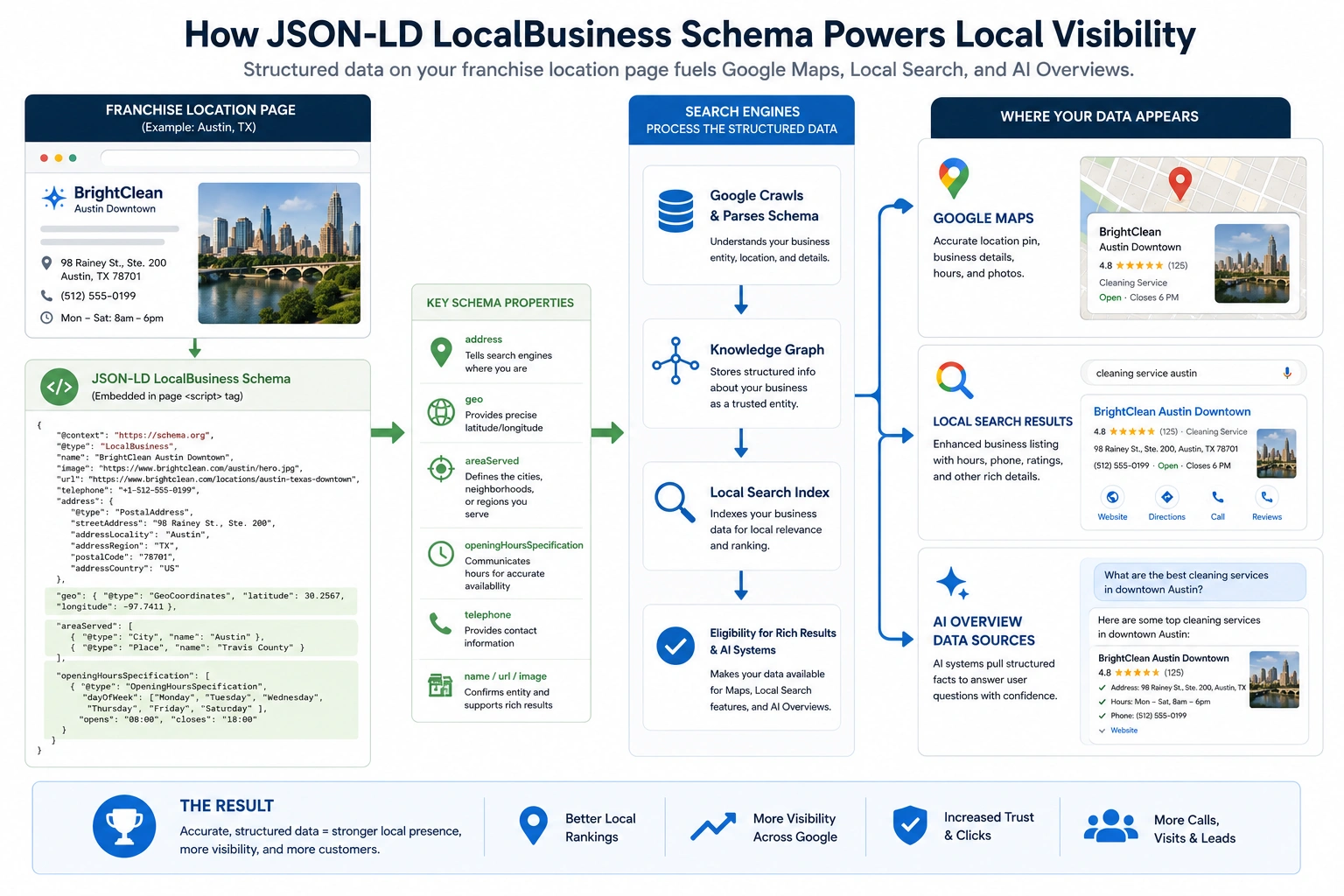
Learn how LocalBusiness schema markup helps Google understand franchise location data for Maps, local search, and AI results.
Scale Your Franchise SEO Without the Stress
Managing SEO for dozens or hundreds of locations is a significant operational undertaking. Let our team of local search experts handle the heavy lifting. Explore Our Franchise SEO Services
A realistic timeline for franchise SEO success
- Months 1 to 3 (The Foundation): Focus on technical audits, resolving duplicate content conflicts, claiming and verifying all Google Business Profiles, and standardizing NAP data across major directories. Nothing else compounds until this layer is clean.
- Months 3 to 6 (Local Optimization): Launch unique franchise location pages, implement structured
LocalBusinessschema across all active branches, and establish automated review acquisition systems integrated with your existing POS or CRM. - Months 6 to 12 (Authority Building): Execute hyper-local link-building campaigns, optimize location page content for AI Overviews using question-and-answer formatting, and refine landing pages based on behavioral and conversion data from real users.
- Months 12 and Beyond (Scaling & Dominance): Use earned authority through demonstrated results to launch new locations with immediate search traction. Campaigns at this stage regularly deliver an 8 to 12x ROI, lowering customer acquisition costs well below what paid advertising can sustain over the same period.
Balancing corporate governance with franchisee autonomy
The governance conflict is real, and it rarely gets resolved cleanly. Efforts to scale franchise marketing and SEO consistently run into the same friction point: corporate teams want airtight control over brand presentation and technical infrastructure, while franchisees want the operational flexibility to post their own hours, respond to local reviews, and run neighborhood promotions without filing a ticket. Both instincts are reasonable. The problem is that most franchise systems default to one extreme: either locking franchisees out entirely (killing local signal generation) or granting unrestricted access (introducing data drift and off-brand content). A hybrid governance model threads this needle. Corporate owns the website architecture, schema implementation, domain authority strategy, and any element that affects the technical integrity of the whole system. Franchisees get a controlled portal to manage their own Google Business Profile, respond to reviews from local customers, and contribute hyper-local content: photos, community updates, location-specific service notes: directly to their dedicated landing pages. The division isn’t about trust; it’s about matching the right level of expertise to the right layer of the system.
How to conduct a quick franchise local SEO audit
Before committing resources to complex campaigns, you need an honest starting point. A practical local SEO audit for franchise chains covers three areas: indexation, consistency, and visibility. Start with indexation: search your brand name alongside various city locations and observe whether Google surfaces the correct local landing pages or defaults to your homepage. That single test reveals whether your location architecture is registering at all. Check this first. Consistency comes next: run a citation scanner against major directories like Yelp, Apple Maps, and Bing to surface NAP discrepancies. Even minor variations, like “St.” versus “Street” or a missing suite number, can fragment your local authority across platforms. Finally, dig into your Google Business Profile insights and compare direct search volume against discovery search volume for each location. A location generating almost no discovery traffic is effectively invisible to customers who don’t already know you exist. These three data points won’t give you a complete picture, but they will tell you exactly where to start.
Frequently asked questions about franchise SEO
How much does franchise SEO typically cost?
Franchise SEO pricing varies considerably based on location count and market competitiveness. Most campaigns are structured with a centralized corporate strategy fee layered over a per-location optimization fee. The upfront investment is real, but established franchise campaigns regularly deliver an 8 to 12x ROI over 18+ months, which meaningfully undercuts the per-acquisition cost of sustained paid advertising once the organic foundation is built.
How long does it take to see visibility improvements for new locations?
Newly launched locations typically need 3 to 6 months to establish solid local search visibility. That timeline is driven by how quickly you can claim and verify your Google Business Profile, deploy structured schema, and publish a unique location page. Existing locations with established profiles often move faster, sometimes within 30 to 90 days, once duplicate content conflicts and NAP inconsistencies are cleared.
Who should be responsible for SEO: corporate or the individual franchisee?
Shared responsibility, with clear division. Corporate handles the technical foundation: website architecture, domain authority, structured data. Franchisees own the local signals that require ground-level knowledge: gathering reviews, updating hours, contributing photos and community-specific content. Conflating these two layers is where most franchise SEO programs break down.
How do we prevent our franchise locations from competing with each other in search?
Sibling cannibalization is solved through differentiation at the content and schema level. Each location page needs to be optimized for its specific neighborhood, local landmarks, and zip codes, not just the city name. Using the areaServed schema property to define explicit geographic boundaries for each branch tells Google which location owns which territory, eliminating the ambiguity that triggers internal competition.
Do we need separate websites for each franchise location?
No. Separate websites or subdomains actively work against you. Splitting your brand across multiple domains dilutes domain authority and turns technical SEO management into an operational nightmare at scale. A centralized subfolder architecture (brand.com/locations/city-name) keeps all location pages drawing from the same domain authority pool, which is precisely what makes competitive local visibility achievable for newer branches.
Getting every franchise location visible in local search is a compounding problem: it requires resolving duplicate content conflicts, building out hyper-local landing pages, maintaining clean schema across every branch, and generating a steady stream of authentic local reviews: simultaneously, at scale. None of those pieces work in isolation. Partnering with a specialized franchise SEO agency gives your brand the technical infrastructure and operational discipline to execute all of them without pulling your internal teams in ten directions at once. The visibility your locations are missing right now is recoverable. It just requires building the right foundation first.
Get Your Free Location-Visibility Check
Are search engines hiding your franchise locations? Let our team of local SEO experts run a thorough diagnostic check on your brand’s search visibility. We’ll identify duplicate content conflicts, NAP inconsistencies, and missed local visibility opportunities. Claim Your Free Visibility Check Today