Key Takeaways:
- Organic search carries the load. Strict paid ad bans across Google, Meta, and TikTok mean organic search is the only reliable, scalable path to customer acquisition for CBD and hemp brands.
- E-commerce and physical storefronts require fundamentally different approaches. National brands must build deep topical authority, while physical storefronts live or die by Google Business Profile optimization and NAP consistency.
- Topical authority and FDA compliance are not in conflict: they just require deliberate architecture. Educational content built around the hub-and-spoke model can rank for high-intent queries without triggering regulatory penalties.
- Product pages, compliant language, and local citations each carry their own checklist. Each of these areas requires a distinct optimization framework.
With Constantly Changing Rules and Heavy Restrictions on Digital Ads, how can a CBD or Hemp Brand Successfully Get Found Online by New Customers?
Because most mainstream digital advertising channels remain entirely blocked to CBD and hemp brands, organic search is the single most reliable path to sustainable growth. Consumers actively search Google and AI engines for relief and wellness solutions, meaning you must position your site to answer those exact queries. Google and Meta do offer a topical CBD exception: creams, lotions, and cosmetics. However, these exceptions require expensive, multi-step LegitScript certification and are restricted to select states. For ingestible CBD, supplements, and vapes, paid ads are entirely off the table. To cut through the regulatory murk, maximize your online visibility, and have your CBD brand survive and scale, mastering search engine optimization is not a strategic option: it is your operating condition.
Navigating the search landscape for hemp-derived products demands fluency in two distinct disciplines simultaneously: search engine algorithms and federal regulatory compliance. Unlike traditional e-commerce niches, CBD falls under Google’s “Your Money or Your Life” (YMYL) classification, which means search engines hold your content to the highest standards of accuracy, safety, and trustworthiness. To rank, you must demonstrate genuine Experience, Expertise, Authoritativeness, and Trustworthiness (E-E-A-T) while adhering to compliance standards set by the FDA and the FTC. These aren’t parallel tracks: they are the exact same track. Compliance is search performance.
The Reality of CBD Advertising Restrictions and the Power of Organic Search
CBD ads are still mostly banned. That’s not hyperbole; it’s the operational reality that shapes every marketing decision a hemp brand makes in 2026.
Google’s ad policies prohibit advertising for ingestible CBD products entirely, grouping hemp among several other industries that can’t run Google Ads. Topical CBD has one narrow exception: ads are permitted only in California, Colorado, and Puerto Rico, and only after advertisers complete LegitScript certification. That certification carries real cost: a single CBD product certification runs $1,650 in the first year ($650 application fee plus $1,000 annual monitoring), while a full website certification climbs to $2,400 ($800 application fee plus $1,600 annual monitoring fee). Meta follows a similar structure, permitting certified topical hemp-derived ads nationwide but prohibiting all targeting of users under 18 and requiring prior written platform authorization. TikTok maintains a blanket ban on all CBD promotions, regardless of application or source.
What this means practically: organic search carries the load for your digital marketing funnel. There’s no paid channel to supplement it, no retargeting campaign to recover abandoned carts, and no awareness layer to prime cold audiences. Every qualified buyer you reach through search found you because your content earned that position. They chose to click.
The ROI case for organic investment is persuasive on its own merits. Organic SEO leads close at a 14.6% rate, compared to just 1.7% for paid or outbound leads (HubSpot, 2025). That gap exists because organic visitors arrive with pre-formed intent: they searched for something specific, found your content, and decided it was worth their attention. A SurferSEO case study from 2024 documented a CBD e-commerce store that achieved a 557% increase in organic traffic over 18 months through deep content expansion and technical SEO, translating directly into a 340% year-over-year sales increase. Those numbers aren’t typical, but they illustrate what’s possible when organic search is treated as infrastructure rather than a secondary channel.
Organic search drives over 60% of all traffic to successful CBD e-commerce sites, and unlike paid campaigns, that traffic doesn’t evaporate the moment a budget runs dry. By investing in a strong organic strategy, you build a permanent digital asset, one that compounds in value month after month without the constant threat of ad account suspension.
Shifting from paid campaigns to long-term organic authority requires a different mental model. Think of your website’s reputation the way you’d think of a local business’s standing in a community: other reputable businesses vouching for you carries far more weight than shouting the loudest. In the CBD space, that means earning high-quality backlinks from authoritative health, wellness, and industry publications, signals that tell Google your site is a safe, reliable source of information. The top challenges in SEO for the CBD industry are well-documented, and link acquisition is consistently near the top of that list, precisely because the regulatory environment makes many publishers cautious about associating with hemp brands.
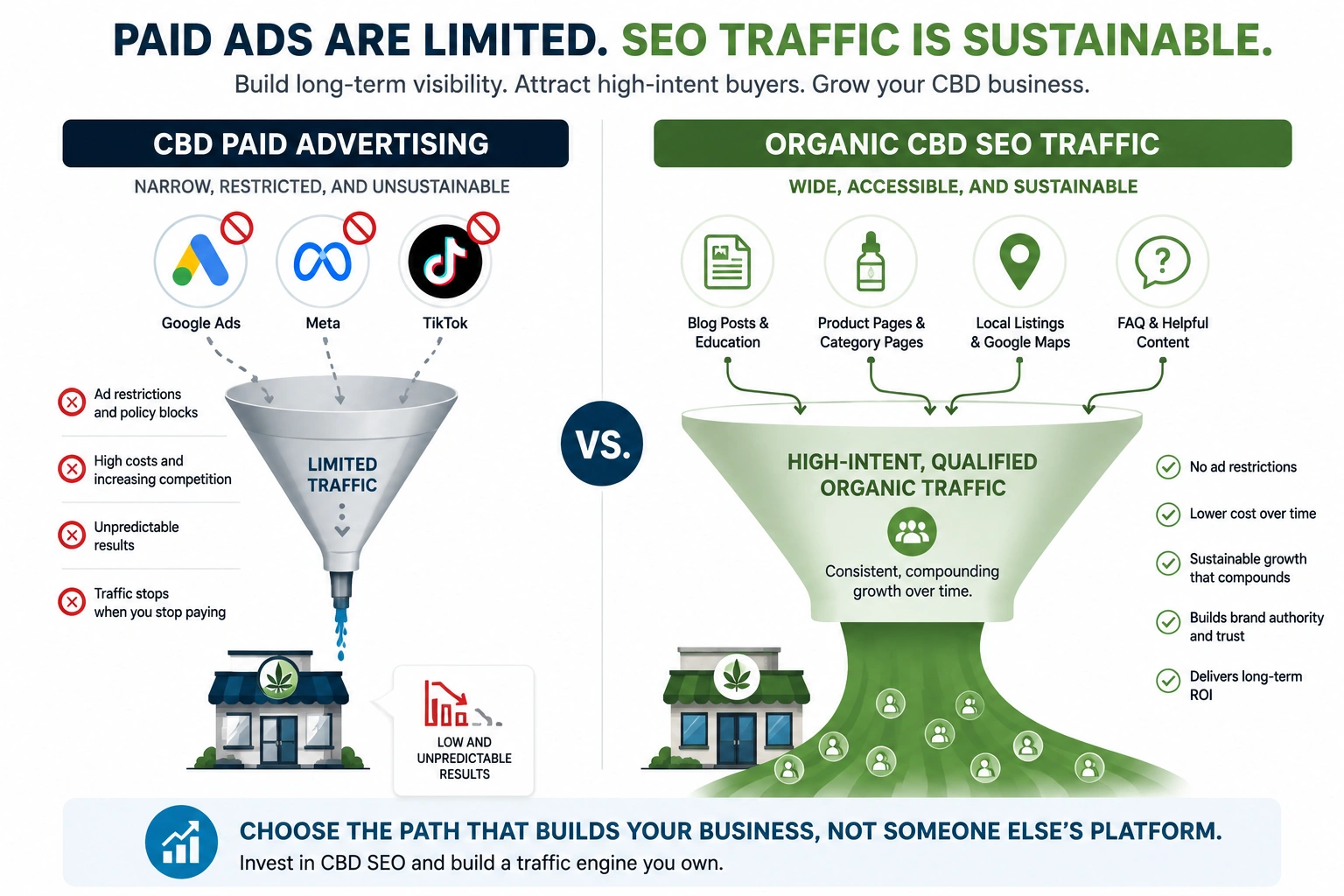
Compare the limited reach of CBD paid advertising with the long-term, sustainable traffic generated through organic SEO.
E-Commerce versus Local Storefront SEO Realities
These are two genuinely different problems. Mixing them leads to wasted effort on both fronts.
A physical CBD boutique and a national e-commerce brand share a primary keyword universe but almost nothing else about their search strategy. Local storefronts live or die by geographic proximity signals: which means Google Business Profile optimization is not optional, it’s foundational. Your Name, Address, and Phone number must be identical across every directory where your business appears: Yelp, Bing Places, Apple Maps, Weedmaps, Leafly, and your website footer. Imagine your business has three different phone numbers listed around town; customers get confused, and so does Google. That inconsistency erodes the local trust signals that determine whether you appear in the map pack for “CBD store near me.”
National e-commerce brands face a different constraint. Competition is fierce. Competing for “CBD gummies” or “CBD oil” at a national level means going head-to-head with brands that have spent years accumulating domain authority and thousands of backlinks. The more productive path is targeting specific-use queries like “CBD cream for arthritis” or “full-spectrum CBD topical cream for athletes” in the 100 to 1,000 monthly search range. These queries attract buyers who are further along in the decision process, which means conversion rates are higher even when raw traffic volume is lower.
The compliance dimension cuts across both segments. According to FDA and Vicente LLP data from 2023, 97% of CBD marketing violations are found on company websites, with 56% of cited violations occurring on social media platforms. Every web property, whether it is a local listing, a product page, or a blog post, is a potential enforcement surface. Accuracy isn’t just good SEO practice; it’s regulatory hygiene. For a deeper look at how these dynamics interact, the SEO and the CBD industry landscape requires brands to treat every published claim as a compliance decision, not just a marketing one.
Key Actions for Local and National CBD SEO:
- Google Business Profile Optimization: Claim and optimize your local listing under the “CBD store” or “Herbal Medicine Store” category. Your NAP details must match your website footer character-for-character: no abbreviations, no formatting variations.
- Local Citation Building: Submit your business to reputable local and industry-specific directories including Weedmaps, Leafly, and local chambers of commerce. Each consistent citation strengthens your local search equity.
- National Keyword Targeting: E-commerce brands should build content around specific-use queries like “CBD cream for arthritis” rather than high-competition head terms. Qualified buyers, not raw traffic volume, is the metric that matters.
- Geographic Landing Pages: Create dedicated, compliant landing pages for each physical storefront location, incorporating local schema markup and neighborhood-specific language that reflects how nearby customers actually search.
Building Topical Authority Without Triggering Regulatory Penalties
Topical authority, in the context of CBD SEO, means search engines recognize your site as the most thorough and credible source of answers within a defined subject area. It requires depth. It’s earned incrementally, through a body of content that covers a topic from multiple angles, not through a single well-optimized page.
The structural approach that works best here is hub-and-spoke architecture. A centralized pillar page covers the broad topic (say, “CBD for joint comfort and mobility”) at depth, while a constellation of spoke articles targets the specific questions that branch from it: “how to apply CBD topical cream,” “what is the endocannabinoid system,” and “full-spectrum vs. broad-spectrum CBD for athletes.” Each spoke article links back to the pillar, concentrating authority and signaling to Google that your site has genuine depth on the subject, rather than just a collection of loosely related posts.
Because CBD is a YMYL category, Google’s quality raters examine the editorial process behind the content, not just the content itself. “Medically Reviewed By” signatures from qualified professionals, such as physicians, pharmacists, or registered dietitians, are not cosmetic additions. They’re a functional component of your E-E-A-T signal. Without them, even technically accurate content can underperform against competitors who have formalized their review workflow. Every product page and informational guide should also carry a prominent FDA disclaimer and a direct link to the third-party Certificate of Analysis (COA) for the relevant batch. These aren’t just compliance checkboxes; they’re trust signals that both users and crawlers register.
The SurferSEO 2024 CBD SEO case study demonstrated what this architecture produces at scale: 557% organic traffic growth over 18 months, driven by systematic content expansion paired with technical SEO. The 5 must-do SEO tips for an online CBD business consistently point to this same combination: content depth and technical rigor working together, not independently.
Best Practices for Building Topical Authority:
- Focus on Educational Content: Write detailed guides explaining how cannabinoids interact with the endocannabinoid system, citing peer-reviewed studies. This satisfies both user intent and Google’s E-E-A-T requirements without requiring any therapeutic claims.
- Avoid Disease and Cure Claims: Never state that your CBD products can treat, cure, or prevent specific medical conditions. This includes arthritis, anxiety, cancer, insomnia, or any other diagnosable condition, regardless of how the claim is phrased.
- Use Structure and Schema: Implement Article and Product schema markup so search engine crawlers can accurately interpret the context, safety, and relevance of your content. FAQ schema is particularly valuable for capturing “People Also Ask” placements.
- Publish Third-Party Lab Reports: Make Certificate of Analysis documents directly accessible on every product page. A buried or missing COA is a trust gap that both users and algorithms notice.
Struggling to navigate the complex world of CBD SEO? We can help you build a compliant, high-performing organic strategy tailored to your brand. Learn more about our CBD SEO services and schedule a free strategy session with us today to audit your search visibility and find your next step.
Navigating FDA Compliance and Safe Language in Content Writing
The FDA’s position on CBD is clear, even if the broader regulatory framework feels perpetually unresolved. Under section 201(ff)(3)(B)(ii) of the FD&C Act, CBD is excluded from the dietary supplement definition. When a brand makes disease claims, stating or implying that a product treats, cures, or prevents a specific medical condition, the FDA reclassifies that product as an unapproved new drug under section 201(g)(1). That reclassification triggers enforcement action. The FDA’s official regulatory guidance makes this framework explicit, and the agency’s enforcement record confirms it takes the position seriously.
The FDA actively monitors the CBD market and issues warning letters with regularity. They do not hesitate. In 2022, the agency issued a warning letter to CBD Social for claims that their products could address chronic pain, anxiety, and sleep disorders. That case is instructive not because the brand was reckless, but because the violations were the kind of language that appears routinely in CBD marketing: specific condition references framed as benefits. To protect your website from both search engine demotions and legal exposure, your content must use non-therapeutic language that centers on general wellness rather than disease treatment. This applies equally to your blog posts, product descriptions, social captions, and, critically, any customer reviews you publish. Sound digital marketing for small business practice in regulated industries starts with understanding where the enforcement lines actually sit, not where you assume they sit.
Instead of writing “CBD cream cures arthritis pain,” the compliant and equally effective framing is “CBD cream for joint comfort and daily wellness.” That shift satisfies the user’s search intent: they searched for “CBD cream for arthritis,” they found content that speaks directly to joint discomfort, while remaining fully within FTC and FDA guidelines. Educational, user-focused content built around specific-use queries like “CBD cream for arthritis” can rank competitively and drive high-intent traffic without ever making a prohibited claim. The key is separating the search query (what the user typed) from the claim (what you assert about your product). You can address the former without making the latter.
“The FDA continues to advise the public that CBD products are not approved as dietary supplements or food additives. Marketing CBD with therapeutic claims without FDA approval violates the Federal Food, Drug, and Cosmetic Act.”
—U.S. Food and Drug Administration Compliance Guidelines
Product Page Optimization and Compliant Language Checklists
Your product pages are the most critical conversion points on your website, and they are also the most heavily inspected surfaces: by search crawlers, by payment processors, and by federal regulators simultaneously. Optimizing them requires holding three distinct requirements in tension: SEO performance, transactional stability, and regulatory compliance. None of these can be treated as secondary.
On Shopify specifically, the baseline requirements before you list a single product are non-negotiable. Shopify Payments must be deactivated: using it for CBD transactions results in immediate account suspension. Do not risk it. You must complete Shopify’s mandatory Hemp Attestation and integrate a verified third-party high-risk payment gateway. Compatible processors include DigiPay, Bankful, PaymentCloud, and PayKings. Shopify’s payment compliance documentation outlines the specific steps, and skipping any of them creates account vulnerability regardless of how well your SEO is performing.
From a search visibility standpoint, structured JSON-LD schema markup on product pages is one of the highest-leverage technical investments you can make. Properly implemented Product schema, covering name, description, image, SKU, brand, GTIN, offers, and aggregateRating, enables rich snippets in search results, which meaningfully increases click-through rates from the SERP. For brands building toward an enterprise SEO strategy, this kind of structured data implementation at scale is what separates sites that occupy one result from those that dominate an entire SERP layout. An age-gate is also required, and your metadata, including titles under 60 characters and descriptions under 160, must use specific-use keywords without crossing into therapeutic claim territory.
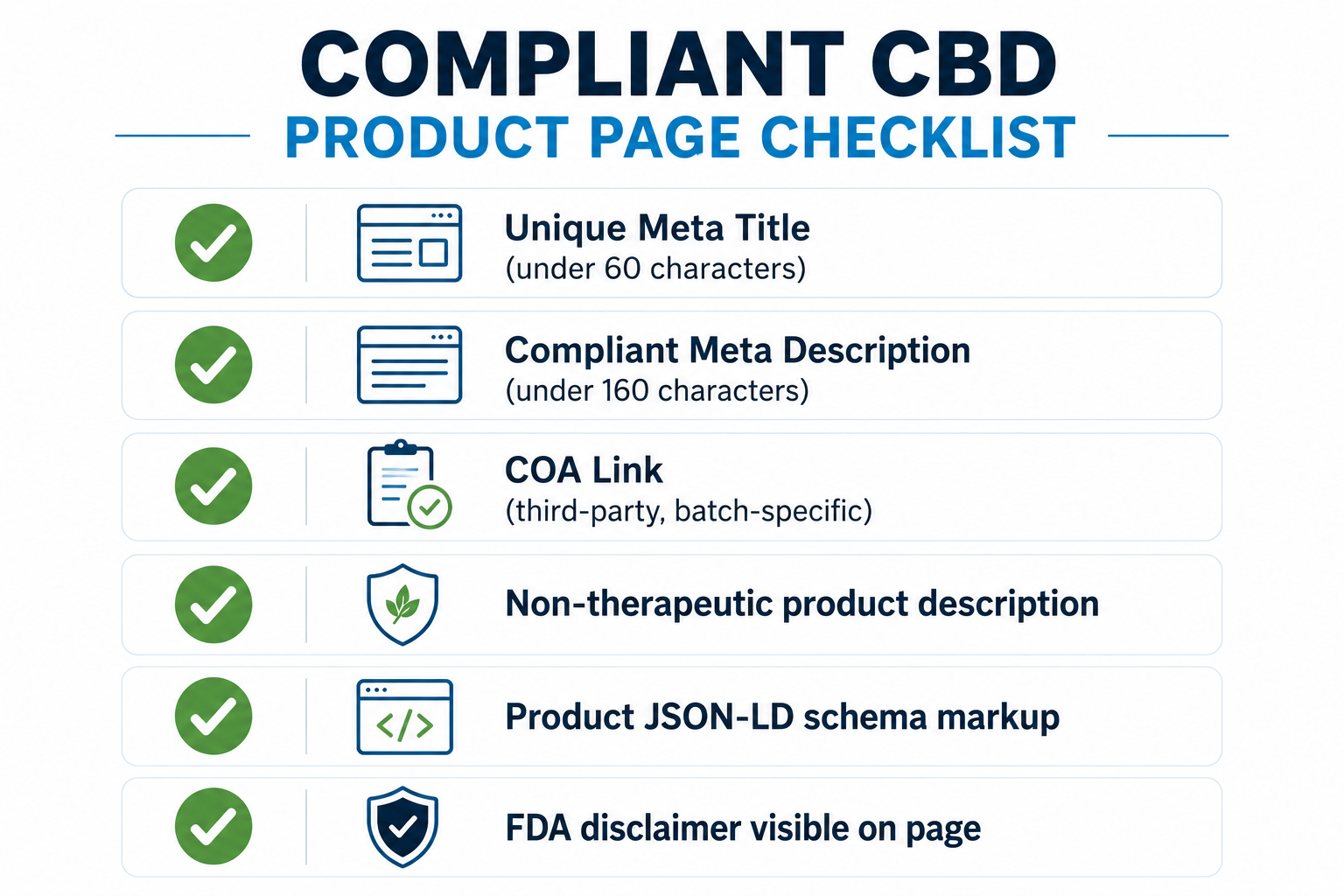
Use this compliant CBD product page checklist to improve SEO, build consumer trust, and meet industry best practices.
Is your CBD website fully optimized for search and compliance? Don’t risk losing your organic rankings or payment processing stability. Learn how to strengthen your foundation with our detailed 5 must-do SEO tips for an online CBD business or contact us today to ensure your product pages are fully compliant and built to rank.
Actionable Checklist for Compliant CBD Product Pages
The gap between a product page that ranks and one that converts, without triggering enforcement, usually comes down to execution on a handful of specific elements. These aren’t idealized best practices; they’re the minimum standard for operating in this space. They are mandatory.
- Write Unique Meta Titles and Descriptions: Keep meta titles under 60 characters and meta descriptions under 155 characters. Use specific-use keywords like “hemp topical cream” or “full-spectrum CBD balm” rather than generic terms. Every product page needs its own distinct metadata: duplicate titles are a crawl signal problem and a missed keyword opportunity.
- Link Directly to COAs: Provide a clear, clickable link to the third-party Certificate of Analysis for every batch of products sold on that page. The COA should be current, batch-specific, and hosted by the testing laboratory, not a PDF you’ve uploaded and can quietly replace.
- Use Non-Therapeutic Descriptions: Focus on sensory experience, ingredient transparency, and general wellness benefits. Words like “soothing,” “calming,” “moisturizing,” and “supportive” carry genuine meaning for buyers without crossing into medical claim territory.
- Implement Product Schema: Add structured data to display product ratings, pricing, and availability directly in search results. For CBD brands competing against well-resourced national players, rich snippet real estate is a meaningful competitive advantage.
Review and Citation Strategy for Trust and Authority
Customer reviews and local citations function as external reputation signals, and Google’s search quality rater guidelines treat external reputation as a meaningful component of E-E-A-T evaluation. A site with strong on-page content but sparse third-party validation will consistently underperform against a competitor with equivalent content and an active review profile. For CBD brands, where trust is already a harder sell than in conventional product categories, this gap is magnified. Trust is everything.
Building citation equity means submitting your business to high-authority local and industry-specific directories with absolute NAP consistency. Weedmaps and Leafly carry genuine domain authority within the cannabis and hemp space. Local chambers of commerce, Better Business Bureau listings, and regional health and wellness directories extend that signal into the broader local search ecosystem. Each accurate, consistent citation is a small vote of confidence in your business’s legitimacy, and those votes accumulate into a measurable local ranking advantage.
Implementing a Compliant Review Acquisition Strategy
The FDA’s position on customer testimonials is unambiguous: reviews and testimonials published on your website or social media profiles are treated as marketing claims made by the brand. That assignment doesn’t require you to have written the words yourself. If a customer leaves a review stating your product “cured my insomnia” and you publish it on your product page, the FDA considers that a disease claim originating from your brand. The source does not matter. The same 97% violation rate that applies to company-generated content applies to user-generated content displayed on company properties.
A compliant review moderation policy isn’t about suppressing honest feedback: it is about filtering for the specific language that creates regulatory exposure. Reviews that describe product quality, texture, scent, shipping speed, packaging, and customer service are entirely appropriate and genuinely useful for prospective buyers. Reviews that reference specific medical conditions, symptoms, or treatment outcomes need to be withheld from public display, even when the customer’s experience was positive. Implementing this as a documented internal workflow, rather than a case-by-case judgment call, protects your brand consistently and scales as your review volume grows. Actively soliciting reviews from in-store customers and post-purchase email sequences remains a sound strategy; the moderation layer simply ensures that what gets published stays within bounds.
Frequently Asked Questions About CBD and Hemp SEO
Can I legally sell and ship CBD products across state lines?
Yes, under the 2018 Farm Bill, hemp-derived CBD products containing less than 0.3% THC are federally legal to transport and ship across state lines. Individual state laws vary significantly, however. Idaho, for example, maintains highly restrictive laws regarding hemp-derived products, and several other states impose specific labeling or ingestible product restrictions. E-commerce platforms like Shopify currently support sales and shipping to approximately 41 states, provided both the merchant’s location and the shipping destination permit the sale. Verifying destination-state regulations before fulfilling orders is a non-negotiable operational step.
What are the details of the topical CBD advertising exception on Google and Meta?
Both Google and Meta allow limited advertising for topical, non-ingestible CBD products, such as creams, lotions, and cosmetics, containing less than 0.3% THC. To qualify, advertisers must obtain LegitScript certification and prior written authorization from each platform. Google further restricts these ads geographically to California, Colorado, and Puerto Rico. Meta permits certified topical ads nationwide but strictly prohibits targeting users under 18. Ingestible CBD products, vapes, and pet supplements remain completely banned from paid advertising on both platforms.
How do I set up compliant payment processing for a CBD store on Shopify?
Shopify Payments, powered by Stripe, does not support CBD or hemp transactions. Using it will result in immediate account suspension: not a warning, an immediate suspension. Before listing any CBD products on Shopify, you must deactivate Shopify Payments and integrate a verified third-party high-risk payment gateway. Processors that are currently compatible and verified for CBD include DigiPay, Bankful, PaymentCloud, and PayKings. Completing Shopify’s Hemp Attestation is also required as part of the merchant compliance process.
How long does it take to see organic traffic results from CBD SEO?
Because CBD is classified as a YMYL industry, search engines apply elevated examination to hemp websites throughout the ranking process. A thorough CBD SEO strategy typically requires 6 to 12 months to deliver meaningful organic traffic and revenue lift. That timeline is longer than standard e-commerce niches; not because the tactics are different, but because the prerequisites are more demanding. Building deep topical authority, securing high-quality backlinks from credible publications, and maintaining absolute regulatory compliance across every page takes time to accumulate into measurable ranking momentum. There’s no clean shortcut here.
Can I use customer testimonials that mention health benefits on my website?
No. The FDA and FTC treat customer testimonials as marketing claims made by the brand itself, regardless of who wrote them. If a testimonial states that your CBD oil “cured my chronic back pain” or “eliminated my anxiety,” displaying that testimonial on your website or social media channels constitutes a disease claim under federal guidelines and can result in a warning letter. All published reviews and testimonials must use compliant, non-therapeutic language, focused on product experience, general wellness, and customer service rather than medical outcomes.
Competing in the CBD market without a compliant organic search strategy isn’t a calculated risk: it’s an operating gap that compounds over time. Paid channels are largely unavailable, regulatory enforcement is active, and Google’s YMYL standards mean that thin or non-compliant content gets filtered out before it ever reaches a buyer. Organic search is essential. Building deep topical authority, maintaining strict FDA compliance across every published surface, and investing in local listings for physical storefronts are not parallel initiatives: they are a single, integrated approach to sustainable visibility. Brands that treat organic search as infrastructure, rather than a campaign, are the ones that accumulate market share while competitors cycle through ad account suspensions and warning letters.
Ready to dominate the search results and scale your CBD brand safely?
Don’t let confusing regulations hold your business back. Schedule a free consultation with the SEO experts at BizIQ to build a custom, compliant organic strategy that drives real revenue.