What you’ll learn in this guide:
- How to claim and optimize your Google Business Profile to dominate local search and Google Maps results
- Why NAP consistency across local directories functions as a foundational trust signal for Google’s ranking algorithm
- How to target high-intent, occasion-based local keywords that capture lucrative group bookings: birthdays, corporate events, and date nights
- Why authentic, on-site photos consistently outperform polished stock imagery for driving user engagement and conversions
- How to build an automated, steady review generation habit that compounds your local rankings over time
Can I Do SEO Myself for My Entertainment or Recreation Venue?
Yes, you can manage your venue’s local SEO yourself. Local search rankings depend on consistent, accurate information rather than motivational theories. Consistency and local authenticity outperform complex technical maneuvers every single time. The majority of what moves the needle is work you can execute without a developer or an agency retainer.
Entertainment and recreation SEO is the process of getting local visibility for your venue when customers are actively searching for immediate, local experiences. It’s categorically different from broad-market SEO, which chases informational queries. Your potential customers aren’t researching escape rooms in the abstract: they’re searching for one to book this Saturday. That distinction shapes everything about how you should optimize.
Roughly 80% of local SEO tasks, like updating business hours, uploading weekly photos, and responding to customer reviews, can be managed in-house in just 4 to 6 hours per month. That is a manageable commitment for a busy venue operator. The remaining 20% involves more technical territory: structured data markup, site speed optimization, and link acquisition. For most single-location venues, that 80% is where the ranking power lives. If you want to explore what DIY SEO on a budget looks like in practice, BizIQ has a detailed breakdown worth bookmarking.
What follows is a field-tested playbook built specifically for entertainment and recreation businesses: the kind of venues where a packed Friday night isn’t a vanity metric, it’s the margin.
Local SEO operates on three variables that Google uses to rank every business in its local results: relevance, proximity, and prominence. Relevance is how well your profile matches what someone searched. Proximity is your physical distance from the searcher. Prominence is how well-known, active, and trusted your business appears across the web.
You can’t move your building. Proximity is fixed. But relevance and prominence are entirely within your control, and for most venues, they’re dramatically under-optimized. Mobile searches with local intent are highly transactional: 76% of users visit a physical business within 24 hours of their search, and 28% of those visits result in an immediate purchase (Google, 2025). That’s not a slow-burn awareness channel. That’s a direct pipeline from search query to front door.
Local SEO is what separates the escape room that appears when someone searches “birthday party near me” from the one that doesn’t. The difference between those two outcomes is rarely location: it’s optimization.
Claiming and completing your Google Business Profile
Your Google Business Profile is your venue’s digital storefront. It’s the first thing most potential customers encounter, before your website, before your Instagram, before any ad you’ve ever run. This single listing drives over 32% of local map pack ranking signals, which makes it the most valuable asset in your entire local search strategy.
Claiming and verifying your profile is the non-negotiable first step. Google uses your GBP data to feed directly into Google Maps and local search results. An unverified or incomplete profile is the equivalent of leaving your physical storefront’s sign turned off: you exist, but you’re invisible to anyone passing by. A complete, optimized profile makes a business 2.7x more likely to be viewed as reputable by potential customers, according to Google’s own data.
The verification process typically involves Google mailing a postcard to your physical address with a PIN, though video verification and instant verification are available for some accounts. Once verified, the work of completing every field begins, and “every field” means every field. Do not cut corners.
Selecting the correct primary category is one of the most consequential decisions you’ll make in this process. Google uses your primary category as a core relevance signal, so precision outweighs breadth. A trampoline park should select “Trampoline Park” or “Amusement Park” as its primary category, then layer in secondary categories like “Children’s Amusement Center” or “Event Venue” to capture adjacent search intent. An escape room’s primary category should be “Escape Room Center,” not “Entertainment Center” or “Amusement Center,” which are broader and less specific.
Beyond categories, complete every available field: operating hours (including holiday hours), phone number, website URL, service attributes, and your business description. The description is a frequently neglected opportunity: it should include your primary service keywords and your city name without reading like a keyword list. Write it for a person who’s already found your profile and wants to understand what makes your venue worth booking. For a deeper walkthrough of what a fully built-out profile looks like, BizIQ’s guide on Google Business Profile optimization covers the tactical specifics in detail.
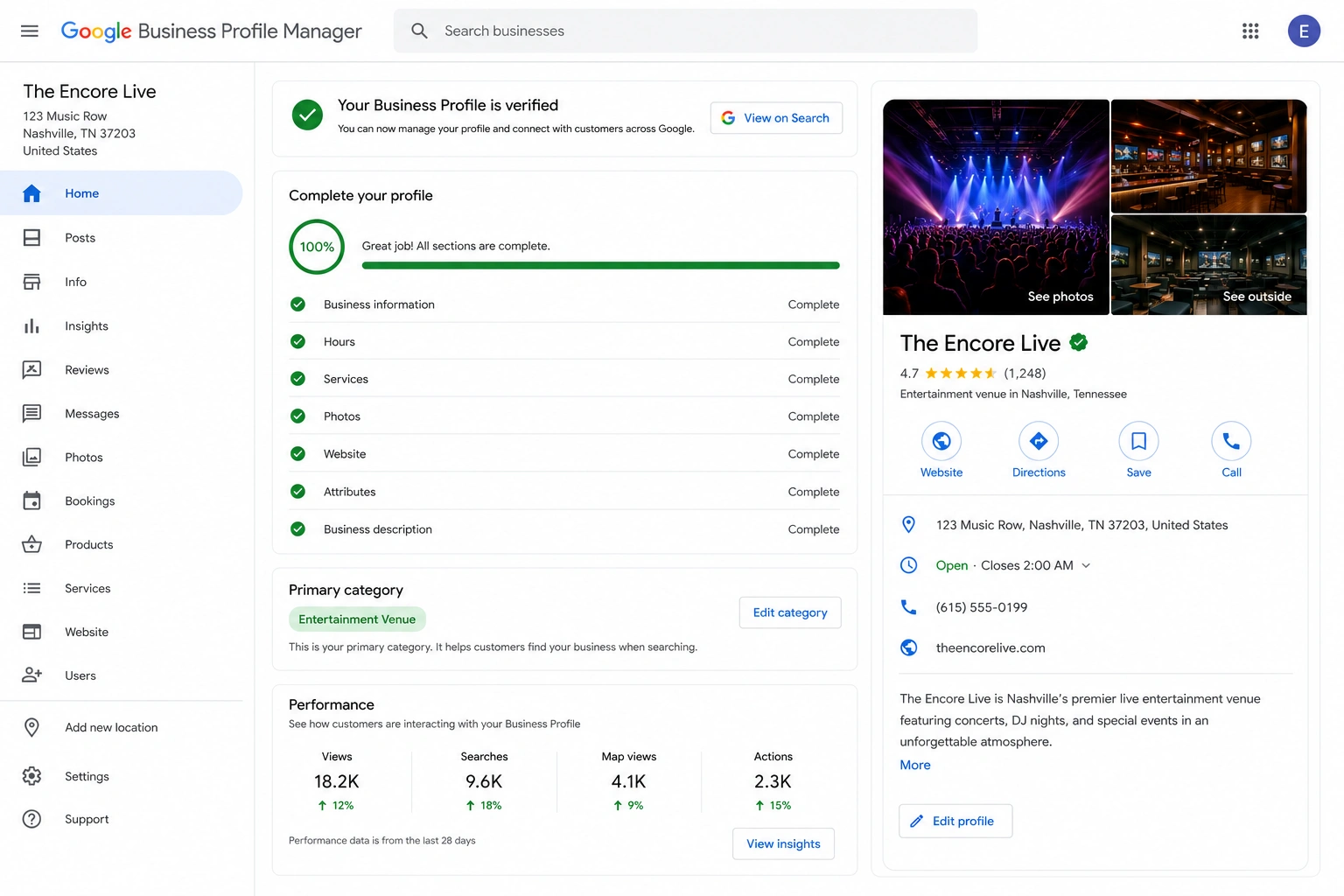
An optimized Google Business Profile with verified status, complete information, and quality photos helps improve local visibility.
Establishing NAP consistency across local directories
NAP consistency, the exact match of your Name, Address, and Phone Number across every online directory, serves as a verification mechanism for Google. When Google scans the web and finds your business information repeated accurately across dozens of authoritative sources, it interprets that pattern as a trust signal: this business is real, stable, and operating at this location. Maintaining a consistent NAP profile across 40 or more local directories makes a business 4.1 times more likely to rank in the Google Local Pack (Digital Applied, 2026).
The analogy that holds up in practice: NAP consistency is like making sure your business name, address, and phone number look exactly the same everywhere online, like giving customers the same directions no matter which map app they use. One wrong turn sign doesn’t just confuse drivers: it makes people question whether the destination is real.
The core directories every venue owner must audit:
- Yelp: Critical for local discovery and, importantly, for Apple Maps data integration. Many venue owners don’t realize that Apple Maps pulls business data directly from Yelp.
- TripAdvisor: Essential for tourist-heavy recreation venues and family fun centers. A strong TripAdvisor presence captures travelers who are actively planning activities in an unfamiliar city.
- Apple Maps: Used by every iPhone user navigating on the go. This one is frequently neglected and often contains outdated information.
- Foursquare: Feeds location data to dozens of downstream local apps and navigation systems. Its influence is broader than its direct user base suggests.
The discrepancy threshold is lower than most venue owners expect. An escape room in Seattle that lists its address as “123 Main Street Suite A” on Google but “123 Main St. #A” on Yelp has introduced a data conflict that dilutes local authority, even though a human would recognize both as identical. Google’s crawlers don’t make that inference. They flag the inconsistency. We recommend starting with an audit of every major directory against a single canonical NAP format before you do anything else. For a broader view of how citation consistency fits into your overall local search strategies, that resource is worth the read.
Targeting occasion-based local keywords
Most venue owners optimize for their primary service descriptor, like “mini golf course,” “trampoline park,” or “escape room.” That’s necessary but insufficient. The higher-margin bookings come from customers who are searching around an event they’re planning, not a category they’re browsing. When someone Googles “date night ideas near me,” your venue should be the answer: not because you stuffed those words in, but because you are the answer. Targeting occasion-based keywords through dedicated landing pages on your website is how you intercept that traffic at the exact moment search intent is highest.
Group bookings, such as corporate events, birthday parties, and team outings, represent the highest-margin revenue streams for local recreation venues. A single corporate team-building booking can fill a Tuesday afternoon that would otherwise sit empty. A birthday party package sells add-ons that a walk-in customer never considers. Every add-on boosts profit. These aren’t incidental revenue; they are the bookings that determine whether a slow week is survivable.
High-intent occasion-based keywords worth building dedicated pages around:
- Date night activities: “unique date night ideas in [City]” performs particularly well for escape rooms and upscale mini-golf. Couples searching this phrase are ready to book; they just need a clear reason to choose your venue.
- Birthday party venues: “kids birthday party places near me” generates steady volume for trampoline parks and family fun centers. This is a year-round search term with a clear transactional intent.
- Team building events: “corporate team building activities in [City]” is a high-value term for escape rooms and boutique bowling alleys. The person searching it often has a budget and a deadline.
- Rainy-day activities: “indoor activities for kids on a rainy day” drives spontaneous weekday traffic. This is the search that fills a Tuesday morning when the weather turns and parents are scrambling.
Dedicating resources to optimizing these high-value terms yields a measurably higher return than chasing low-intent, generic keywords. Each occasion deserves its own page, not a paragraph buried in your homepage copy. If you operate across multiple territories, the keyword architecture becomes more complex; BizIQ’s breakdown of multi-location SEO strategies addresses that specific challenge directly by showing you how to structure city-specific landing pages without triggering duplicate content penalties.
Is your venue visible to local searchers?
Check your business’s current search footprint and identify directory errors instantly with BizIQ’s Free Local SEO Audit Tool. It takes two minutes and shows you exactly where your online presence is leaking ranking potential.
Prioritizing authentic photos over stock imagery
A persistent misconception exists in local SEO circles that manually embedding GPS coordinates into your image metadata, known as geotagging, improves your local rankings by proving your physical location to search crawlers. Controlled studies show that Google strips EXIF data upon upload, meaning manual geotagging has zero direct impact on rankings (Search Engine Land). The ranking benefit of photos comes entirely from user engagement: click-through rates, profile interactions, and direction requests. Google’s algorithm rewards profiles that drive higher engagement, and authentic photos drive engagement in a way that stock imagery simply doesn’t.
Google Business Profiles with 100 or more images experience a 520% increase in phone calls and a 2,717% increase in direction requests compared to average listings (BrightLocal, 2025). That’s not a marginal difference. It reflects a simple truth about human decision-making: people want to see the actual experience before they commit to booking it.
Stock photos feel like someone else’s story. A family laughing in a generic trampoline park photo could be anywhere, and potential customers know it. Real photos of your specific venue, your actual staff, and genuine guests mid-experience build immediate trust. They answer the question every first-time visitor is silently asking: “What is it like there?”
The practical workflow is simpler than most venue owners assume. Shoot with your smartphone during busy weekend sessions: natural light, candid moments, real expressions. Take photos of your interior, exterior, staff, and happy customers, with their documented permission. Establish a habit of uploading 3 to 5 new photos every week. That cadence signals active operations to Google’s algorithm and keeps your profile visually current. Avoid overly polished, professionally staged photos that read as stock imagery even when they’re technically original. Raw, high-quality smartphone photography consistently outperforms studio-quality images in local search engagement metrics.
“Authentic visual proof is the bridge between a searcher’s screen and your venue’s front door. Show them the real experience, and they will book.”
Cultivating a steady review habit
Review velocity, meaning the consistent rate at which you acquire new reviews, matters more to Google’s local ranking algorithm than your total review count. This is a counterintuitive finding that changes how venue owners should think about reputation management. Review recency is the active variable; historical volume is largely inert. Freshness is key.
A venue with 50 reviews that receives 5 new reviews every month will consistently outrank a competitor with 200 stale reviews and no recent activity. Google treats fresh reviews as a proxy for real-time customer demand and active business operations. Businesses that secure at least one new review every 7 days rank an average of 2.3 positions higher in local search results than competitors with older reviews (Sterling Sky, 2025). Review signals account for roughly 16% of local pack ranking factors, making this one of the most effective activities in your weekly routine.
The operational challenge isn’t convincing customers to leave reviews: most satisfied guests are willing when asked at the right moment. The challenge is building a system that asks consistently without relying on a staff member to remember. An automated post-visit email or SMS sent 2 hours after a booking concludes is the most effective mechanism. The timing is intentional: the experience is still fresh, the emotional high is intact, and the customer hasn’t yet moved on to the next thing in their day.
Social proof compounds over time in a way that paid advertising doesn’t. A venue with 80 recent, detailed reviews and active owner responses to each one communicates something that no ad can replicate: this place is genuinely good, people keep coming back, and the owner cares. That signal influences both the algorithm and the human reading the listing.
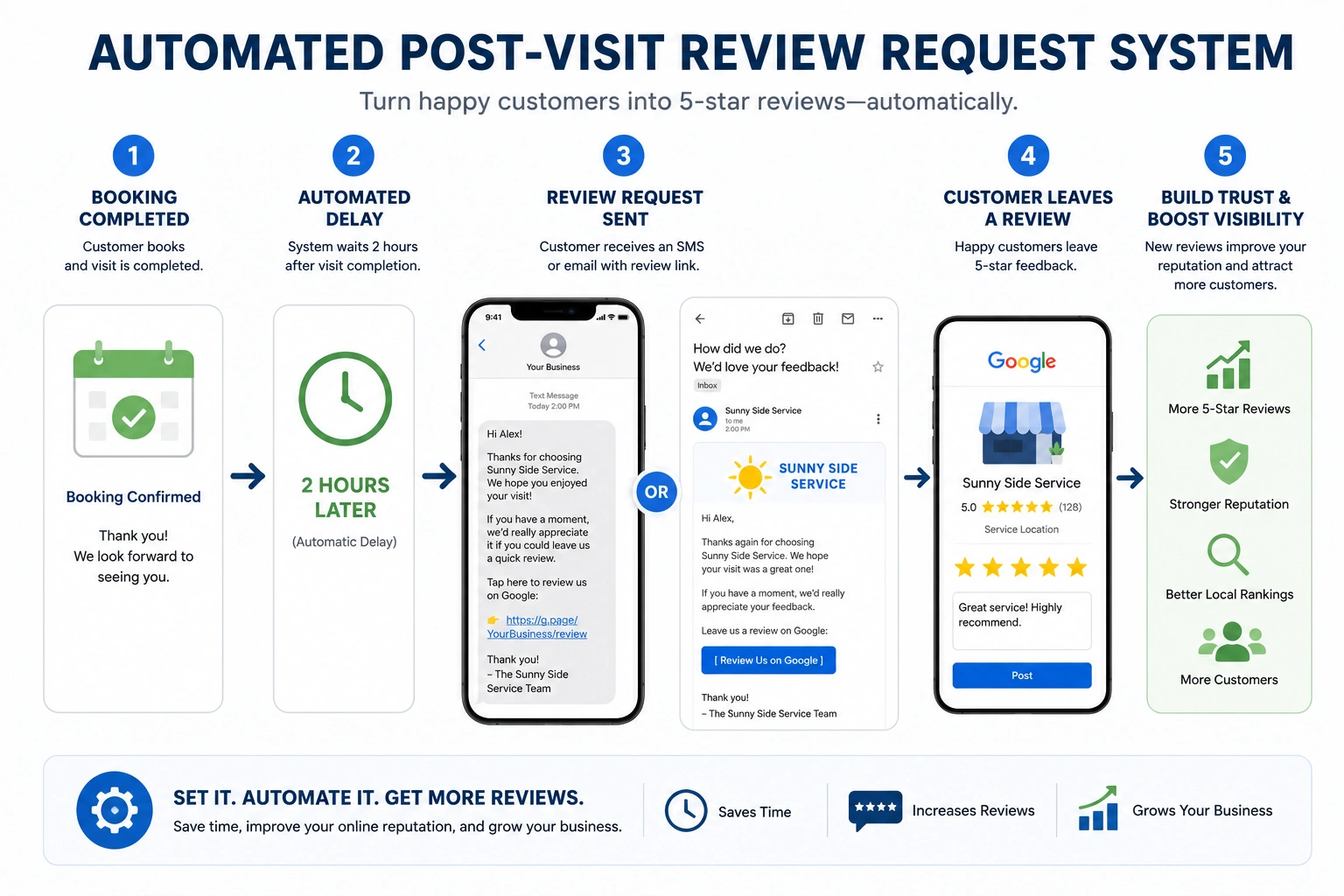
An automated review request workflow helps businesses consistently collect Google reviews after every completed customer visit.
Don’t let review collection fall by the wayside. Automate your review generation, monitor customer feedback, and build trust at scale with BizIQ’s Reputation Management and Review Generation Solutions. Consistent reviews are a ranking signal you can systematize: let us show you how.
Roughly 80% of local SEO tasks can be managed in-house in just 4 to 6 hours per month. This action list is designed to get you from zero to operational in five focused days. Each task is ordered systematically. Don’t skip ahead, because Day 2 depends on the canonical NAP format you establish on Day 1, and Day 5’s review campaign is more effective once your profile is fully built out.
The 5-Day Action Plan of next steps I can take this week:
- Day 1: Claim your Google Business Profile, verify your physical address, and select your primary and secondary business categories. If your profile already exists but was auto-generated by Google, claim it and correct any pre-populated errors before adding new information.
- Day 2: Establish your canonical NAP format (decide on the exact spelling, abbreviations, and suite number format you’ll use everywhere) and audit your listings on Yelp, TripAdvisor, and Facebook to ensure they match exactly.
- Day 3: Take 10 high-quality, authentic photos of your venue’s interior, exterior, and staff, and upload them to your Google Business Profile. Prioritize images that show the experience in action, with guests engaged rather than empty rooms.
- Day 4: Write and publish a dedicated landing page on your website targeting a high-value occasion. “Corporate Team Building Events in [Your City]” is a strong starting point for most venue types; it’s high-margin, consistently searched, and rarely well-served by competitor pages.
- Day 5: Launch an automated email or SMS campaign to ask your past customers for Google reviews. Set it to trigger automatically after each completed booking. Consistency builds momentum. This is the step most venue owners defer indefinitely, but starting early builds momentum.
For a structured format that maps this approach across a longer horizon, BizIQ’s local SEO checklist for small businesses extends this framework into a repeatable monthly routine.
The quantitative impact of local SEO on venue bookings
Ranking in the top 3 spots of the Google Local Map Pack drives 126% more traffic and 93% more actions, including calls, website clicks, and direction requests, than ranking in positions 4 through 10 (SOCi Local Map Pack Study). That disparity is not gradual; it is a steep drop-off. Positions 3 and 4 are separated by a behavioral threshold that most users never cross.
Forty-six percent of all Google searches carry local intent, and 78% of local mobile searches result in an offline visit within 24 hours (Map Labs). For a venue that lives and dies by foot traffic and advance bookings, those numbers describe your entire addressable market. When you show up on Google when people search for “things to do this weekend” or “birthday party venues near me” in your city, you capture a potential booking. Organic search captures that intent at zero cost per click, unlike paid advertising, which stops the moment the budget runs out.
Google heavily prioritizes proximity-based ranking, and your physical location is the single strongest ranking factor in the local map pack. A perfectly optimized profile can’t fully overcome a significant distance disadvantage. What optimization does is ensure you capture every ounce of search volume within your geographic radius, and for most venues, that radius contains far more potential customers than they’re currently reaching. The gap between your current visibility and your maximum possible visibility within your proximity zone is where local SEO operates. Conversion rates from map pack positions are high enough that even a modest improvement in ranking position translates directly into booking volume.
Frequently asked questions about venue SEO
Local SEO is highly effective, but the path from “I should do this” to “I’m doing this consistently” involves a few genuine decision points. Recreation SEO is a compounding strategy: it builds on itself over time rather than delivering a single spike of results. It requires patience. These common questions address the practical decisions venue owners face when managing their own SEO. Whether you continue managing this in-house or eventually bring in professional support, the goal is that you make that decision with accurate information about timelines, effort, and search visibility outcomes so you can maximize your marketing budget.
Common venue SEO questions answered
Do I need to hire an agency?
No, you do not necessarily need to hire an expensive agency to rank locally. For local venues, consistency in managing your Google Business Profile, gathering reviews, and maintaining directory accuracy outweighs complex technical SEO in most markets. You can manage this in-house using 2 to 3 hours per week without specialized tools or technical knowledge. The calculus changes if you operate multiple locations, compete in an ultra-dense metro market where your competitor ranks higher than you, or have accumulated technical website errors that are actively suppressing your rankings. In those scenarios, professional support pays for itself. For venues that are starting from scratch or operating in mid-size markets, affordable SEO strategies cover exactly where to focus your limited time and budget.
How long until I see results?
Results vary based on your current presence, industry, and competition. Most venues begin to see measurable movement in the Google Map Pack within 60 to 90 days of optimizing their Google Business Profile and cleaning up their NAP citations. That’s a realistic baseline, not a guarantee: competitive density in your specific market affects the timeline. Driving significant organic website traffic through occasion-based landing pages typically requires 4 to 6 months of consistent content publishing and link building. Local SEO doesn’t behave like a paid campaign where results appear immediately and stop when you pause. It accumulates. The work you do in month one still contributes to your rankings in month twelve.
How many keywords should my venue target?
Prioritize quality over sheer volume. Spreading effort across hundreds of search terms produces thin, unfocused content that ranks for nothing particularly well. A tight group of 10 to 15 high-intent keywords, such as your primary terms like “escape room near me” alongside your core occasion-based terms like “birthday party venues in [City],” gives you enough surface area to capture meaningful search volume without diluting your optimization effort. We recommend starting with the terms that describe your highest-margin bookings, building dedicated pages for each, and expanding the list once those pages are ranking.
Is local SEO still worth it in the era of AI search?
AI search engines, such as Google’s AI Overviews, ChatGPT Search, and Perplexity, do not generate local business data independently. They extract it from trusted local directories, Google Business Profiles, and user reviews. The same signals that drive traditional local rankings feed directly into AI-generated local recommendations. Businesses that allow their NAP data to drift across three or more major citation sources face a 74% exclusion rate from AI-generated local search answers (Semrush, 2026). That’s a significant finding. Maintaining an active, consistent, well-reviewed online presence doesn’t just protect your traditional search rankings: it determines whether AI search agents recommend your venue at all. Keyword targeting and reputation management are, if anything, more critical in an AI-influenced search environment than they were before.
What is the biggest mistake venues make with local SEO?
Two mistakes appear consistently. The first is relying on generic stock photography while neglecting review management: both signal to Google and to potential customers that the venue is either inactive or unconfident about its product. Real photos and active review responses communicate that your venue is alive, well-rated, and run by people who pay attention. The second mistake is inconsistent business information across directories. It’s a slow, invisible drain on your local authority: nothing breaks dramatically, but your rankings plateau and you can’t identify why. Audit your citations before you invest time in anything else.
Dominating your local search market doesn’t require a massive advertising budget or a dedicated marketing team. What it requires is consistency applied to the right signals: a fully built-out Google Business Profile, directory citations that tell a single coherent story about your business, landing pages that speak directly to the occasions your customers are planning around, authentic photos that show the real experience, and a review generation system that runs without you having to remember to ask.
Here’s what to do next: start with the five-day checklist. Claim your profile, lock in your canonical NAP, upload your first batch of authentic photos, publish one occasion-based landing page, and launch your review request automation. Those five moves, executed this week, will put you ahead of the majority of local competitors who are still waiting for the right moment to start. Your organic search visibility compounds from there, and a packed weekend calendar is a more achievable outcome than most venue owners realize when they’re still invisible in local search.
Ready to accelerate your venue’s local search presence? If you’d rather focus on running your business and let the experts handle the heavy lifting, explore BizIQ’s Local SEO Services today. A small business ourselves, with the same goals as you, we work specifically with entertainment and recreation venues to build the kind of local search dominance that translates into real bookings, not just rankings.