This guide focuses on what matters most when you are evaluating SEO for your auto glass operation. No inflated promises, no vague agency-talk: just direct answers to the questions shop owners ask most.
- Transparent Cost Benchmarks: Learn what to expect for monthly SEO packages and how they compare to paid ads.
- Geographic Targeting Parameters: Discover how specialists optimize for mobile service vans and multi-city territories.
- Monthly Keyword Health Checks: Understand the exact practices used to track and maintain your rankings.
- ADAS Calibration Optimization: Capture high-ticket calibration jobs by targeting low-competition, high-value search terms.
When a driver notices a crack spreading across their windshield, the decision cycle is measured in minutes, not days. They pull out their phone, type something like “windshield fix near me” or “mobile auto glass repair,” and they call the first credible result they see. There is no comparison shopping, no browsing national directories: it is immediate, high-intent action. This mobile-first behavior defines the auto glass search market, and it is specifically why specialized auto glass SEO exists as its own specialty rather than a subset of general local marketing.
The US automotive glass manufacturing industry is valued at approximately $7.7 billion in 2025 to 2026, a figure driven not just by volume but by increasing vehicle complexity: more sensors, more cameras, more calibration requirements per job. The market isn’t shrinking. Complexity drives this growth. What is shrinking is the tolerance for shops that don’t appear when customers are looking. Generalist marketing agencies tend to miss the operational nuances here: the service-area business model, the insurance claim workflows, the ADAS calibration upsell, and the hyper-local urgency of the search query. An agency that treats your shop like a plumber or a dentist will produce results that reflect that misunderstanding.
Understanding Auto Glass SEO Costs and Package Structures
Glass repair marketing cost is the first question most shop owners ask, and it deserves a straight answer rather than a vague deflection.
For small-market operations, such as a single van, one primary service area, and modest competition, SEO packages for auto glass typically run $700 to $2,000 per month. That range covers the essential work: technical website audits, Google Business Profile optimization, niche citations across directories including industry-specific platforms like Auto Glass Quotez, and the creation of high-value service pages. Competitive markets or multi-location franchises require a different level of effort; those campaigns generally fall in the $2,000 to $5,000 and up per month range to help you rank higher in [city] across multiple territories.
One framing that tends to clarify your real cost: SEO is a long-term asset, not a recurring line item that disappears when you stop paying. Each optimized page, each citation, and each backlink accumulates authority over time. That means more people finding your shop on Google without paying for every click.
The paid channel comparison is worth addressing directly. Google Local Service Ads operate on a pay-per-lead model, with costs typically ranging from $20 to $60 per lead depending on market density and competition. Traditional Google PPC campaigns average $8 to $25 per click, and clicks are not leads. Think of it this way: paid ads are renting visibility, while organic SEO is building equity in a property you own. The moment you pause a PPC campaign, the leads stop. A mature organic presence keeps generating traffic whether or not you are actively spending. That doesn’t make paid ads wrong. Both have their place. A parallel strategy using PPC for immediate cash flow while building organic authority is a smart approach. An SEO and Google PPC case study highlights how these channels work together, but it does clarify why the glass repair marketing cost of SEO looks different on a 24-month horizon than it does in month one.
To start, calculate your current cost per lead across all channels to see where your budget is spent.
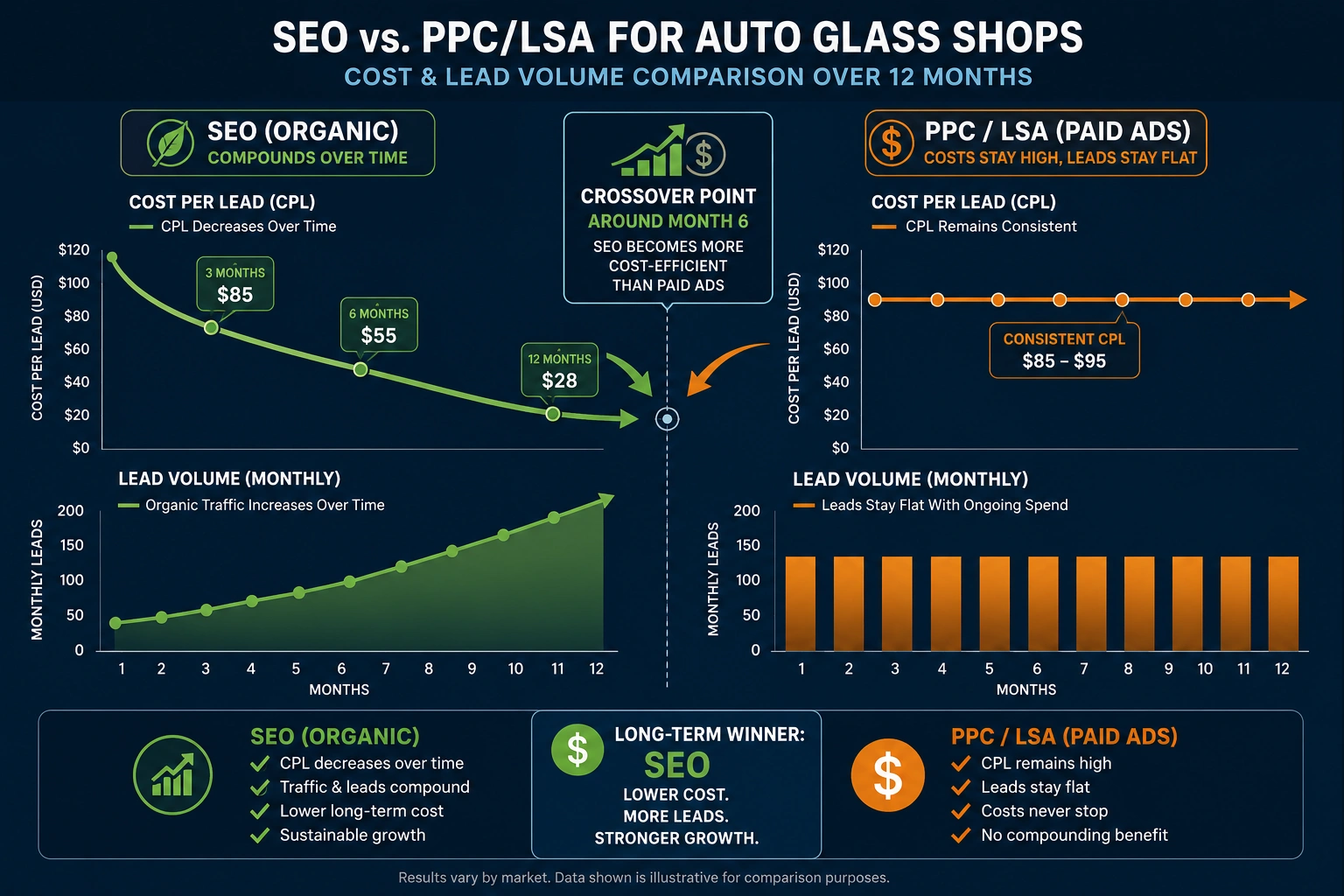
SEO compounds over time to lower cost per lead and increase lead volume, while PPC delivers steady but non-compounding results.
Geographic Targeting Parameters for Mobile Auto Glass Services
Mobile service vans create a targeting problem that most generalist agencies handle poorly. Without a physical storefront in every city you service, Google’s proximity bias works against you by default: the algorithm wants to surface businesses that are physically close to the searcher. An experienced auto glass SEO specialist understands how to work around that hurdle systematically rather than hoping the GBP radius setting does the heavy lifting.
It doesn’t. Proximity bias is real. Google’s service area configuration within a Google Business Profile communicates your coverage zone to users, but it is not a meaningful ranking signal on its own. Ranking outside your immediate physical location requires deliberate, content-driven work.
- Service Area Configuration: The GBP should reflect exact zip codes and municipalities within a realistic service radius, typically a maximum two-hour drive. Overextending the radius beyond what your operation can realistically serve creates expectation mismatches and hurts conversion rates.
- City-Specific Landing Pages: Dedicated geo-pages for every major suburb or city in your territory are the primary mechanism for capturing localized queries. Each page needs genuine, location-specific content, not a template with the city name swapped in. Google’s quality signals are sophisticated enough to distinguish between a page written for a location and a page written about a location.
- Local Entity Integration: Incorporating regional highway references, local landmarks, and community-specific context into service page content signals geographic relevance to search engines in ways that generic copy cannot replicate. A page mentioning the specific interchange where a customer’s windshield cracked reads differently to both Google and the customer than a page that simply says “serving the greater metro area.”
Action step: List your top three service cities outside your home base and verify if you have dedicated pages for them.
Monthly Keyword Health Checking Practices
Keyword rankings are not a set-and-forget metric. They shift constantly. Search intent shifts, competitors adjust their strategies, and algorithm updates redistribute visibility. Without a structured monthly review process, you won’t know your rankings have slipped until the phone goes quiet. Think of monthly keyword health checks like maintaining your shop’s equipment: consistent care keeps things running smoothly.
Here’s what to check monthly to keep things running smoothly:
- Rank Tracking Audits: Daily position monitoring for high-intent terms like “windshield replacement near me,” “mobile auto glass repair,” and “windshield glass replacement near me.” Ranking shifts at this frequency reveal algorithm reactions before they become sustained drops.
- Search Console Analysis: Monthly review of Google Search Console data to surface emerging queries, track impressions against clicks, and identify pages where CTR is underperforming relative to position. A page ranking in position four with a 2% CTR has a title tag problem, not a ranking problem, and that distinction matters for where you direct effort.
- Competitor Gap Analysis: Monitoring the keyword movements of competing local shops is as important as tracking your own. When a competitor’s rankings decline, there’s a window to capture that displaced traffic, but only if you’re watching for it.
Action step: Set up a recurring calendar reminder on the first of the month to check your Google Search Console impressions.
Ready to see how your shop stacks up online? Schedule a Free Auto Glass SEO Audit. Our specialists will analyze your local market, identify the keywords you should target, and build a custom growth blueprint. When you’re ready to hire an SEO specialist, start with a clear picture of where you stand. Claim your free audit to get started.
Capturing High-Ticket ADAS Calibration Search Volume
Modern windshield replacement is not what it was a decade ago. The spread of Advanced Driver Assistance Systems, including lane departure warning, automatic emergency braking, and forward collision detection, means that a significant portion of replacements now require ADAS calibration to restore system functionality to OEM specifications. This isn’t an upsell; it is a safety-critical requirement.
How significant is the demand? ADAS calibration now represents over 33% of windshield replacements in 2025, with projections placing it at 60% to 65% of collision repairs by 2026. The global ADAS calibration services market is projected to reach $5.79 billion by 2026 at a 10.5% CAGR. Shops that perform calibration and rank for calibration-specific keywords are capturing an unequal share of high-ticket jobs: the kind that increase average ticket size rather than just adding volume.
The keyword opportunity here is real. Terms like “windshield camera calibration near me” and “ADAS recalibration after windshield replacement” carry high commercial intent and, in most mid-size markets, face significantly less competition than generic windshield replacement queries. Building dedicated service pages that explain the calibration process, the safety rationale, and the OEM standards involved does two things: it ranks for those low-competition terms, and it positions the shop as a technically credible authority rather than a commodity glass installer. That positioning matters when a customer is deciding between three shops with similar prices.
“ADAS calibration is no longer an optional add-on; it is a safety-critical requirement. Shops that fail to optimize their digital presence for calibration keywords are leaving money on the table every single month.” – Industry Technical Specialist
Action step: Add an ADAS calibration service page to your site this month to capture these high-value leads.
Implementing Structured Data for Rich Search Results
Schema markup is how you speak Google’s language directly rather than hoping the algorithm infers what your business does from your page content. For auto glass shops, two schema types are non-negotiable: LocalBusiness and Service JSON-LD schemas.
LocalBusiness schema tells search engines your business name, address, phone number, hours, and service area in a structured format they can parse without confusion. Service schema extends that by defining each specific offering, including windshield replacement, rock chip repair, and ADAS camera calibration, with its own structured data block. Together, these schemas create the conditions for rich-snippet visibility: star ratings pulled from your review totals, FAQ dropdowns surfaced directly in the search result, and service details displayed before a user even clicks through. That kind of SERP real estate is not available to shops running plain HTML pages without structured data.
The practical impact is measurable. Rich snippets increase click-through rates by making your result visually distinct from the standard blue-link format surrounding it. In a local SERP where three or four competitors are listed, a result with star ratings and an FAQ dropdown draws the eye. It also signals to search engines that your site is technically well-maintained, a factor that compounds over time as Google’s quality assessments evolve.
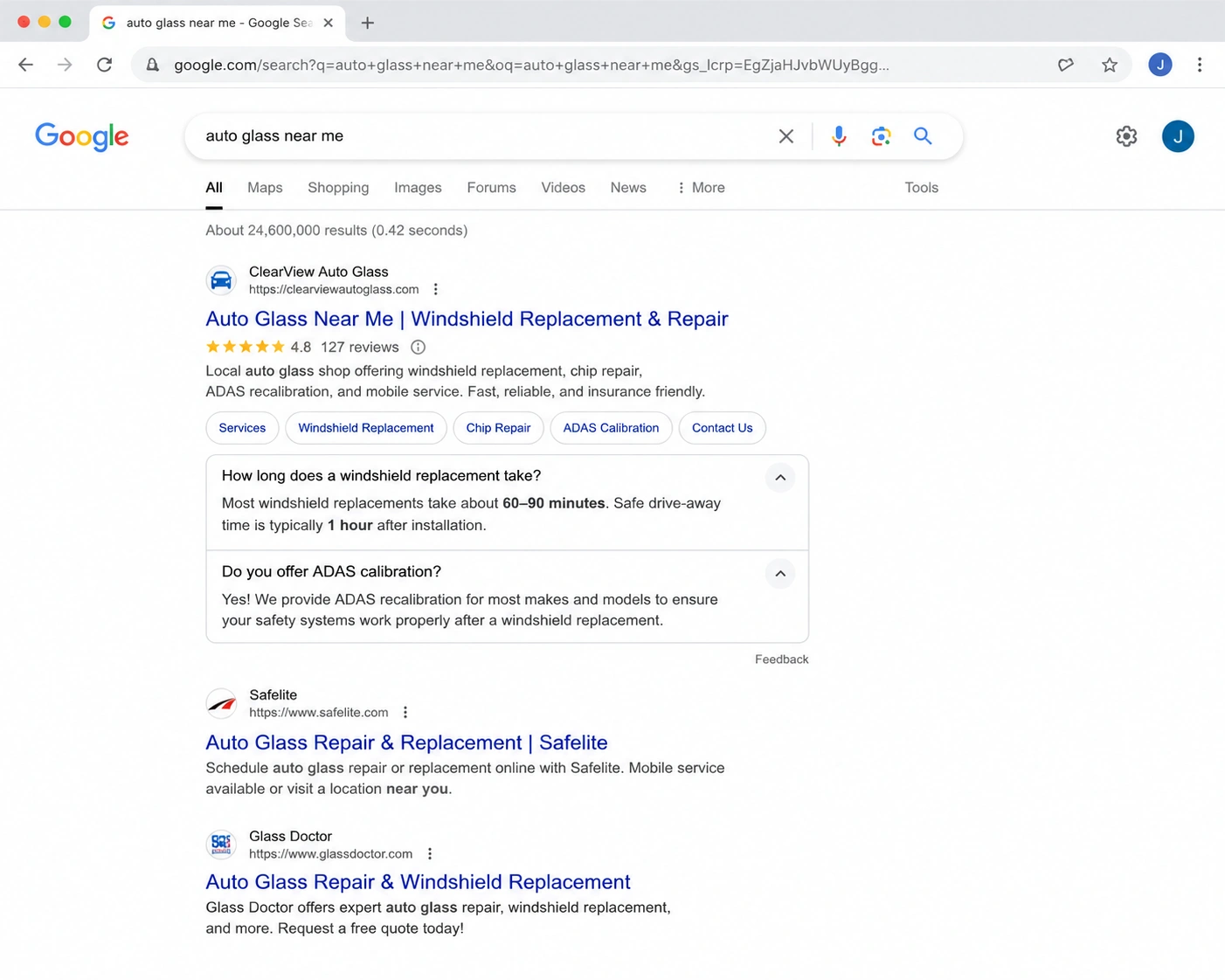
Rich snippets with reviews and FAQ schema help auto glass shops stand out in Google search results and improve click-through rates.
Evaluating the ROI of Specialized Auto Glass SEO
Measuring automotive digital marketing ROI requires looking beyond month-over-month traffic numbers and connecting organic performance directly to booked jobs. The metrics that matter are organic conversions, such as calls, form submissions, and direction requests, not vanity metrics like impressions or session duration. An SEO case study shows how tracking these metrics directly correlates to shop revenue.
The long-term case for organic SEO in the automotive digital marketing sector rests on three compounding advantages:
- Compounding Traffic Growth: Paid ads deliver leads proportional to spend. Organic SEO delivers leads proportional to accumulated authority. This authority doesn’t reset when you pause a payment. It keeps working. A well-optimized service page built today can generate leads for three to five years without additional investment.
- Higher Conversion Rates: The urgency of the auto glass customer creates helpful conversion conditions. Optimized auto glass landing pages frequently achieve conversion rates of 20% to 33%, compared to the 7.5% industry average for Google Ads campaigns across all verticals. The customer who finds you organically has already made a decision to act; your page just needs to make the next step obvious.
- Brand Authority: Consistent presence in the local map pack and top organic positions establishes a shop as the recognized local authority in auto glass repair, a perception that influences both first-time callers and repeat customers.
Shops tracking organic conversions see up to a 3x lower cost per acquisition compared to paid search campaigns over 12 months.
The Critical Role of Review Acquisition Systems
Google’s local ranking algorithm weights review volume, recency, and sentiment more heavily than most shop owners realize. It’s not enough to have a 4.8-star average from 30 reviews accumulated over three years. Review speed, which is the rate at which new reviews arrive, is a distinct signal, and a shop with 12 new reviews in the past 90 days will typically outrank a competitor with 200 total reviews and nothing recent.
The operational challenge for auto glass businesses, particularly mobile operations, is that the service interaction ends at the customer’s location. There’s no front desk moment, no checkout counter where a technician can hand over a review card. The solution is automation: an SMS sent within 15 minutes of job completion with a direct link to the Google review form. That timing matters: the customer’s satisfaction is highest immediately after the technician drives away, and the friction of navigating to a review page drops significantly when the link is already in their hand. Email follow-ups work as a secondary touchpoint, but SMS response rates for review requests consistently outperform email in service-based industries.
Consistent review velocity does more than influence rankings. It builds trust. It builds the kind of social proof that converts a hesitant searcher into a caller, particularly for higher-ticket services like ADAS calibration, where a customer is making a trust-based decision about a safety system on their vehicle.
Action step: Set up an automated SMS template today that triggers immediately after a job is marked complete.
Frequently Asked Questions About Auto Glass SEO Specialists
Choosing an SEO marketing company is a decision that deserves more attention than most shop owners apply to it. The agency landscape is crowded with generalists who will take your retainer, produce monthly reports full of metrics that don’t connect to revenue, and renew the contract before you’ve had a chance to evaluate whether anything truly moved. Hiring an auto glass SEO expert requires asking specific questions about pricing structure, reporting transparency, timeline expectations, and, critically, whether the agency has worked in the auto glass vertical before or is learning your industry on your dime.
Action step: Use these specific questions when interviewing any marketing partner to verify their industry experience.
Common Questions and Expert Answers
80% of auto glass searches on mobile result in a phone call within one hour.
What is the typical timeline to see results from an auto glass SEO campaign?
Technical updates and Google Business Profile optimizations can produce measurable movement within the first 60 to 90 days: improved map pack visibility, higher impressions, and better CTR on existing pages. Sustainable page-one rankings for competitive terms like “windshield replacement near me” in a mid-size market typically require 3 to 6 months of consistent work. That timeline reflects how Google’s algorithm evaluates trust and authority: it doesn’t reward new content immediately, it rewards demonstrated consistency over time. Campaigns that promise page-one rankings in 30 days are either targeting keywords with no search volume or overstating what’s achievable.
How do you optimize search visibility for mobile service vans without a physical storefront?
The GBP is configured as a Service Area Business (SAB), with service areas defined by the specific zip codes and municipalities your operation realistically covers. That is the baseline. The real work happens at the content level: building dedicated, localized landing pages for each target city that go beyond a name swap and directly address the local context, such as nearby highways, common weather-related damage patterns, and local insurance providers. Local SEO strategies and proven local search tactics for service-area businesses require this content depth to overcome proximity bias, because Google’s algorithm needs more than a GBP setting to justify ranking a business in a city where it has no physical address.
What specific metrics are tracked during monthly keyword health checks?
The core tracking set for an auto glass operation covers organic keyword rankings (position by keyword, tracked daily for high-intent terms), search impressions and click-through rates from Google Search Console, and organic conversions, including calls, form submissions, and direction requests attributable to organic traffic. Impressions without clicks indicate a title or meta description problem. Clicks without conversions indicate a landing page problem. Tracking all three together creates a diagnostic chain that connects search visibility directly to booked jobs rather than stopping at traffic volume.
Why is ADAS calibration optimization prioritized in modern auto glass SEO?
Because the revenue concentration is significant and the keyword competition is comparatively low. ADAS calibration already accounts for over 33% of modern windshield replacements, and that percentage is climbing as newer vehicle models become the majority of the fleet. A shop that ranks for “ADAS recalibration after windshield replacement” in its market is capturing a high-margin job that many competitors aren’t even advertising. The search volume for calibration-specific terms is smaller than for generic windshield queries, but the intent is more specific and the average ticket value is substantially higher, which makes the cost-per-acquisition math work in the shop’s favor.
Is auto glass repair profitable, and is it a good trade to invest in?
Auto glass repair is genuinely profitable, and the business case is more durable than many trades. Overhead is low relative to full-service auto body work: no paint booths, no frame equipment, and no heavy machinery. A significant portion of jobs are insurance-covered, which removes price sensitivity from the transaction and stabilizes revenue. As a trade, it offers high job security, relatively fast certification timelines, and demand that holds steady across economic cycles because windshield damage doesn’t wait for favorable conditions. The addition of ADAS calibration services has expanded the revenue ceiling considerably for shops willing to invest in the equipment and training.
Investing in specialized auto glass SEO is not a hedge against slow seasons: it’s the mechanism that determines whether your shop ranks higher in your city or misses out on local calls. The organic search channel, built correctly, generates a continuous stream of high-intent leads that compounds in value over time rather than resetting with each billing cycle. Every optimized service page, every calibration-specific keyword you rank for, and every review that lands in the past 30 days is a durable asset working on your behalf around the clock.
The shops that will build the strongest local search presence in the next three years are the ones making that investment now, before their competitors do.
Ready to rank higher in your city? Start by claiming your Google Business Profile if you haven’t already, then verify your service area settings are correct. If you’re still weighing the decision on who to partner with, our guide on whether hiring a local SEO consultant is worth it lays out the honest case. Let’s talk.