The data confirms the value of organic search for auto glass shops:
- 61.83% of all online auto glass conversions stem from organic search, outperforming all paid channels combined.
- $30 to $60 average cost-per-lead (CPL) achieved by mature organic campaigns by year two, compared to $40 to $120+ for paid ads.
- 30% to 50% of total windshield replacement job revenue is now driven by advanced driver-assistance system (ADAS) calibration.
- 150 to 300 additional calls per month generated by moving into the top three positions of the Google Map Pack.
You know the feeling. It’s 10 a.m. on a Tuesday, your two best technicians are standing around, and the phone hasn’t rung since 8. Meanwhile, somewhere within a five-mile radius, dozens of drivers are pulling over on the shoulder, cracked windshields staring back at them, searching “windshield repair near me” on their phones, and booking with someone else. That gap between the demand that exists and the demand that reaches your shop is exactly what a specialized auto glass SEO agency is built to close.
We get it because we’ve lived it. Running an independent automobile repair shop means wearing every hat simultaneously: estimator, technician, scheduler, and marketer. Competing against national conglomerates with seven-figure advertising budgets on top of that isn’t just difficult; it’s structurally unfair unless you have an asymmetric advantage. We recommend marketing that fits a small budget but delivers outsized results. Organic search is that advantage. Unlike paid ads that evaporate the moment your budget runs dry, a well-built organic lead engine compounds over time, driving high-intent traffic from queries like “windshield glass replacement near me” at a fraction of the long-term cost. The shops filling their bays year-round aren’t outspending the nationals. They’re outranking them.
The Urgent Customer Mindset and Search Intent
Auto glass is one of the few service categories where the customer’s decision cycle shrinks to minutes. A rock kicks up on the interstate at 7:45 a.m., the driver watches a chip spider across their windshield, and by 7:47 they’re already in local search, not browsing a national directory, not asking a friend, not filling out a contact form. They want a phone number and a same-day appointment. Speed is everything.
That urgency fundamentally changes what visibility means for your shop. Ranking on page two of a search engine results page is functionally invisible for this customer. Page two is dead. Appearing in the top three of the Google Map Pack, with a strong review count and accurate hours, is the difference between a booked job and a missed one. Think of your Google Business Profile like your shop’s storefront on the busiest street in town: if the sign is faded and the hours are wrong, people walk past.
This is the core argument for digital marketing for auto glass repair shops built around search intent rather than brand awareness. The searcher’s immediate objective is locating a trusted local technician who can solve a problem they didn’t anticipate having today. Capturing that customer requires showing up precisely where they’re looking, with the right signals of credibility, the moment they look.
The Financial Reality of Auto Glass Lead Generation
Cost-Per-Lead: Paid vs. Organic
Paid search in the auto glass category is a bidding war with diminishing returns. It gets expensive fast. Keywords like “windshield replacement near me” carry per-click costs of $15 to $30 in competitive mid-sized markets, and that’s before accounting for the clicks that don’t convert. When you factor in a realistic conversion rate on a paid landing page, cost-per-lead through Google Ads routinely lands between $40 and $120+, with some markets pushing higher during peak seasons when every competitor is fighting for the same inventory of clicks.
Organic search operates on an entirely different economic model. The investment is front-loaded, covering content creation, technical optimization, and citation building, but the leads it generates don’t carry a per-click fee. A mature organic campaign, typically by the 18 to 24-month mark, drives CPL down to the $30 to $60 range. That’s not a marginal improvement; it’s a structural cost reduction that directly expands net margin on every job. If you’re weighing the economics of choosing an affordable SEO agency, the CPL trajectory over 24 months is the number that matters most: not the monthly retainer in isolation.
It’s also worth noting that organic leads tend to convert at higher rates than paid traffic. A driver who found your shop through an unprompted search, read your reviews, and clicked through to your site has already done a meaningful portion of their own vetting. That pre-qualification shows up in booking rates.
Bay Utilization and Revenue Modeling
Bay utilization is the operational metric that ties everything together. A shop running at 60% capacity isn’t just leaving revenue on the table; it’s absorbing fixed overhead without the throughput to justify it. The math on Map Pack rankings is direct: moving into the top three positions for local SEO for auto glass shops generates an estimated 150 to 300 additional inbound calls per month, depending on market size and search volume. For a two-bay shop with a single crew, that’s not a marginal lift. That’s the difference between a reactive schedule and a booked-out week.
The case of Stealth Windshield Repairs illustrates what a disciplined organic strategy can produce at the regional level. Over 30 months, the shop grew from 17 monthly organic visitors to 3,000, which is a 17,547% increase, capturing a 35% share of local auto glass search traffic in their market. No additional bays. No new location. The revenue growth came entirely from windshield repair and windshield replacement leads that were already being searched for locally, just not finding them. Regional shops running comparable campaigns have scaled annual revenues by $250,000 or more without adding physical overhead, simply by converting hidden local demand into booked appointments.
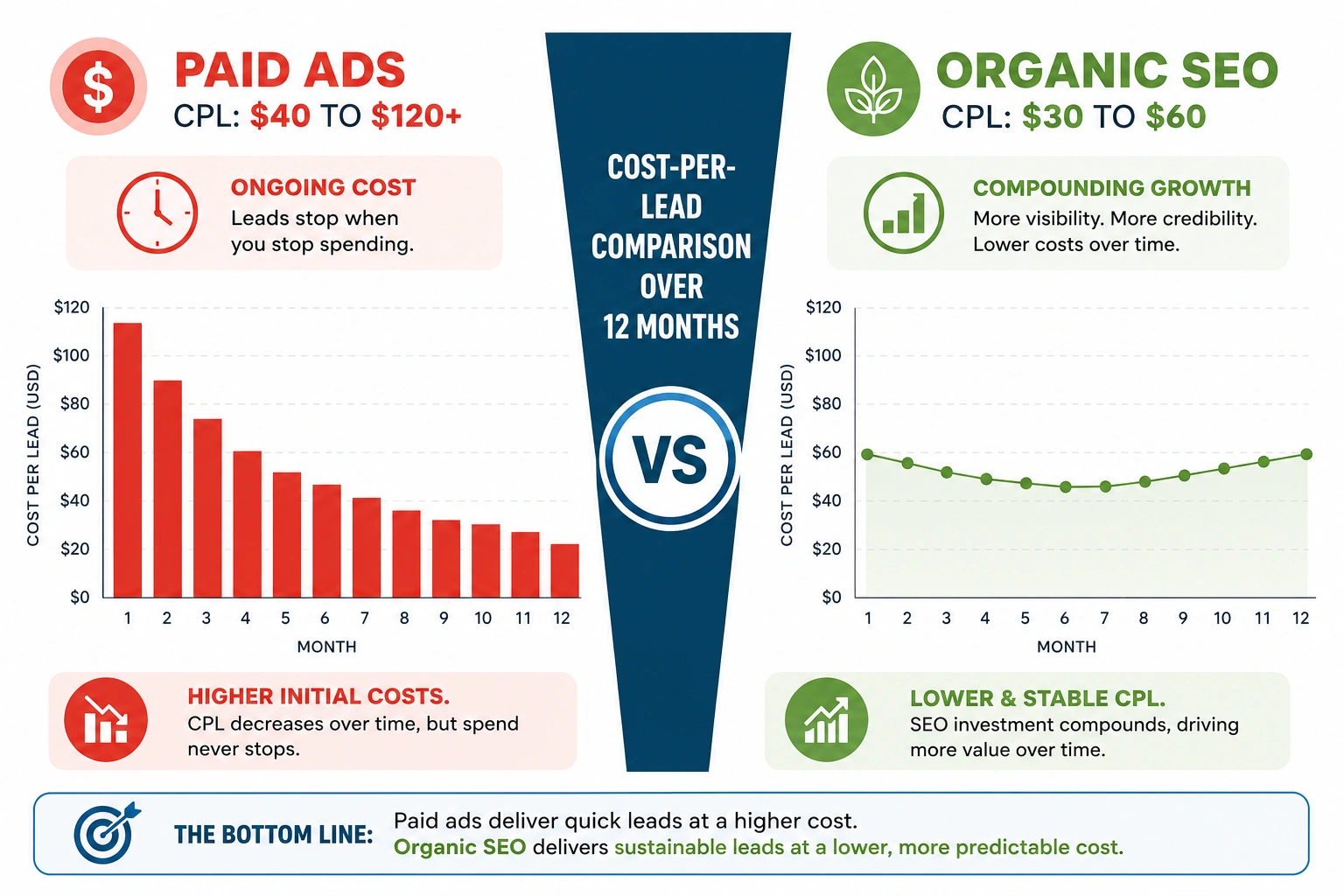
Paid ads deliver immediate leads but rising costs, while organic SEO compounds over time to lower cost per lead and improve ROI.
Standing Out in the Google Map Pack for Immediate Calls
Google Business Profile and Map Pack Optimization
The Map Pack is not a passive ranking. You must earn it. It rewards active, well-structured profiles with consistent signals, and it penalizes neglect with brutal efficiency. Getting this right starts with category selection: “Auto Glass Shop” as your primary category, and “Windshield Repair Service” as secondary. These aren’t interchangeable with generic automotive categories; they tell Google’s algorithm exactly what service you provide and which queries should trigger your listing.
NAP consistency (Name, Address, Phone) across every business directory website, citation source, and local listing is essential. A single inconsistency between your GBP listing and a Yelp entry can suppress your local search engine optimization services ranking in ways that take months to diagnose and fix. We recommend auditing every citation before you build new ones.
Online reviews are where most shops leave the most ground uncaptured. Email review requests convert at 2% to 7%. Automated SMS requests sent within 30 to 60 minutes of job completion achieve a 12% to 34% conversion rate, a gap that compounds dramatically over a year of consistent volume. A shop completing 15 jobs per week that switches from email to SMS follow-up could realistically generate 4x to 8x more reviews in the same period. Google Maps rankings respond to that signal directly. Reviews drive phone calls.
Understanding what an SEO agency does in the context of local map optimization goes well beyond profile setup. It includes ongoing citation management, review velocity monitoring, Q&A optimization, and photo cadence: the operational details that most shop owners don’t have bandwidth to maintain consistently while running a full service schedule.
Capturing High-Ticket Revenue with ADAS Calibration SEO
Calibration as a Revenue Category, Not an Add-On
The vehicle fleet has changed faster than most shops’ service menus. In 2016, roughly 25% of vehicles required safety camera recalibration after a windshield replacement. By 2023, that figure had reached 89%. ADAS calibration has become, as one industry analysis put it, a billion-dollar industry, and most independent shops are still treating it as a footnote on their services page.
A single calibration adds $150 to $600 in high-margin revenue to a job. A standard $350 glass replacement that includes ADAS recalibration becomes a $750 complete service. That’s not upselling; that’s accurately pricing a mandatory safety procedure. The advanced driver-assistance system in a modern vehicle is calibrated to the windshield’s optical properties; replacing the glass without recalibrating the forward-facing camera is a documented safety liability, and customers who understand that are willing to pay for the complete service.
The SEO impact is significant. Most competitors are still burying calibration under a generic “services” dropdown. Creating individual, technically optimized pages for ADAS calibration, explaining why it’s mandatory, which vehicle makes require it, and what the process involves, positions your shop as the category authority for those queries. Implementing specialized ADAS_Calibration service schema alongside that content gives search engines the structured signal they need to surface your pages for high-value, low-competition calibration keywords that your competitors aren’t even contesting.
Partnering with an automotive digital marketing agency that understands the technical depth of ADAS content is what separates shops capturing this revenue from those still pricing calibration as an afterthought.
Free Auto Glass Local SEO Audit
Find out exactly where your shop is losing ground to local competitors, and what it would take to close the gap. Free Auto Glass Local SEO Audit
The Compounding ROI of Organic Search Over Paid Ads
Organic Conversion Rates and Traffic Growth
Paid ads stop the moment the budget does. That’s not a criticism of paid search as a tactic; it’s a structural fact that shapes how you should think about budget distribution over a 24-month horizon. Organic search builds an asset. The content, the backlinks, the schema, the review velocity: these don’t disappear when you stop paying a platform. They compound.
The conversion data from mature organic campaigns supports this clearly. Only1 Auto Glass, a multi-location provider that committed to a dedicated organic strategy, achieved a 12% website-to-lead conversion rate, with 87% of total website traffic arriving through organic channels. The industry average for local service businesses sits around 3%. That four-fold gap isn’t explained by a better landing page or a more compelling offer; it’s explained by the quality of the traffic itself. Organic visitors who searched a specific, high-intent query and chose your listing over competitors are already pre-qualified in a way that paid clicks rarely are.
What works in practice in this category is a strategy built around search intent architecture: dedicated pages for each service, each geography, and each customer scenario, rather than a single homepage trying to rank for everything simultaneously.
Long-Term Cost Reduction and Net Profit Margins
Year one of an organic SEO campaign requires upfront investment without immediate relative return. That’s the honest framing, and any agency that tells you otherwise is selling you something. SEO takes time. The foundation, which includes technical audits, content architecture, citation cleanup, and schema implementation, takes time to index and accumulate authority. Most shops begin seeing meaningful Map Pack movement between months three and six, with organic traffic growth accelerating from month six onward.
By year two, the economics shift decisively. CPL in the $30 to $60 range, combined with the higher average ticket value from ADAS calibration jobs, produces net profit margins that paid-only strategies structurally cannot match. The shops that understand this invest in digital marketing SEO agencies as a capital allocation decision, not a marketing line item, since the return profile looks more like an owned asset than an advertising expense.
There’s a case to be made that the first 90 days of a combined paid-plus-organic strategy is the highest-leverage period: paid ads capture immediate emergency leads while the organic foundation is being built, then budget gradually shifts as organic begins to carry the load. That sequencing is what separates search engine optimization and digital marketing done strategically from either channel deployed in isolation.
“Moving into the top three Google Maps positions transformed our business. We went from chasing low-margin fleet work to booking 200+ high-ticket retail and ADAS jobs every single month on autopilot.”
Regional Auto Glass Shop Owner
Building Local Authority and Trust Signals
Local Citation Ecosystem and Backlink Strategy
Google’s local ranking algorithm treats third-party endorsements as a proxy for real-world credibility. Citations, which are consistent mentions of your business across local business directories, industry databases, and community organizations, tell the algorithm that your shop exists, operates at a specific address, and is recognized by other established entities. Backlinks from locally relevant sources carry that signal even further. They act as digital votes.
The most lasting local authority comes from relationships that make operational sense anyway: referral partnerships with nearby mechanics and auto body shops, membership in the local chamber of commerce, and sponsorships of community events. These aren’t manufactured link-building tactics; they’re the digital footprint of a business that’s genuinely embedded in its local market. A backlink from a local business directory or a chamber of commerce member page carries more geographic relevance than a generic citation from a national aggregator, and Google’s local algorithm weights that distinction.
The Half Price Auto Repair case study demonstrates how a structured local authority strategy translates into measurable ranking improvements for automotive shops operating in competitive urban markets. The pattern holds across categories: shops that build a dense, locally coherent backlink profile outperform competitors with higher domain authority but weaker geographic signal.
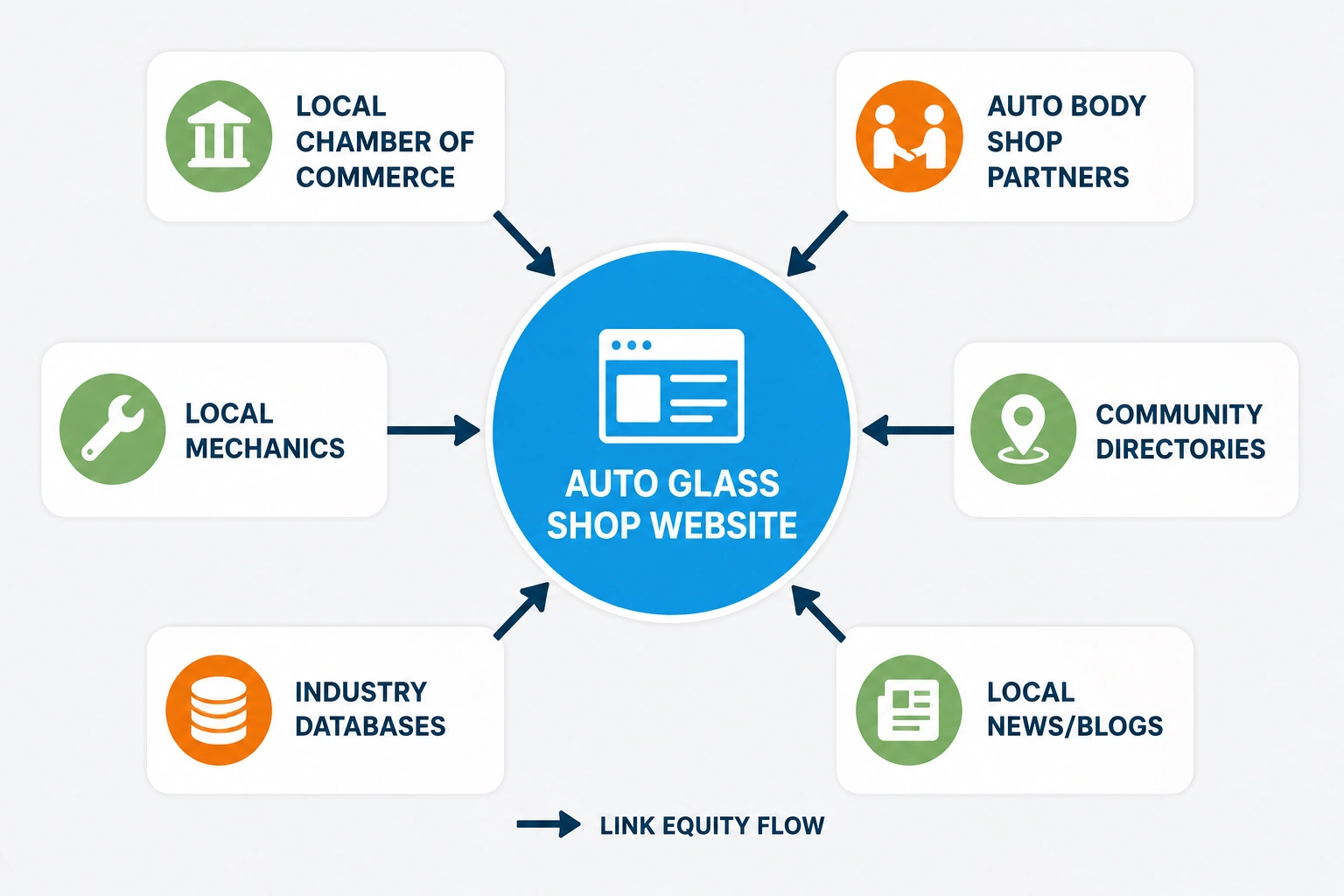
A strong local backlink network helps auto glass shops build authority, improve search rankings, and attract more local customers.
Competitor Backlink Analysis
See exactly where your local competitors are earning their authority, and identify the gaps your shop can move into first. Learn how partnering with the top SEO companies for collision repair can help you audit your market and outpace regional competition.
Technical SEO and Schema Markup for Search Engines
Structured Data: The Signal Layer Most Shops Skip
Schema markup is the layer of structured data that tells search engines what your content means, not just what it says. For auto glass shops, three schema types carry the most direct ranking and visibility impact.
LocalBusiness schema clearly communicates your operating hours, accepted payment methods, physical coordinates, and service radius to Google’s crawlers. Without it, the algorithm infers this information from unstructured text: a process that introduces ambiguity and ranking inconsistency. With it, your GBP and organic listings draw from a single, authoritative source of truth. It removes all doubt.
Service schema for specific offerings like “WindshieldRepair” and “ADAS_Calibration” enables rich snippet eligibility in search engine results pages. When a driver searches “ADAS calibration near me” and your listing returns with a structured service description and pricing range, the click-through rate differential over a plain blue link is substantial. This is also where keyword research search engine optimization and schema intersect most directly: the schema markup reinforces the on-page content signals that your target queries are built around.
Review schema pulls your aggregate star rating into the organic search listing itself. Shops with 4.7-star ratings displayed directly in results see meaningfully higher CTR than identical listings without visible ratings. Given that auto glass customers are making an urgent, trust-dependent decision, that visual credibility signal at the search engine optimization service near me query level influences booking behavior before the customer ever reaches your website.
New York SEO agencies and other regional specialists have documented the compounding effect of full schema implementation; it’s not a one-time technical task but an ongoing maintenance layer that requires updates as services, hours, and pricing evolve. The brief from regional specialists on schema maintenance cadence applies directly to auto glass shops operating in any competitive metro market.
Tracking and Measuring Your SEO Success
Key Performance Metrics and Analytics Setup
Visibility without measurement is just activity. The shops that scale their organic lead volume consistently are the ones tracking the right metrics at the right granularity: not just “traffic went up” but which keywords drove qualified visits, which pages converted, and where in the funnel the drop-offs are occurring.
Google Search Console is the starting point. Organic impressions and click-through rates for high-intent keyword clusters, such as “windshield repair near me,” “ADAS calibration [city],” and “auto glass shop open now,” tell you whether your content is surfacing for the right queries and whether searchers are choosing your listing when it appears. A high impression count with a low CTR usually points to a title tag or meta description problem, not a ranking problem. These are fixable with targeted copy revisions, not a full content overhaul.
Google Analytics layers behavioral data on top of that: which landing pages hold visitor attention, which ones lose traffic within ten seconds, and what the visitor-to-call conversion rate looks like across device types. Mobile performance deserves its own audit cadence given that the majority of urgent auto glass searches happen on phones, often in the car immediately after the damage occurs.
Call tracking from the Google Business Profile using UTM parameters closes the attribution loop. Without it, you’re crediting organic search for leads that may have originated from a GBP click, a Maps direction request, or a direct call button tap, all of which have different optimization implications. Knowing precisely which marketing touchpoint generated a booked job is what separates informed budget decisions from guesswork.
Frequently Asked Questions About Auto Glass SEO
Choosing the right agency partner is a high-stakes decision for any small business owner, and the specific questions they ask during that evaluation process reveal exactly where the real confusion lies. Most of the doubt isn’t about whether SEO works; the data on that is settled. It is. It’s about timeline expectations, scope of effort, and how organic strategy intersects with the specific revenue dynamics of auto glass.
How long does it take to see real results from auto glass SEO?
Initial local Map Pack improvements are often visible within 30 to 60 days of a focused Google Business Profile optimization. That is fast. A tailored organic SEO campaign, which includes deep content architecture, technical schema markup, and local citation building, typically requires 3 to 6 months to generate a steady, compounding volume of high-intent leads. The timeline isn’t random; it reflects how long Google’s algorithm takes to accumulate and validate the authority signals being built.
Can I handle my shop’s SEO on my own?
Basic tasks are genuinely manageable in-house: claiming your GBP, requesting reviews after jobs, and keeping your hours current. They take little time. The complexity rises sharply when you move into technical SEO, schema markup implementation, content creation for ADAS calibration pages, and local link building. These tasks are time-intensive and require ongoing expertise that most shop owners, running full service schedules, do not have the bandwidth to maintain at the level required to outrank well-resourced competitors.
Why is ADAS calibration so important for SEO?
ADAS calibration now represents 30% to 50% of a windshield replacement job’s total revenue, and most competitors are not optimizing for calibration-specific keywords. That gap is a clear opportunity. Do not ignore it. Shops that build dedicated, technically accurate calibration pages and implement the appropriate service schema are capturing high-value leads in a search segment where competition is still relatively thin, which means lower difficulty to rank and higher ticket value per conversion.
What is the difference between SEO and Local Service Ads (LSAs)?
LSAs are paid placements: “Google Guaranteed” listings at the very top of results where you pay per lead, with no ongoing equity built from that spend. You pay for every click. SEO is a long-term organic strategy that steadily gathers ranking authority over time, generating consistent visibility without a cost-per-click or cost-per-lead fee attached to each conversion. The two aren’t mutually exclusive; the most effective approach uses LSAs to capture immediate volume while organic SEO builds the long-term asset.
How does insurance coverage affect my SEO strategy?
A significant segment of auto glass searches are insurance-adjacent: customers trying to understand whether their full-coverage policy covers replacement, whether filing a claim will raise their premium, or which shops are approved by their carrier. These drivers have questions. Creating content that addresses the insurance claim process directly, and positioning your shop as a knowledgeable guide through it, captures high-intent searchers who are already committed to getting the work done and just need a trusted local shop to handle the paperwork.
Strategic Next Steps for Shop Owners
The shops that will stand out in their local auto glass markets over the next three years aren’t necessarily the ones with the largest fleets or the most bays. They’re the ones building organic search infrastructure now, while competitors are still burning budget on paid ads that stop working the moment the credit card is charged.
The path forward is sequential, not simultaneous. Start with a thorough audit of your current local search presence, evaluating GBP categories, NAP consistency across every citation source, review velocity, and whether your site has any schema markup at all. Most shops discover significant gaps in the first 30 minutes of that exercise. From there, the priority stack is clear: Map Pack optimization first for immediate call volume, ADAS calibration content second for high-ticket revenue capture, and technical schema implementation third to lock in the structured data signals that compound over time.
Auto glass SEO isn’t a set-and-forget channel. It requires the same operational discipline as running your service bays: consistent execution, regular audits, and adjustments when the data signals a change in direction. That’s precisely where standing beside you as a dedicated agency partner makes the difference between a strategy that stalls at month four and one that’s generating 200+ booked jobs per month by month twelve.
The logical next step isn’t a complicated one. It’s an honest look at where your shop currently ranks, what your competitors are doing that you’re not, and what a realistic 12-month organic growth plan would produce for your specific market. That’s a conversation worth having, and it starts with a single audit.
Schedule Your Strategy Call
Build your custom organic growth plan with a team that specializes in auto glass SEO, and start filling bays with high-intent leads that don’t disappear when the ad budget runs out. Schedule Your Strategy Call