In this guide, you’ll get straight answers to the questions that matter most before committing a marketing budget:
- How much you should realistically invest in search engine optimization, and what each price tier delivers
- The exact timeline required before organic inbound leads start arriving consistently
- How to evaluate automated local SEO models versus full-service agency retainers
- The technical foundations (schema, citations, and page speed) that determine whether any campaign succeeds or stalls
Running a pest control business leaves little room for vague marketing promises. You’re managing technicians, routing schedules, handling emergency calls, and trying to grow at once. The last thing you need is an agency pitching you a “black box” of digital activity with no clear connection to your phone ringing. This guide provides clear, data-driven answers to help you make informed decisions. You’ll find realistic benchmarks drawn from industry data, a clear breakdown of what different pest control SEO investment levels produce, and an honest account of how long organic search takes to build equity in your business. It is like building equity in a property: every month you put in work, you own more of the asset. SEO is not a monthly expense that disappears when you stop paying. Done correctly, it builds an owned digital asset that keeps generating leads long after the initial work is complete. It is a long-term asset.
Local SEO, which means optimizing your online presence so local customers find you first, is less about chasing abstract rankings and more about capturing demand that already exists. When a homeowner discovers termites in their crawl space at 9 PM, they don’t search for a brand name. They type “termite treatment near me” or “exterminator near me” and call whoever appears at the top of the results. That moment of high-intent, emergency-driven search is where local SEO for pest control does its work, connecting an active, ready-to-buy searcher with your business before they ever consider a competitor.
Why Local Search Visibility is Vital for Pest Control Operators
The Dominance of Local Search Behavior
The scale of local search activity is worth sitting with for a moment. Approximately 46% of all online search is local search, and 97% of consumers search online to find local businesses rather than consulting print directories or physical ads. For a pest control operator, those figures aren’t abstract marketing statistics: they represent the primary channel through which your next customer is looking for you right now. Local search visibility isn’t a competitive advantage; it’s the baseline requirement for operating a visible business in your market.
The Reality of Unbranded Queries
Unbranded local searches account for 81% of all local search activity, meaning the vast majority of people searching for pest control services are typing phrases like “pest control services near me” or “pest and rodent control near me”, not your company name. That figure has a direct result: if your brand isn’t ranking for those generic, service-specific queries, you are structurally invisible to 81% of your addressable market. No amount of branded awareness advertising compensates for that gap. You miss out. Inbound lead generation at scale requires owning the unbranded search terms your potential customers use before they know who you are.
Organic search compounds in a way that outbound channels simply don’t. Direct mail generates responses during the campaign window and then stops. The leads dry up. Pay-per-lead platforms charge a continuous toll for access to customers you never own. Organic search engine optimization, by contrast, delivers a measurably lower cost per acquisition compared to those outbound channels, a dynamic well-documented across the broader home services sector. Every piece of optimized content, every citation corrected, every technical fix applied accumulates into an asset that keeps working. The economics shift over time in your favor, which is precisely why operators who commit early tend to widen their lead gap against competitors who keep renting.
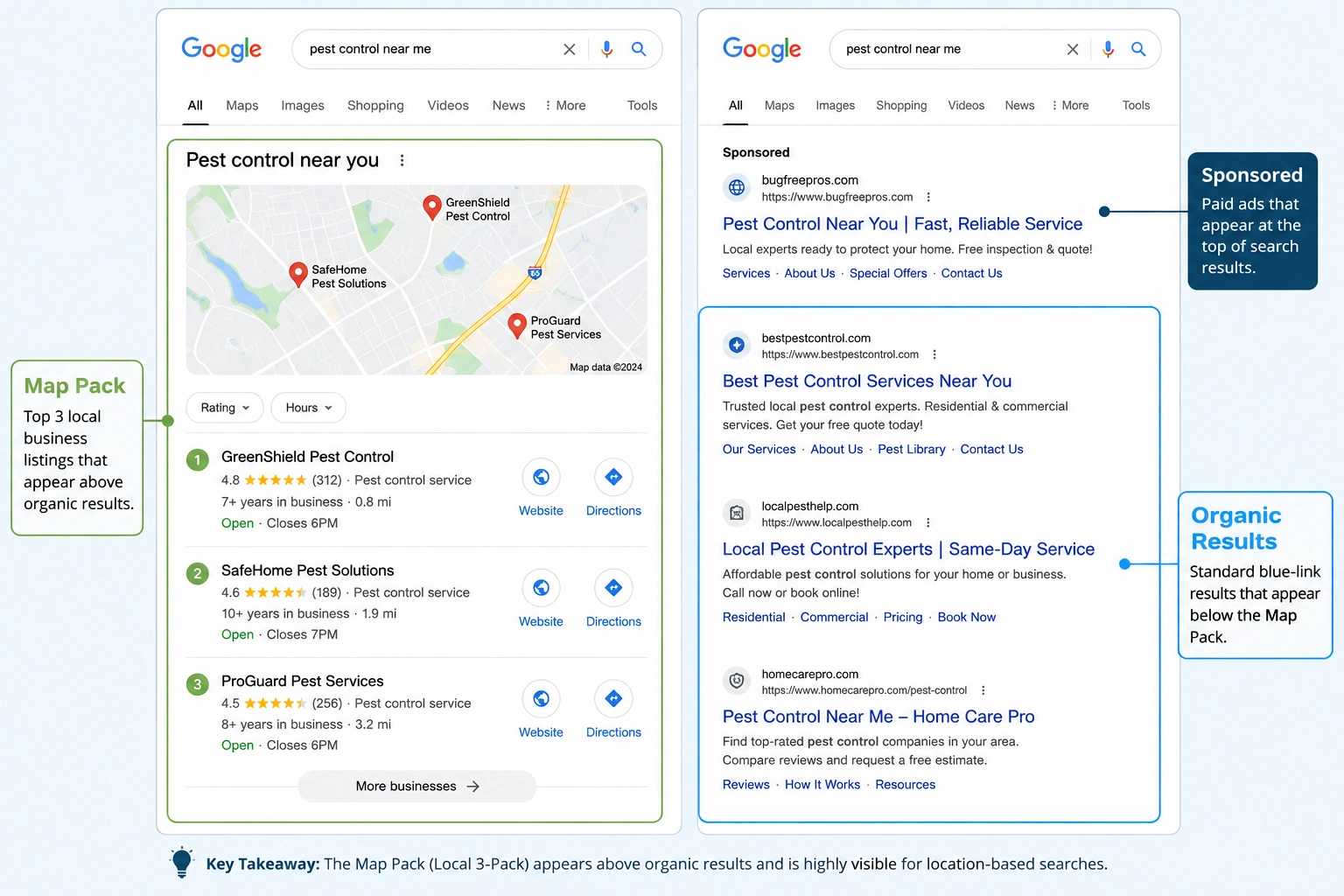
See how Google’s Local Map Pack, sponsored ads, and organic results appear for a “pest control near me” search.
Demystifying the Cost: What Does Pest Control SEO Cost?
Pricing in this space spans a wide range, and the gap between tiers reflects genuine differences in scope, not just margin. Understanding where each model sits helps you match investment level to your current business stage.
Entry-Level and Automated Local SEO Models
Entry-level automated local search products can carry a retail price of approximately $375 per month, typically with zero setup fees. These pricing standards are designed for single-location operators who need to establish a baseline local footprint quickly: automated directory distribution, citation management, and basic local presence signals. They won’t win you a competitive metro market, but they’re a legitimate starting point. Start simple.
Enterprise and Full-Service Agency Retainers
Enterprise-level local SEO solutions generally range from $500 to $2,000 per month, while full-service digital marketing agencies typically charge monthly retainers from $1,000 into the tens of thousands, often accompanied by setup fees of several thousand dollars. SEO freelancers generally start around $500 per month for manual, localized campaign management. The full-service tier buys you custom content strategy, dedicated account management, and active link acquisition, capabilities that matter significantly in dense competitive markets.
Choosing the right tier by business stage:
- Automated Local SEO (~$375/mo): Best fit for new operators or single-territory businesses needing fast local directory setup and citation coverage without a large upfront commitment.
- Enterprise Local SEO ($500 to $2,000/mo): Built for established operators targeting multiple local markets simultaneously, where consistent ranking across service areas requires more structured campaign management.
- Full-Service Retainers ($1,000+/mo): Appropriate for multi-location brands that need custom content marketing, advanced link building, dedicated account management, and competitive overtaking strategies.
- The Role of Content Regardless of Tier: No pricing model compensates for a thin website. Your pest control website SEO must prioritize service-by-city pages to rank effectively. Pages drive rankings. A five-page site will not compete against a competitor with fifty targeted landing pages, regardless of how much you spend on citations.
Setting Realistic Timelines: When Will Your Phone Start Ringing?
The Traditional Organic Timeline
If you are asking, “How long until I see results?” or “What’s realistic?”, the answer depends on the path you choose. Traditional agencies and SEO freelancers consistently set expectations of achieving tangible organic results within six to twelve months of campaign launch. That window is driven by Google’s indexing cycles, the gradual accumulation of domain authority, and the time required to build a credible local link profile. It’s not a stalling tactic: it reflects how search engines process and reward new content and signals. Search takes time. Google changes the rules regularly, like a city updating zoning laws: but the fundamentals of being findable stay the same. The compounding value of organic SEO means that while month three may show modest traction, month eighteen often produces a cost-per-lead that no paid channel can match.
The Automated Local SEO Timeline
Automated local SEO platforms utilizing programmatic landing pages can demonstrate measurable local search impact within 30 days of launch. That speed comes from the speed of templated, geo-targeted page creation rather than the slower process of building editorial authority from scratch. It works fast. The practical implication: a well-structured campaign often combines rapid-launch local landing pages to capture immediate search prominence while the longer-term authority work builds in parallel.
A realistic month-by-month roadmap for a standard pest control SEO campaign:
- Month 1: Technical foundation work, including LocalBusiness schema launch, page speed optimization, mobile performance audit, and a complete Google Business Profile review.
- Months 2 to 3: Citation cleanup across local directories, initial keyword research targeting service-by-city combinations, and creation of core landing pages.
- Months 4 to 6: Local link building begins, content marketing produces secondary keyword traction, and early ranking movement becomes measurable.
- Months 6 and beyond: Lead volume scales, conversion rate optimization refines the funnel, and the compounding ROI curve begins to steepen meaningfully.
Tired of being locked into rigid, 12-month marketing contracts that don’t deliver?
At BizIQ, we operate on a flexible, month-to-month basis because we believe in earning your business every single month through transparent execution and measurable lead growth. No long-term lock-ins. No opaque retainers. Just clear work tied to real results. Call us at (888) 416-9800 or visit us at 3627 E Indian School Rd Suite 103, Phoenix, AZ 85018.
Why Page-One Rankings Are Essential for Survival
The Danger of Page Two
More than 95% of consumers are more likely to enter a new search query than to click through to page two of search results. That number reframes what page-one ranking means for a local service business. It’s not a performance milestone: it’s the threshold between existing in the market and being functionally absent from it. Searcher behavior doesn’t give second chances to businesses buried on page two; users simply reformulate their query or call whoever they already see.
Dominating the Google Local 3-Pack
The Map Pack, the three-business block that appears above organic results for queries like “pest control exterminator near me”, captures a large share of high-intent clicks. Ranking there requires a fully optimized Google Business Profile, citation consistency across directories, and a sustained volume of positive local reviews. Organic rankings and Map Pack visibility aren’t competing strategies; they’re complementary positions on the same search results page, and occupying both maximizes the local real estate available to your business.
Page-one real estate is zero-sum. Every position your business gains comes at the direct expense of a competitor who loses it. You might ask: “Can I compete with the big companies?” National directory sites, such as Yelp, Angie’s List, and HomeAdvisor, often crowd the top organic slots for broad queries, which can feel discouraging. The counter-strategy is precision: hyper-local, service-specific pages that target queries national directories rarely bother to build dedicated content for. A page targeting “rodent control in Chandler AZ” competes in a narrower pool than “pest control near me,” and the operators who build those pages methodically accumulate positions that aggregate into dominant local coverage.
Long-tail, service-specific queries carry a different quality of intent than broad category searches. A homeowner searching “pest control services for bed bugs” has already identified the problem, assessed severity, and decided to act. That search is not exploratory; it is transactional. Ranking for those terms captures users at the exact moment of decision, which translates to higher conversion rates and lower cost per booked appointment than almost any other digital channel. The search volume is smaller, but the lead quality is substantially higher. They are ready.
“The professional team at BizIQ is AWESOME. They have been very attentive to my business objective and understand the complexities of my marketing challenges. Search results are always top tier. Money very well spent.” – Robert N
Technical Foundations: Setting Up Your Campaign for Success
Consistent Citation Management
Citation management (maintaining accurate, consistent business name, address, and phone number (NAP) data across Google Business Profile, Yelp, Yahoo Local, and dozens of secondary directories) is the structural bedrock of local search prominence. Inconsistent NAP data doesn’t just create confusion for customers; it introduces conflicting signals that search algorithms interpret as unreliability, actively holding back your local rankings. Regular audits aren’t optional maintenance; they’re a continuous requirement as directories update, merge, or introduce errors independently.
Page Speed and Schema Deployment
Page load speed directly influences search algorithm performance: fast-loading pages improve both user experience and conversion rates, and Google’s ranking systems treat mobile page speed as a meaningful quality signal. Schema markup, specifically LocalBusiness schema, functions as a structured data layer that tells search engines your business hours, service areas, and service categories in a format they can parse without ambiguity. Think of it as a digital business card written in the language search engines read, rather than the language your customers see.
Some owners ask: “Is SEO worth it for a small pest control company?” Yes, but only if the technical foundation is solid. Speed matters. A content marketing campaign running on a slow, poorly structured website wastes your budget because visitors leave before your pages can load. Link building, content creation, and citation management all produce diminished returns when the technical foundation is weakened. Most local pest control websites have at least two or three correctable technical issues, such as schema gaps, render-blocking scripts, or uncompressed images, that are holding back rankings independent of any content or authority work. Fixing those issues first is not glamorous, but it’s often the highest-leverage action available in the first thirty days of a campaign. Do it first. And given that most local searches happen on mobile devices while users are actively in problem-solving mode, a site that loads in under two seconds on a phone is a competitive advantage, not a baseline expectation.
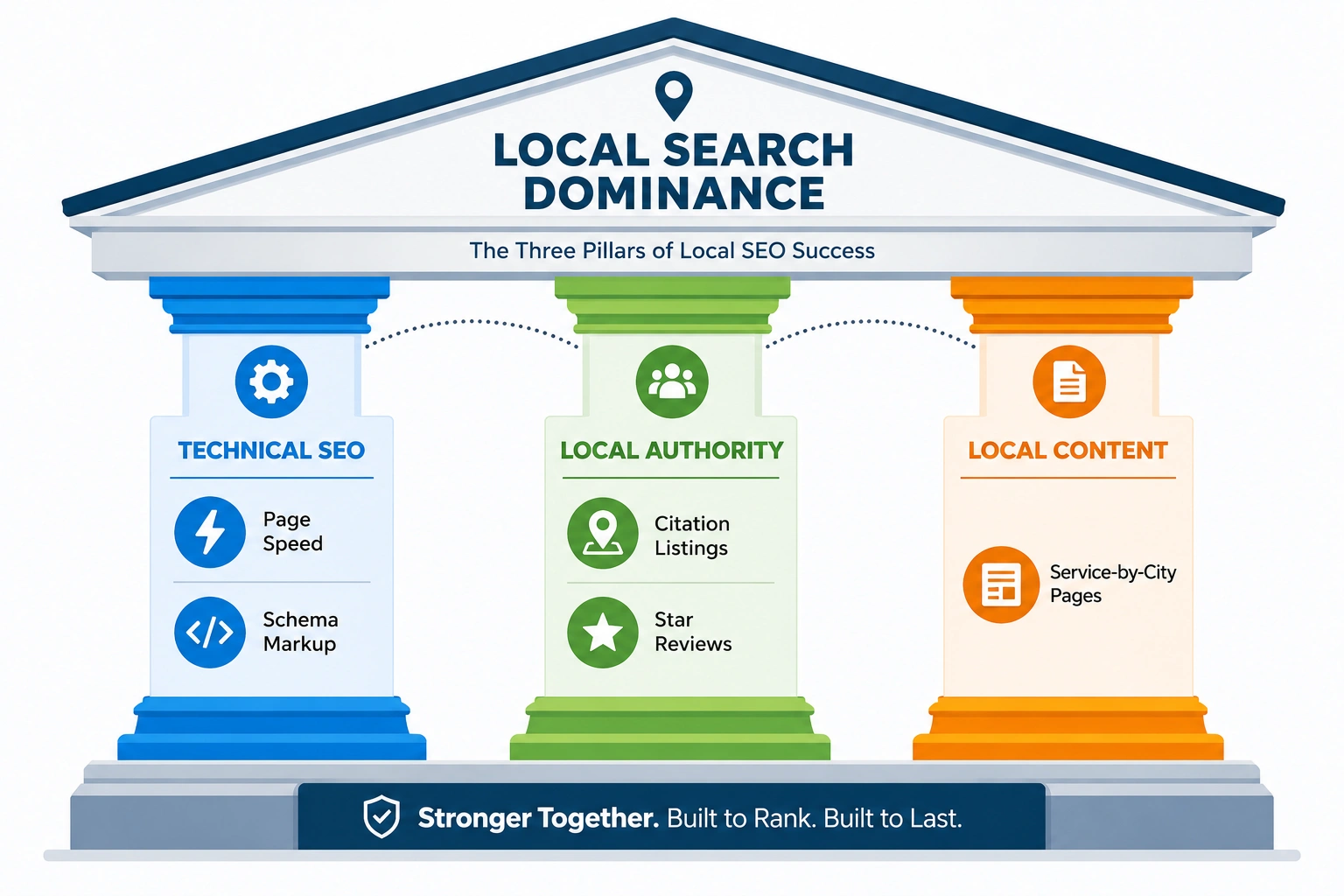
Local search dominance is built on three connected pillars: Technical SEO, Local Authority, and Local Content.
Want to see where your business stands right now?
Request a free, thorough local SEO audit. We’ll identify critical technical errors holding you back and reveal the exact gaps between your site and your top three local competitors, with no obligation and no sales pressure. Call (888) 416-9800 or visit BizIQ at 3627 E Indian School Rd Suite 103, Phoenix, AZ 85018.
The Service-by-City Matrix: Expanding Your Local Footprint
Calculating Your Ranking Gap
If you are wondering, “What do I need to do?” to scale, local search dominance is, at its core, a page-building exercise. The logic is straightforward: ranking for multiple services across multiple cities requires a dedicated page for each service-city combination. The formula is simple: Core Services × Target Cities = Required Pages. Five core services across ten target cities produce fifty required landing pages. The math is clear. A five-page website competing against a competitor with fifty targeted pages isn’t losing because of a technical error or a weak link profile; it’s losing because the page-count gap makes full ranking coverage structurally impossible. The service-by-city matrix is how operators close that gap systematically. It works.
Programmatic vs. Manual Local Content
Programmatic local SEO uses automated, template-driven landing pages to target hundreds of micro-locations rapidly and cost-effectively. Manual optimization produces deeply customized local content that builds stronger long-term authority and reader trust, but requires proportionally more time and budget. There’s a legitimate case for both approaches, and an equally legitimate case for combining them. Programmatic pages capture the geographic coverage quickly; manual content builds the editorial depth that sustains rankings under algorithmic review. Neither approach is universally superior; the right balance depends on your market’s competitiveness and your timeline. You can’t expect one flyer to bring calls forever: you need to keep showing up with fresh local coverage.
A concrete Service-by-City matrix example for a Phoenix-area pest control operator:
- Core Services: Termite Treatment, Bed Bug Removal, Rodent Control, Mosquito Control, General Pest Prevention
- Target Cities: Phoenix, Scottsdale, Tempe, Mesa, Chandler
- Resulting Pages: 5 Services × 5 Cities = 25 highly targeted landing pages, each optimized for local search intent (e.g., “termite treatment in Scottsdale,” “bed bug removal in Mesa,” “rodent control in Tempe”)
- Each page targets a distinct, rankable query, building a coverage map that compounds as pages build up authority over time
The Future of Search: Generative Engine Optimization
The Rise of AI Search
The search landscape is shifting in a direction that most local operators haven’t fully accounted for yet. McKinsey research indicates that approximately 50% of Google searches already feature AI summaries, with that figure expected to exceed 75% by 2028 (McKinsey). Generative engine optimization (structuring your content and authority signals to appear within those AI summaries) is becoming a parallel practice to traditional keyword ranking. The businesses that get cited by large language models as authoritative local sources will capture a disproportionate share of future search traffic, regardless of where they rank in the traditional blue-link results.
Optimizing for LLMs and Brand Mentions
Large language models pull their local business recommendations from the same sources that traditional SEO has always prioritized: authoritative directories, structured schema data, high-volume positive reviews, and website content that answers specific user queries directly and completely. The practical implication is that the foundational work of local SEO, including citation accuracy, review generation, and schema deployment, is simultaneously the foundation for AI search visibility. There’s no separate AI strategy to build from scratch; there’s an extension of the same disciplined local presence work, applied with the additional goal of being cited rather than just ranked.
Preparing for generative search today doesn’t require abandoning what already works. Keep it simple. AI engines verify business facts against structured data: correct schema markup and consistent directory listings make it easier for those systems to surface your business as a credible local recommendation. The operators who treat citation management and review generation as ongoing operational priorities, rather than one-time setup tasks, are already building the infrastructure that AI search rewards. Start now.
Outcome-Based Pricing vs. Retainers
The Shift Toward Outcome-Based Models
When deciding on a marketing budget, you have to ask: “How much does it cost?” and how do those costs scale over time? There is a growing movement toward outcome-based pricing in digital marketing: models where operators pay only for guaranteed search rankings or verified lead generation rather than a fixed monthly fee (Deloitte). The appeal is obvious: you pay for results, not activity. The complications are less obvious. As lead volume scales, outcome-based costs can escalate rapidly, and disputes over lead quality, such as what counts as a qualified inquiry, require clear, audited tracking infrastructure that many small operators don’t have in place. The model shifts risk from the operator to the agency at the outset, but that risk transfer has a price that compounds over time.
The Stability of Flat Monthly Retainers
Flat monthly retainers offer something outcome-based models structurally cannot: predictable marketing investment that aligns agency incentives with long-term authority building rather than short-term lead volume. The legitimate concern is paying a retainer through the initial setup phase before results materialize. This is a real friction point, particularly for operators who’ve been burned by agencies that collected fees without delivering movement. The solution is choosing a partner with transparent, month-to-month terms rather than locking into a 12-month contract that insulates the agency from accountability.
For most local pest control operators, a transparent flat-rate monthly model with flexible terms offers the most workable balance of cost predictability and performance accountability. Avoid agencies that require long-term contract commitments paired with large setup fees: that structure protects the agency, not your business. The more important factor is whether your partner is building owned assets (optimized pages, citations, reviews, authority) or renting temporary visibility that evaporates when you stop paying. A compounding strategy builds long-term equity, while temporary visibility requires continuous spending.
Frequently Asked Questions About Pest Control SEO
These are the questions pest control operators ask most consistently when evaluating search engine optimization as a marketing channel. Each answer is written to give you a concrete takeaway, not a hedge. No fluff. These frequently asked questions reflect the real operational and strategic concerns that come up before a decision gets made, and they’re worth working through before you commit budget anywhere.
What is the hardest pest to get rid of?
Bed bugs are widely considered the most difficult pest to eliminate due to their ability to hide in tiny crevices, their resistance to many insecticides, and their rapid reproduction cycle. From an SEO perspective, that high difficulty level translates directly to high search volume and intense competition for terms like “bed bug removal” and “pest control services for bed bugs.” If you offer bed bug treatments, having dedicated, highly optimized service pages for those queries is critical to capturing these high-value leads, and it’s one of the clearest cases where a single well-built page can generate a significant return on its own.
What are the three C’s of pest control?
The three C’s of pest control are typically identified as Control (the treatment method), Containment (limiting the infestation), and Cleanup (sanitizing and removing waste). In digital marketing, the same framework maps cleanly onto your online presence: Control your local directory data so search engines trust your NAP consistency, Contain your local market by out-ranking competitors on the service-city queries that matter most, and Clean up your technical website errors to ensure a smooth user experience that converts visitors into booked appointments.
Will pest control be replaced by AI?
AI will likely assist pest control through better monitoring, predictive analytics, and automated drone or robot deployment, but the physical removal and management of pests still requires human technicians. The more pressing concern for operators isn’t whether AI replaces their workforce; it’s whether AI search summaries replace their visibility. Visibility is key. Optimizing your online presence for AI-generated search results is essential to ensure your company remains the top recommendation when a homeowner asks an AI assistant for a local exterminator.
How much does an SEO agency cost?
Costs vary widely based on scope. Traditional digital marketing agencies typically charge between $1,500 and $5,000 per month for retainers, or $100 to $250 per hour for project-based consulting. For local pest control operators, automated local search products starting at $375 per month offer a highly cost-effective entry point to establish strong local search prominence without the enterprise price tag, particularly for single-location operators who need foundational coverage before scaling into a complete campaign.
What is the 80/20 rule in SEO?
The 80/20 rule, the Pareto Principle applied to search, suggests that roughly 80% of your website’s traffic and leads will come from 20% of your keyword-optimized pages. For pest control companies, that means a concentrated set of high-intent service-by-city pages (like “termite treatment near me” or “rodent control in [city]”), will drive the vast majority of your phone calls. Identifying and prioritizing those high-leverage pages first, rather than building content uniformly across every possible topic, is how operators maximize return on investment before expanding their content footprint.
Organic search is not a campaign you run and then evaluate. It’s an infrastructure investment that builds compounding value over time, one that becomes more defensible, more cost-efficient, and more difficult for competitors to displace the longer it runs. The operators who treat it as a temporary expense tend to restart from zero every few years; the ones who treat it as an owned asset tend to widen their market lead steadily. If you’re ready to stop paying a continuous toll to lead rental platforms and start building something your business owns, the next step is a conversation about where your current presence stands and what it would take to close the gap. Contact BizIQ to speak with a local marketing specialist about a customized strategy for your market.
Ready to see how your website stacks up against the competition?
Claim your free SEO audit today. Our team will analyze your local search rankings, identify critical technical errors, and show you exactly what it takes to dominate your local market, with no commitment required.
Call (888) 416-9800, BizIQ, 3627 E Indian School Rd Suite 103, Phoenix, AZ 85018.