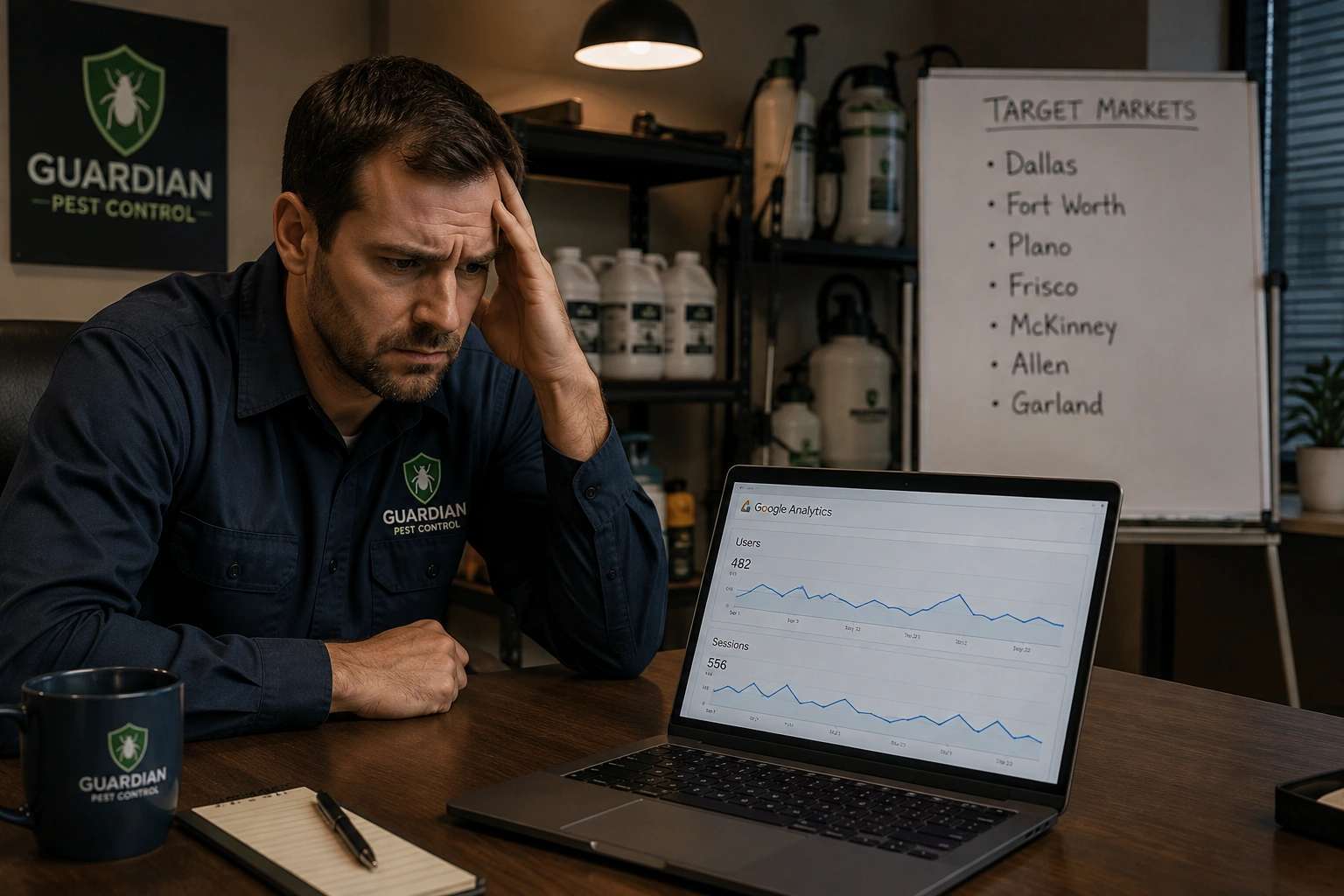
A pest control business owner reviews disappointing website traffic while trying to reach customers across multiple local markets.
Key Takeaways
- Identify critical website issues, duplicate content errors, and faulty local listings that are currently blocking your business from ranking in search results for local customers searching.
- Learn how to structure unique local pages to avoid search engine filters and capture high-intent local traffic searching for terms like “pest control exterminator near me” or “pest and rodent control near me.”
- Discover the impact of Google Business Profile map pins and address settings on local map pack rankings: and what a misplaced pin is costing you.
- Understand the role of customer reviews, including review velocity and recency, in maintaining consistent search visibility, and why your total review count matters far less than you probably think.
- Find out when to partner with a professional
pest control seo companyto resolve complex technical bottlenecks that no amount of DIY tinkering will fix.
Your trucks are ready. Your technicians are trained. Your service area is defined. Yet the phone isn’t ringing the way it should, the schedule has gaps, and your competitors, some of whom you know are running leaner operations, keep showing up above you in Google’s local results and in AI searches. That gap rarely comes down to service quality or effort. It comes down to a set of pest control SEO mistakes in the form of technical and structural problems embedded in your website and local listings that are actively suppressing your visibility, and most owners never know they exist.
Every issue covered here is a concrete, diagnosable error with a practical solution. The goal is to give you a clear picture of what’s broken and exactly what to do about it.
Why local SEO is the lifeblood of pest control
Roughly 1 in 3 searches on Google carry local intent (moz.com). For a service category like pest control, where urgency is high, the decision window is short, and customers are not comparison shopping for weeks: that local search moment is often the only moment. A homeowner who finds a cockroach infestation at 9 p.m. is not reading blog posts. They are typing “cockroach pest control near me” and calling the first credible result they see.
That commercial reality is what makes SEO for pest control company websites essentially different from general content marketing. The customer is already motivated. Your job is simply to show up in search results when they search. Successful pest control company SEO rests on three pillars: clean site architecture that search engines can crawl without confusion, unique local content that earns topical authority in each service area, and consistent citation data that confirms your business is legitimate and geographically relevant.
The five mistakes below are the most common structural failures that collapse one or more of those pillars. Each one is diagnosable, fixable, and, if left unaddressed, genuinely expensive in lost leads.
Duplicate content on local city pages
The trap of cookie-cutter location pages
The logic seems reasonable at first: you service twelve cities, so you build twelve city pages, swap the city name into the template, and publish. Fast, scalable, done. The problem is that Google’s crawlers read those pages as near-identical documents, and near-identical documents get filtered out of search results to protect the user experience.
Copying testimonials verbatim from your Google Business Profile or Yelp onto your website compounds the problem. That content already exists at a known URL, and republishing it word-for-word creates duplicate content that prevents those pages from ranking organically. Think of it like registering two different addresses for the same business: Google gets confused about which one is authoritative, and in that confusion, both lose ground.
How search engines treat content overlap
Search engine crawlers are designed to surface the most relevant, unique result for any given query. When they encounter multiple pages with significantly identical text, even if the city name changes, they suppress the duplicates. The practical outcome is that your page targeting “pest and rodent control near me” in a specific suburb never surfaces, because the crawler has already indexed a nearly identical version of it for a different city and treats the second as redundant.
This dilution of authority is cumulative. Every duplicate page you publish draws crawl budget away from your genuinely unique content and signals to Google that your site is thin. For high-intent queries like “pest control services for bed bugs” or “exterminator pest control services,” that signal actively works against you.
Writing unique local content for each service area
The fix requires genuine investment in each city page, but the structure is replicable once you establish it. Each service area page needs locally specific content: references to pest pressures particular to that region, testimonials sourced from customers in that specific city (not copy-pasted from your GBP), localized pricing context, and service descriptions that reflect the environmental conditions of that market. A pest control company offering bed bug treatments, for instance, should build out localized bed bug pages for each market: pages that reference local housing stock, seasonal patterns, and area-specific service details.
This approach does more than satisfy a crawl filter. It builds topical authority by demonstrating genuine expertise in each geography, which is precisely what earns rankings for terms like “bed bug pest control services” in a specific city. For a deeper breakdown of how to architect these pages correctly, the resource on avoiding duplicate content filters covers the structural logic in detail.
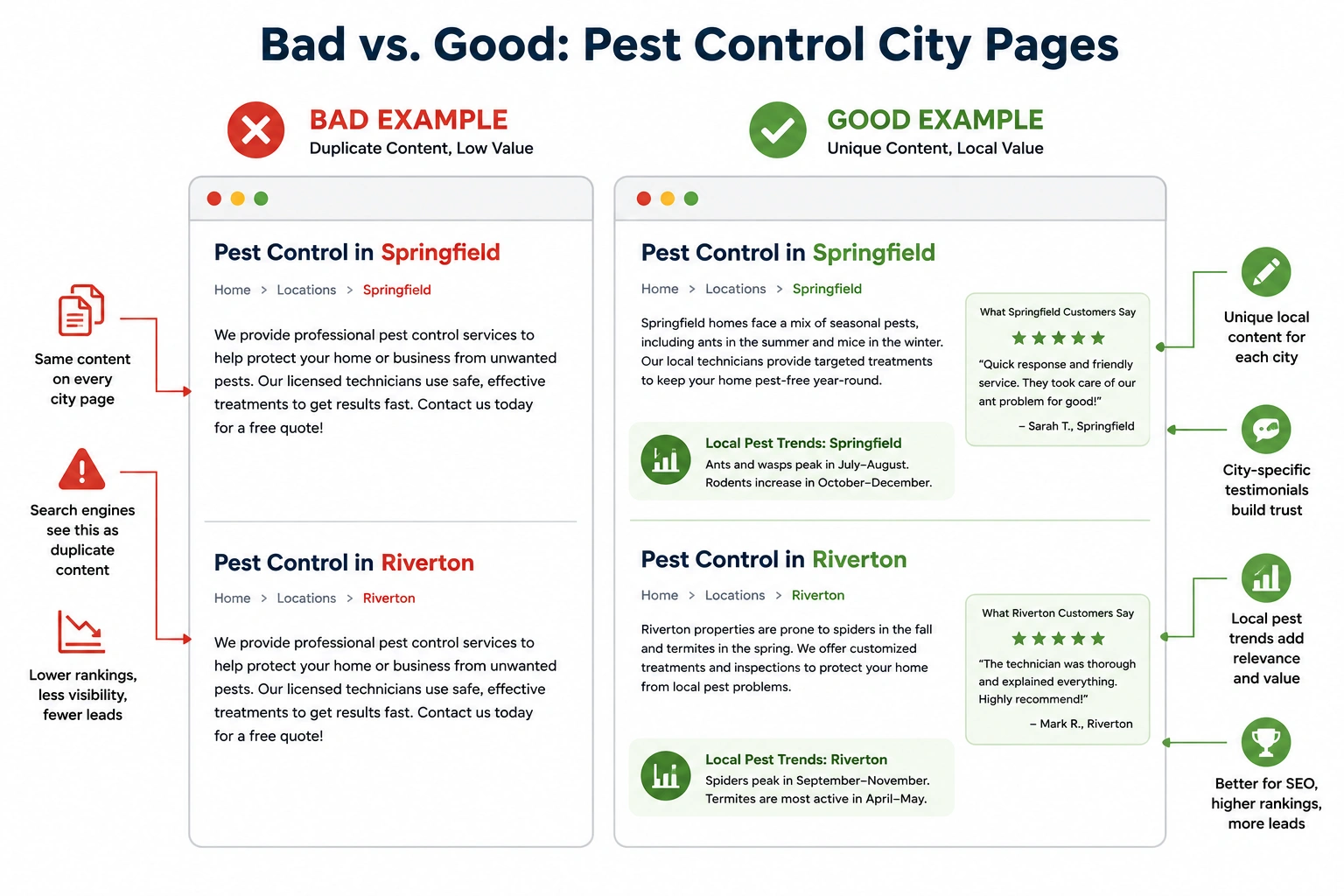
Unique city pages with local insights, pest trends, and testimonials provide more SEO value than duplicate location content.
Incorrect Google Business Profile map pins and address settings
The geography of local rankings
Google’s definition of city boundaries on Google Maps is not static. Municipal lines get redrawn, new neighborhoods get reclassified, and the algorithm recalibrates what it considers “inside” a given city. If your map pin falls outside the official city borders, even by a few blocks, your rankings for location-specific keywords will drop significantly compared to competitors whose pins sit inside those borders.
This is one of the more counterintuitive ranking factors in local SEO because the business may be operating perfectly well in that area, serving customers daily, and still losing map pack visibility purely due to a geographic technicality. The algorithm doesn’t know your service radius. It only reads coordinates. It knows where your pin is.
How to confirm and correct your map pin location
- Open Google Maps and search for your target city by name. Switch to the satellite or boundary view to see where the official city limits fall.
- Log into your Google Business Profile dashboard and pull up the map pin placement. Compare it against the city boundary you just identified.
- If the pin sits outside the boundary and you can move it to a legitimate location inside the city (your actual office, a registered address, or a verifiable service location), do so. If the gap is substantial, establishing a legitimate office address inside the target city is the compliant path forward.
- Audit this for every city where you have a GBP listing, not just your primary location. A single misplaced pin in a high-revenue service area can represent a substantial loss of inbound calls.
- Thorough Google Business Profile optimization covers pin placement as one component of a broader set of settings that collectively determine your map pack eligibility.
Appearing in the local Map Pack, the three-business cluster that appears above organic results, is the single highest-value placement in local search for pest control. A misplaced pin is a structural barrier to that placement, and it’s one most owners don’t know to check.
Inconsistent NAP data and call tracking errors
The confusion of mismatched business information
NAP (Name, Address, and Phone number) functions as your business’s identity signal across the web. When that identity is inconsistent across directories, Google’s local algorithm treats the mismatches as ambiguity, and ambiguity reduces trust. Reduced trust means lower rankings.
Call tracking creates a specific version of this problem. The desire to measure lead sources is completely valid, but using a tracking number as your only listed phone number, or listing different tracking numbers across different directories, fragments your NAP signal. The local search environment is already demanding: 62% of marketers say local search is getting harder. Introducing NAP inconsistencies into that environment is the equivalent of filing paperwork under two different business names and expecting the system to reconcile them automatically.
If your GBP shows “123-4567” and your Yelp listing shows “555-123-4567,” search engines treat those as two different businesses. Neither gets the full authority signal it deserves.
Best practices for NAP consistency and call tracking
- Maintain identical NAP data (exact name formatting, address structure, and phone number) across every major directory: Google, Yelp, Bing Places, Apple Maps, and any industry-specific directories you’re listed in.
- Add your dedicated call tracking number as the primary number on your Google Business Profile. This preserves your measurement capability.
- Add your true local number as the secondary number on the GBP listing. This prevents Google from automatically overwriting your tracking number with a number it finds elsewhere on the web.
- Run a full citation audit at least twice per year. Old phone numbers, previous business names, and outdated directory listings accumulate in directories over time and actively erode your local authority.
- Clean data is a compounding asset. Every consistent citation across the web reinforces the same identity signal, and that reinforcement is what builds the local trust score that drives map pack and organic rankings.
Is your pest control business invisible on Google Maps?
Stop guessing why your competitors are getting all the local calls. Get a free SEO audit, a zero-obligation, real-time look at your local search health, listing inconsistencies, and Google Business Profile performance.
Neglecting service-specific landing pages
The failure of homepage-only targeting
A homepage is structurally unable to rank for every service you offer. It carries too many competing signals, too little topical depth on any single subject, and too broad a keyword footprint to satisfy the specificity that Google’s algorithm rewards for transactional queries. The data makes this concrete: “termite treatment” generates an estimated 33,000 monthly searches in the US with a Keyword Difficulty score of 41 out of 100 (ahrefs.com). A homepage targeting that term alongside ant control, rodent control, and bed bug services simultaneously will not rank for any of them at a competitive level.
Search engines match specific queries to specific pages. When a homeowner searches “pest control services for bed bugs,” Google is looking for a page that is focused entirely on bed bug pest control services, not a homepage that mentions bed bugs in a bullet point.
The structure of high-converting service pages
Each service page needs a clear hierarchy: a primary heading that matches the search intent, a service description that goes beyond generic copy, pricing guidance (even if it’s a range or a “starting from” figure), and localized FAQs that address the questions your technicians hear in the field. Mobile optimization is non-negotiable here; emergency pest searches happen overwhelmingly on phones, and a page that loads slowly or renders poorly on mobile loses the conversion before it starts.
Creating dedicated landing pages for ant control, rodent control, termite treatment, bed bug services, and cockroach pest control, each built around the specific commercial keywords for that service, is how you capture the high-intent traffic that converts directly into booked jobs. These aren’t content marketing pages. They’re commercial assets.
Enhancing local relevance on service pages
Service pages gain additional ranking power when they incorporate local signals beyond just the city name. Referencing the pest pressures specific to your region, seasonal rodent migration patterns, the humidity conditions that accelerate termite activity, and the housing types most susceptible to bed bug introduction demonstrates geographic expertise that generic service descriptions cannot mirror. That specificity is what separates a page that ranks from one that doesn’t.
Maintaining NAP consistency across your on-page details and your citation profile ensures that the local signals on your service pages align with the signals Google finds when it cross-references your business across the web. Those two data sets need to tell the same story.
“A homepage is your digital storefront, but service pages are the individual shelves holding the exact products your customers are already searching for. Without them, your most profitable services like termite treatments, bed bug remediation, and commercial rodent control are effectively hidden from Google and from the customers who need them most.”
Failing to maintain review velocity and recency
The importance of a steady review stream
A burst of twenty reviews in one week followed by four months of silence does not look like an active, thriving business to Google’s algorithm. It looks like a manipulation attempt, and the response is either a ranking drop or a spam filter trigger. Review velocity and recency impact rankings more than the total number of reviews gathered over time. A business with 40 reviews collected steadily over six months will generally outperform one with 200 reviews that stopped gathering two years ago.
The opportunity here is significant and underutilized. 70% of consumers will leave a review when asked. Most pest control companies are completing dozens of service calls per week and asking for reviews inconsistently, or not at all. That’s a steady stream of ranking fuel being left on the table after every job.
Implementing a consistent review process
The most effective review acquisition systems are automated and triggered at the point of service completion. A text message sent within an hour of a completed job, when the customer’s satisfaction is highest and the experience is fresh, consistently outperforms email follow-ups sent days later because it captures their attention while the service is top-of-mind, often yielding response rates up to 18% compared to email’s typical 3% to 7%. The message should be direct, frictionless, and link straight to the Google Business Profile review form. No login required, no extra steps.
Displaying those reviews on your localized service pages creates a secondary benefit: social proof embedded directly in the commercial pages where purchase decisions happen. Responding to every review, positive and negative, signals active business management to Google and demonstrates engagement to prospective customers reading those reviews before they call.
The consistency principle extends to negative reviews. A measured, professional response to a critical review carries more trust weight than a business that only engages with five-star feedback.
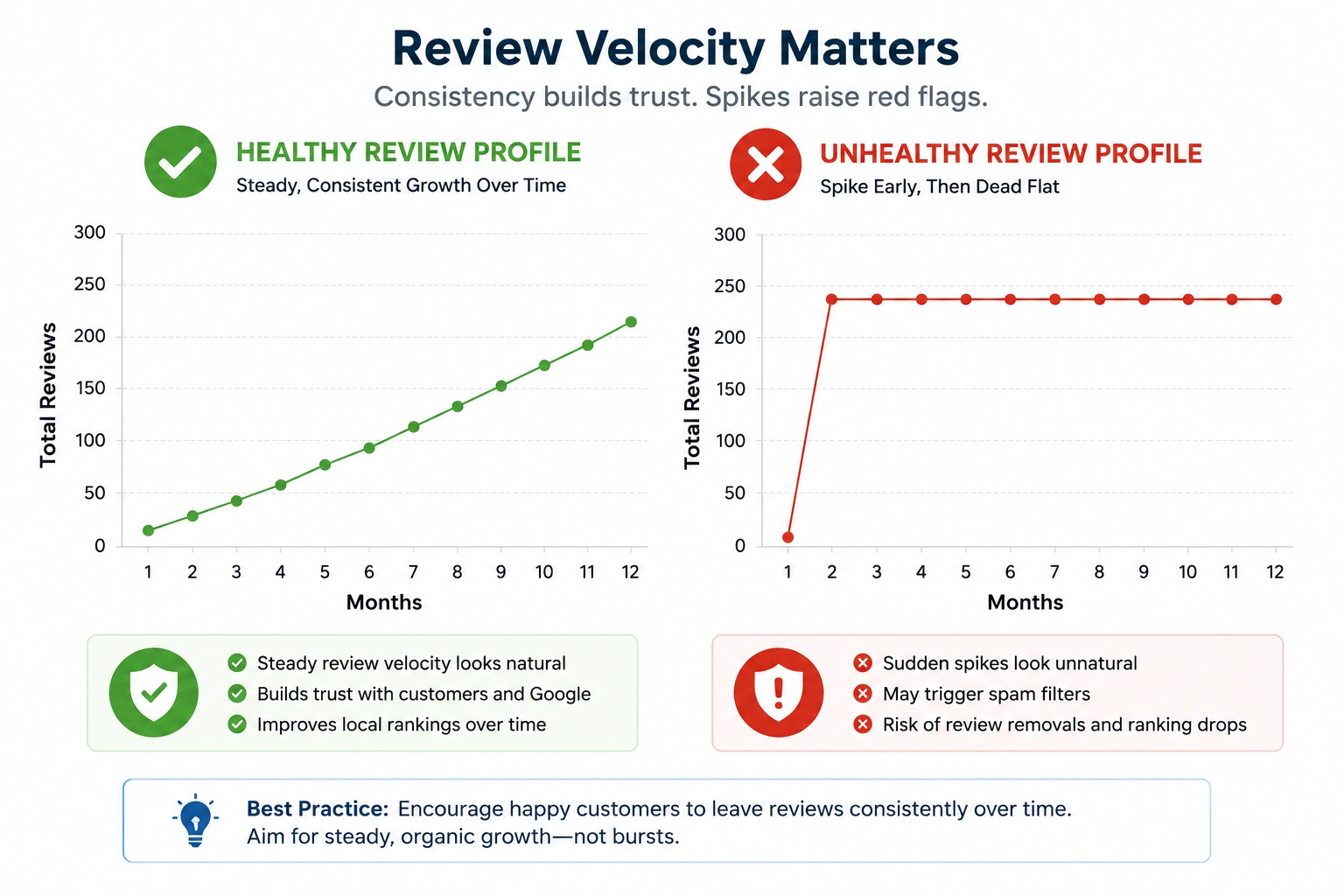
Consistent review growth builds trust and local SEO strength, while sudden bursts can appear unnatural and raise spam concerns.
Are your reviews working for you, or triggering Google’s spam filters?
Find out how your business looks to search engines and local customers. Get a free scan of your local directory listings and review health. No obligation, no sales pressure, just a clear picture of where you stand.
How a Professional Pest Control SEO Company Resolves Hidden Bottlenecks
Some of the fixes described above are owner-executable with the right instructions. Others, particularly the technical audit components, crawl error resolution, and structured citation cleanup, require tools and expertise that go beyond what most business owners have bandwidth for. More importantly, the interconnected nature of these issues means that fixing one in isolation while leaving others unaddressed produces limited results. A clean GBP with a misplaced pin and duplicate city pages still underperforms.
Partnering with a professional pest control seo company provides systematic diagnosis rather than piecemeal fixes. A team that works specifically with pest control operators understands the seasonal demand cycles, the competitive dynamics of service-area businesses, and the specific technical patterns that tend to gather in this industry’s websites over time.
What a Professional SEO Audit Covers
- A thorough technical audit identifying crawl errors, broken internal links, page speed bottlenecks, and indexation issues that prevent your pages from being discovered or ranked.
- Resolution of duplicate content across all service area and city landing pages, including a content architecture plan that supports unique, authoritative pages for every market you serve.
- Google Business Profile alignment with Google’s strict local guidelines, including pin placement, category selection, service area configuration, and attribute completeness, to secure map pack eligibility.
- A structured approach to managing Google Reviews, including acquisition workflows, response protocols, and velocity monitoring to maintain consistent ranking signals.
- A sustainable local search engine optimization strategy built around compounding organic growth rather than short-term ranking spikes that fade when the work stops.
Navigating Industry Debates: Call Tracking and Hidden Addresses
Two areas in local SEO for pest control generate genuine disagreement among practitioners, and both are worth addressing directly rather than glossing over.
The call tracking debate centers on whether using a tracking number as your primary GBP listing is safe long-term. Most experienced local SEO professionals accept the practice of listing the tracking number as primary and the true local number as secondary: the dual-number setup described in Mistake 3 above. The concern is that Google has historically overwritten numbers it detects as inconsistent with what appears elsewhere on the web, and some practitioners argue the risk of that overwrite outweighs the measurement benefit. There is no clean consensus. The dual-number approach is the current best practice, but it requires active monitoring to catch any overwrites quickly.
The address visibility question is more settled in terms of guidelines but messier in terms of outcomes. Google’s guidelines now require service-area businesses, those that travel to customers rather than serving them at a physical location, to hide their address on their GBP listing. The complication is that studies have shown hidden addresses can negatively impact ranking visibility compared to businesses with a verified physical storefront. It is a compliance requirement with a real visibility cost, and the way to offset that cost is through stronger local content, more complete citation profiles, and higher review velocity: the signals that compensate for the absence of a visible address.
For service-area pest control businesses, the practical path is compliance with Google’s guidelines combined with aggressive investment in the local signals that remain available. Building strong localized service pages, maintaining citation accuracy, and sustaining review velocity are the levers that offset the ranking disadvantage of a hidden address. A professional digital marketing agency for small businesses with experience in service-area businesses understands how to calibrate that combination for your specific competitive environment.
Understanding these debates is one thing. Translating that understanding into a coherent local search strategy is where the real work begins.
Why Partnering with a Google Partner Matters
Google Partner status is not a marketing badge. It reflects adherence to strict performance standards, demonstrated proficiency in Google’s advertising and search products, and ongoing certification requirements that require active maintenance. For a pest control operator evaluating which pest control seo company to trust with their local search presence, it is a meaningful signal of accountability.
BizIQ holds Google Partner status and focuses specifically on small and local businesses, the segment where local SEO complexity is highest relative to available internal resources. The work is grounded in transparent, ethical practices: no black-hat link schemes, no ranking guarantees that aren’t backed by a clear methodology, and reporting that connects SEO activity to business outcomes rather than vanity metrics.
The Compounding ROI of Ethical Local SEO
Ethical local SEO builds differently than paid advertising. The first three months are primarily diagnostic and structural: fixing the errors described in this article, establishing clean citation profiles, and building the content architecture that supports long-term authority. Sustainable, compounding organic growth typically becomes measurable between three and six months after a professional campaign launches.
The importance of local citations in that compounding process is often underestimated. Each consistent citation across a high-authority directory reinforces the same identity signal, and those signals gather over time in a way that paid placements cannot replicate. Clean site architecture and a well-maintained citation profile also provide a degree of insulation against algorithm updates: businesses with strong foundational signals tend to weather changes better than those relying on tactical shortcuts.
The business-level translation of these metrics is simple: more booked jobs per marketing dollar, lower customer acquisition costs over time, and a web presence that generates leads around the clock without requiring ongoing ad spend to maintain visibility.
Frequently Asked Questions About Pest Control SEO
Can a pest control company have multiple Google Business Profiles for different services?
No. Google’s guidelines explicitly prohibit creating separate listings for different services at the same location. Attempting to do so risks suspension of all associated profiles, including your primary listing. The correct approach is a single, well-optimized GBP listing combined with dedicated service-specific landing pages on your website that target each service’s commercial keywords individually.
Does hiding my business address on Google Maps hurt my rankings?
It is not always clean-cut. Historically, hiding an address did correlate with ranking drops, but Google’s guidelines now require service-area businesses to hide their address if they don’t serve customers at their physical location. Compliance is mandatory. The visibility gap that can result from a hidden address is best offset by building stronger local content, maintaining consistent citations, and sustaining review velocity: the signals that remain fully available to service-area businesses.
How do I handle duplicate reviews copied from Yelp or Google onto my website?
Copying reviews verbatim creates duplicate content that may prevent your testimonial pages from ranking organically, though it is unlikely to trigger a site-wide penalty. The cleaner approach is to paraphrase the review content and link to the original source, or to implement schema markup that references the external review without reproducing the text verbatim. Either method preserves the social proof value without the content duplication risk.
Should I use a separate domain for each city I service?
No. A single domain with dedicated local landing pages is the correct architecture for multi-city pest control businesses. Splitting across multiple domains fragments your domain authority, doubles your technical maintenance burden, and creates thin content issues across every additional domain. All the local SEO equity you build, such as citations, backlinks, and review signals, compounds on a single domain rather than being divided across several weak ones.
How long does it take to see results from pest control SEO?
Most pest control companies see sustainable, compounding organic growth and measurable increases in inbound leads within three to six months of launching a professional campaign. Technical fixes, like resolving crawl errors, correcting GBP settings, and cleaning up citation inconsistencies, can produce faster improvements in specific ranking positions. Building the topical authority and review velocity that sustains those rankings takes consistent effort over time. There’s a case to be made that the first 90 days of a well-executed campaign are the most important, because the structural work done in that period determines the trajectory of everything that follows.
Your Next Step to Increasing Local Search Visibility
The five mistakes covered here (duplicate city pages, misplaced GBP pins, inconsistent NAP data, missing service-specific pages, and erratic review patterns) are not obscure edge cases. They are the most common structural failures found in pest control websites that aren’t generating the local calls they should be. Each one is diagnosable. Each one is fixable. And addressing them systematically is what transforms a website from a digital placeholder into a 24/7 lead-generation asset. Here is your next step.
The path forward starts with an honest audit of where your current presence stands. BizIQ’s pest control SEO services are built specifically for operators who need more than generic digital marketing advice: they need a partner who understands the competitive dynamics, seasonal demand patterns, and technical nuances of ranking in local search for a high-urgency service category.
Ready to stop guessing and start growing?
BizIQ is a certified Google Partner with a dedicated focus on helping small and local businesses build sustainable organic visibility. Contact BizIQ for a personalized, zero-obligation Free SEO Analysis: a clear-eyed look at exactly what’s holding your pest control website back and a concrete plan to fix it.
What Our Clients Say: “Our pest control business was completely invisible in neighboring suburbs until we partnered with BizIQ. They rebuilt our local city pages and resolved our Google Business Profile map pin issues. Within three months, our call volume from those target areas doubled.”, John D., Owner, Premier Pest Solutions