If your accounting firm’s website isn’t showing up in local search results, you’re not just losing traffic; you’re losing potential clients who have already decided they need exactly what you offer. They searched, they found someone else, and they moved on. That opportunity is gone. That’s the part most firm owners don’t fully reckon with: the loss is invisible. You never see the inquiry that never arrived. This is where Accountant Website SEO comes in.
The way clients find financial professionals has shifted dramatically. Word-of-mouth still matters, but it now typically ends with a Google search to verify, compare, and contact. A referral who can’t find your website, or finds one that loads slowly, looks generic, or doesn’t clearly explain your services, will often choose a competitor whose digital presence signals competence before a single conversation happens. According to Harvard Business Review’s analysis of search engine optimization, search engines serve as the foremost showcase for establishing a business’s online visibility, and firms that don’t appear in those results practically don’t exist to their target audience.
The technical side of accountant website SEO can feel like a maze of jargon and contradictory advice. We want to simplify that by focusing on the seven specific structural, technical, and content mistakes that prevent accounting websites from ranking locally and converting visitors into clients.
Search engine optimization is a set of technical and strategic practices designed to improve a website’s position in search engine results, with the ultimate goal of increasing web traffic from specific user queries. For accounting firms, this isn’t an abstract marketing exercise: it’s the mechanism that determines whether a small business owner searching for a CPA in your city finds you or your competitor. Our deeper guide on SEO for accountants covers the broader strategic picture, but this piece focuses on the specific errors that quietly undermine even well-intentioned optimization efforts. Local search engine optimization, in particular, is what connects your firm to business owners and individuals within your immediate geographic area, connecting you with people who are ready to hire, not just browse.
The seven mistakes covered below are:
- Relying on duplicate content libraries and shared website templates
- Missing dedicated, high-intent service pages for core offerings
- Neglecting local schema markup and structured data
- Leaving Google Business Profile listings unoptimized
- Tolerating slow website speeds and poor mobile user experiences
- Ignoring the rise of AI-driven search engines and conversational queries
- Failing to track search performance with Google Search Console
The Duplicate Content Trap of Shared Website Templates
Many accounting firms launch their websites using content packages: pre-written articles, service descriptions, and blog posts sold by web design vendors to dozens or hundreds of CPA firms simultaneously. It feels convenient. The copy sounds professional. The problem is that duplicate content across multiple websites is one of the most reliable ways to suppress your search engine visibility, because Google’s algorithm is specifically designed to identify and devalue identical text appearing on multiple domains.
Think of it like a phone book listing where fifty businesses in your neighborhood share the exact same description, word for word. The directory doesn’t know which one to recommend, so it recommends none of them with any confidence. That’s roughly what happens in organic search results when your homepage copy, service descriptions, or blog articles match content already indexed on other CPA websites. Google doesn’t penalize duplicate content in the dramatic sense people sometimes imagine, but it does filter, choosing one version to show and suppressing the rest. If your site isn’t the original source, you’re almost certainly the one being filtered out.
The damage compounds over time. When your pages consistently fail to rank because they share content with dozens of other sites, your domain authority stalls. New pages you publish inherit that stagnation. A solid local SEO strategy depends on Google trusting your domain as a distinct, authoritative source, and that trust erodes when your content is indistinguishable from a template used across the country.
We recommend starting with your service pages and homepage. Write custom descriptions that reflect your firm’s actual approach, the specific industries you serve, and the geographic communities you work in. A bookkeeping page that mentions your city, your typical client profile, and your specific process will outperform a generic “we handle bookkeeping for your business” paragraph every time. Pre-written blog packages can feel like a shortcut, but unique content is what truly moves the needle for long-term search engine rankings. The investment in original writing pays dividends that templated content structurally cannot.
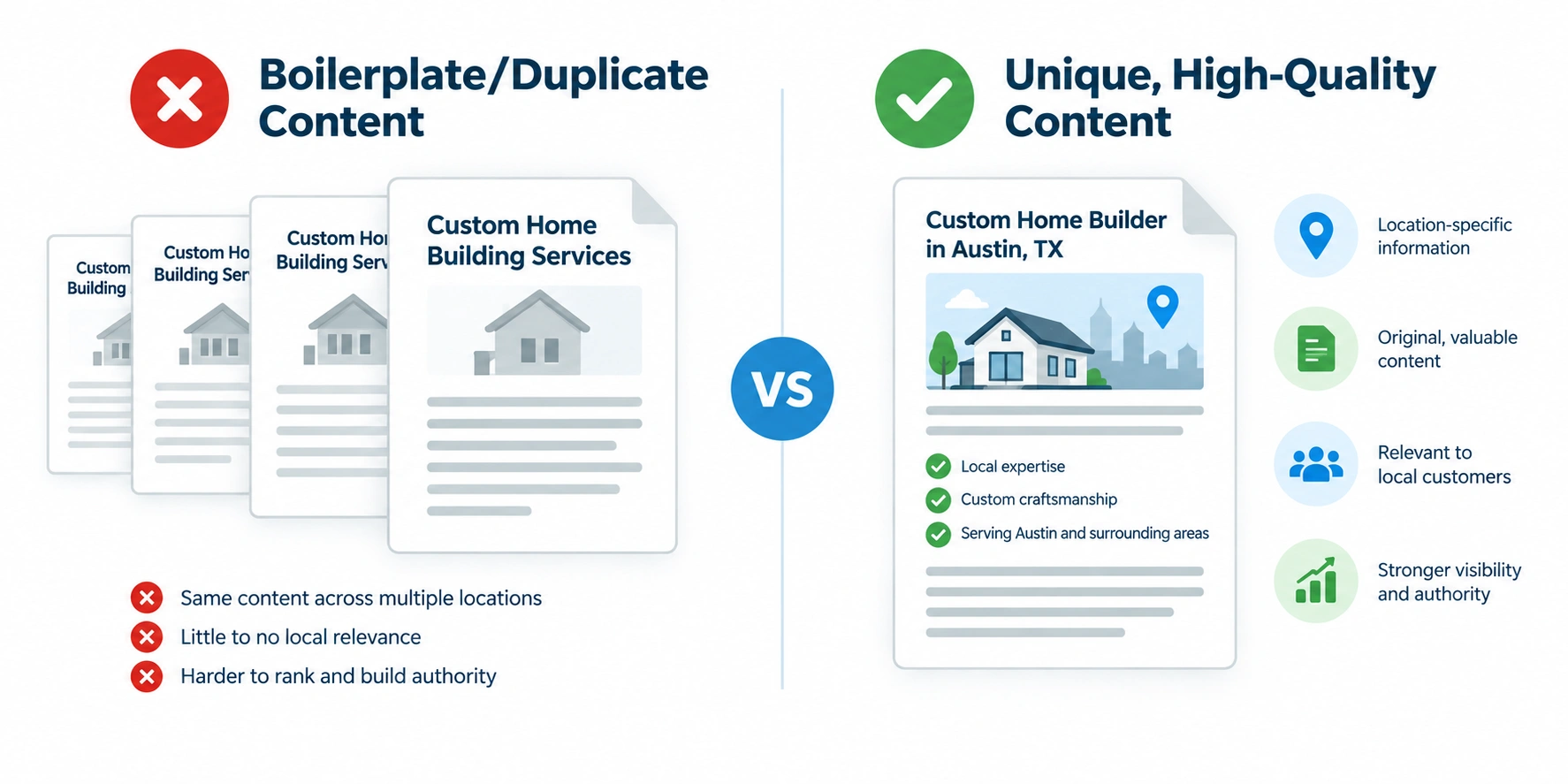
A side-by-side comparison highlights the difference between replicated boilerplate pages and unique, locally relevant website content.
Missing Dedicated Service Pages for Core Accounting Offerings
Grouping every service your firm offers, including tax preparation, bookkeeping, payroll, and fractional CFO work, onto a single “Services” page is one of the most common structural errors in accounting website design. It feels organized from a navigation standpoint, but it creates a substantial problem for dedicated service pages and local search engine optimization: search engines rank individual pages for specific queries, not entire websites.
When a small business owner searches “bookkeeping services for startups in [your city],” Google looks for a page that specifically addresses that query. A single services page that mentions bookkeeping in two sentences alongside seven other offerings doesn’t give the algorithm enough signal to rank it confidently for that search. A dedicated bookkeeping page with localized content, relevant headings, and a clear description of who you serve gives Google exactly what it needs, giving the visitor a focused, relevant experience that supports lead generation. This structure works.
Every accounting firm’s website should include, at minimum, the following dedicated pages:
- Tax Preparation and Planning: Targeting business owners who need year-round tax strategy, not just April filing. This page should address estimated quarterly payments, entity structure considerations, and industry-specific deductions.
- Bookkeeping Services: Targeting local startups and small businesses that need monthly financial tracking, reconciliation, and reporting. Mention the software platforms you work with (QuickBooks, Xero, etc.) and the types of businesses you typically serve.
- Fractional CFO Services: Targeting growing companies that need high-level financial guidance without the cost of a full-time hire. This audience searches differently: they’re looking for strategic language, not just task-based descriptions.
- Payroll and Compliance: Targeting local employers who want to automate payroll processing and stay current with state and federal compliance requirements.
Each of these pages needs unique, localized content. A tax preparation page that references your city, the local business landscape, and the specific client types you serve will consistently outperform a generic national-sounding page. The specificity signals pertinence to both search engines and the humans reading the page.
Why digital marketing for accountants Requires Local Schema Markup
Schema markup is a layer of code added to your website that communicates directly with search engines in their own language. Without it, Google reads your pages and makes its best inference about what your business does, where it’s located, and who it serves. With it, you’re handing the search engine a structured, unequivocal briefing. It removes the guesswork. For accounting firms competing in local markets, that difference in clarity can determine whether your listing appears as a rich result, displaying your address, hours, and star rating directly on the search results page, or as a plain blue link that blends into the results.
Structured data isn’t a ranking factor in the traditional sense, but it does influence how conspicuously and attractively your firm appears in local search results, which directly affects click-through rates. Firms that implement schema correctly tend to occupy more visual real estate on the SERP, which builds trust before the visitor even reaches the website.
The schema types that matter most for accounting practices:
- LocalBusiness Schema: Communicates your exact physical address, phone number, and operating hours to search engines. This is the foundation of local search presence and should be implemented on every page, not just the homepage.
- ProfessionalService Schema: Categorizes your business specifically as an accounting or CPA firm, helping search engines surface your site for profession-specific queries rather than generic business searches.
- FAQ Schema: Marks up question-and-answer content so that Google can display those answers directly on the search results page. A well-structured FAQ section with schema can earn your firm a featured snippet position, dramatically increasing visibility without requiring a higher organic ranking.
Schema implementation is technical work that many website platforms don’t handle automatically. If your site was built on a standard CMS without a developer reviewing the structured data, there’s a reasonable chance this layer is either absent or misconfigured, leaving you with no visible indication of the problem from the front end of your site.
Is your accounting website missing schema markup, duplicate content flags, or critical service pages?
Let’s take a look at your website together. Our team will run a thorough audit to find the hidden mistakes holding you back from local search visibility.
Neglecting Google Business Profile Optimization
Google Business Profile (GBP) is the single most consequential factor for appearing in the Google Local Map Pack: the three-business block that appears at the top of local search results, above organic listings. Most accounting firms claim their profile at some point and then treat it as a static directory entry. That approach leaves a significant amount of local visibility on the table.
A fully optimized GBP requires consistent Name, Address, and Phone number (NAP) information that matches exactly what appears on your website and across every other directory where your firm is listed. Even minor inconsistencies, like an abbreviated street name or an omitted suite number, create conflicting signals that can suppress your Google Maps ranking. Beyond NAP consistency, your business categories need to be precise. Selecting “Accountant” as your primary category is a starting point, but adding secondary categories like “Tax Preparation Service” or “Bookkeeping Service” helps Google understand the full scope of what you offer and match your profile to a wider range of relevant searches.
Regular activity on your GBP also matters more than most firms realize. This includes:
- Posting business updates
- Uploading photos of your office and team
- Responding to client questions directly on the profile
These actions all send engagement signals that influence local search visibility. While initial movement in the Local Map Pack typically takes a few months of consistent optimization, the compounding effect of sustained activity builds a profile that becomes increasingly difficult for competitors to displace.
Client reviews deserve their own attention within your GBP strategy. Reviews influence both your ranking position and the conversion rate of people who find your profile. Establishing a systematic process for asking satisfied clients to leave a review, whether through a follow-up email after tax season or a direct ask at the end of an engagement, creates a steady stream of social proof that search engines and prospective clients both weigh heavily.
A common objection from accounting firm partners is that they get all their clients through referrals and don’t need online reviews. That reasoning has a gap in it. Buyers verify everything. Modern referrals almost always search for your firm online before making contact, even when they’ve been personally recommended. A GBP with no reviews, outdated photos, or inconsistent hours can undermine a warm referral before it ever reaches your inbox. The person who was referred to you found a competitor with 47 reviews and a complete profile, and they made a different call.
“Why is SEO important for your small business in Phoenix?
SEO levels the playing field by boosting your website’s search ranking, allowing you to compete with larger competitors even on a limited budget. It provides a cost-effective strategy for reaching more customers and building brand awareness through keyword optimization, attracting visitors interested in your offerings.”, Tyson Copeland, Local SEO Manager Based in Phoenix, AZ
Slow Website Load Speed and Poor Mobile Responsiveness
A slow website is like a locked front door to your office. If clients have to wait too long for it to open, they walk away, not because they weren’t interested, but because the friction was unnecessary and another option was one tap away. Website load speed is a confirmed ranking factor for Google, meaning a tardy site doesn’t just frustrate visitors; it actively suppresses your position in search results before anyone even arrives.
The technical contributors behind slow load times are usually predictable:
- Unoptimized images that weren’t compressed before upload
- Bloated JavaScript and CSS files that load before the visible content renders
- Outdated hosting infrastructure
- Plugins or third-party scripts that add request overhead on every page load
None of these are exotic problems, but they compound quickly. Speed is everything. A site that loads in four seconds instead of two can see a significant increase in bounce rate, representing visitors who leave before the page finishes loading and never convert.
Mobile responsiveness compounds this issue further. The vast majority of mobile local searchers reach out to a business within a single day of their search, making a fast, mobile-friendly site absolutely critical for capturing that intent. An accounting firm website that renders beautifully on a desktop but collapses into unreadable columns on a smartphone is effectively invisible to a substantial portion of its potential audience. Google’s mobile-first indexing means the mobile version of your site is what the algorithm primarily evaluates, so a poor mobile user experience doesn’t just cost you visitors; it costs you rankings.
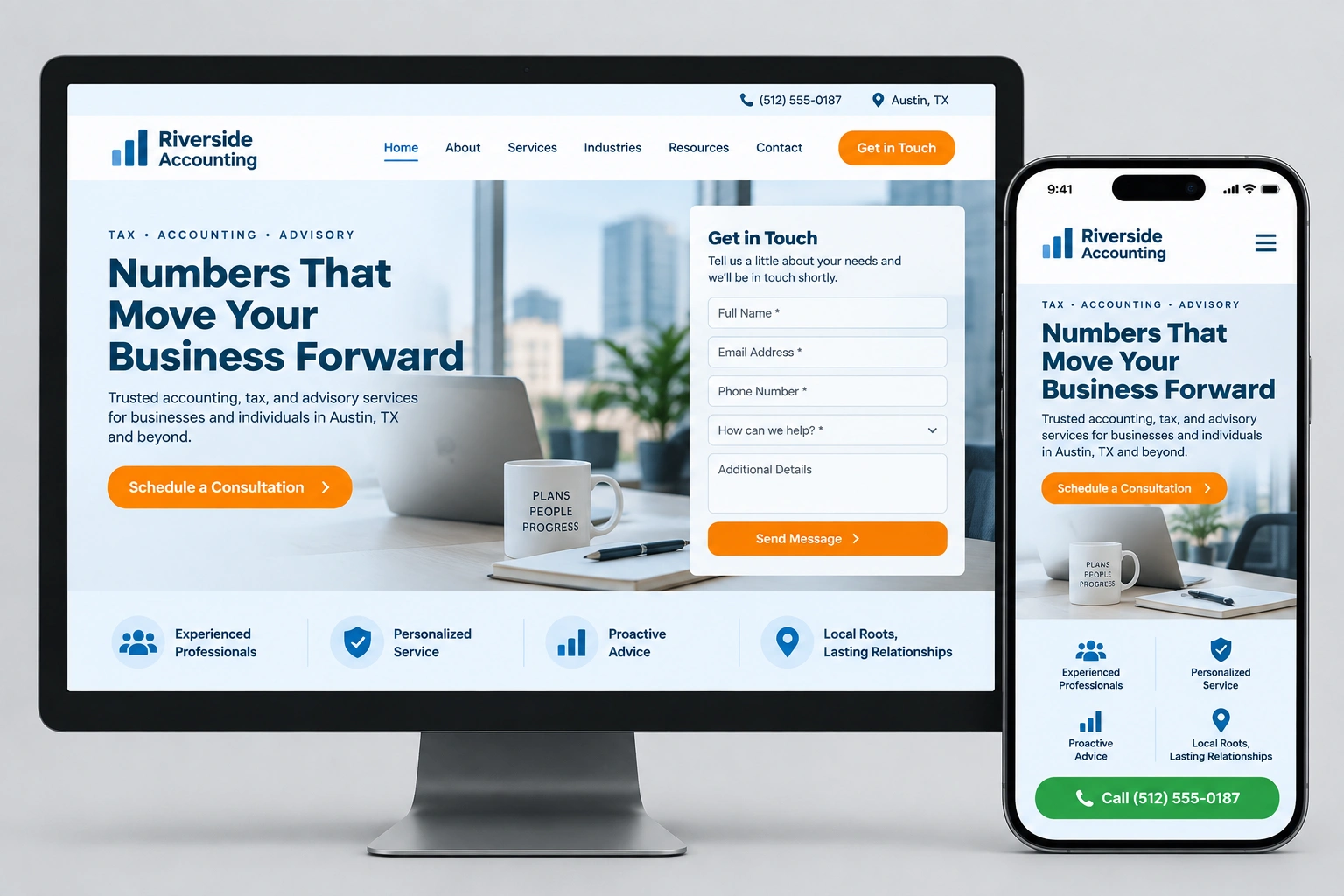
A responsive accounting website adapts across desktop and mobile with readable content, clear navigation, and convenient contact options.
You don’t have to navigate the technical side of web development alone.
Let’s chat about how we can make your website fast, responsive, and ready to convert local visitors into paying clients. Speak with our team directly at (888) 416-9800.
Integrating AI Search Optimization with Your small business digital marketing blog Strategy
AI search optimization is no longer a future consideration: it’s a present one. Tools like ChatGPT, Google Gemini, and AI-powered search overviews are increasingly influencing how potential clients discover and evaluate accounting firms. According to Harvard Business Review’s research on AI and customer choice, algorithms are increasingly researching and selecting suppliers on behalf of customers, reshaping the competitive landscape in ways that traditional keyword-focused SEO doesn’t fully address.
The implication for accounting firms is concrete: if your website content isn’t structured to answer conversational queries, the kind a person would type into an AI assistant rather than a search bar, you’re missing an emerging and growing segment of client discovery. This isn’t about abandoning traditional SEO; it’s about extending your existing content strategy to serve both audiences. The firms that build topical authority now, while many competitors are still ignoring AI search entirely, will hold a compounding advantage as these digital marketing solutions become the dominant discovery channel.
Practical steps for optimizing your accounting firm’s content for AI-mediated search:
- Focus on Natural Language: Write content that directly answers conversational questions like “Who is the best small business CPA near me?” or “What’s the difference between a bookkeeper and a fractional CFO?” rather than structuring every page around short, fragmented keywords. AI models pull from content that reads like a knowledgeable person explaining something clearly.
- Build Topical Authority: Publish detailed guides on complex tax and accounting topics, such as entity selection, R&D tax credits, and cash flow forecasting for service businesses. When AI models treat your site as a reliable source for accounting questions, they surface it more frequently in generated responses.
- Unify Your Business Data: Ensure your business name, address, phone number, and service descriptions are consistent across every directory, social profile, and citation source. According to Harvard Business Review’s analysis of business process automation, creating a single, unified source of truth for business data is foundational to delivering accurate, personalized experiences at scale, and AI search agents depend on that consistency to verify and recommend your firm with confidence.
Failing to Track Search Performance and Local Rankings
Flying blind is the most avoidable mistake on this list. Data beats guesswork. Firms that invest time and resources into their website but never check how it performs in search are essentially guessing, and guessing rarely produces consistent local client acquisition. Google Search Console is a free tool that tells you exactly how Google sees your website: which queries trigger impressions, which pages rank for which keywords, how often users click through, and what technical errors are preventing pages from being indexed. Without it, you have no reliable way to know whether your optimization efforts are working or where the gaps are.
Search performance data reveals patterns that aren’t visible from inside your own website. You might discover that your tax preparation page ranks well for a handful of queries but has a low click-through rate, a signal that your page title or meta description isn’t persuasive enough to earn the click even when you’ve earned the ranking. Or you might find that a blog post you wrote six months ago is quietly driving a meaningful share of your traffic, which tells you to publish more content on that topic and update the existing post to keep it current.
Tracking local rankings over time is equally important. A single snapshot of where you rank today tells you almost nothing useful. A trend line showing consistent movement, or inactivity, over three to six months gives you the data you need to make informed decisions about where to invest your optimization effort. Most firms that struggle with SEO accounting challenges aren’t failing because they lack good intentions; they’re failing because they have no feedback loop connecting their actions to measurable outcomes.
Now that you know the hidden mistakes that might be costing you local clients, the logical next step is running a quick diagnostic on your own website to see which of these issues are actually present.
How to Perform a Quick Local SEO Audit for Your Accounting Website
A basic accounting website audit doesn’t require bespoke software or technical expertise to get started. The goal is to surface the most obvious problems quickly so you can prioritize fixes, and understand where professional support will make the biggest difference.
Three immediate checks that any firm partner can run today: Start with these.
- Search your business name on Google and review your Google Business Profile. Check that your name, address, phone number, and hours are accurate and consistent with what appears on your website. Look at your review count, your photos, and whether you’ve selected the right primary business category.
- Copy a paragraph from your homepage, ideally your main service description, and paste it into Google with quotation marks around it. If identical text appears on other websites, you have a duplicate content issue that’s actively suppressing your search visibility.
- Open your website on a smartphone and navigate through it as a first-time visitor would. Does it load quickly? Are the menus usable? Is the contact information easy to find without zooming? Can you tap a phone number to call directly? These are the friction points that cause mobile visitors to leave before converting.
This self-audit is a useful starting point for local search engine optimization assessment, but it only surfaces the visible layer of what’s affecting your rankings. Technical issues like crawl errors, broken internal links, missing canonical tags, misconfigured schema, and page speed bottlenecks require tools and expertise that go beyond a manual review. Knowing how to improve accountant website ranking at a deeper level means understanding what’s happening in the code and server configuration, not just what’s visible in the browser. Partnering with local SEO specialists who work specifically with professional services firms can compress the timeline considerably and prevent the trial-and-error cycle that costs most firms months of lost visibility.
Frequently Asked Questions About Accountant Website SEO
Frequently asked questions about accountant website SEO and SEO for accounting firms tend to cluster around a few persistent themes: how long it takes, whether it’s still relevant, and how to prioritize limited resources. The answers below address the questions we hear most often from firm partners and practice leaders.
Is SEO still worth it in 2026?
Yes, and the case for it has grown stronger, not weaker. SEO has evolved significantly with the integration of AI-driven search experiences and the growing importance of topical authority and genuine user intent. Keyword stuffing and thin content no longer move the needle; instead, well-structured, authoritative content that answers real questions continues to compound in value over time. The firms that invested in SEO three years ago are now benefiting from domain authority that newer competitors can’t quickly replicate.
Can you make $500,000 a year as an accountant?
Reaching a $500,000 annual income as an accountant is achievable, typically through partner roles at established firms, building a specialized private practice with premium positioning, or serving as a CFO or senior financial executive in the corporate sector. For firm owners specifically, scaling revenue to that level almost always involves methodizing client acquisition, which is where a strong digital presence and consistent local search visibility become direct contributors to income, not just marketing overhead.
What websites do accountants use?
Accountants commonly rely on industry-standard platforms including the AICPA website for professional standards and continuing education, tax research databases like Checkpoint or RIA, accounting software ecosystems such as QuickBooks or Xero for client work, and regulatory sites like the IRS and SEC for compliance reference. For their own firm websites, the platform matters less than the SEO configuration and content strategy built on top of it.
What is the 80/20 rule in SEO?
The 80/20 rule in SEO holds that roughly 80% of your organic traffic and measurable results come from 20% of your content. For accounting firms, this usually means a handful of well-optimized service pages and a few high-authority blog posts drive the majority of inbound inquiries. The practical implication is that identifying and doubling down on your highest-performing pages, rather than spreading effort evenly across everything, produces better returns. Google Search Console is the tool that makes this analysis possible.
What are the 3 C’s of SEO?
The 3 C’s of SEO refer to Content (the relevance, depth, and quality of the information on your pages), Code (the technical health and performance of your website’s underlying structure), and Credibility (the authority and quality of the backlink profile pointing to your domain). For accounting firms, all three matter, but most websites have the most immediate room for improvement in Content and Code, which are also the most directly controllable.
Building a strong online presence for your accounting firm is an investment in its future, not a one-time task. The mistakes covered here, such as duplicate content, missing service pages, absent schema, an unoptimized GBP, slow load speeds, AI search blindspots, and no performance tracking, are fixable problems, not permanent conditions. Most firms that address even three or four of them see meaningful improvement in local visibility within a few months of consistent effort.
Small businesses are the backbone of local economies, and accounting firms are among the key professionals those businesses rely on. The firms that show up consistently in local search aren’t necessarily the largest or the most experienced; they are the ones that made their digital presence a priority and maintained it. That’s a competitive advantage that’s genuinely available to practices of any size.
We’re here to help you navigate this journey. We partner with you. Let’s work together to make sure your accounting firm gets the local visibility and clients it deserves.
Ready to stop losing local clients to competitors with better-optimized websites?
BizIQ’s local search specialists work specifically with small businesses and professional services firms to fix the technical, structural, and content issues that suppress local rankings. We get your business listed on the first page of Google’s local maps or organic search results within 60 days for at least two keyword phrases, or we work for free.
Explore our digital marketing packages for small business to find the right fit for your firm’s goals and budget.
Call us at (888) 416-9800 or visit our office at 3627 E Indian School Rd Suite 103. Our team is available Monday through Friday, 7 AM to 4 PM.