Accounting firms do not lose clients to competitors with better credentials: they lose them to competitors who show up first. Visibility is everything. If your firm is not visible in local search results, the most technically qualified CPA in your market can still be invisible to the clients actively searching for help right now. A curated list of 15 high-authority business directories builds the foundation your practice needs to establish credibility, get found, and convert local searches into real client relationships. These are the same local SEO strategies that separate firms with a steady pipeline from those depending entirely on word-of-mouth.
Search engines hold financial services to a standard they do not apply to most other industries. Because accounting falls squarely within Google’s “Your Money or Your Life” (YMYL) category, a website alone carries limited weight as a trust signal. Your site is, in effect, a self-declaration of authority. High-authority business directories function as third-party corroboration: independent sources that confirm your firm exists, operates at a specific address, and serves real clients. Without that web of external verification, even a well-designed accounting website struggles to earn the algorithmic confidence required for meaningful online visibility.
Directory listings deliver several cumulative benefits for accounting firms:
- Establishing foundational trust by proving to search engines that your practice is active, legitimate, and geographically anchored
- Improving local Map Pack presence to drive highly qualified, location-specific leads directly to your office
- Feeding structured data to AI search engines, ensuring emerging AI-driven search agents can identify and recommend your firm to automated buyers
- Generating low-cost growth through free business directory listings that produce high-intent client referrals without ongoing ad spend
Why Local Citations and Directories Matter for Accounting Firms
Search engines do not take your word for it. They need proof. They cross-reference your business information across dozens of external sources to verify that what your website claims matches what the broader web reports. Every directory listing that confirms your firm’s name, address, and phone number is a small vote of confidence: and those votes accumulate into the trust score that determines where you appear in local results.
Think of it this way: if you handed out business cards at a networking event and each one listed a slightly different address or phone number, people would start questioning whether your firm is stable. Search engines operate on the same logic. Fragmented or inconsistent directory data creates doubt, and doubt suppresses rankings. This is precisely why optimizing your Google Business Profile is the non-negotiable first step before any broader citation-building effort: it anchors the rest of your local presence.
When a potential client searches for “tax planning CPA near me” or “small business accountant,” Google’s algorithm is actively verifying whether your firm’s information is consistent across the web. Firms with a verified, coherent local presence get prioritized. Those without it get buried, regardless of how polished their website looks.
Understanding the Power of Consistent Business Information
NAP (Name, Address, Phone number) sounds deceptively simple. In practice, it is one of the most commonly neglected elements of local SEO for accounting firms. A single variation in how your business name appears, such as “Johnson & Associates CPA” versus “Johnson and Associates, CPA LLC”, can fragment your directory authority across platforms, diluting the trust signals you have worked to build.
The risk compounds over time. If your firm has moved offices, changed phone numbers, or rebranded in the last several years, legacy listings with outdated information may still be active across dozens of directories. A stale phone number from a previous location does not just fail to convert: it actively confuses search engines trying to verify your current business identity. Managing that legacy search content and correcting inaccurate listings is as strategically important as building new ones.
Centralized directory listing management solves this by maintaining a single source of truth that propagates accurate business information across the entire web. It keeps things simple. When your information changes, corrections flow outward in real time rather than sitting dormant on directories you have forgotten about.
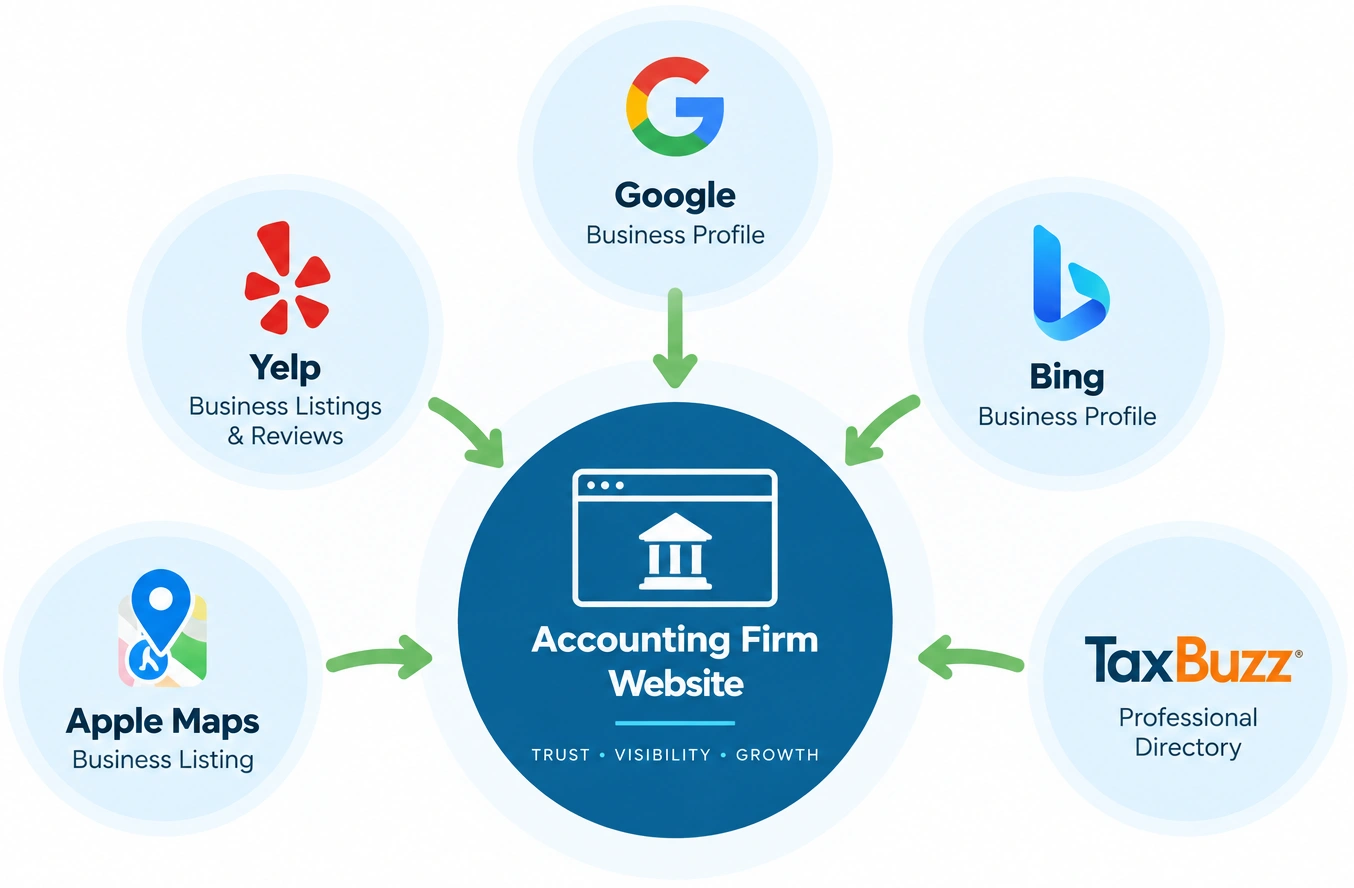
Consistent listings across trusted directories create a connected network of business signals supporting an accounting firm’s online presence.
The Big Four General Directories for Maximum Visibility
These four platforms form the bedrock of any local SEO strategy for accountants. Skipping or half-completing any of them leaves a visible gap in your listings that competitors can exploit.
Google Business Profile is the primary anchor. A fully completed profile, featuring accurate categories like “Certified Public Accountant” or “Accounting Service,” real office photos (not stock images), and consistent business information, directly influences your visibility in Google’s local Map Pack. This is where the majority of high-intent local searches convert into contact.
Bing Places for Business gets underestimated because Bing’s overall market share is smaller, but that framing misses the context. Bing powers search on Windows devices and feeds results into corporate environments where many of the businesses you want to reach operate. Ignoring it means ceding ground in a segment that skews toward business decision-makers.
Yelp for Business carries substantial algorithmic trust. Search engines treat Yelp as a high-authority source of business verification, and local businesses and individuals actively use it to research professional service providers before making contact. Monitoring and responding to reviews here, professionally and consistently, signals to both search engines and prospects that your firm is engaged and accountable.
Apple Business Connect covers iOS users through Apple Maps. Given that iOS users represent a demographic with above-average purchasing power and a high proportion of business owners, this listing is worth claiming and maintaining carefully.
Optimization steps that apply across all four:
- Claim and verify each profile completely, including phone, email, or postcard verification steps; partial claims leave listings vulnerable to third-party edits
- Select precise categories (for example, “Tax Preparation Service” rather than the generic “Financial Service”) to match the specific queries your ideal prospects are typing
- Add high-quality photos of your team, office exterior, and interior to build the human connection that converts a search result into a phone call
- Keep operating hours synchronized with your website, including holiday closures, to avoid the trust erosion that comes from a visitor showing up to a locked door
Niche Directories Tailored Specifically for Financial Professionals
General directories establish that your business exists. Niche directories establish that your business belongs in the conversation about financial expertise. For local SEO accounting purposes, industry-specific platforms carry outsized weight because they signal topical relevance, not just geographic presence.
TaxBuzz is among the most authoritative platforms dedicated exclusively to tax professionals and accountants. A well-maintained listing here signals professional legitimacy to both search engines and prospective clients who are specifically vetting financial advisors.
CPA Directory and CPA Finder verify professional credentials as part of the listing process, which means the backlinks and directory listings they generate carry a higher trust signal than generic directories. For firms targeting clients who prioritize verified credentials, these listings are worth the effort to complete thoroughly.
QuickBooks ProAdvisor Directory is a direct pipeline to business leads. Business owners who are already using QuickBooks and searching for a certified ProAdvisor are high-intent prospects: they have already committed to the software and need expert guidance. If your firm holds that certification, this directory is not optional.
Alignable operates as a local B2B networking platform and functions as a modern referral engine for professional services. Connections made here often translate into direct referrals from other local business owners who trust peer recommendations over advertising.
Why niche directories deserve dedicated attention in your local SEO accounting strategy:
- Industry-specific relevance signals to search engines that your firm is a genuine subject matter authority, not just a business that happens to mention accounting
- Prospective clients researching financial services actively look for specialized credentials and peer-validated listings before reaching out
- Ensuring NAP accuracy in local SEO across niche directories is critical: a mismatch between your TaxBuzz listing and your Google Business Profile creates the exact kind of inconsistency that suppresses rankings
- Platforms like Alignable and QuickBooks ProAdvisor connect you directly with local business owners who need ongoing accounting support, not just one-time tax filing
Managing dozens of directory listings while running a busy accounting practice is an inefficient use of your billable hours. Let our team handle it. Our SEO services for accounting businesses are designed to build, optimize, and maintain your local directory listings, ensuring your firm gets found by clients searching online. Call us today at (888) 416-9800 to speak with a specialist.
High-Trust Local and B2B Directories to Build Authority
The remaining seven directories in this list operate at the intersection of local community trust and B2B authority. They build real authority. They may not carry the immediate name recognition of Google or Yelp, but search engines crawl them actively, and high-value clients use them to compare and vet service providers.
Your local Chamber of Commerce listing is one of the most powerful local trust signals available. It confirms active participation in the local business community: something search engines interpret as a strong indicator of legitimacy and permanence. Many chambers also offer member directory pages that generate direct backlinks to your website.
Clutch is a premier B2B ratings and reviews platform that accounting firms targeting mid-sized businesses and corporate accounts should treat as a priority. Decision-makers at growing companies regularly use Clutch to shortlist professional service providers before issuing RFPs or scheduling discovery calls.
UpCity functions similarly, helping businesses identify credible service providers through verified reviews and ratings. A complete, active profile here positions your firm in front of buyers who are already in research mode.
YellowPages and Foursquare are legacy platforms, but dismissing them entirely is a mistake. Both feed data to hundreds of smaller search engines, mapping applications, and data aggregators that collectively influence how your business information propagates across the web. Their direct traffic may be modest, but their role in the broader directory ecosystem is real.
Facebook Pages and LinkedIn Company Directory round out the list as essential social directories. Search engines crawl both platforms to verify business activity, brand consistency, and client engagement. An incomplete or dormant Facebook business page or LinkedIn company profile creates a gap in the verification chain that search algorithms notice.
Modern clients do not limit their research to a single Google search. Platforms like Clutch, LinkedIn, and local Chamber directories function as secondary search engines where potential clients compare firms, read reviews, and assess professional credibility before ever visiting your website. A firm with a complete, active presence on these platforms captures high-value B2B leads that competitors with Google-only strategies consistently miss.
Reviews are the currency of professional services in local search. Search engines reward businesses with active, positive review profiles with higher local visibility: and the effect compounds across platforms. A systematic process for requesting and managing reviews across these directories is not a nice-to-have; it is a core component of maintaining your online reputation and sustaining the ranking gains that directory building creates.
“Because we started as a small business, we understand the hurdles that many small business owners have to face when they begin to market their brand and services online” : Garrett Cisek, Co-Founder of BizIQ
Step-by-Step Guide to Claiming and Optimizing Your Listings
The workflow for building a clean directory profile follows a logical sequence. Skipping steps, especially the early audit phase, is where most self-managed efforts go wrong.
Conduct a directory audit first. Search for your business name across the web to identify existing listings, duplicate profiles, and any incorrect information already circulating. You cannot fix what you have not found.
Standardize your business information before submitting anything. Write down your exact business name, address, and phone number in the precise format you intend to use everywhere. A single character difference, such as an abbreviated “St.” versus “Street,” or a suite number formatted differently, creates the kind of fragmentation that quietly degrades your local rankings over months.
Gather your assets before you start claiming. Prepare high-resolution team photos, a compelling business description that reflects your actual specializations, and documentation of your professional credentials. Having these ready before you begin prevents the common mistake of submitting incomplete profiles that you never return to finish.
Claim and verify methodically. Work through the 15 directories listed above in sequence, completing every verification step for each platform. A claimed-but-unverified profile is only marginally better than no profile at all: many platforms restrict the visibility of unverified listings.
A rushed submission introduces formatting errors that hurt your SEO rather than helping it. An address entered inconsistently across three platforms, or a business description copy-pasted verbatim from your website, can undermine the effort you have invested. If the time required to do this correctly is not available during your current workload, particularly heading into tax season, partnering with our team to execute the initial build ensures it is done right from the start rather than patched together later.
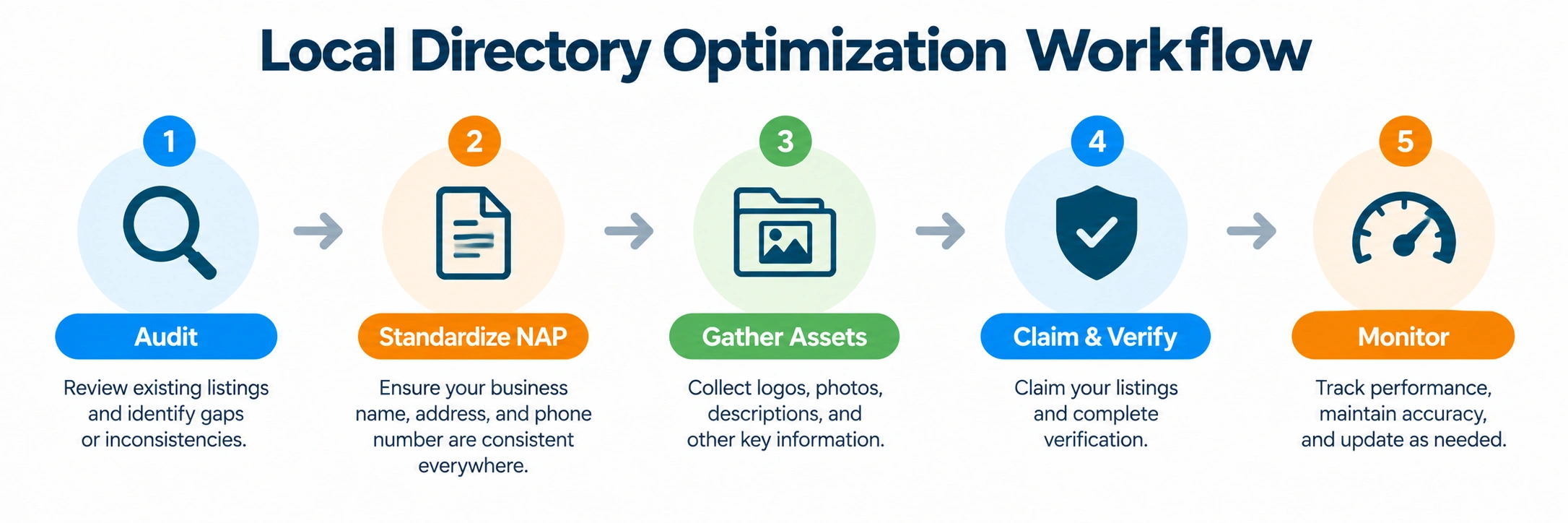
A five-step local directory workflow moves from auditing existing listings to standardizing business data, verifying profiles, and monitoring accuracy.
Building a flawless local presence takes time and precision. At BizIQ, located at 3627 E Indian School Rd Suite 103, we specialize in digital marketing for accountants to help you secure top local rankings and manage your online reputation. Contact us at (888) 416-9800 to schedule your thorough local directory audit.
Common Citation Mistakes That Hurt Accounting Firm Rankings
Most directory problems are not the result of neglect: they are the result of well-intentioned but inconsistent self-management. Consistency is key. Knowing where the common failure points are helps you avoid them before they compound into ranking damage that takes months to reverse.
Duplicate listings are among the most damaging. When multiple profiles exist for the same office location, often created accidentally during different claiming attempts, search engines split the review authority and directory signals across them rather than consolidating them behind a single authoritative profile.
Keyword stuffing in your business name is a violation of directory guidelines that can result in listing suspensions. Adding descriptors like “Best Tax Accountant” or “Top CPA Firm” to your business name field might seem like a quick SEO win, but platforms including Google strictly penalize this practice.
Neglecting reviews, both in terms of requesting them and responding to them, signals inactivity. Search engines interpret an unresponsive business profile as a low-engagement entity, and prospective clients draw the same conclusion. Responding to every review, including negative ones, demonstrates that your firm is present and professionally accountable.
Quick diagnostic checks to run on your current listings:
- Check for variations in your business name across platforms (for example, “LLC” vs. “Inc.” vs. no suffix at all)
- Verify that your phone number is formatted identically on every major platform
- Search for old office addresses that may still be active and pointing clients to a location you no longer occupy
- Confirm that you have responded to all recent client reviews across your primary directories
How to Manage and Maintain Your Listings Over Time
Claiming your listings is the beginning, not the finish line. Maintenance is required. Directory data is not static: third-party data aggregators and user-submitted suggestions can alter your listings without your knowledge, introducing the same inconsistencies you worked to eliminate. Monitoring your directory profile is an ongoing operational requirement, not a one-time project.
Tax season makes this particularly acute. During the months when your attention is most consumed by client work, your directory listings are most vulnerable to drift. A phone number correction that goes unnoticed for three months during peak season can quietly erode the local rankings you have built over the prior year.
Manual monitoring is possible, but managed directory services, which provide automated monitoring and real-time corrections across hundreds of directories, offer a more reliable solution for firms where billable hours are the chief constraint. Tools like BrightLocal are widely used in the SEO industry to track directory health and identify inconsistencies at scale, though the depth of their coverage and the level of hands-on management they require varies meaningfully between platforms.
Consistent, verified directories build a trust foundation that search engines reward with sustained local visibility. Firms that treat directory management as a long-term investment, rather than a one-time setup task, see compounding returns in organic search performance and a steadier flow of inbound client inquiries year-round. Outsourcing this technical work to our team protects your firm’s reputation while keeping your focus where it generates the most value: serving your clients.
Frequently Asked Questions About SEO for Accountants
Local search optimization can feel overwhelming, especially as AI-driven search continues to reshape how clients find professional services. The questions below address the most critical points of confusion for accounting firms working to build their online presence. Many of the same principles that apply to SEO tips for law firms and other professional services translate directly to accounting, with the added layer of YMYL scrutiny that makes trust signals even more impactful.
How does local SEO for accountants differ from other professional services?
While the core principles of local search remain consistent across industries, financial services face a much higher trust bar due to Google’s YMYL guidelines. Trust is paramount. Unlike other professional services where a basic listing might suffice, accountants must demonstrate accurate business information and NAP details alongside active credential verification. Drawing parallels from SEO tips for law firms, success relies heavily on building localized authority, securing high-quality client reviews, and using niche, industry-specific directories to prove expertise and credibility to search engines.
Is SEO still worth it for accounting firms with the rise of AI search?
Yes, and the argument for it is stronger now than it was five years ago. Emerging AI search engines and shopping agents rely on structured data, consistent business directories, and verified local directory listings to recommend service providers. If your firm’s information is inconsistent or missing from high-authority sites, AI engines will not surface your business to automated buyers or local searchers. The firms that invest in directory consistency today are building the structured data foundation that AI-driven search will depend on tomorrow.
Can ChatGPT perform a local SEO audit for my accounting website?
AI tools like ChatGPT are genuinely useful for drafting directory descriptions, brainstorming keyword variations, and reviewing on-page content, but they have real limitations here. ChatGPT cannot actively crawl the web in real time to identify fragmented directory listings, duplicate profiles, or inconsistent business information distributed across hundreds of directories. A thorough local SEO audit requires specialized tools built for that purpose and human expertise to interpret and act on the findings.
How long does it take to see results from building directory listings?
Local SEO is a long-term investment with compounding returns. High-authority directories like Google Business Profile can show local Map Pack improvements within a few weeks of a fully verified, optimized listing. Building a consistent web of directory listings across the broader directory landscape typically takes 60 to 90 days to fully influence organic search results. That foundational work does not expire: it continues generating trust signals and client inquiries long after the initial effort is complete.
What is the risk of using duplicate content in my directory descriptions?
Using identical, generic descriptions across dozens of directories can signal low quality to search engine crawlers. Your business information must be identical everywhere, which is non-negotiable, but your business descriptions should be uniquely written for your primary profiles. A distinct, compelling description on Google, Yelp, and TaxBuzz demonstrates genuine professional authority and gives prospective clients a reason to choose your firm over a competitor with a copy-pasted paragraph that reads like it was written for no one in particular.
A strong, consistent presence across high-authority business directories is not an administrative checkbox: it is the infrastructure that makes every other element of your digital marketing strategy work harder. For modern accountants, these listings build the foundational trust signals that search engines require before recommending your firm to local clients. They protect your professional reputation, improve your visibility in organic search results, and create a steady inbound channel for high-value client leads that does not depend on advertising spend or algorithm changes.
Taking control of your local directory listings means taking control of how your firm is perceived before a potential client ever visits your website. That is not a small thing.
Ready to scale your accounting firm’s online presence without sacrificing your billable hours? Let the local search experts at BizIQ manage your directory listings, optimize your profiles, and drive more local clients to your practice. Explore our specialized digital marketing for accountants services today or contact us at (888) 416-9800 to schedule your detailed local SEO audit.