Every CPA firm owner wrestling with local marketing eventually hits the same fork in the road: do you pay for immediate visibility through Google Local Services Ads, or do you invest in organic SEO that compounds over time? The answer is not simple, and anyone who tells you otherwise has not spent much time inside a professional services firm.
If you need leads fast, Local Services Ads are the answer. If you need sustainable, cost-effective growth, organic maps optimization is the path. Let’s look at how to decide which fits your practice.
Think of it this way. Google Local Services Ads (LSAs) operate on a pay-per-lead model. You pay for each phone call or message you receive: like hiring a receptionist, but you only pay when they connect you with a prospect. It is like renting prime commercial space on page one. You get traffic the day you sign the lease, but the moment you stop paying, the space goes dark. Local organic SEO is closer to owning the building. It takes longer to secure, requires more upfront effort and strategy, and you won’t see the full value for months. But once it is yours, it appreciates. The local search visibility you build does not vanish when you pause a campaign.
What makes this choice genuinely difficult for CPA practices specifically is the seasonal revenue model, the high lifetime value of a single retained client, and the trust-sensitive nature of financial services. These three factors change the math in ways that a generic comparison never captures.
Performance Marketing, Brand Building, and Why Both Matter
Performance marketing, as HBR on brand building and performance marketing defines it, means paying for measurable results, such as leads, clicks, or sales, conducted through third-party channels, including search engines. For CPA practices, this model has obvious appeal. The math is simple. You know exactly what you paid and exactly what you received. This approach is highly practical because it allows firms to run targeted campaigns with measurable return on investment (ROI), addressing the historical challenge of not knowing which half of your advertising spend is wasted.
In contrast, brand-building activities focus on enhancing customer perceptions of the brand over the long term. It builds trust. It is the reason a prospect chooses your firm over a competitor with similar credentials and a lower price. Performance marketing and brand building should not be treated as mutually exclusive, but rather can work together to increase the return on both. For a CPA practice, that integration is where the real value lives.
Understanding paid search marketing fundamentals helps clarify how LSAs fit into the performance side of this equation, while the benefits of content marketing explain how organic SEO builds the brand equity side.
The core distinctions between these two paradigms, applied specifically to CPA firm marketing, come down to three dimensions:
- Immediate vs. Compounding Visibility: LSAs place your firm at the very top of Google’s local search results from the first day your campaign is active. Organic SEO builds authority and map pack rankings gradually, but that visibility does not require ongoing ad spend to maintain once established.
- Pay-Per-Lead vs. Fixed Investment: With LSAs, every direct inquiry carries a cost. Organic SEO demands upfront investment in technical optimization, content, and citations, but once those rankings hold, the traffic they generate carries no per-lead fee.
- The Retention Multiplier: Whichever channel brings a client through the door, keeping them is where the economics really shift. Acquiring a new client is estimated to be five to 25 times more expensive than retaining an existing one, according to HBR on customer retention value. Increasing customer retention rates by just 5% can boost profits by 25% to 95%. That asymmetry means your marketing channel choice should prioritize attracting clients with long-term retention potential, not just the highest raw lead volume.
Understanding Google Local Services Ads (LSAs) for CPA Firms
Google LSAs are pay-per-lead ads that appear above everything else on the local search results page: above traditional pay-per-click ads, above the organic map pack, and above standard website listings. When a prospective client searches for a CPA in their area, LSA listings are the first thing they see, which is a substantial positioning advantage in a trust-sensitive category like accounting.
The mechanism that makes LSAs particularly effective for professional services is the “Google Guaranteed” badge. Trust is everything. This badge signals to searchers that Google has verified the business, which carries real weight when someone is deciding who to trust with their financial records and tax filings. The specific background check and verification requirements Google imposes on accounting firms to earn this badge vary and are subject to change; firms should consult Google’s current LSA enrollment documentation directly rather than rely on any third-party summary, including this one.
The mechanics of how LSAs operate, including how leads are routed, how disputes are handled, and how the bidding algorithm determines placement, are consistent across service categories. A detailed breakdown of how this plays out in practice is covered in our piece on Google Local Services Ads for auto glass; while the industry context differs, the underlying LSA mechanics are identical for CPA firms seeking pre-qualified phone calls and form submissions.
One important gap to flag: the average cost-per-lead range for CPA and accounting services within Google LSAs fluctuates based on market competition, geography, and seasonality. No verified, current benchmark for this figure is available in the research for this piece, and any specific number cited elsewhere should be treated with skepticism unless it comes from a recent, first-party source.
LSAs operate on a pure performance marketing model: you pay for every lead that comes through. That clarity is genuinely useful. You can calculate your cost per acquisition in real time, adjust your budget ahead of tax season, and pause the campaign without any long-term penalty. The trade-off, as HBR on brand building and performance marketing notes, is that an over-reliance on short-term performance marketing can crowd out the brand-building activities that shape long-term client perceptions. A firm that runs LSAs exclusively may generate steady lead flow while simultaneously failing to build the kind of recognizable local authority that makes clients refer their colleagues.
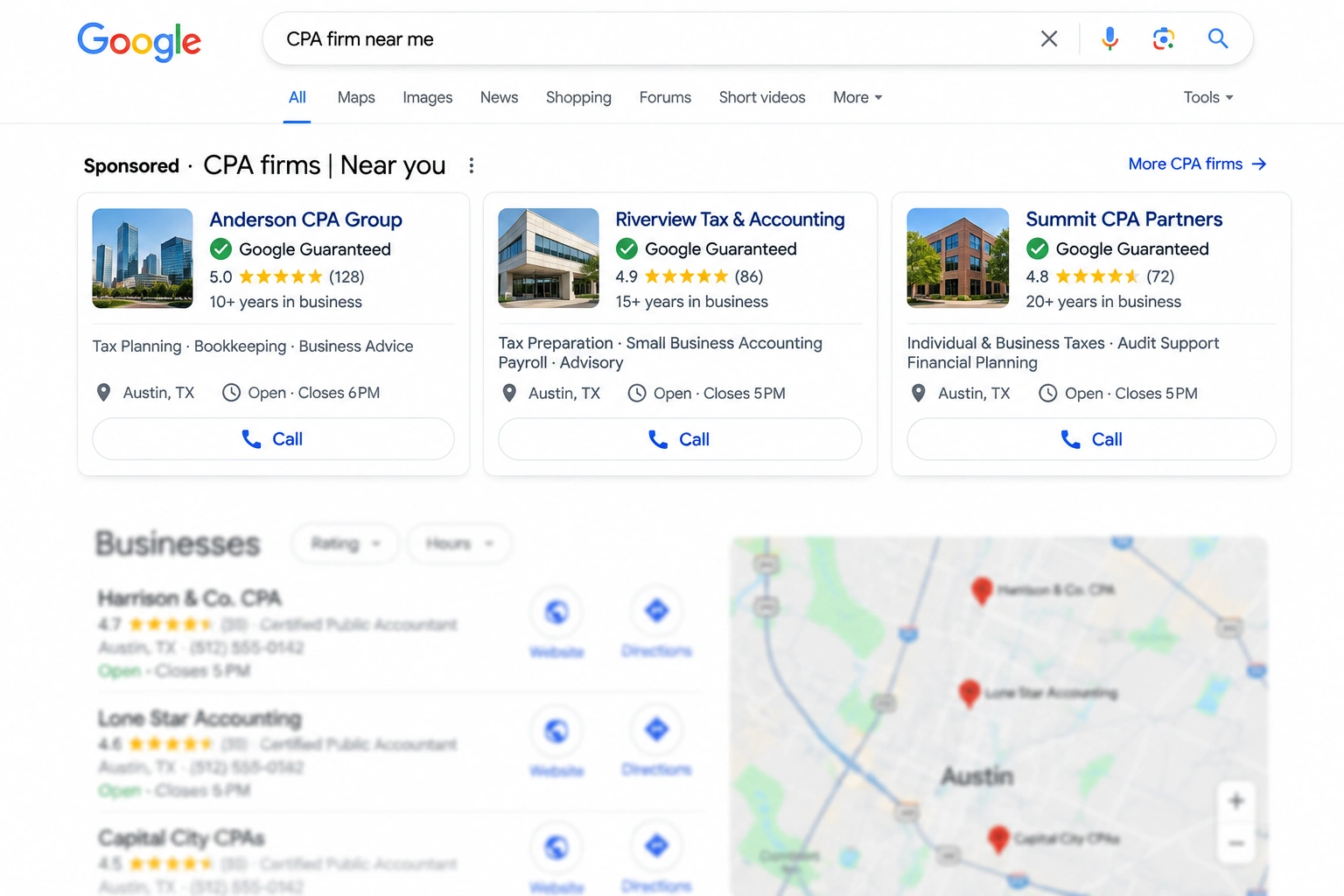
Sponsored CPA listings appear prominently above local map results, highlighting ratings, services, business details, and direct contact options.
The Power of Local Organic SEO for Long-Term Practice Growth
Organic local SEO for accounting firms is not a single tactic; it is a system of linked signals that collectively determine where your firm appears in Google’s map pack and organic results. The components that matter most:
- Google Business Profile Optimization: Your GBP is the foundation of local search visibility. A fully optimized profile, featuring accurate categories, detailed services, consistent NAP data, active review management, and regular posts, is the baseline requirement for appearing in the local map pack at all.
- On-Page SEO and Content Strategy: Creating original, substantive content that addresses the specific questions your target clients are searching for is how you build topical authority. This is where keywords like
seo for cpa firmsandaccountant seo servicesbecome relevant, not as phrases to stuff into headings, but as signals of the specific expertise your content demonstrates. - YMYL Compliance and E-E-A-T: Financial and tax-related websites fall into a category Google treats with heightened scrutiny because the stakes of bad advice are high. The exact language Google uses in its search quality evaluator guidelines for this category is not something we will paraphrase here; the guidelines themselves are publicly available and worth reading directly. What is clear is that thin, generic, or duplicated content on a financial services site carries a higher penalty risk than it would on a lower-stakes topic.
- Timeline Realities: Organic SEO does not produce results on the same schedule as LSAs. It takes time. How long it takes a new or under-optimized local website to achieve stable rankings in a competitive market depends on factors including domain age, existing citation health, competitor strength, and content quality. Any specific timeline estimate should come from an audit of your firm’s current standing, not a generic benchmark.
Comparing the ROI: Speed vs. Compounding Equity
The financial logic of each channel looks very different depending on your time horizon. Timeframes dictate strategy.
- LSA Cost Model: Variable and immediate. You pay per lead, which gives you real-time cost visibility and easy campaign control. The limitation is that this spend builds nothing permanent; pause the campaign and the leads stop. There is no residual asset.
- Organic SEO Cost Model: Fixed investment with compounding returns. The work done in month three, including technical fixes, content published, and citations built, continues generating traffic in month eighteen without additional spend. Once rankings stabilize, the cost per acquisition drops significantly compared to a sustained pay-per-lead model.
- The Retention Connection: The channel that brings a client in matters less than whether that client stays. A five percent increase in client retention rates can boost profits by 25% to 95%, according to HBR on customer retention value. Organic search tends to attract clients who were actively researching and comparing options; this is a behavior pattern that often correlates with higher intent and longer retention than a cold phone call from an ad.
- Measurement Challenges: Evaluating these channels purely through short-term ROI calculations can skew decision-making. HBR’s Balanced Scorecard research makes the case that traditional financial accounting measures like ROI can give misleading signals regarding the continuous improvement and innovation needed in a competitive environment. A firm that cuts its organic SEO investment because it does not show immediate returns in a spreadsheet may be optimizing for the wrong metric entirely.
Ready to evaluate which channel fits your firm’s current stage?
BizIQ’s local marketing specialists work specifically with professional services firms to assess their online presence and build a channel strategy that fits their growth timeline. Call (888) 416-9800, Monday through Friday from 7 AM to 4 PM, or explore our SEO services for accounting businesses to see what a custom strategy looks like.
Why Cheap SEO Packages Fail CPA Practices
The templated content packages marketed to accounting firms, such as a set number of blog posts per month pulled from a shared content library and published across dozens of client sites simultaneously, are not a neutral choice. They are an active liability. Search engines are increasingly effective at identifying duplicate and low-effort content, and for a financial services website operating under heightened quality scrutiny, that kind of content can suppress overall search visibility rather than build it.
The problem is structural, not just executional. A CPA firm’s website needs to demonstrate genuine expertise, authoritativeness, and trustworthiness on financial topics. Content that was written generically and distributed to multiple firms in the same category does the opposite; it signals that no one with real expertise was involved in producing it. That is a significant distinction in a category where Google’s quality signals are calibrated to protect users from unreliable financial guidance.
Professional seo for cpa firms requires something fundamentally different: custom content built around the specific services your firm offers, the client types you serve, and the geographic markets you compete in. Technical optimization, including site speed, crawlability, structured data, and mobile performance, needs to be addressed at the individual site level, not applied through a one-size template. And authoritative local citation management, the process of ensuring your firm’s name, address, and phone number are consistent and accurate across every relevant directory and data aggregator, is the kind of detail work that cheap packages skip entirely.
Investing in quality accountant seo services is not a premium option for large firms; it is the baseline requirement for any firm that wants to compete in local search without risking a visibility penalty. The firms that treat SEO as a commodity line item tend to discover that reality the hard way, usually after a Google core update.
“Why is SEO important for your small business in Phoenix? SEO levels the playing field by boosting your website’s search ranking, allowing you to compete with larger competitors even on a limited budget. It provides a cost-effective strategy for reaching more customers and building brand awareness through keyword optimization, attracting visitors interested in your offerings.” (Tyson Copeland, Local SEO Manager Based in Phoenix, AZ)
The Hybrid Strategy: Sequencing LSAs and SEO for Maximum Impact
The most effective path for a growing CPA practice is not a choice between LSAs and organic SEO; it is an intentional sequencing of both. Performance marketing and brand building are not competing budget lines; they can work together to increase the return on both, as HBR on brand building and performance marketing documents. The key is understanding which channel does what job and at what point in your firm’s growth trajectory. Timing is critical.
In practical terms, this looks like launching Google LSAs at the outset to generate immediate lead flow, capturing demand that already exists while your organic presence is still being built. That revenue funds the ongoing investment in local organic SEO, which is simultaneously being developed in the background. Over time, as organic rankings mature and the map pack presence strengthens, the firm’s dependence on paid leads decreases. LSAs shift from being the primary acquisition channel to a tactical supplement, useful for seasonal surges, new service launches, or competitive markets where organic rankings are contested.
The firms that execute this well do not think of it as two separate campaigns running in parallel. They treat it as a single, phased strategy with different tools doing different work at different stages. It works. The organic asset we build together is not just a traffic source; it is a long-term competitive moat that a competitor cannot simply outspend to eliminate.
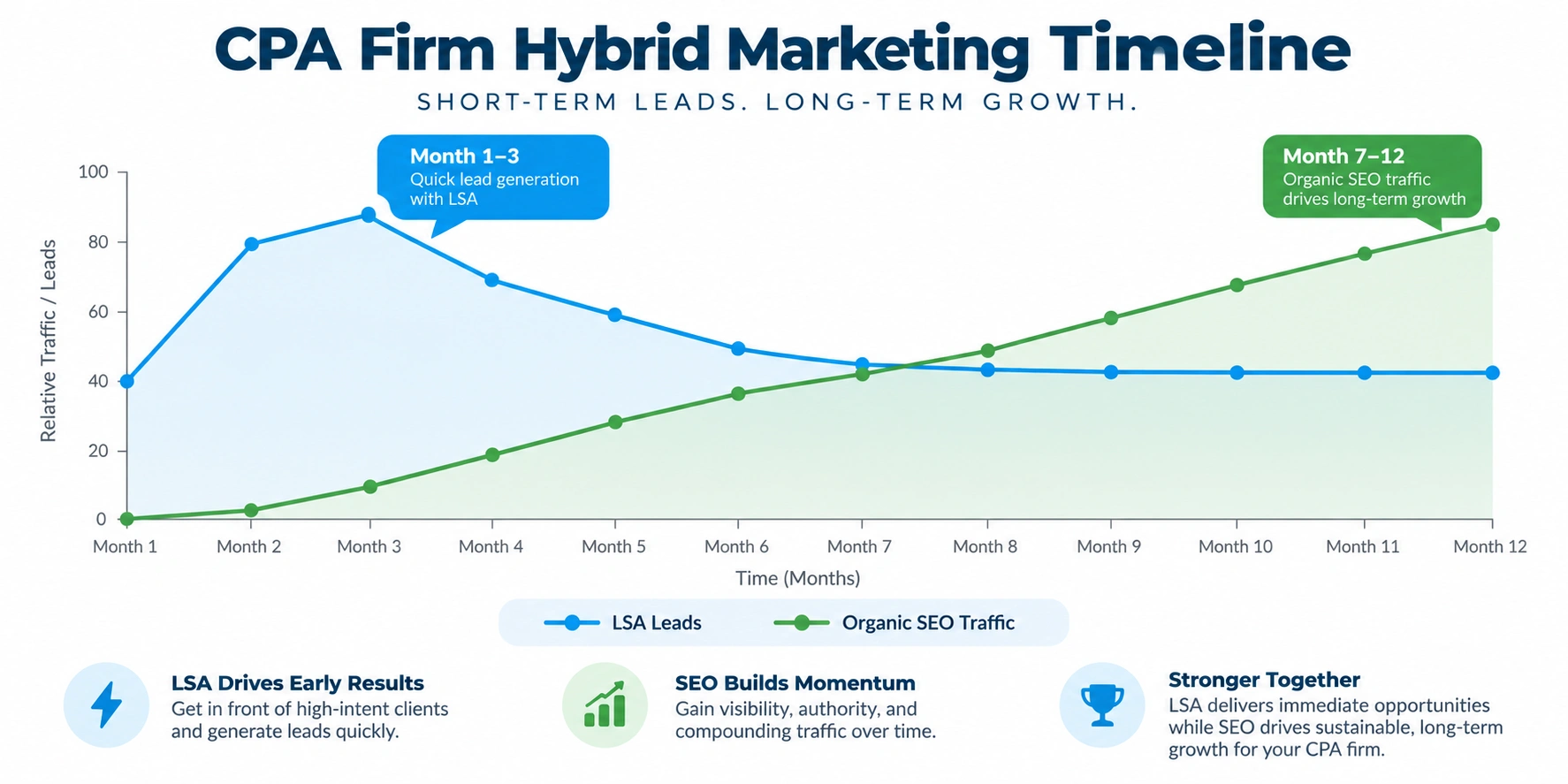
LSAs can generate early leads while organic SEO builds over time, illustrating how the two channels can support different stages of CPA firm growth.
Want a custom hybrid roadmap built around your firm’s specific market and growth goals? BizIQ’s team designs sequenced local marketing strategies for professional services firms at every stage of growth.
Call (888) 416-9800, Monday through Friday from 7 AM to 4 PM, to schedule your personalized strategy session.
Key Decision Factors for Your CPA Practice
Before committing to either channel, or a combination of both, there are four variables worth working through honestly:
- Current Budget and Cash Flow: LSAs require sustained per-lead spend to maintain visibility. Ads require cash. If your firm is in a growth phase with limited cash reserves, a variable cost model that scales with lead volume can burden operations. Organic SEO requires a larger upfront investment but transitions to a more predictable fixed cost over time. The right model depends on where your firm’s cash flow is today, not where you expect it to be.
- Growth Timeline and Seasonality: If you need clients before the next tax season, organic SEO cannot deliver on that timeline. LSAs can. If you are planning 18 months out and want to reduce your long-term cost per acquisition, organic SEO is the more efficient path. Many firms need both answers simultaneously, which is exactly what the hybrid approach addresses.
- Market Competition: The intensity of local search competition in your market affects both channels differently. In highly competitive metro markets, LSA costs tend to rise as more firms bid for the same leads. Organic rankings in those same markets take longer to achieve but, once held, are harder for competitors to displace. The percentage of local searchers who click on organic map pack results versus paid local ads varies by market and query type; this is a figure worth pulling from your own Google Business Profile and Search Console data rather than relying on a generic industry average.
- Internal Capacity to Handle Leads: LSAs generate phone calls immediately, during business hours, from people who want to talk to someone now. If your firm does not have the front-desk capacity or intake process to handle that volume responsively, you will pay for leads you cannot convert. Organic search tends to produce a steadier, more distributed inquiry flow, including contact form submissions and appointment requests, which are easier to manage with a smaller team.
Overcoming Common Client Acquisition Obstacles
The two objections CPA partners raise most often about digital marketing are expected: LSAs feel too expensive because you pay for every lead, and SEO feels too slow because the results are not visible for months. Both concerns are legitimate, but they are also symptoms of evaluating these channels through a single metric, such as short-term ROI, rather than a fuller picture of practice health. Context matters.
HBR’s Balanced Scorecard research argues that organizations need a balanced set of measures to drive performance effectively, because traditional financial metrics alone can give misleading signals about the continuous improvement a competitive environment demands. Applied to a CPA firm’s marketing decisions, this means tracking not just cost per lead, but also client retention rates, average client lifetime value, referral rates from organically acquired clients, and brand search volume over time. Those metrics tell a different story than a single-channel ROI calculation, and they tend to justify the hybrid investment more clearly.
The firms that struggle most with digital marketing are usually the ones that treat it as a cost to minimize rather than an asset to build. The ones that grow consistently tend to measure it the way they would measure any long-term investment: with patience for the compounding returns and discipline around the inputs.
Frequently Asked Questions About CPA Search Marketing
Local search marketing shifts rapidly, and the decisions you make about channel mix, budget allocation, and content strategy today will shape your firm’s competitive position for years. Staying informed on the fundamentals, and the nuances, is part of running a practice that grows on its own terms. Knowledge is power.
What is CPA in SEO?
In digital marketing, CPA stands for Cost Per Action (or Cost Per Acquisition), a pricing model where an advertiser pays only when a user completes a specific action, such as submitting a contact form, making a phone call, or scheduling a tax consultation. It is worth noting the terminology overlap: in this article, “CPA” refers to Certified Public Accountant, while in a paid media context, the same acronym describes a performance pricing model. When evaluating your LSA campaigns, your cost per acquisition is one of the most important metrics to track, because it connects your ad spend directly to the revenue value of the clients it generates.
Why are so many CPAs quitting the profession?
Burnout is the most commonly cited driver: long hours concentrated in tax season, increasing regulatory complexity, and a talent pipeline that has not kept pace with demand. The result is that many experienced CPAs are exiting private practice for corporate roles or leaving the profession entirely, which increases workload pressure on the partners who remain. Workloads are rising. For firms navigating this environment, efficient and automated client acquisition becomes more than a growth strategy; it is an operational necessity. A practice that can generate a steady flow of qualified inquiries without requiring partners to spend time on marketing is better positioned to retain the staff it has and serve the clients it wants.
What do most CPAs charge per hour for services?
Rates vary considerably based on experience, specialization, and geography, but most CPAs typically charge between $150 and $450 per hour for professional accounting and tax services. That range matters for marketing ROI calculations. A single retained client who engages your firm annually for tax preparation, advisory, and bookkeeping can represent thousands of dollars in recurring revenue; this means even a relatively high cost per acquisition through LSAs or organic SEO can pay back quickly, provided the client stays.
Can a non-CPA buy or own a CPA firm?
In many jurisdictions, non-CPAs can hold a minority ownership interest in a CPA firm, but most state boards and professional licensing bodies require that a majority of ownership remain with licensed CPAs. This ensures professional oversight and compliance with the ethical standards that govern the profession. The specifics vary by state, so any firm exploring ownership structure changes should consult their state board directly.
Which exam is generally considered harder, the CPA or the Bar?
Difficulty is genuinely personal here, and the comparison depends heavily on the individual’s academic background. The CPA exam is technically dense and quantitatively demanding, with a heavy emphasis on accounting standards, financial data interpretation, and tax law. The Bar exam leans more heavily on legal reasoning, extensive memorization of case law across multiple jurisdictions, and essay writing under time pressure. Both require sustained, rigorous preparation; the more useful question for a CPA firm owner is probably not which is harder, but how the credential you have earned positions your firm in a market where trust and expertise are the primary purchase criteria.
Choosing between Google LSAs and local organic SEO is not an all-or-nothing decision, and for most CPA practices, it should not be framed that way. The most profitable path involves a deliberate, sequenced integration of both channels: LSAs to capture immediate demand while your organic presence is being built, and local SEO to create a compounding digital asset that reduces your long-term cost per acquisition and builds the kind of authoritative local presence that attracts high-value clients consistently.
The firms that get this right do not stumble into it. They work with a team that understands the specific dynamics of professional services marketing, knows how to sequence the investment, and can measure performance across the full picture, rather than just the metrics that show up in a single campaign dashboard.
Ready to scale your firm’s local visibility? Contact BizIQ today at (888) 416-9800, Monday through Friday from 7 AM to 4 PM, to schedule your personalized strategy session. You can also explore our resources on SEO for accountants to see the full picture of what a well-executed local SEO strategy looks like for firms at every stage of growth.