
Key Takeaways:
- Mobile-first layouts that capture urgent emergency calls in under three seconds.
- High-visibility trust signals including license numbers, insurance badges, and real-time reviews.
- Strategic site architecture with dedicated service pages for electricians to maximize local search rankings.
What Makes a High-Converting Electrician Website?
A high-converting electrician website combines strong SEO, fast page speed, clear service pages, trust signals, compelling calls to action, and an intuitive user experience that makes it easy for visitors to request service. The best electrician websites not only rank well in traditional and AI-powered search but also turn more visitors into qualified leads and paying customers.
When sparks fly from an outlet or a home suddenly loses power, homeowners do not browse the web for leisure: they grab their smartphones to find an immediate, trustworthy solution. Your website has exactly 0.5 seconds to prove your business is licensed, insured, and ready to dispatch a technician before that panicked visitor clicks away to a competitor. Speed is everything.
As small business owners ourselves, we know that getting website visitors to pick up the phone and book service calls requires a calculated mix of speed, clarity, and immediate peace of mind, especially when a homeowner is dealing with a smoking outlet or a complete blackout. While many trade websites rely on generic templates and stock imagery, high-performing electrical contractor sites function as active lead-generation engines. By structuring your online presence around user intent and friction-free navigation, you can turn casual searchers into lifelong clients.
Designing for the Mobile-First Emergency Searcher
Mobile-First Layout Requirements
Over 70% of home service inquiries come from mobile devices, and for electrical emergencies, that number skews even higher. When a homeowner experiences a partial power outage at 10 PM, they are not sitting at a desktop. They are standing in a dark hallway, phone in hand, scanning results with one eye on the breaker box. They need help fast. An interface that requires pinching, zooming, or horizontal scrolling to find a phone number will lose that lead in under three seconds, sending them straight to the next electrician on the list.
Google has made its position clear: your site needs to work as well on a phone in bright sunlight as it does on a desktop in an office. A slow-loading site does not just frustrate users; it stops you from showing up when people search on Google. Your mobile layout needs a clean, high-contrast header that communicates availability immediately, with all critical contact options right at the top of the screen where they can see them.
Tap-to-Call Technical Specifications
The mechanics are simple, but the execution gap is wide. Implementing the HTML tel: protocol, <a href="tel:+11234567890">Call Now: (123) 456-7890</a>, eliminates the friction of copying and pasting a number. One tap starts the call. That single tap-to-call button makes an immediate difference in getting more calls.
Button sizing is non-negotiable. All tap-to-call elements must meet a minimum height of 48 pixels and a width of at least 150 pixels to fit natural thumb placement, particularly for users operating under stress. Pair that with a persistent, sticky bottom call bar, anchored to the base of the screen as the user scrolls, and the option to call stays within reach of their thumb. High-contrast styling matters too: bright orange or green against a dark navy background draws the eye to the tap-to-call button before the user consciously processes the rest of the page. Applying targeted website optimization strategies to your mobile rendering and image compression can push your load time under three seconds on standard 4G networks, which is where you either get the call or lose it.
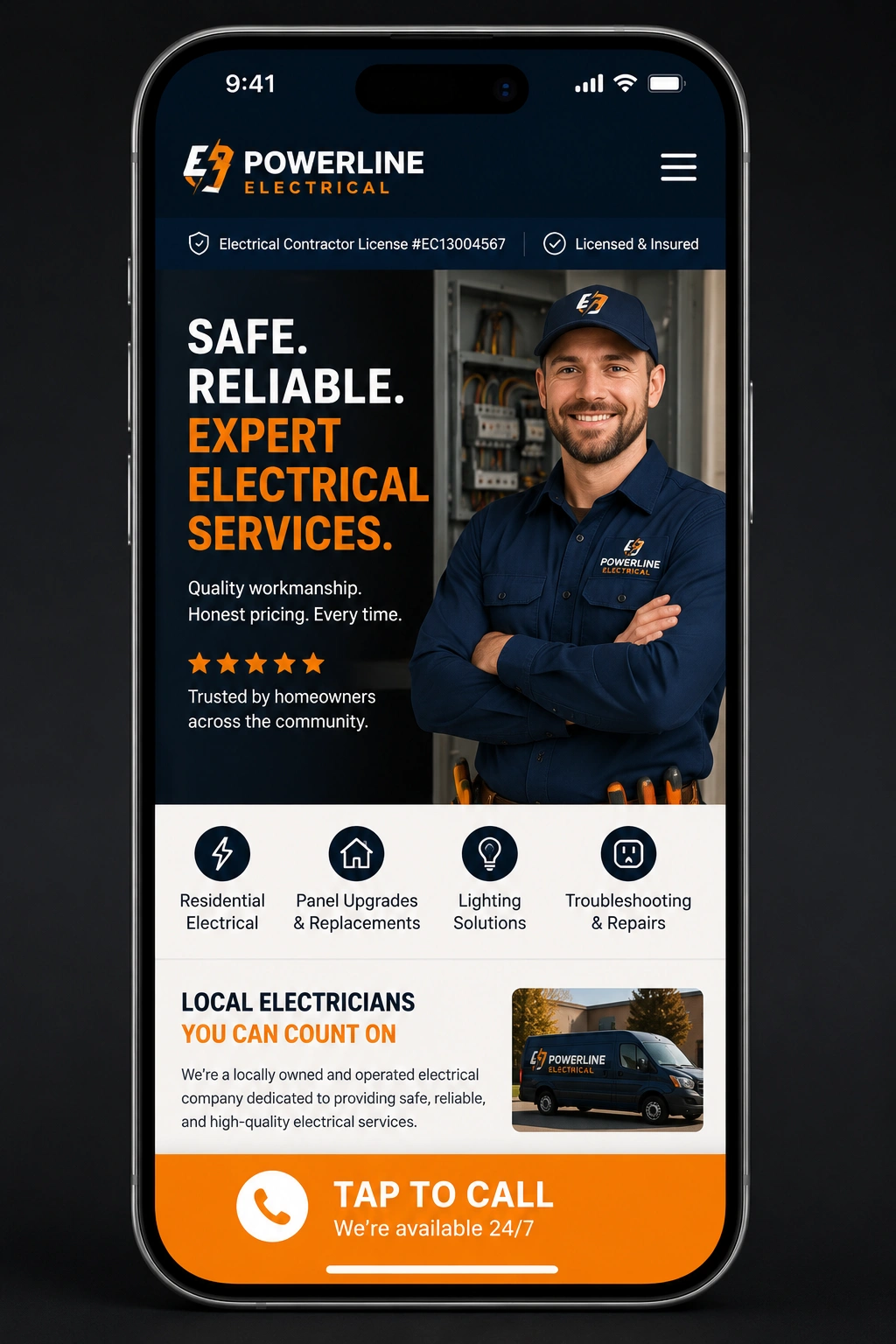
A mobile-friendly electrician website featuring trust signals, fast access to services, and a prominent tap-to-call button.
Essential Trust Signals That Eliminate Customer Friction
Licensing and Insurance Display
Displaying your state electrical license number, formatted as Licensed Electrical Contractor #EC-12345, is not a mere detail. It is the fastest trust signal available to a visitor who has never heard of your company. An audit of 1,390 electrician websites by the Industry Usability Report revealed that 56% hid their license number and 42% failed to mention they were licensed and insured. That is more than half of the market voluntarily surrendering the one piece of information that gets customers to trust you with their electrical work. Don’t make that mistake.
Placement matters as much as presence. Your license number and insurance status belong in the website footer so they show up on every single page, and we should repeat them on our “About” and “Contact” pages where customers make their decisions. Beyond building trust, showing this prominently ensures compliance with local advertising regulations in most states: a detail that unlicensed competitors cannot match.
Social Proof and Reviews
An overwhelming 87% of consumers read online reviews before hiring a local tradesperson, which means almost every single visitor is looking for confirmation that you do good work. That statistic gets thrown around a lot, but the real impact is worth sitting with: nearly nine out of ten people who land on your site will look for proof before they call you. A static “What Our Customers Say” section with three hand-picked quotes does not satisfy that need. A live Google Reviews widget, pulling authentic, recent, unedited feedback in real time, does. It proves you are real.
Industry badges from recognizable organizations like the Better Business Bureau (BBB) or the National Electrical Contractors Association (NECA) add a second layer of trust. These logos function as visual shorthand for “this business has been screened by someone other than themselves,” which reduces hesitation at the exact moment a visitor is deciding whether to call or scroll back to the search results.
- Prominent License and Insurance Display: Place your state license number and “Licensed & Insured” badge directly in your website’s header and footer to build immediate trust.
- Real-Time Google Reviews: Embed a live review widget showcasing recent five-star ratings, as 87% of consumers read online reviews before hiring a local tradesperson.
- Clear Safety Guarantees: Highlight your compliance with the National Electrical Code (NEC) and your commitment to background-checked, drug-tested technicians.
Structuring High-Converting Service Pages for Electricians
Hub-and-Spoke Architecture
Listing every service on a single, generic page is one of the most common structural mistakes in electrician website design, and one of the most expensive. High-converting sites use a hub-and-spoke model: a central Services hub that branches into individual, dedicated service pages for electricians for each core offering. Panel upgrades, EV charger installations, generator setups, and emergency repairs each deserve their own page, their own H1, and their own targeted content. One size does not fit all.
The search engine logic is direct. A homeowner searching “emergency electrician near me” at midnight is not looking for a company overview: they are looking for a page that speaks directly to their situation. A dedicated emergency services page, with its own URL, its own localized content, and its own clear path to call, shows up in search far more effectively than a generic services list. Directing paid search traffic to these service-specific landing pages, rather than a generic homepage, produces a 100% to 500% increase in calls across documented trade service campaigns.
Service Page Blueprint
Every individual service page should follow a structured layout that mirrors the customer’s decision process. Open with a clear H1 that matches what they are searching for directly, such as Professional Panel Upgrade Services in [City Name], supported by a high-quality photo of an actual installation. Follow that with a concise problem-and-solution section that acknowledges the specific pain point, not a generic description of what electricity is. Then detail the exact scope of work: permitting, panel capacity assessment, installation, and testing. Be clear and detailed. Localized trust signals, like two or three reviews that specifically mention the service, close the loop before the visitor reaches your call button. You don’t need to be techy to see how these pieces fit together: you just need to know what works and why.
The final call block should offer two options at the same time: a phone number for immediate dispatch and a short form for scheduled requests. Not every visitor is in emergency mode: some are planning a project and prefer to send a message. Give them choices. Capturing both ways to contact you on the same page is a structural decision that compounds over time. If you are looking for partners to build this architecture, choosing a web design service that understands how to build these structured layouts and genuinely understands trade contractor workflows will save you significant rework down the line. We recommend reading our guide on what to consider when choosing a web design service to make sure you get real results.
- Dedicated Service Pages: Create individual service pages for electricians for high-value offerings like panel upgrades, EV charger installations, and emergency repairs rather than grouping them on a single page.
- Localized Content: Integrate specific city and neighborhood names naturally within your headings and body copy to show up when people search for local help.
- Transparent Process Overviews: Outline exactly what the customer can expect during a service call, including diagnostic fees, arrival windows, and safety protocols.
Need to see how your current website measures up?
Get a detailed, professional analysis of your site’s performance today to identify and fix the hidden bottlenecks holding your business back.
The Psychology of Color and Visual Hierarchy in Trade Marketing
High-Contrast Color Palettes
Visual design communicates professionalism before a visitor reads a single word of your copy. A professional image is built on consistent, intentional choices. High-converting trade websites consistently use a high-contrast color palette: deep navy blue anchors the layout with associations of trust and stability, while vibrant orange or yellow accents mark every primary tap-to-call button. This pairing is not arbitrary; it is a deliberate visual hierarchy that guides the user’s eye toward quote forms and phone numbers without requiring them to hunt. The contrast does the navigational work.
Color choices also carry subtle brand signals. Navy reads as established and dependable: qualities that matter enormously when someone is about to let a stranger into their home’s electrical system. Orange signals urgency and action, which is precisely the emotional feeling you want attached to your “Call Now” button.
Authentic Imagery vs. Stock Photos
Generic stock photos of smiling models holding tools are a liability, not an asset. People see right through them. Visitors process visual authenticity faster than they process copy, and a staged lightbulb photo signals “template website” before the headline even registers. Websites featuring real photos of local technicians, branded service trucks, and actual completed projects, such as before-and-after breaker panel upgrades, freshly installed EV chargers, or clean conduit runs, consistently outperform stock-dependent sites on both trust metrics and how many calls they get.
Real imagery proves the business is local, active, and operating at a professional standard. A branded service van in a recognizable neighborhood is worth more than any tagline. It shows you are real. Uniformed technicians with identifiable faces reduce the mystery that makes homeowners reluctant to invite a contractor inside to trust you with their electrical work.
“An audit of 1,390 electrician websites revealed that 56% hid their license number and 42% failed to mention they were licensed and insured. Contractors who display these credentials prominently see a massive lift in user trust and how many calls they get.”
Industry Usability Report
Technical Performance Benchmarks for Contractor Websites
Page Load Speed and Mobile Performance
A well-designed website that loads in six seconds is functionally invisible to the users who matter most. Mobile searches for home services are fast and urgent; 78% of local mobile searches for home services result in a booked job within 24 hours, which means the window between search and decision is narrow. If your site does not load before the user’s attention shifts, you are not competing: you are simply absent from the search results. Speed wins the job.
The technical foundation is not exciting, but it is load-bearing: an active SSL certificate, spam-protected contact forms, clean and descriptive URL structures, such as /panel-upgrade-phoenix/ rather than /services?id=4, and compressed images that do not slow down users on slower connections. These are not advanced optimizations; they are baseline requirements for a site that works on their phone.
Conversion Benchmarks
High-performing electrician websites target a 6% to 10% site-to-lead conversion rate, turning visitors into tracked calls or form submissions. The broader contractor median sits at 2% to 4%, which means most sites are leaving more than half their potential leads on the table. That is lost revenue. Highly optimized trade websites regularly achieve conversion rates of 8% to 12%, and the gap between median and top-performer is almost entirely explained by the structural and trust-signal decisions covered in this guide.
Paid search raises the stakes. Directing ad traffic to a dedicated, service-specific landing page rather than a generic homepage produces a 100% to 500% increase in booked jobs: a range that reflects how much difference exists in baseline site quality. The better our organic site, the more our paid campaigns benefit from the same infrastructure.
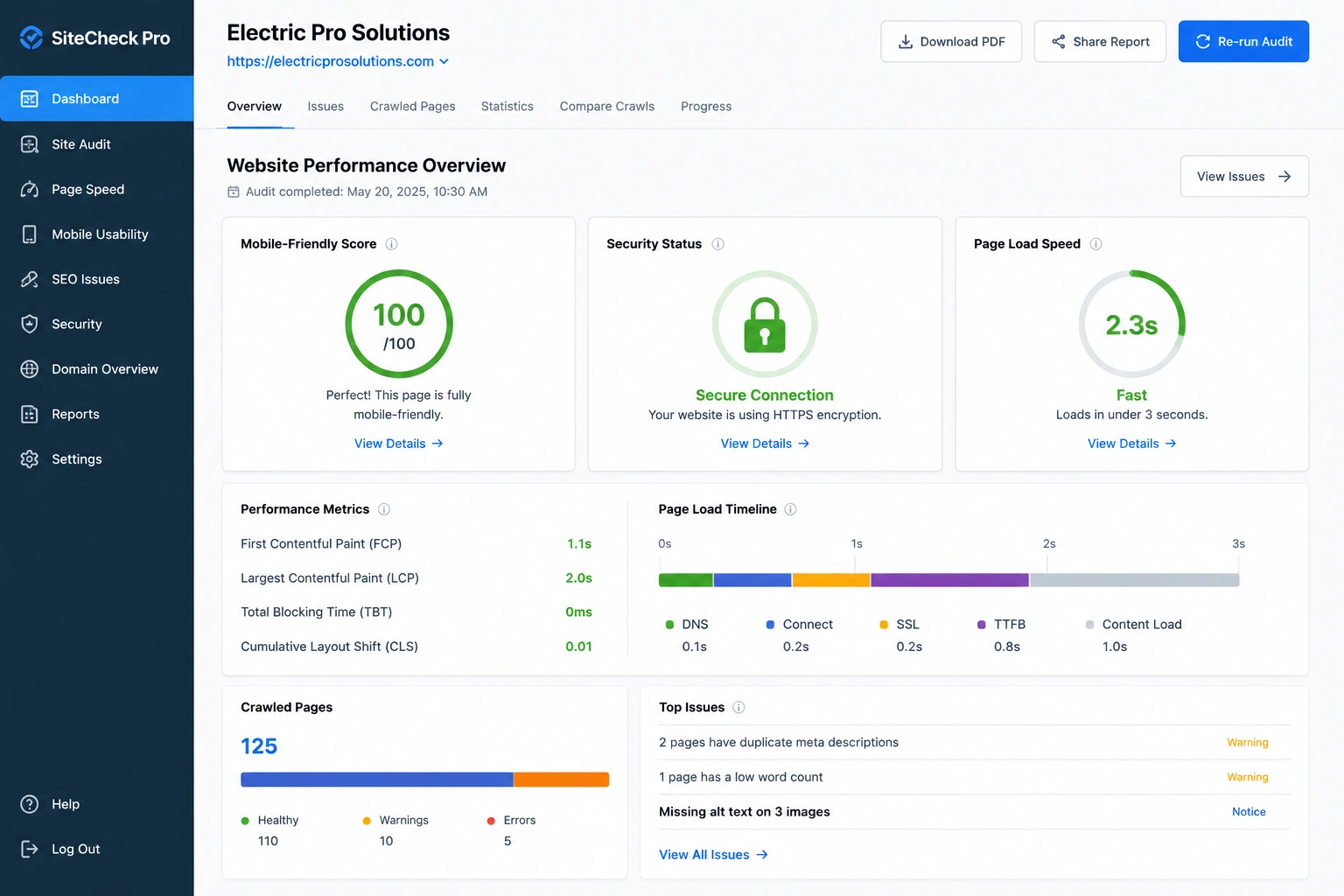
A technical website performance report highlighting mobile usability, HTTPS security, and fast page load speeds for an electrician business.
Ready to transform your online presence into a consistent source of booked jobs?
Explore our in-depth guide to building a high-performing digital footprint. Read the Full SEO-Friendly Website Design Guide to discover advanced technical strategies and platform recommendations.
Maximizing Local Search Visibility with Service Area Architecture
Service Area Landing Pages
A single homepage cannot rank for every city and suburb in your service territory. You need local reach. Building dedicated landing pages for each major market you serve, complete with local landmarks, ZIP codes, and an embedded Google Map, gives search engines discrete, location-specific signals to index and rank. A page titled Emergency Electrician in Scottsdale, AZ with genuine local content will outrank a generic homepage for that query every time.
NAP consistency is the structural requirement that ties this together. Your business name, address, and phone number must match exactly across your website and your Google Business Profile. Consistency is key. A single character mismatch, such as an abbreviated street name on one platform and a spelled-out version on another, introduces ambiguity that weakens your local authority in ways that are difficult to diagnose and slow to recover from.
Local SEO Technical Signals
Schema markup is the part of local SEO that most contractors skip because it is invisible to the human eye. It is highly effective. Implementing LocalBusiness and Electrician structured data schema is the technical equivalent of handing Google a perfectly filled-out business card instead of making it guess your service radius from your copy, which helps you show up when people search for local help. You are clearly declaring your service area, business hours, license information, and service categories in a format the algorithm reads directly: no guesswork required on either side.
- Service Area Pages: Build dedicated landing pages for each major city or suburb you serve, complete with local landmarks, ZIP codes, and embedded Google Maps.
- Google Business Profile Integration: Ensure your business name, address, and phone number (NAP) match exactly across your website and your Google Business Profile.
- Local Schema Markup: Implement
LocalBusinessandElectricianstructured data schema to help search engines understand your exact service radius and business hours.
Using Educational Content to Build Long-Term Authority
Educational Blogging Strategy
Not every visitor arrives in crisis mode. A significant number of homeowners reach our site during the research phase of a planned project: they are weighing whether to upgrade their panel before finishing the basement, or trying to understand what an EV charger installation involves. Publishing high-quality, educational blog posts about common electrical issues, such as the signs of an overloaded circuit, the practical case for upgrading to a 200-amp service, or what whole-home surge protection protects against, places our brand as the leading local authority on these questions.
The compounding effect is worth understanding. A homeowner who reads our article on overloaded circuits in January, bookmarks it, and then experiences a tripped breaker in March already knows our name. They are not starting a cold search: they are returning to a business they have already decided to trust.
Building Local Authority
Educational content earns something that service pages cannot: time on page. It keeps them reading. A visitor who spends four minutes reading your guide on panel capacity is showing a level of engagement that signals genuine purchase intent to both search algorithms and your own analytics. That dwell time improves your organic rankings for informational queries, which feeds more research-phase visitors into our pipeline: visitors who are considerably easier to book because they arrive pre-warmed.
Why Website Management and Maintenance Matter for Getting Calls
Regular Content and Image Updates
A website is not a set-it-and-forget-it asset. It needs constant care. Licensing details change, service offerings expand, and contact information shifts, and a site that reflects last year’s reality damages trust with visitors who notice the discrepancy. We recommend updating your website at least quarterly to ensure licensing, insurance, and contact details remain accurate. Adding new customer reviews and fresh project photos monthly signals to both search engines and potential clients that your business is active, growing, and worth contacting.
Stale content carries a specific risk for trade contractors: an outdated license number or an expired insurance badge displayed on your site is not just a missed opportunity: it is a liability. Visitors who catch the inconsistency will not call to ask for clarification.
Security and SSL Certificates
An expired SSL certificate triggers browser warnings that are functionally equivalent to a “Do Not Enter” sign on your homepage. Most visitors will not look further; they will leave and call the next result. You lose the lead. Broken contact forms carry the same cost in lost jobs: a visitor who fills out a quote request and never hears back does not assume the form failed; they assume you are too busy and will immediately call another electrical contractor.
Regular security audits and software updates prevent malware injections and hacking attempts that can redirect your traffic, corrupt your rankings, or expose customer data without your knowledge. Implementing website management best practices ensures your site remains secure, fast, and fully functional, preventing broken links or expired SSL certificates from quietly killing your leads.
Frequently Asked Questions About Electrician Web Design
What is the average call rate for an electrician website?
The average call rate for a typical electrician website is between 1% and 3%. That is very low. However, by implementing dedicated service pages, optimizing mobile tap-to-call buttons, and displaying prominent trust signals, highly optimized sites can achieve call rates between 8% and 12%.
Should I put my electrical license number on my website?
Yes. Do it today. Displaying your state electrical license number and insurance status is one of the most important trust signals for an electrician website. It should be placed prominently in the website footer so it appears on every page, as well as on our “About” and “Contact” pages. This builds immediate trust and ensures compliance with local advertising regulations.
Why are dedicated service pages better than a single services list?
Dedicated service pages, like a page specifically for “Panel Upgrades,” allow you to target high-intent, localized search queries, which helps you show up when someone searches ‘electrician near me’ on Google. They capture local searches. They also allow you to address the specific questions, pain points, and safety concerns linked with that exact service, leading to much higher call rates than a generic bullet-point list ever will.
How big should tap-to-call buttons be on mobile devices?
Mobile tap-to-call buttons should have a minimum touch target size of 44 × 44 pixels, though 48 × 48 pixels or larger is strongly recommended. Make them easy to tap. This ensures that users, especially those in stressful emergency situations or those with limited hand movement, can tap the button accurately with their thumb without misclicking adjacent elements.
How do I track where my website leads are coming from?
Implement Google Analytics 4 (GA4) to track form submissions and pair it with dynamic call tracking numbers. Know what works. Call tracking links phone calls to specific traffic sources, including organic search, Google Local Services Ads, and social media campaigns, giving you the data needed to spend your marketing budget toward the channels that are generating revenue.
Building an electrician website that gets more calls is not about chasing design trends; it is about creating a fast, trustworthy, and effortless pathway for a customer to hire you. By implementing a mobile-first layout, displaying prominent trust signals, and structuring dedicated service pages, we can transform our website from a static digital brochure into our most productive lead-generation asset.
Take the first step toward dominating your local market and securing more high-value service calls. Discover how top-performing electrical contractors structure their digital marketing strategies to outrank the competition. Explore the Best Electrician Website Marketing Strategies and start optimizing your online platform today.