- Shortlist Dominance: Position your firm on the “Day One” shortlist before RFPs are issued.
- Risk Mitigation: Prove budget and schedule certainty through technical, high-intent content.
- Authority Building: Turn complex zoning, permitting, and safety protocols into search assets.
Corporate real estate developers do not buy construction services on a whim; they hire liability management partners who can guarantee schedule and budget certainty. When a multi-million-dollar development is on the line, developers don’t look for flashy marketing: they look for a team that understands how to de-risk the entire preconstruction phase.
B2B buyers consume an average of 13.4 content assets before contacting a sales representative, according to Directive Consulting. For commercial builders, that figure reframes the entire acquisition problem. Passive marketing fails. Waiting for a formal Request for Proposal to land in your inbox is a defensive stance that cedes the shortlist to competitors who started publishing six months ago. To win high-value commercial contracts, your digital presence must actively build trust with developers, institutional investors, and procurement officers long before they draft their vendor list.
Why corporate developers ignore standard construction websites
Based on what we’ve seen, corporate developers don’t just encounter partners. Forrester research puts a sharp number on this reality: 92% of B2B buyers begin their vendor search with a preferred firm already in mind, and 95% of contract winners were on that initial shortlist. That means the competitive window isn’t the RFP: it’s the quiet research phase that precedes it by months.
Most commercial builder websites aren’t built for that phase. They’re structured as digital brochures: a portfolio of completed projects, a services page, a contact form. What they don’t communicate is process: how the firm navigates a contested site plan review, how it manages phased permitting across jurisdictions, or how it handles a material lead-time disruption mid-schedule. Developers aren’t browsing for aesthetic inspiration. They want proof. They’re conducting due diligence, and a gallery of finished buildings tells them almost nothing about execution risk.
Corporate developers typically spend three to six months in a self-directed research phase before making any direct contact with a contractor. During that window, they’re consuming technical guides, case studies, regulatory explainers, and anything else that helps them model risk. A builder’s website that speaks only to completed outcomes, and not to the operational discipline that produced them, gets filtered out early. The developer’s internal evaluation script runs something like: I need a builder who won’t blow my budget or delay my schedule. If your content doesn’t answer that question directly, it doesn’t make the cut.
The real story is that a structured commercial construction content strategy converts a passive portfolio into an active lead-generation engine. By publishing the kind of technical, process-oriented content developers are already searching for, you show them you speak their language. This means addressing preconstruction hurdles: permitting timelines, zoning entitlements, safety protocols, and material procurement, directly on your website, in enough depth to demonstrate genuine operational fluency. Developers aren’t looking for a general contractor in the commodity sense; they’re looking for a liability management partner who has solved the problems they’re about to face. Four content pillars anchor this strategy: permits, zoning, safety, and materials.
Before investing in content, it’s worth auditing your current site’s foundation. If you built it on DIY website builders, the structural limitations may undermine even well-crafted content. And if you’re looking for a broader starting point, our 10 marketing ideas for construction companies covers the full channel mix worth considering alongside content.

A construction management dashboard overlays a commercial site plan with real-time scheduling, budgeting, and compliance insights.
The four pillars of B2B construction expertise
A developer evaluating your firm is running a simultaneous risk assessment across four dimensions. Your content strategy should map directly to each one. Focus on risk.
- Pillar 1: Permits: Demystifying the multi-stage approval workflow to show developers how to compress approval timelines and anticipate municipal friction points before they become schedule killers.
- Pillar 2: Zoning: Addressing land-use compatibility, setbacks, floor area ratios (FAR), and entitlement risks to position your firm as an active regulatory partner, not a passive executor.
- Pillar 3: Safety: Demonstrating jobsite risk management, OSHA compliance, and site-specific safety planning to reduce the developer’s perceived liability exposure before a contract is signed.
- Pillar 4: Materials: Analyzing material performance, lead-time sensitivities, and sustainable alternatives like mass timber or low-carbon concrete to prove supply chain fluency and ESG alignment.
De-risking the permitting maze
Permitting is frequently the single greatest schedule delay in commercial development, and the one developers most want a builder to own, not just navigate reactively. Delays cost money. Here’s what you need to know to establish authority in this space:
- Multi-stage approval workflow: Content should walk through the full sequence: site plan reviews, building permits, MEP (mechanical, electrical, plumbing) approvals, and fire safety clearances. Developers want to see that you understand the interdependencies between these stages, not just the individual checkboxes.
- Pre-submittal checklists and phased permitting: Publishing these tools publicly demonstrates technical competence in a way that a portfolio page simply cannot. A downloadable pre-submittal checklist signals that your firm has institutionalized this knowledge, not just accumulated it informally.
- Compressing approval timelines: Guides that explain how to sequence submittals, pre-coordinate with municipal reviewers, and structure phased permits to allow early site work show developers that you’ve solved this problem before, repeatedly.
- Search intent alignment: This content directly targets high-intent queries like “commercial building permit timeline” or “how to fast-track municipal approvals”: terms that indicate a developer actively working through preconstruction feasibility, not casually browsing.
Ready to Build Your Commercial SEO Strategy?
We’re a small business ourselves, and we know that navigating B2B marketing can feel like a complex preconstruction phase. Let us help you turn your technical building expertise into a predictable pipeline of developer leads. Explore our Commercial Construction Digital Marketing Services
Navigating zoning and entitlement hurdles
Land-use compatibility, setback requirements, and floor area ratios are the variables that determine whether a development concept is financially feasible before a single structural drawing is commissioned. Entitlement risk is where projects die quietly: not during construction, but during the months of regulatory negotiation that precede it. Risk is high. A builder who can articulate this process in writing, with specificity, signals something that a portfolio of finished buildings cannot: they’ve been in the room when the variance was contested.
Navigating zoning rules isn’t just bureaucratic red tape: zoning rules determine what you can legally build on your lot. Think of it as your property’s operating manual. Explaining the mechanics of a variance application, when it’s warranted, what documentation strengthens the case, and how to engage planning commissioners before a public hearing, demonstrates the kind of boots-on-the-ground regulatory fluency that developers pay a premium for. When targeting real estate developers in construction marketing, this is the content category that most directly maps to their preconstruction anxiety.
The real story is that navigating zoning variances is like solving a Rubik’s cube where the rules change with every turn: you need a partner who has solved it hundreds of times. By publishing detailed guides on local zoning codes, overlay districts, and entitlement sequencing, builders prove that expertise without needing to say it explicitly. What this means for your project is clear: it helps developers calculate their yield and assess feasibility during early-stage planning.
“The builders who win the most lucrative commercial contracts are those who use their digital platforms to solve regulatory problems before the shovel ever hits the dirt.”
Demonstrating jobsite safety and OSHA compliance
Corporate developers carry insurance and liability structures that make jobsite safety a contractual obligation, not just an ethical one. A single recordable incident on a high-profile development can trigger insurance reviews, delay financing draws, and create reputational exposure for the developer’s own stakeholders. This is why safety content on a builder’s website lands differently than most firms expect: it’s not a credential display, it’s a risk transfer conversation. Safety is security.
The content focus here should move past EMR ratings and into the systems that produce them: daily safety stand-downs, subcontractor pre-qualification protocols, site-specific safety plans developed before mobilization, and incident-response procedures that minimize schedule disruption when something does go wrong. Documenting how your firm maintains a zero-incident jobsite, the actual mechanisms, not the aspirational language, gives developers something concrete to evaluate. OSHA compliance is the floor; what developers want to see is the architecture above it. A builder who can explain their safety management system in writing, with enough technical granularity to be credible, is demonstrating operational discipline in the most direct way possible.
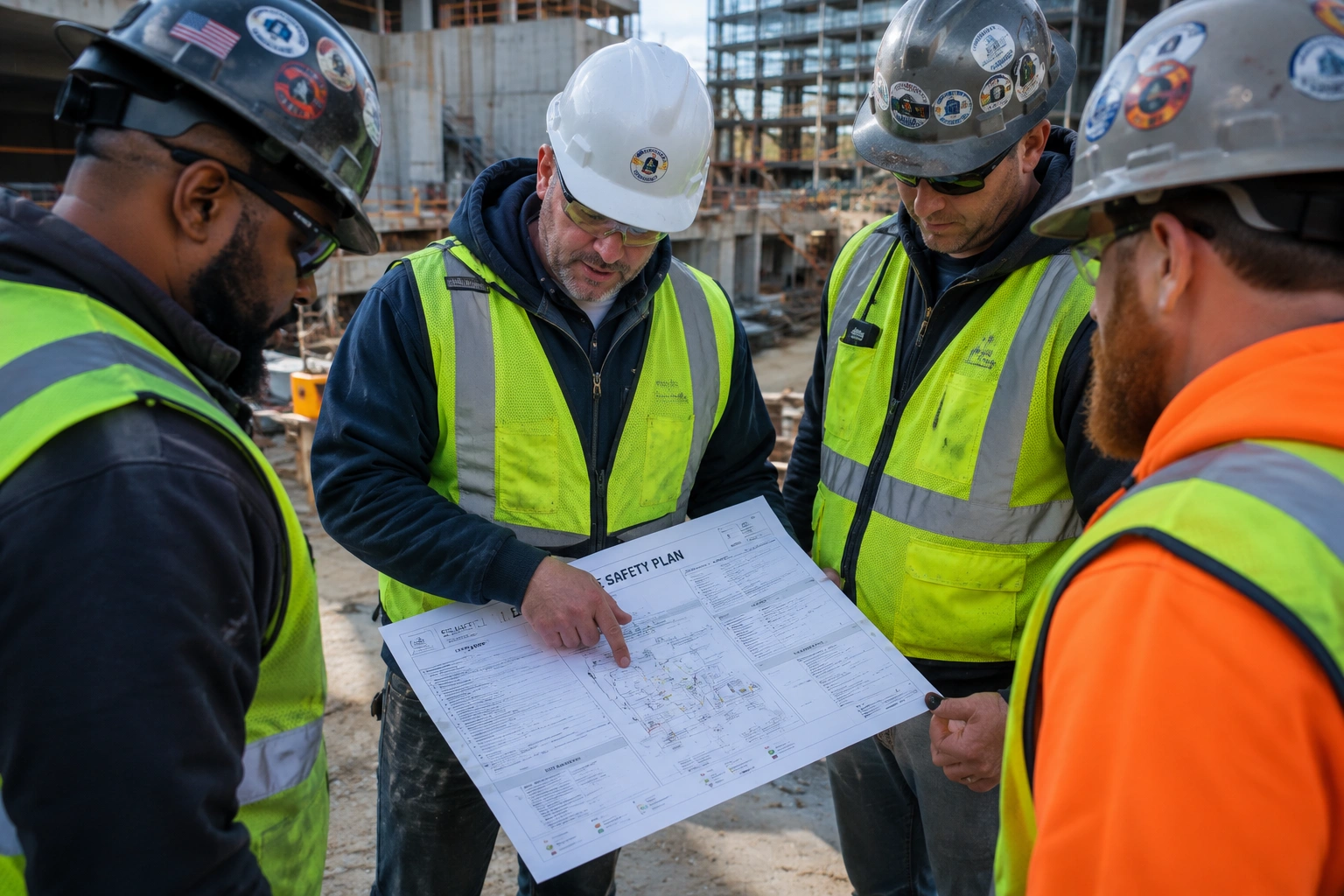
A project manager leads a site safety meeting, reviewing the construction safety plan with crew members before work begins.
Turn Your Technical Expertise Into Search Authority
You don’t need a massive enterprise budget to compete online. You need consistency, the right strategy, and a partner who understands your industry. See how our Construction Company SEO Services can help you rank
Value engineering and material selection
- Material performance and lead-time sensitivity: The supply chain disruptions of recent years fundamentally changed how developers think about procurement risk. Risk is real. Content that addresses lead-time variability for structural steel, precast concrete, or curtain wall systems, and how your firm manages it, speaks directly to a concern that is now baked into every development pro forma.
- Sustainable material alternatives: Mass timber and low-carbon concrete are no longer niche specifications. Corporate developers with ESG reporting obligations are actively seeking builders who can execute these systems without a learning curve. Publishing technical guides on these materials, structural performance, fire rating compliance, and cost differentials, positions your firm as a credible partner for sustainability-driven projects.
- Value Engineering Analysis guides: What matters most is demonstrating that choosing the right materials isn’t about the flashiest option: it’s about what will still be standing decades from now. A published guide that walks through how to reduce structural costs without compromising design intent demonstrates analytical rigor and financial alignment with the developer’s interests.
- Supply chain resilience: Documenting your relationships with domestic suppliers and your procurement protocols for managing material shortages signals the kind of operational depth that developers factor into vendor selection, especially on projects with aggressive delivery schedules.
Building E-E-A-T through credentialed authorship and real-world evidence
Google’s E-E-A-T framework: Experience, Expertise, Authoritativeness, and Trustworthiness, is not a theoretical quality signal. It is a ranking factor. For commercial construction content, it’s a practical publishing standard that determines whether your guides rank alongside the regulatory agencies and trade publications your audience already trusts.
The most direct way to satisfy E-E-A-T is credentialed authorship. Articles authored by a licensed project manager, a certified estimator, or a LEED-accredited professional, complete with a short bio detailing their credentials and project history, carry measurably more weight than anonymous or generically attributed content. This isn’t just about Google’s quality evaluators: developers reading a guide on commercial permitting timelines want to know whether the author has personally sat through a contested site plan review or is summarizing someone else’s experience.
Real-world evidence is the other half of this equation. Gitnux’s research found that 78% of B2B decision-makers prefer case studies and customer success stories when evaluating potential vendors. That preference isn’t incidental: it reflects how procurement decisions get made in commercial development, where past performance on analogous projects is the most reliable proxy for future execution. Case studies that detail project scope, specific regulatory challenges resolved, safety records, and budget outcomes give developers the evidence base they need to justify a shortlist decision internally. Pair these with a strong web design portfolio that presents completed projects with technical depth: square footage, structural system, delivery method, and occupancy type, rather than just photography.
Overcoming the B2B keyword search volume illusion
Traditional SEO tools have an inherent blind spot for niche B2B queries. They miss the mark. According to Altitude Marketing’s analysis, search volume estimates from standard keyword platforms deviate from real-world B2B search data by an average of 99% for specialized queries. A term like “zoning variance process for commercial developments” might show 10 estimated monthly searches in your keyword tool. The actual search volume, and more importantly, the conversion value of each visit, is almost certainly orders of magnitude higher.
This matters because it changes how you should prioritize your content calendar. Broad terms like “commercial general contractor” carry high competition and attract a wide range of search intent, including researchers, students, and competitors. Highly specific queries: “commercial building permit timeline,” “design-build vs. design-bid-build for mixed-use development,” and “how to calculate FAR for commercial zoning,” attract developers who are actively working through a preconstruction problem. That’s a fundamentally different visitor, and the content that captures them is fundamentally different too.
Your commercial construction SEO strategy should be organized around intent and business value, not raw search volume. A single well-ranked guide on phased permitting strategies, written with genuine technical depth, can generate more qualified developer inquiries in a year than a dozen generic “commercial contractor” landing pages. Understanding how to calibrate that online marketing investment against realistic pipeline outcomes is part of building a sustainable content program. For the local search layer of this strategy, particularly if your firm operates across multiple metropolitan markets, our local SEO guide covers the technical and content requirements in detail.
Frequently asked questions about commercial construction content strategy
How does commercial construction SEO differ from residential SEO?
Commercial construction SEO targets a multi-stakeholder B2B buying committee (developers, investors, compliance officers) who prioritize risk mitigation, budget certainty, and regulatory compliance. Residential SEO focuses on B2C homeowners looking for local remodeling or home-building services, relying heavily on local map pack visibility and visual inspiration. The content depth, keyword intent, and conversion path are distinct disciplines.
What are the most important keywords for commercial builders?
The highest-value keywords combine geographic specificity with commercial intent: “design-build contractor in [City]” or “commercial general contractor [City]” for bottom-funnel capture, supported by long-tail informational queries like “how to navigate commercial zoning variances” or “commercial building permit timeline” for top-of-funnel authority building. Neither category alone is sufficient: the strategy requires both working in concert.
How long does it take to see results from construction company blogging?
Low-difficulty local terms can show movement within weeks. A structured commercial SEO and blogging strategy, one that targets the technical, high-intent queries developers use, typically requires three to six months to generate substantial, consistent organic traffic and qualified leads. The timeline reflects the trust-building nature of B2B content: developers don’t convert on a first visit.
Should we publish project case studies on our builder website?
Yes, and with more technical specificity than most firms currently use. Case studies that detail project scope, regulatory challenges resolved (zoning entitlements, permitting sequences, variance approvals), safety records, and budget outcomes are among the most effective trust-building assets available to commercial builders. They also function as durable SEO assets, ranking for project-type and location-specific queries over time.
How do we demonstrate building expertise without naming confidential clients?
Describe the project by facility type, geographic region, square footage, structural system, and the specific technical challenges your team resolved. A case study framed as “a 180,000 SF mixed-use development in a coastal municipality with dual-jurisdiction permitting requirements” communicates operational depth without exposing client identity. Developers evaluating your capabilities care far more about the problem-solving narrative than the client name.
To capture the attention of corporate real estate developers, commercial builders must treat their website as a digital extension of their preconstruction team. Publishing deep, technical content that addresses zoning, permitting, safety, and material selection proves operational excellence before a bid is ever requested. This search-first approach ensures your firm is positioned on the “Day One” shortlist, converting organic search into a predictable engine for pipeline growth. Start building today.
Your next step is to look closely at how your current digital presence represents your real-world capabilities. If you want to see how a business like yours can build authority that translates to real project pipelines, what we recommend is starting with a focused strategy session.
Ready to Build Your Commercial SEO Strategy?
We’re a small business ourselves, and we believe that small business is the backbone of innovation. Let us help you turn your technical building expertise into a powerful lead-generation engine.