
- Why corporate developers and general contractors use local search to vet builders.
- Step-by-step Google Business Profile optimization tailored for commercial construction.
- How to build high-authority local citations and backlinks that drive search prominence.
- Strategies for managing service areas, embedding maps, and generating high-impact reviews.
We see it happen all the time: competitors are winning bids you should be getting. It is not because they have a stronger safety record or a deeper subcontractor bench, but because when a regional procurement officer searches for a commercial general contractor in your market, those competitors appear in the top three map results and you do not. That gap is not a field problem. It is a digital footprint problem.
Corporate developers and institutional procurement teams do not rely exclusively on pre-existing networks to fill their vendor lists. They use local search to verify and cross-reference builders before extending a formal bid invitation. A firm that looks invisible online raises an immediate credibility question, regardless of how many square feet it has delivered. If your commercial construction firm does not hold a visible position in local search results, you are being filtered out before the conversation even starts.
Securing these bids requires a systematic approach to regional Google Maps optimization, authoritative citations, and localized content.
The value of the local Map Pack for commercial builders
The commercial contractor local map pack is the cluster of three business listings that appears at the top of Google’s search results page, above organic listings, whenever someone searches for a geographically relevant service. For commercial construction searches, this placement is the most contested and most valuable digital real estate available. According to First Page Sage’s 2025/2026 data, those three local pack results capture approximately 42% of all local search clicks, with the top position alone drawing a 17.6% click-through rate.
Optimizing this profile is the digital equivalent of setting up your storefront on the busiest corner in town. What makes the Map Pack structurally different from standard organic rankings is the immediacy of the trust signals it delivers. A well-optimized listing surfaces your firm’s review rating, physical address, phone number, and operating hours without requiring a single additional click. For a corporate decision-maker running a quick vendor verification check, that density of information in a single glance is exactly what they need to decide whether your firm warrants further scrutiny or gets scrolled past.
Knowing how to rank on Google Maps is not a tangential marketing concern for commercial builders: it is a pipeline issue. When procurement teams search terms like “commercial general contractor” or “tenant improvement specialist” followed by a metro area, they are not browsing. They are building a shortlist. A prominent Map Pack position places your firm on that shortlist before a single email is exchanged.
The distinction between residential lead generation is worth drawing sharply here. Residential contractors optimize for call volume: high-frequency, lower-ticket inquiries, where speed of response drives conversion. Commercial builders operate on a different timeline and a different vetting logic. The stakes are higher. Even when a bid arrives through a formal RFP channel, the procurement officer will independently search your brand to verify operational capacity, physical presence, and client reputation. A strong Map Pack listing does not just generate inbound traffic; it functions as a real-time credibility certificate that survives the scrutiny of a B2B due diligence process.
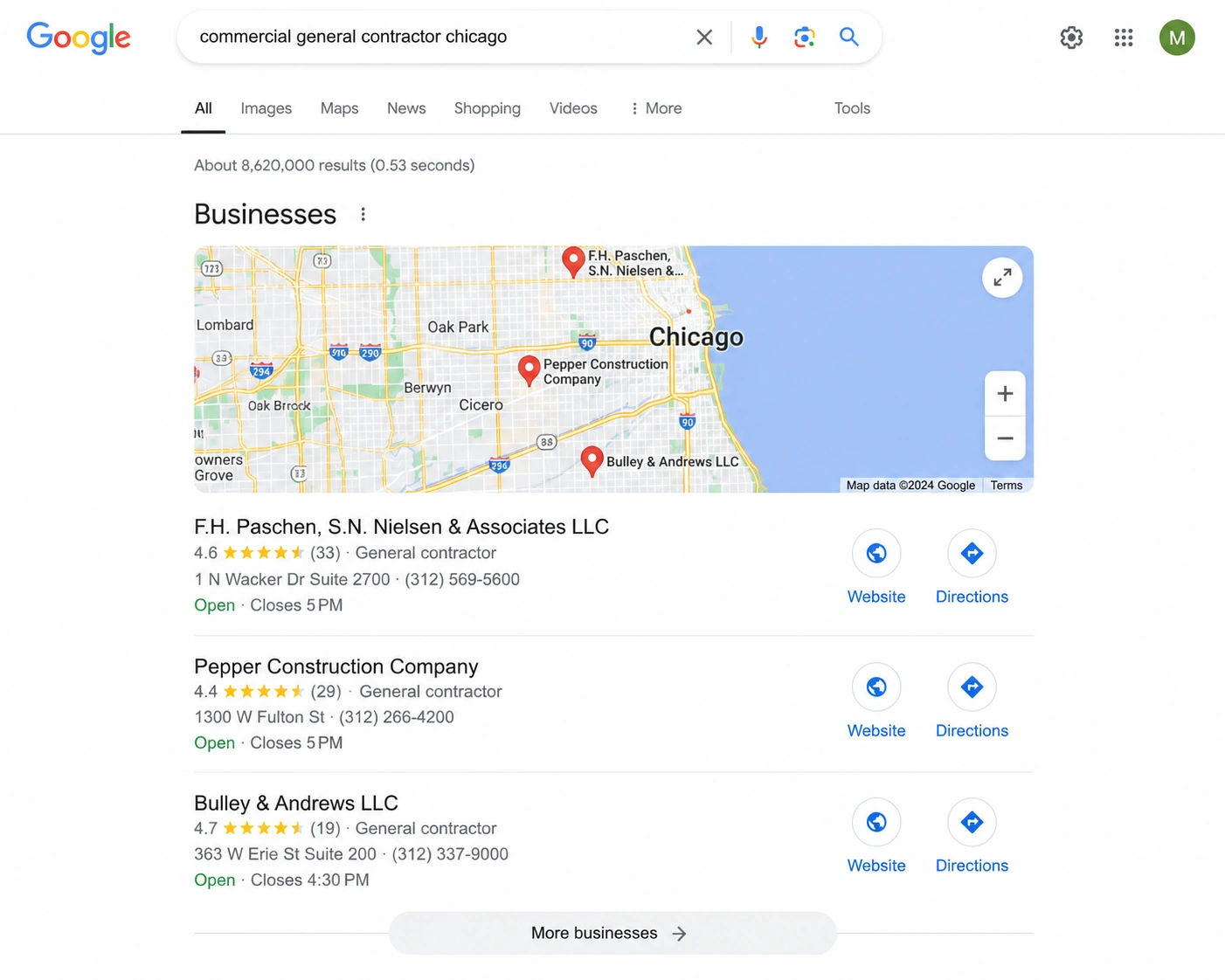
A Google Map Pack search result highlights top commercial general contractors, showcasing the importance of local SEO visibility for construction firms.
Optimizing your Google Business Profile for B2B construction bids
Complete Google Business Profiles generate seven times more clicks than incomplete ones, and profiles with photos receive 42% more direction requests and 35% more website clicks. Those numbers are not surprising when you consider that a sparse profile communicates the same thing to a procurement officer that a half-finished project portfolio would: this firm is not paying attention to details.
Claiming and verifying your profile using a physical commercial office address is the non-negotiable starting point. A residential address or P.O. Box undermines the legitimacy signal you are trying to build with corporate clients who are accustomed to dealing with established firms operating out of real commercial space.
Category selection is where many commercial contractors quietly compromise their own visibility. Choosing “Remodeler” or “Home Builder” as your primary category does not just attract the wrong audience, it actively suppresses your appearance in commercial-intent searches. Select Commercial General Contractor or “Construction Company” as your primary category, and use secondary categories to capture adjacent commercial services you provide.
Your business description carries more weight than most contractors realize. Google allows 750 characters, and most profiles use fewer than 200. Fill it. Detail your commercial capabilities: office buildouts, industrial construction, tenant improvements, ground-up commercial development, alongside your safety certifications, bonding status, and the metropolitan regions you actively serve. This is keyword-rich territory that feeds Google’s relevance matching. To optimize Google Maps performance for commercial searches, your description needs to speak the language of B2B procurement, not consumer home improvement.
Photo uploads are a direct demonstration of physical capacity. Visual proof wins bids. Upload at minimum 30 high-resolution images: active job sites showing scale and complexity, completed structural projects with visible signage, branded fleet vehicles, and team photos that convey workforce depth. A procurement officer evaluating two contractors with similar review scores will gravitate toward the profile that visually proves it can handle a 50,000-square-foot warehouse buildout.
Core optimization priorities for your GBP:
- Primary category selection, such as “Commercial General Contractor” or “Construction Company.”
- Service area definition using precise counties or metropolitan regions that align with your actual bidding territory.
- High-resolution project and equipment photo uploads demonstrating commercial-scale capacity.
- Detailed, keyword-rich business description foregrounding B2B capabilities, certifications, and service specializations.
Ready to scale your commercial pipeline and dominate local search?
Discover how our specialized SEO Services for Contractors can help you secure more corporate bids.
Building high-authority B2B contractor citations
Think of your business citation as a business card, except this one is distributed across hundreds of directories, databases, and industry registries. We need to make sure your business name and address appear everywhere directories list contractors, consistently, so Google trusts you are real. When the name, address, and phone number on that card do not match perfectly across every platform, search engines treat the inconsistency as a trust deficit. Google’s local algorithm uses NAP consistency (Name, Address, Phone) as a primary verification mechanism for physical location and business legitimacy. Research from BrightLocal consistently identifies citation consistency as one of the heaviest-weighted local search ranking factors.
The citation scrutiny comes first. Before submitting to any new directories, use a tool like BrightLocal to surface every existing mention of your business online. Duplicate listings, outdated addresses from previous office locations, and phone numbers that no longer route correctly are all actively diluting your ranking power. Standardize your NAP format against your official state licensing records: not your website header, not your email signature, but your licensing records. That is the authoritative source Google will eventually cross-reference.
For commercial contractors specifically, the citation ecosystem extends well beyond the standard Yelp and BBB submissions that residential service businesses rely on. The Blue Book Building and Construction Network, ConstructConnect, and the Dodge Construction Network are the tier-one industry-specific platforms where your firm needs a verified, complete presence. These directories do not just feed Google’s trust signals; they place your business directly in front of active project estimators and procurement officers who use those platforms as part of their standard vendor research workflow.
An ultimate local SEO strategy for commercial builders treats citations not as a one-time setup task but as an ongoing data hygiene practice. Mergers, relocations, rebrands, and phone system changes all create citation drift. This drift hurts rankings. Quarterly audits catch the inconsistencies before they compound into a ranking problem.
Citation-building process for commercial contractors:
- Audit existing listings using BrightLocal to identify inconsistencies, duplicates, and outdated NAP data.
- Standardize your NAP format based on your official state licensing records.
- Submit to tier-1 general directories, including Google, Bing Places, Yelp, and the Better Business Bureau.
- Secure verified listings on industry-specific platforms like The Blue Book, AGC, ConstructConnect, and the Dodge Construction Network.
Local link-building strategies for commercial builders
Backlinks from authoritative local websites function as third-party endorsements in Google’s ranking logic. A link from a regional chamber of commerce, a municipal development authority, or a well-established local supplier carries significantly more weight for Map Pack prominence than a generic directory listing, because it signals that your business is genuinely embedded in the local economic fabric, not just registered in it.
The divergence between general backlinks and geographically anchored ones matters more for commercial contractors than for most industries. A link from a national trade publication, while valuable for domain authority, does not carry the local weight of a link from a regional builder association. A link from a local chamber of commerce, or from a regional concrete supplier’s page, tells Google’s algorithm something specific: this firm operates here, works with established local businesses, and has a verifiable physical footprint in this market. That geographic signal feeds directly into Map Pack proximity and prominence calculations.
One of the most underutilized construction marketing ideas for link acquisition is the supplier testimonial exchange. If your team recently completed a major office buildout using a specific structural steel fabricator or a regional glazing contractor, offer to write a brief, substantive case study featuring their materials or craftsmanship on your website, and ask them to link back to your project page from their partners or featured projects section. Both parties gain a relevant, contextual backlink. The outreach email does not need to be elaborate: explain the project, offer the case study draft, and make the link request direct.
The same logic applies to subcontractors, architectural partners, and municipal development blogs that cover regional construction activity. Commercial contractors work with dozens of these partners on every major project. These relationships are assets. Each one is a potential high-quality, geographically relevant backlink that most firms never pursue because they are focused on the build, not the digital footprint the build generates.
A construction contractor campaign that committed to this approach saw organic sessions increase by 889% and new users by 1,209% after systematically building out their local search presence and backlink profile, according to a local SEO case study of a regional contracting company. That kind of growth does not happen from a single tactic: it is the compounding effect of citations, links, and profile optimization working in concert.
“A strong local presence does not just win local search; it builds the baseline trust corporate decision-makers require during the vetting process.”
Creating hyper-local content for commercial construction projects
Generic blog content about construction safety or project management timelines does not move the needle for commercial search visibility. What does move it is content that is geographically and operationally specific enough to match the long-tail queries that developers, architects, and municipal procurement officers type into Google. This is how we speak Google’s language: so when a developer searches for a commercial builder in your city, they find you first. It works.
A Texas-based commercial contractor implemented a localized content strategy and achieved a 197% increase in project inquiries and a 295% boost in search visibility within seven months, as documented in this Texas commercial construction SEO study. The mechanism is clear: when your content mentions specific neighborhoods, references regional zoning ordinances, and discusses the permitting realities of a particular municipality, it becomes the most relevant result for searches that carry those geographic and operational signals.
Project case studies are the highest-leverage content format for commercial builders. They prove your track record. Structure each one around a challenge, solution, and results framework. Include the physical address or neighborhood of the project, the specific local regulatory or logistical constraints your team navigated, and quantified outcomes wherever possible. A case study about a 40,000-square-foot warehouse buildout in a specific industrial corridor, one that details how your team managed a compressed timeline under a city-mandated noise ordinance, is doing double duty: it is demonstrating capability to sophisticated B2B buyers while feeding Google’s local relevance signals with every geographic and operational detail.
Operational content is where most commercial contractors leave significant SEO value on the table. Instead of writing about why safety matters in construction (your audience already knows), write a detailed breakdown of how your team navigated a specific local permitting challenge, managed material logistics through a congested urban corridor, or met a municipality’s green-building compliance requirements on a tight schedule. This kind of hyper-local content proves your capability to the exact audience you are trying to reach, while simultaneously signaling deep local knowledge to search engines. For a broader framework on how content fits into your overall local presence, our detailed local SEO guide covers the full strategic picture.
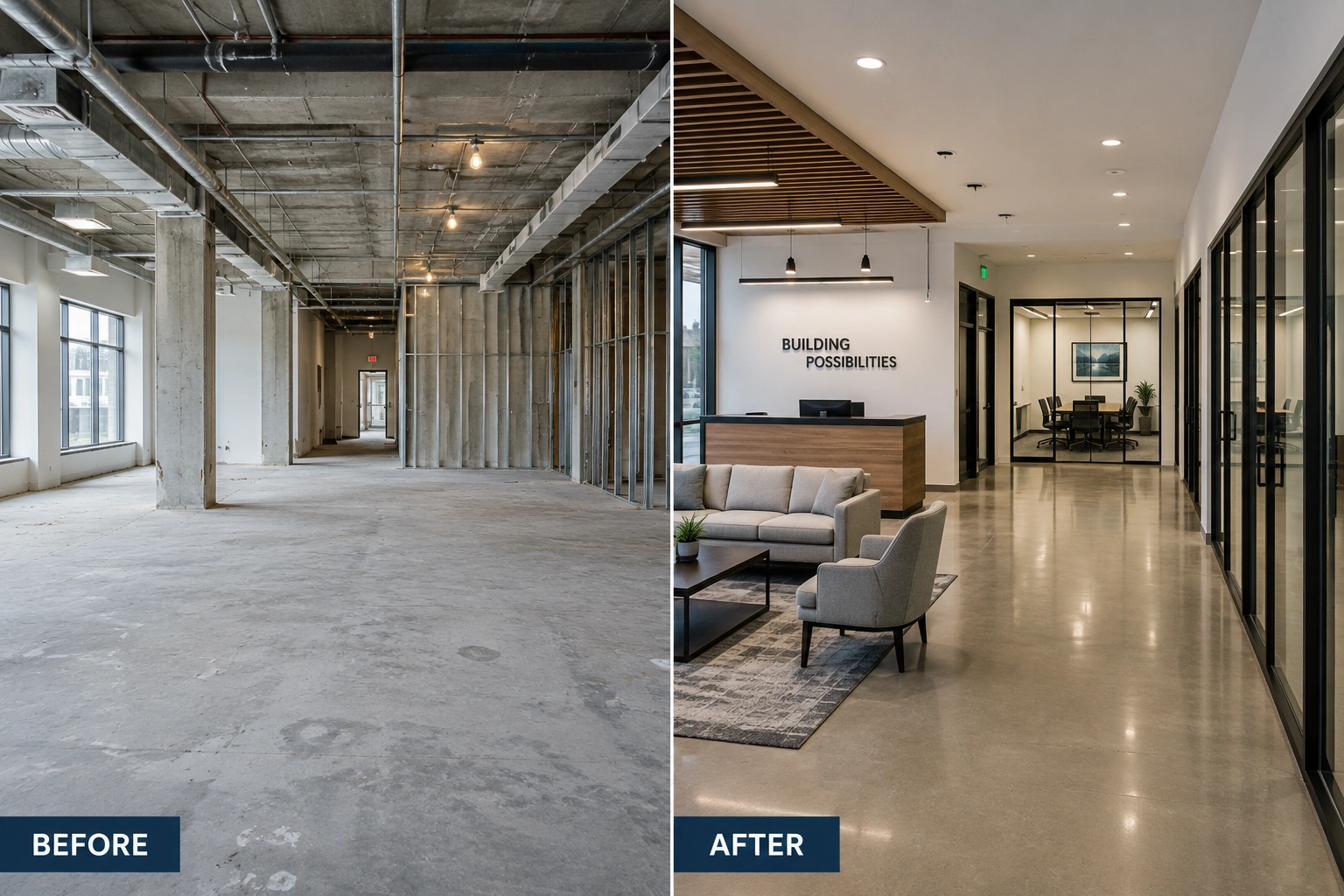
A side-by-side comparison highlights the transformation of a commercial interior from a raw shell to a fully finished tenant improvement project.
Want to see how smart construction companies show up on Google? Read our detailed guide on Local SEO for Construction Companies to learn more.
Embedding Google Maps to prove proximity and legitimacy
Embedding a verified Google Map on your website is one of the lower-effort, higher-signal structural moves available to commercial contractors. When Google’s crawlers encounter an embedded map that matches your GBP address on your contact or location page, it reinforces the proximity signal that feeds Map Pack rankings. It is a direct, crawlable confirmation that your physical office is where you say it is.
The setup is direct, but placement matters. An embedded map buried in a footer that does not load on mobile devices is worse than no map at all; it creates a broken experience for the procurement officer who pulls up your site on a phone during a site visit. To properly optimize local SEO efforts through map embedding, the implementation needs to be both technically clean and strategically placed.
Steps to embed your Google Map correctly:
- Locate your verified business listing on Google Maps and click the “Share” button on your profile panel.
- Select the “Embed a map” tab and copy the generated HTML iframe code.
- Paste the HTML code directly into your “Contact Us” page or a dedicated location page, not just the footer.
- Run a mobile check to verify that the embedded map renders correctly and loads at full functionality on both desktop and mobile devices before publishing.
The mobile check is not optional. According to research on construction-related search behavior, 74% of mobile searches with local intent result in a direct call or office visit within 24 hours. A map that fails to load on mobile is a missed conversion at the exact moment a prospect is most ready to act.
📥 Free Resource: Commercial Contractor Local SEO Checklist
Audit your Google Business Profile, clean up your citations, and optimize your local search presence to win more corporate bids. Get the Free Checklist
Managing service areas vs. physical office locations
Physical office listings hold a measurable proximity advantage over service area businesses (SABs) in competitive commercial Map Pack rankings. Google’s algorithm weights distance as one of its three primary local ranking factors (relevance, distance, and prominence) and a verified physical address gives the algorithm a precise geographic anchor to work with. A service area business profile, which allows you to hide your address, removes that anchor and forces your listing to compete on relevance and prominence alone.
For commercial contractors operating out of a legitimate commercial office, the guidance is unequivocal: display your address publicly. Do not hide it. The trust signal it sends to corporate clients, who expect to deal with firms that have established operational infrastructure, compounds the ranking benefit. A physical address on your GBP, matched to your website, your citations, and your state licensing records, creates a consistent geographic signal that Google’s local algorithm rewards with stronger Map Pack placement.
The more complex scenario involves firms managing multiple regional offices or temporary field offices for large-scale projects. This requires careful management. Creating separate GBP listings for each legitimate physical location is the correct approach, provided each location has a distinct, verifiable address and genuine operational activity. What you want to avoid is creating duplicate or near-duplicate listings for the same address under slightly different business names: Google’s algorithm treats this as manipulation, and the penalty can suppress all your listings simultaneously.
If your firm must operate as a service area business, for a temporary regional office or a market you are actively expanding into, the compensating strategy is to concentrate aggressively on local prominence signals: citation volume and consistency, review acquisition from clients in that region, and locally anchored backlinks from suppliers and partners operating in that market. For a full breakdown of how construction company SEO intersects with multi-location strategy, the tactical considerations go deeper than a single section can cover.
When a procurement officer searches for your firm in a market where you operate as a service area business, your listing’s ability to compete depends almost entirely on how much local prominence you have built.
Generating and managing high-impact reviews
Reviews are the trust infrastructure that converts local search visibility into active bid conversations. Procurement officers and corporate developers use formal proposals to evaluate technical capability and pricing, but they use your online review profile to assess something harder to quantify: whether your firm is the kind of operation that delivers on its commitments without creating downstream problems.
A commercial contractor who systematically builds a review profile from project managers, developers, and institutional clients can grow their qualified pipeline by 179% over a twelve-month period. That figure reflects something real about how B2B procurement works: when a decision-maker is comparing two contractors with similar credentials and pricing, the one with 40 detailed, recent reviews from recognizable commercial clients wins the shortlist position. The other one gets a polite non-response.
The timing of review requests is where most contractors leave this value forfeited. The optimal window is immediately after a successful project handoff or a significant milestone completion, when the client’s experience is fresh and their satisfaction is at its peak. A project manager can send a simple, direct message: “We are glad the [project name] handoff went smoothly. If you have two minutes, a Google review from your team would mean a great deal to us, and here is the direct link.” No elaborate follow-up sequence required. Direct, professional, and timed correctly.
Keyword-rich reviews from commercial clients carry additional SEO weight. When a client mentions “tenant improvement,” “warehouse construction,” or “ground-up commercial development” in their review text, those terms reinforce your profile’s relevance for exactly those search queries. You cannot write reviews for your clients, but you can prompt them by being specific in your request: ask them to describe the type of project and what stood out about your team’s execution.
Responding to reviews, both positive and negative, is part of the same commercial construction digital marketing discipline. A professional, measured response to a critical review signals to every future reader that your firm handles adversity with maturity. A response to a positive review that acknowledges the specific project reinforces the geographic and service-type signals in the original text.
Frequently asked questions about commercial construction SEO
How does the Google Map Pack help commercial contractors win corporate bids?
The Map Pack delivers immediate visibility at the exact moment corporate developers and procurement teams are actively researching local builders. Appearing in the top three results confirms your physical proximity to the project location, surfaces your client review rating, and drives high-intent traffic directly to your commercial portfolio, all before a prospect clicks a single link. For procurement officers running a preliminary vendor scan, that concentration of trust signals in a single search result can be the difference between making the shortlist and being overlooked entirely. Visibility is credibility.
Can a commercial contractor rank in the Map Pack without a physical office?
Yes, with caveats. A service area business (SAB) profile, allowing you to hide your physical address, lets you define your coverage zone by county or metro region. The challenge is that proximity remains a primary ranking factor, and without a fixed address pin, your listing competes at a structural disadvantage against firms with verified physical locations in the target market. To offset that gap, you need stronger local citation consistency, higher review volume from clients in that region, and more geographically anchored backlinks than your physically located competitors. It is achievable; it just requires more deliberate effort across every other prominence signal. Do not ignore this.
What is the most important ranking factor for the Google Map Pack?
Google’s local algorithm evaluates three dimensions: relevance (how precisely your profile matches the search query), distance (how close your business is to the searcher’s location), and prominence (how established and trusted your business appears across the web). Distance is largely outside your control. Relevance is determined by your GBP category selection, business description, and the keywords present in your reviews and posts. Prominence is built through citation volume and consistency, backlink quality, and review depth. Optimizing all three in parallel, rather than treating them as sequential tasks, is what separates contractors who hold stable Map Pack positions from those who fluctuate. Consistency is key.
How many reviews does a commercial builder need to rank competitively?
There is no universal threshold, and anyone who gives you a fixed number is oversimplifying. Every market differs. The practical benchmark is competitive parity: audit the review count and average rating of the top three Map Pack results in your target market and use that as your floor. In most commercial construction markets, 30 to 50 detailed, recent reviews from verifiable commercial clients establishes sufficient prominence to compete. The recency distribution matters as much as the total count: a profile with 50 reviews, 40 of which are three years old, is less compelling to both Google and procurement officers than one with 30 reviews spread consistently across the past 18 months.
How often should a commercial contractor update their Google Business Profile?
Weekly activity is the practical standard. Upload new project photos as jobs progress, publish brief Google Posts linking to recent case studies or project completions, and respond to any new reviews within 48 hours. Active profiles signal operational relevance to Google’s algorithm: a profile that has not been touched in six months reads as dormant, regardless of how strong its historical citation and review profile might be. The investment is modest: 20 to 30 minutes per week is sufficient to maintain the activity signals that keep your listing competitive in local search results. Keep it fresh.
Local SEO is a business development channel, not a marketing checkbox
Commercial contractors who treat local SEO as a one-time setup task: claim the profile, submit to a few directories, and move on, are leaving a compounding asset unmanaged. The firms that consistently appear at the top of the Map Pack for high-value commercial search queries got there through systematic, sustained execution across every layer of local search. This includes a verified, complete GBP with current photos and active posts; a clean, consistent citation network that includes both general directories and industry-specific platforms; a backlink profile built from genuine local relationships; hyper-local content that demonstrates regional operational expertise; and a review profile that reflects the caliber of the commercial clients they have served.
Online search is now the primary lead generation source for 60% of construction businesses. That shift is not reversing. Corporate developers and procurement officers who once relied entirely on referral networks now use local search as a standard verification step, and the contractors who understand that are building their digital presence with the same rigor they bring to a project schedule.
Taking control of your local search footprint today means your firm is the first result a corporate developer encounters when they are ready to build. That is not a marketing outcome; it is a business development outcome that compounds every quarter you maintain it. Start building today.
Ready to streamline your commercial construction marketing and secure more high-value corporate bids?
Schedule a free local SEO consultation with BizIQ today to see how our purpose-built local marketing strategies can scale your business.