52% of small businesses operate with monthly marketing budgets under $1,000 — yet 88% of those that increased their spend saw stable or improved sales revenue. Local marketing in 2026 is defined by a widening efficiency gap: businesses that invest strategically in high-ROI digital channels are compounding their competitive advantage, while those spreading thin budgets across ineffective channels or underinvesting entirely are falling further behind. This data guide covers the full local marketing landscape for 2026 — budgets, channels, ROI, and what separates high-performing SMBs from the rest.
- 52% of SMBs have monthly marketing budgets under $1,000 — yet 88% of those that increased spend saw sales improve (LocaliQ Big SMB Report 2026 / Taradel 2025).
- 72% of SMB marketing budgets now go toward digital channels — the shift from traditional to digital is structural and accelerating.
- Local SEO is a top priority for 59% of SMBs in 2026 — ranking it above social media advertising, email, and paid search for planned investment (CEO GPS 2026).
- 24% of SMBs plan to invest less in traditional media in 2026, up from 16% in 2025 — traditional media decline is accelerating (LocaliQ Big SMB Report 2026).
- 81% of SMBs now use at least two marketing channels, and 82% agree that multi-channel marketing leads to better results (Taradel 2025 / Constant Contact 2024).
- Multi-channel SMBs are 53% more likely to see email success, 43% better paid social results, and 21% stronger search marketing results than single-channel businesses (Constant Contact 2025).
- Email marketing delivers $36–$42 ROI per $1 invested — the highest ROI of any marketing channel available to local businesses (Constant Contact / Revenue Memo 2026).
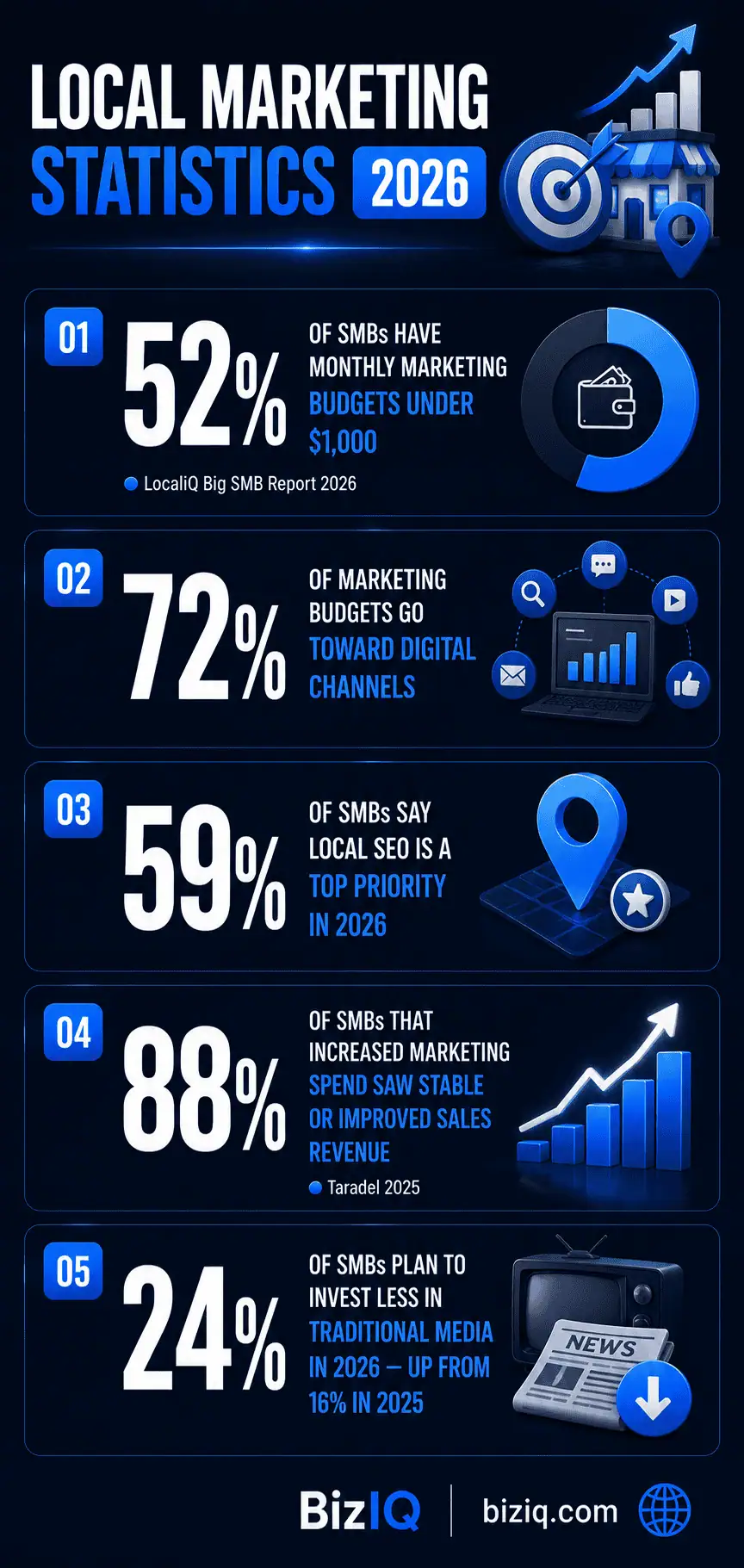
Key local marketing statistics for 2026 — budget benchmarks, channel priorities, and ROI data for small businesses.
SMB Marketing Budget Benchmarks (2026)
Understanding where most small businesses actually stand on marketing investment — and where the benchmarks say they should be — is the foundation of any honest local marketing strategy conversation. The 2026 budget data reveals a persistent gap between what SMBs invest and what research consistently shows they need to invest to achieve meaningful results.
Budget Planning Reality in 2026
The 2026 budget environment is shaped by two competing forces: economic uncertainty that is causing 54% of SMBs to maintain rather than grow budgets (compared to 49% planning to increase in 2025), and the clear revenue evidence that marketing investment pays off. 66% of small businesses say economic uncertainty will be somewhat or very challenging — a significant jump from 48% the prior year. Yet the businesses reducing marketing investment in response to economic pressure are the most likely to see the compounding negative impact: reduced visibility at precisely the time competitors are maintaining or increasing spend.
73% of small businesses worldwide are not confident their current marketing strategy is working (Constant Contact 2024). Yet only 37% increased their marketing budgets in 2025, and marketing confidence fell to just 18% globally. The data reveals a consistent pattern: businesses that spend less on marketing feel less confident about marketing, which makes them less likely to increase spend, which perpetuates underperformance. The 88% of SMBs that increased spend and saw results break this cycle — the investment-performance correlation is one of the most consistent findings in small business marketing research.
Source: LocaliQ — Big SMB Marketing Trends Report 2026 | Taradel — Small Business Advertising Survey 2025 | PostcardMania — Small Business Marketing Statistics 2026
See BizIQ’s Local Marketing Packages — Call (888) 416-9800
Digital vs. Traditional Marketing Spend (2026)
The structural shift from traditional to digital local marketing has been underway for over a decade — but the 2026 data shows that the pace of shift is accelerating even among small businesses that were previously slower to move.
What “Less Traditional Media” Means in Practice
The 24% of SMBs reducing traditional media spend in 2026 are primarily pulling back from print advertising (newspaper, magazine inserts, direct mail at scale), broadcast radio, and printed directories. The key driver is measurability: digital channels provide attribution data that traditional channels cannot match. For local businesses that have historically relied on community newspapers, local radio, and Yellow Pages-style directories, the shift to digital is not primarily about lower cost — it is about moving to channels where investment impact can be tracked, optimized, and proven. The 8-percentage-point jump (16% to 24%) from the 2025 to 2026 report is the largest single-year acceleration in the traditional media pullback documented by LocaliQ’s annual SMB survey.
Source: LocaliQ — Big SMB Marketing Trends Report 2026 | Revenue Memo — Small Business Marketing Statistics 2026
Local Marketing Channel Performance (2026)
The most commonly tracked marketing channels for local businesses in 2026 and the performance data available for each reveal significant variance in both effectiveness and adoption. The gap between the highest-ROI channels and the most commonly used channels is one of the defining inefficiencies in small business marketing.
The Local Marketing Channel Hierarchy
The performance data across channels consistently places channels in a clear hierarchy for local business results. Organic channels (local SEO, content marketing, email list) build compounding assets — rankings, subscriber relationships, content that keeps driving traffic. They require upfront investment but deliver ongoing returns without continuous spend. Paid channels (search ads, social ads, display) deliver immediate traffic but require continuous investment to maintain. Social media organic is effectively free in time cost but algorithmically limited in reach for business pages, particularly on Facebook where organic business post reach has declined to under 3% of followers. The highest-performing local marketing strategies in 2026 combine organic foundation with paid amplification — not one or the other.
Source: CEO GPS — 500 Key Digital Marketing Statistics 2026 | Revenue Memo — Small Business Marketing 2026
Build Your Local SEO Foundation with BizIQ — Call (888) 416-9800
Multi-Channel Marketing Performance Data
One of the most consistent findings in local marketing research is that multi-channel strategies outperform single-channel approaches across every measured outcome. The 2026 data quantifies exactly how much the performance difference is.
The multi-channel performance premium operates through a reinforcement mechanism: a consumer who sees a business in local search results, encounters a social media post, and then receives an email is more likely to convert at each touchpoint than a consumer encountering any single channel in isolation. The channels amplify each other. A local SEO presence builds brand awareness that improves ad CTR. Email nurturing converts organic search visitors who didn’t immediately inquire. Social proof from review acquisition supports both search ranking and paid ad performance. The businesses operating single-channel are not just missing one channel’s results — they are forgoing the amplification effect that each additional channel provides to all the others.
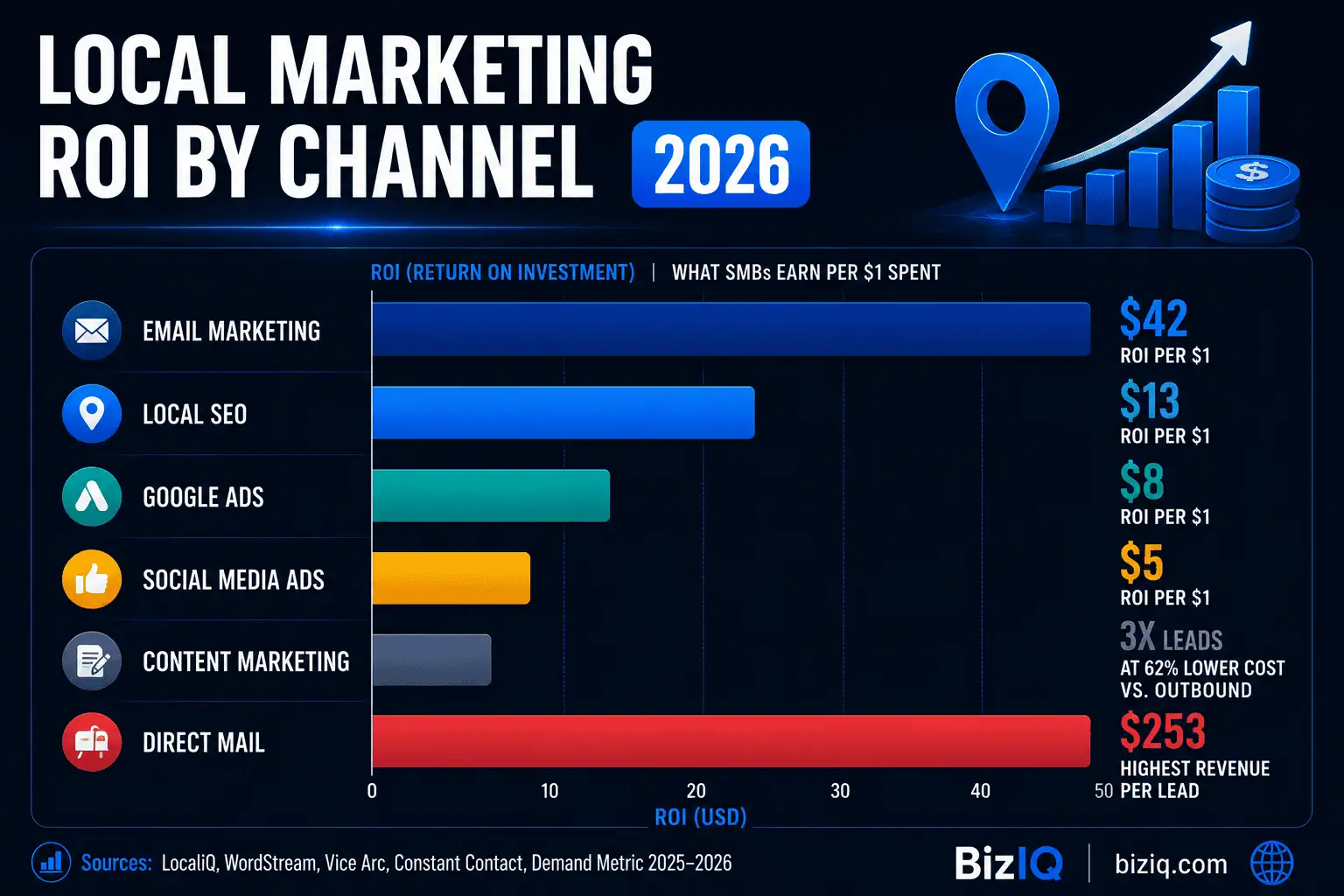
Local marketing ROI benchmarks by channel in 2026 — email and local SEO deliver the strongest returns per dollar invested.
Source: PostcardMania — Small Business Marketing Statistics 2026 | LocaliQ — Big SMB Report 2026
Build a Multi-Channel Local Marketing Strategy with BizIQ — Call (888) 416-9800
Local Marketing ROI by Channel
The ROI data by channel allows local businesses to make direct investment comparisons — the clearest input for budget allocation decisions. The variance across channels is substantial, and the highest-ROI channels are not the same as the most commonly used ones.
For a local business with a $2,000 monthly marketing budget allocated exclusively to social media advertising ($5 ROI), the expected monthly return is approximately $10,000. Reallocating that same $2,000 across email marketing ($42 ROI), local SEO ($13 ROI), and Google Ads ($8 ROI) — split $400 / $900 / $700 — produces an estimated blended return of approximately $18,800 per month, roughly 88% more from the same budget. The channel allocation decision, not the budget level, is the primary driver of local marketing performance for most SMBs. Calculation original to BizIQ using published ROI benchmarks; actual results vary by business type, market, and execution quality.
The Compounding vs. Linear ROI Distinction
The ROI figures above represent point-in-time returns — but the more important distinction for local businesses making long-term investment decisions is the compounding vs. linear return structure. Email marketing and local SEO build compounding assets: subscriber lists and organic rankings that continue delivering value without continuous reinvestment at the same rate. Paid advertising (Google Ads, social ads) delivers linear returns — traffic and leads proportional to spend, stopping when spend stops. The highest-performing local marketing programs in 2026 use paid channels to generate immediate leads while simultaneously building the compounding channels that reduce long-term cost-per-acquisition.
Source: Revenue Memo — Small Business Marketing Statistics 2026 | WordStream — Digital Marketing Statistics 2026
Start Building High-ROI Email Marketing with BizIQ — Call (888) 416-9800
AI in Local Marketing (2026)
Artificial intelligence has moved from an advanced capability to a mainstream small business marketing tool in 2026, with measurable performance advantages documented for SMBs that have adopted AI tools vs. those that have not.
The 5.7x success rate differential for AI-adopting SMBs is the single most significant competitive advantage data point in 2026 small business marketing research. The gap is not primarily about content production speed — it is about the ability to optimize campaigns in real time, personalize outreach at scale, identify the highest-value customer segments, and allocate budget to the specific combinations of channels, times, and audiences that convert at the highest rates. For local businesses with limited marketing resources, AI tools effectively function as a force multiplier — enabling the strategic complexity of a larger marketing operation without the corresponding headcount.
Source: Revenue Memo — Small Business Marketing Statistics 2026 | HubSpot State of Marketing 2026
Most Valuable Lead Types for Local Businesses
Understanding which lead types produce the highest-value customers helps local businesses prioritize the marketing channels and tactics that deliver them.
Phone calls and in-person consultations ranking as the top two most valuable lead types has direct implications for local marketing channel selection. The channels that most reliably produce phone calls for local service businesses are Google Local Services Ads (pay-per-lead model with click-to-call), optimized Google Business Profile listings (GBP actions include direct calls), and Google Ads with call extensions. The channels that most reliably produce in-person consultation bookings are local SEO (organic trust-building that precedes consultation requests), email marketing (relationship nurturing over time), and review management (social proof that converts prospects who found the business organically).
Source: Taradel — Small Business Advertising Survey 2025 | CEO GPS — Digital Marketing Statistics 2026
Get More Phone Calls and Leads from Local Search — Call (888) 416-9800
Local Marketing Statistics Summary Table
| Statistic | Figure | Source | Year |
|---|---|---|---|
| SMBs with monthly marketing budgets under $1,000 | 52% | LocaliQ Big SMB Report | 2026 |
| SMBs spending less than $500/month on advertising | 41% | Taradel | 2025 |
| Average annual small business advertising budget | $78,000 | Intuit | 2025 |
| Recommended revenue allocation to marketing (SBA) | 7–8% of revenue | SBA | 2026 |
| SMBs with no dedicated marketing employees | 50% | LocaliQ Big SMB Report | 2026 |
| SMBs maintaining (not increasing) budgets in 2026 | 54% | LocaliQ Big SMB Report | 2026 |
| SMBs citing economic uncertainty as major challenge | 66% | LocaliQ Big SMB Report | 2026 |
| SMBs that increased spend and saw sales improve | 88% | Taradel | 2025 |
| SMBs not confident in their marketing strategy | 73% | Constant Contact | 2024 |
| SMB marketing budgets allocated to digital channels | 72% | CEO GPS / Revenue Memo | 2026 |
| Global ad spending that is digital | 75.2% | Marketing LTB | 2025 |
| SMBs planning less traditional media spend in 2026 | 24% | LocaliQ Big SMB Report | 2026 |
| SMBs planning more video marketing investment | 53% | LocaliQ Big SMB Report | 2026 |
| SMBs planning more search advertising spend | 47% | LocaliQ Big SMB Report | 2026 |
| SMBs planning more social media ad spend | 47% | LocaliQ Big SMB Report | 2026 |
| Local SEO as top priority for SMBs | 59% | CEO GPS | 2026 |
| SMBs using Facebook for social marketing | 76–83% | Revenue Memo / Taradel | 2025–2026 |
| SMBs investing in search advertising | Only 45% | CEO GPS | 2026 |
| SMBs using at least two marketing channels | 81% | Taradel | 2025 |
| SMBs agreeing multi-channel leads to better results | 82% | Constant Contact | 2024 |
| Email success lift — multi-channel vs. single-channel | 53% more likely | Constant Contact | 2025 |
| Paid social lift — multi-channel vs. single-channel | 43% better results | Constant Contact | 2025 |
| Search marketing lift — multi-channel vs. single | 21% stronger | Constant Contact | 2025 |
| Email marketing ROI per $1 invested | $36–$42 | Constant Contact / Revenue Memo | 2026 |
| Local SEO ROI per $1 invested | $13 | Vice Arc Creative | 2025 |
| Google Ads ROI per $1 invested | $8 | Google economic impact research | 2026 |
| Social media ad ROI per $1 invested (SMBs) | ~$5 | Revenue Memo | 2026 |
| Content marketing leads vs. outbound (same cost) | 3x more leads at 62% lower cost | Demand Metric | 2025 |
| SMBs using AI in marketing workflows | 94% planning to in 2026 | Revenue Memo | 2026 |
| AI-adopting SMBs success rate vs. non-adopters | 5.7x higher | HubSpot State of Marketing | 2026 |
| Most valuable lead type — phone calls | 24% rank #1 | Taradel | 2025 |
| Most valuable lead type — in-person consultation | 22% rank #1 | Taradel | 2025 |
| Local searches resulting in a sale within 24 hours | 18% | CEO GPS | 2026 |
Frequently Asked Questions: Local Marketing Statistics 2026
Methodology & Sources
This article was researched and written by David McGinnis, SEO Strategist at BizIQ. All statistics are sourced from Tier 1 primary sources. Sources include:
- LocaliQ — Big Small Business Marketing Trends Report 2026: Annual primary survey of SMB marketing budgets, channel priorities, and investment plans. Published February 2026.
- Taradel — Small Business Advertising Survey 2025: Primary research on SMB advertising budgets, channel usage, lead type preferences, and spending outcomes.
- Constant Contact — SMB Marketing Research 2024/2025: Multi-year survey of small business marketing strategy confidence and multi-channel performance data.
- HubSpot — State of Marketing 2026: Survey of 1,500+ global marketers on channel ROI, AI adoption, and marketing priorities.
- Intuit 2025: Average annual advertising budget data for small businesses.
- PostcardMania — Small Business Marketing Statistics Guide 2026: Aggregated small business marketing data from Taradel, Constant Contact, Wix/VistaPrint, and SimpleTexting research.
- Revenue Memo — Small Business Marketing Statistics 2026: Comprehensive analysis of email ROI, AI adoption rates, digital spend allocation, and platform usage benchmarks.
- CEO GPS — 500 Key Digital Marketing Statistics 2026: Aggregated digital marketing statistics including SMB channel prioritization and investment data.
- Demand Metric: Content marketing lead generation vs. outbound cost comparison research.
BizIQ Analysis calculations are original to BizIQ and clearly labeled as such.
Get a Free Local Marketing Strategy Consultation — Call (888) 416-9800