Written by the BizIQ Editorial Team We are a team of local marketing strategists dedicated to helping small businesses grow. As a small business ourselves, we stand beside auto repair shop owners to deliver practical, evidence-based marketing strategies that drive real outcomes on the shop floor.
What you will find in this guide:
- Google Business Profile Mastery: How to configure your profile to dominate the Google Local Pack.
- High-Converting Site Architecture: Why dedicated service pages outperform a single “all-in-one” services page.
- Automated Review Generation: Simple systems to consistently drive fresh, positive customer feedback.
- Local Authority Link Building: How to earn high-value local backlinks from your physical community.
- Conversion Optimization: Using Digital Vehicle Inspections (DVIs) to turn search clicks into high-value repair orders.
How can Auto Repair Shops use Local SEO to Consistently Fill their Service Bays?
As a mechanic, you must optimize your Google Business Profile (GBP), target specific repair keywords, and build consistent local citations. A comprehensive Local SEO Strategy requires gathering fresh customer reviews and using structured data schemas, ensuring search engines and AI platforms easily discover and recommend your shop.
When a driver hears a grinding noise from their brakes or watches their check engine light flicker on, they do not search for national automotive brands or read general industry blogs. They pull out their phone and search for an immediate, nearby solution. They need help fast. Search volume data confirms the scale of that demand: the term “auto repair near me” generates between 110,000 and 140,000 monthly searches in the United States alone, and the top 25 automotive repair keywords collectively pull over 12.4 million monthly searches across North America. These are not passive browsers; they are drivers with a problem, a phone in hand, and a strong preference for whoever appears first. To intercept them at that exact moment, your shop must rank where they are looking. This is where strategic Mechanic SEO becomes your primary driver of modern customer acquisition.
At BizIQ, we understand that running an auto repair shop leaves very little time for decoding search engine algorithms. We are a small business helping small businesses, and we share your goals of maximizing efficiency and driving consistent growth. Local search engine optimization is not about chasing vanity metrics or gaming the system; it is about establishing clear digital relevance, proximity, and prominence so that search engines confidently recommend your shop. By aligning your digital footprint with what search engines value, you can transform your online presence into a reliable, automated lead generation engine that keeps your service bays occupied week after week.
Why Local SEO is the Ultimate Lead Generator for Auto Repair Shops
Traditional advertising interrupts consumers with messages they may not need at that moment, but local search engine optimization does the exact opposite: it captures existing, high-intent demand. When a vehicle breaks down, the driver is not browsing; they are actively looking to book an appointment within the hour. Industry data shows that 87% of mobile auto-service searches lead to a phone call or a directions request within 24 hours. That conversion window is narrow, and the shops that appear first are the ones that capture it. Speed wins.
The mechanism that controls the first-position advantage is the Google Local Pack: the map and three business listings that dominate the top of the search engine results page. Think of Google as a librarian who recommends your business to people asking for recommendations nearby. To get that recommendation, your digital storefront has to be clear. The Local Pack captures 40% to 55% of all click-through traffic for automotive repair queries, and 68% of local searchers click on one of those top three map results without scrolling further. For shops buried in standard organic listings below the map, the numbers deteriorate sharply: the first organic position below the map receives roughly 25% click-through rate, position three drops to 9%, and position ten receives a mere 1.2%. Every position you fall costs you a disproportionate share of the available traffic, which is why securing a spot in that Local 3-Pack is not a secondary goal; it is the primary one.
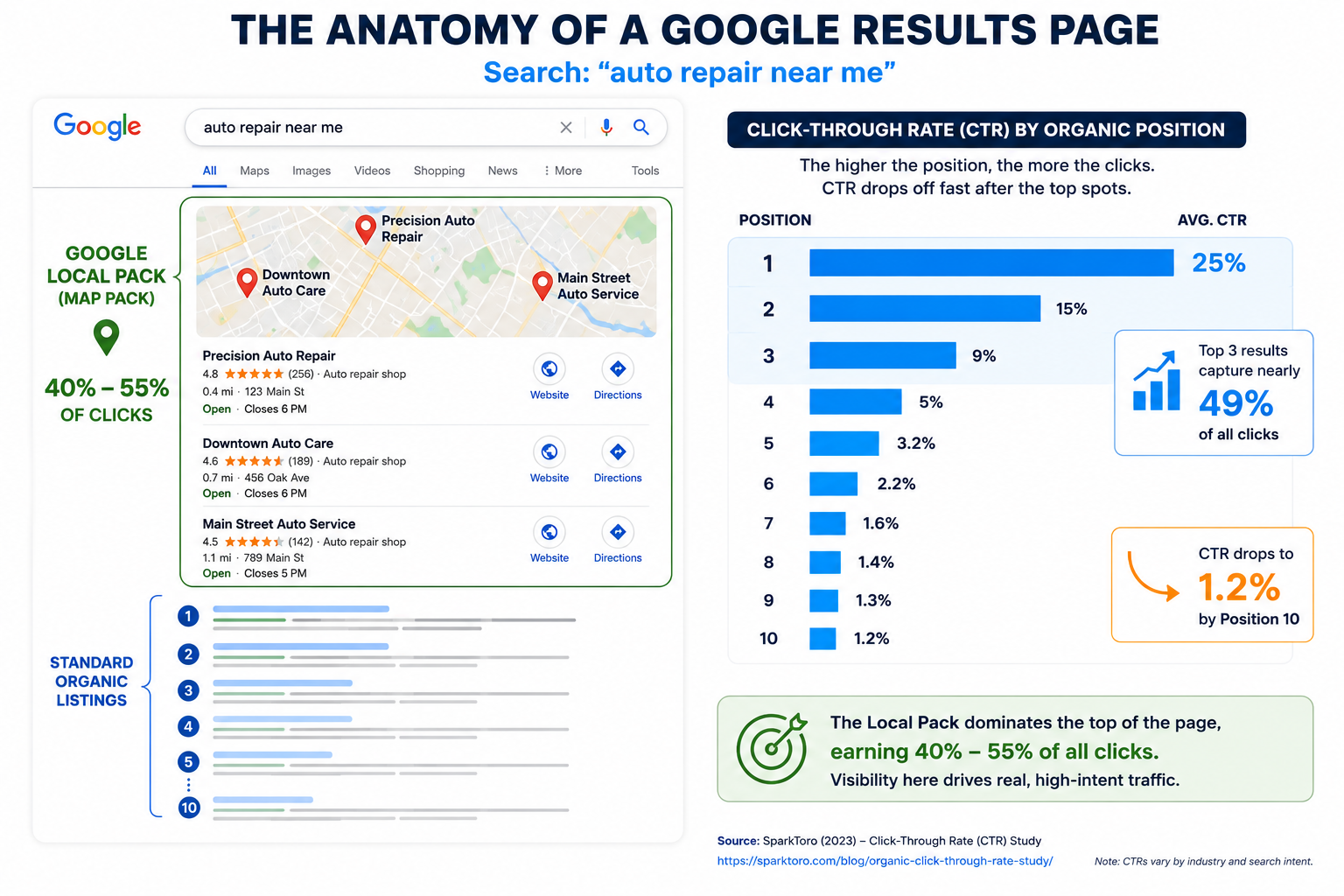
The Google Local Pack captures up to 55% of clicks, while organic CTR drops sharply beyond the top search positions.
Step 1: Map High-Intent Keywords to Dedicated Service Pages
The Pitfall of the Single “Services” Page
- Many auto repair websites list every service, including brakes, oil changes, diagnostics, and AC repair, on one generic page, which feels efficient but works against you in search.
- Search engines rank individual pages, not entire websites. A single page cannot simultaneously build strong relevance for multiple, distinct service queries. One page cannot do it all.
- Transitioning to a granular site architecture where each core service has its own dedicated, high-quality landing page is one of the smartest moves you can make to see real progress.
Keyword Mapping Blueprint
- Instead of guessing, here’s what works and why: map specific search terms directly to dedicated pages. Be specific. Target “brake repair [City]” on a standalone Brake Repair page, not on a catch-all services list.
- Apply the same logic across your service menu: “oil change service [City]” on an Oil Change page, and “car inspection station [City]” on an Inspections page.
- Incorporate symptom-based search terms, such as “why is my steering wheel shaking when I brake,” to capture early-stage researchers before they have even decided on a shop.
On-Page Optimization Essentials
A common mistake is writing a generic title tag like “Home” or “Services” that tells Google nothing about your shop.
- Keep your H1 tag localized and direct:
<h1>Brake Repair in [City, State]</h1>, with no ambiguity and no cleverness. - Front-load your Title Tag with the primary keyword and city:
Brake Repair [City] | [Shop Name]. Search engines and searchers both read left to right. - Write a meta description that earns the click. Make it count. Include a warranty detail, a clear call-to-action, and the city name. A well-written meta description is one of the few places where marketing copy directly influences click-through rate before anyone has visited your site.
This simple on-page adjustment is one of the fastest ways to improve your click-through rate.
Implementing Schema Markup
- Add AutoRepair JSON-LD structured data to your website’s header. This is not optional if you want to compete for rich snippets and voice search results. It is essential.
- The schema communicates your physical address, business hours, and service categories to search engines in machine-readable format, removing any ambiguity about what your business does and where it operates.
- Shops with correctly implemented schema markup are meaningfully more likely to appear in Google’s AI Overviews and voice search responses, both of which are growing in share.
Step 2: Optimize Your Google Business Profile (GBP) for the Local Pack
Claim and Verify Your Profile
- Complete Google’s verification process, which is currently most often via video verification or phone, to gain full profile management capabilities.
- Your business Name, Address, and Phone number (NAP) must match your legal business documents exactly. Even minor formatting differences create downstream citation inconsistencies.
- An unverified or partially completed profile will not compete in the Local 3-Pack, regardless of how well-optimized your website is.
- Do not skip this.
Select Your Primary and Secondary Categories
- Choosing the wrong primary category can make your shop invisible for your most profitable services. This establishes your baseline relevance across the broadest set of local repair queries.
- Add secondary categories that reflect your actual service mix: Brake Shop, Oil Change Service, Tire Shop, Auto Air Conditioning Service, and Car Inspection Station are all worth including if they apply.
- Category selection is the single most consequential configuration decision in your entire GBP setup. It determines which queries Google considers you eligible to appear for. Choose carefully.
- Make sure your primary category matches your main source of revenue.
Complete Every Profile Field
- Fill out business hours, phone number, website URL, and physical address without gaps. Incomplete profiles signal low engagement to Google’s ranking system. Details matter.
- Write a business description that works in your city name and core services naturally, not as a keyword list, but as a readable paragraph a prospective customer would find useful.
- Upload high-quality photos of your shop’s exterior, service bays, diagnostic equipment, and team. Profiles with photos receive significantly more direction requests and click-throughs than those without.
Weekly GBP Maintenance Cadence
- Publish weekly Google Updates (posts) featuring seasonal maintenance tips, current promotions, or a recent repair story that demonstrates your team’s diagnostic depth.
- Use the built-in Q&A feature proactively. Pre-populate the questions your service advisors hear most often, with professional answers already in place.
- Monitor and respond to customer messages promptly. Response speed is a measurable engagement signal, and Google’s algorithm registers it. Be quick.
Need help dominating the Local 3-Pack?
We know that managing your shop’s digital footprint can feel overwhelming when you are busy managing service bays. We can work beside you to build your search visibility, step by step.
Step 3: Build Local Citations and NAP Consistency
To build trust with search engine algorithms, your business information must be consistent across the internet, meaning not approximately consistent, but identical. Consistency is key. Search engines crawl hundreds of online directories to cross-reference your business Name, Address, and Phone number. If your shop appears as “Joe’s Auto Repair” on Yelp, “Joe’s Automotive” on YellowPages, and “Joe’s Auto Repair, Inc.” on your Google Business Profile, the algorithm encounters three different entities and loses confidence in all of them. That eroded confidence suppresses your Map Pack rankings in ways that are difficult to diagnose if you are not looking for it.
We recommend auditing your online citations and standardizing your NAP data across all major platforms, including Yelp, YellowPages, RepairPal, and AutoMD. Claiming your free listings on these industry-specific directories secures a foundational backlink and reinforces your physical location signal simultaneously. Think of citation consistency as the digital equivalent of having a legible, accurate sign on your physical storefront: it ensures both search engines and local drivers know exactly who you are and where to find you.
“Inconsistent NAP data is one of the most common technical issues we see holding back local auto repair shops. When search engines encounter conflicting addresses or phone numbers across directories, they lose confidence in your business’s physical location, which directly suppresses your Map Pack rankings.”
BizIQ Local SEO Specialist
Step 4: Future-Proof Your Content for AI Search and Google’s AI Overviews
The way drivers search for mechanical help is shifting in a way that rewards shops with structured, conversational content. With the rise of AI-driven search generative experiences, Google is actively routing users toward natural, complex questions rather than short keyword strings. A driver who once typed “mechanic near me” may now ask, “My car is making a high-pitched squealing noise when I brake, is it safe to drive to a shop?” These conversational queries pull from structured FAQ content, schema-marked answers, and pages that address the diagnostic question directly, not just the service category. Keeping up with these changes might feel like a lot, but sophisticated marketing belongs to you too. You can do this. It is about answering real questions with real expertise. Shops that have already built symptom-based content and FAQ schema into their site architecture are positioned to capture this emerging traffic channel; shops that have not are increasingly invisible to it.
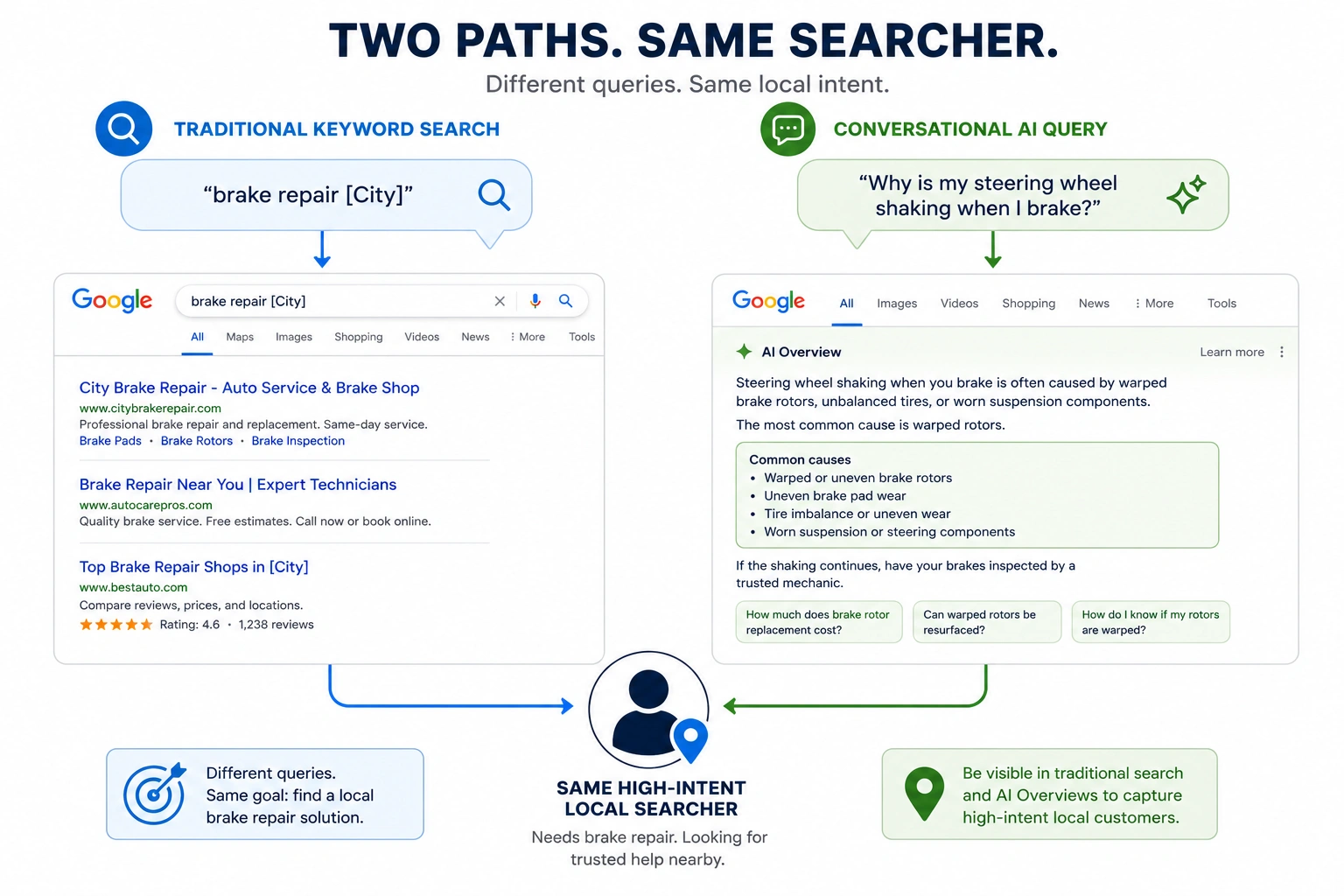
Traditional Google searches and AI-generated answers may look different, but both serve the same local customer intent.
Get Your Free Local SEO Audit
Discover exactly where your shop stands in local search results and identify hidden opportunities to outrank your local competitors.
Step 5: Build Local Authority Through Strategic Link Building
Focus on Local Relevance Over Global Authority
- Traditional link building chases high-traffic national websites, but for local SEO, a backlink from a nationally ranked blog carries far less weight than a link from a trusted organization in your city.
- A backlink from a local business or community organization tells Google’s prominence algorithm that you are an active, embedded member of your physical market, not just a website that mentions a city name.
- Local links are disproportionately powerful for Map Pack rankings relative to the effort required to earn them. They drive real results.
Join Your Local Chamber of Commerce
For an independent shop owner, joining the local Chamber of Commerce is a highly effective way to build local prominence. A Chamber of Commerce directory listing is one of the most straightforward high-authority, geographically anchored backlinks available to any local business. It is a quick win. These directories carry strong trust signals with search engines and provide a clear geographic relevance marker that reinforces your Map Pack eligibility. The annual membership fee is modest relative to the compounding SEO value of the backlink and the referral network access it provides. The resulting backlink is a powerful signal of geographic relevance.
Sponsor Local Youth Sports and Events
- Sponsor a local Little League team, youth soccer club, or high school athletics program. Sponsoring these groups is a great way to support the families who keep your business running. It helps everyone. Small business is the backbone of innovation and the heartbeat of America, driving America forward.
- School and youth organization websites frequently link back to sponsors from
.orgor.edudomains: exactly the kind of authoritative, locally rooted backlinks that carry genuine weight in Google’s prominence scoring. - This is one of the few link-building strategies that simultaneously builds offline brand recognition and online domain authority.
Establish Local Business Partnerships
- Partner with non-competing automotive businesses in your area: towing companies, auto body shops, local parts suppliers, and car washes are natural referral partners.
- Create a “Trusted Partners” page on your website and exchange links to build a localized link network that reinforces geographic relevance for all parties involved.
- Cross-promotion of this kind drives both referral traffic and local search authority, yielding two outcomes from a single relationship-building effort. Everyone wins.
Step 6: Use Digital Vehicle Inspections (DVIs) to Convert Organic Traffic
Getting a driver to click on your website is only half the equation. Your online presence must also convert that traffic into booked appointments and revenue. Traffic alone is not enough. In automotive repair, customer anxiety is a real and persistent friction point; drivers are often skeptical of repair recommendations and worried about costs they cannot anticipate. To bridge that trust gap and maximize conversion rates, we take an evidence-based approach: integrating Digital Vehicle Inspections (DVIs) into your shop’s operational workflow is one of the most effective moves available. When a prospective customer lands on your website and sees that your shop provides transparent, photo-documented inspections sent directly to their phone, the psychological barrier to booking drops considerably. They are not just reading a promise of honesty; they are seeing the mechanism that delivers it.
How Digital Transparency Drives Higher Average Repair Orders (ARO)
Data from the PartsTech of General Auto Repair Report quantifies the revenue impact of that trust gap: shops utilizing Digital Vehicle Inspections see an average repair approval rate of 42%, compared to just 28% for non-digital shops, which represents a 50% relative lift in customer approvals. Digitally authorized repair orders also average 50% higher in dollar value than those authorized over a traditional phone call. Seeing is believing. The underlying reason is straightforward: when a customer can see a photo of the worn brake pad or the corroded battery terminal on their own phone, the repair recommendation stops being the shop’s word against their skepticism and becomes self-evident. When you prominently feature your DVI process on your website’s service pages and Google Business Profile, you are not just building trust with customers already in your bay. You are pre-qualifying the high-intent searchers who find you through local search and converting them into booked appointments before they have even called. When we see the positive impacts we make on our partners after they adopt these transparent practices, it reminds us why we do this work.
Frequently Asked Questions About Mechanic SEO
How long does it take to see results from Mechanic SEO?
For a brand-new website or a newly claimed Google Business Profile, consistent optimization, citation building, and review generation typically produce meaningful Map Pack visibility within 3 to 6 months. Patience is required. If you are working with an existing profile that has established history, ranking improvements and increased inbound calls can surface within 30 to 60 days, particularly if your current profile has obvious gaps in category selection or missing NAP data.
Should I pay for premium listings on directories like Yelp or RepairPal?
Claim the free listings on Yelp, RepairPal, and AutoMD without hesitation; the foundational backlink and citation value are worth the 20 minutes it takes. Paying for their premium advertising tiers is a different calculation. Usually, it is not worth it. For most independent shops, that budget produces better returns when redirected toward website optimization, automated review generation, and local community sponsorships that build durable authority rather than rented visibility.
What is the best primary category for my Google Business Profile?
For 90% of general mechanics, Auto Repair Shop is the correct primary category. This is your foundation. If your revenue is concentrated in a specific specialty, such as transmission work, collision repair, or tire service, use that specialty as your primary and list “Auto Repair Shop” as a secondary. The primary category is the strongest single relevance signal in your GBP configuration, so it should reflect where your business generates its volume.
How do I handle negative Google reviews?
Do not ignore them, and do not delete them. Take action. Neither option is available to you anyway, and attempting either signals poor reputation management to anyone reading your profile. Respond promptly, acknowledge the frustration specifically, and move the resolution offline by providing a direct phone number or email. Keep the public response brief. A measured, professional reply to a negative review often builds more prospective customer trust than a page of five-star reviews with no negatives at all, because it demonstrates that your shop handles problems rather than hiding them.
What is the “Proximity Paradox” in local SEO, and can I bypass it?
Google’s proximity filter prioritizes shops physically closest to the searcher, which creates a structural disadvantage for shops on the geographic edge of a market. You cannot relocate your building, but you can expand your effective reach by building hyper-local content targeting specific neighborhoods, creating dedicated service-area pages, and generating reviews from customers in your target zip codes. One path that some shops have explored, such as using virtual offices or UPS Store addresses to fake a downtown presence, violates Google’s guidelines outright and carries a high probability of permanent profile suspension. It is not worth the risk.
Dominating your local market does not require a corporate marketing budget or a dedicated in-house SEO team. You can compete. By systematically optimizing your Google Business Profile, restructuring your website around dedicated service pages, building a consistent citation footprint, and earning locally anchored backlinks from your community, you can establish your shop as the recognized authority in your area’s search results. We have seen these exact strategies move independent shops from invisible to fully booked, not through tricks, but through disciplined execution of the fundamentals that Google’s local algorithm rewards. As a practical next step, take five minutes to log into your Google Business Profile today and verify your primary category. It is a quick check that often serves as the fastest path to better local visibility.
Ready to Fill Your Service Bays?
Let us help you implement a tailored local SEO strategy that drives high-intent drivers straight to your shop. Partner with BizIQ and we can work beside you to manage the technical details while you focus on fixing cars.
Schedule Your Strategy Session with BizIQ.