Local SEO myths are not harmless misunderstandings. Every one of the beliefs below is actively costing small businesses customers who are searching for them right now. Forty-six percent of all Google searches have local intent — and businesses operating on false assumptions about local search are invisible for nearly half of the most purchase-ready queries on the internet. Here are the 10 most damaging myths, each debunked with primary source data.
- MYTH: A website alone is enough. TRUTH: Google’s Local Pack is driven by GBP signals — a website without an optimized GBP is largely invisible in local results.
- MYTH: Word of mouth makes local SEO unnecessary. TRUTH: 87% of consumers Google a business even after receiving a personal recommendation.
- MYTH: Local SEO is a one-time setup. TRUTH: Review recency, GBP posting, and competitor activity all require continuous maintenance to sustain rankings.
- MYTH: More keywords in your business name helps rankings. TRUTH: This is a direct guidelines violation that triggers profile suspension.
- MYTH: Fake reviews boost rankings. TRUTH: Google detects manufactured reviews and suspends profiles that use them.
- MYTH: Small businesses can’t compete with larger brands in local search. TRUTH: The Local Pack levels the playing field — proximity, GBP quality, and reviews matter more than brand size.
- MYTH: Local SEO takes years to show any results. TRUTH: Properly executed local SEO shows measurable ranking improvements within 3–6 months.
10 local SEO myths that are costing small businesses customers — each debunked with data from Tier 1 primary sources.
MYTH #1: “A Website Is All I Need to Show Up on Google”
The Truth: A website and a Google Business Profile are complementary assets that serve different functions in local search. Your website earns organic blue-link rankings. Your GBP earns Local Pack and Google Maps visibility. The two systems overlap but do not replace each other. A business with a strong website but no GBP will almost never appear in the Local 3-Pack — the highest-CTR position in local search results.
What to Do Instead: Claim, verify, and completely fill out your Google Business Profile. Treat it as a second website — one that appears before your actual website in most local searches. Both assets require active management and both contribute to your overall local search visibility.
Source: Moz Local Search Ranking Factors 2025
MYTH #2: “My Customers Find Me Through Word of Mouth — I Don’t Need Local SEO”
The Truth: Word of mouth and local search are not competing channels. They are sequential steps in the same customer journey. A friend recommends your restaurant. The prospect Googles your name. They see 3.8 stars, one photo, and no website link. They choose the competing restaurant with 4.7 stars, 80 photos, and a menu. You generated the referral. Your competitor captured the customer.
What to Do Instead: Treat your Google Business Profile and review rating as the “landing page” for every word-of-mouth referral you generate. Every referral that Googles you should find a profile that converts that interest into a call or visit — not a weak listing that sends them somewhere else.
Source: BrightLocal Local Consumer Review Survey 2025
BizIQ Reputation Management — Turn Referrals Into Customers
MYTH #3: “Local SEO Is a One-Time Setup”
The Truth: Local SEO is a sustained program, not a launch event. Three ongoing dynamics require continuous attention:
Review recency: 73% of consumers only trust reviews written in the last month. Google weights recent reviews more heavily than older ones. A business that acquired 50 reviews in a launch campaign two years ago and acquired none since is losing both consumer trust and ranking weight to businesses with a steady monthly cadence of new reviews.
GBP posting signals: Google treats profile activity as a freshness signal. Businesses that post weekly demonstrate ongoing engagement; dormant profiles lose visibility over time relative to active competitors.
Competitor activity: Every month, competing businesses are acquiring new reviews, adding photos, posting updates, and building citations. A static local SEO presence falls behind an actively managed competitive landscape.
What to Do Instead: Build a local SEO maintenance calendar. Weekly GBP posts, monthly review acquisition targets, quarterly citation audits, and annual full profile reviews. Treat local SEO like any other ongoing business operation — not a project with a completion date.
Source: BrightLocal Local Consumer Review Survey 2025
MYTH #4: “Adding Keywords to My Google Business Name Boosts Rankings”
The Truth: Your GBP business name must exactly match your real, registered business name — the name on your signage, business license, and legal documents. Adding keywords, locations, or slogans creates a false business name that Google’s algorithm detects and penalizes.
The irony: keyword relevance comes from legitimate fields that are specifically designed for it — your business description, services list, product descriptions, and GBP posts. These fields are indexed by Google and contribute to keyword relevance signals without any guidelines risk.
What to Do Instead: Use your exact legal business name in the name field. Optimize your description, services, and posts with natural keyword usage. Add secondary categories to expand your query eligibility. These legitimate optimization activities are more effective than name stuffing and carry zero suspension risk.
Source: Google Business Profile — Guidelines for Representing Your Business
BizIQ GBP Optimization — Done Right, Done Safely
MYTH #5: “Fake Five-Star Reviews Help My Rankings”
The Truth: Google’s review quality systems detect patterns consistent with manufactured reviews: sudden volume spikes, reviews from accounts with no posting history, reviews from the same geographic location or IP cluster, and reviews that lack the specific business details that authentic customer experiences include. Businesses caught using fake reviews face profile suspension, review removal, and legal exposure.
What to Do Instead: Build a systematic genuine review acquisition process. Use the GBP short review link. Ask at the moment of peak satisfaction. Create a follow-up email or text sequence for recent customers. Set a monthly review target and hold someone accountable for hitting it. Genuine reviews compound in value; fake reviews compound in risk.
Source: FTC Enforcement Actions | Google Business Profile Review Policies
MYTH #6: “Small Businesses Can’t Compete With Big Brands in Local Search”
The Truth: Local search is the great equalizer. The Local Pack ranking algorithm weights proximity, GBP quality, and review signals — not domain authority, not advertising spend, not brand size. A local plumbing company with a complete GBP, 80 five-star reviews, and consistent citations can outrank a national home services franchise in local search. This happens every day across every market in the country.
What to Do Instead: Compete on the factors you control. Accumulate more reviews than your local competitors. Maintain a more complete and active GBP. Build stronger citation consistency. Produce more relevant local content. These are the levers that move Local Pack rankings — and they are all accessible to any business regardless of size or budget.
Source: Moz Local Search Ranking Factors 2025
How BizIQ Levels the Playing Field for Small Businesses
MYTH #7: “My Industry Doesn’t Need Local SEO”
The Truth: Local search intent spans every industry where customers have a geographic preference. Plumbers, dentists, lawyers, accountants, restaurants, retailers, auto repair shops, gyms, salons, veterinarians, insurance agencies, real estate professionals, contractors — all of these categories generate millions of local intent searches monthly. Any business in any of these categories that is not present in local search is missing its primary digital acquisition channel.
What to Do Instead: Search Google for your primary service + your city. Observe who appears in the Local 3-Pack. Those businesses are capturing leads from customers who are actively searching for exactly what you offer. The question is not whether to compete in local search — it is how quickly you can close the gap with competitors who are already there.
Source: Google Think with Google — Local Search Research
MYTH #8: “Local SEO Takes Years to Show Results”
The Truth: Properly executed local SEO shows measurable ranking improvements within 3–6 months for most small businesses. In less competitive markets, results can appear within 4–8 weeks of completing a full GBP optimization. The misconception that results take years often comes from businesses that either started with a heavily penalized or dormant profile, operate in highly saturated markets, or worked with providers who did not execute the strategy correctly.
What to Do Instead: Start immediately with the highest-impact activities: complete GBP profile, begin review acquisition, fix citation inconsistencies. These produce the fastest early ranking signals. Sustained content and link building compound those early gains into durable, long-term positions.
MYTH #9: “Online Reviews Are Just for Reputation — They Don’t Affect Rankings”
The Truth: Review signals account for approximately 15–17% of Local Pack ranking weight — the third-largest ranking factor category. This is not indirect or theoretical. Review quantity, average rating, recency, and response rate are directly evaluated by Google’s local ranking algorithm. A business with 10 reviews is competing at a structural disadvantage against a business with 80 reviews on every local query they share.
What to Do Instead: Build a systematic review acquisition process. Set a monthly target (2–5 new reviews minimum). Train your team to ask at the moment of completed service. Respond to every review within 48 hours. Track your review velocity relative to your top 3 local competitors and maintain a faster cadence.
Source: Moz Local Search Ranking Factors 2025 | BrightLocal 2025
BizIQ Review Strategy and Reputation Management
MYTH #10: “If My Business Information Is Correct on Google, It’s Correct Everywhere”
The Truth: Google cross-references your business information from dozens of third-party sources to validate your NAP (name, address, phone). Inconsistent data across these sources — different phone numbers, address formatting variations, old addresses from a previous location — weakens the citation signals that account for approximately 14% of Local Pack ranking weight. The most common source of NAP inconsistency is a business that moved locations or changed phone numbers and updated Google but not the broader directory ecosystem.
What to Do Instead: Run a citation audit using a tool like BrightLocal, Whitespark, or BizIQ’s local presence analysis. Identify every listing where your business name, address, or phone number differs from your primary GBP data. Correct each inconsistency systematically, starting with the highest-authority directories: Yelp, Bing Places, Apple Maps, Facebook, and Foursquare. Maintain a citation monitoring process quarterly.
Source: BrightLocal Research 2025 | Whitespark Local Citation Study
Why These Myths Persist
Local SEO myths spread and survive for predictable reasons. Word-of-mouth recommendations (“my cousin said just get a website”) spread faster than nuanced marketing education. The results of local SEO are delayed 3–6 months, making it easy to conclude “it doesn’t work” during the investment phase before results materialize. And low-quality providers who sell set-it-and-forget-it packages reinforce the myth that local SEO is a one-time event because that’s what their service model delivers.
The businesses winning local search in 2026 are not the ones with the largest budgets. They are the ones who understand how local search actually works and execute accordingly — consistently, over time.
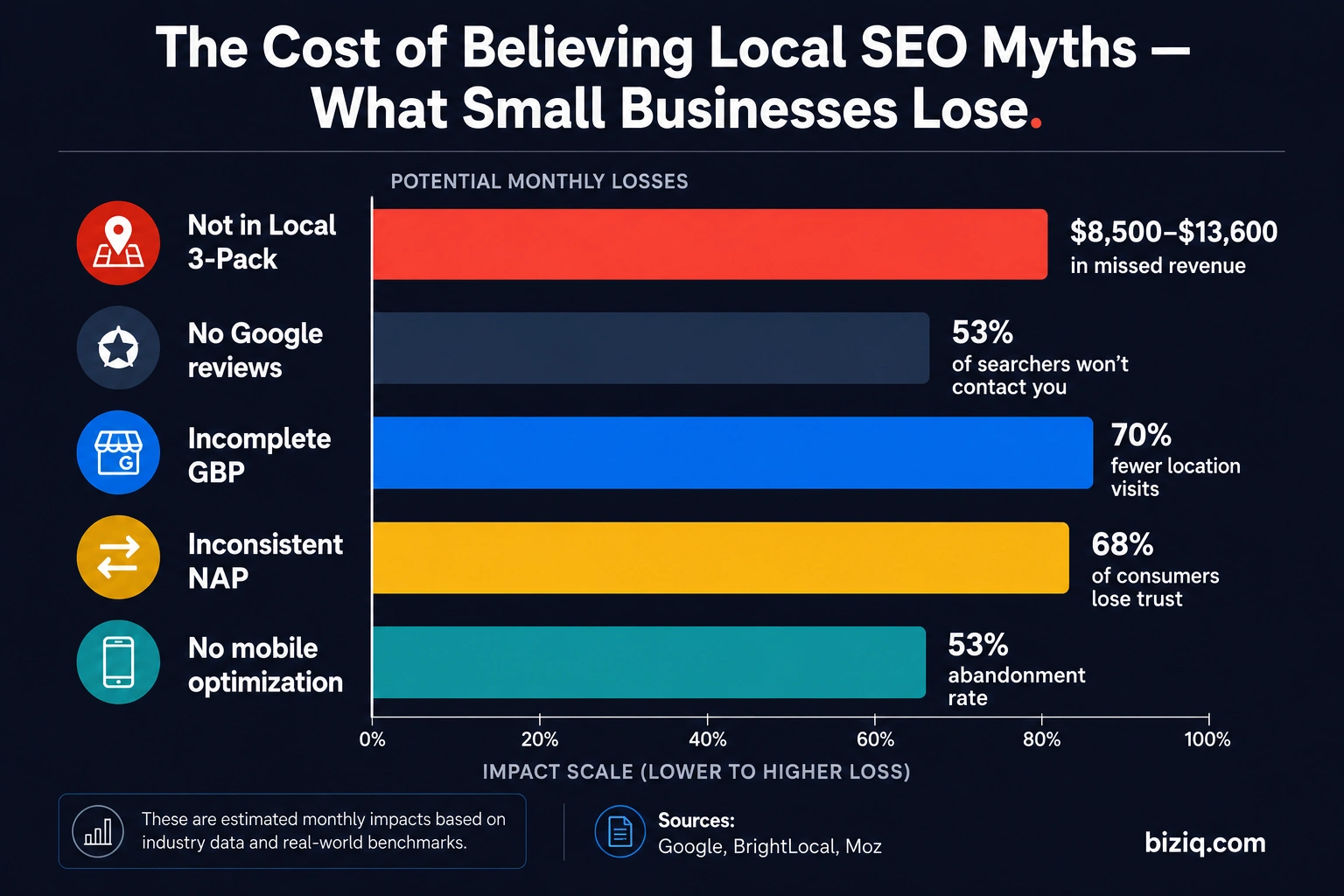
The data behind why local SEO myths aren’t just wrong — they’re expensive.
The Cost of Believing These Myths — Summary
| Myth | The Truth | Source |
|---|---|---|
| A website alone is enough | Local Pack driven by GBP signals — website is secondary for local visibility | Moz |
| Word of mouth replaces local SEO | 87% of consumers Google a business even after a personal recommendation | BrightLocal |
| Local SEO is a one-time setup | Review recency, posting, and competitor activity require ongoing maintenance | BrightLocal |
| Keywords in GBP name boost rankings | Direct guidelines violation; causes profile suspension | Google Help Center |
| Fake reviews help rankings | Google detects and penalizes; FTC fines up to $700K documented | FTC, Google |
| Small businesses can’t compete | Local Pack weights proximity and GBP quality — not brand size or budget | Moz |
| My industry doesn’t need local SEO | 46% of all Google searches have local intent across all consumer industries | |
| Local SEO takes years | Measurable improvements typically appear in 3–6 months | Industry data |
| Reviews don’t affect rankings | Review signals = 15–17% of Local Pack ranking weight | Moz |
| Google info = all directory info | Google validates against 37 directories; inconsistency suppresses rankings | Whitespark, BrightLocal |
Frequently Asked Questions
Sources
- Moz Local Search Ranking Factors 2025
- BrightLocal Local Consumer Review Survey 2025
- Google Business Profile — Guidelines for Representing Your Business
- FTC Enforcement Actions — Fake Reviews
- Whitespark Local Citation Study
- Google Think with Google — Local Search Research
Last updated: May 2026.