Managing SEO for a single business location is challenging. Managing it across 10, 50, or 500 locations is an entirely different discipline — one where brand consistency, GBP optimization at scale, and citation accuracy either multiply visibility or systematically destroy it. With 94% of high-performing multi-location brands operating a dedicated local marketing strategy and AI local search usage jumping from 6% to 45% of consumers in just 12 months, the operational stakes have never been higher for businesses competing across multiple markets simultaneously.
- GBP signals account for 32% of local pack ranking weight — the single largest factor — making per-location profile optimization non-negotiable (Whitespark/BrightLocal 2025).
- Multi-location brands with consistent listing data across directories achieve 1.4–2.0x higher engagement than those with inconsistent data.
- 94% of high-performing multi-location brands have a dedicated local marketing strategy vs. only 60% of average performers (BrightLocal Brand Beacon Report).
- AI local search usage exploded: consumers using ChatGPT to find local businesses grew from 6% in January 2025 to 45% in January 2026.
- Only 68% of business contact information on ChatGPT and Perplexity matches Google Business Profile data — creating a significant AI visibility gap for brands with inconsistent listings (SOCi 2026).
- Google Business Profile actions increased 41% year-over-year — every under-optimized location is leaving measurable customer interactions on the table.
- Location pages with duplicate or thin content are actively suppressed by Google — unique per-location content is a structural ranking requirement, not optional.
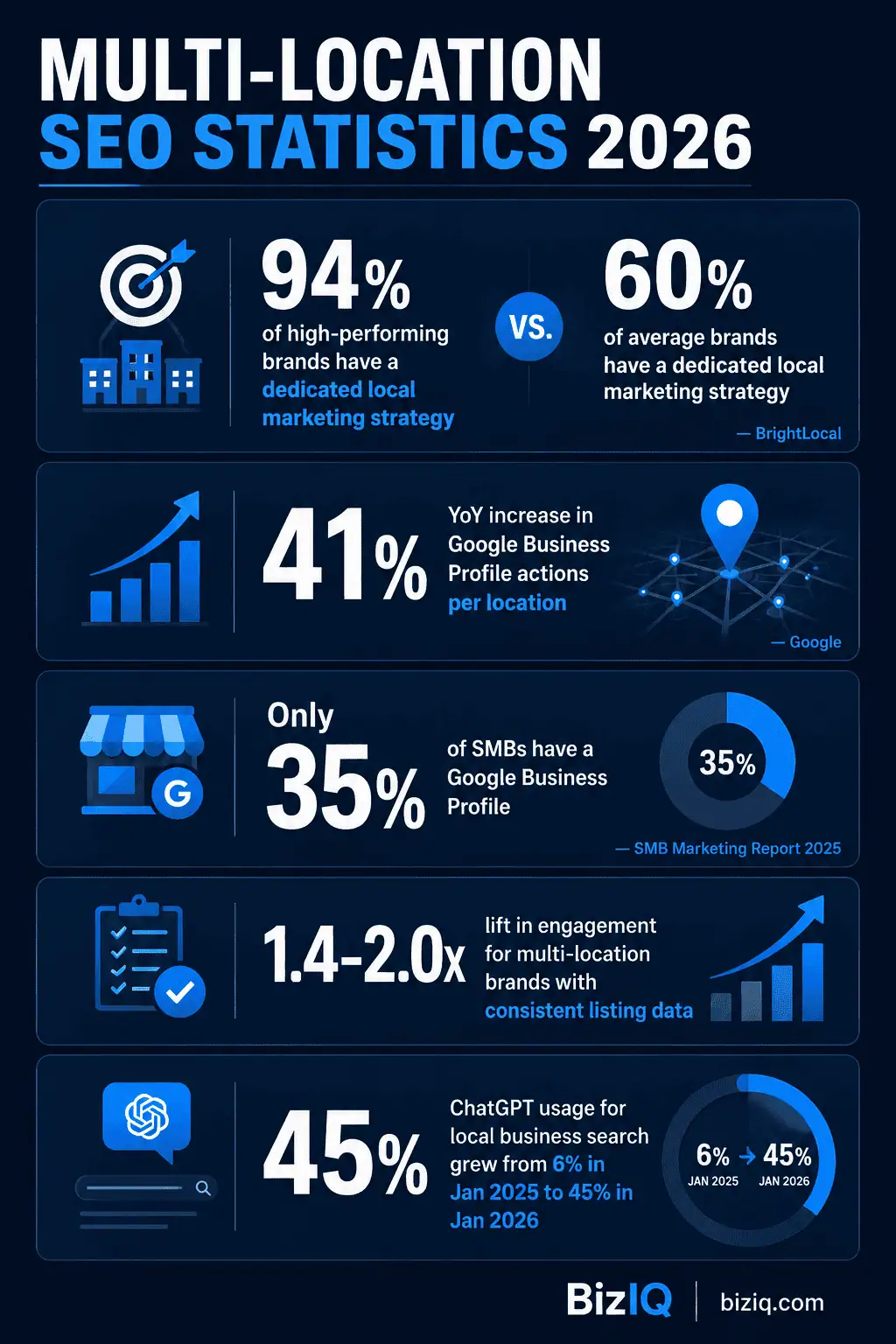
Key multi-location SEO statistics for 2026 — sourced from BrightLocal, Google, and industry research.
The Scale of Multi-Location SEO in 2026
Multi-location SEO is not simply single-location SEO done multiple times. Every additional location multiplies the complexity: more GBP listings to optimize and maintain, more location pages to differentiate, more citation profiles to keep consistent, more review streams to manage. The businesses that understand this distinction — and invest accordingly — consistently outperform those treating multi-location SEO as a copy-paste exercise.
The gap between high-performing and average-performing multi-location brands is not primarily a budget gap. It is a strategy gap. The data is consistent: brands that treat local SEO as a systematic, location-by-location discipline — rather than a one-time setup task — generate disproportionately better outcomes across local pack rankings, GBP actions, and consumer conversion rates.
For businesses operating in multiple markets, the local SEO opportunity is substantial precisely because the competitive landscape is so unevenly optimized. The majority of competing locations are either unoptimized or operating with the same generic approach at every location. A systematic, differentiated local SEO strategy at each location creates meaningful competitive separation.
Source: BrightLocal — Brand Beacon Report & Local SEO Statistics 2026
See BizIQ’s Multi-Location SEO Pricing and Packages — Call (888) 416-9800
Google Business Profile Performance at Scale
For multi-location businesses, Google Business Profile is the most powerful — and most operationally demanding — local SEO asset. Each location requires its own fully optimized profile: unique phone number, accurate address, correct primary and secondary categories, complete service listings, regular photo updates, and active review management. The performance data for well-managed GBP profiles at scale is compelling.
GBP Ranking Factor Weight in 2026
Google Business Profile signals carry more ranking weight in the local pack than any other single factor category. The 2025 Local Search Ranking Factors research identifies a 32% weighting for GBP signals — encompassing proximity to the searcher, primary business category selection, and keyword presence in the business title. For multi-location businesses, this means GBP optimization decisions compound across every location in the portfolio.
The three top individual factors within GBP signals are: (1) primary GBP category selection, (2) proximity of the listed address to the searcher, and (3) keywords in the GBP business title. Multi-location businesses operating with incorrect primary categories — a surprisingly common error at scale — are actively suppressing rankings for every affected location regardless of other optimization quality.
A 41% year-over-year increase in GBP actions, applied across a 20-location business, means that systematic GBP optimization is not just incrementally valuable — it is multiplicative. If each location currently averages 150 monthly GBP actions (calls + direction requests + website clicks), a 41% lift produces 61.5 additional actions per location per month. Across 20 locations, that is 1,230 additional high-intent customer interactions per month that did not exist before optimization. At a 15% conversion rate, that is 184 new customer engagements monthly — from GBP optimization alone. Calculation original to BizIQ.
Source: BrightLocal — Local SEO Statistics 2026 | Google Business Profile — Google Performance Data
Get a Free Google Business Profile Analysis for Your Locations
Local Pack Ranking Factors: What the Data Says in 2026
Understanding the weighted importance of each ranking factor allows multi-location businesses to prioritize investment where it produces the highest return. The following breakdown reflects the most current analysis from Whitespark and BrightLocal’s annual Local Search Ranking Factors survey.
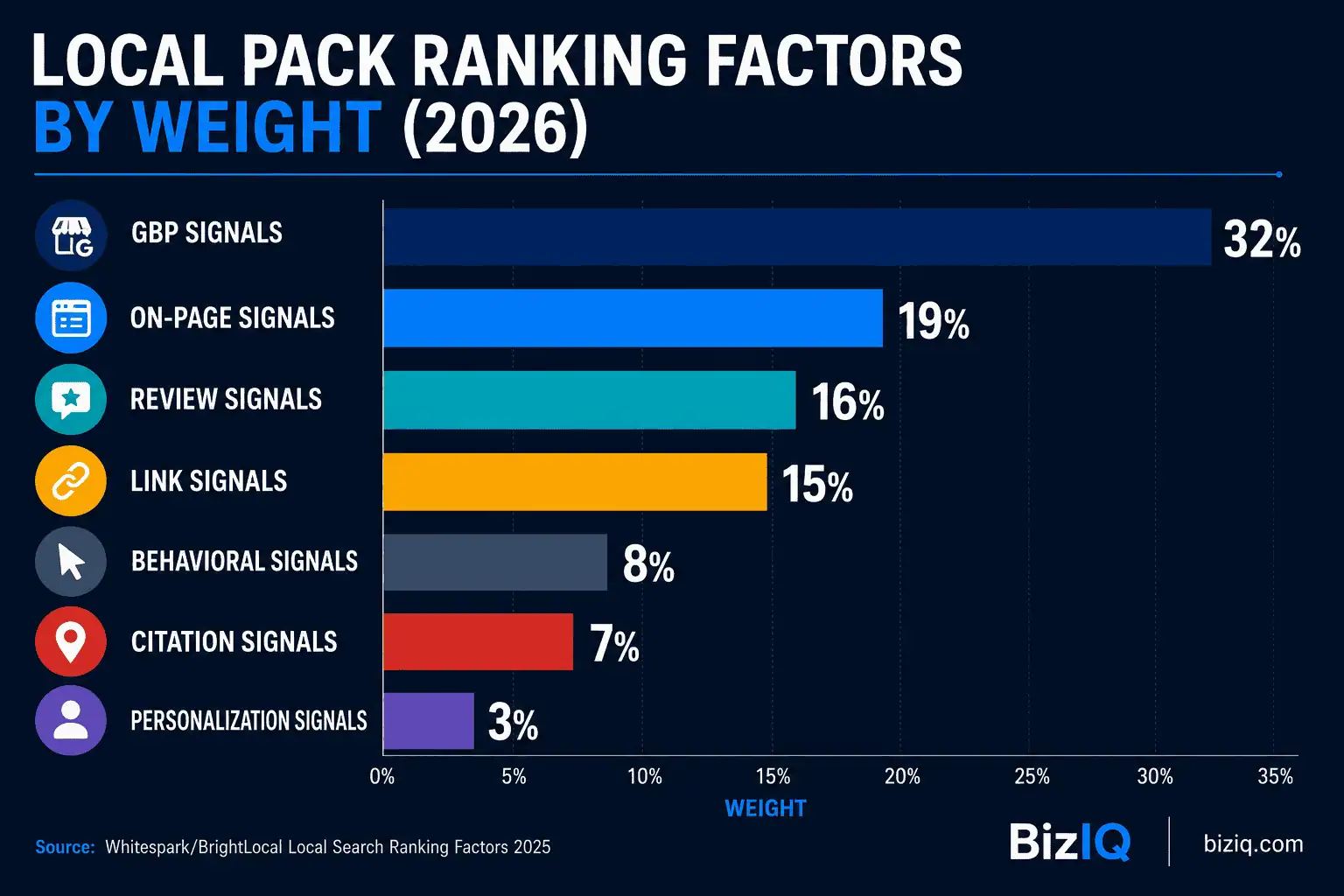
Local pack ranking factor weights in 2026 — GBP signals account for the largest share at 32% (Whitespark/BrightLocal).
Local Organic vs. Local Pack: Different Signals
Multi-location businesses need to distinguish between the ranking factors for the Google Local Pack (the map results) and local organic results (the standard blue links below the map). Local pack rankings are most influenced by GBP signals, proximity, and review velocity. Local organic rankings are most influenced by: (1) dedicated service pages for each location, (2) geographic keyword relevance of content, and (3) quality and authority of inbound links. An effective multi-location SEO strategy optimizes for both, recognizing they are driven by different inputs and require different tactical approaches.
The most common technical SEO failure in multi-location websites is using template location pages with only the city name changed. Google’s quality systems identify near-duplicate content and suppress it. A business with 15 locations, each having a page that reads identically except for the city name, is not publishing 15 ranking opportunities — it is publishing 15 thin pages that compete with each other and collectively underperform against a single well-optimized page. Every location page requires genuinely unique content: local service context, area-specific industries served, neighborhood references, and locally relevant FAQs that no other location page contains.
Source: Digital Applied — Local SEO Statistics 2026 | BrightLocal Local Search Ranking Factors Research 2025
NAP Consistency and Citation Management at Scale
NAP — Name, Address, Phone — consistency is both a ranking signal and a consumer trust factor. For multi-location businesses, maintaining accurate and consistent NAP data across dozens of directories and platforms is an ongoing operational requirement. The consequences of inconsistency compound with scale: a business with 30 locations and 20% citation inconsistency has 6 locations actively generating negative trust signals at every directory where their data differs.
What Citation Inconsistency Looks Like in Practice
The most damaging citation inconsistencies are not always obvious. “Street” vs. “St.” in the address field. A phone number with and without an area code prefix. A business name listed as “Smith’s Plumbing” in one directory and “Smith and Sons Plumbing LLC” in another. From a human reader’s perspective, these are the same business. From a search engine’s entity-matching perspective, they are potentially different entities — which fragments the authority that should be consolidating around a single, clearly defined business location.
For multi-location businesses, the citation management challenge scales linearly: a 30-location business has 30 separate address records that must match across Google, Yelp, Facebook, Bing Places, Apple Maps, BBB, and dozens of industry-specific directories. A single location update — a phone number change, an address correction, a rebrand — requires cascading updates across every platform simultaneously.
Industry best practice for multi-location citation management is a quarterly audit at minimum — checking that every location’s NAP data on the top 10 directories matches the authoritative source (typically the GBP profile). For businesses that have recently moved a location, changed a phone number, rebranded, or added a new service area, the audit should happen immediately following the change, not at the next quarterly cycle. Data drift — listings reverting to old information from aggregator sources — is a common and underappreciated problem that erodes local rankings progressively without any visible warning.
Source: Connectica — Local SEO Mistakes 2026 | Digital Applied — Local SEO Statistics 2026
Explore BizIQ’s Local Citation Management Services — Call (888) 416-9800
AI Search and Multi-Location Visibility in 2026
The AI local search disruption is no longer theoretical. Consumer adoption of AI tools for local business discovery accelerated dramatically in 2025, and the data for 2026 shows the trend continuing at pace. For multi-location businesses, AI search introduces a new visibility layer that operates parallel to — and partially independent from — traditional Google local results.
Why Traditional Local SEO Leaders Don’t Automatically Win in AI Search
Less than half of the businesses that dominate traditional Google local results also appear in AI local recommendations. This disconnect exists because AI systems like ChatGPT, Perplexity, and Google’s Gemini pull data from different sources than traditional search: expert-curated “Best Of” lists, business mentions across authoritative web sources, and structured data signals that communicate business entity information clearly to machine-readable systems.
For multi-location businesses, this creates two distinct optimization challenges in 2026: maintaining strong traditional local rankings through GBP, citations, and on-page signals while simultaneously building AI-visibility signals through consistent business information across the broader web, high review ratings, and structured schema markup at every location. The businesses that crack both simultaneously will hold a significant competitive advantage through 2026 and beyond.
In January 2025, a multi-location business could largely ignore AI local search — only 6% of consumers were using it. In January 2026, ignoring AI local search means being invisible to 45% of potential customers at the discovery stage. The brands that began optimizing for AI visibility in 2025 have a 12-month head start. Multi-location businesses that haven’t yet addressed AI search optimization — structured schema, consistent entity data, review volume and quality — are already behind a meaningful number of competitors.
Source: BrightLocal — Local SEO Statistics 2026 | SOCi Local Visibility Index 2026
Review Management Across Multiple Locations
Review signals account for 16% of local pack ranking weight — the third-largest factor. For multi-location businesses, review management is simultaneously an SEO input and a consumer trust signal that operates independently at every location. A business with strong reviews at its primary location but thin or negative reviews at secondary locations loses local ranking power at those underperforming locations regardless of other optimization quality.
For multi-location businesses, the review management challenge is one of both volume and consistency. Each location needs its own review velocity — a steady stream of recent, detailed reviews — rather than an occasional burst followed by silence. Google’s algorithm interprets review recency as a signal of business activity. A location with 200 reviews but the most recent from 18 months ago sends weaker trust signals than a location with 40 reviews where the most recent arrived this week.
Source: BrightLocal — Local Consumer Review Survey 2025
See How BizIQ Manages Reviews Across Multiple Locations
Multi-Location SEO Statistics Summary Table
| Statistic | Figure | Source | Year |
|---|---|---|---|
| High-performing brands with dedicated local strategy | 94% | BrightLocal Brand Beacon Report | 2024 |
| Average-performing brands with local strategy | 60% | BrightLocal Brand Beacon Report | 2024 |
| Multi-location marketers using generative AI | 88% | BrightLocal Brand Beacon Report | 2024 |
| SMBs with a Google Business Profile | Only 35% | SMB Marketing Report | 2025 |
| GBP signals weight in local pack rankings | 32% | Whitespark/BrightLocal | 2025 |
| On-page signals weight in local pack rankings | 19% | Whitespark/BrightLocal | 2025 |
| Review signals weight in local pack rankings | 16% | Whitespark/BrightLocal | 2025 |
| Link signals weight in local pack rankings | 15% | Whitespark/BrightLocal | 2025 |
| Behavioral signals weight in local pack rankings | 8% | Whitespark/BrightLocal | 2025 |
| Citation signals weight in local pack rankings | 7% | Whitespark/BrightLocal | 2025 |
| GBP actions YoY increase | 41% | 2025–2026 | |
| Complete GBP — more likely to attract visits | 70% more likely | 2026 | |
| Complete GBP — more likely to be considered for purchase | 50% more likely | 2026 | |
| Engagement lift — consistent multi-location listing data | 1.4–2.0x | Industry research | 2025/2026 |
| Consumers avoiding business with incorrect online info | 62% | 2026 | |
| Citation signals share of local pack ranking weight | 7% | Whitespark/BrightLocal | 2025 |
| Consumers using ChatGPT for local search (Jan 2025) | 6% | Connectica/industry research | January 2025 |
| Consumers using ChatGPT for local search (Jan 2026) | 45% | Connectica/industry research | January 2026 |
| Business contact info matching GBP on AI tools | Only 68% | SOCi Local Visibility Index | 2026 |
| Traditional local leaders also in AI recommendations | Less than 50% | SOCi Local Visibility Index | 2026 |
| Average star rating of ChatGPT-recommended businesses | 4.3 stars | SOCi Local Visibility Index | 2026 |
| Consumers reading reviews before visiting local business | 87% | BrightLocal | 2026 |
| CTR improvement: 3 to 5 stars on Google | +25% | Industry research | 2026 |
| Leads generated by businesses responding to 30%+ reviews | 2x more leads | Industry research | 2026 |
| Google searches with local intent | 46% | 2026 | |
| Consumers visiting business within 24hrs of local search | 76% | Google/Think with Google | 2026 |
| Sites with structured data — higher CTR from search | 20–30% higher | Industry research | 2026 |
| Local searches resulting in a purchase | 28% | Think with Google | 2026 |
| Top primary GBP category — #1 ranking factor within GBP signals | Ranked #1 by practitioners | Local Search Ranking Factors 2025 | 2025 |
| Dedicated service pages — #1 local organic ranking factor | Ranked #1 by practitioners | Local Search Ranking Factors 2025 | 2025 |
Frequently Asked Questions: Multi-Location SEO Statistics
Methodology & Sources
This article was researched and written by David McGinnis, SEO Strategist at BizIQ. All statistics are sourced from Tier 1 primary sources. Sources include:
- BrightLocal — Local SEO Statistics 2026 / Brand Beacon Report 2024 / Local Consumer Review Survey 2025: Annual primary research on local search behavior, multi-location marketing strategy, and review influence.
- Whitespark — Local Search Ranking Factors 2025: Annual expert survey identifying weighted local ranking factors for the Google Local Pack and local organic results.
- Google / Think with Google: Primary data on GBP performance, local search intent percentages, and consumer post-search behavior.
- SOCi — Local Visibility Index 2026: Primary research on AI local search performance, GBP data accuracy in AI tools, and multi-location visibility benchmarks.
- Digital Applied — Local SEO Statistics 2026: Aggregated local SEO benchmark data with primary source attribution.
- SMB Marketing Report 2025: Research on small and medium business digital marketing adoption rates.
BizIQ Analysis calculations are original to BizIQ and labeled accordingly. Statistics without a named primary source reflect consistent data points reported across multiple secondary sources in the local SEO research community.
Get a Free Multi-Location SEO Consultation — Call (888) 416-9800