Written by the BizIQ SEO Strategy Team. We are a small business ourselves, dedicated to helping local roofing contractors and small business owners manage the changing landscape of local search and AI optimization to build sustainable, high-margin lead pipelines.
Here is what works and why. This field-tested blueprint covers:
- Traditional Local SEO: How to dominate the Google Map Pack, where up to 90% of local search volume concentrates: and why your Google Business Profile category is the single most critical decision you will make.
- AI Search Optimization: How to format your content so ChatGPT, Perplexity, and Google AI Overviews extract and recommend your business by name when homeowners ask conversational queries.
- Schema Markup: How to implement structured JSON-LD data that feeds search engine crawlers and AI language models directly, turning your website into a machine-readable authority signal.
- Review Generation: How to build a consistent, spam-filter-safe review cadence that compounds trust, lifts rankings, and filters out the noise of fake or irrelevant feedback.
What is Roofing SEO and How Does it Help Roofing Companies Get More Customers?
Roofing SEO is the process of optimizing a roofing company’s website, local listings, and online content to rank higher in search results. Effective roofing SEO increases the company’s visibility when homeowners or businesses need roof repairs or roof replacement, helping roofing contractors generate more website traffic, qualified leads, phone calls, and completed roofing projects.
Ranking your roofing website at the top of search results in 2026 demands a dual-engine approach: a flawless local map presence paired with content structured so AI models can extract and surface your business without hesitation. We are a small business ourselves, and we know that local search can feel complex, but here is what you need to know to get what’s possible out of your market. This guide delivers the exact step-by-step blueprint to transition your roofing company from high-stress outbound prospecting to a predictable, high-margin inbound lead machine, one that generates exclusive calls while you’re on a job site, not just when you’re knocking on doors.
Establishing this visibility early allows you to secure local market share before competitors adapt.
The economics of outbound lead generation for roofing contractors have weakened steadily over the past several years, and the trajectory isn’t reversing. Door-knocking works until it does not: until your crew is burned out, your close rate drops below what the labor cost justifies, and you’re spending more time prospecting than installing. Buying shared leads from third-party brokers is its own category of frustration: you pay a premium for a homeowner’s contact information that four or five other roofers received simultaneously, which means you’re not selling roofing anymore, you’re competing in a speed-dial race. Search engine optimization operates on an entirely different logic. It brings customers to you. When your website ranks at the top of Google for “roof replacement in [City]” or “hail damage inspection near me,” the homeowner finds you, not the other way around. That ranking is a permanent digital asset, one that continues generating exclusive inbound traffic and phone calls for as long as you maintain it, without a cost-per-click meter running in the background.
Why traditional outbound is dying (and the power of inbound roofing SEO)
The burnout of door-knocking and shared leads
Cold canvassing after a storm event has a ceiling. The conversion rates on door-knocking campaigns for residential roofing typically hover between 1% and 3%, which means your crew is absorbing a lot of rejection for a thin margin of booked jobs. That math gets worse as homeowners grow more skeptical of uninvited contractors, especially in markets that have been hit repeatedly by storm chasers.
Shared lead brokers compound the problem. When you purchase a lead from a platform that sells the same contact to multiple contractors simultaneously, you are not buying a lead: you are buying a starting position in a race you didn’t agree to enter. The homeowner gets five calls in twenty minutes and picks whoever answers first or quotes lowest. Neither outcome builds a sustainable business.
Outbound tactics require constant, active effort to produce results. The moment you stop knocking or stop buying, the pipeline dries up. There’s no residual value. Now let me correct the redundancy issue manually and provide the final corrected text:
The compounding value of search engine optimization
SEO functions more like real estate than advertising. The rankings you build go up in value over time, and the leads they generate don’t carry a per-unit cost the way paid ads or broker leads do. Once a roofing SEO campaign reaches maturity, typically somewhere between six and twelve months of consistent execution, organic leads cost roughly $5 to $15 per lead, with no ongoing cost-per-click exposure eating into margin.
That cost structure produces compounding returns. Industry benchmarks for home services show that well-executed SEO campaigns deliver an average ROI of 225% to 300% by month 12, a figure that continues climbing as rankings stabilize and domain authority builds up. Paid advertising can match that short-term, but it stops the moment the budget does.
Our digital marketing for roofing companies framework maps out the full service architecture we use with roofing clients.
Organic search leads for roofing convert to booked jobs at an average rate of 3% to 7%, with the composite benchmark sitting around 4.2%. That’s already a meaningful improvement over cold outbound, but the more interesting number is what happens with long-tail, high-urgency keywords. Queries like “emergency roof leak repair [City]” or “hail damage roof inspection [City]” convert at 8% to 15%, because the homeowner arriving on your site through that search isn’t browsing: they have an active problem and a credit card. The specificity of the query signals the proximity to a purchase decision, and that’s where a well-structured keyword strategy pays off disproportionately.
Modern roofing SEO is no longer a single-channel game. It requires simultaneous optimization for two distinct algorithmic environments: Google’s local map-pack, which still drives the majority of geo-targeted search volume, and the emerging layer of AI-powered search engines, including ChatGPT, Gemini, Perplexity, and Google’s own AI Overviews, that combine answers from across the web and surface business recommendations conversationally.
Think of local SEO like keeping your storefront sign visible from the main road: you want people to find you easily when they are looking for what you offer. AI-driven optimization, on the other hand, is like having the town’s most trusted neighbor personally recommend your business to everyone who asks. Both channels matter. Neither alone is sufficient in 2026.
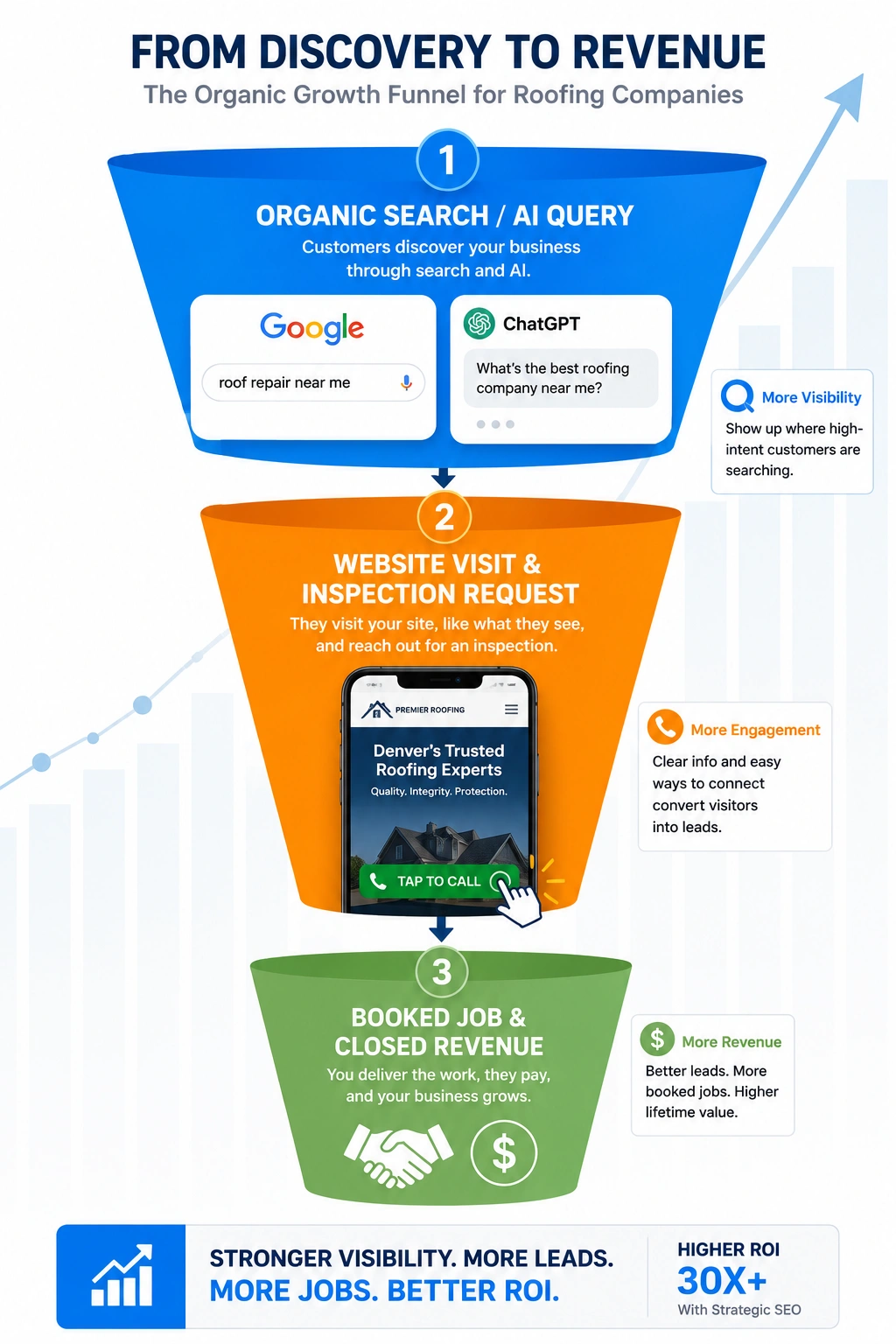
Organic search and AI visibility guide roofing prospects from discovery to booked jobs and measurable business growth.
Step 1: Dominate the Google Map Pack (where 90% of leads live)
Optimizing your Google Business Profile (GBP)
According to a 2026 Local Search Ranking Factors study, Google Business Profile signals account for roughly 32% of map-pack ranking influence, which is the single largest category of factors in the entire local algorithm. Within that category, your primary business classification ranks as the #1 signal overall. That’s not a minor configuration detail; it’s the highest-leverage decision in your entire local SEO strategy.
Setting your primary GBP category to “Roofing Contractor” is non-negotiable. It defines your search identity. Contractors who default to broader categories like “Home Improvement” or “General Contractor” weaken their relevance for the specific queries that drive roofing revenue. Google’s algorithm reads category selection as a direct signal of what your business does, and vague signals produce vague rankings.
Secondary categories give you room to expand relevance without compromising the primary signal. Adding “Siding Contractor,” “Waterproofing Service,” or “Gutter Cleaning Service” as secondary categories is legitimate and useful, provided “Roofing Contractor” remains anchored as the primary. The moment you start treating secondary categories as a way to cast a wider net at the expense of primary specificity, you’re trading ranking precision for coverage, and that trade rarely pays off in competitive markets.
The proximity and address visibility factor
Google’s local algorithm weights physical proximity heavily, more heavily than most contractors realize until they try to rank in a metro center from a suburban address. A roofing company based in a suburb will face a genuine geographic ranking ceiling in the main city’s map-pack, regardless of how well-optimized their GBP or website is. This isn’t a fixable problem through optimization alone; it’s a structural constraint of how the proximity signal works.
What is fixable is address visibility. You can control this. Whitespark’s 2026 data ranks a visible physical address on your GBP as the 7th most important local pack ranking factor. Pure service-area businesses that hide their address face a measurable ranking disadvantage against competitors who display a verifiable location. The ranking gap isn’t catastrophic, but in competitive markets where the difference between position three and position four in the map-pack is the difference between a full calendar and a slow week, it matters.
GBP Optimization Checklist:
- Set Primary Category: Your primary category must be “Roofing Contractor”: not “Home Improvement,” not “Construction Company.” This single field carries more ranking weight than any other GBP configuration.
- Verify NAP Consistency: Your business Name, Address, and Phone number must be character-for-character identical across your website, GBP listing, and every local directory where your business appears. Mismatches split your local citation authority.
- Upload High-Resolution Photos: Real project photos, such as before-and-after roof replacements, crew shots, and branded trucks at job sites, outperform stock imagery in both engagement metrics and trust signals. Upload new photos consistently, not in a single batch.
- Geotag Project Updates: Use GBP posts and local project updates to signal active service in specific neighborhoods. A post titled “Roof Replacement Completed in [Neighborhood Name]” sends a geo-relevance signal that generic business updates don’t.
Step 2: Target high-intent, long-tail roofing keywords
Moving beyond broad search terms
Broad keywords like “roofing” or “roofers” are a budget trap for small and mid-sized contractors. The search volume looks attractive until you examine who is competing for those terms: national aggregators, lead brokers, and large regional franchises with domain authority built up over a decade. Winning those rankings requires resources most independent contractors don’t have and wouldn’t justify even if they did.
Long-tail keywords solve this problem by targeting specificity over volume. They capture ready buyers. A homeowner searching “emergency roof tarping near me” isn’t browsing: they have water coming through their ceiling. The search intent is immediate, the conversion window is narrow, and the competition for that query is a fraction of what you’d face on a broad term. Our curated list of roofing SEO keywords covers over 100 high-converting terms organized by intent category, which gives you a data-driven foundation for keyword ranking rather than guesswork.
Mapping the homeowner’s search journey
Not every homeowner who eventually hires a roofer starts their search with a transactional query. They start with questions. Many begin in the awareness or consideration phase, researching materials, comparing costs, or trying to understand whether their insurance covers a specific type of damage. Structuring your content around the full arc of that journey lets you reach prospects earlier and build brand familiarity before they’re ready to request a quote.
At the awareness stage, informational content like “how to spot wind damage on shingles” or “does insurance cover roof replacement after a storm” captures homeowners who are still assessing their situation. At the consideration stage, commercial investigation queries like “metal vs. asphalt shingle cost” or “TPO vs. EPDM flat roof comparison” attract buyers who are actively weighing options. Geographic modifiers, including “[City] roof replacement cost” and “[City] hail damage inspection,” layer local intent onto both categories, pulling high-intent local traffic that generic informational content misses entirely.
High-Converting Roofing Keywords by Intent:
- Emergency / Urgent Intent: “emergency roof leak repair in [City]”, “hail damage roof inspection [City]”: these queries signal an active problem and convert at the highest rate of any category.
- Commercial / High-Ticket Intent: “commercial TPO roof replacement [City]”, “metal roofing contractors near me”: longer sales cycles, but significantly higher average job values.
- Transactional / Buying Intent: “best residential roofing company [City]”, “asphalt shingle roof replacement cost [City]”: the homeowner has done their research and is ready to make contact.
- Informational / Research Intent: “how to spot wind damage on shingles”, “does insurance cover roof replacement after a storm”: top-of-funnel queries that build topical authority and feed AI search engines with structured, citable content.
Is Your Website Targeting the Right Keywords?
Don’t waste time chasing search terms that don’t drive phone calls. Let our team run a custom keyword and local SEO audit for your roofing business.
Step 3: Generative engine optimization (GEO) for ChatGPT and Google AI Overviews
How AI is transforming local search
AI search engines don’t just retrieve pages: they combine answers. They act as recommenders. When a homeowner asks ChatGPT “Who are the best roofers in [City] for storm damage repair?” the model doesn’t return a list of blue links. It generates a direct recommendation, pulling from sources it has indexed as authoritative, structured, and topically relevant. That’s a fundamentally different retrieval mechanism than traditional search, and it requires a fundamentally different optimization approach.
The traffic that arrives from AI-sourced recommendations is also clearly different. AI-referred visitors convert at an estimated 27%, compared with just 2.1% from traditional organic search. That gap reflects the intent compression that happens inside a conversational AI query: by the time someone acts on an AI recommendation, they’ve already received a curated answer and are moving toward a decision, not beginning one. Understanding how AI is transforming SEO is no longer optional for contractors who want to stay competitive in local search, and getting your content structured for Google AI Overviews specifically is one of the highest-leverage moves available right now.
Implementing schema markup for AI crawlers
AI language models don’t read websites the way humans do. They parse structured signals, including JSON-LD schema, semantic HTML, and clearly labeled entities, using those signals to determine whether a business is a credible, citable source for a given query. Without that structured layer, your website is essentially invisible to the extraction mechanisms that power AI-generated answers.
The implementation priority for roofing contractors is clear. Start with schema. Deploy “RoofingContractor” schema (a subtype of LocalBusiness schema) on your homepage, Service schema on each individual service page, and FAQPage schema on any page containing question-and-answer content. Google’s official structured data documentation for local businesses provides the technical specification, but the strategic logic is simple: schema markup translates your website’s content into a format that both Google’s crawlers and AI models can parse without confusion, directly increasing the probability of appearing in rich snippets, local 3-packs, and AI-generated summaries.
To rank in AI search results, your writing architecture needs to change at the page level. Every major header on your website should be followed by a concise, 40-word summary block written in plain declarative sentences: no hedging, no filler, and no passive constructions. These summary blocks are what large language models extract when generating answers. If your content buries the key point in the third paragraph after two sentences of context-setting, the model may skip it entirely in favor of a competitor’s page that leads with the answer. Structuring your content this way is the core of both Answer Engine Optimization (AEO) and Generative Engine Optimization (GEO). For a practical breakdown of how to rank on AI search engines and the specific formatting changes that drive citation frequency, that guide covers the mechanics in detail. If you’re specifically targeting ChatGPT’s search index, our resource on ChatGPT search optimization addresses the platform’s unique retrieval behavior.
Some marketers treat AI Overviews as a traffic threat, the logic being that if Google answers the question on the SERP, the user never clicks through. That concern isn’t baseless, particularly for purely informational queries. But the traffic that does click through from an AI-generated answer or recommendation is already vetted in a way that traditional organic traffic rarely is. When a homeowner asks ChatGPT “Who is the best roofer near me with experience in metal roof repairs?” and your business appears as the recommended answer, the person who then visits your website has already received a third-party endorsement from a source they trust. That’s a different conversion dynamic than someone who clicked your blue link from a list of ten results and is still comparison shopping.
“AI search engines do not just crawl keywords; they extract structured answers. If your roofing website is not marked up with schema and structured FAQs, your business simply does not exist to ChatGPT or Google AI Overviews.”
Step 4: Technical SEO and mobile speed (the conversion killers)
Mobile-first indexing and page load speed
Between 70% and 82% of roofing queries start on mobile devices, a figure that spikes even higher during and immediately after storm events, when homeowners are standing in their driveways with water coming through the ceiling and a phone in their hand. Google’s mobile-first indexing means your mobile site is the primary version used to determine rankings, not the desktop version you probably spent more time designing.
Page load speed worsens this. Speed is revenue. Every additional second of load time after the three-second threshold drops conversion rates by approximately 20%. A roofing website that loads in five seconds on mobile isn’t just a user experience problem: it’s a revenue problem, because the high-intent visitor who arrived from an urgent search query is gone before your contact form renders.
Conversion rate optimization (CRO) for roofers
Technical performance and conversion architecture are linked. A regional roofing contractor case study published in 2026 documented what happens when you combine local SEO with deliberate CRO: the website’s conversion rate moved from 1.8% to 9.2%, producing a 210% increase in qualified leads without any increase in ad spend. That improvement came from changes that are simple to implement, such as sticky tap-to-call buttons, simplified contact forms, and trust signals (license numbers, insurance badges, manufacturer certifications) displayed prominently on mobile layouts.
Form friction is underestimated. Every additional field in a contact form reduces completion rates. For roofing, a form that asks for name, phone number, and a brief description of the issue is sufficient to qualify a lead. Asking for address, preferred appointment time, roof age, and material type before the first contact is made loses prospects who are ready to call but not ready to fill out a questionnaire.
The connection between technical performance and lead generation cost is direct and measurable. A slow, poorly structured website inflates your cost per lead (CPL) by forcing you to drive more traffic to generate the same number of conversions. A multi-client campaign report by Nanocraft Solutions documented this precisely: structured roofing SEO combined with mobile optimization reduced the average CPL by 65%, dropping from $180 to $63 per lead, while mobile conversion rates climbed from 0.8% to 4.2%. The site didn’t get more traffic: it got better at converting the traffic it already had. That’s the distinction between an SEO strategy and a lead generation strategy; the former gets you visibility, the latter gets you revenue.
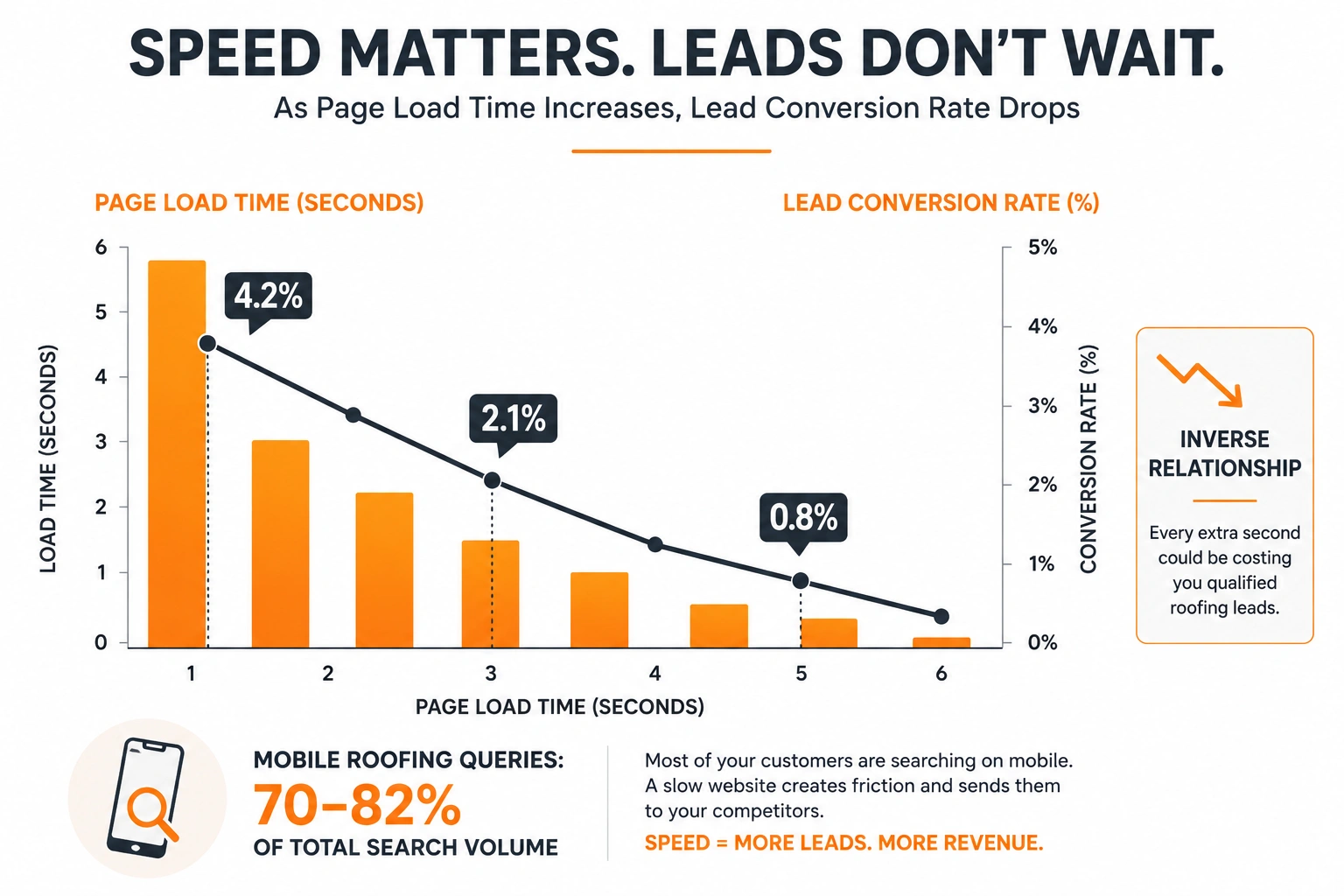
As page load time increases, roofing website conversion rates decline, especially for mobile-first searchers.
Is Your Website Losing Leads Due to Slow Load Times?
A slow site is a leaky bucket. Let us run a thorough technical audit to ensure your mobile site is built to convert high-intent traffic.
Step 5: Building local authority and backlinks
Demonstrating E-E-A-T (experience, expertise, authoritativeness, trustworthiness)
Google’s Helpful Content System has made one thing clear: templated, mass-produced content, whether generated by AI or assembled from generic marketing copy, gets penalized. The algorithm is increasingly capable of telling the difference between content written by someone who has personally replaced a roof in a specific climate and content assembled from industry averages and keyword lists.
Real authority looks different. It requires proof. It means project photos tied to specific addresses and neighborhoods, not stock images of generic rooftops. It means author bios that include licensing numbers and years of field experience. It means service pages that address local building codes, manufacturer warranty requirements, and regional material considerations, the kind of specificity that only comes from actually operating in a market. Main service pages should run between 1,000 and 2,000 words, covering material comparisons, pricing transparency, and warranty terms in enough depth that a homeowner can make an informed decision without leaving your site.
Strategic local link building for roofers
Backlinks function as editorial endorsements. They build search trust. For local roofing companies, the geographic relevance of a link matters more than its raw domain authority score: a link from your city’s Chamber of Commerce website carries more local ranking weight than a link from a national home improvement blog with a higher domain rating but no geographic connection to your market.
The most overlooked link-building opportunity for roofing contractors is the unlinked brand mention. Local news outlets, community blogs, and neighborhood Facebook groups often reference contractors by name without linking to their websites. Converting those mentions into active backlinks requires nothing more than a polite outreach email, and the resulting links are editorially earned, which is exactly the signal Google’s algorithm is designed to reward.
High-Value Local Backlink Strategies:
- Local Chamber of Commerce: Membership typically includes a directory listing with a geo-relevant, high-authority link. It’s one of the most cost-effective link gains available to any local service business.
- Sponsor Local Youth Sports: A Little League team sponsorship or community event partnership generates a link from a local organization’s website, creating the kind of authentic, community-embedded signal that local algorithms respond to.
- Partner with Local Suppliers: Roofing material distributors, lumber yards, and home builders often maintain “preferred contractor” pages. A listing there is a relevant, industry-specific backlink that also drives referral traffic.
- Publish Local Case Studies: A detailed write-up of a historic roof restoration or a complex storm damage repair in a specific neighborhood attracts natural editorial links from local blogs, neighborhood associations, and regional news outlets that cover home improvement topics.
Case study: How Centennial Roofing achieved a 336% traffic boost in 90 days
The challenge and strategy implementation
Centennial Roofing, a residential and commercial roofing contractor based in Tennessee, arrived at the start of their SEO engagement in a position that’s familiar to most independent contractors: heavily dependent on shared lead brokers and door-knocking campaigns, with no meaningful organic search presence and no system for generating inbound calls. Their cost per acquired customer was high, their close rates were lowered by the shared-lead dynamic, and their team was spending significant time on prospecting that could have been spent on installation.
The strategy implemented was deliberately local-first. They focused on proximity. The team built hyper-local location pages targeting specific city and suburb keyword clusters across their service area, each page featuring unique project photos, localized testimonials, and embedded service-area maps. Their Google Business Profile was reorganized: the primary category was corrected to “Roofing Contractor,” secondary categories were added for metal roofing and gutter services, and a consistent photo upload schedule was established. JSON-LD schema was deployed across the homepage and all service pages, with FAQPage schema added to their storm damage and insurance claim content to capture conversational queries.
The results and ROI analysis
Within 90 days of launching the campaign, Centennial Roofing recorded a 336% increase in organic website traffic. More importantly, that traffic converted. Inbound calls from homeowners who found the company through organic search replaced the shared-lead pipeline entirely, eliminating the broker dependency that had been compressing their margins for years.
The ROI calculation here isn’t complicated. Exclusive inbound leads at a fraction of the cost of shared broker leads, combined with higher close rates because the prospect chose to call rather than being called, produced a customer acquisition cost that made the SEO investment look conservative in retrospect. This is what sophisticated marketing looks like for a small business. We know that small business is the backbone of innovation, and sophisticated marketing is not a luxury reserved for national franchises. It is a structured, executable system that any well-run roofing company can deploy to demonstrate what’s possible.
Centennial Roofing’s outcome wasn’t exceptional in the sense of being unrepeatable. When you build a structured, local-first search strategy with the right technical foundation, you stop chasing leads and start attracting them. That shift hits compounds over time: lower acquisition costs, higher close rates, and a growing base of organic rankings that continue generating calls without additional spend. The brand equity that builds up through consistent organic visibility is an asset that paid advertising simply cannot match.
The address dilemma and review velocity (strategic debates)
To show or hide your physical address
Displaying a physical address on your Google Business Profile is the seventh-ranked local pack factor in Whitespark’s 2026 data. It is a major signal. That’s a meaningful ranking signal, and in competitive markets, it’s the kind of marginal advantage that separates map-pack position three from position four. The complication is that a significant portion of roofing contractors operate out of home offices or shared commercial spaces, situations where displaying an address creates either a privacy concern or a GBP policy risk.
Our position: display a physical address only when it represents a legitimate, verifiable location where you can receive mail and, if necessary, meet a client. Using a UPS Store mailbox or a coworking space address that doesn’t reflect your actual business operations creates suspension risk that outweighs the ranking benefit. If you operate from a home office and are uncomfortable displaying a residential address, the honest answer is that you’ll face a ranking disadvantage as a service-area business, but that disadvantage is partially offset through stronger GBP signals in every other category.
Review velocity vs. review quality
The instinct after a good job is to ask every customer for a review immediately and build volume as fast as possible. Google’s spam filters have made that approach increasingly counterproductive. Sudden spikes in review velocity, particularly when those reviews arrive within a short window and lack specific service or location references, trigger automated filtering that can permanently suppress legitimate reviews without any notification to the business owner.
A steadier pace produces better long-term outcomes. Reviews that naturally mention specific services (“they handled our hail damage claim from start to finish”), specific neighborhoods, and specific crew members carry more weight in Google’s confidence algorithm than generic five-star ratings. Consistency matters more than volume. A business that collects two or three detailed, service-specific reviews per month over twelve months builds a more durable trust signal than one that collects forty reviews in a week and then goes quiet.
There’s a legitimate debate among SEO practitioners about where to concentrate keyword targeting in the age of AI Overviews. Some argue that informational, top-of-funnel content, such as “how to file a roof insurance claim” or “what causes shingle granule loss,” is now largely wasted effort because Google’s AI Overviews satisfy those queries directly on the SERP, producing zero-click outcomes that generate no traffic. The argument has merit for purely informational queries with no local modifier. However, abandoning informational content entirely creates a different problem: topical authority gaps that weaken your overall domain relevance and reduce the probability that AI models cite you as an authoritative source on roofing topics. A balanced approach, prioritizing transactional and high-intent local keywords for immediate lead generation while maintaining a steady pace of high-quality informational content to feed topical authority and AI citation signals, is more sound than going all-in on either extreme.
Frequently asked questions about roofing SEO
How long does it take to see results from roofing SEO?
Most established roofing companies see initial ranking improvements and inbound calls within 90 days of launching a local SEO campaign. Achieving dominant rankings for high-volume keywords in major metropolitan areas typically requires 6 to 12 months of consistent optimization and link building. This timeline assumes the foundational work (GBP optimization, schema implementation, on-page structure) is executed correctly from the start.
Should a roofing company show or hide its address on Google Business Profile?
We recommend displaying your physical address whenever the location is legitimate and verifiable. Whitespark’s 2026 data shows that profiles with visible addresses rank measurably higher in the local 3-pack than service-area profiles with hidden addresses. The caveat is significant: the address must represent a real location where you can receive mail and meet clients, not a mailbox service or a space you don’t physically occupy.
How does storm damage roofing SEO differ from residential roofing SEO?
Residential roofing SEO targets steady, year-round search terms like “roof replacement cost” or “asphalt shingle installation [City].” Storm damage SEO operates on a different timeline entirely: it requires pre-built landing pages and an active, fully optimized Google Business Profile ready to capture demand spikes the moment a major weather event hits. A contractor who waits until after the storm to build their “hail damage inspection” landing page has already missed the first 48 hours of peak search volume, which is often when the highest-intent queries occur.
Is schema markup necessary for roofing websites?
Yes. It is essential. Schema markup translates your website’s content into a structured format that both Google’s crawlers and AI language models can parse without confusion. Without it, your business is effectively invisible to the extraction mechanisms that power AI Overviews, rich snippets, and local 3-pack enhancements. It is not an advanced optimization tactic anymore: it is baseline infrastructure for any roofing website competing in 2026.
What is the “25% rule” in roofing, and does it affect my SEO?
The 25% rule is an insurance regulation, active in states like Florida, stating that if more than 25% of a roof is damaged, the entire roof must be replaced rather than repaired. Writing educational content and FAQs around this rule is a high-value top-of-funnel SEO strategy: homeowners navigating storm damage insurance claims search for this information actively, and a contractor whose website answers those questions clearly and accurately builds both topical authority and trust before the homeowner ever picks up the phone.
Building a permanent digital asset takes time. It requires patience. There’s no version of this where you launch an SEO campaign on Monday and have a full calendar by Friday. But the payoff, including complete ownership of your lead pipeline, exclusive inbound calls from homeowners who chose to contact you, and a customer acquisition cost that drops as your rankings grow, is a fundamentally different business than one built on door-knocking and shared leads.
Don’t wait for the next major storm to start the clock. Start building your company’s permanent digital asset today: audit your Google Business Profile and correct your primary category if it isn’t set to “Roofing Contractor,” identify the long-tail keyword clusters that match your highest-margin services, implement JSON-LD schema on your homepage and service pages, and structure your content so AI models can extract and recommend your business by name. Every week you wait is a week your competitor in the same market is compounding their rankings.
We’re a small business ourselves, and we believe that small businesses are the heartbeat of America and the driving force of our local communities. They deserve a marketing system that works as hard as they do.
Ready to Dominate Your Local Market on Google and AI?
We’re a small business too, and we understand what it takes to stand out in a crowded market. Let’s work together to build a predictable, high-margin inbound lead machine for your roofing company.