
Written by the BizIQ Organic Strategy Team. We are small business owners and technical marketers who live and breathe local search. We help automotive aftermarket providers turn complex databases into high-ranking, revenue-generating assets.
- Data-Driven Cataloguing: Why clean ACES and PIES data is the true foundation of search engine visibility.
- Dynamic Metadata Scaling: How to safely automate titles and meta descriptions across 100,000+ SKUs.
- Crawl Budget Protection: Smart indexing rules that prevent faceted navigation from destroying your rankings.
- Entity-Based Schema: Implementing advanced JSON-LD structured data to feed search engines and AI Overviews.
How can Auto Parts Retailers Optimize Their Digital Catalogs for Top Search and AI Rankings?
Your store(s) must pair structured inventory data with localized product keywords and robust citation management. An effective Catalog-First SEO Blueprint implements schema markup and optimized part descriptions, ensuring search engine and AI engines can crawl, understand, and cite your exact inventory to ready-to-buy shoppers.
In automotive e-commerce, search engine optimization is not a content problem: it is a catalogue-data problem. Unlike conventional retail, where a buyer looks for “red running shoes,” an auto parts buyer searches with acute precision. They search for a specific year, make, model, or manufacturer part number (MPN). If your technical architecture cannot translate these complex relationships for search engine crawlers, your products will remain invisible to the $200 billion digitally influenced auto parts market. Auto parts buyers don’t browse; they search with surgical precision: “OEM front brake pads for 2019 Toyota Camry,” or a 12-digit manufacturer part number they copied off a worn-out component. If your website cannot prove fitment to a search engine, it will not rank for high-intent queries, regardless of how well-written your homepage is. The market rewards technical precision, not marketing polish. Precision wins.
The global e-commerce automotive aftermarket sits at roughly $110 billion to $130 billion as of 2026, and is projected to reach $237 billion to $277 billion by 2030 to 2031, growing at a compounded annual growth rate of 11.5% to 16.6%. That is not a niche. Managing a catalogue of 50,000 or 500,000 SKUs is genuinely overwhelming, and the assumption that sophisticated technical marketing is reserved for enterprise brands with eight-figure budgets is one of the most expensive myths in this industry. At BizIQ, we believe small businesses are the backbone of innovation and the heartbeat of America. Businesses like yours drive America forward, and we get it because we’ve lived it. This guide is the exact technical blueprint for turning your inventory database into an organic traffic engine, without needing an enterprise budget.
The Foundation of Auto Parts SEO: Translating ACES and PIES Standards
The automotive aftermarket runs on two data standards administered by the Auto Care Association, and understanding them is non-negotiable for any serious SEO program. ACES (Aftermarket Catalogue Exchange Standard) governs vehicle fitment data: the structured mapping of year, make, model, sub model, engine type, and transmission that tells a buyer, and a search engine, whether a part fits their vehicle. PIES (Product Information Exchange Standard) handles the product side: part numbers, brand identifiers, dimensions, weight, pricing tiers, and image references. Both matter.
Most retailers receive these as unprocessed database feeds from warehouse distributors. The data exists. The problem is that it rarely gets translated into the on-page HTML elements that search crawlers can read. Raw product feeds ingested directly from a distributor will look identical across hundreds of rival retail sites, meaning they share the same description, same specs, and same everything. Search engines have no mechanism to reward one copy of that content over another. The only path to visibility is translating ACES and PIES into crawlable, on-page elements: unique title tags, structured HTML specification tables, and JSON-LD schema that explicitly declares fitment relationships. Without that translation layer, your catalogue cannot compete for high-intent queries, no matter how large your inventory is.
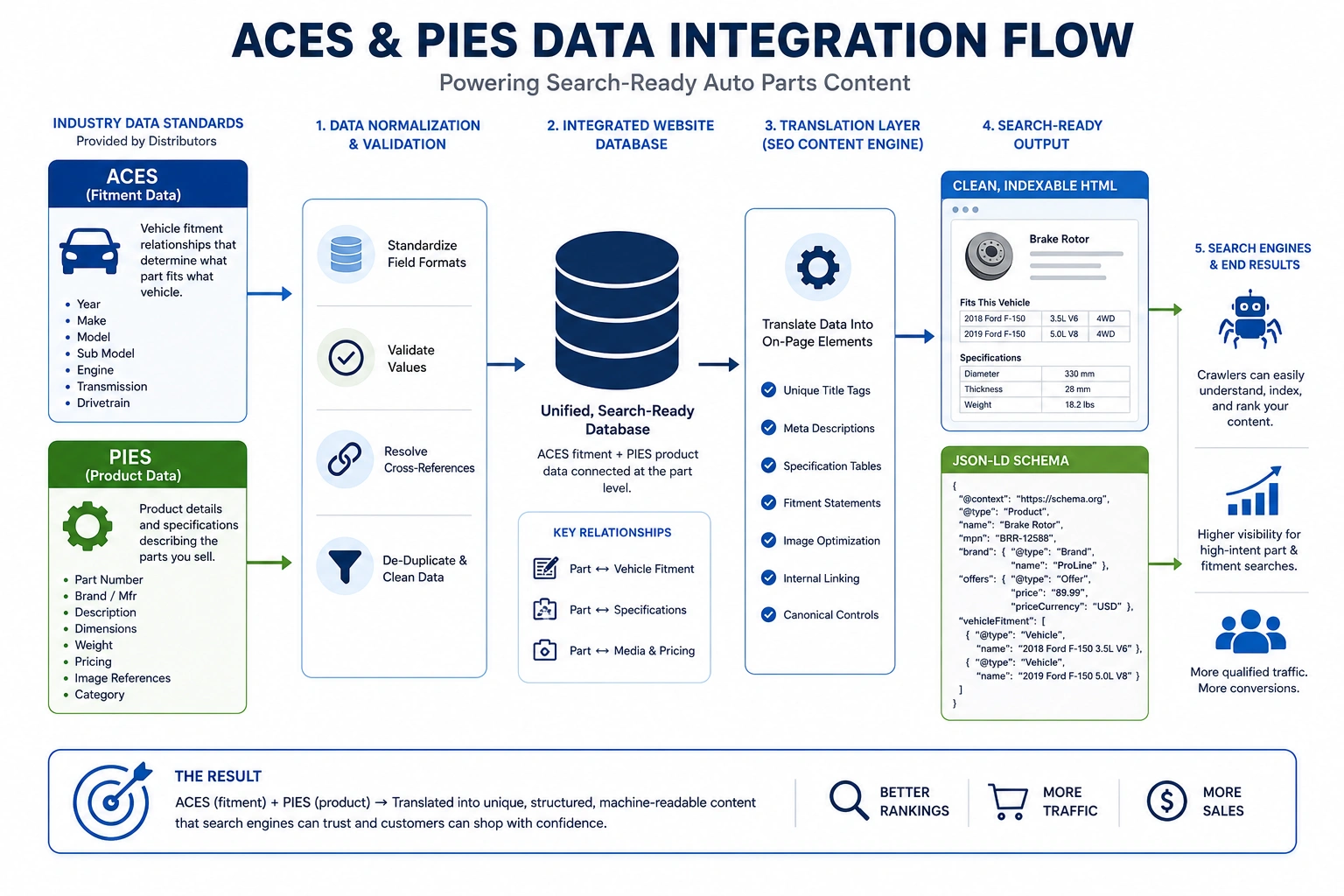
ACES fitment data and PIES product data work together to create search-ready auto parts content and schema markup.
Scaling Metadata with Dynamic SEO Templates
Manually writing title tags for 100,000 SKUs is not a strategy: it’s a staffing crisis waiting to happen. Scale is mandatory. The pragmatic solution is programmatic metadata generation using structured templates that pull directly from your product database fields. Here’s exactly how to do it:
Structure Rules for Scaled Metadata
- Automated Title Tags:
{Brand} {Part Name} for {Year} {Make} {Model} | Part #{MPN}to target precise search queries. - Dynamic Meta Descriptions:
{Brand} {Part Name} (Part #{MPN}) for {Year} {Make} {Model}. In stock, fast shipping, and guaranteed fitment.to maximize click-through rates. - H1 Tag Optimization: Set the primary H1 as
{Brand} {Part Name} - Part #{MPN}to establish instant relevance for both users and crawlers. - CTR Optimization Impact: A study by Hedges & Company showed that identifying low-CTR keywords and optimizing their meta titles and snippets resulted in a 30% increase in organic traffic, a 20% boost in CTR, and a 23% increase in organic revenue within 30 days.
Optimizing for Part Numbers, MPNs, and GTINs
Capturing High-Intent Part Number Searches
- Visible HTML Specifications: Always display the Manufacturer Part Number (MPN) and Global Trade Item Number (GTIN) in a clean, searchable HTML table on the product page.
- Cross-Reference Mapping: Include original equipment manufacturer (OEM) and rival cross-reference part numbers in your copy to capture searchers looking for direct replacements.
- Database Schema Mapping: Ensure your backend database maps these identifiers directly to the
mpnandgtin12fields in your JSON-LD structured data. - Long-Tail Dominance: Sector data shows that over 70% of automotive searches are long-tail queries containing specific year, make, model, or exact part numbers.
Is your catalogue database holding back your organic growth? We’re a small business too, and we know how overwhelming it is to manage thousands of SKUs. Let us help you simplify. Request a free, evidence-based technical audit of your auto parts website today. Our success is tied to yours.
Building Crawlable Year, Make, Model (YMM) Fitment Pages
The primary conflict in auto parts technical SEO is the debate around Indexing vs. Blocking YMM Pages, and there’s no clean universal answer, which is worth acknowledging upfront. Most auto parts sites rely on a JavaScript-driven YMM selector widget: the user picks a year, then a make, then a model, and the catalogue filters accordingly. It’s a good user experience. Search engine crawlers, though, cannot interact with dropdown menus. They see the widget and stop. The “Index All” camp’s response is to generate static, crawlable category pages for every YMM combination, paths like /brakes/honda/civic/2018, because those URLs map directly to long-tail search queries with real commercial intent and measurable search volume.
The contrary stance has genuine merit, too. Indexing every possible YMM permutation across a large catalogue can mean millions of near-identical pages competing against each other for the same ranking signals. That is index bloat in its most severe form, and it burns through your crawl budget on pages that add no incremental value. The hybrid approach that most experienced automotive SEOs land on is to block filtered URL parameters in your robots.txt file, following Google’s documented guidance on faceted navigation, and invest in a smaller set of static, hand-curated landing pages for your highest-volume vehicle models. It’s a prioritization decision, not a technical one: which models drive your revenue, and which YMM combinations have enough search volume to justify a dedicated page?
“A 9-month strategic SEO program executed by Spork for a $50M enterprise auto parts retailer resulted in a 29% year-over-year increase in organic sales by focusing on structured fitment data and clean catalogue architecture.”
Managing Faceted Navigation to Prevent Index Bloat
Faceted navigation is simultaneously one of the most beneficial features on an auto parts site and one of the most dangerous from an SEO standpoint. Every time a user filters by brand, price range, material, or fitment attribute, the platform generates a new URL. A catalogue of 50,000 parts with five active filter dimensions can mathematically produce millions of unique URL strings: most of them thin, duplicate content variations of the same underlying product set. Search engines that crawl those URLs are not discovering new content; they are diluting your site’s search authority across a sprawling index of near-identical pages.
The operational controls are well-established: use rel="canonical" tags on filtered URLs pointing back to the root category, configure your robots.txt to block crawling of parameter-based URLs, and audit your Google Search Console coverage report regularly to catch new filter patterns before they compound. What is less discussed is the platform dependency problem: no standard SaaS e-commerce platform handles complex automotive fitment facets cleanly out of the box. Shopify, Magento, and BigCommerce all require meaningful custom development to implement these controls correctly at scale.
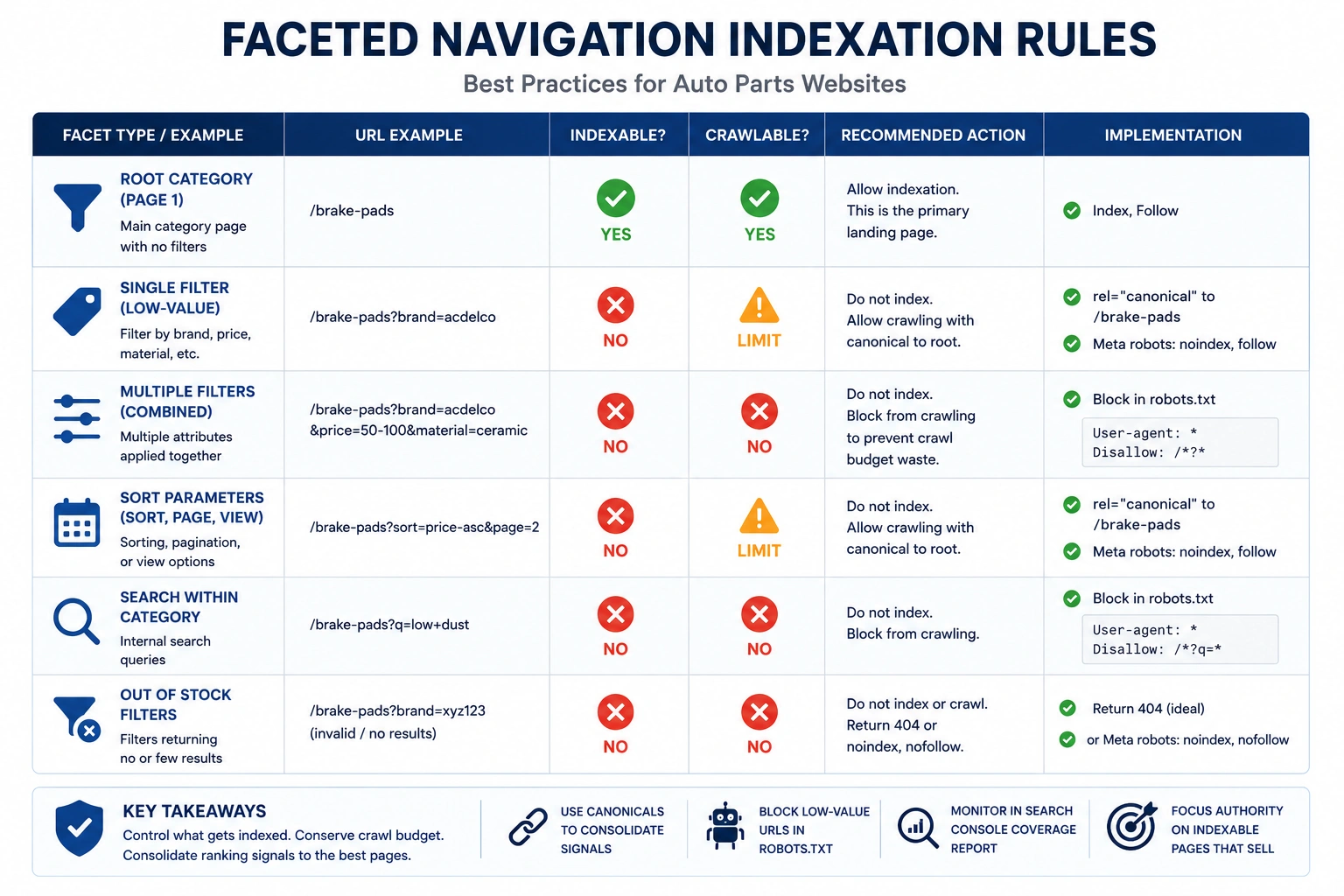
Recommended crawl and indexation settings help auto parts retailers control faceted navigation and preserve SEO value.
Confused about crawl budget and index bloat? We get it because we’ve lived it. Let’s sit down and look at your Google Search Console together. We’ll show you exactly where Google is getting stuck in your filters.
Applying Automotive Product Schema for Rich Snippets
Schema drives visibility.
Sophisticated Structured Data Implementation
- Product Schema: Implement the
Productschema type on every product page, populating thename,image,brand, andoffersproperties. - Offer Schema: Use nested
Offerschema to communicate live pricing and stock availability directly to Google Merchant Center. - AggregateRating Schema: Expose customer reviews directly to search results to increase click-through rates (CTR) by up to 20%.
- Vehicle Compatibility Schema: Integrate vehicle compatibility directly into the schema to help search engines match your product pages directly to long-tail fitment queries.
Overcoming the Duplicate Content Trap with Custom Content
The duplicate content issue in auto parts e-commerce is systemic, not accidental. Feeds are identical. When your product feed comes from the same distributor as 300 other retailers, you are all publishing the same manufacturer description, the same spec table, and often the same image filename. Search engines do not penalize this in the sensational sense that some SEO content implies, but they do have to choose one version to rank, and that version is rarely yours unless you have given them a reason to prefer it. The practical answer is to triage your top-performing SKUs first: identify the products that already drive revenue or have meaningful search volume, and rewrite those descriptions to include something no distributor feed contains: installation context, common failure symptoms, tool requirements, or fitment edge cases that real mechanics search for. That is the unique value that separates a rankable product page from a duplicate.
Canonical tags handle the rest. For product variants, left-side versus right-side components, color variations, or packaging differences, a strict rel="canonical" pointing to a single parent URL consolidates ranking signals rather than splitting them across near-identical pages.
Improving Page Speed and Mobile UX in the Garage
Picture your typical customer: they are crouched next to a lifted vehicle in a driveway, phone in one hand, trying to verify whether a part number matches what is currently bolted to the car. Mobile page loads that take four seconds don’t just feel slow in that context: they cost you the sale entirely, because the competitor’s page that loads in 1.8 seconds is one thumb-tap away. Google’s Core Web Vitals benchmarks exist precisely because this scenario is the norm, not the exception. Aim for a Largest Contentful Paint (LCP) of under 2.5 seconds and an Interaction to Next Paint (INP) of under 200 milliseconds; those thresholds are where the conversion data starts to meaningfully improve for mobile-first automotive buyers.
The fitment selector itself deserves focused attention here. A YMM widget that freezes, reloads the entire page on each selection, or fails to populate correctly on older Android devices is a conversion killer that no amount of schema markup can compensate for. Mobile UX and technical SEO are not separate workstreams in this industry: they are the same problem. Speed is revenue.
Frequently Asked Questions About Auto Parts SEO
What is the difference between ACES and PIES data in auto parts SEO?
ACES manages vehicle fitment and compatibility, while PIES manages product attributes. Both are essential for clean, search-engine-friendly product feeds and schema markup.
Should I index my year/make/model filter pages?
Only index high-value YMM hub pages with real search volume and unique content. Do not index every single filter combination, as this will cause severe duplicate content issues and index bloat.
How do I optimize my product pages for part number searches?
Ensure the MPN and GTIN are visible in HTML, included in the page title or H1, and mapped correctly in JSON-LD product schema.
What schema markup is most important for auto parts websites?
The Product schema is most critical, particularly mpn, gtin, brand, and offers properties for rich snippets and merchant listings.
How does page speed affect my auto parts conversion rate?
Slow load times or unresponsive selectors on mobile lead to high bounce rates and lost sales, as buyers are often working on their vehicles.
The businesses that will capture the largest share of this growing market aren’t necessarily the ones with the biggest catalogues: they are the ones whose catalogues are structured the way buyers search. Part numbers in the HTML. Fitment relationships in the schema. YMM pages built for real search volume, not abstract completeness. Crawl budgets are protected from filter sprawl. These are not enterprise-only capabilities. They are decisions about priorities, and every independent retailer and aftermarket manufacturer can make them.
Ultimately, sophisticated technical marketing belongs to you too. The gap between where your catalogue ranks today and what’s possible based on evidence is almost always a data architecture problem with a solvable answer. Your business is part of what keeps the automotive industry moving: businesses like yours are the backbone of innovation and drive America forward. You deserve the same caliber of search strategy that the big players take for granted. Here is your next step: you can take control of your data and build an organic traffic engine that lasts.
Ready to turn your catalogue into a high-ranking organic traffic engine? Let’s build a technical blueprint that works for your unique inventory. No high-pressure sales pitches: just real, evidence-based strategies from a team that gets it because we’ve lived it. Schedule Your Technical Strategy Call with BizIQ