
Author Bio This guide was written by a senior digital marketing strategist at BizIQ with over 15 years of hands-on experience building search visibility systems for construction companies and general contractors. At BizIQ, we’re a small business ourselves. We know the daily grind. We share the same goals and aspirations as the business owners we serve, and we’ve spent more than a decade in the trenches helping contractors convert organic traffic into signed contracts. We focus specifically on local search engine optimization services that translate directly into qualified project inquiries, not vanity metrics.
- Technical Foundation: Build a fast, mobile-responsive digital showroom that search engine crawlers can read, index, and trust.
- Local Authority: Optimize your Google Business Profile to capture high-intent local searches and claim your position in the Local Pack.
- Content Tiers: Structure your website with targeted content that addresses every member of the buying committee: from early-stage researchers to decision-ready project owners.
- Trust Velocity: Drive high-quality backlinks and a steady stream of fresh reviews to lock in rankings and build durable digital authority.
How do General Contractors Build a Predictable Pipeline using SEO?
General contractors (GC’s) build a predictable pipeline by targeting high-intent, localized keywords for high-ticket services like home remodeling and commercial construction. By pairing up local SEO, such as an active Google Business Profile (GBP) and geo-targeted landing pages, with direct, clear answers that AI search engines or LLM’s can cite, GC’s turn random search traffic into a steady stream of qualified project inquiries.
Your pipeline shouldn’t depend on whether your last referral remembered to mention your name. If your lead flow spikes after a satisfied client posts on Nextdoor and dries up the moment that conversation fades, your business isn’t growing; it’s swinging wildly. This blueprint lays out a four-phase SEO blueprint that turns your website into a self-sustaining lead engine, one that qualifies prospects at 2 a.m. while you’re reviewing tomorrow’s job schedule.
Rather than rehashing basic definitions, we focus on how to build rankings in a search environment that has shifted heading into 2026, and what most contractor websites are still getting wrong.
Think of your digital presence the way you’d approach a commercial build. The technical infrastructure is your foundation: pour it wrong and nothing above it holds. It must be solid. Content is the framing; it defines the structure, the rooms, the load-bearing walls. Trust signals (reviews, backlinks, and citations) are the finishing work that determines whether a client walks through the door or keeps driving. Each phase depends on the one before it. Skipping the foundation because you want to get to the finish work faster is how you end up with a site that ranks briefly, then collapses after the next algorithm update.
Ranking on Google is a mathematical equation of authority, relevance, and trust, not a mysterious art project. We’re a small business ourselves, and we understand that your website is your most valuable digital asset. Let’s build your technical infrastructure and content tiers correctly so your business earns the visibility it deserves.
The 2026 search reality: Zero-click searches and AI overviews
The search results page your clients see today looks almost nothing like what it did three years ago. The rules have changed. That shift has direct consequences for how you generate leads.
Data shows that 60% of search queries now end without a single click: AI-generated answers satisfy the searcher’s intent directly on the results page, before they ever reach your website. According to 2026 SEO statistics, on queries where Google’s AI Overviews appear, organic click-through rates have collapsed to 0.61%. For contractors who built their lead flow around ranking for informational keywords and waiting for traffic to arrive, that model is no longer viable.
This doesn’t mean SEO is less valuable, but it does mean you must adapt to AI Overviews where organic click-through rates have dropped to 0.61%. It means the mechanism has changed. Blogging for raw click volume (publishing generic “how much does a kitchen remodel cost” articles and hoping for traffic) is a shrinking return strategy. Instead of chasing raw traffic, here’s what actually works: focusing on topical authority. This means building a website that Google and AI engines recognize as the definitive local resource on construction services in your market. When your site is the source AI Overviews pull from, you’re not competing for clicks; you are the answer.
Generative Engine Optimization (GEO) is the emerging discipline that addresses this directly. AI search engines, such as Google AI Overviews, ChatGPT, and Perplexity, do not crawl the web the way traditional bots do. They synthesize information from authoritative databases, local directories, structured web pages, and verified citations. To get recommended by these systems, your business needs to appear consistently across trade journals, local news sites, and high-authority directories. It is not enough to have a well-written homepage; your brand needs to exist as a recognized entity across the broader web ecosystem. Integrating local search optimization for general contractors into your GEO strategy means treating every citation, every press mention, and every structured data element as a vote that AI models count when deciding who to recommend.
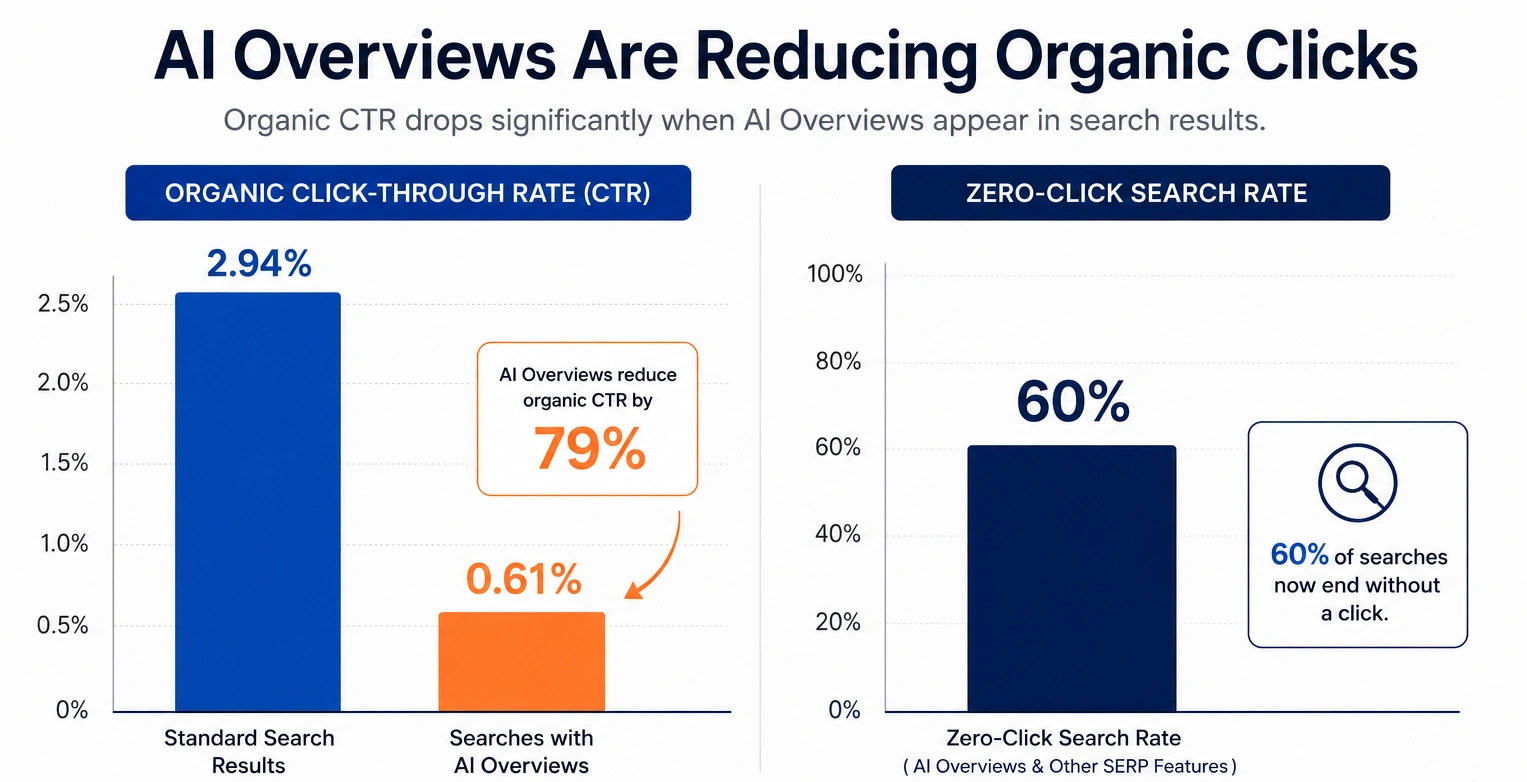
AI Overviews are reducing organic clicks, with many searches ending without a website visit.
Phase 1: Laying the technical and local foundation
Before any content strategy or link-building campaign produces results, the underlying infrastructure has to be solid. This is where most contractor websites fail: not because of bad content, but because the technical and local signals are broken at the root.
- Google Business Profile: Select “General Contractor” as your primary category without exception. Add secondary categories (Home Remodeler, Bathroom Remodeler, Construction Company) to widen your query coverage. Upload high-resolution project photos on a weekly schedule; GBP freshness is a ranking signal, not a cosmetic detail. GBP signals account for 32% of Local Pack ranking weight: more than any other single factor.
- Mobile Page Speed: The average contractor website scores a 56/100 on mobile. Your target is above 80. That gap isn’t cosmetic; it directly affects both your search rankings and the percentage of visitors who stay long enough to request an estimate. A slow site is a leaking funnel.
- LocalBusiness Schema: Hardcode LocalBusiness and Service schema markup into your site’s code, using structured data. This structured data acts as a direct translation layer for search engines and AI discovery engines, allowing them to instantly verify your physical address, service areas, licensing status, and customer ratings without having to infer that information from your page copy, which ultimately builds immediate trust. It is also one of the clearest signals that your site is built for AI search readiness.
NAP consistency (your business Name, Address, and Phone number) must be identical across every directory, citation, and social profile. A single character discrepancy between your GBP listing and your website footer creates conflicting signals that suppress your local rankings. To get your local presence in order, here’s exactly how to do it, step by step.
Phase 2: Building content tiers for the buying committee
A commercial construction project rarely has a single decision-maker. The same is true for the search journey that leads to a signed contract. Your content architecture needs to address the researcher, the evaluator, and the final approver: often three different people with three different questions.
- Definition Pages (Top of Funnel): These pages capture early-stage research traffic by answering broad informational queries, such as “What is design-build construction?” or “What does a general contractor actually manage?” They establish topical authority and introduce your brand before a prospect is ready to request a bid. Per BrightLocal’s guide on local SEO for contractors, early-stage content that answers genuine questions builds the trust equity that converts later.
- Application Pages (Mid-Funnel): These are your highest-value service pages, targeting specific commercial or residential niches. A page titled “Design-Build for Commercial Warehouses” or “Multi-Family Residential Construction in [City]” captures searchers who already know what they need and are evaluating which contractor to call. This is where commercial construction digital marketing strategy becomes a direct revenue lever; each application page is a targeted bid for a specific contract type.
- Proof Pages (Bottom of Funnel): Detailed, outcome-focused case studies that document schedule certainty, safety compliance, and measurable project results. For example, a recent case study on SEO for a home remodeler shows how targeted local proof pages drive high-intent inquiries. Similarly, analyzing how top general contractors use SEO reveals that case studies do the qualification work your estimating team would otherwise have to do on the phone. A prospect who has read your definition pages, reviewed your application pages, and then consumed a case study showing a comparable project completed on time and under budget is not a cold lead; they are a warm one.
Each tier should link to the others. This keeps readers engaged. Internal linking spreads authority across your site and gives search crawlers a clear map of your content hierarchy.
“SEO is not a short-term marketing campaign; it is a long-term business asset. When you build a website that Google trusts, you own a digital lead machine that keeps producing bids long after you stop paying for ads.”
Bob Generale, President of Digital at Percepture
Free 20-Minute SEO Audit
We’ll analyze your website’s technical health, check your mobile page speed score, and map out your top 5 competitor gaps: completely free.
Phase 3: Accelerating trust velocity with reviews and backlinks
Rankings stabilize when Google sees consistent trust signals accumulating over time. Two sources drive that trust more than anything else in local search: reviews and backlinks.
On the review side, the data is clear. Reviews drive local rankings. A 2026 Local Search Ranking Factors report attributes 20% of Local Pack ranking weight to review signals: not just the aggregate star rating, but the velocity and recency of incoming reviews. A contractor with 50 reviews and five new ones posted this month will routinely outrank a competitor sitting on a static 5.0 rating from two years ago. Google interprets review frequency as a proxy for business activity. The practical implication: build a systematic review acquisition process, not a one-time push. Text a custom Google review link to every client immediately upon project completion. Aim for at least two new reviews per month that include specific service keywords like “home addition,” “kitchen remodel,” or “commercial build-out,” because those terms reinforce your relevance for related queries.
Backlinks operate on a different mechanism but carry equal weight for organic and AI search visibility. Cheap, purchased links from irrelevant directories are not a shortcut; they are a liability. Google’s spam detection has become precise enough that a cluster of low-quality inbound links can trigger ranking suppression that takes months to recover from. The durable approach is relational: earn links from local suppliers who reference you as a trusted partner, from subcontractors who list you on their project pages, from your local Chamber of Commerce member directory, and from regional trade publications that cover notable projects in your market. Each of those links carries geographic and topical relevance that generic link farms cannot replicate. Local citations, which are consistent listings across Houzz, Angi, HomeAdvisor, and industry-specific directories, function as supporting votes that reinforce your legitimacy to both Google’s algorithm and AI search models.
Measuring the blueprint: ROI and conversion benchmarks
Contractors who treat SEO as a cost rather than an investment typically abandon it before it compounds. The financial case for organic search is worth examining directly.
Organic search leads close at a 14.6% rate, compared to 1.7% for outbound methods like cold calling or direct mail, according to a recent 2026 contractor research analysis. That’s not a small difference; it is a structural one. A prospect who finds your website by searching “commercial general contractor [city]” has already self-qualified. They have a project, they’re in your market, and they’re actively evaluating options. That intent gap is why organic leads close at nearly nine times the rate of cold outreach.
Conversion rates tell a similar story. High conversions mean more revenue. The average contractor website converts 2% to 4% of visitors into leads. That number sounds modest until you consider what it becomes when optimized: sites featuring local case studies, clear calls-to-action, and service-area specificity typically achieve conversion rates of 8% to 12%. Doubling or tripling your conversion rate on existing traffic is often more impactful than doubling your traffic budget. Your website is your best estimator: if it is optimized, it qualifies leads around the clock without adding headcount.
Organic search drives 38% to 54% of qualified project inquiries for established general contractors. That’s not supplemental traffic; for most contractors who have built their search presence deliberately, it is the primary lead channel.
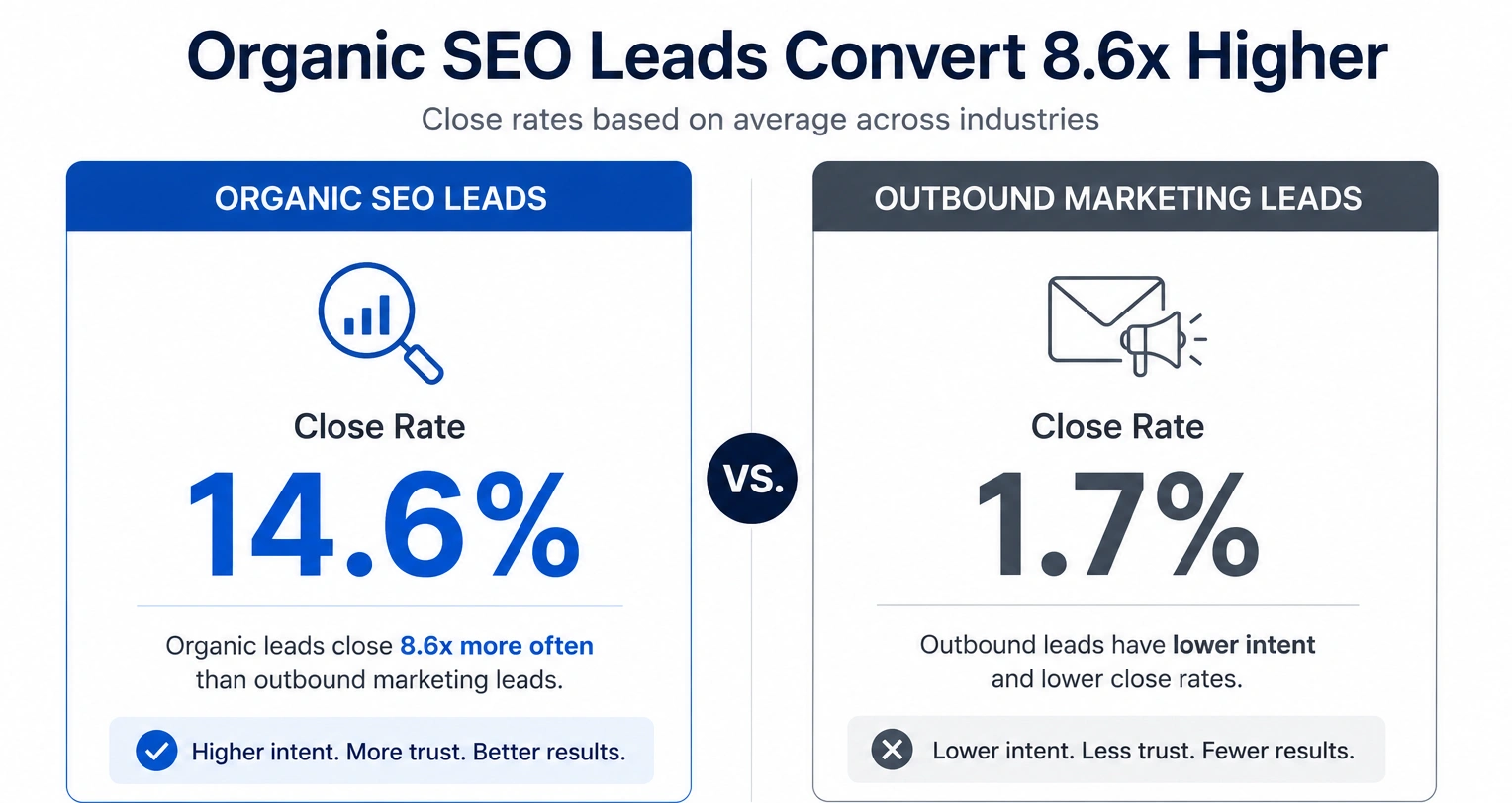
Organic SEO leads convert significantly better than outbound marketing leads, delivering higher close rates and stronger buyer intent.
Common pitfalls: Why most contractor SEO fails
Execution errors at the tactical level can cancel out an otherwise sound strategy. These three mistakes appear consistently across contractor websites that plateau or decline in rankings.
- Keyword Stuffing: Embedding location keywords into your Google Business Profile name (e.g., “Smith General Contractor Best Phoenix Remodeler”) violates Google’s guidelines and triggers profile suspensions. The same applies to footer text packed with city names. Search engines have become sophisticated enough to recognize manipulative patterns, and the penalties are disproportionate to whatever short-term lift the tactic might produce.
- Ignoring Review Responses: Failing to respond to Google reviews, whether positive or negative, signals to both Google’s algorithm and prospective clients that your business is dormant. Response activity is a measurable engagement signal. A contractor who responds directly to every review, including critical ones, demonstrates operational accountability. That matters to a homeowner deciding between two equally-rated competitors.
- Siloed Content: Service pages that exist in isolation (with no internal links pointing to them and no links pointing outward) are invisible to search crawlers in terms of authority distribution. PageRank flows through internal links, which means your highest-value service pages will struggle to rank if they are isolated from the rest of your site. If your “Commercial Build-Outs” page has no links from your homepage, your blog posts, or your service-area pages, it accumulates no authority and ranks nowhere. Internal linking is not optional architecture; it’s how you tell search engines which pages matter.
The future of search: Voice and GEO readiness
Homeowners and commercial developers are no longer just typing keywords into a search bar. They’re asking complete questions: “Who is the best commercial general contractor near me with a verified safety record?” or “Which home remodeler in [city] has handled projects over $500,000?” Voice-activated assistants and AI chat interfaces process these queries conversationally, and they pull answers from sources that have structured their content to respond in kind.
Structuring your service pages to answer these questions directly (using natural, declarative language rather than keyword-dense headers) is how you position your brand for AI extraction. A page that opens with “We specialize in commercial warehouse construction in [city], with a documented safety compliance record across 47 completed projects” gives an AI model something concrete to cite. A page that opens with “Welcome to our construction services” gives it nothing. Be specific. The distinction is not subtle; it’s the difference between being recommended by voice assistants and AI engines or remaining completely invisible to high-intent searchers.
Building a strong construction company SEO presence in this environment means treating your website as a structured knowledge base, not a digital brochure. Every FAQ section, every schema element, and every citation you earn across the web contributes to the entity profile that AI search models use to verify and recommend your business.
Taking the first step: Your 90-day action plan
Ninety days is enough time to establish meaningful ranking momentum, provided the effort is ordered correctly.
Days 1 to 30 are entirely diagnostic and foundational. Audit your Google Business Profile: verify that your business name matches your legal filing exactly, confirm your primary category is “General Contractor,” and fill out every available service field with detailed, keyword-relevant descriptions. Resolve your technical speed issues: compress images, eliminate render-blocking scripts, and switch to a mobile-responsive template if you haven’t already. Audit every directory listing for NAP consistency and correct any discrepancies. This phase is unglamorous, but it’s the work that makes everything else compound.
Days 31 to 60 shift to content production. Draft your core service pages, at minimum, one page per high-revenue service, with at least 1,000 words of substantive, FAQ-inclusive content per page. Build your Tier 1 definition content to capture early-stage research traffic. Incorporate practical marketing ideas for construction companies into your content calendar to maintain publishing consistency beyond the initial sprint. Connect your pages with deliberate internal links.
Days 61 to 90 focus on off-page authority. Launch your review acquisition campaign: text your custom Google review link to every client at project close. Begin outreach to local suppliers, subcontractors, and Chamber of Commerce contacts for link placements. Publish your first case study with documented project outcomes. By day 90, you should have a technically sound site, a content architecture that covers your core services, and an active review velocity that signals ongoing business activity to Google’s algorithm.
Frequently asked questions about contractor SEO
How long does it take for a general contractor to rank on Google?
For a new website or a newly claimed Google Business Profile, expect 4 to 6 months of consistent optimization, review acquisition, and content publishing before first-page local rankings appear. Highly competitive metropolitan markets, where established contractors have years of accumulated authority, can require 9 to 12 months of continuous effort to displace incumbents. The timeline is not arbitrary; it reflects how long it takes for trust signals to accumulate to a threshold Google recognizes.
What is the best primary category for a general contractor on Google Business Profile?
Select “General Contractor” as your primary category if that represents your core business model. Secondary categories (Home Remodeler, Bathroom Remodeler, Construction Company) expand your query coverage without diluting the primary ranking signal. The primary category carries the most algorithmic weight for Local Pack placement, so precision here matters more than breadth.
Do general contractors need separate pages for every city they serve?
Yes, without exception. If your office is in City A but you build in City B and City C, you need unique service-area pages for each. Those pages must contain genuinely localized content: photos of completed projects in that city, references to local building permit processes, and testimonials from clients in those neighborhoods. Duplicating your City A page and swapping the city name is a penalty trigger, not a shortcut.
How does AI search affect contractor SEO?
AI search engines synthesize information from authoritative, structured web pages. To get recommended by Google AI Overviews, ChatGPT, or Perplexity, your site needs clear FAQ sections, properly implemented schema markup, and consistent business information across the web. AI models verify entity data before recommending a business; inconsistent NAP data, missing schema, or thin content are all signals that reduce your recommendation probability.
What is the average cost per lead for contractor SEO?
The range runs from $150 to $450 per lead depending on local market competitiveness, but organic SEO leads carry a substantially lower long-term acquisition cost than continuous paid ad spend because the investment compounds rather than resets each billing cycle. Partnering with professional SEO marketing companies can help calibrate that acquisition cost against your market’s specific competitive density and average project value.
Building a dominant search presence is structurally identical to executing a successful construction project: it requires a proven blueprint, quality materials at every phase, and the discipline to execute without cutting corners when the timeline gets uncomfortable. This blueprint is built on what works and why, based on real data from the field. Contractors who treat their website as a living business asset, one that requires ongoing investment in technical health, content depth, and trust signals, build lead pipelines that do not evaporate when a referral source goes quiet.
Stop anchoring your revenue to unpredictable sources. The contractors who own their local search rankings in 2026 started building that authority 12 months ago. The ones who will own it in 2027 are starting now. We’re a small business ourselves, and we believe that small business is the backbone of innovation, driving our nation forward. We measure our success by the positive impacts we make on our partners, and your construction case study starts with the first step you take today.
Let’s Build Your 90-Day SEO Action Plan
Schedule a 20-minute strategy session with our construction SEO experts. We’ll build a custom action plan for your business, based on real evidence from contractors we’ve helped grow.